REVIEW 2 major objections 4 minor 61 references
Simultaneous estimation of normal means with side information
T0 review · 2 major / 4 minor · reviewed 2026-08-14 · deepseek-v4-flash
Pith's one-line read This paper claims that, in the Gaussian sequence model with paired auxiliary data, a data-driven rule found by minimizing an unbiased risk estimate asymptotically attains the best risk achievable by any separable estimator.
desk verdict A careful compound-decision paper whose main theorem covers a regularized, ρ>0 procedure on a fixed set, while the implemented and tested version uses ρ=0 on a data-dependent grid—a real gap, but one the author openly flags. read the letter →
The pith
A machine-rendered reading of the paper's core claim, the machinery that carries it, and where it could break.
The reading
What carries the argument
The load-bearing object is the oracle kernel rule $f^\star(x_1,x_2)=\sum_j \theta_{j1}p_j^0(x_1,x_2)/\sum_j p_j^0(x_1,x_2)$, a separable posterior expectation under the empirical prior. A regularized version $f^{\rho}$ adds a small positive constant to the denominator so the rule is well defined everywhere. The data-driven estimator substitutes the free parameter vector $t$ into the same form and chooses $t\in T$ to minimize an unbiased risk estimate derived from Stein's lemma. The proof chains three results: the regularized oracle has the same asymptotic risk as the oracle, the SURE statistic approximates the true loss uniformly over $T$, and minimizing that approximation therefore yields the oracle risk. The uniform approximation is proved with empirical-process truncation, symmetrization, and a covering-number bound that approximates the empirical prior by a finite mixture with a controlled number of atoms.
What would settle it
Set one primary mean to $\theta_{i1}=n^{1/3}$ with all other means zero and $\theta_{i2}=0$, then compare the proposed estimator's average loss with the oracle separable risk as $n$ grows; the claimed asymptotic optimality fails if the gap does not shrink to zero, since Assumption 1 is violated.
Extended reading notes
Core claim
The central claim is Theorem 3: for independent pairs $X_{i1}\sim N(\theta_{i1},\sigma_1^2)$ and $X_{i2}\sim N(\theta_{i2},\sigma_2^2)$, the estimator $\delta_{\hat t}^{\rho}$ that minimizes the unbiased risk estimate $\operatorname{sure}(t)$ over a bounded set $T$ satisfies $\lim_{n\to\infty}\{E\ell_n(\hat t)-R_n(\theta,\delta^\star)\}\le 0$, where $R_n(\theta,\delta^\star)$ is the minimum risk among all separable decision rules. The oracle $\delta^\star$ is the posterior expectation of $\theta_{i1}$ under the discrete empirical prior, and the data-driven estimator approximates it by replacing the unknown means with free tuning parameters selected by SURE. Thus the procedure achieves oracle-level separable risk without requiring any explicit model for how $\theta_{i2}$ relates to $\theta_{i1}$.
Load-bearing premise
All true means in both sequences must stay within $Cn^{1/4-\eta}$ in absolute value for some positive constants $C$ and $\eta$; if a nontrivial share of means grows faster than this, the regularized oracle is not guaranteed to match the oracle and the SURE approximation to the true loss can break down.
Editorial extensions
If this is right
- Integrative estimation becomes fully data-driven: no model for the relationship between the primary mean and the auxiliary observation is needed, so nonlinear or unknown relationships cause no misspecification problem.
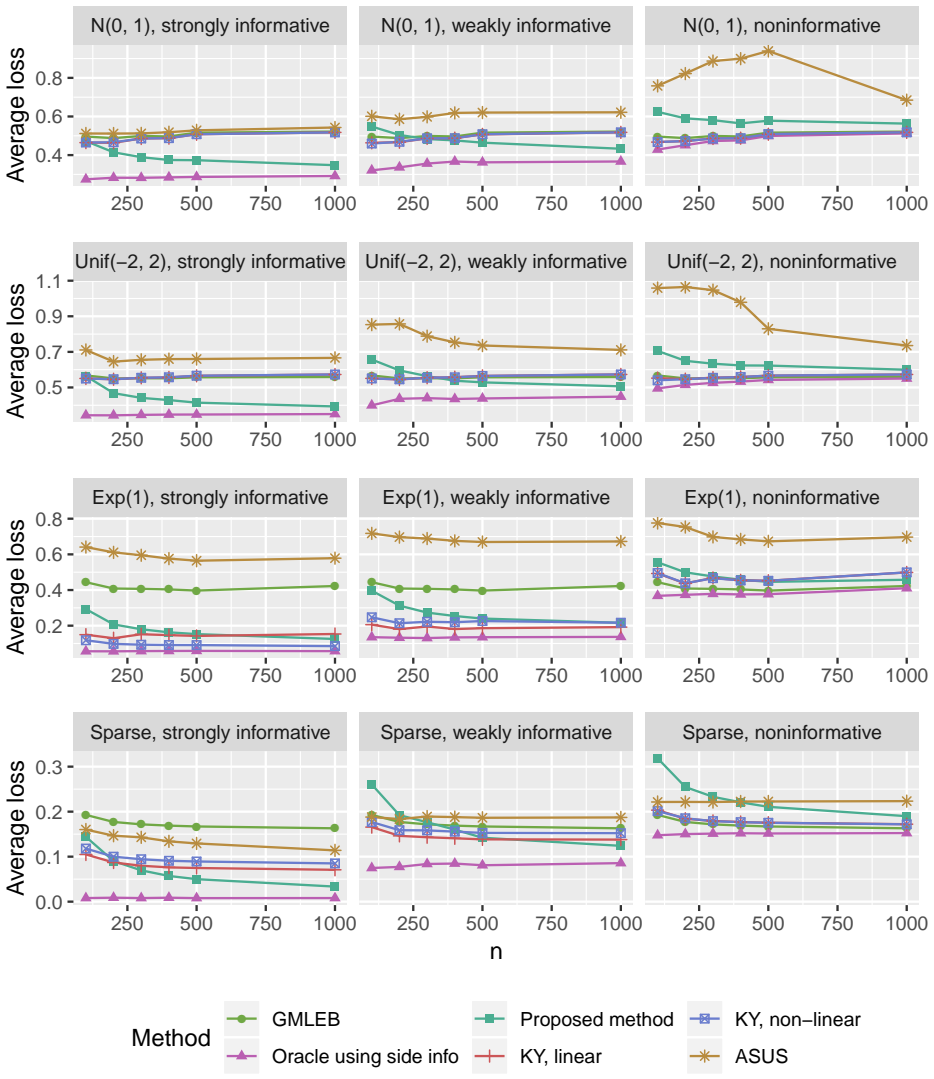
- Asymptotically, using an auxiliary sequence cannot hurt: when the side information is uninformative the rule learns to discard it, and when informative it approaches the oracle separable risk.
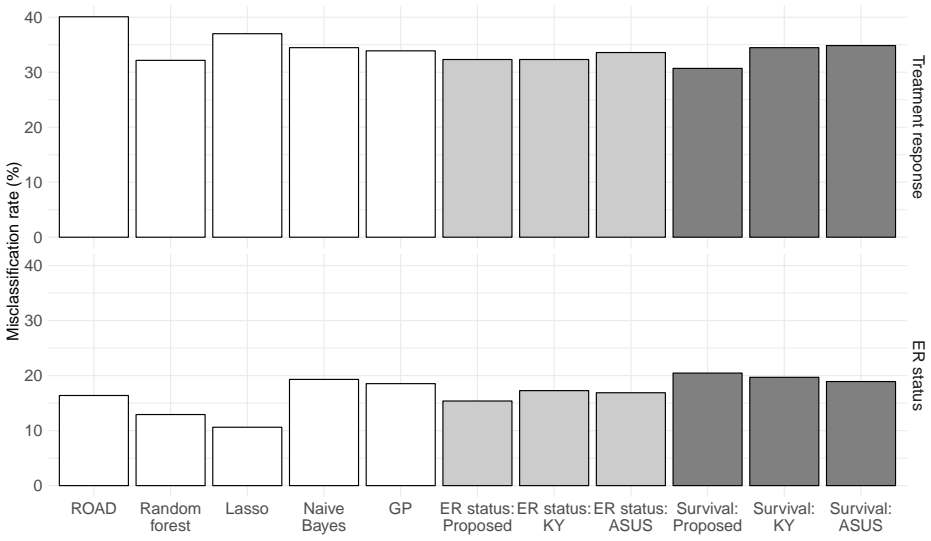
- Plugging the estimated means into the Greenshtein-Park classification rule yields an integrative high-dimensional classifier; in the paper's breast-cancer analysis, the integrative rule achieved the lowest misclassification rate for treatment-response prediction.
- The framework extends to correlated primary and auxiliary observations, where auxiliary data help even when the mean vectors are unrelated, because the correlation itself carries information about the primary means.
- The estimator, although not designed for sparse means, matches or beats sparse-focused methods in simulations when the side information is strong and the sample size is large.
Reading between the lines
- Editorial: the same SURE-minimization template should transfer to heteroscedastic sequences or unknown variances, where Stein-type unbiased risk estimates already exist; the main obstacle is computational rather than statistical.
- Editorial: at small sample sizes with uninformative side data, the procedure initially underperforms single-sequence methods; an adaptive screening step that tests whether the auxiliary sequence is informative before integrating would likely close that gap.
- Editorial: the finite-mixture approximation used in the proof suggests a practical alternative to coordinate descent: solve for a small number of support points and weights of the empirical prior, turning the nonconvex optimization into a lower-dimensional problem.
- Editorial: because the oracle rule is a conditional expectation, standard diagnostics such as binned observed-versus-estimated means and bootstrap intervals could be built to measure how much side information is being borrowed in a given dataset.
Signed reviews
Editorial analysis
A structured set of objections, weighed in public.
Referee Report
Summary. The paper studies simultaneous estimation of n normal means θ_i1 from primary observations X_i1, with auxiliary observations X_i2 used as side information. The estimation problem is formulated as a compound decision problem over separable rules of the form δ_i(x1,x2)=f(x1,x2). The author derives an oracle separable rule f* (4), introduces a regularized oracle f*_ρ (6), and proposes a fully data-driven estimator obtained by minimizing an unbiased SURE-type risk estimate sure(t) over a feasible set T (10). The main theoretical results are Theorem 1 (regularized oracle is asymptotically equivalent to the oracle), Theorem 2 (uniform approximation of the loss by sure(t) over T), and Theorem 3 (the data-driven estimator asymptotically attains the optimal separable risk). The paper also reports simulations and an integrative genomics classification application, and it describes an R package implementation called cole.
Significance. If Theorems 1–3 hold as stated, the paper makes a useful contribution to compound decision theory and integrative analysis: it provides a direct risk-minimization route to the oracle separable rule with side information, avoiding the intermediate f- or g-modeling steps, and it gives detailed proofs using SURE and empirical process techniques. The oracle derivation in Proposition 1 is elegant, and the numerical results suggest practical potential. However, the significance is currently limited by a substantial gap between the theoretical procedure analyzed in the theorems and the procedure that is actually implemented and evaluated in the simulations and data analysis.
major comments (2)
- [§4.3 and Theorem 3] Theorem 3 is proved only for the exact minimizer of sure(t) over the fixed, non-random set T in (10), with 0<ρ≤1 and the constants C and η of Assumption 1 assumed known. The implementation described in §4.3, and every simulation and data analysis in Sections 5 and 6, instead uses ρ=0 and minimizes over the data-dependent set \hat T = ∏_i [X_id−Mσ_d, X_id+Mσ_d] with M=5. The proof of Theorem 2 requires ρ>0 in the denominator bounds, for example (18) and the bounds following (34), and the uniform approximation of sure(t) by the loss is established only over the fixed set T, not over the random set \hat T. The manuscript itself states in §4.3 that 'bridging the gap between the theoretical procedure and its practical implementation is an important direction for future work.' As a consequence, the abstract's claim that the data-driven rule asymptotically achieves the optimal separable risk, and the simulation evidence for the implemented rule, are not covered by the theorems as stated. The paper should either extend the theory to \hat T and ρ=0, or sharply qualify the claims so that the theorem and the implementation are clearly distinguished.
- [§4.3, Eq. (11)] The estimator in Theorem 3 is \hat t = argmin_{t∈T} sure(t), an exact global minimizer. The implementation instead uses coordinate descent with K=10 equally spaced candidate values per coordinate and a tolerance of 10^{-5}; sure(t) is nonconvex, and no result is given showing that this procedure reaches the global minimizer. Therefore the numerical comparisons in Section 5 and the genomics application in Section 6 evaluate an approximate, possibly local-minimum version of the estimator, and they cannot be interpreted as direct verifications of Theorem 3. This is a second gap between theory and implementation that should be stated explicitly, together with either a convergence guarantee for the optimization algorithm or a clear caveat that the theoretical result applies to the exact global minimizer.
minor comments (4)
- [Theorem 3] The statement 'lim_{n→∞} {Eℓ_n(\hat t) − R_n(θ,δ*)} ≤ 0' is not a well-formed limit statement; the proof actually establishes limsup ≤ 0. Moreover, because δ_{\hat t}_ρ is a separable rule, Proposition 1 implies its risk is never below R_n(θ,δ*), so the correct conclusion is lim_{n→∞} {Eℓ_n(\hat t) − R_n(θ,δ*)} = 0.
- [Appendix C, proof of Theorem 1] The definition of the set A2 is printed as A2 = {(x1,x2) : −C n^{1/4−η} < x1 ≤ −C n^{1/4−η}}, which is empty; the later integration from −C n^{1/4−η} to C n^{1/4−η} indicates the intended upper endpoint is +C n^{1/4−η}.
- [§4.3, paragraph on \hat T] The sentence 'it is known from Theorem 1 that E{sure(t)} achieves a global minimum at t_{jd}=θ_{jd}' is not a consequence of Theorem 1 for the regularized family with ρ>0; Theorem 1 only compares the risk of δρ* with the oracle risk and does not identify θ as the minimizer over all t. For ρ=0, t=θ makes δ^θ_0 exactly the oracle f*, but ρ=0 is excluded from Theorem 2. The statement should be corrected or proved.
- [General presentation] The paper would benefit from a concise summary table that distinguishes the theoretical estimator (11) over T with 0<ρ≤1 from the practical estimator over \hat T with ρ=0, and from an explicit statement about which claims are asymptotic, which are finite-sample, and which are only supported by simulations.
Circularity Check
No circularity: the oracle, SURE, and oracle-inequality steps are self-contained against external benchmarks.
full rationale
The paper's derivation chain is non-circular. Proposition 1 derives the oracle separable rule f*(x1,x2) = sum_j theta_j1 p0_j / sum_j p0_j from the compound-decision identity, citing external classical results (Robbins 1951; Jiang et al. 2009). Theorem 1 is a direct analytic comparison between the regularized oracle (6) and the oracle (4) under Assumption 1. Theorem 2 establishes uniform convergence of the unbiased risk estimate sure(t) (8) to the loss l_n(t) (9) over the fixed set T (10), using Stein's lemma and empirical process bounds; no fitted constant or self-authored uniqueness theorem is invoked. Theorem 3 then combines Theorem 2 with the minimizing property of the data-driven t in (11) and Theorem 1, giving the asymptotic oracle inequality. The only self-citations (Zhao 2017; Dicker and Zhao 2016) are contextual or application-level and are not load-bearing for the theorems. The paper candidly notes that the implemented procedure uses rho = 0 and a data-dependent search set T_hat, which are not covered by Theorem 3; this is an acknowledged theory-implementation gap and a correctness/scope concern, not circularity. There is no equation in which the target risk is defined in terms of the estimator, and no fitted parameter is renamed as a prediction.
Assumptions & free parameters
free parameters (3)
- rho =
0 (default in implementation; theory requires 0 < rho <= 1)
- M =
5
- K =
10
assumptions (4)
- domain assumption Assumption 1: |theta_id| <= C n^{1/4 - eta} for all i and d, for positive constants C and eta.
- domain assumption X_i1 and X_i2 are independent for each i, with known variances sigma_1^2 and sigma_2^2.
- domain assumption The theta_id are fixed nonrandom constants.
- standard math Lemma A.1 of Ghosal and Van Der Vaart (2001) on approximating empirical measures by discrete measures with K support points.
Cite this review
Pith. "Pith review of Simultaneous estimation of normal means with side information." pith.science (2026). https://pith.science/paper/EE2R23DD
@misc{pith2026190806129,
  author       = {Pith},
  title        = {Pith review of: Simultaneous estimation of normal means with side information},
  year         = {2026},
  howpublished = {\url{https://pith.science/paper/EE2R23DD}},
  note         = {Machine review of arXiv:1908.06129}
}
read the original abstract
The integrative analysis of multiple datasets is an important strategy in data analysis. It is increasingly popular in genomics, which enjoys a wealth of publicly available datasets that can be compared, contrasted, and combined in order to extract novel scientific insights. This paper studies a stylized example of data integration for a classical statistical problem: leveraging side information to estimate a vector of normal means. This task is formulated as a compound decision problem, an oracle integrative decision rule is derived, and a data-driven estimate of this rule based on minimizing an unbiased estimate of its risk is proposed. The data-driven rule is shown to asymptotically achieve the minimum possible risk among all separable decision rules, and it can outperform existing methods in numerical properties. The proposed procedure leads naturally to an integrative high-dimensional classification procedure, which is illustrated by combining data from two independent gene expression profiling studies.
Figures

Figures from the paper (1 more)

Reference graph
Works this paper leans on
-
[1]
T. Banerjee, G. Mukherjee, and W. Sun. Adaptive sparse estimation with side information. Technical report, University of Southern California, 2018
work page 2018
-
[2]
L. D. Brown and E. Greenshtein. Nonparametric empirical bayes and compound decision approaches to estimation of a high-dimensional vector of normal means. The Annals of Statistics, pages 1685--1704, 2009
2009
-
[3]
T. T. Cai. Minimax and adaptive inference in nonparametric function estimation. Statistical Science, pages 31--50, 2012
work page 2012
-
[4]
I. Castillo, A. van der Vaart, et al. Needles and straw in a haystack: Posterior concentration for possibly sparse sequences. The Annals of Statistics, 40 0 (4): 0 2069--2101, 2012
work page 2012
- [5]
-
[6]
L. H. Dicker and S. D. Zhao. High-dimensional classification via nonparametric empirical bayes and maximum likelihood inference. Biometrika, pages 21--34, 2016
work page 2016
-
[7]
D. L. Donoho and I. M. Johnstone. Adapting to unknown smoothness via wavelet shrinkage. Journal of the american statistical association, 90 0 (432): 0 1200--1224, 1995
1995
-
[8]
D. L. Donoho and J. M. Johnstone. Ideal spatial adaptation by wavelet shrinkage. biometrika, 81 0 (3): 0 425--455, 1994
work page 1994
Show all 61 references
-
[9]
Edgar, M
R. Edgar, M. Domrachev, and A. E. Lash. Gene expression omnibus: Ncbi gene expression and hybridization array data repository. Nucleic Acids Research, 30 0 (1): 0 207--210, 2002
2002
-
[10]
B. Efron. Two modeling strategies for empirical bayes estimation. Statistical science: a review journal of the Institute of Mathematical Statistics, 29 0 (2): 0 285, 2014
2014
-
[11]
B. Efron. Bayes, Oracle Bayes, and Empirical Bayes . Statistical Science, 2019. to appear
2019
-
[12]
Efron and C
B. Efron and C. Morris. Stein's estimation rule and its competitors—an empirical bayes approach. Journal of the American Statistical Association, 68 0 (341): 0 117--130, 1973
1973
-
[13]
J. Fan, Y. Feng, and X. Tong. A road to classification in high dimensional space: the regularized optimal affine discriminant. Journal of the Royal Statistical Society: Series B (Statistical Methodology), 74 0 (4): 0 745--771, 2012
2012
-
[14]
Feng and L
L. Feng and L. H. Dicker. Approximate nonparametric maximum likelihood for mixture models: A convex optimization approach to fitting arbitrary multivariate mixing distributions. Computational Statistics & Data Analysis, 2018
2018
-
[15]
Friedman, T
J. Friedman, T. Hastie, and R. Tibshirani. Regularization paths for generalized linear models via coordinate descent. Journal of Statistical Software, 33 0 (1): 0 1, 2010
2010
-
[16]
L. Fu, W. Sun, and G. M. James. Nonparametric empirical bayes estimation on heterogeneous data. Technical report, University of Southern California, 2019
2019
-
[17]
C. R. Genovese, K. Roeder, and L. Wasserman. False discovery control with p-value weighting. Biometrika, 93 0 (3): 0 509--524, 2006
2006
-
[18]
Ghosal and A
S. Ghosal and A. W. Van Der Vaart. Entropies and rates of convergence for maximum likelihood and Bayes estimation for mixtures of normal densities . Annals of Statistics, 29 0 (5): 0 1233--1263, 2001
2001
-
[19]
Greenshtein and J
E. Greenshtein and J. Park. Application of non parametric empirical Bayes estimation to high dimensional classification . J. Mach. Learn. Res., 10: 0 1687--1704, 2009
2009
-
[20]
Greenshtein and Y
E. Greenshtein and Y. Ritov. Asymptotic efficiency of simple decisions for the compound decision problem. In Optimality: The Third Erich L. Lehmann Symposium, pages 266--275. Institute of Mathematical Statistics, 2009
2009
-
[21]
Gu and R
J. Gu and R. Koenker. Empirical bayesball remixed: Empirical bayes methods for longitudinal data. Journal of Applied Econometrics, 32 0 (3): 0 575--599, 2017
2017
-
[22]
Y. Hu, Q. Lu, W. Liu, Y. Zhang, M. Li, and H. Zhao. Joint modeling of genetically correlated diseases and functional annotations increases accuracy of polygenic risk prediction. PLoS genetics, 13 0 (6): 0 e1006836, 2017
2017
-
[23]
James and C
W. James and C. M. Stein. Estimation with quadratic loss. In Proceedings of the Fourth Berkeley Symposium on Mathematical Statistics and Probability, volume 1, pages 367--379. Berkeley and Los Angeles, University of California Press, 1961
1961
-
[24]
Jiang, C.-H
W. Jiang, C.-H. Zhang, et al. General maximum likelihood empirical Bayes estimation of normal means . The Annals of Statistics, 37 0 (4): 0 1647--1684, 2009
2009
-
[25]
Jiang, C.-H
W. Jiang, C.-H. Zhang, et al. Empirical bayes in-season prediction of baseball batting averages. In Borrowing Strength: Theory Powering Applications--A Festschrift for Lawrence D. Brown, pages 263--273. Institute of Mathematical Statistics, 2010
2010
-
[26]
B.-Y. Jing, Z. Li, G. Pan, and W. Zhou. On sure-type double shrinkage estimation. Journal of the American Statistical Association, 111 0 (516): 0 1696--1704, 2016
2016
-
[27]
I. M. Johnstone. Gaussian estimation: Sequence and wavelet models. Technical report, Department of Statistics, Stanford University, Stanford, 2017
2017
-
[28]
Kiefer and J
J. Kiefer and J. Wolfowitz. Consistency of the maximum likelihood estimator in the presence of infinitely many incidental parameters. The Annals of Mathematical Statistics, pages 887--906, 1956
1956
-
[29]
R. Koenker. A gaussian compound decision bakeoff. Stat, 3 0 (1): 0 12--16, 2014
2014
-
[30]
Koenker and I
R. Koenker and I. Mizera. Convex optimization, shape constraints, compound decisions, and empirical bayes rules. Journal of the American Statistical Association, 109 0 (506): 0 674--685, 2014
2014
-
[31]
Kou and J
S. Kou and J. J. Yang. Optimal shrinkage estimation in heteroscedastic hierarchical linear models. In Big and Complex Data Analysis, pages 249--284. Springer, 2017
2017
-
[32]
Koudstaal and F
M. Koudstaal and F. Yao. From multiple gaussian sequences to functional data and beyond: a stein estimation approach. Journal of the Royal Statistical Society: Series B (Statistical Methodology), 80 0 (2): 0 319--342, 2018
2018
-
[33]
Martin, S
R. Martin, S. G. Walker, et al. Asymptotically minimax empirical bayes estimation of a sparse normal mean vector. Electronic Journal of Statistics, 8 0 (2): 0 2188--2206, 2014
2014
-
[34]
Y. Pan, Q. Mai, and X. Zhang. Tulip: A toolbox for linear discriminant analysis with penalties. arXiv preprint arXiv:1904.03469, 2019
1904 arXiv
-
[35]
J. K. Pickrell, T. Berisa, J. Z. Liu, L. S \'e gurel, J. Y. Tung, and D. A. Hinds. Detection and interpretation of shared genetic influences on 42 human traits. Nature Genetics, 48 0 (7): 0 709, 2016
2016
-
[36]
Ramdas, R
A. Ramdas, R. F. Barber, M. J. Wainwright, and M. I. Jordan. A unified treatment of multiple testing with prior knowledge. arXiv preprint arXiv:1703.06222, 2017
2017 arXiv
-
[37]
Richardson, G
S. Richardson, G. C. Tseng, and W. Sun. Statistical methods in integrative genomics. Annual Review of Statistics and its Application, 3: 0 181--209, 2016
2016
-
[38]
M. D. Ritchie, E. R. Holzinger, R. Li, S. A. Pendergrass, and D. Kim. Methods of integrating data to uncover genotype--phenotype interactions. Nature Reviews Genetics, 16 0 (2): 0 85, 2015
2015
-
[39]
H. Robbins. Asymptotically subminimax solutions of compound decision problems. In Proceedings of the Second Berkeley Symposium on Mathematical Statistics and Probability, pages 131--–148. University of California Press, Berkeley, 1951
1951
-
[40]
H. Robbins. The empirical bayes approach to statistical decision problems. The Annals of Mathematical Statistics, 35: 0 1--20, 1964
1964
-
[41]
Saha and A
S. Saha and A. Guntuboyina. On the nonparametric maximum likelihood estimator for gaussian location mixture densities with application to gaussian denoising. arXiv preprint arXiv:1712.02009, 2017
2017 arXiv
-
[42]
L. Shi, G. Campbell, W. D. Jones, F. Campagne, Z. Wen, S. J. Walker, Z. Su, T.-M. Chu, F. M. Goodsaid, L. Pusztai, et al. The microarray quality control (maqc)-ii study of common practices for the development and validation of microarray-based predictive models. Nature Biotech...
2010
-
[43]
H. Y. Shpigler, M. C. Saul, F. Corona, L. Block, A. C. Ahmed, S. D. Zhao, and G. E. Robinson. Deep evolutionary conservation of autism-related genes. Proceedings of the National Academy of Sciences, 114 0 (36): 0 9653--9658, 2017
2017
-
[44]
G. K. Smyth. Limma: linear models for microarray data. In Bioinformatics and computational biology solutions using R and Bioconductor, pages 397--420. Springer, 2005
2005
-
[45]
C. Stein. Inadmissibility of the usual estimator for the mean of a multivariate normal distribution. In Proceedings of the Third Berkeley Symposium on Mathematical Statistics and Probability, volume 1, pages 197--206. Berkeley and Los Angeles, University of California Press, 1956
1956
-
[46]
C. M. Stein. Estimation of the mean of a multivariate normal distribution. The Annals of Statistics, 9: 0 1135--1151, 1981
1981
-
[47]
S. M. Stigler. The 1988 Neyman memorial lecture: a Galtonian perspective on shrinkage estimators . Statistical Science, pages 147--155, 1990
1988
-
[48]
Z. Tan. Steinized empirical bayes estimation for heteroscedastic data. Statistica Sinica, pages 1219--1248, 2016
2016
-
[49]
G. C. Tseng, D. Ghosh, and X. J. Zhou. Integrating Omics Data. Cambridge University Press, 2015
2015
-
[50]
A. W. van der Vaart and J. Wellner. Weak convergence and empirical processes: with applications to statistics. Springer Science+Business Media, New York, 1996
1996
-
[51]
Y. Wang, J. G. Klijn, Y. Zhang, A. M. Sieuwerts, M. P. Look, F. Yang, D. Talantov, M. Timmermans, M. E. Meijer-van Gelder, J. Yu, et al. Gene-expression profiles to predict distant metastasis of lymph-node-negative primary breast cancer. The Lancet, 365 0 (9460): 0 671--679, 2005
2005
-
[52]
Weinstein, Z
A. Weinstein, Z. Ma, L. D. Brown, and C.-H. Zhang. Group-linear empirical bayes estimates for a heteroscedastic normal mean. Journal of the American Statistical Association, pages 1--13, 2018
2018
-
[53]
M. N. Wright and A. Ziegler. ranger: A fast implementation of random forests for high dimensional data in c++ and r. Journal of Statistical Software, 77 0 (1): 0 1--17, 2017
2017
-
[54]
X. Xie, S. Kou, and L. D. Brown. SURE estimates for a heteroscedastic hierarchical model . Journal of the American Statistical Association, 107 0 (500): 0 1465--1479, 2012
2012
-
[55]
X. Xie, S. C. Kou, and L. Brown. Optimal shrinkage estimation of mean parameters in family of distributions with quadratic variance. Annals of statistics, 44 0 (2): 0 564, 2016
2016
-
[56]
D. V. Zaykin and D. O. Kozbur. P-value based analysis for shared controls design in genome-wide association studies. Genetic epidemiology, 34 0 (7): 0 725--738, 2010
2010
-
[57]
C.-H. Zhang. Empirical Bayes and compound estimation of normal means . Statistica Sinica, 7 0 (1): 0 181--193, 1997
1997
-
[58]
C.-H. Zhang. Compound decision theory and empirical bayes methods. The Annals of Statistics, 31 0 (2): 0 379--390, 2003
2003
-
[59]
C.-H. Zhang. Generalized maximum likelihood estimation of normal mixture densities. Statistica Sinica, 19: 0 1297--1318, 2009
2009
-
[60]
Zhang and A
X. Zhang and A. Bhattacharya. Empirical bayes, sure and sparse normal mean models. arXiv preprint arXiv:1702.05195, 2017
2017 arXiv
-
[61]
S. D. Zhao. Integrative genetic risk prediction using non-parametric empirical bayes classification. Biometrics, 73 0 (2): 0 582--592, 2017
2017
Reviewed August 14, 2026 · model on record in the stance chip above.
Discussion (0). Continue with ORCID to comment.