REVIEW 4 major objections 5 minor 1 cited by
S and VV Corona Australis: Spectroscopic Variability in Two Young Binary Star Systems
T0 review · 4 major / 5 minor · reviewed 2026-08-14 · deepseek-v4-flash
Pith's one-line read All four stars in the S CrA and VV CrA binaries are actively accreting and bridge the Class I–Class II evolutionary stages
desk verdict First spectral types and multi-epoch veiling for S/VV CrA are genuinely useful, but the SED classification is too shaky to support the 'Class I/II bridging' claim without revisions. read the letter →
The pith
A machine-rendered reading of the paper's core claim, the machinery that carries it, and where it could break.
The reading
What carries the argument
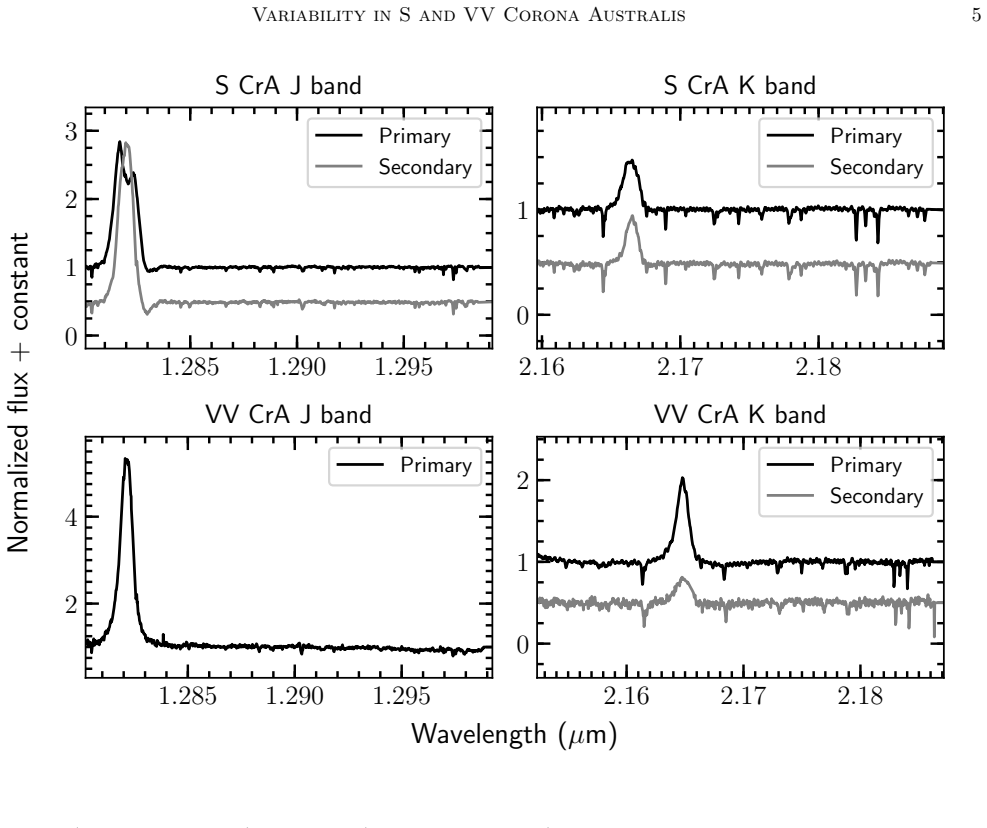
The argument rests on simultaneous spectral typing and veiling measurement using the depth ratio of two Fe I lines at $1.562$ and $1.563\,\mu$m flanking an unresolved OH doublet near $1.5625\,\mu$m in the observed H-band order. Because the OH/Fe ratio is temperature-sensitive in low-mass stars, matching a veiled template to the observed line ratios yields both the spectral type and the H-band veiling at each epoch. Around this core sit the SED spectral index $\alpha = d\log(\lambda F_\lambda)/d\log \lambda$, measured between 2.3 and 10.5 $\mu$m, which assigns each component to Classes I, flat-spectrum, or II, and the $\mathrm{Pa}\beta$ and $\mathrm{Br}\gamma$ line-luminosity relations that convert measured equivalent widths into accretion luminosities and mass accretion rates. The same H-band order also contains the $\mathrm{Br}_{16}$ emission line, whose veiling-corrected equivalent widths are compared with the measured veiling across epochs.
What would settle it
Take new adaptive-optics JHK and mid-infrared imaging of both systems in a single epoch, measure the component flux ratios and fluxes simultaneously, and recompute the SED spectral indices; if all four $\alpha$ values fall below $-0.3$, the flat-spectrum and Class I classifications, and with them the bridging-stage conclusion, would be overturned.
Extended reading notes
Core claim
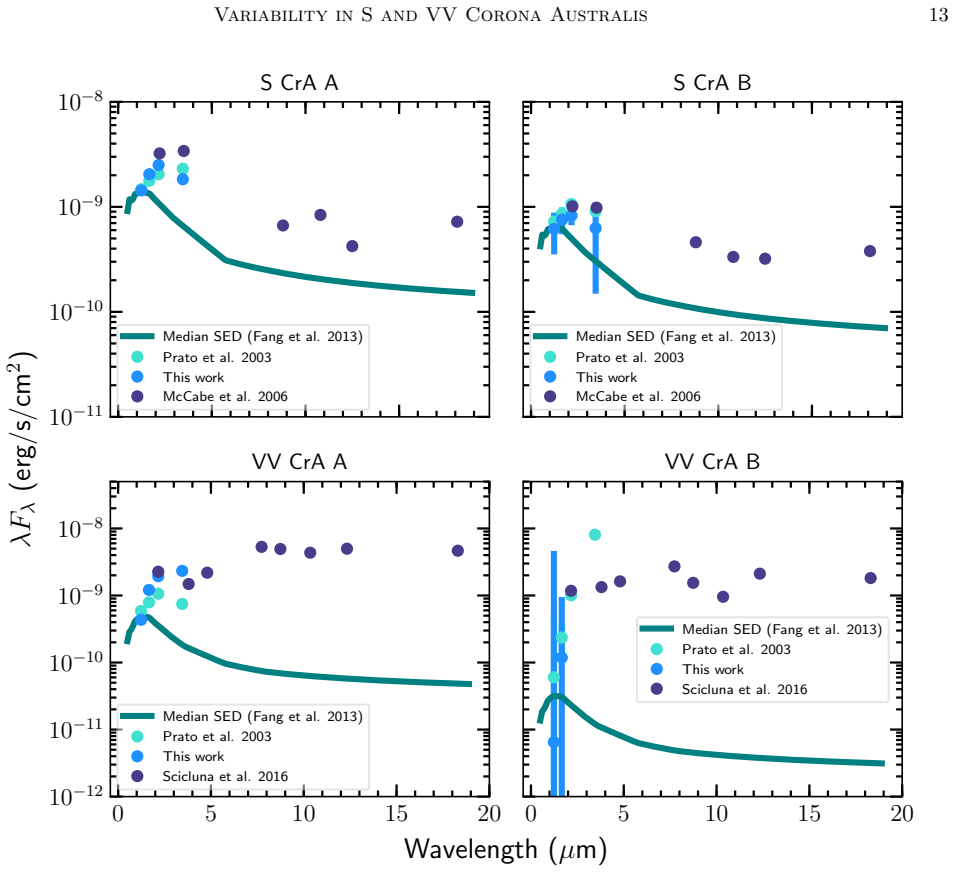
The central discovery is that this paper establishes the first spectral types for all four components of S CrA and VV CrA and finds that the systems are not classical Class II T Tauri stars but objects in transition between the Class I and Class II embedded stages. All four components are actively accreting from optically thick circumstellar disks, with high, time-variable near-infrared veiling and hydrogen emission lines. The SED spectral indices place S CrA A, S CrA B, and VV CrA A in the flat-spectrum category ($\alpha \approx -0.17$, $-0.17$, and $0.13$) and VV CrA B in Class I ($\alpha = 0.37$), with silicate absorption in VV CrA consistent with an earlier embedded stage. The paper also finds that the infrared companion VV CrA B has an earlier spectral type (M0) than VV CrA A (M1), making it the more massive component despite being fainter at shorter wavelengths because of its high extinction.
Load-bearing premise
The load-bearing premise is that the 2015 secondary-to-primary flux ratios, which the paper itself shows changed dramatically over earlier epochs, are representative of the epochs when the older JHK and mid-infrared photometry used to build the SEDs was taken; if not, the derived spectral indices could cross the class boundaries.
Editorial extensions
If this is right
- If the classification is right, S CrA A, S CrA B, and VV CrA A are flat-spectrum sources rather than Class II, and VV CrA B is Class I, so the two binaries occupy the evolutionary window in which infalling envelopes are giving way to circumstellar disks.
- The four components share similar masses, ages, and temperatures, so differences in veiling, accretion, and emission-line strength between them point to systemic or environmental factors rather than gross stellar parameters.
- Because VV CrA B is M0 and hence more massive than its M1 primary, the nominal 'secondary' in this infrared companion system is actually the more massive star, hidden by extinction.
- The mass accretion rates derived here, roughly $10^{-8}\,M_\odot\,\mathrm{yr}^{-1}$ and exceeding typical T Tauri values, imply these are relatively young, vigorously accreting systems.
- The epoch-to-epoch changes in veiling and $\mathrm{Br}_{16}$ emission mean that single-epoch snapshots misrepresent the accretion state, so multi-epoch monitoring is required to characterize such systems.
Reading between the lines
- If the slope of the veiling versus $\mathrm{Br}_{16}$ equivalent-width relation traces the inner dust truncation radius relative to the corotation radius, then the systematic difference between S CrA and VV CrA could be tested directly by measuring inner-disk radii with infrared or submillimeter interferometry in both systems.
- Because component flux ratios varied by factors of several to ten between 1996 and 2015, SED-based evolutionary classifications of close young binaries are only as reliable as the epoch matching between the resolved flux ratios and the broadband photometry; future surveys should prioritize contemporaneous measurements.
- The Fe I/OH line-ratio method demonstrated here could be applied to other embedded young binaries to map the Class I–Class II transition across a larger population, provided similar high-resolution H-band spectra are available.
Signed reviews
Editorial analysis
A structured set of objections, weighed in public.
Referee Report
Summary. The paper presents multi-epoch Keck/NIRSPEC H-band spectroscopy of all four components of the young binary systems S CrA and VV CrA, supplemented by archival J- and K-band spectra and 2015 NIRC2 adaptive-optics photometry. The authors determine spectral types for the four stars, measure H-band veiling at multiple epochs, measure Br16 equivalent widths and correct them for veiling, derive Paβ and Brγ accretion luminosities and mass accretion rates, and construct component-resolved SEDs from new and archival photometry. The central conclusion is that S CrA and VV CrA are young binary systems bridging the Class I and Class II evolutionary stages, with high accretion luminosities and variable emission lines.
Significance. If the results hold, the paper supplies the first secure spectral classification of all four components, a valuable multi-epoch veiling record, and one of the few component-resolved SEDs for such close binaries. The careful template-based spectral typing, the explicit treatment of the J- and K-band equivalent widths as lower limits, and the use of archival plus new data are strengths. However, the evolutionary-stage claim rests on epoch-mixed SED construction, and the veiling-versus-equivalent-width correlation is partly algebraic, so the central conclusions are not yet established at the level of rigor claimed in the abstract.
major comments (4)
- [Section 3.7, Tables 4 and 8] The four spectral indices that drive the "bridging Class I/II" conclusion are computed by combining 2015 AO flux ratios (Table 3) with 2MASS/WISE, Prato et al. (2003), McCabe et al. (2006), and Scicluna et al. (2016) photometry from different epochs, and no uncertainty is quoted for any α. The paper itself shows that secondary-to-primary flux ratios change by large factors (VV CrA J ratio: 0.25 in 1996 vs 0.015 in 2015, Section 2.2), so the assumption that the 2015 ratios describe the earlier photometric epochs is not justified. Because VV CrA B's α = 0.37 sits only 0.07 above the Class I/flat-spectrum boundary, a plausible epoch-related shift could move it into the flat-spectrum or Class II category and remove the only Class I object. Please recompute α from single-epoch ratios or quantify how α varies when the ratios are allowed to vary across their observed range.
- [Section 3.7, Table 4] The text states that silicate emission in S CrA A "agrees with its spectral index to verify its classification as a Class II source," but α = -0.17 lies in the flat-spectrum range (0.3 to -0.3) by the paper's own definition. This is an internal inconsistency in the classification scheme. Please either classify S CrA A as flat-spectrum and discuss the consequence for the evolutionary-stage claim, or provide a definition that makes α = -0.17 consistent with Class II.
- [Section 3.6, Table 7, Figure 4] The plotted "veiling-corrected" Br16 equivalent width is computed as EW_obs × (1 + rH), and the observed Br16 EWs in Table 5 are nearly constant for each star. The plotted quantity is therefore essentially a linear function of rH by construction, so the reported small p-values for VV CrA A and B do not by themselves demonstrate a physical correlation between accretion emission and NIR veiling. Please add a regression of the observed (uncorrected) EW against rH, or a permutation test that randomizes the observed EWs, to show that the correlation is not introduced by the correction factor.
- [Section 3.5, Table 6] The accretion luminosities and mass accretion rates are labeled lower limits because the Paβ and Brγ EWs are not veiling-corrected and because the line EWs, photometry, and flux ratios come from epochs separated by as much as ~13 years, yet Section 5 states the "high accretion luminosity" result as a firm conclusion. The text acknowledges a possible ~1 mag uncertainty from the epoch mismatch (citing Gahm et al. 2008); please propagate this into Lacc and Ṁ and state explicitly whether the "high accretion" conclusion survives when the input fluxes are varied by that amount.
minor comments (5)
- [Section 3.4 and Table 2] The text refers to a "single epoch (2003/05/23 UT)" for the Paβ and Brγ measurements, but Table 2 lists no observation on that date; the closest entries are 2003/05/14 and 2003/09/07. Please correct the date or the table.
- [Table 6] The row label "VV CrA" should read "VV CrA A" for consistency with the other rows.
- [Section 3.7] The spectral-index equation is written as α = d log(λFλ)/d log(λ) = αλ2 − αλ1; the second equality omits the denominator and should be written as (log(λ2F2) − log(λ1F1))/(log λ2 − log λ1), with the flux convention specified explicitly.
- [Table 4 note] The note says α is measured "between 10.5 and 2.3 μm," which reverses the order of the wavelengths given in the text (λ1 ≈ 10.5 μm, λ2 ≈ 2.3 μm); please make the convention consistent.
- [Facility line] The facility is listed as "Keck:II (ESI)" in the acknowledgments, but the observations were made with NIRSPEC; please correct this.
Circularity Check
The central Class I/II classification is not circular, but the Section 3.6 veiling–Br16 EW correlation is partly constructed from the veiling-correction definition.
-
self definitional
[Section 3.4 (Equation for EW correction) and Section 3.6 (Veiling/Equivalent Width correlation, Table 7)]
"Because this line is adjacent to the spectral features used to determine veiling, we were able to correct the measured equivalent widths for the veiling at each epoch, such that EWcorrected = EWobserved ∗ (1 +r1.55). ... We plotted the veiling-corrected Br16 equivalent widths against the H band continuum veiling for each star at each epoch (Figure 4). We performed a linear regression fit to the data; a P-value of less than 0.05 indicates a statistically significant correlation (Table 7)."
The ordinate in Figure 4, EW_corrected, is defined as EW_observed × (1 + r_H). Thus any regression of EW_corrected against r_H contains an automatic linear term r_H. Table 5 shows the observed EWs are nearly constant within each star (e.g., VV CrA A observed EWs range only 1.3–2.1 Å while r_H ranges 1.3–3.0), so the plotted relation is essentially a scaled and shifted copy of (1 + r_H). The small p-values in Table 7 therefore follow algebraically from the correction formula and do not independently establish a physical correlation between Br16 strength and veiling. The paper presents this as evidence that veiling traces accretion, but that inference is partly an artifact of how the corrected EW was defined.
full rationale
The paper's headline claim—that S CrA and VV CrA bridge the Class I and Class II stages—rests on SED spectral indices computed from resolved photometry and standard Lada/Greene thresholds; that derivation is not circular, though it is subject to a correctness risk from mixing 2015 flux ratios with older 2MASS/WISE, McCabe et al., and Scicluna et al. photometry. The spectral types, veiling measurements, and accretion-luminosity estimates are likewise independent empirical measurements using external templates and calibrations; the several self-citations (Prato et al. 2003, McCabe et al. 2006, Schaefer et al. 2014/2018) are data sources, not load-bearing uniqueness claims. The one genuine circular step is the Section 3.6 veiling–Br16 EW correlation, where the y-variable is defined from the x-variable via EW_corrected = EW_observed(1 + r_H), making the reported strong correlation and p-values largely mathematical. This is a secondary result, not the central classification claim, so it does not by itself force the paper's main conclusion; however, the paper's discussion uses this correlation to argue that NIR veiling traces accretion, and that specific inference is weakened by the construction. The internal inconsistency of labeling S CrA A (alpha = -0.17) as Class II and VV CrA A (alpha = 0.13) as 'Class I or slightly later' is noted, but it is an interpretive inconsistency rather than circularity.
Assumptions & free parameters
free parameters (3)
- H-band veiling rH =
0.5 to 8.6 per star and epoch (Table 5)
- Assumed distance to S CrA =
150 pc
- Per-star extinction A_V =
2.0, 2.0, 1.7, 10.2 mag
assumptions (7)
- domain assumption Baraffe et al. (2015) isochrones provide valid masses, radii, and luminosities for these pre-main-sequence stars.
- domain assumption Alcala et al. (2017) empirical relations between hydrogen line luminosity and accretion luminosity apply to these systems.
- domain assumption The extinction law A_lambda = A_V [0.55/lambda]^1.6 and the A_V values from Varga et al. (2018) are correct for all four stars.
- ad hoc to paper The 2015 AO flux ratios are representative of the epochs of the older photometry used in the SEDs.
- domain assumption The main-sequence template stars GJ 281, GJ 763, and GJ 752a are adequate spectral standards for these pre-main-sequence stars.
- domain assumption J-band veiling is negligible when deriving absolute magnitudes and ages.
- domain assumption The inner disk radius is 5 stellar radii (Gullbring et al. 1998), used in the mass accretion rate conversion.
Cite this review
Pith. "Pith review of S and VV Corona Australis: Spectroscopic Variability in Two Young Binary Star Systems." pith.science (2026). https://pith.science/paper/KO666RJD
@misc{pith2026190806135,
  author       = {Pith},
  title        = {Pith review of: S and VV Corona Australis: Spectroscopic Variability in Two Young Binary Star Systems},
  year         = {2026},
  howpublished = {\url{https://pith.science/paper/KO666RJD}},
  note         = {Machine review of arXiv:1908.06135}
}
read the original abstract
We used high-resolution near-infrared spectroscopy from the NIRSPEC instrument on the Keck II telescope, taken over multiple epochs spanning five years, to examine two young binary T Tauri star systems, S Corona Australis and VV Corona Australis. The stars in these 1-2" separation systems have optically thick circumstellar disks and high extinctions at optical and near-infrared wavelengths. Using a combination of new and archival data, we have determined the spectral types of all the stars in these two systems for the first time, examined the variable NIR veiling, measured the emission line equivalent widths, and created spectral energy distributions. They have similar spectral types (K7-M1) and are at approximately the same evolutionary stage, allowing comparison of the four stars in the two systems. We conclude that S CrA and VV CrA are young binary systems of stars bridging the Class I and Class II evolutionary stages, characterized by high accretion luminosities and variable emission lines.
Figures


Figures from the paper (2 more)

Forward citations
Cited by 1 Pith paper
-
Circumstellar and circumbinary discs in multiple stellar systems
This review consolidates current knowledge on how stellar multiplicity shapes protoplanetary disc structure, dust evolution, and planet formation outcomes.
Reference graph
Works this paper leans on
-
[1]
, " * write output.state after.block = add.period write newline
ENTRY address archivePrefix author booktitle chapter doi edition editor eprint howpublished institution journal key month number organization pages publisher school series title misctitle type volume year version url label extra.label sort.label short.list INTEGERS output.state before.all mid.sentence after.sentence after.block FUNCTION init.state.consts ...
-
[2]
write newline
" write newline "" before.all 'output.state := FUNCTION format.url url empty "" new.block "" url * "" * if FUNCTION format.eprint eprint empty "" archivePrefix empty "" archivePrefix "arXiv" = new.block " " eprint * " " * new.block " " eprint * " " * if if if FUNCTION format.doi doi empty "" " " doi * " " * if FUNCTION format.pid doi empty eprint empty ""...
-
[3]
op 0> l !н-YvN 4T 2m w <gv ̅| YP8ӀqJnL;9|m . i \ ִ
thebibliography [1] 20pt to REFERENCES 6pt =0pt 10pt plus 3pt =0pt =0pt =1pt plus 1pt =0pt =0pt -12pt =13pt plus 1pt =20pt =13pt plus 1pt \@M =10000 =-1.0em =0pt =0pt 0pt =0pt =1.0em @enumiv\@empty 10000 10000 `\.\@m \@noitemerr \@latex@warning Empty `thebibliography' environment \@ifnextchar \@reference \@latexerr Missing key on reference command Each re...
2017
-
[4]
Adams , F. C., Lada , C. J., & Shu , F. H. 1987, APJ, 312, 788, 10.1086/164924
doi:10.1086/164924 1987
-
[5]
Akeson , R. L., Jensen , E. L. N., Carpenter , J., et al. 2019, APJ, 872, 158, 10.3847/1538-4357/aaff6a
-
[6]
Alcal \'a , J. M., Manara , C. F., Natta , A., et al. 2017, AAP, 600, A20, 10.1051/0004-6361/201629929
-
[7]
Allen , T. S., Gutermuth , R. A., Kryukova , E., et al. 2012, APJ, 750, 125, 10.1088/0004-637X/750/2/125
-
[8]
Andrews , S. M., & Williams , J. P. 2005, APJ, 619, L175, 10.1086/427325
doi:10.1086/427325 2005
Show all 79 references
-
[9]
Bailer-Jones , C. A. L., Rybizki , J., Fouesneau , M., Mantelet , G., & Andrae , R. 2018, AJ, 156, 58, 10.3847/1538-3881/aacb21
2018 doi
-
[10]
Baraffe , I., Chabrier , G., Allard , F., & Hauschildt , P. H. 1998, , 337, 403. astro-ph/9805009
1998 arXiv
-
[11]
2015, AAP, 577, A42, 10.1051/0004-6361/201425481
Baraffe , I., Homeier , D., Allard , F., & Chabrier , G. 2015, AAP, 577, A42, 10.1051/0004-6361/201425481
2015 doi
-
[12]
Bate , M. R. 2018, MNRAS, 475, 5618, 10.1093/mnras/sty169
2018 doi
- [13]
-
[14]
2005, AJ, 129, 402, 10.1086/426331
Bender , C., Simon , M., Prato , L., Mazeh , T., & Zucker , S. 2005, AJ, 129, 402, 10.1086/426331
2005 doi
-
[15]
1998, APJ, 509, 802, 10.1086/306527
Calvet , N., & Gullbring , E. 1998, APJ, 509, 802, 10.1086/306527
1998 doi
-
[16]
E., & Henning , T
Carmona , A., van den Ancker , M. E., & Henning , T. 2007, AAP, 464, 687, 10.1051/0004-6361:20065509
2007 doi
-
[17]
W., Mathieu , R
Casey , B. W., Mathieu , R. D., Vaz , L. P. R., Andersen , J., & Suntzeff , N. B. 1998, AJ, 115, 1617, 10.1086/300270
1998 doi
-
[18]
F., Liu , H
Cazzoletti , P., Manara , C. F., Liu , H. B., et al. 2019, arXiv e-prints, arXiv:1904.02409. 1904.02409
2019 arXiv
-
[19]
G., Myers , P
Chen , H., Grenfell , T. G., Myers , P. C. , & Hughes , J. D. 1997, APJ, 478, 295, 10.1086/303769
1997 doi
-
[20]
A., Padgett , D
Cieza , L. A., Padgett , D. L., Allen , L. E., et al. 2009, APJL, 696, L84, 10.1088/0004-637X/696/1/L84
2009 doi
-
[21]
2006, APJ, 638, 314, 10.1086/498861
D'Alessio , P., Calvet , N., Hartmann , L., Franco-Hern \'a ndez , R., & Serv \' n , H. 2006, APJ, 638, 314, 10.1086/498861
2006 doi
-
[22]
V., & Lamzin , S
Dodin , A. V., & Lamzin , S. A. 2012, Astronomy Letters, 38, 649, 10.1134/S1063773712100027
2012 doi
-
[23]
1991, AAP, 248, 485
Duquennoy , A., & Mayor , M. 1991, AAP, 248, 485
1991
-
[24]
D., Davies , J
Eiroa , C., Oudmaijer , R. D., Davies , J. K., et al. 2002, AAP, 384, 1038, 10.1051/0004-6361:20020096
2002 doi
-
[25]
M., Covey , K
Faesi , C. M., Covey , K. R., Gutermuth , R., et al. 2012, Publications of the Astronomical Society of the Pacific, 124, 1137, 10.1086/668548
2012 doi
-
[26]
S., van Boekel, R., et al
Fang, M., Kim, J. S., van Boekel, R., et al. 2013, The Astrophysical Journal Supplement Series, 207, 5
2013
-
[27]
F., et al
Fedele , D., Bruderer , S., van Dishoeck , E. F., et al. 2013, AAP, 559, A77, 10.1051/0004-6361/201321118
2013 doi
-
[28]
2011, APJ, 730, 73, 10.1088/0004-637X/730/2/73
Fischer , W., Edwards , S., Hillenbrand , L., & Kwan , J. 2011, APJ, 730, 73, 10.1088/0004-637X/730/2/73
2011 doi
-
[29]
Folha , D. F. M., & Emerson , J. P. 1999, AAP, 352, 517
1999
-
[30]
F., Petrov , P
Gahm , G. F., Petrov , P. P., Tambovsteva , L. V., et al. 2018, AAP, 614, A117, 10.1051/0004-6361/201832891
2018 doi
-
[31]
F., Walter , F
Gahm , G. F., Walter , F. M., Stempels , H. C., Petrov , P. P., & Herczeg , G. J. 2008, AAP, 482, L35, 10.1051/0004-6361:200809488
2008 doi
-
[32]
Gaia Collaboration , Prusti , T., de Bruijne , J. H. J., et al. 2016, , 595, A1, 10.1051/0004-6361/201629272
2016 doi
-
[33]
Gaia Collaboration , Brown , A. G. A., Vallenari , A., et al. 2018, , 616, A1, 10.1051/0004-6361/201833051
2018 doi
-
[34]
Graham , J. A. 1992, PASP, 104, 479, 10.1086/133021
1992 doi
-
[35]
2017, , 608, A78, 10.1051/0004-6361/201731058
Gravity Collaboration , Garcia Lopez , R., Perraut , K., et al. 2017, , 608, A78, 10.1051/0004-6361/201731058
2017 doi
-
[36]
P., Wilking , B
Greene , T. P., Wilking , B. A., Andre , P., Young , E. T., & Lada , C. J. 1994, APJ, 434, 614, 10.1086/174763
1994 doi
-
[37]
1998, APJ, 492, 323, 10.1086/305032
Gullbring , E., Hartmann , L., Brice \ n o , C., & Calvet , N. 1998, APJ, 492, 323, 10.1086/305032
1998 doi
-
[38]
J., & Hillenbrand , L
Herczeg , G. J., & Hillenbrand , L. A. 2008, APJ, 681, 594, 10.1086/586728
2008 doi
-
[39]
2008, APJ, 686, 1195, 10.1086/591224
Hern \'a ndez , J., Hartmann , L., Calvet , N., et al. 2008, APJ, 686, 1195, 10.1086/591224
2008 doi
-
[40]
A., Strom , S
Hillenbrand , L. A., Strom , S. E., Calvet , N., et al. 1998, AJ, 116, 1816, 10.1086/300536
1998 doi
-
[41]
Jensen , E. L. N., Mathieu , R. D., & Fuller , G. A. 1996, APJ, 458, 312, 10.1086/176814
1996 doi
-
[42]
Joy , A. H. 1945, APJ, 102, 168, 10.1086/144749
1945 doi
-
[43]
2017, APJ, 844, 168, 10.3847/1538-4357/aa7c60
Kellogg , K., Prato , L., Torres , G., et al. 2017, APJ, 844, 168, 10.3847/1538-4357/aa7c60
2017 doi
-
[44]
2015, REDSPEC: NIRSPEC data reduction , Astrophysics Source Code Library
Kim , S., Prato , L., & McLean , I. 2015, REDSPEC: NIRSPEC data reduction , Astrophysics Source Code Library. 1507.017
2015
-
[45]
o hler , R., Neuh \
K \"o hler , R., Neuh \"a user , R., Kr \"a mer , S., et al. 2008, AAP, 488, 997, 10.1051/0004-6361:200809897
2008 doi
-
[46]
D., Herbst , T
Koresko , C. D., Herbst , T. M., & Leinert , C. 1997, APJ, 480, 741, 10.1086/303993
1997 doi
-
[47]
A., et al
K \'o sp \'a l , \'A ., \'A brah \'a m , P., Acosta-Pulido , J. A., et al. 2012, APJS, 201, 11, 10.1088/0067-0049/201/2/11
2012 doi
-
[48]
L., Ireland , M
Kraus , A. L., Ireland , M. J., Hillenbrand , L. A., & Martinache , F. 2012, APJ, 745, 19, 10.1088/0004-637X/745/1/19
2012 doi
-
[49]
L., Ireland , M
Kraus , A. L., Ireland , M. J., Huber , D., Mann , A. W., & Dupuy , T. J. 2016, AJ, 152, 8, 10.3847/0004-6256/152/1/8
2016 doi
-
[50]
J., Richter , M
Kruger , A. J., Richter , M. J., Carr , J. S., et al. 2011, APJ, 729, 145, 10.1088/0004-637X/729/2/145
2011 doi
-
[51]
Lada , C. J. 1987, in IAU Symposium, Vol. 115, Star Forming Regions, ed. M. Peimbert & J. Jugaku , 1--17
1987
-
[52]
E., J rgensen , J
Lindberg , J. E., J rgensen , J. K., Watanabe , Y., et al. 2015, AAP, 584, A28, 10.1051/0004-6361/201526222
2015 doi
-
[53]
L., Brice \ n o , C., Stauffer , J
Luhman , K. L., Brice \ n o , C., Stauffer , J. R., et al. 2003, APJ, 590, 348, 10.1086/374983
2003 doi
-
[54]
Luri , X., Brown , A. G. A., Sarro , L. M., et al. 2018, AAP, 616, A9, 10.1051/0004-6361/201832964
2018 doi
-
[55]
F., Testi , L., Herczeg , G
Manara , C. F., Testi , L., Herczeg , G. J., et al. 2017, AAP, 604, A127, 10.1051/0004-6361/201630147
2017 doi
-
[56]
2010, AAP, 520, A79, 10.1051/0004-6361/200913725
Mart \' nez-Arn \'a iz , R., Maldonado , J., Montes , D., Eiroa , C., & Montesinos , B. 2010, AAP, 520, A79, 10.1051/0004-6361/200913725
2010 doi
-
[57]
M., Prato , L., et al
McCabe , C., Ghez , A. M., Prato , L., et al. 2006, APJ, 636, 932, 10.1086/498207
2006 doi
-
[58]
2003, APJL, 597, L149, 10.1086/379921
Muzerolle , J., Calvet , N., Hartmann , L., & D'Alessio , P. 2003, APJL, 597, L149, 10.1086/379921
2003 doi
-
[59]
2001, AAP, 371, 186, 10.1051/0004-6361:20010334
Natta , A., Prusti , T., Neri , R., et al. 2001, AAP, 371, 186, 10.1051/0004-6361:20010334
2001 doi
-
[60]
2006, AAP, 452, 245, 10.1051/0004-6361:20054706
Natta , A., Testi , L., & Randich , S. 2006, AAP, 452, 245, 10.1051/0004-6361:20054706
2006 doi
-
[61]
P., Gahm , G
Petrov , P. P., Gahm , G. F., Herczeg , G. J., Stempels , H. C., & Walter , F. M. 2014, AAP, 568, L10, 10.1051/0004-6361/201424374
2014 doi
- [62]
-
[63]
P., & Simon , M
Prato , L., Greene , T. P., & Simon , M. 2003, APJ, 584, 853, 10.1086/345828
2003 doi
-
[64]
2002, APJ, 569, 863, 10.1086/339397
Prato , L., Simon , M., Mazeh , T., et al. 2002, APJ, 569, 863, 10.1086/339397
2002 doi
-
[65]
A., Henry , T
Raghavan , D., McAlister , H. A., Henry , T. J., et al. 2010, The Astrophysical Journal Supplement Series, 190, 1, 10.1088/0067-0049/190/1/1
2010 doi
-
[66]
P., Clarke , C
Rosotti , G. P., Clarke , C. J., Manara , C. F., & Facchini , S. 2017, MNRAS, 468, 1631, 10.1093/mnras/stx595
2017 doi
-
[67]
H., Prato , L., & Simon , M
Schaefer , G. H., Prato , L., & Simon , M. 2018, AJ, 155, 109, 10.3847/1538-3881/aaa59a
2018 doi
-
[68]
H., Prato , L., Simon , M., & Patience , J
Schaefer , G. H., Prato , L., Simon , M., & Patience , J. 2014, AJ, 147, 157, 10.1088/0004-6256/147/6/157
2014 doi
-
[69]
A., Wolf , S., Hummel , C
Schegerer , A. A., Wolf , S., Hummel , C. A., Quanz , S. P., & Richichi , A. 2009, AAP, 502, 367, 10.1051/0004-6361/200810782
2009 doi
-
[70]
2016, MNRAS, 458, 2476, 10.1093/mnras/stw460
Scicluna , P., Wolf , S., Ratzka , T., et al. 2016, MNRAS, 458, 2476, 10.1093/mnras/stw460
2016 doi
-
[71]
R., Campbell , R., et al
Service , M., Lu , J. R., Campbell , R., et al. 2016, PASP, 128, 095004, 10.1088/1538-3873/128/967/095004
2016 doi
-
[72]
2013, AAP, 551, A34, 10.1051/0004-6361/201220170
Sicilia-Aguilar , A., Henning , T., Linz , H., et al. 2013, AAP, 551, A34, 10.1051/0004-6361/201220170
2013 doi
-
[73]
R., Hillenbrand , L
Soderblom , D. R., Hillenbrand , L. A., Jeffries , R. D., Mamajek , E. E., & Naylor , T. 2014, in Protostars and Planets VI, ed. H. Beuther , R. S. Klessen , C. P. Dullemond , & T. Henning , 219
2014
-
[74]
2018, AAP, 617, A83, 10.1051/0004-6361/201832599
Varga , J., \'A brah \'a m , P., Chen , L., et al. 2018, AAP, 617, A83, 10.1051/0004-6361/201832599
2018 doi
-
[75]
2012, AAP, 543, A162, 10.1051/0004-6361/201218892
Vural , J., Kreplin , A., Kraus , S., et al. 2012, AAP, 543, A162, 10.1051/0004-6361/201218892
2012 doi
-
[76]
M., & Miner , J
Walter , F. M., & Miner , J. 2005, in ESA Special Publication, Vol. 560, 13th Cambridge Workshop on Cool Stars, Stellar Systems and the Sun, ed. F. Favata , G. A. J. Hussain , & B. Battrick , 1021
2005
-
[77]
A., Bontemps , S., Schuler , R
Wilking , B. A., Bontemps , S., Schuler , R. E., Greene , T. P., & Andr \'e , P. 2001, APJ, 551, 357, 10.1086/320067
2001 doi
-
[78]
L., Acton , D
Wizinowich , P. L., Acton , D. S., Lai , O., et al. 2000, in Adaptive Optical Systems Technology, Vol. 4007, 2--13
2000
-
[79]
Yudin , R. V. 2000, AAPS, 144, 285, 10.1051/aas:2000343
2000 doi
Reviewed August 14, 2026 · model on record in the stance chip above.
Discussion (0). Continue with ORCID to comment.