REVIEW 3 major objections 5 minor 63 references
Meta-study of laser power calibrations ranging 20 orders of magnitude with traceability to the kilogram
T0 review · 3 major / 5 minor · reviewed 2026-08-14 · deepseek-v4-flash
Pith's one-line read Eight distinct laser power measurement techniques, spanning from single-photon counting to 100-kilowatt beams, agree within 3 percent when their calibrations are traced through the kilogram by radiation pressure.
desk verdict Useful and mostly honest NIST internal consistency check, but the 'eight techniques through the kilogram' headline is a derived chain, not independent validation of each meter against radiation pressure. read the letter →
The pith
A machine-rendered reading of the paper's core claim, the machinery that carries it, and where it could break.
The reading
What carries the argument
The load-bearing object is the comparison factor $K_{a,b}$, the ratio of the powers two meters report for the same beam, together with its transitivity rule $K_{n,1} = \prod K_{i+1,i}$, which lets a chain of local comparisons stand in for a direct comparison across non-overlapping ranges. Its uncertainty is deliberately statistical only, coming from repeatability of the ratios and the transfer standard's nonlinearity and spectral-responsivity terms, so Equation (16), $|1-K_{a,b}| \le U_{K_{a,b}}$, serves as the agreement test. On the kilogram side, the mechanism is radiation pressure: a reflecting mirror experiences force $F = 2P/c$ from power $P$, and the force sensor is calibrated against test masses, so the watt is tied to the kilogram through $mg = P Q(\theta)/c$. The paper's proposed future mechanism is to replace the mass calibration with a watt-balance or electrostatic force balance, which would realize the optical watt from $h$ and the cesium hyperfine frequency without the kilogram.
What would settle it
Run a direct, independent comparison between a radiation-pressure force standard and a thermal power meter without passing through the existing transfer chain, using a force calibration derived from a watt-balance rather than from the same test masses and local gravity value; if the resulting comparison factor differs from the paper's chain value by more than the stated $U_K$, the claimed kilogram traceability would be refuted. A simpler spot check is to replace one node of the chain, such as the optical-fiber power meter, with an independently calibrated artifact and test whether all chained comparison factors still satisfy Equation (16).
Extended reading notes
Core claim
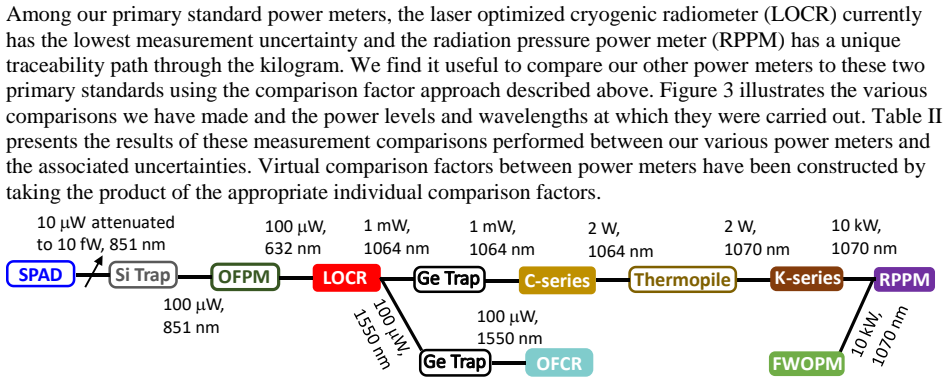
The central discovery is a demonstrated agreement, better than 3 %, among eight different laser power measurement techniques whose uncertainties are propagated through a common comparison-factor chain. For each pair of meters the comparison factor $K_{a,b}=P_a/P_b$ measures the ratio of reported powers, and transitive products of such factors connect meters that cannot be collocated or that operate at non-overlapping power and wavelength ranges. The authors show that every meter's comparison factor with their cryogenic radiometer satisfies $|1-K_{a,b}| \le U_{K_{a,b}}$, and that the same is true when the comparison standard is the radiation-pressure power meter, whose traceability runs through the kilogram, meter, and second. In particular, the single-photon avalanche detector, whose calibration chain includes a silicon trap, an optical-fiber power meter, and the cryogenic radiometer, is shown to carry a relative expanded uncertainty of 1.53 % through the cryogenic path and less than 3 % when the entire chain is re-routed through the kilogram.
Load-bearing premise
The load-bearing premise is that the comparison-factor uncertainty captures all errors that matter for the agreement test; if a systematic error is shared by the electrical-substitution radiometers, for example in their common voltage or resistance traceability, the comparison chain would not reveal it and the claimed agreement and kilogram-traceability uncertainty would be overstated.
Editorial extensions
If this is right
- Every primary and secondary power meter in the laboratory can be assigned a calibration factor through the cryogenic radiometer path without significantly increasing its intrinsic uncertainty, so the low-uncertainty electrical traceability is transferable across the full 20-decade range.
- Single-photon detectors, currently used for quantum information and metrology, can be calibrated with less than 3 % expanded uncertainty through a kilogram-based chain, giving them an independent SI route.
- Kilogram-based traceability is currently limited more by the radiation-pressure meter's 1.6 % uncertainty and the length of the comparison chain than by any demonstrated physical mismatch; reducing either would tighten the whole network.
- With a watt-balance or electrostatic force balance replacing the test-mass calibration, the optical watt could be realized directly from the Planck constant and the cesium hyperfine frequency, eliminating the kilogram and the need to know local gravity.
- Because the radiation-pressure meter has no demonstrated upper power limit, the same agreement chain can be extended to 100 kW and beyond without a new traceability path.
Reading between the lines
- A consequence the paper does not develop is that the agreement test as formulated would miss a common-mode systematic error shared by all electrical-substitution radiometers; an independent check comparing two thermal meters through a force-based standard not sharing the electrical traceability would settle whether the mutual agreement is genuine.
- The comparison-factor framework is general enough to validate multi-decade chains in other quantities, such as optical energy, radiant flux, or force, wherever transfer standards bridge non-overlapping ranges; the paper's transitivity and uncertainty rules apply directly to any ratio measurement of that kind.
- If the proposed watt-balance realization matures, the optical watt could effectively become a branch of force metrology, with power calibrations transportable as a reference mass rather than as a power meter; this would be a practical route toward portable high-power standards.
- A short-term testable step suggested by the paper's own analysis is to develop roughly 30 dB of high-accuracy attenuation so that the radiation-pressure meter can be compared directly with the mid-power calorimeter, shortening the kilogram chain and reducing the accumulated uncertainty.
Signed reviews
Editorial analysis
A structured set of objections, weighed in public.
Referee Report
Summary. This manuscript reports a meta-study of internal intercomparisons among NIST laser power meters spanning roughly 20 orders of magnitude in power, from photon counting to 100 kW. The authors define a comparison factor K_{a,b}, propagate it through chains of transfer standards, and compare seven power meters with the laser-optimized cryogenic radiometer (LOCR) and, by re-mapping through a single RPPM-LOCR link, with the radiation-pressure power meter (RPPM), whose traceability is through the kilogram. They report agreement within a few percent in all cases and specifically claim kilogram traceability for single-photon power measurements with relative expanded uncertainty below 3%.
Significance. If the claims hold, this is a valuable meta-analysis: it provides a public record of NIST's internal consistency checks, demonstrates a viable alternative traceability path for optical power through the kilogram, and quantifies the uncertainty penalties of that path. The paper is strong in its clear formal framework for comparison factors, explicit uncertainty propagation (including the Type A-only nature of comparison uncertainties), and a concrete proposal for a Kibble-balance-based realization of the optical watt. The authors also explicitly acknowledge in the abstract that the RPPM comparisons are re-mapped from LOCR comparisons, which is a commendable transparency, although the conclusion still overstates the independence of those comparisons.
major comments (3)
- [Table II, Section III.b] The bottom-half entries for SPAD vs RPPM and OFPM vs RPPM list K_DUT,RPPM = 1, but this is inconsistent with the transitive construction in Section III.a. From Eqs. (10)-(13) and the top-half values, K_SPAD,RPPM = K_SPAD,LOCR * K_LOCR,RPPM = 1.0000 * 0.9878 = 0.9878, and the same applies to OFPM. The explanation in Section III.b that secondary standards have K=1 is valid only when the standard is the one used in their calibration (LOCR), not when the standard is RPPM. As printed, the table makes the agreement of these two techniques with the kilogram path appear exact by construction rather than by measurement. Please correct the central values and the corresponding 1-K column, or explicitly state the normalization convention used.
- [Eq. (11), Eq. (16), Section IV] The comparison uncertainty U_K in Eq. (11) contains only Type A statistical components (u_a,stat and u_b,stat), and the agreement test in Eq. (16) uses this U_K. Therefore, the statement in Section IV that the primary standards 'demonstrate mutual agreement within their stated uncertainty' is not supported with respect to the full stated uncertainties, which include Type B systematic components. A common-mode systematic error in the electrical-substitution traceability path (for example, in electrical standards) would be invisible to this comparison. Please revise the claim to 'within the comparison (Type A) uncertainty' or provide a concrete justification for why common-mode Type B errors are negligible for the agreement claim.
- [Section V, Table II] The conclusion 'We have shown agreement better than 3 % between eight different measurement techniques ... with traceability through the kilogram via radiation pressure' overstates the independence of the evidence. The bottom half of Table II is a re-mapping of the LOCR comparisons through a single RPPM-LOCR link (Section III.a, Eqs. (10)-(13)); the only direct RPPM comparisons are with the K-series and FWOPM at multi-kW levels (Appendix A.9). The transitive consistency check is legitimate and useful, but it is not eight independent validations against the kilogram path. Please recast the conclusion to state that each technique agrees with the LOCR chain and that the LOCR chain agrees with the RPPM through a linked comparison chain.
minor comments (5)
- [Appendix A.7] The text reads 'NIST-calibrated voltmeter and shut resistor'; 'shut' should be 'shunt'.
- [Section III.b] The phrase 'it’s SI traceability' should be 'its SI traceability'.
- [Section II, Figure 2] The figure caption describes open symbols as secondary standards, but the main text does not clearly define the symbol shapes; please ensure the caption is self-contained.
- [Table II] The column header '1-KDUT,Std' lacks spacing and subscripts; consider formatting as '1 - K_DUT,Std' for readability.
- [Appendix C] Equations (13) and (C9) are identical; cross-reference one to the other to avoid unnecessary duplication.
Circularity Check
The claimed agreement of eight techniques with kilogram traceability is partly constructed: secondary-standard K=1 values are calibration-forced, and the RPPM agreement block is mostly remapped from LOCR comparisons.
-
self definitional
[Section III.b (Calibration of Secondary Standards), Table II]
"Were this calibrated secondary standard then re-compared to the primary standard used to establish it’s SI traceability, we would expect to measure a comparison factor of 1 (neglecting the randomness of a particular measurement). This is why the comparison factor equals 1 for the secondary standards of Table II."
For SPAD and OFPM, K=1 against LOCR is not a measured agreement; it is imposed by the prior calibration step that rescales the secondary standard's output to agree with LOCR. Listing these units as 'agreeing' and then counting them among the 'eight different measurement techniques' in the conclusion makes part of the headline agreement true by definition. The same K=1 values also appear in the RPPM block, where RPPM was not the calibrating standard, so those entries cannot be independent validations either.
-
renaming known result
[Abstract; Section III.b, Eq. (12); Table II; Section III.c, Figure 5]
"Then, these intercomparison results are re-mapped to describe the agreement of the various techniques with our radiation-pressure-based power measurement approach ... Virtual comparison factors between power meters have been constructed by taking the product of the appropriate individual comparison factors."
The bottom half of Table II is presented as each meter's comparison with RPPM, but for most of the meters it is not a direct RPPM measurement. It is the DUT-vs-LOCR comparison factor multiplied by the RPPM-vs-LOCR factor through Eq. (12). For example, K_OFCR,RPPM = K_OFCR,LOCR * K_LOCR,RPPM = 0.9985 * 0.9878 = 0.9864, exactly the Table II value; the same identity holds for C. Thus the claim of 'agreement with traceability through the kilogram' for seven non-RPPM meters is the LOCR agreement data renamed in RPPM coordinates plus a single RPPM-LOCR junction, not an independent validation of each technique against the kilogram path.
full rationale
The paper contains genuine independent anchors: direct comparisons between RPPM and the K-series and FWOPM are described in Appendix A.9, and the LOCR block includes comparisons with multiple primary standards. The transitive construction in Eqs. (4)-(13) is mathematically legitimate. The circularity is narrower but real: the secondary-standard K=1 entries are enforced by calibration rather than measured, and the RPPM agreement block is largely remapped from the LOCR comparisons rather than independently tested, despite the abstract and conclusions presenting it as a separate validation through the kilogram. The paper is transparent about the re-mapping and the calibration forcing, which keeps this from being a fully circular derivation. The Type-B omission in Eq. (11) is a separate correctness concern, not a circularity, so it does not affect this score. Overall, the central claim partially reduces by construction, giving a score of 6.
Assumptions & free parameters
assumptions (4)
- domain assumption The comparison factor uncertainties are purely Type A statistical and independent, so they combine in quadrature (Eq. C9).
- domain assumption The transfer standard's power nonlinearity and spectral responsivity ratio are known and their uncertainties are included (Eq. 10).
- domain assumption Power meter response scales linearly with power, as in Eq. (3), allowing extrapolation between power levels.
- domain assumption Radiation pressure force relates to optical power by F = 2P/c at normal incidence with Q(theta) = 2.
Cite this review
Pith. "Pith review of Meta-study of laser power calibrations ranging 20 orders of magnitude with traceability to the kilogram." pith.science (2026). https://pith.science/paper/LGT3L26V
@misc{pith2026190806139,
  author       = {Pith},
  title        = {Pith review of: Meta-study of laser power calibrations ranging 20 orders of magnitude with traceability to the kilogram},
  year         = {2026},
  howpublished = {\url{https://pith.science/paper/LGT3L26V}},
  note         = {Machine review of arXiv:1908.06139}
}
read the original abstract
Laser power metrology at the National Institute of Standards and Technology (NIST) ranges 20 orders of magnitude from photon-counting (1000 photons/s) to 100 kW (10^23 photons/s at a wavelength of 1070 nm). As a part of routine practices, we perform internal (unpublished) comparisons between our various power meters to verify correct operation.
Figures

Reference graph
Works this paper leans on
-
[1]
Unconditional violation of the shot-noise limit in photonic quantum metrology,
S. Slussarenko, M. M. Weston, H. M. Chrzanowski, L. K. Shalm, V. B. Verma, S. W. Nam, and G. J. Pryde, "Unconditional violation of the shot-noise limit in photonic quantum metrology," Nature Photonics 11, 700-703 (2017)
work page 2017
-
[2]
Strong Loophole-Free Test of Local Realism,
L. K. Shalm, E. Meyer-Scott, B. G. Christensen, P. Bierhorst, M. A. Wayne, M. J. Stevens, T. Gerrits, S. Glancy, D. R. Hamel, M. S. Allman, K. J. Coakley, S. D. Dyer, C. Hodge, A. E. Lita, V. B. Verma, C. Lambrocco, E. Tortorici, A. L. Migdall, Y. Zhang, D. R. Kumor, W. H. Farr, F. Marsili, M. D. Shaw, J. A. Stern, C. Abellán, W. Amaya, V. Pruneri, T. Jen...
work page 2015
-
[3]
Significant-Loophole-Free Test of Bell's Theorem with Entangled Photons,
M. Giustina, M. A. M. Versteegh, S. Wengerowsky, J. Handsteiner, A. Hochrainer, K. Phelan, F. Steinlechner, J. Kofler, J.-Å. Larsson, C. Abellán, W. Amaya, V. Pruneri, M. W. Mitchell, J. Beyer, T. Gerrits, A. E. Lita, L. K. Shalm, S. W. Nam, T. Scheidl, R. Ursin, B. Wittmann, and A. Zeilinger, "Significant-Loophole-Free Test of Bell's Theorem with Entangl...
work page 2015
-
[4]
Photon-counting compressive sensing laser radar for 3D imaging,
G. A. Howland, P. B. Dixon, and J. C. Howell, "Photon-counting compressive sensing laser radar for 3D imaging," Applied Optics 50, 5917-5920 (2011)
work page 2011
-
[5]
Kilometer-range, high resolution depth imaging via 1560 nm wavelength single-photon detection,
A. McCarthy, N. J. Krichel, N. R. Gemmell, X. Ren, M. G. Tanner, S. N. Dorenbos, V. Zwiller, R. H. Hadfield, and G. S. Buller, "Kilometer-range, high resolution depth imaging via 1560 nm wavelength single-photon detection," Opt Express 21, 8904-8915 (2013)
work page 2013
-
[6]
Provably secure and practical quantum key distribution over 307 km of optical fibre,
B. Korzh, C. C. W. Lim, R. Houlmann, N. Gisin, M. J. Li, D. Nolan, B. Sanguinetti, R. Thew, and H. Zbinden, "Provably secure and practical quantum key distribution over 307 km of optical fibre," Nature Photonics 9, 163 (2015)
work page 2015
-
[7]
Satellite-to-ground quantum key distribution,
S.-K. Liao, W.-Q. Cai, W.-Y. Liu, L. Zhang, Y. Li, J.-G. Ren, J. Yin, Q. Shen, Y. Cao, Z.-P. Li, F.-Z. Li, X.- W. Chen, L.-H. Sun, J.-J. Jia, J.-C. Wu, X.-J. Jiang, J.-F. Wang, Y.-M. Huang, Q. Wang, Y.-L. Zhou, L. Deng, T. Xi, L. Ma, T. Hu, Q. Zhang, Y.-A. Chen, N.-L. Liu, X.-B. Wang, Z.-C. Zhu, C.-Y. Lu, R. Shu, C.- Z. Peng, J.-Y. Wang, and J.-W. Pan, "S...
work page 2017
-
[8]
G. Cushman, A. Alumni, J. Balboni, P. Zell, J. Hartman, and D. M. Empey, "The Laser Enhanced Arc-Jet Facility (LEAF-Lite): Simulating Convective and Radiative Heating with Arc-jets and Multiple 50-kW CW Lasers," in 48th AIAA Thermophysics Conference, (Alanta, GA, 2018)
work page 2018
Show all 63 references
-
[9]
International vocabulary of metrology - Basic and general concempts and associated terms (VIM 3rd edition, 2012),
"International vocabulary of metrology - Basic and general concempts and associated terms (VIM 3rd edition, 2012)," (Joint Committee for Guides in Metrology (JCGM), https://www.bipm.org/utils/common/documents/jcgm/JCGM_200_2012.pdf (retrieved 2019)
2012
-
[10]
https://www.nist.gov/calibrations/laser-power-and-energy-meter-measurements- free-space-and-fiber
M. Spidell, "https://www.nist.gov/calibrations/laser-power-and-energy-meter-measurements- free-space-and-fiber" (2018), retrieved
2018
-
[11]
Cryogenic primary standard for optical fibre power measurement,
M. G. White, Z. E. Ruiz, C. S. Yung, I. Vayshenker, N. A. Tomlin, M. S. Stephens, and J. H. Lehman, "Cryogenic primary standard for optical fibre power measurement," Metrologia 55, 706-715 (2018)
2018
-
[12]
Optical fibre power meter calibration at 0.1% uncertainty with fibre¬-coupled primary standard,
M. G. White, E. Baumann, I. Vayshenker, Z. E. Ruiz, and M. S. Stephens, "Optical fibre power meter calibration at 0.1% uncertainty with fibre¬-coupled primary standard," (In preparation)
-
[13]
High-Accuracy Laser Power and Energy Meter Calibration Service,
D. J. Livigni, "High-Accuracy Laser Power and Energy Meter Calibration Service," in NIST Special Publication 250-62, (2003), p. 144
2003
-
[14]
A Reference Calorimeter for Laser Energy Measurements,
E. D. West, W. E. Case, A. L. Rasmussen, and L. B. Schmidt, "A Reference Calorimeter for Laser Energy Measurements," Journal of Research of the National Bureau of Standards 76A, 13-26 (1972)
1972
-
[15]
From Laboratory to CubeSat - Room Temperature Absolute Bolometers for Laser Power Standards, Solar Spectral Irradiance, and Total Solar Irradiance
M. Stephens, N. Tomlin, C. Yung, M. White, J. Lehman, D. Harber, G. Kopp, K. Heuerman, J. Sprunck, Z. Castleman, G. Drake, and E. Richard, "From Laboratory to CubeSat - Room Temperature Absolute Bolometers for Laser Power Standards, Solar Spectral Irradiance, and Total Solar I...
2018
-
[16]
Theory of isoperibol calorimetry for laser power and energy measurements,
E. D. West and K. L. Churney, "Theory of isoperibol calorimetry for laser power and energy measurements," Journal of Applied Physics 41, 2705-2712 (1970)
1970
-
[17]
Flowing water optical power meter for primary-standard, multi-kilowatt laser power measurements,
P. A. Williams, J. A. Hadler, C. Cromer, J. West, and X. Li, "Flowing water optical power meter for primary-standard, multi-kilowatt laser power measurements," Metrologia 55, 427-436 (2018)
2018
-
[18]
Radiation-Pressure Enabled Traceable Laser Sources at CW Powers up to 50 kW,
P. Williams, A. Artusio-Glimpse, J. Hadler, D. King, T. Vo, K. Rogers, I. Ryger, and J. Lehman, "Radiation-Pressure Enabled Traceable Laser Sources at CW Powers up to 50 kW," IEEE T Instrum Meas (2018)
2018
-
[19]
Use of radiation pressure for measurement of high-power laser emission,
P. A. Williams, J. A. Hadler, R. Lee, F. C. Maring, and J. H. Lehman, "Use of radiation pressure for measurement of high-power laser emission," Opt Lett 38, 4248-4251 (2013)
2013
-
[20]
Portable, high-accuracy, non-absorbing laser power measurement at kilowatt levels by means of radiation pressure,
P. Williams, J. Hadler, F. Maring, R. Lee, K. Rogers, B. Simonds, M. Spidell, M. Stephens, A. Feldman, and J. Lehman, "Portable, high-accuracy, non-absorbing laser power measurement at kilowatt levels by means of radiation pressure," Opt Express 25, 4382-4392 (2017)
2017
-
[21]
Detecting single infrared photons with 93% system efficiency,
F. Marsili, V. B. Verma, J. A. Stern, S. Harrington, A. E. Lita, T. Gerrits, I. Vayshenker, B. Baek, M. D. Shaw, R. P. Mirin, and S. W. Nam, "Detecting single infrared photons with 93% system efficiency," Nature Photonics 7, 210 (2013)
2013
-
[22]
Verification of calibration methods for determining photon-counting detection efficiency using superconducting nano-wire single photon detectors,
I. Mueller, R. D. Horansky, J. H. Lehman, S. W. Nam, I. Vayshenker, L. Werner, G. Wuebbeler, and M. White, "Verification of calibration methods for determining photon-counting detection efficiency using superconducting nano-wire single photon detectors," Opt Express 25, 21483-...
2017
-
[23]
Calibration of free-space and fiber-coupled single-photon detectors,
T. Gerrits, A. Migdall, J. C. Bienfang, J. Lehman, S. W. Nam, J. Splett, I. Vayshenker, and J. Wang, "Calibration of free-space and fiber-coupled single-photon detectors," in Submitted to Metrologia, available at https://arxiv.org/abs/1906.02258, (2019)
2019 arXiv
-
[24]
Vayshenker, X
I. Vayshenker, X. Li, D. J. Livigni, T. R. Scott, and C. L. Cromer, Optical Fiber Power Meter Calibrations at NIST, NIST Special Publication 250-54 (2000)
2000
-
[25]
Understanding the Revised SI: Background, Consequences, and Perspectives,
T. C. Liebisch, J. Stenger, and J. Ullrich, "Understanding the Revised SI: Background, Consequences, and Perspectives," Annalen der Physik, 1800339 (2019)
2019
-
[26]
Calibration of free-space and fiber-coupled single-photon detectors
T. Gerrits, A. Migdall, J. C. Bienfang, J. Lehman, S. W. Nam, J. Splett, I. Vayshenker, and J. Wang, "Calibration of free-space and fiber-coupled single-photon detectors " (In preparation, 2019)
2019
-
[27]
"Joint Committee for Guides in Metrology (2008) JCGM 100:2008, Evaluation of Measurement Data - Guide to the Expression of Uncertainty in Measurement (GUM 1995 with minor corrections) (Joint Committee for Guides in Metrology, Paris, France). ."
2008
-
[28]
B. N. Taylor and C. E. Kuyatt, Guidelines for evaluating and expressing the uncertainty of NIST measurement results, NIST Technical Note 1297 (1994)
1994
-
[29]
Optical detector nonlinearity: Simulation,
S. Yang, I. Vayshenker, X. Li, T. R. Scott, and M. Zander, "Optical detector nonlinearity: Simulation," in NIST Technical Note 1376, (1995)
1995
-
[30]
Vayshenker, S
I. Vayshenker, S. Yang, X. Li, T. R. Scott, and C. L. Cromer, Optical fiber power meter nonlinearity calibrations at NIST, NIST Special Publication 250-56 (2000), Vol. 56
2000
-
[31]
Optical tunnel-trap detector for radiometric measurements,
J. Lehman and C. L. cromer, "Optical tunnel-trap detector for radiometric measurements," Metrologia 37, 477-480 (2003)
2003
-
[32]
Thermopile Radiation Detector System,
P. Villers and G. Falbel, "Thermopile Radiation Detector System," United States Patent 3424624 (1969)
1969
-
[33]
Power Meter for Measurement of Radiation,
W. S. Mefferd, R. J. Rorden, and J. L. Hobart, "Power Meter for Measurement of Radiation," United States Patent 3596514 (1971)
1971
-
[34]
Geometric contributions to chopper wheel optical attenuation and uncertainty
M. Spidell, H. Hadler, M. Stephens, P. Williams, and J. Lehman, "Geometric contributions to chopper wheel optical attenuation and uncertainty " Metrologia 54, L19-L25 (2017)
2017
-
[35]
Inline laser power measurement by photon momentum,
J. Lehman, K. Rogers, D. Rahn, and P. Williams, "Inline laser power measurement by photon momentum," Applied Optics 58, 1239-1241 (2019)
2019
-
[36]
Micromachined force scale for optical power measurement by radiation pressure sensing,
I. Ryger, Artusio-Glimpse, A.B., Williams, P.A., Tomlin, N., Stephens, M., Rogers, K., Spidell, M., Lehman, J., "Micromachined force scale for optical power measurement by radiation pressure sensing," IEEE Sensors 18, 7941-7948 (2018)
2018
-
[37]
Direct measurement of radiation pressure and circulating power inside a passive optical cavity,
R. Wagner, F. Guzman, A. Chijioke, G. K. Gulati, M. Keller, and G. Shaw, "Direct measurement of radiation pressure and circulating power inside a passive optical cavity," Opt Express 26, 23492- 23506 (2018)
2018
-
[38]
Total momentum transfer produced by the photons of a multi-pass laser beam as an evident avenue for optical and mass metrology,
S. Vasilyan, T. Frohlich, and E. Manske, "Total momentum transfer produced by the photons of a multi-pass laser beam as an evident avenue for optical and mass metrology," Opt Express 25, 20798-20816 (2017)
2017
-
[39]
The pressure due to radiation,
E. E. Nichols and G. F. Hull, "The pressure due to radiation," Physical Review 17, 25 (1903)
1903
-
[40]
The Pressure Due to Radiation,
E. F. Nichols and G. F. Hull, "The Pressure Due to Radiation," Astrophysical Journal 17, 315-351 (1903)
1903
-
[41]
Experimental Examination of Light Pressure,
P. N. Lebedev, "Experimental Examination of Light Pressure," Annalen der Physik 6, 26 (1901)
1901
-
[42]
Torsion Pendulum Photometer,
M. Stimler, Z. I. Slawsky, and R. E. Grantham, "Torsion Pendulum Photometer," Rev Sci Instrum 35, 311-313 (1964)
1964
-
[43]
Measurement of Laser Output by Light Pressure,
J. J. Cook, W. L. Flowers, and C. B. Arnold, "Measurement of Laser Output by Light Pressure," P Ire 50, 1693 (1962)
1962
-
[44]
A New Pulse Laser Energy Meter,
Y. P. Yuan, "A New Pulse Laser Energy Meter," Rev Sci Instrum 61, 1743-1746 (1990)
1990
-
[45]
Precise measurement of laser power using an optomechanical system,
K. Agatsuma, D. Friedrich, S. Ballmer, G. DeSalvo, S. Sakata, E. Nishida, and S. Kawamura, "Precise measurement of laser power using an optomechanical system," Opt Express 22, 2014- 2031 (2014)
2014
-
[46]
A new facility to realize a nanonewton force standard based on electrostatic methods,
V. Nesterov, M. Mueller, L. L. Frumin, and U. Brand, "A new facility to realize a nanonewton force standard based on electrostatic methods," Metrologia 46, 277-282 (2009)
2009
-
[47]
Determination of a cantilever's mechanical impedance using photon momentum,
P. R. Wilkinson, G. A. Shaw, and J. R. Pratt, "Determination of a cantilever's mechanical impedance using photon momentum," Appl Phys Lett 102, 184103 (2013)
2013
-
[48]
Quantitative measurement of radiation pressure on a microcantilever in ambient environment,
D. K. Ma, J. L. Garrett, and J. N. Munday, "Quantitative measurement of radiation pressure on a microcantilever in ambient environment," Appl Phys Lett 106, 091107 (2015)
2015
-
[49]
Comparison of electrostatic and photon pressure force references at the nanonewton level,
G. Shaw, J. Stirling, J. Kramar, P. Williams, M. Spidell, and R. Mirin, "Comparison of electrostatic and photon pressure force references at the nanonewton level," Metrologia 56, 025002 (2018)
2018
-
[50]
The watt or Kibble balance: a technique for implementing the new SI definition of the unit of mass,
I. A. Robinson and S. Schlamminger, "The watt or Kibble balance: a technique for implementing the new SI definition of the unit of mass," Metrologia 53, A46-A74 (2016)
2016
-
[51]
Milligram mass metrology using an electrostatic force balance,
G. A. Shaw, J. Stirling, J. A. Kramar, A. Moses, P. Abbott, R. Steiner, A. Koffman, J. R. Pratt, and Z. J. Kubarych, "Milligram mass metrology using an electrostatic force balance," Metrologia 53, A86-A94 (2016)
2016
-
[52]
Measurement of Submilligram Masses Using Electrostatic Force,
G. A. Shaw and J. Stirling, "Measurement of Submilligram Masses Using Electrostatic Force," Ieee T Instrum Meas, 1-6 (2019)
2019
-
[53]
Measurement of the Planck constant at the National Institute of Standards and Technology from 2015 to 2017,
D. Haddad, F. Seifert, L. S. Chao, A. Possolo, D. B. Newell, J. R. Pratt, C. J. Williams, and S. Schlamminger, "Measurement of the Planck constant at the National Institute of Standards and Technology from 2015 to 2017," Metrologia 54, 633-641 (2017)
2017
-
[54]
A Cryogenic Radiometer for Absolute Radiometric Measurements
J. E. Martin, N. P. Fox, and P. J. Key, "A Cryogenic Radiometer for Absolute Radiometric Measurements " Metrologia 21, 147-155 (1985)
1985
-
[55]
Deposition and characterization of far-infrared absorbing gold black films,
D. J. Advena, V. T. Bly, and J. T. Cox, "Deposition and characterization of far-infrared absorbing gold black films," Applied Optics 32, 1136-1144 (1993)
1993
-
[56]
Black coatings for absolute radiometers,
W. R. Blevin and W. J. Brown, "Black coatings for absolute radiometers," Metrologia 2, 139-143 (1966)
1966
-
[57]
Data analysis for isoperibol laser calorimetry,
E. D. West, "Data analysis for isoperibol laser calorimetry," in NBS Technical Note 396, (1971)
1971
-
[58]
J. A. Hadler, C. L. Cromer, and J. H. Lehman, NIST Measurement Services: cw Laser Power and Energy Calibrations at NIST, NIST Special Publication (2007), Vol. 250-75
2007
-
[59]
Documentation of the NBS C, K, and Q laser calibration systems,
W. E. Case, "Documentation of the NBS C, K, and Q laser calibration systems," National Bureau of Standards Internal Report 82-1676, (1982)
1982
-
[60]
X. Li, J. A. Hadler, C. L. Cromer, J. H. Lehman, and M. L. Dowell, NIST Measurement Services: High power laser calibrations at NIST, NIST Special Publication 250-77 (2008)
2008
-
[61]
Comparison of Three Different NIST-Developed Primary Standards for Multi-kW Laser Power Measurement,
J. A. Hadler and P. A. Williams, "Comparison of Three Different NIST-Developed Primary Standards for Multi-kW Laser Power Measurement," in 13th International Conference on New Developments and Applications in Optical Radiometry, (Tokyo, Japan, 2017)
2017
-
[62]
Progress toward radiation-pressure-enabled traceable laser sources,
P. A. Williams, Hadler, J.A., Ryger, I., Artusio-Glimpse, A.B., Lehman, J.H., "Progress toward radiation-pressure-enabled traceable laser sources," in Conference on Precision Electromagnetic Measurements, (CPEM, 2018),
2018
-
[63]
Bridging classical and quantum mechanics,
D. Haddad, F. Seifert, L. S. Chao, S. Li, D. B. Newell, J. R. Pratt, C. Williams, and S. Schlamminger, "Bridging classical and quantum mechanics," Metrologia 53, A83-A85 (2016)
2016
Reviewed August 14, 2026 · model on record in the stance chip above.
Discussion (0). Continue with ORCID to comment.