REVIEW 5 major objections 6 minor 3 references
On $(t,r)$ broadcast domination of certain grid graphs
T0 review · 5 major / 6 minor · reviewed 2026-08-14 · deepseek-v4-flash
Pith's one-line read The paper proves exact formulas for the (t,r) broadcast domination number of paths, finite grid graphs, and king's grid graphs via tilings by efficient two-tower starting blocks.
desk verdict The grid and king's-grid formulas are likely correct but the proofs don't establish minimality; this is a promising paper that needs a serious rewrite, not a desk reject. read the letter →
The pith
A machine-rendered reading of the paper's core claim, the machinery that carries it, and where it could break.
The reading
What carries the argument
The load-bearing object is the (t,r) starting block: a rectangular grid that two towers of strength t dominate with no wasted signal, so every vertex in the overlap receives exactly r. The arguments prove the dimensions of such a block in each family and then tile the graph with copies of it, inserting r−1 columns of overlap between consecutive blocks so no vertex falls below reception r. The overlap requirement comes from Lemma 2.1, which says any two consecutive towers must share at least r−1 vertices in their broadcast zones. The formulas are the arithmetic of this tiling: block width determines the denominator, starting towers determine the numerator offset, and the ceiling counts the last partial block.
What would settle it
Run an exhaustive search or integer program for a small case inside the theorem's range, for example G_{3,6} with (t,r)=(4,2), where the formula predicts 2+\lceil (6-5)/4 \rceil = 3 towers, and also G_{3,5}, where it predicts the base case of 2 towers. A minimum below the predicted value in either case would disprove the formula; equality in both is consistent with it.
Extended reading notes
Core claim
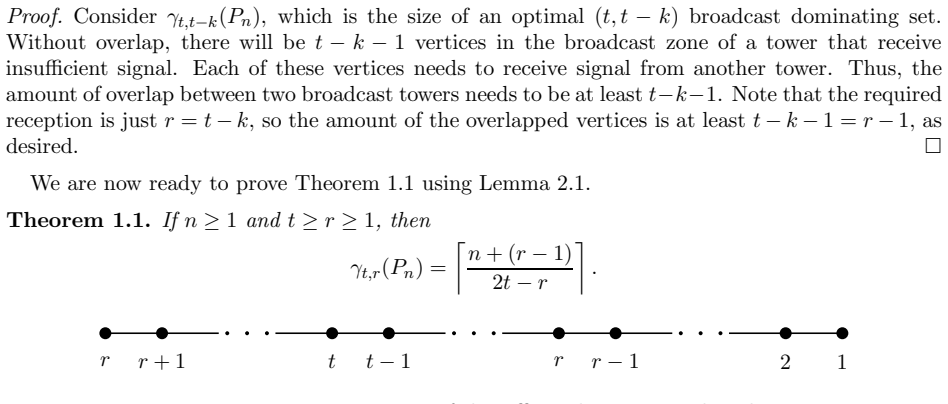
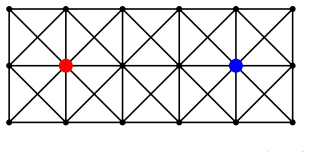
The central discovery is that optimal (t,r) broadcasts on these graphs are column-by-column tilings by an efficient two-tower block, and once the block's width is known the domination number follows by counting columns. For a path P_n the block has width 2t−r, giving γ_{t,r}(P_n) = \lceil (n+r-1)/(2t-r) \rceil. For an m×n grid with m≥2, 2t−r>m−1, and n≥2t−r−(m−2), the block width is 2t−r−(m−2), giving γ_{t,r}(G_{m,n}) = 2 + \lceil (n-(2t-r-(m-2)))/((2t-r-(m-2))-1) \rceil. For a king's grid with t>r and m≤2(t−r)+1, placing towers along the middle row makes the count match the path formula, γ_{t,r}(K_{m,n}) = \lceil (n+r-1)/(2t-r) \rceil. The same starting-block vocabulary produces upper bounds for 3D grids and for slant grids, and exact two-row slant counts.
Load-bearing premise
The grid and king's-grid formulas assume that an optimal dominating set can always be cut into identical two-tower starting blocks of the exact dimensions used in the constructions, with the proof of the grid block's base case left as an induction sketch that does not explicitly check reception at every vertex after the shift.
Editorial extensions
If this is right
- For paths, the (t,r) broadcast domination number is now known for every t≥r≥1; the exact value is \lceil (n+r-1)/(2t-r) \rceil for all n≥1.
- For m×n grids in the stated range, the number of towers grows linearly in the number of columns with slope 1/(2t−r−(m−1)), plus two towers for the starting block.
- For king's grids with m≤2(t−r)+1, the diagonal edges do not lower the tower count below the path value; the middle row alone carries the domination.
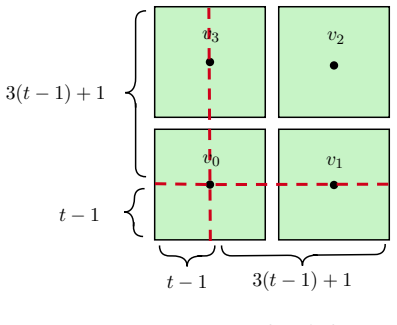
- For 3D grids, any rectangular box can be covered by copies of a two-tower starting block, giving the upper bound γ_{t,r}(G_{m,n,k})≤2B where B is the number of blocks needed.
- For two-row slant grids, the exact count is \lceil 2(n+r-1)/(4t-2r-1) \rceil whenever t>r.
Reading between the lines
- If the starting-block tiling is optimal at every parameter value covered by the theorems, the same column-counting argument should yield exact formulas for wider king's-grid bands; the natural test is to increase m past 2(t−r)+1 and look for the threshold where diagonal edges begin to reduce the tower count.
- The paper's path and king's-grid formulas both use the r−1 overlap rule, which suggests that cycles may often attain the upper bound given in Corollary 6.1; one could test whether γ_{t,r}(C_n) equals \lceil (n+r-1)/(2t-r) \rceil except when the closing of the cycle forces a larger last block.
- The block widths in the grid theorem are all of the form 2t−r−(m−2), so the same machinery might give exact counts for other rectangular families with fixed row number m, replacing exhaustive search with a one-line formula once the correct starting block is identified.
Signed reviews
Editorial analysis
A structured set of objections, weighed in public.
Referee Report
Summary. The paper studies $(t,r)$ broadcast domination numbers for paths, rectangular grid graphs, 3D grid graphs, slant grids, and king's grids. It claims exact formulas for paths, grids, and king's grids, and upper bounds for 3D grids and slant grids. The constructions are based on 'starting blocks' efficiently dominated by two towers, which are then tiled across larger graphs. The paper also includes a SageMath algorithm for paths and several results on infinite king's lattices.
Significance. Explicit formulas for $(t,r)$ broadcast domination numbers would be a useful contribution to the literature, and the paper addresses natural families of graphs. However, the central exact-formula claims are not established: the proofs rely on unsupported tiling-optimality assumptions, and the grid formula is actually false. The 3D grid result is not a substantive quantitative bound because the quantity $B$ is never defined through a concrete covering algorithm. The paper does provide a constructive path algorithm, but the main theoretical results lack the necessary rigorous lower-bound arguments.
major comments (5)
- [§3, Theorem 1.2] Theorem 1.2 is false. For $t=2$, $r=1$, $m=3$, $n=5$, the formula claims $\gamma_{2,1}(G_{3,5}) = 2 + \lceil (5-2)/1 \rceil = 5$. But the set $D=\{(2,1),(1,3),(3,3),(2,5)\}$ of four towers is a $(2,1)$ broadcast dominating set of $G_{3,5}$: every vertex is at Manhattan distance at most 1 from one of these towers, hence receives signal at least 1. Thus $\gamma_{2,1}(G_{3,5}) \le 4 < 5$. The minimality proof in Section 3 only checks local efficiency of the constructed tiling and does not rule out alternative configurations with fewer towers.
- [§3, Lemma 3.2] Lemma 3.2 is not proven. The induction step from $G_{m,n}$ to $G_{m+1,n-1}$ asserts that shifting the second tower down one row and left one column preserves domination, but it does not provide tower coordinates or verify reception for every vertex. The claim that shifting the tower 'results in an efficiently dominated grid' is exactly what needs proof, and the lemma is load-bearing as the base of the tiling formula in Theorem 1.2.
- [§5.2, Lemma 5.4 and Theorem 1.4] The king's grid formula in Theorem 1.4 has the same two gaps. Lemma 5.4's induction on $t$ and $r$ is only sketched: it says to shift the first tower one column and the second tower four columns, but it never lists the resulting positions or checks all vertices. The lower-bound part of Theorem 1.4 argues that the first tower cannot move right and that starting blocks cannot be spread apart, which establishes only local optimality of the constructed configuration. It does not rule out a completely different dominating set with fewer towers, so no genuine lower bound is given.
- [§2, Theorem 1.1 and Lemma 2.1] The path formula is a main result, but its proof is informal. The lower-bound argument 'if we remove one tower, we lose one broadcast zone... shift the remaining towers... insufficient reception at the beginning or end' is not a rigorous counting argument. Lemma 2.1, which is used as the overlap estimate, also lacks a valid proof: the statement about $\gamma_{t,t-k}(P_n)$ does not establish a lower bound for an arbitrary dominating set. The formula may be true, but the manuscript does not provide a proof.
- [§4, Theorem 1.3 and Theorem 4.2] Theorem 1.3 is not a substantive upper bound because $B$ is never defined as a computable covering number, and no algorithm or existence argument for covering an arbitrary $G_{m,n,k}$ by starting blocks is given. Theorem 4.2's proof only checks vertices that lie inside the two broadcast zones and does not show that every vertex of the block lies in the union of those zones; moreover, the displayed equations assume both towers contribute to every vertex considered, which is not justified and is not true for vertices far from both towers.
minor comments (6)
- [§1, page 2] The definition of 'efficient broadcast' as 'minimizes wasted signal in the sense that every vertex in the overlap between multiple towers receives a signal of strength exactly r' is informal and not used as a formal definition in the proofs; please make it precise or remove it.
- [§3, Lemma 3.1] The induction in Lemma 3.1 is phrased confusingly: it simultaneously refers to induction on $t$ and on $r$ without a clear base case and induction step for each parameter. For example, 'Assume, by induction, that $\gamma_{t,1}(G_{2,(2t-1)})=2$' followed by 'we will show that $\gamma_{(t+1),1}$' mixes the two inductions.
- [§4, Theorem 4.2] There is a typo in the reception computation: the line for $r'(v')$ is missing a closing parenthesis and uses $t'$ where $t$ is intended. This makes the displayed formula hard to follow.
- [§5.2, Lemma 5.5] The explanation of the equal-diagonal case in the proof of Lemma 5.5 says 'you will have path length of $n + (n-1)$', but the shortest path length in the king's lattice when $|p-x|=|q-y|$ is $|p-x|$, not $n+(n-1)$. The lemma statement is correct, but the explanation is wrong.
- [§7, Appendix] The GitHub URL is not properly formatted: it contains a space ('t r path domination.git') and is not a clickable link.
- [§5.1, Theorem 5.4] The proof of the lower bound in Theorem 5.4 again asserts minimality from the local efficiency of the starting block ('if the towers were further apart, vertices... would have insufficient reception'), which does not rule out alternative configurations with fewer towers. Since this is an exact-formula claim, the same lower-bound concern applies as in Theorem 1.4.
Circularity Check
No significant circularity: the exact grid and king's-grid formulas are stated as theorems with constructive upper bounds and asserted (not derived) lower bounds; the lower-bound gaps are proof errors, not circular reductions.
full rationale
I find no load-bearing circular step that can be exhibited as an equation reducing to its own input. The path formula (Theorem 1.1) is a construction with a hand-wavy minimality argument; the grid formula (Theorem 1.2) and king's-grid formula (Theorem 1.4) similarly prove upper bounds by tiling starting blocks and then assert minimality because the blocks are 'efficient' (e.g., 'Therefore, if we made any of these blocks larger ... So, the dominating set we've constructed is minimal'). This is an unproved optimality claim comparing the construction only with its own perturbations, but it is not a case where the target formula is assumed in the construction or where a fitted parameter is renamed a prediction. The definition of 'efficient' as 'every vertex in the overlap ... receives a signal of strength exactly r' is not by definition 'minimum cardinality,' so the gap is a correctness/rigor problem, not self-definitional circularity. Lemma 3.2's induction is a sketched construction, not a circular use of Theorem 1.2. Theorem 1.3 is a trivial upper bound following from the definition of B and of a starting block; it is non-substantive but not a circular derivation of a predicted value. The only self-citation, [2] (Harris-Luque-Flores-Sepulveda), supplies an infinite triangular-lattice pattern used for slant-grid upper bounds (Theorem 5.2 and Table 1); the exact path, grid, and king's-grid theorems do not rely on it, and the cited pattern is a stated parameter-free construction from prior work. Thus no step meets the standard of 'Eq. X = Eq. Y by construction' or 'fitted input called prediction.' The paper's weaknesses are missing lower-bound proofs, which belong under correctness risk, not circularity.
Assumptions & free parameters
assumptions (4)
- domain assumption Definition of (t,r) broadcast domination and signal function f(v) = sum_{w in T} max(0, t - d(v,w)) from Blessing et al. [1].
- domain assumption Theorem 5.1 from Harris et al. [2]: the tower placement formula for the infinite triangular lattice is an efficient (t,r) broadcast domination pattern.
- ad hoc to paper Lemma 3.2 / Lemma 5.4: certain rectangular blocks are efficiently dominated by exactly two towers.
- domain assumption The distance in the king's lattice is max(|x-p|, |y-q|) (Lemma 5.5).
Cite this review
Pith. "Pith review of On $(t,r)$ broadcast domination of certain grid graphs." pith.science (2026). https://pith.science/paper/CFXHUVEJ
@misc{pith2026190806189,
  author       = {Pith},
  title        = {Pith review of: On $(t,r)$ broadcast domination of certain grid graphs},
  year         = {2026},
  howpublished = {\url{https://pith.science/paper/CFXHUVEJ}},
  note         = {Machine review of arXiv:1908.06189}
}
abstract
Let $G=( V(G), E(G) )$ be a connected graph with vertex set $V(G)$ and edge set $E(G)$. We say a subset $D$ of $V(G)$ dominates $G$ if every vertex in $V \setminus D$ is adjacent to a vertex in $D$. A generalization of this concept is $(t,r)$ broadcast domination. We designate certain vertices to be towers of signal strength $t$, which send out signal to neighboring vertices with signal strength decaying linearly as the signal traverses the edges of the graph. We let $\mathbb{T}$ be the set of all towers, and we define the signal received by a vertex $v\in V(G)$ from a tower $w \in \mathbb T$ to be $f(v)=\sum_{w\in \mathbb{T}}max(0,t-d(v,w))$. Blessing, Insko, Johnson, Mauretour (2014) defined a $(t,r)$ broadcast dominating set, or a $(t,r) $ broadcast, on $G$ as a set $\mathbb{T} \subseteq V(G) $ such that $f(v)\geq r$ for all $v\in V(G)$. The minimal cardinality of a $(t, r)$ broadcast on $G$ is called the $(t, r)$ broadcast domination number of $G$. In this paper, we present our research on the $(t,r)$ broadcast domination number for certain graphs including paths, grid graphs, the slant lattice, and the king's lattice.
Figures


Figures from the paper (14 more)






Reference graph
Works this paper leans on
-
[2]
Broadcast Domination of Triangular Matchstick Graphs and the Triangular Lattice
Pamela E. Harris, Dalia K. Luque, Claudia Reyes Flores, a nd Nohemi Sepulveda, Broadcast Domination of Tri- angular Matchstick Graphs and the Triangular Lattice , arXiv e-prints (2018Apr), arXiv:1804.07812, available a t 1804.07812. ↑2, 9, 10
-
[1]
On (t,r) Broadcast Domination Numbers of Grids
David Blessing, Erik Insko, Katie Johnson, and Christie Mauretour, On (t,r) Broadcast Domination Numbers of Grids, arXiv e-prints (2014Jan), arXiv:1401.2499, available at 1401.2499. ↑1, 2, 3
-
[3]
Asymptotically Optimal Bounds for (t,2) Broadcast Domination on Finite Grids
Timothy W. Randolph, Asymptotically Optimal Bounds for (t,2) Broadcast Dominat ion on Finite Grids , arXiv e-prints (2018May), arXiv:1805.06058, available at 1805.06058. ↑2 21 Department of Mathematics, Harvey Mudd College, United Sta tes E-mail address : ncrepeau@hmc.edu Department of Mathematics and Statistics, Williams Colleg e, United States E-mail ad...
Reviewed August 14, 2026 · model on record in the stance chip above.
Discussion (0). Continue with ORCID to comment.