REVIEW 3 major objections 5 minor 36 references
How Drag Force Evolves in Global Common Envelope Simulations
T0 review · 3 major / 5 minor · reviewed 2026-08-14 · deepseek-v4-flash
Pith's one-line read In global common-envelope simulations, the drag force on the companion after the first periastron passage is up to an order of magnitude smaller than Bondi-Hoyle-Lyttleton theory predicts, because opposing gravitational forces from gas in…
desk verdict A credible, useful demonstration that BHL drag fails at late common-envelope inspiral, but convergence of the late-time force is not yet established. read the letter →
The pith
A machine-rendered reading of the paper's core claim, the machinery that carries it, and where it could break.
The reading
What carries the argument
The load-bearing object is the net gas force on the companion computed in the non-inertial rest frame of the primary, $F_{2-\mathrm{gas},1}=F_{2-\mathrm{gas}}-(M_2/M_{1,c})F_{1-\mathrm{gas}}$, decomposed into its azimuthal component (drag) and its projection along the relative velocity. The analytic comparison uses the Bondi-Hoyle-Lyttleton accretion radius $R_a=2GM_2/(c_\infty^2+v_\infty^2)$, whose ratio to the orbital separation $a$ identifies when local theory breaks down. The mechanism that suppresses drag at late times is the development of a turbulent, thermalized, nearly symmetric flow region that cancels the front/back gravitational forces on the companion.
What would settle it
Re-run the largest-companion simulation (Model A) with radiative transfer or a cooling source term; if the azimuthal drag after the first periastron passage stays within a factor of about two of the BHL/DM prediction instead of dropping by an order of magnitude, the symmetry-suppression mechanism is an artifact of the adiabatic equation of state.
Extended reading notes
Core claim
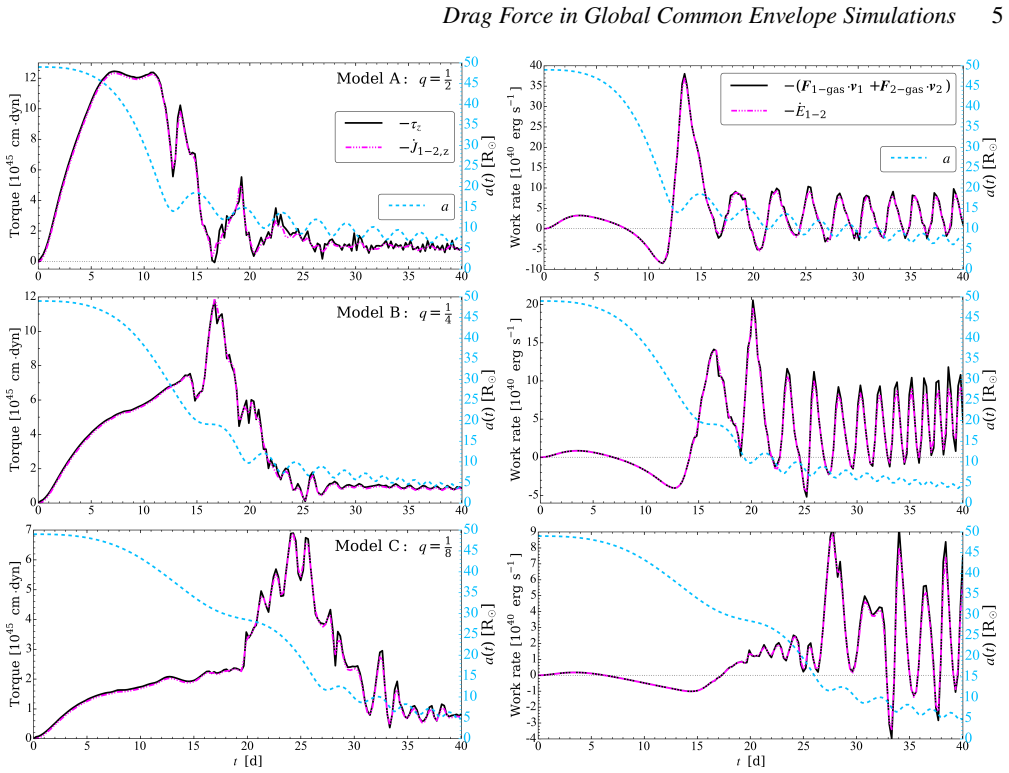
The central discovery is that the drag force in global common-envelope simulations has two regimes divided by the first periastron passage. Before and during that passage, gas in front of the companion is dense and the drag is large, peaking at values proportional to companion mass, well described by Bondi-Hoyle-Lyttleton theory with a density-gradient correction and by local wind-tunnel simulations. Afterwards, when the inter-particle separation $a$ shrinks to roughly the accretion radius $R_a$, the companion moves through gas it has already reprocessed: the flow becomes subsonic, turbulent, and left-right symmetric, and the gravitational forces from gas in front and behind nearly cancel. The measured drag then becomes quasi-steady at about $7\times 10^{33}$ dyn for all but the lightest companion, an order of magnitude below analytic estimates; the paper connects this suppression to why envelope ejection is not achieved in common-envelope simulations.
Load-bearing premise
The late-time result rests on the assumption that radiative cooling is negligible in the hot, turbulent, symmetric region around the companion; the paper estimates a photon diffusion time of about 20 years against a 40-day simulation, but if real cooling is faster, the symmetry would break and the drag could return toward analytic predictions.
Editorial extensions
If this is right
- During the early plunge-in phase, BHL/DM theory and local wind-tunnel simulations give a good account of the drag, so analytic estimates remain reliable for the early inspiral, especially for low companion mass.
- At late times, analytic drag estimates overestimate the force by an order of magnitude for a mass ratio of $q=1/2$, which explains why common-envelope simulations stall at separations too large to eject the envelope.
- When the separation shrinks to roughly the accretion radius, fixed-$q_{\rm enc}$ wind-tunnel models cease to apply; matching the global evolution requires patching together local simulations with different $q_{\rm enc}$.
- The measured torque and orbital energy dissipation rate agree, so the computed drag can be used to estimate the luminosity of potential luminous red nova events once radiative transfer is included.
Reading between the lines
- If the late-time symmetry suppression holds in nature, orbital-decay timescales in common-envelope evolution could be longer than population-synthesis models that apply BHL drag throughout the inspiral, shifting predicted final separations and merger rates.
- The cancellation mechanism predicts that any perturbation breaking front/back symmetry—a density or velocity gradient in the envelope, an eccentric orbit, or a companion outflow—should restore a larger drag, which is testable in targeted simulations.
- A direct check of the radiative-transfer assumption would be to rerun Model A with flux-limited diffusion; if even modest cooling removes the hot symmetric region, the late-time drag should rise back toward analytic values.
Signed reviews
Editorial analysis
A structured set of objections, weighed in public.
Referee Report
Summary. This paper presents three global 3D AMR simulations of common envelope evolution that are identical except for the companion mass (0.98, 0.49, and 0.245 solar masses), and measures the drag force, torque, and orbital energy dissipation on the secondary. The forces are computed by direct domain integration and are cross-checked against time derivatives of the particle angular momentum and orbital energy. The authors compare the simulated drag with Bondi-Hoyle-Lyttleton and Dodd-McCrea analytic estimates, and with local wind-tunnel fits from MacLeod et al. (2017). The main claim is that during and just before first periastron the drag is reasonably described by analytic and wind-tunnel theory and scales with companion mass, whereas after first periastron, once the accretion radius approaches the orbital separation, the flow becomes turbulent, thermalized, and symmetric around the secondary, and the drag is up to an order of magnitude smaller than theoretical predictions, quasi-steady, and only weakly dependent on companion mass. This reduced late-time drag is proposed as the explanation for why global CE simulations do not reach the separations needed for envelope ejection. A resolution/softening comparison is made with a coarser Model F, and the neglect of radiative transfer is argued via a diffusion-time estimate.
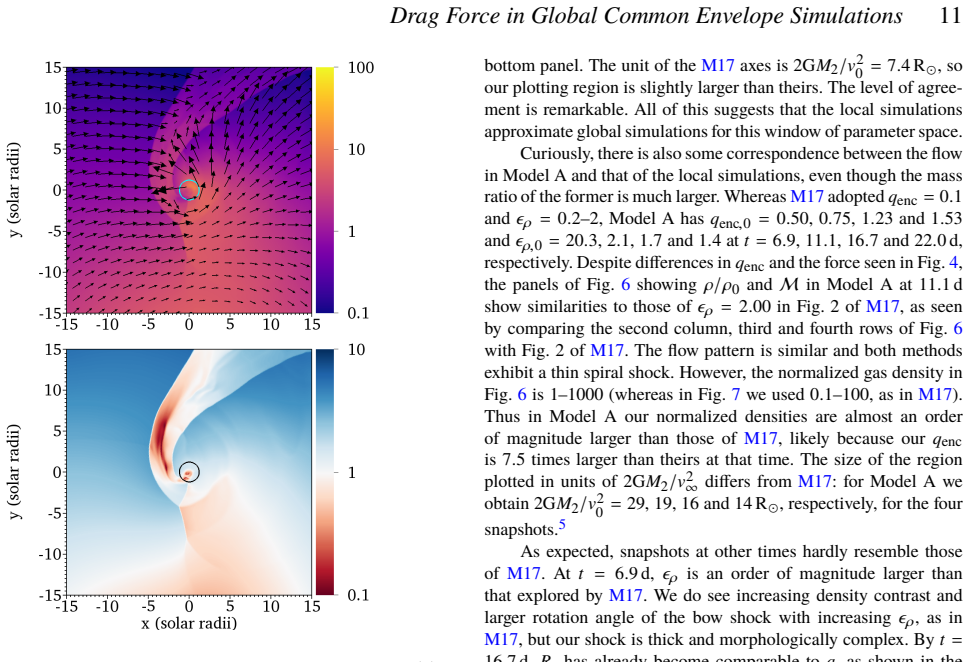
Significance. If the late-time drag reduction is robust, it is an important result for common envelope astrophysics: it provides a physical mechanism for the stalled inspiral seen in many global simulations and defines the regime in which Bondi-Hoyle-Lyttleton or local wind-tunnel drag prescriptions should not be used. The measurement methodology is a clear strength: the torque and energy dissipation rates computed from force integration agree very well with independent time-derivative estimates (Fig. 3), and the intermediate-time agreement between the global simulation and the local wind-tunnel fitting formula (Fig. 7, Model C) is a strong positive control. The radiative-transfer argument using Eq. (16) is also robust once a typographical optical-depth value is corrected: t_d ~ 20 yr is much longer than the 40 d simulation, so cooling is justifiably neglected for the duration considered. These strengths make the paper valuable even though the central late-time claim needs additional numerical support.
major comments (3)
- [§5.3, Appendix A] The resolution check does not establish convergence of the late-time drag. Model F retains rsoft = 2.4 R_sun and δ = 0.14 R_sun for the full run, whereas Model A halves both at t = 16.7 d, so the comparison in Fig. A1 shows insensitivity to that particular coarsening, not that the solution has converged; both runs could be affected by the same numerical diffusion and viscosity. This matters because the central late-time claim is that the drag becomes small as the force-density pattern becomes symmetric (top row of Fig. 6 at t = 22 d), and the net drag is a delicate cancellation of large opposing contributions. A run with δ = 0.035 R_sun (or otherwise higher resolution than Model A at late times) is needed to show that the symmetric pattern and the residual net drag do not change substantially. The paper's own statement in §5.3 that turbulence is not produced by the resolution change addresses the timing of turbulence onset, but not the amplitude of the late-time drag.
- [§3.2, Fig. 2] The late-time claims of 'quasi-steady' drag and 'weak dependence on companion mass' are made without error bars, variance estimates, or defined averaging intervals. The curves in Fig. 2 show periodic oscillations tied to orbital phase, and Model C is described as not yet stabilized by t = 40 d; the late-time values quoted in §3.2 (∼7×10^33 dyn for Models A and B, ∼4×10^33 dyn for Model C) are therefore not quantities with a stated uncertainty. Please report time averages and standard deviations over well-defined orbital cycles for each model, and state explicitly whether the residual mass dependence is significant compared with those variances.
- [§5.1, Fig. 6] The proposed mechanism for the reduced drag—near balance between thrust and drag contributions in the force density—is shown qualitatively in the top row of Fig. 6, but the integrated positive and negative contributions are not reported. Because the net force is a small difference of large numbers, quantifying the separate integrals (and their dependence on resolution and on the outer integration radius) would make the explanation falsifiable and would connect directly to the convergence concern raised above.
minor comments (5)
- [§7, Eq. (16)] The optical depth quoted as τ∼40 is inconsistent with Eq. (16); using ne = ρ/mH, R∼7 R_sun, and ρ∼2×10^-4 g cm^-3 gives τ∼4×10^7. The diffusion time t_d∼20 yr is unaffected and still much longer than 40 d, so the conclusion stands, but the typo should be corrected.
- [§3.2] There is a duplicated word in 'the the first term on the right of equation (1)'.
- [§4.4] The notation for the relative velocity is inconsistent: v∞ appears lowercase in most of the subsection, but 'V∞ = 0.3v0' appears with a capital V in the sentence after Eq. (12).
- [Fig. A1 caption] 'Comparion' should be 'Comparison'.
- [Fig. 6] The color-bar ranges differ between rows and between Fig. 6 and Fig. 7; a sentence in each caption stating the normalization and range would help the reader compare panels.
Circularity Check
No significant circularity: the late-time drag reduction is a direct numerical measurement compared against, not derived from, BHL/DM theory or wind-tunnel benchmarks.
full rationale
The central claim of the paper—that after first periastron the drag force is up to an order of magnitude smaller than analytic predictions and only weakly mass-dependent—is a measurement obtained by directly integrating the gravitational force of the gas on particle 2 (Eq. 1 and Sec. 3.2). Analytic BHL/DM theory enters only as a comparator (Eqs. 7, 8, 11, 12), with parameters taken either from the initial envelope profile or from the simulated orbit; it is not fitted to the measured force and then renamed a prediction. The Sec. 4.4 attempt to repair late-time theory by reading local rho_inf, v_inf, and c_inf from the simulation is explicitly acknowledged by the authors as 'not well-motivated for late times ... sensitive to arbitrary choices, and cannot reproduce the force measured from the simulation,' so it is neither load-bearing nor part of the headline result. The wind-tunnel comparison uses an external fitting formula, Eq. (15), fitted to MacLeod et al. (2017) local simulations; that is a benchmark, not an input derived from the global simulation being tested. Self-citations to the authors' Papers I and II supply initial conditions and orbit context but do not carry the argument that late-time drag is small. The resolution check in Appendix A is a convergence-style comparison, not a fitted prediction. The radiative-transfer estimate in Sec. 7 contains an apparent arithmetic inconsistency (the quoted tau ~ 40 is too small by orders of magnitude given the stated rho, sigma_T, and R), and the numerical value of t_d from Eq. (16) is accordingly suspect; however, even a conservative recomputation gives t_d > 40 d, so the qualitative conclusion is not overturned. This is a numerical robustness concern, not circularity. No step in the derivation reduces by construction to its own inputs.
Assumptions & free parameters
free parameters (2)
- rmin = rsoft(t=0) = 2.4 R_sun =
2.4 R_sun
- Local fluid quantities (rho_inf, v_inf, c_inf) at t=22 d =
rho ~ (5-10) rho_0, v ~ 0.5 v_0, c ~ 2 c_0 (one of several cases)
assumptions (4)
- domain assumption BHL/DM drag formula (Hoyle-Lyttleton, Bondi, Dokuchaev, Dodd-McCrea) is an appropriate benchmark for dynamical friction.
- domain assumption Ideal gas equation of state with gamma = 5/3 and neglect of accretion onto the companion do not qualitatively alter the drag evolution.
- domain assumption Neglect of radiative transfer at late times is justified because the diffusion time t_d ~ 20 yr from Eq. (16) greatly exceeds the simulation time.
- standard math Spline softening of the particle potential (Springel 2010) adequately represents the gravitational influence of the cores.
Cite this review
Pith. "Pith review of How Drag Force Evolves in Global Common Envelope Simulations." pith.science (2026). https://pith.science/paper/OIQ2RJ4P
@misc{pith2026190806195,
  author       = {Pith},
  title        = {Pith review of: How Drag Force Evolves in Global Common Envelope Simulations},
  year         = {2026},
  howpublished = {\url{https://pith.science/paper/OIQ2RJ4P}},
  note         = {Machine review of arXiv:1908.06195}
}
read the original abstract
We compute the forces, torque and rate of work on the companion-core binary due to drag in global simulations of common envelope (CE) evolution for three different companion masses. Our simulations help to delineate regimes when conventional analytic drag force approximations are applicable. During and just prior to the first periastron passage of the in-spiral phase, the drag force is reasonably approximated by conventional analytic theory and peaks at values proportional to the companion mass. Good agreement between global and local 3D "wind tunnel" simulations, including similar net drag force and flow pattern, is obtained for comparable regions of parameter space. However, subsequent to the first periastron passage, the drag force is up to an order of magnitude smaller than theoretical predictions, quasi-steady, and depends only weakly on companion mass. The discrepancy is exacerbated for larger companion mass and when the inter-particle separation reduces to the Bondi-Hoyle-Lyttleton accretion radius, creating a turbulent thermalized region. Greater flow symmetry during this phase leads to near balance of opposing gravitational forces in front of and behind the companion, hence a small net drag. The reduced drag force at late times helps explain why companion-core separations necessary for envelope ejection are not reached by the end of limited duration CE simulations.
Figures


Figures from the paper (4 more)


Reference graph
Works this paper leans on
-
[1]
Bondi H., 1952, @doi [ ] 10.1093/mnras/112.2.195 , http://adsabs.harvard.edu/abs/1952MNRAS.112..195B 112, 195
-
[2]
Bondi H., Hoyle F., 1944, @doi [ ] 10.1093/mnras/104.5.273 , http://adsabs.harvard.edu/abs/1944MNRAS.104..273B 104, 273
-
[3]
Chamandy L., et al., 2018, @doi [ ] 10.1093/mnras/sty1950 , http://adsabs.harvard.edu/abs/2018MNRAS.480.1898C 480, 1898
-
[4]
Chamandy L., Tu Y., Blackman E. G., Carroll-Nellenback J., Frank A., Liu B., Nordhaus J., 2019, @doi [ ] 10.1093/mnras/stz887 , https://ui.adsabs.harvard.edu/abs/2019MNRAS.486.1070C 486, 1070
-
[5]
Dodd K. N., McCrea W. J., 1952, @doi [ ] 10.1093/mnras/112.2.205 , https://ui.adsabs.harvard.edu/abs/1952MNRAS.112..205D 112, 205
-
[6]
P., 1964, , https://ui.adsabs.harvard.edu/abs/1964SvA.....8...23D 8, 23
Dokuchaev V. P., 1964, , https://ui.adsabs.harvard.edu/abs/1964SvA.....8...23D 8, 23
work page 1964
-
[7]
Edgar R., 2004, @doi [ ] 10.1016/j.newar.2004.06.001 , http://adsabs.harvard.edu/abs/2004NewAR..48..843E 48, 843
-
[8]
Eker Z., et al., 2018, @doi [ ] 10.1093/mnras/sty1834 , https://ui.adsabs.harvard.edu/abs/2018MNRAS.479.5491E 479, 5491
Show all 36 references
-
[9]
Grichener A., Sabach E., Soker N., 2018, preprint, http://adsabs.harvard.edu/abs/2018arXiv180305864G ( @eprint arXiv 1803.05864 )
2018 arXiv
-
[10]
A., 1939, @doi [Proceedings of the Cambridge Philosophical Society] 10.1017/S0305004100021150 , http://adsabs.harvard.edu/abs/1939PCPS...35..405H 35, 405
Hoyle F., Lyttleton R. A., 1939, @doi [Proceedings of the Cambridge Philosophical Society] 10.1017/S0305004100021150 , http://adsabs.harvard.edu/abs/1939PCPS...35..405H 35, 405
1939 doi
-
[11]
arXiv:1902.02039
Iaconi R., De Marco O., 2019, arXiv e-prints, https://ui.adsabs.harvard.edu/abs/2019arXiv190202039I p. arXiv:1902.02039
2019 arXiv
-
[12]
Iaconi R., Reichardt T., Staff J., De Marco O., Passy J.-C., Price D., Wurster J., Herwig F., 2017, @doi [ ] 10.1093/mnras/stw2377 , http://adsabs.harvard.edu/abs/2017MNRAS.464.4028I 464, 4028
2017 doi
-
[13]
Iaconi R., De Marco O., Passy J.-C., Staff J., 2018, @doi [ ] 10.1093/mnras/sty794 , http://adsabs.harvard.edu/abs/2018MNRAS.477.2349I 477, 2349
2018 doi
-
[14]
Ivanova N., 2018, @doi [ ] 10.3847/2041-8213/aac101 , http://adsabs.harvard.edu/abs/2018ApJ...858L..24I 858, L24
2018 doi
-
[15]
R., McKee C
Krumholz M. R., McKee C. F., Klein R. I., 2006, @doi [ ] 10.1086/498844 , https://ui.adsabs.harvard.edu/abs/2006ApJ...638..369K 638, 369
2006 doi
-
[16]
Livio M., Soker N., 1988, @doi [ ] 10.1086/166419 , http://adsabs.harvard.edu/abs/1988ApJ...329..764L 329, 764
1988 doi
-
[17]
MacLeod M., Antoni A., Murguia-Berthier A., Macias P., Ramirez-Ruiz E., 2017, @doi [ ] 10.3847/1538-4357/aa6117 , http://adsabs.harvard.edu/abs/2017ApJ...838...56M 838, 56
2017 doi
-
[18]
Nandez J. L. A., Ivanova N., 2016, @doi [ ] 10.1093/mnras/stw1266 , http://adsabs.harvard.edu/abs/2016MNRAS.460.3992N 460, 3992
2016 doi
-
[19]
Nandez J. L. A., Ivanova N., Lombardi J. C., 2015, @doi [ ] 10.1093/mnrasl/slv043 , http://adsabs.harvard.edu/abs/2015MNRAS.450L..39N 450, L39
2015 doi
-
[20]
G., 2006, @doi [ ] 10.1111/j.1365-2966.2006.10625.x , http://adsabs.harvard.edu/abs/2006MNRAS.370.2004N 370, 2004
Nordhaus J., Blackman E. G., 2006, @doi [ ] 10.1111/j.1365-2966.2006.10625.x , http://adsabs.harvard.edu/abs/2006MNRAS.370.2004N 370, 2004
2006
-
[21]
T., R \"o pke F
Ohlmann S. T., R \"o pke F. K., Pakmor R., Springel V., 2016, @doi [ ] 10.3847/2041-8205/816/1/L9 , http://adsabs.harvard.edu/abs/2016ApJ...816L...9O 816, L9
2016 doi
-
[22]
T., R \"o pke F
Ohlmann S. T., R \"o pke F. K., Pakmor R., Springel V., 2017, @doi [ ] 10.1051/0004-6361/201629692 , http://adsabs.harvard.edu/abs/2017A
2017 doi
-
[23]
C., 1999, @doi [ ] 10.1086/306858 , http://adsabs.harvard.edu/abs/1999ApJ...513..252O 513, 252
Ostriker E. C., 1999, @doi [ ] 10.1086/306858 , http://adsabs.harvard.edu/abs/1999ApJ...513..252O 513, 252
1999 doi
-
[24]
Passy J.-C., Mac Low M.-M., De Marco O., 2012, @doi [ ] 10.1088/2041-8205/759/2/L30 , http://adsabs.harvard.edu/abs/2012ApJ...759L..30P 759, L30
2012 doi
-
[25]
Paxton B., et al., 2015, @doi [ ] 10.1088/0067-0049/220/1/15 , http://adsabs.harvard.edu/abs/2015ApJS..220...15P 220, 15
2015 doi
-
[26]
J., Chang P., 2019, @doi [ ] 10.1093/mnras/stz1219 , https://ui.adsabs.harvard.edu/abs/2019MNRAS.486.5809P 486, 5809
Prust L. J., Chang P., 2019, @doi [ ] 10.1093/mnras/stz1219 , https://ui.adsabs.harvard.edu/abs/2019MNRAS.486.5809P 486, 5809
2019 doi
-
[27]
A., De Marco O., Iaconi R., Tout C
Reichardt T. A., De Marco O., Iaconi R., Tout C. A., Price D. J., 2019, @doi [ ] 10.1093/mnras/sty3485 , http://adsabs.harvard.edu/abs/2019MNRAS.484..631R 484, 631
2019 doi
-
[28]
M., Taam R
Ricker P. M., Taam R. E., 2008, @doi [ ] 10.1086/526343 , http://adsabs.harvard.edu/abs/2008ApJ...672L..41R 672, L41
2008 doi
-
[29]
M., Taam R
Ricker P. M., Taam R. E., 2012, @doi [ ] 10.1088/0004-637X/746/1/74 , http://adsabs.harvard.edu/abs/2012ApJ...746...74R 746, 74
2012 doi
-
[30]
Sabach E., Hillel S., Schreier R., Soker N., 2017, @doi [ ] 10.1093/mnras/stx2272 , http://adsabs.harvard.edu/abs/2017MNRAS.472.4361S 472, 4361
2017 doi
-
[31]
Shima E., Matsuda T., Takeda H., Sawada K., 1985, @doi [ ] 10.1093/mnras/217.2.367 , http://adsabs.harvard.edu/abs/1985MNRAS.217..367S 217, 367
1985 doi
-
[32]
Springel V., 2010, @doi [ ] 10.1111/j.1365-2966.2009.15715.x , http://adsabs.harvard.edu/abs/2010MNRAS.401..791S 401, 791
2010
-
[33]
E., De Marco O., Wood P., Galaviz P., Passy J.-C., 2016, @doi [ ] 10.1093/mnras/stw331 , http://adsabs.harvard.edu/abs/2016MNRAS.458..832S 458, 832
Staff J. E., De Marco O., Wood P., Galaviz P., Passy J.-C., 2016, @doi [ ] 10.1093/mnras/stw331 , http://adsabs.harvard.edu/abs/2016MNRAS.458..832S 458, 832
2016 doi
-
[34]
Towns J., Cockerill T., Dahan M., Foster I., 2014, @doi [Computing in Science and Engineering] 10.1109/MCSE.2014.80 , 16, 62
2014 doi
-
[35]
F., 1984, @doi [ ] 10.1086/161701 , https://ui.adsabs.harvard.edu/abs/1984ApJ...277..355W 277, 355
Webbink R. F., 1984, @doi [ ] 10.1086/161701 , https://ui.adsabs.harvard.edu/abs/1984ApJ...277..355W 277, 355
1984 doi
-
[36]
van den Heuvel E. P. J., 1976, in Eggleton P., Mitton S., Whelan J., eds, IAU Symposium Vol. 73, Structure and Evolution of Close Binary Systems. p. 35
1976
Reviewed August 14, 2026 · model on record in the stance chip above.
Discussion (0). Continue with ORCID to comment.