REVIEW 3 major objections 4 minor 24 references
Multimode Fiber Coupled Superconducting Nanowire Single Photon Detectors with High Detection Efficiency and Time Resolution
T0 review · 3 major / 4 minor · reviewed 2026-08-14 · deepseek-v4-flash
Pith's one-line read Superconducting nanowire detectors can couple to multimode fibers and still beat 20 ps timing while exceeding 80% efficiency.
desk verdict The 19.5 ps multimode-fiber jitter is a genuine advance, but the 'simultaneously achieved >80% and <20 ps' claim is not directly supported by any single measurement in the paper. read the letter →
The pith
A machine-rendered reading of the paper's core claim, the machinery that carries it, and where it could break.
The reading
What carries the argument
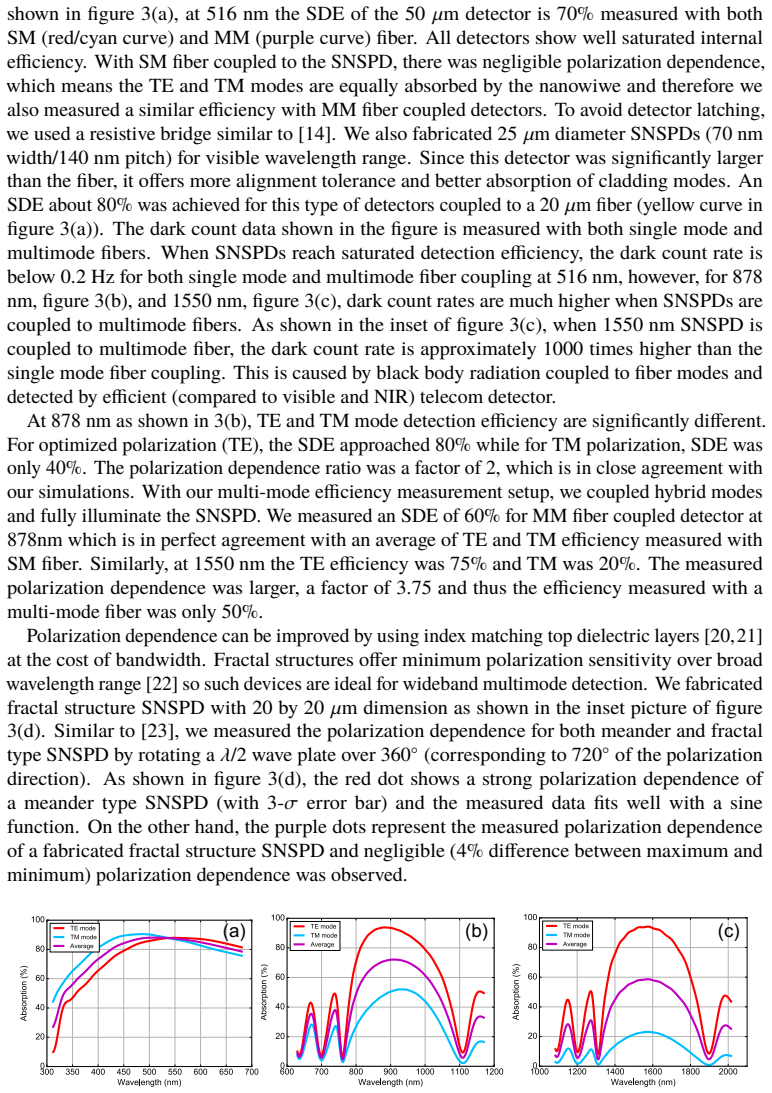
The central objects are NbTiN superconducting nanowire meanders (20, 25, and 50 µm diameter) inside cavity stacks that push absorption toward saturation: an aluminum/SiO2 cavity for visible wavelengths and a distributed Bragg reflector for 900 and 1550 nm. The argument about polarization is carried by the TE/TM absorption ratio of the nanowire, which grows with wavelength and is also the mechanism behind the efficiency measured with randomized modes. Two design elements do the practical work: the fractal nanowire geometry suppresses polarization sensitivity, and the graded-index multimode fiber suppresses modal dispersion, so the cryogenic amplifier's low electrical noise can reveal a 19.5 ps IRF.
What would settle it
Measure the instrument response with a much shorter laser pulse (below 1 ps) and a higher-bandwidth oscilloscope, or compare jitter across two different amplifier chains; if the FWHM drops noticeably below 19.5 ps, the reported jitter is partly electronic rather than intrinsic to the detector-fiber system.
Extended reading notes
Core claim
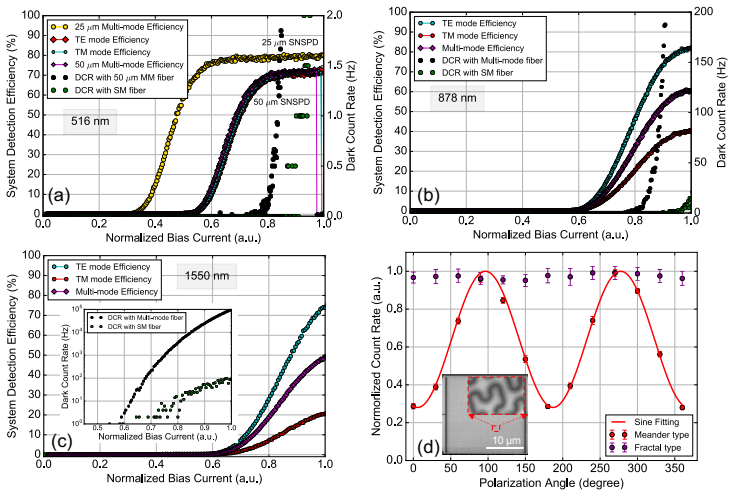
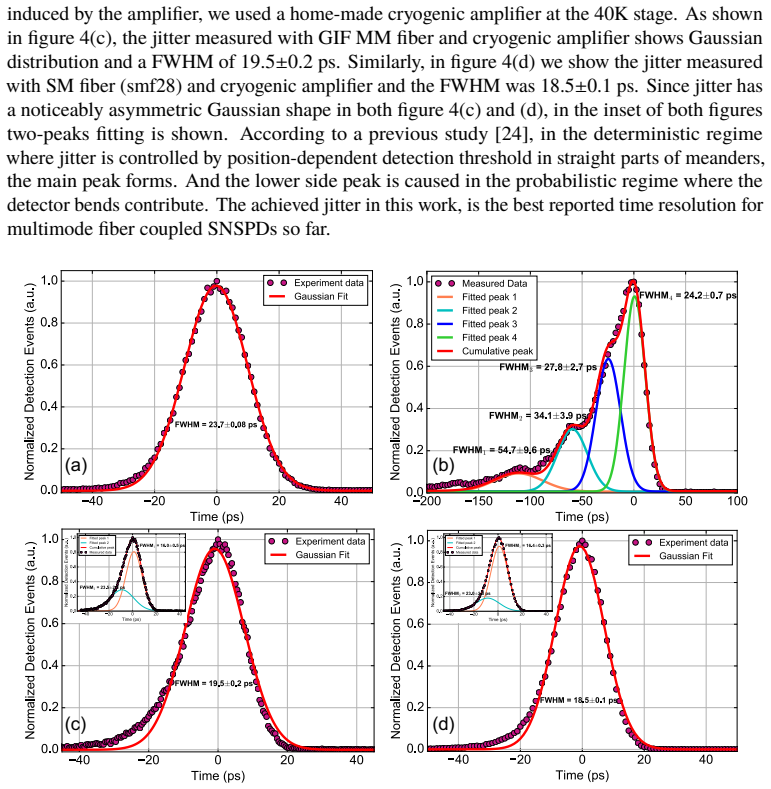
The paper's core discovery is that the multimode fiber itself is not the fundamental limit: polarization of the detected light is. At 516 nm, the TE and TM absorptions of the NbTiN meander are nearly equal, so a 25 µm detector coupled to a 20 µm fiber saturates at about 80% system efficiency with negligible polarization dependence. At 878 nm the TE/TM efficiency ratio is about 2, giving 60% efficiency under randomized modes, and at 1550 nm the ratio is about 3.75, giving 50%. A fractal nanowire layout reduces the polarization sensitivity to about 4% between maximum and minimum, which points to a broadband route for multimode detection. On the timing side, step-index multimode fiber spreads the instrument response into several peaks through modal dispersion, whereas graded-index fiber keeps a single Gaussian peak; with a cryogenic amplifier, the jitter is 19.5±0.2 ps for a 20 µm detector, close to the 18.5±0.1 ps measured through single-mode fiber with the same readout.
Load-bearing premise
The reported 19.5 ps timing width is treated as the detector-fiber system's own jitter, but the measurement also includes the 4.2 ps laser pulse, the oscilloscope bandwidth, the trigger electronics, and the amplifier; if those add substantially, the detector's true timing improvement is overstated.
Editorial extensions
If this is right
- With graded-index multimode fiber and a cryogenic readout, a 20 µm detector shows 19.5±0.2 ps jitter, so multimode coupling no longer forces a timing penalty below the single-mode value.
- Random-mode efficiency is predictable from the TE/TM absorption average: 60% at 878 nm and 50% at 1550 nm match the mean of the two polarization-efficiency curves.
- The 25 µm detector saturates at about 80% system efficiency through a 20 µm fiber at 516 nm, giving alignment tolerance for visible-light experiments that need large collection areas.
- Fractal nanowire layouts keep polarization sensitivity near 4%, meaning efficiency stays stable even if the fiber scrambles the input polarization.
- At telecom wavelengths, multimode fiber coupling raises the dark count rate roughly 1000 times over single-mode coupling due to fiber-coupled blackbody radiation, so system design must trade collection area against dark counts.
Reading between the lines
- The reported 19.5 ps jitter still contains the 4.2 ps laser pulse width, the 4 GHz oscilloscope bandwidth, and the amplifier chain; deconvolving those would test whether the detector-fiber system itself is closer to 15 ps or better.
- The same fractal geometry that removes polarization dependence at 1550 nm could be combined with larger-area meanders or arrays, potentially extending polarization-insensitive multimode efficiency to the 100 µm core fibers used in lidar and bio-optics.
- Since the TE/TM ratio grows with wavelength, cavity designs that equalize absorption at telecom—for example, thicker index-matching layers—could lift random-mode efficiency from 50% toward the 75% TE ceiling, at the cost of bandwidth.
- A direct check of the two-peak IRF interpretation would be to vary the bias current: if the side peak grows at low bias, it matches the probabilistic bend-detection regime; if it stays constant, another electronic source is likely.
Editorial analysis
A structured set of objections, weighed in public.
Referee Report
Summary. This manuscript reports the fabrication and characterization of NbTiN superconducting nanowire single-photon detectors (SNSPDs) with 20, 25, and 50 µm diameters coupled to multimode fibers, targeting visible, near-infrared, and telecom wavelengths. The authors measure system detection efficiency (SDE) under single-mode and deliberately randomized multimode illumination, observe wavelength-dependent TE/TM polarization sensitivity that increases toward telecom wavelengths, and compare the results with FDTD simulations. They also measure timing jitter at 1064 nm for a 20 µm detector, showing that graded-index fiber avoids the multi-peak instrument response obtained with step-index fiber and that a cryogenic amplifier reduces the FWHM to 19.5±0.2 ps. The abstract and conclusions claim simultaneous system efficiency >80% and time resolution <20 ps.
Significance. If fully supported, the results would be a useful engineering advance for applications such as quantum-dot photon collection, bio-optics, and lidar, where multimode fiber coupling relaxes alignment constraints. The paper's strengths are the detailed efficiency measurements under randomized multimode illumination, the FDTD comparison with no fitted parameters, and the explicit demonstration that graded-index fiber prevents modal-dispersion broadening of the instrument response. However, the headline 'simultaneously achieved' claim is not demonstrated by the reported data, and the jitter numbers are system-level values without a decomposed jitter budget. These issues are correctable with additional data or a qualified claim.
major comments (3)
- [Abstract and Section 5] The claim 'We simultaneously achieved system efficiency >80% and time resolution <20 ps' is not supported by any single experimental configuration in the paper. The efficiency value supporting the claim is 'about 80%' for a 25 µm detector at 516 nm coupled to a 20 µm fiber (Fig. 3(a), yellow curve, Section 3), while the sub-20 ps jitter is 19.5±0.2 ps for a 20 µm detector at 1064 nm with graded-index multimode fiber and cryogenic amplifier (Fig. 4(c), Section 4). No jitter measurement is reported at 516 nm and no efficiency measurement is reported at 1064 nm for the same device. Section 5 repeats the 'at the same time' claim; the paper should either add a configuration that shows both properties or explicitly qualify the claim as a combination of results from different devices and wavelengths.
- [Section 3, Fig. 3(a)] The quantitative basis for '>80%' is not established. The text states 'An SDE about 80% was achieved' for the 25 µm visible detector, yet the abstract states '>80%'; no uncertainty or error bars are given for the SDE curves. In addition, the conclusion 'both single-mode and multi-mode coupled SNSPDs showed >80% system detection efficiency' is contradicted by Fig. 3(a), where the 50 µm detector reaches 70% with both SM and MM fibers, and no SM-fiber data are shown for the 25 µm detector. The authors should present the actual saturation value with uncertainty and restrict the claim to the configurations measured.
- [Section 4] The jitter measurement does not separate the detector/fiber timing response from the measurement electronics. The setup includes a 4.2 ps pulsed laser, a 4 GHz oscilloscope, a fast photodiode reference, and rising-edge triggering (Section 4), and the reported 19.5±0.2 ps FWHM is a system-level instrument response function without deconvolution or an independent estimate of the electronic jitter. Because the claim 'best reported time resolution for multimode fiber coupled SNSPDs' is a comparative claim, the authors need to provide a jitter budget or explicitly state that all comparisons are system-level values obtained with the same electronics.
minor comments (4)
- [Throughout] There are several typographical errors, including 'croystat' (Fig. 1 caption), 'sysytem' (Section 1), and 'nanowiwe' (Section 3); these should be corrected.
- [Section 2, fabrication] The phrase 'Similar to [9], we fabricated SNSPDs' cites reference [9], which concerns quantum-dot microcavity sources and appears unrelated to SNSPD fabrication; a relevant NbTiN SNSPD fabrication reference, such as [14], would be more appropriate.
- [Section 3, U-bench setup] The randomization of modes and polarization in the U-bench is described qualitatively; a measurement of the output mode distribution or residual degree of polarization would strengthen the claim that the multimode illumination is randomized.
- [Section 4, fitting] The fitting procedure for the jitter histograms could be described more fully; Fig. 4(c) and (d) show asymmetric responses and two-peak fits, but it is not stated whether the reported 19.5±0.2 ps FWHM comes from a single Gaussian fit or from the main peak of a two-peak fit.
Circularity Check
No circularity found: the reported efficiencies and timing values are direct measurements, and the FDTD simulations are forward design calculations rather than fits.
full rationale
The paper's central claims are measurements of system detection efficiency and timing jitter on fabricated devices, not derived predictions. The FDTD simulations in Section 3 are forward calculations: the cavity parameters (Al/SiO2 thickness, DBR period counts, meander width and pitch) are stated design/fabrication inputs, and the simulated TE/TM absorption curves are compared with measured polarization ratios after the fact rather than used to adjust parameters to reproduce the measured efficiencies. For example, the factor-of-2 polarization dependence at 878 nm is reported as 'in close agreement with our simulations,' but no fitting loop is described. The jitter values in Section 4 are measured Gaussian FWHMs of recorded IRF histograms, with no fitted parameter renamed as a prediction. Self-citations such as [14] ('we used a resistive bridge similar to [14]') and [23] (polarization dependence measurement method) are procedural references and not load-bearing for the claimed performance numbers. The abstract's 'simultaneously achieved system efficiency >80% and time resolution <20 ps' may be under-supported because the supporting efficiency and jitter datapoints come from different detectors/configurations, but that is a claim-support issue, not a circularity: no result reduces by construction to its inputs.
Assumptions & free parameters
assumptions (3)
- domain assumption The SNSPD internal detection efficiency saturates at the operating bias current, so the measured system efficiency is set by optical absorption and coupling rather than by the counting electronics.
- domain assumption FDTD simulations with the assumed NbTiN, SiO2, Nb2O5, and metal optical constants and nominal meander geometry accurately represent the fabricated devices.
- domain assumption The U-bench with two diffusers creates sufficiently randomized hybrid modes and polarization to represent realistic multimode fiber illumination.
Cite this review
Pith. "Pith review of Multimode Fiber Coupled Superconducting Nanowire Single Photon Detectors with High Detection Efficiency and Time Resolution." pith.science (2026). https://pith.science/paper/XRFTZIBD
@misc{pith2026190806205,
  author       = {Pith},
  title        = {Pith review of: Multimode Fiber Coupled Superconducting Nanowire Single Photon Detectors with High Detection Efficiency and Time Resolution},
  year         = {2026},
  howpublished = {\url{https://pith.science/paper/XRFTZIBD}},
  note         = {Machine review of arXiv:1908.06205}
}
read the original abstract
In the past decade superconducting nanowire single photon detectors (SNSPDs) have gradually become an indispensable part of any demanding quantum optics experiment. Until now, most SNSPDs are coupled to single-mode fibers. SNSPDs coupled to multimode fibers have shown promising efficiencies but are yet to achieve high time resolution. For a number of applications ranging from quantum nano-photonics to bio-optics, high efficiency and high time-resolution are desired at the same time. In this paper, we demonstrate the role of polarization on the efficiency of multi-mode fiber coupled detectors, and show how it can be addressed. We fabricated high performance 20, 25 and 50{\mu}m diameter detectors targeted for visible, near infrared, and telecom wavelengths. A custom-built setup was used to simulate realistic experiments with randomized modes in the fiber. We simultaneously achieved system efficiency >80% and time resolution <20 ps and made large detectors that offer outstanding performances.
Figures

Figures from the paper (1 more)
Reference graph
Works this paper leans on
-
[1]
New high-intensity source of polarization-entangled photon pairs,
P. G. Kwiat, K. Mattle, H. Weinfurter, A. Zeilinger, A. V. Sergienko, and Y. Shih, “New high-intensity source of polarization-entangled photon pairs,” Phys. Rev. Lett.75, 4337 (1995)
work page 1995
-
[2]
Stable solid-state source of single photons,
C. Kurtsiefer, S. Mayer, P. Zarda, and H. Weinfurter, “Stable solid-state source of single photons,” Phys. Rev. Lett. 85, 290 (2000)
work page 2000
-
[3]
Creating single-atom and single-photon sources from entangled atomic ensembles,
M. Saffman and T. Walker, “Creating single-atom and single-photon sources from entangled atomic ensembles,” Phys. Rev. A66, 065403 (2002)
work page 2002
-
[4]
Single photons on demand from a single molecule at room temperature,
B. Lounis and W. E. Moerner, “Single photons on demand from a single molecule at room temperature,” Nature407, 491 (2000)
work page 2000
-
[5]
Bright single-photon sources in bottom-up tailored nanowires,
M. E. Reimer, G. Bulgarini, N. Akopian, M. Hocevar, M. B. Bavinck, M. A. Verheijen, E. P. Bakkers, L. P. Kouwenhoven, and V. Zwiller, “Bright single-photon sources in bottom-up tailored nanowires,” Nat. Commun.3, 737 (2012)
work page 2012
-
[6]
On-demand generation of background-free single photons from a solid-state source,
L. Schweickert, K. D. Jöns, K. D. Zeuner, S. F. Covre da Silva, H. Huang, T. Lettner, M. Reindl, J. Zichi, R. Trotta, A. Rastelli, and V. Zwiller, “On-demand generation of background-free single photons from a solid-state source,” Appl. Phys. Lett.112, 093106 (2018)
work page 2018
-
[7]
Entangledphoton pairs from semiconductor quantum dots,
N.Akopian, N.Lindner, E.Poem, Y.Berlatzky, J.Avron, D.Gershoni, B.Gerardot, andP.Petroff, “Entangledphoton pairs from semiconductor quantum dots,” Phys. review letters96, 130501 (2006)
work page 2006
-
[8]
Wavelength-tunable entangled photons from silicon-integrated iii–v quantum dots,
Y. Chen, J. Zhang, M. Zopf, K. Jung, Y. Zhang, R. Keil, F. Ding, and O. G. Schmidt, “Wavelength-tunable entangled photons from silicon-integrated iii–v quantum dots,” Nat. Commun.7, 10387 (2016)
work page 2016
Show all 24 references
-
[9]
Efficient source of single photons: A single quantum dot in a micropost microcavity,
M. Pelton, C. Santori, J. Vučković, B. Zhang, G. S. Solomon, J. Plant, and Y. Yamamoto, “Efficient source of single photons: A single quantum dot in a micropost microcavity,” Phys. Rev. Lett.89, 233602 (2002)
2002
-
[10]
Brightsingle-photon sources based on anti-reflection coated deterministic quantum dot microlenses,
P. Schnauber, A. Thoma, C. V. Heine, A. Schlehahn, L. Gantz, M. Gschrey, R. Schmidt, C. Hopfmann, B. Wohlfeil, J.-H.Schulze,A.Strittmatter,T.Heindel,S.Rodt,U.Woggon,D.Gershoni,andS.Reitzenstein,“Brightsingle-photon sources based on anti-reflection coated deterministic quantum d...
2016
-
[11]
On-demandsinglephotonswithhighextractionefficiencyandnear-unityindistinguishability from a resonantly driven quantum dot in a micropillar,
X. Ding, Y. He, Z.-C. Duan, N. Gregersen, M.-C. Chen, S. Unsleber, S. Maier, C. Schneider, M. Kamp, S. Höfling, C.-Y.Lu,andJ.-W.Pan,“On-demandsinglephotonswithhighextractionefficiencyandnear-unityindistinguishability from a resonantly driven quantum dot in a micropillar,” Phys. R...
2016
-
[12]
Resolution limits for imaging through turbid media with diffuse light,
J. A. Moon, R. Mahon, M. D. Duncan, and J. Reintjes, “Resolution limits for imaging through turbid media with diffuse light,” Opt. Lett.18, 1591–1593 (1993)
1993
-
[13]
Demonstration of measuring sea fog with an snspd-based lidar system,
J. Zhu, Y. Chen, L. Zhang, X. Jia, Z. Feng, G. Wu, X. Yan, J. Zhai, Y. Wu, Q. Chenet al., “Demonstration of measuring sea fog with an snspd-based lidar system,” Sci. reports7, 15113 (2017)
2017
-
[14]
Single-photondetectorscombininghighefficiency,highdetectionrates,andultra-hightimingresolution,
I. Esmaeil Zadeh, J. W. Los, R. B. Gourgues, V. Steinmetz, G. Bulgarini, S. M. Dobrovolskiy, V. Zwiller, and S. N. Dorenbos,“Single-photondetectorscombininghighefficiency,highdetectionrates,andultra-hightimingresolution,” Appl. Photonics2, 111301 (2017)
2017
-
[15]
Multimode fiber-coupled superconducting nanowire single-photon detector with 70% system efficiency at visible wavelength,
D. Liu, S. Miki, T. Yamashita, L. You, Z. Wang, and H. Terai, “Multimode fiber-coupled superconducting nanowire single-photon detector with 70% system efficiency at visible wavelength,” Opt.Expr.22, 21167–21174 (2014)
2014
-
[16]
Large-sensitive-area superconducting nanowire single-photon detector at 850 nm with high detection efficiency,
H. Li, L. Zhang, L. You, X. Yang, W. Zhang, X. Liu, S. Chen, Z. Wang, and X. Xie, “Large-sensitive-area superconducting nanowire single-photon detector at 850 nm with high detection efficiency,” Opt.Expr.23, 17301– 17308 (2015)
2015
-
[17]
Large active area superconducting single-nanowire photon detector with a 100µm diameter,
C. Lv, H. Zhou, H. Li, L. You, X. Liu, Y. Wang, W. Zhang, S. Chen, Z. Wang, and X. Xie, “Large active area superconducting single-nanowire photon detector with a 100µm diameter,” Supercond. Sci. Technol.30, 115018 (2017)
2017
-
[18]
A 16-pixel nbn nanowire single photon detector coupled with 300 micrometer fiber,
Q. Chen, B. Zhang, L. Zhang, R. Ge, R. Xu, Y. Wu, X. Tu, X. Jia, L. Kang, J. Chenet al., “A 16-pixel nbn nanowire single photon detector coupled with 300 micrometer fiber,” arXiv preprint arXiv:1811.09779 (2018)
2018 arXiv
-
[19]
Superconducting single photon detectors with minimized polarization dependence,
S. N. Dorenbos, E. M. Reiger, N. Akopian, U. Perinetti, V. Zwiller, T. Zijlstra, and T. M. Klapwijk, “Superconducting single photon detectors with minimized polarization dependence,” Appl. Phys. Lett.93, 161102 (2008)
2008
-
[20]
Polarization-insensitive fiber-coupled superconducting-nanowire single photon detector using a high-index dielectric capping layer,
A. Mukhtarova, L. Redaelli, D. Hazra, H. Machhadani, S. Lequien, M. Hofheinz, J.-L. Thomassin, F. Gustavo, J. Zichi, V. Zwilleret al., “Polarization-insensitive fiber-coupled superconducting-nanowire single photon detector using a high-index dielectric capping layer,” Opt. Expr...
2018
-
[21]
Design of polarization-insensitive superconducting single photon detectors with high-index dielectrics,
L. Redaelli, V. Zwiller, E. Monroy, and J. Gérard, “Design of polarization-insensitive superconducting single photon detectors with high-index dielectrics,” Supercond. Sci. Technol.30, 035005 (2017)
2017
-
[22]
Fractal superconducting nanowire single-photon detectors with reduced polarization sensitivity,
X. Chi, K. Zou, C. Gu, J. Zichi, Y. Cheng, N. Hu, X. Lan, S. Chen, Z. Lin, V. Zwiller, and X. Hu, “Fractal superconducting nanowire single-photon detectors with reduced polarization sensitivity,” Opt. Lett.43, 5017–5020 (2018)
2018
-
[23]
Superconducting single photon detectors with minimized polarization dependence,
S. Dorenbos, E. Reiger, N. Akopian, U. Perinetti, V. Zwiller, T. Zijlstra, and T. Klapwijk, “Superconducting single photon detectors with minimized polarization dependence,” Appl. Phys. Lett.93, 161102 (2008)
2008
-
[24]
Physical mechanisms of timing jitter in photon detection by current-carrying superconducting nanowires,
M. Sidorova, A. Semenov, H.-W. Hübers, I. Charaev, A. Kuzmin, S. Doerner, and M. Siegel, “Physical mechanisms of timing jitter in photon detection by current-carrying superconducting nanowires,” Phys. Rev. B96, 184504 (2017)
2017
Reviewed August 14, 2026 · model on record in the stance chip above.
Discussion (0). Continue with ORCID to comment.