REVIEW 4 major objections 4 minor 30 references
Indetermination of networks structure from the dynamics perspective
T0 review · 4 major / 4 minor · reviewed 2026-08-14 · deepseek-v4-flash
Pith's one-line read The paper argues that the local/global timescale ratio of a networked dynamical process forces a trade-off: a single observable cannot reveal both a network's local node roles and its global community structure.
desk verdict The scalar reaching-time result is real, but the 'uncertainty principle' is an assertion, not a theorem—still worth a referee. read the letter →
The pith
A machine-rendered reading of the paper's core claim, the machinery that carries it, and where it could break.
The reading
What carries the argument
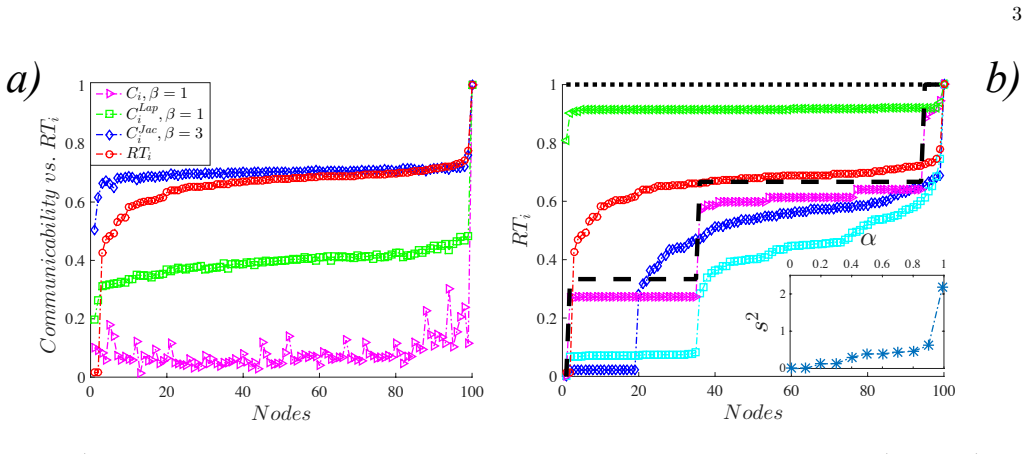
The central object is the reaching time $RT_i$, the threshold-crossing time of an infection seeded at node $i$ and measured at a fixed observation node, compared against communicability centrality $C_{ij} = (e^{\beta A})_{ij}$, where $A$ is the adjacency matrix. The communicability is tied to the dynamics by the fact that the linearized SI model is bounded above by $\dot I \le r A I$, making the matrix exponential a natural linear proxy for the infection process. The tuning parameter $\alpha$ controls the balance between the node-level reaction term and the inter-node diffusion term in the mean-field equations, and the paper uses the sample variance of $RT_i$ over nodes, together with a correlation score between modules, to quantify when nodes or communities become indistinguishable.
What would settle it
Simulate the same SI metapopulation model with $\alpha$ close to zero and attempt to recover known community structure from the complete infected-concentration trajectories of all nodes, rather than from only the threshold-crossing times; if trajectory-based or correlation-based reconstruction reliably distinguishes the modules in the regime where the paper predicts they merge, the stated uncertainty principle fails for that class of observables.
Extended reading notes
Core claim
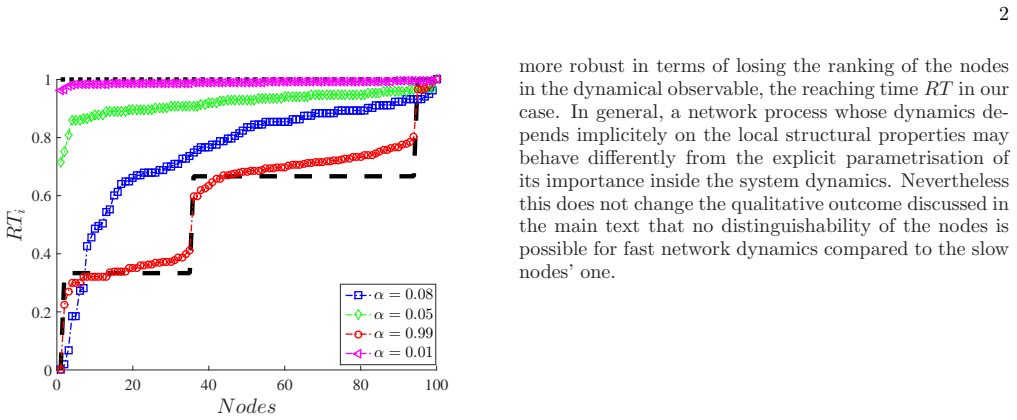
For an SI epidemic spreading in a metapopulation network, the time at which an initially infected node causes a measured node to cross a fixed observation threshold—the reaching time $RT_i$—is taken as the dynamical observable of node relevance. The paper shows that as the parameter $\alpha$ tunes the balance between local node dynamics and inter-node diffusion, the ranking of nodes changes dramatically: for small $\alpha$, diffusion homogenizes the system and the reaching times of all nodes collapse, erasing structural distinctions; for large $\alpha$, the process behaves like a contact process and nodes fall into distance shells, losing local differentiation. The paper also proposes dynamic-aware communicability measures built from the Laplacian or Jacobian matrices, but argues that in strongly nonlinear regimes no linear-operator centrality can fully match the dynamical observable. The conclusion is that network centrality and network inference are not universal: they depend on the ratio of local to global dynamical time scales, and there is a fundamental limit to extracting multi-resolution structural information from a single dynamical observable.
Load-bearing premise
The argument assumes that all structural information available in the dynamics is carried by the spread of one scalar per node—the reaching time—so that when this spread shrinks the nodes are indistinguishable; methods that use the full infection time series or correlations between node trajectories are not ruled out by the paper's reasoning.
Editorial extensions
If this is right
- Centrality rankings obtained from static topology alone are regime-dependent: the same network can rank nodes differently depending on the timescale of the dynamical process being observed.
- When inter-node dynamics are fast relative to node dynamics, all nodes appear to respond nearly simultaneously, so degree-based or communicability-based rankings lose their discriminating power.
- When node dynamics dominate, the system reduces to a contact-process-like picture in which nodes are organized into shortest-distance shells and local node identities are lost.
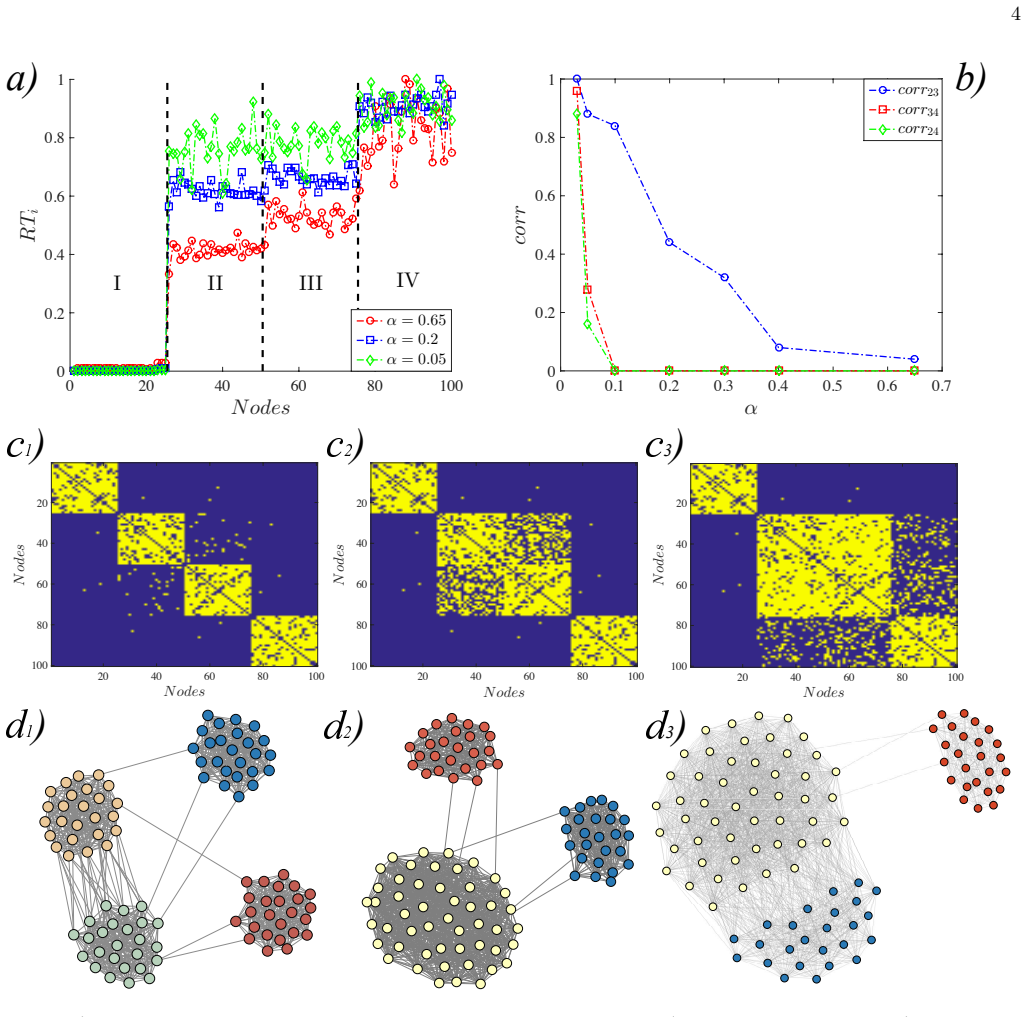
- Community detection from dynamics is fragile in strongly modular networks: with fast global dynamics, distinct modules can produce overlapping reaching-time windows and appear merged.
- Adding dynamical information to the centrality measure, for example by using the Jacobian communicability $C^{\rm Jac}_{ij} = (e^{\beta J})_{ij}$, improves agreement with the observable but does not fully recover the nonlinear dynamical ranking.
Reading between the lines
- The stated uncertainty principle is proven for a particular scalar observable, the reaching time; whether the same trade-off holds for methods that use the full multivariate infection trajectories or pairwise correlations is a testable conjecture rather than a consequence of the paper's argument.
- A direct test would be to attempt community reconstruction from the complete infected-concentration time series in the small-$\alpha$ regime, where the paper predicts modules merge; successfully recovering the modular structure there would narrow the scope of the claimed limit.
- In neuroimaging contexts, fast global hemodynamic averaging could mimic the small-$\alpha$ regime and hide modular connectivity even when it exists structurally, suggesting that the paper's mechanism may be relevant beyond epidemic models.
- The communicability family could be made more dynamics-aware by fitting the scaling parameter $\beta$ to the observed local-to-global timescale ratio rather than fixing it a priori, an adjustment the paper motivates but does not implement.
Signed reviews
Editorial analysis
A structured set of objections, weighed in public.
Referee Report
Summary. The paper studies how the balance between intra-node and inter-node dynamics affects the possibility of inferring network structure from dynamical observations. Using an SI metapopulation model with infection rate r=α and diffusion rate D=1−α, the authors define a reaching time RT_i as the time for a seed infection started at node i to reach a fixed concentration I0 at an observation node. They compare RT_i with communicability-type centralities and show numerically that for α→0 the RT vector becomes flat, while for α→1 it organizes into distance shells. For a modular network, they add white noise and define a module-overlap correlation corr_xy based on RT ranges; as α decreases, module ranges overlap and the inferred community structure degrades. The paper concludes that these observations constitute an 'uncertainty principle' limiting the joint recovery of local and global network properties from dynamics.
Significance. If the central claim were established, it would have broad relevance for network inference in neuroscience and data science, because it would imply fundamental limits on what can be recovered from dynamical measurements. The paper's concrete contribution is the observation that a single scalar observable (threshold-crossing time) becomes uninformative at both extremes of the α parameter, together with a valid inequality in the Supplemental Information showing that the linearized SI dynamics upper-bounds the nonlinear one. The numerical illustrations for scale-free and modular networks are transparent and reproducible from the described setup. However, the 'uncertainty principle' is a strong impossibility statement that is not derived; the paper demonstrates a degradation of one specific observable, not an information-theoretic limit on all observables.
major comments (4)
- [Main text, paragraph after Fig. 1b] The limit arguments for α→0 and α→1 are based on a heuristic factorization of the nonlinear SI operator into independent exponentials, and they are applied to \tilde C_{ij}, a formal object, rather than to the actual reaching time RT_i. The equation \lim_{t→∞} \tilde C_{ij}^{α→0} = (e^{β f(x)})_{ij} mixes an infinite-time limit with a finite-time observable and is not a derivation; consequently the central claim that 'the system may lose track of the structural features' is not established for the dynamics, only for the chosen centrality proxy.
- [Main text, paragraph before Fig. 2] The statement 'if the range of values taken by the reaching time RT_i over all nodes i is small, then in the presence of noise ... it is not possible to distinguish the nodes anymore' is asserted for the scalar RT_i only. The paper does not provide an information-theoretic bound or any argument excluding reconstruction methods that use the full infection trajectories I_i(t) or their correlations; such methods could in principle distinguish nodes even when the threshold-crossing times collapse. This is the load-bearing assumption of the claimed uncertainty principle.
- [Fig. 2, definition of corr_xy] The correlation is defined as the fraction of nodes of module x whose RT value lies between the minimum and maximum RT of module y. This is an overlap statistic of one-dimensional ranges, not a measure of the success of community detection or network reconstruction. The noise amplitude σ of the Langevin equation is not specified anywhere in the figure or text, so the reported merging of modules is not shown to be a property of the deterministic dynamics; it may depend on an arbitrary noise level. The conclusion that 'precise inference of the community structure is impossible' is therefore not supported by the presented evidence.
- [Summary section] The paper extrapolates from the SI spreading model to a general 'uncertainty principle' for network inference. No argument is given that the trade-off observed for RT_i in the SI model applies to other dynamics (e.g., threshold, voter, or linear systems) or to other observables (e.g., full time series, spectra, or covariances). Without such a generalization or an explicit restriction of the claims to the scalar-observable setting, the title and abstract overstate the result.
minor comments (4)
- [p. 2, Introduction] The phrase 'renowed Milgram's experiment' contains a typo: 'renowed' should be 'renowned'.
- [p. 2, definition of RT_i] The sentence 'we take the time needed for the infection to reach such node' is unclear; 'such node' should be 'a pre-selected observation node'.
- [Fig. 2b, Eq. for corr_xy] The formula for corr_xy is incomplete as printed; it lacks a closing bracket and a clear definition of the summation index i.
- [p. 4, Langevin equation] In the equation \dot ξ_i = F(α,A) ξ_i + η_i, the stochastic state vector ξ_i is introduced but its relation to S_i and I_i is not defined; please clarify.
Circularity Check
No significant circularity: the communicability benchmark is external, the upper bound is derived from the model, and the modular reconstruction is explicitly illustrative.
full rationale
The paper's derivation chain is self-contained and does not reduce to its own inputs. The SI model is specified independently; the communicability measure is an external, parameter-free centrality benchmark (Estrada–Hatano) used for comparison, not fitted to the reaching-time data. The upper-bound inequality in the Supplemental Information, dot I(t) ≤ r A I(t), is derived directly from the model equations (via r[1 − I_i] ≤ r) and does not assume the paper's conclusion. The Lee et al. renormalization result cited for the uniqueness of the exponential form is external and is not by the present authors. The collapse of reaching times for α → 0 is explained by the diffusive homogenization of the metapopulation, and the α → 1 limit is similarly derived from the dominance of local infection over diffusion. The 'uncertainty principle' is an interpretive summary of these two limits rather than a fitted or definitional identity. The modular example in Fig. 2 is explicitly described as a visualization ('for visualization purposes'), so the merging of modules is constructed for illustration, not presented as an independently predicted outcome. The paper's main limitation — that the impossibility claim is tied to the scalar threshold-crossing observable RT_i rather than the full infection trajectories — is a scope restriction and a potential correctness risk, but it is not circularity: the observable is not defined in terms of the conclusion, and no parameter is fitted and then renamed as a prediction. Therefore no circular step is present.
Assumptions & free parameters
free parameters (4)
- alpha =
0.05 to 0.99 in figures
- beta =
1 (adjacency and Laplacian), 3 (Jacobian) in Fig. 1a
- I0 =
0.001
- noise amplitude sigma =
not specified
assumptions (5)
- domain assumption SI reaction-diffusion metapopulation model (Eq. 2)
- ad hoc to paper Constraint r = alpha and r + D = 1
- standard math Communicability (e^{beta A}) is a relevant upper bound to SI dynamics
- domain assumption Structural information is equivalent to node ranking by reaching time
- ad hoc to paper The conclusion generalizes from SI dynamics to network inference in general
Cite this review
Pith. "Pith review of Indetermination of networks structure from the dynamics perspective." pith.science (2026). https://pith.science/paper/4WXH3UBZ
@misc{pith2026190806339,
  author       = {Pith},
  title        = {Pith review of: Indetermination of networks structure from the dynamics perspective},
  year         = {2026},
  howpublished = {\url{https://pith.science/paper/4WXH3UBZ}},
  note         = {Machine review of arXiv:1908.06339}
}
read the original abstract
Networks are universally considered as complex structures of interactions of large multi-component systems. In order to determine the role that each node has inside a complex network, several centrality measures have been developed. Such topological features are also important for their role in the dynamical processes occurring in networked systems. In this paper, we argue that the dynamical activity of the nodes may strongly reshape their relevance inside the network making centrality measures in many cases misleading. We show that when the dynamics taking place at the local level of the node is slower than the global one between the nodes, then the system may lose track of the structural features. On the contrary, when that ratio is reversed only global properties such as the shortest distances can be recovered. From the perspective of networks inference, this constitutes an uncertainty principle, in the sense that it limits the extraction of multi-resolution information about the structure, particularly in the presence of noise. For illustration purposes, we show that for networks with different time-scale structures such as strong modularity, the existence of fast global dynamics can imply that precise inference of the community structure is impossible.
Figures
Reference graph
Works this paper leans on
-
[1]
with a noise term, yielding the Langevin dynamics ˙ξi = F(α, A)ξi + η i where now ξi is the stochastic state vector and η i is the noise term with mean ⟨η ⟩ = 0 and variance ⟨η i(t)η j (t′)⟩ = σ δij (t − t′) for each node i. The magnitude of the noise is given by the parameter σ . In Fig. 2 a), we plot the reaching time variable RTi for different values of...
-
[3]
M. E. J. Newman, Networks: An introduction 2ed, Ox- ford University Press (2018)
work page 2018
-
[4]
S. Boccaletti, V. Latora, Y. Moreno, M. Chavez, and D.- U. Hwang, Phys. Rep. 424, 175 (2006)
work page 2006
-
[5]
S. S. Shen-Orr, R. Milo, S. Mangan and U. Alon, Nat. Gen. 31(1), 64, (2002)
work page 2002
-
[6]
D. Garlaschelli, G. Caldarelli and L. Pietronero, Nature 423(6936), 165, (2003)
work page 2003
- [7]
-
[8]
B. R. Da Cunha and S. Gon¸ calves, Appl. Netw. Sci. 3(1), 36,(2018)
work page 2018
-
[9]
J. Van Dijck, The culture of connectivity: A critical his- tory of social media , Oxford University Press (2013)
work page 2013
Show all 30 references
-
[10]
Sporns, Networks of the Brain , MIT Press (2010)
O. Sporns, Networks of the Brain , MIT Press (2010)
2010
-
[11]
Asllani, T
M. Asllani, T. Carletti, F. Di Patti, D. Fanelli, F. Piazza, Phys. Rev. Lett. 120(15) 158301 (2018)
2018
-
[12]
Asllani, R
M. Asllani, R. Lambiotte and T. Carletti, Sci. Adv. 4 eaau9403 (2018)
2018
-
[13]
Y. Y. Liu, A.-L. Barab´ asi Rev. Mod. Phys.88(3), 035006 (2016)
2016
-
[14]
A. J. Gates and L. M. Rocha, Sci. Rep. 6 24456, doi:10.1038/srep24456 (2017)
2017 doi
-
[17]
Gilson, N
M. Gilson, N. E. Kouvaris, G. Deco, and G. Zamora- L´ opez, Phys. Rev. E97, 052301 (2018)
2018
-
[18]
J. M. Kleinberg, J. ACM 46, 604 (1999)
1999
-
[19]
Martin, X
T. Martin, X. Zhang, and M. E. J. Newman, Phys. Rev. E 90, 052808 (2014)
2014
-
[20]
M. A. Porter and J. P. Gleeson Dynamical systems on networks , Frontiers in Applied Dynamical Systems: Re- views and Tutorials 4 (2016)
2016
-
[21]
Murray, Mathematical Biology: I
J. Murray, Mathematical Biology: I. An introduction 3ed, Springer (2002)
2002
-
[22]
Brockmann and D
D. Brockmann and D. Heilbing, Science 342(6164), 1337–1342 (2013)
2013
- [23]
-
[24]
Iturria-Medina, R
Y. Iturria-Medina, R. C. Sotero, P. J. Toussaint, A. C. Evans and the Alzheimer’s Disease Neuroimaging Initia- tive, PLOS Comput. Biol. 10(11) e1003956 (2014)
2014
-
[25]
L. C. Walker and M. Jucker, Annu. Rev. Neurosci. 38 87–103 (2015)
2015
-
[26]
Liggett, Stochastic Interacting Systems: Contact, Voter and Exclusion Processes , Springer (1999)
T. Liggett, Stochastic Interacting Systems: Contact, Voter and Exclusion Processes , Springer (1999)
1999
-
[27]
M. E. J. Newman, PNAS 103(23), 8577 (2006)
2006
-
[28]
R. K. Pan and S. Sinha, EPL 85 68006 (2009). arXiv:1908.06339v1 [physics.soc-ph] 17 Aug 2019 Supplemental Information Indetermination of networks structure from the dynamics pe rspective Malbor Asllani 1, Bruno Requi˜ ao da Cunha 1, 2, Ernesto Estrada 3, 4, James P. Gleeson 1 ...
2009 arXiv
-
[29]
C. H. Lee, S. Tenneti, D. Y. Eun, arXiv:1903.00167 (2018)
2018 arXiv
-
[30]
Estrada and N
E. Estrada and N. Hatano, Phys. Rev. E 77(3), 036111 (2008)
2008
-
[31]
Estrada and N
E. Estrada and N. Hatano, M. Benzi, Phys. Rep. 514(3), 89–119 (2012)
2012
-
[32]
Estrada, The structure of complex networks: theory and applications , Oxford University Press (2012)
E. Estrada, The structure of complex networks: theory and applications , Oxford University Press (2012)
2012
-
[33]
M. E. J. Newman, Networks: An introduction 2ed, Oxford University Press (2018)
2018
Reviewed August 14, 2026 · model on record in the stance chip above.
Discussion (0). Continue with ORCID to comment.