REVIEW 3 major objections 5 minor 33 references
Techno-Economic Analysis and Optimization of a Microgrid Considering Demand-Side Management
T0 review · 3 major / 5 minor · reviewed 2026-08-14 · deepseek-v4-flash
Pith's one-line read Smart HVAC setpoint control cuts a five-node microgrid's total annual cost by 10.67 percent and lowers optimal PV and storage capacity.
desk verdict A plausible two-layer DSM-to-microgrid workflow, but the headline 10.67% saving does not survive the paper's own cost tables; the investment cost is off by an order of magnitude. read the letter →
The pith
A machine-rendered reading of the paper's core claim, the machinery that carries it, and where it could break.
The reading
What carries the argument
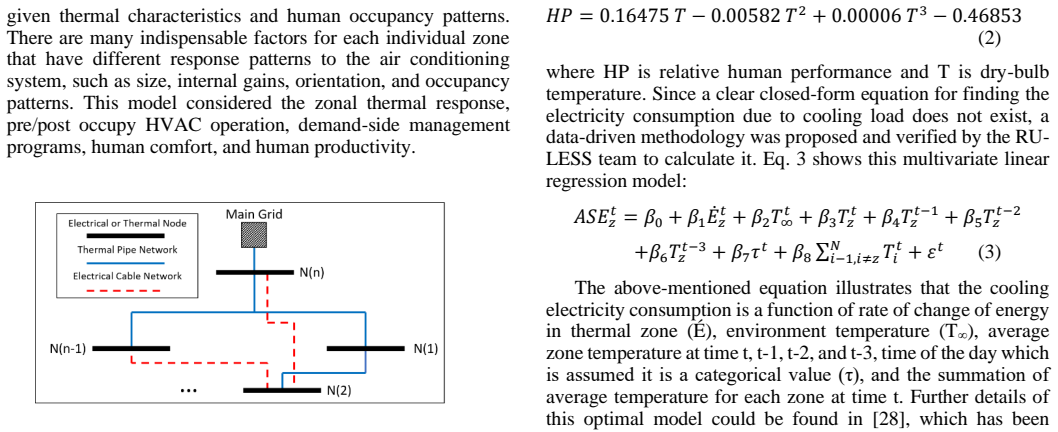
The load-bearing mechanism is the two-layer coupling between a zone-level temperature setpoint controller and a microgrid investment model. Layer 1 chooses each zone's setpoint $T_z(t)$ to minimize weighted cooling electricity cost plus a human-productivity penalty, subject to comfort bounds and temperature ramp limits; cooling electricity consumption is represented by the multivariate linear regression in Eq. (3), which predicts air-conditioning electricity from zone energy rate, ambient temperature, lagged zone temperatures, time-of-day category, and neighboring zone temperatures. Layer 2 feeds the resulting hourly load profile into a mixed-integer linear program that minimizes investment plus operation cost, selecting discrete CHP units and continuous PV and ESS capacities under linearized power flow, voltage, cable current, and thermal balance constraints. The claimed 10.67 percent saving comes from running that same optimization on setback-control versus smart-control load profiles.
What would settle it
Re-run the two-layer optimization using cooling loads for the four buildings obtained from actual meter data or a validated building simulation while holding all other settings fixed; if the smart-control versus setback-control gap in total annual cost is not close to $25,904, or changes sign, the central claim is falsified. A more direct check is to compare the Eq. (3) regression predictions with measured cooling electricity use in the two office buildings and two apartment buildings over a cooling season and see whether the prediction error is smaller than the claimed saving.
Extended reading notes
Core claim
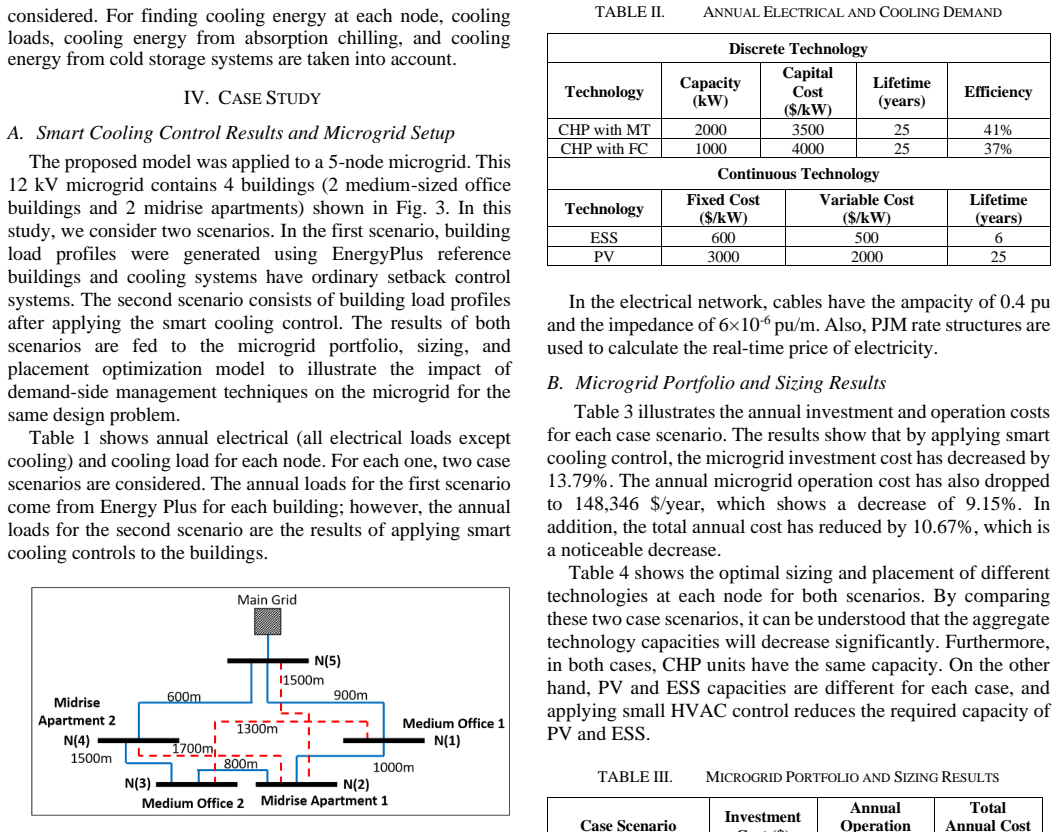
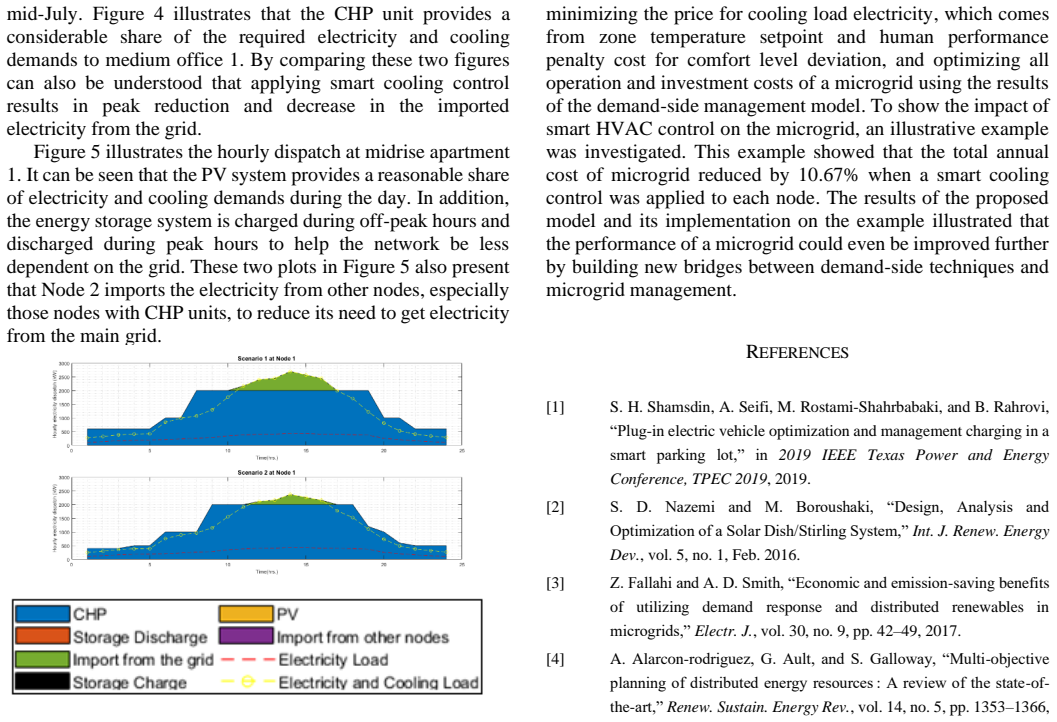
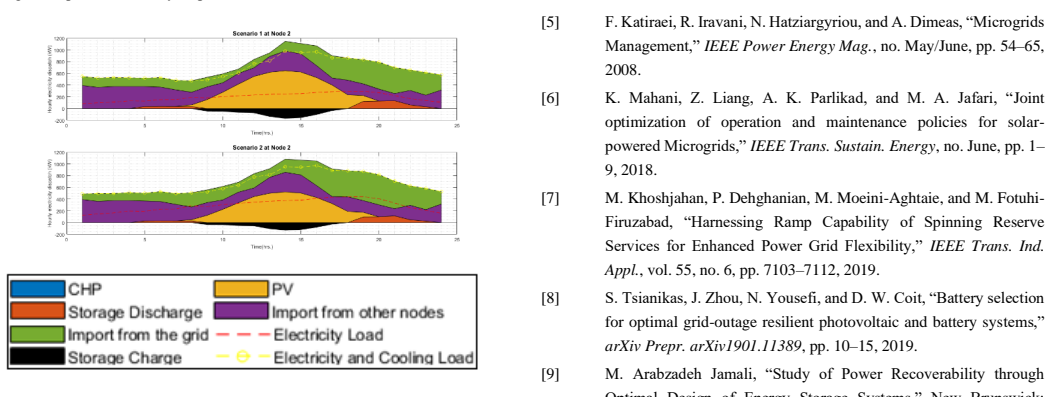
The paper's central claim is that feeding demand-side management results into microgrid portfolio optimization produces a materially cheaper design than optimizing for loads produced by conventional HVAC setback control. In the demonstration on a 12 kV five-node network with two medium office buildings and two midrise apartments, smart cooling control lowers total annual microgrid cost from $242,711 to $216,807, reduces investment cost by 13.79 percent and annual operation cost by 9.15 percent, and shrinks aggregate PV capacity from 1030 kW to 850 kW and ESS capacity from 320 kW to 240 kW while CHP capacity is unchanged. The authors present this as evidence that the optimal microgrid portfolio depends on how buildings are controlled, so DSM should be an input to, not an afterthought of, microgrid sizing and placement.
Load-bearing premise
The case study's smart-control load profiles come from a cooling-electricity formula fitted in earlier work and applied to these four buildings without being re-estimated or checked against measured data; if that formula mispredicts cooling load for these buildings, the 10.67 percent annual cost saving does not follow.
Editorial extensions
If this is right
- If the result holds, the same microgrid constraints are met with 180 kW less PV and 80 kW less storage, so demand-side management acts as a capital-cost-reducing resource rather than only an operating lever.
- Because CHP capacities are identical in both scenarios, the cost saving appears to come from shaving electric cooling loads that would otherwise drive PV and battery investment, not from resizing thermal generation.
- The 10.67 percent total annual cost reduction, $25,904 per year, gives a concrete dollar value for smart HVAC control in a cooling-dominated five-node setting.
- Peak cooling demand falls at every node in the case study, so grid imports and peak-hour network stress drop under smart setpoint control.
Reading between the lines
- The quantitative saving is probably climate- and rate-specific; repeating the two-layer model in a heating-dominated climate or with different demand charges would likely change the size of the saving while preserving its direction for cooling loads.
- A natural testable extension is to run the same optimization on metered load data from real buildings; if the cooling regression is re-estimated on those buildings, the reported cost gap may shrink or grow.
- Because smart control shifts load timing as well as total energy, the same method could be used to evaluate whether DSM can defer feeder or transformer upgrades in addition to reducing PV and battery capacity.
Signed reviews
Editorial analysis
A structured set of objections, weighed in public.
Referee Report
Summary. This paper proposes a two-layer optimization model for microgrid planning with demand-side management. The first layer optimizes building zone temperature setpoints to minimize cooling electricity cost plus an occupant productivity penalty; the second layer solves a mixed-integer linear program for the microgrid's DER portfolio, sizing, placement, and operation, including investment and operation costs. The model is demonstrated on a 5-node, 12 kV microgrid with two medium-office and two mid-rise apartment buildings, comparing conventional setback control (Scenario I) with smart HVAC control (Scenario II). The authors report that smart control reduces the total annual cost from $242,711 to $216,807 (a 10.67% saving) and reduces installed PV and ESS capacities.
Significance. The integration of demand-side management with DER portfolio optimization is a relevant and under-addressed problem, and the paper's two-layer structure is a sensible way to expose the interaction between building-level control and microgrid investment decisions. If the reported 10.67% cost saving were established, it would be a useful demonstration that setpoint control can change optimal microgrid portfolios. The work builds on an existing RU-LESS optimization platform and applies established linearization methods for distribution networks and thermal networks, which are appropriate tools for this type of planning study. However, the manuscript as submitted does not provide enough information to verify either the demand-side model or the cost accounting, so the quantitative claims cannot currently be accepted as evidence.
major comments (3)
- [III-B, Eq. (4), Tables 2-4] The investment-cost entries in Table 3 cannot be reproduced from the capacities in Table 4 and the unit costs in Table 2. For Scenario I, the CHP-MT (2,000 kW x $3,500/kW = $7.0M) and CHP-FC (1,000 kW x $4,000/kW = $4.0M) alone exceed the reported investment cost by two orders of magnitude. Even if the total capital is amortized over 25 years at 0% interest, the annualized investment is approximately $571,000, or about $660,000 if the continuous-technology costs are also treated as one-time capital, not the reported $79,420. Eq. (4) adds C_invd and C_invc to annual operating sums, but no capital-recovery factor, interest rate, or planning horizon M is specified. If C_invd and C_invc are one-time costs, then the "Total Annual Cost" in Table 3 is dimensionally invalid; if they are annualized, the missing financial parameters prevent verification. The headline 10.67% saving and the 13.79% investment-cost reduction are therefore unsupported by the stated data. The authors should provide the complete cost-accounting model and recalculate the results.
- [III-A, Eq. (3)] The cooling-electricity regression ASE_z^t = beta_0 + ... + epsilon is taken from reference [28] and applied to the four case-study buildings without re-estimation or validation. The paper reports no R-squared, no residual analysis, no out-of-sample test, and no sensitivity of the final 10.67% saving to the regression coefficients. Because the "smart" load profiles in Table 1, Scenario II are generated entirely by this model, any error in Eq. (3) propagates directly into the microgrid sizing and cost comparison. The authors should either re-estimate the regression on the actual case-study buildings, provide validation statistics, and report a sensitivity analysis around the regression coefficients, or clearly state the external validity limitations and qualify the quantitative conclusions accordingly.
- [III-A, Eq. (1)] The parameters of the DSM objective are not specified: the weights w_z,1 and w_z,2 in Eq. (1) and the occupant profit constant EP are never assigned numerical values, and the constraints of the first-layer optimization (comfort temperature bounds, setpoint ramp limits, and the optimization horizon) are not stated. Consequently, the optimal setpoint trajectories and the resulting load profiles are not reproducible from the manuscript. The authors should report these parameter values and the full constraint set for the DSM layer.
minor comments (5)
- [Table 2] The caption of Table 2, "ANNUAL ELECTRICAL AND COOLING DEMAND," is identical to Table 1's caption and does not describe the table's content; it should read something like "Technology cost and efficiency parameters."
- [Eqs. (1) and (3)] The summation and indexing notation in Eqs. (1) and (3) is garbled (e.g., "6 t-1 N z-1"); the sums over time and zones should be written with clear indices such as t=1..T and z=1..N.
- [Table 4] The header "ALL NUMBERS ARE IN KW" should be "All numbers are in kW." Also, "Displacement" in the table title and in the Section III-B heading should be "Placement."
- [Table 2] For the continuous technologies, the meaning of "Fixed Cost ($/kW)" and "Variable Cost ($/kW)" is unclear; the authors should state whether these are capital costs, annual fixed O&M costs, or energy-related costs, and specify their units.
- [Table 1] The Node 1 annual cooling usage of 12,958 MWh_th is more than eight times the Node 2 value of 1,497 MWh_th and appears implausible for a medium office building; the authors should check the value and the units.
Circularity Check
No circularity: the microgrid cost comparison is computed independently from load-profile inputs, and the self-cited DSM regression is not fitted to the microgrid objective.
full rationale
The paper's central claim is that smart HVAC setpoint control reduces the total annual microgrid cost by 10.67% relative to conventional setback control. The derivation chain is sequential: the DSM layer (Eqs. 1-3) produces cooling-load profiles for the smart-control scenario, and those profiles are fed as fixed inputs to the microgrid portfolio optimization (Eq. 4), which minimizes investment and operation costs. The 10.67% figure is the difference between two independently computed total annual cost values from that optimization. There is no equation in which the microgrid cost objective is used to define or fit the DSM load profiles, and no fitted parameter of the microgrid model is renamed as a prediction. The cooling-load regression in Eq. 3 is taken from prior RU-LESS work [28] by overlapping authors, and the paper does not revalidate it on the case-study buildings; this is a legitimate concern about external validity and reproducibility, but it is not circularity, because the regression coefficients were not estimated from the microgrid total cost or from the reported 10.67% saving. The apparent inconsistency between the investment costs in Table 3 and the capacities/costs in Tables 2 and 4 is a serious internal-consistency or accounting error, but it is not a circularity issue: it does not show that any output was assumed as an input. Overall, the central microgrid optimization has independent content and the claimed saving is not equivalent to the paper's inputs by construction.
Assumptions & free parameters
free parameters (3)
- w_z,1 and w_z,2 (objective weights in Eq. 1) =
not specified
- beta_0..beta_8 regression coefficients in Eq. 3 =
not reported here; fitted in ref [28]
- EP (occupant profit constant in Eq. 1) =
not specified
assumptions (4)
- domain assumption The multivariate linear regression model for cooling electricity (Eq. 3) accurately predicts ASE for the case-study buildings.
- domain assumption The linearized power flow and network constraints of Bolognani-Zampieri [30] and Mashayekh et al. [31] are accurate for the 5-node 12 kV network.
- domain assumption The sequential two-layer decomposition, where DSM load profiles are fixed before microgrid optimization, does not materially degrade the solution.
- domain assumption The human performance curve HP(T) from Seppanen et al. [29] applies to the occupants in these buildings.
Cite this review
Pith. "Pith review of Techno-Economic Analysis and Optimization of a Microgrid Considering Demand-Side Management." pith.science (2026). https://pith.science/paper/K5KKAGAI
@misc{pith2026190806352,
  author       = {Pith},
  title        = {Pith review of: Techno-Economic Analysis and Optimization of a Microgrid Considering Demand-Side Management},
  year         = {2026},
  howpublished = {\url{https://pith.science/paper/K5KKAGAI}},
  note         = {Machine review of arXiv:1908.06352}
}
read the original abstract
The control and managing of power demand and supply become very crucial because of penetration of renewables in the electricity networks and energy demand increase in residential and commercial sectors. In this paper, a new approach is presented to bridge the gap between Demand-Side Management (DSM) and microgrid portfolio, sizing and placement optimization. Although DSM helps energy consumers to take advantage of recent developments in utilization of Distributed Energy Resources (DERs) especially microgrids, a huge need of connecting DSM results to microgrid optimization is being felt. Consequently, a novel model that integrates the DSM techniques and microgrid modules in a two-layer configuration is proposed. In the first layer, DSM is employed to minimize the electricity demand (e.g. heating and cooling loads) based on zone temperature set-point. Using the optimal load profile obtained from the first layer, all investment and operation costs of a microgrid are then optimized in the second layer. The presented model is based on the existing optimization platform developed by RU-LESS (Rutgers University, Laboratory for Energy Smart Systems) team. As a demonstration, the developed model has been used to study the impact of smart HVAC control on microgrid compared to traditional HVAC control. The results show a noticeable reduction in total annual energy consumption and annual cost of microgrid.
Figures

Figures from the paper (2 more)
Reference graph
Works this paper leans on
-
[28]
A. Ghofrani and M. A. Jafari, “Distributed air conditioning control in commercial buildings based on a physical -statistical approach,” Energy Build., vol. 148, pp. 106–118, 2017
work page 2017
-
[1]
Plug-in electric vehicle optimization and management charging in a smart parking lot,
S. H. Shamsdin, A. Seifi, M. Rostami-Shahrbabaki, and B. Rahrovi, “Plug-in electric vehicle optimization and management charging in a smart parking lot,” in 2019 IEEE Texas Power and Energy Conference, TPEC 2019, 2019
work page 2019
-
[2]
Design, Analysis and Optimization of a Solar Dish/Stirling System,
S. D. Nazemi and M. Boroushaki, “Design, Analysis and Optimization of a Solar Dish/Stirling System,” Int. J. Renew. Energy Dev., vol. 5, no. 1, Feb. 2016
work page 2016
-
[3]
Z. Fallahi and A. D. Smith, “Economic and emission-saving benefits of utilizing demand response and distributed renewables in microgrids,” Electr. J., vol. 30, no. 9, pp. 42–49, 2017
work page 2017
-
[4]
Multi -objective planning of distributed energy resources : A review of the state -of- the-art,
A. Alarcon -rodriguez, G. Ault, and S. Galloway, “Multi -objective planning of distributed energy resources : A review of the state -of- the-art,” Renew. Sustain. Energy Rev., vol. 14, no. 5, pp. 1353–1366, 2010
work page 2010
-
[5]
F. Katiraei, R. Iravani, N. Hatziargyriou, and A. Dimeas, “Microgrids Management,” IEEE Power Energy Mag., no. May/June, pp. 54–65, 2008
work page 2008
-
[6]
Joint optimization of operation and maintenance policies for solar - powered Microgrids,
K. Mahani, Z. Liang, A. K. Parlikad, and M. A. Jafari, “ Joint optimization of operation and maintenance policies for solar - powered Microgrids,” IEEE Trans. Sustain. Energy, no. June, pp. 1– 9, 2018
work page 2018
-
[7]
Harnessing Ramp Capability of Spinn ing Reserve Services for Enhanced Power Grid Flexibility,
M. Khoshjahan, P. Dehghanian, M. Moeini-Aghtaie, and M. Fotuhi- Firuzabad, “Harnessing Ramp Capability of Spinn ing Reserve Services for Enhanced Power Grid Flexibility,” IEEE Trans. Ind. Appl., vol. 55, no. 6, pp. 7103–7112, 2019
work page 2019
Show all 33 references
-
[8]
Battery selection for optimal grid -outage resilient photovoltaic and battery sys tems,
S. Tsianikas, J. Zhou, N. Yousefi, and D. W. Coit, “Battery selection for optimal grid -outage resilient photovoltaic and battery sys tems,” arXiv Prepr. arXiv1901.11389, pp. 10–15, 2019
2019 arXiv
-
[9]
Study of Power Recoverability through Optimal Design of Energy Storage Systems,
M. Arabzadeh Jamali, “Study of Power Recoverability through Optimal Design of Energy Storage Systems,” New Brunswick: Rutgers University - Graduate School, 2019
2019
-
[10]
Evaluation of the behind -the-meter benefits of energy storage systems with consideration of ancillary market opportunities,
K. Mahani, S. D. Nazemi, M. Ara bzadeh Jamali, and M. A. Jafari, “Evaluation of the behind -the-meter benefits of energy storage systems with consideration of ancillary market opportunities,” Electr. J., vol. 33, no. 2, p. 106707, 2020
2020
-
[11]
The Concept of Demand -Side Man agement for Electric Utilities,
C. W. Gellings, “The Concept of Demand -Side Man agement for Electric Utilities,” Proc. IEEE, vol. 73, no. 10, pp. 1468–1470, 1985
1985
-
[12]
Interactive Buildings: A Review,
Z. Fallahi and G. P. Henze, “Interactive Buildings: A Review,” Sustainability, vol. 11, no. 14, p. 3988, 2019
2019
-
[13]
Stackelberg game approach on modeling of supply demand behavior considering BEV uncertainty,
B. Azimian, R. F. Fijani, E. Ghotbi, and X. Wang, “Stackelberg game approach on modeling of supply demand behavior considering BEV uncertainty,” 2018 IEEE Int. Conf. Probabilistic Methods Appl. to Power Syst. 2018 Jun 24 (pp. 1-6)., 2018
2018
-
[14]
A Portfolio Approach of Demand Side Management,
Z. Wu and X. Xia, “A Portfolio Approach of Demand Side Management,” IFAC - Pap. Line, vol. 50, no. 1, pp. 171–176, 2017
2017
-
[15]
Scheduling of Demand Side Resources Using Binary Particle Swarm Optimization,
M. A. A. Pedrasa, T. D. Spooner, and I. F. Macgill, “Scheduling of Demand Side Resources Using Binary Particle Swarm Optimization,” IEEE Trans. Power Syst. , vol. 24, no. 3, pp. 1173 – 1181, 2009
2009
-
[16]
HVAC load synchronization in smart building communities,
A. Ghofrani, S. D. Nazemi, and M. A. Jafari, “HVAC load synchronization in smart building communities,” Sustain. Cities Soc., vol. 51, no. November, 2019
2019
-
[17]
Autonomous Demand-Side Management Based on Game-Theoretic Energy Consumption Scheduling for the Future Smart Grid,
A.-H. Mohsenian-Rad, V. W. S. Wong, J. Jatskevich, R. Schober, and A. Leon-Garcia, “Autonomous Demand-Side Management Based on Game-Theoretic Energy Consumption Scheduling for the Future Smart Grid,” IEEE Trans. Smart Grid , vol. 1, no. 3, pp. 320 –331, 2010
2010
-
[18]
Prediction of building indoor temperat ure response in variable air volume systems,
A. Ghofrani, S. D. Nazemi, and M. A. Jafari, “Prediction of building indoor temperat ure response in variable air volume systems,” J. Build. Perform. Simul., vol. 13, no. 1, pp. 34–47, 2019
2019
-
[19]
Energy Demand Side Management with supply constraints: Game theoretic Approach,
S. Noor, M. Guo, K. H. van Dam, N. Shah, and X. Wang, “Energy Demand Side Management with supply constraints: Game theoretic Approach,” Energy Procedia, vol. 145, pp. 368–373, 2018
2018
-
[20]
GTES : An Optimized Game-Theoretic Demand-Side Management Scheme for Smart Grid,
Z. Fadlullah, D. M. Quan, N. Kato, and I. Stojmenovic, “GTES : An Optimized Game-Theoretic Demand-Side Management Scheme for Smart Grid,” IEEE Syst. J., vol. 8, no. 2, pp. 588–597, 2014
2014
-
[21]
Optimal design of distributed energy resource systems coupled with energy distribution networks,
Y. Yang, S. Zhang, and Y. Xiao, “Optimal design of distributed energy resource systems coupled with energy distribution networks,” Energy, vol. 85, pp. 433–448, 2015
2015
-
[22]
Optimal energy planning and scheduling of microgrids,
N. E. Koltsaklis, M. Giannakakis, and M. C. Georgiadis, “Optimal energy planning and scheduling of microgrids,” Chem. Eng. Res. Des., vol. 1, no. 2013, pp. 318–332, 2017
2013
-
[23]
Optimal Day -ahead Scheduling of Distributed Generations and Controllable Appliances in Microgrid,
H. Firoozi and H. Khajeh, “Optimal Day -ahead Scheduling of Distributed Generations and Controllable Appliances in Microgrid,” in 2016 Smart Grid Conference (SGC), 2016, pp. 59–64
2016
-
[24]
Smart distribution grid: Optimal day -ahead scheduling with reconfigurable topology,
S. Golshannavaz, S. Afsharnia, and F. Aminifar, “Smart distribution grid: Optimal day -ahead scheduling with reconfigurable topology,” IEEE Trans. Smart Grid, vol. 5, no. 5, pp. 2402–2411, 2014
2014
-
[25]
Optimization framework for distributed energy systems with integrated electrical grid constraints,
B. Morvaj, R. Evins, and J. Carmeliet, “Optimization framework for distributed energy systems with integrated electrical grid constraints,” Appl. Energy, vol. 171, pp. 296–313, 2016
2016
-
[26]
Analysis of Various Transformer Structures for High Frequency Isolation Applications,
M. S. Sanjarinia, S. Saadatmand, P. Shamsi, and M. Ferdowsi, “Analysis of Various Transformer Structures for High Frequency Isolation Applications,” in 2019 North American Power Symposium (NAPS), 2019
2019
-
[27]
A new method for estimation of losses in inverter-fed induction machines including electrical insulation losses,
J. Faiz and A. Ghasemi, “A new method for estimation of losses in inverter-fed induction machines including electrical insulation losses,” in 2016 IEEE International Power Electronics and Motion Control Conference (PEMC), 2016, pp. 6–10
2016
-
[29]
Effect of Temperature on Task Performance in Offfice Environment,
O. Seppänen, W. J. Fisk, and Q. H. Lei, “Effect of Temperature on Task Performance in Offfice Environment,” Lawrence Berkeley Natl. Lab., 2006
2006
-
[30]
On the existence and linear approximation of the power flow solution in power distribution networks,
S. Bolognani and S. Zampieri, “On the existence and linear approximation of the power flow solution in power distribution networks,” IEEE Trans. Power Syst. , vol. 31, no. 1, pp. 163 –172, 2016
2016
-
[31]
A mixed integer linear programming approach for optimal DER portfolio , sizing , and placement in multi -energy microgrids,
S. Mashayekh, M. Stadler, G. Cardoso, and M. Heleno, “A mixed integer linear programming approach for optimal DER portfolio , sizing , and placement in multi -energy microgrids,” Appl. Energy, vol. 187, pp. 154–168, 2017
2017
-
[32]
A mixed - integer LP model for the reconfiguration of radial electric distribution systems considering distributed generation,
J. F. Franco, M. J. Rider, M. Lavorato, and R. Romero, “A mixed - integer LP model for the reconfiguration of radial electric distribution systems considering distributed generation,” Electr. Power Syst. Res., vol. 97, pp. 51–60, 2013
2013
-
[33]
Structural and operational optimisation of distributed energy systems,
J. Söderman and F. Pettersson, “Structural and operational optimisation of distributed energy systems,” Appl. Therm. Eng., vol. 26, no. 13, pp. 1400–1408, 2006
2006
Reviewed August 14, 2026 · model on record in the stance chip above.
Discussion (0). Continue with ORCID to comment.