REVIEW 3 major objections 3 minor 43 references
Drug Release Management for Dynamic TDMA-Based Molecular Communication
T0 review · 3 major / 3 minor · reviewed 2026-08-14 · deepseek-v4-flash
Pith's one-line read The paper claims that the bit error rate of each transmitter in a TDMA molecular-communication drug-delivery system can be expressed through Gaussian interference statistics, and that jointly optimizing slot lengths and released molecule…
desk verdict Useful TDMA drug-release framework, but the interference statistics have load-bearing errors that invalidate the BER and optimization results. read the letter →
The pith
A machine-rendered reading of the paper's core claim, the machinery that carries it, and where it could break.
The reading
What carries the argument
The central object is the arrival-probability function $P_h(X_s,t_s)$, the probability that a molecule released by transmitter $s$ is received by time $t_s$, obtained by integrating a 3D Gaussian drift-diffusion density over the receiver volume. The argument is carried by separating the total received count into a wanted Gaussian signal plus an interference Gaussian built from the difference probabilities $Y_{j,s}^u$ and $H_{j,s}$, and then writing the ML BER as an error-function expression in the conditional mean and variance pairs. The same expressions are reused as objectives in four optimization variants, solved by scalarizing weighted sums and alternating between time-slot and molecule-count blocks.
What would settle it
Run a particle-based Brownian simulation of the same three-transmitter geometry with a passive receiver that samples the molecule count inside its volume at the end of each slot, and compare the empirical mean, variance, and BER to Eqs. (13)-(16) and (21). If the simulated interference follows an occupancy-probability model rather than the arrival-difference model, or if the BER ordering of the four strategies changes, the central claim is rejected.
Extended reading notes
Core claim
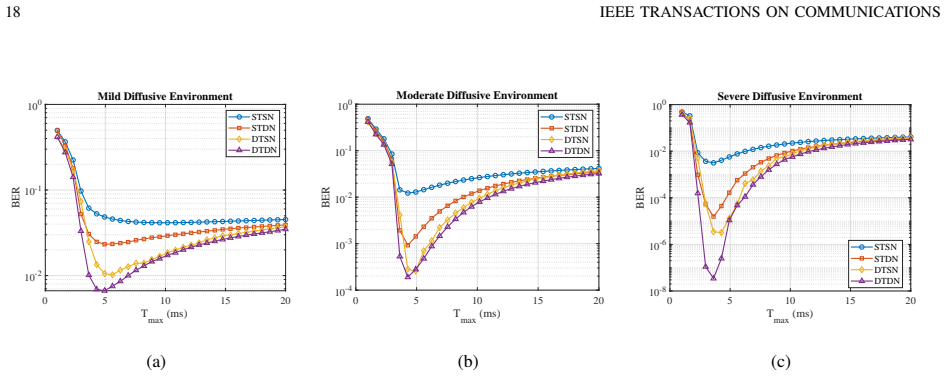
The load-bearing discovery is the interference-aware statistics of the TDMA slot. Received molecules from the intended transmitter are modeled as a Gaussian count $M_s[n]\sim\mathcal{N}(x_s[n]A_s P_h(X_s,t_s), x_s[n]A_sP_h(X_s,t_s)(1-P_h(X_s,t_s)))$, while interference from previous frames and other transmitters is accumulated as sums of Gaussian terms whose means and variances depend on two probability differences: $Y_{j,s}^u=P_h(\lambda_{j,s}^u)-P_h(\lambda_{j,s}^u-t_s)$ for past-frame leakage and $H_{j,s}=P_h(\sum_{q=j}^s t_q)-P_h(\sum_{q=j}^{s-1} t_q)$ for same-frame leakage. The ML threshold decision then yields a per-transmitter BER $P_s^e[n]$ expressed through error functions of the two conditional means and variances, Eqs. (11)-(21). These expressions are the objective functions of weighted-sum multi-objective problems over symbol durations and molecule budgets. The paper reports that jointly optimizing both quantities (DTDN) reaches BER $3.45\times10^{-8}$ in a severe diffusive environment, compared with about $10^{-2}$ for uniform allocation.
Load-bearing premise
The load-bearing premise is that interference from an earlier release can be treated as molecules that arrive at the receiver during the current slot with probability equal to a difference of two arrival probabilities; for the passive receiver the paper describes, which counts molecules inside its volume at the sampling instant, the correct weighting would instead be the probability that the molecule is still inside the receiver volume at that instant.
Editorial extensions
If this is right
- Jointly optimizing slot duration and molecule count (DTDN) gives BER as low as $3.45\times10^{-8}$ in severe diffusion, while static-uniform scheduling (STSN) stalls near $10^{-2}$, so the gap is orders of magnitude.
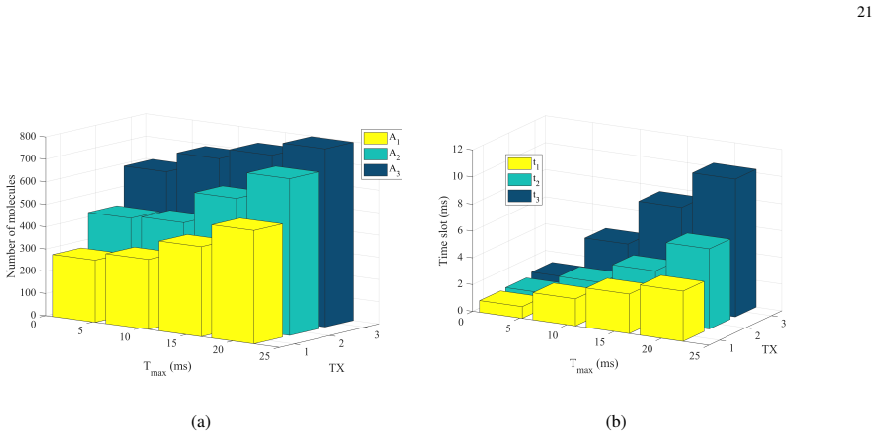
- For small frame budgets, allocating molecule counts matters more than shaping slots; for larger frames, shaping slots matters more, with a crossover that depends on diffusion severity (around 3.29 ms in MDE and 2.97 ms in SDE).
- Only about three previous frames contribute meaningful interference; beyond that the BER is flat, so truncating the interference sum at $U=3$ is safe.
- The stated complexity ranking (STSN lowest, DTDN highest) means that in moderate and severe diffusion with larger frames, DTSN offers most of DTDN's BER at lower complexity.
- When the optimized molecule count is rounded from a real to an integer, the BER penalty is small for typical budgets and shrinks as the lower bound grows.
Reading between the lines
- If the receiver is modeled as occupancy-counting rather than arrival-counting, as the paper's passive-receiver description implies, the interference probabilities would change from interval arrival differences to occupancy probabilities; re-running the same optimizations under that model is a direct test of the reported BER gains.
- The crossover between dose optimization and slot optimization is tied to the drift and diffusion parameters; under different vessel flow or molecule sizes the crossover frame lengths would shift, so a deployed system should recompute the operating regime rather than reuse the reported thresholds.
- The same weighted-sum machinery could be applied to transmitter-specific weights, unequal molecule types, or absorption-based receivers; any of these variations changes the interference structure and likely alters which of the four strategies is preferred.
- A particle-based Brownian simulation of the same geometry would settle whether the Gaussian-sum interference approximation holds at the small molecule budgets near the lower bound of 100 molecules, where the normal approximation is least reliable.
Signed reviews
Editorial analysis
A structured set of objections, weighed in public.
Referee Report
Summary. The manuscript studies a TDMA-based molecular communication via diffusion system with multiple transmitter nanomachines and one passive receiver, modeling the receiver count as Gaussian and deriving mean, variance, and BER expressions that include inter-user and inter-symbol interference. On this basis it defines four resource-allocation cases (STSN, STDN, DTSN, DTDN) and formulates multi-objective optimization problems solved by weighted-sum scalarization and alternating search with CVX. Numerical evaluations across three diffusion environments report that the dynamic-time dynamic-number (DTDN) approach achieves BER near 3.45e-8 in the severe diffusive environment, while the static approach remains near 1e-2.
Significance. The problem is practically motivated, and the four-case framework is clearly organized; if the analytical channel statistics were correct, the paper would provide a useful quantitative design tool for drug-release management in a TDMA molecular communication system with drift. The paper also contains useful sensitivity checks, such as the IUI-length saturation in Fig. 5 and the real-versus-integer molecule count comparison in Fig. 6(b). However, the central quantitative claims depend entirely on the correctness of the interference statistics and the convexity arguments, and the errors identified below mean that the numerical results in Section VI do not follow from the stated model as written.
major comments (3)
- [§II-B and Appendix A, Eqs. (7), (42)-(45)] The variance of the interference mixture is computed incorrectly. For a zero/one Bernoulli mixture of Binomial(A_j, Y), the unconditional variance is 0.5 A_j Y(1-Y) + 0.25 A_j^2 Y^2. Eq. (44) and hence Eq. (15) give the A_j^2 Y^2 coefficient as 1.25 instead of 0.25, and Eq. (42) contains a sign error in the conditional second moment. Because sigma_{0s}^2 and sigma_{1s}^2 enter the BER expression in Eq. (21) and every objective function in Section III, the numerical results reported in Section VI are not supported by the stated statistics.
- [§II-B, Eq. (7)] The interference model is inconsistent with the passive receiver described in Section II. The receiver counts molecules inside its volume at the sampling instant, so the probability that a molecule released from TX-j lambda seconds before the sampling instant is counted is the occupancy probability Ph(X_j, lambda), not the interval arrival difference Y = Ph(X_j, lambda) - Ph(X_s, lambda - t_s). The subtracted form would correspond to counting arrivals during the current slot under an absorbing receiver, which is not the stated model. Moreover, Ph is an occupancy CDF and is not guaranteed to be monotone, so the difference can be negative and is not a valid binomial probability. Because every BER and optimization result is built on these IUI statistics, this inconsistency invalidates the quantitative claims of the paper.
- [Appendices B and C; §IV-A/B/C] The convexity arguments supporting the CVX-based solutions are not established. Appendix C's Eq. (54) gives only part of the second derivative of P_e^s with respect to A_s; it omits the second derivatives of the mean and variance terms that arise from the full chain rule, and the sign conclusion depends on an assertion about the ordering mu_{0s} < tau_s < mu_{1s} rather than a proof. Appendix B similarly asserts positivity of the second derivative 'after some manipulations' and contains a derivative g(t_s) in Eq. (50) that is not a correct derivative of Eq. (4). Since claimed convexity is the justification for solving (29), (31), and (33) with CVX, the optimality of the reported solutions is unsupported.
minor comments (3)
- [Eq. (19)] Eq. (19) uses mu_{0s} and sigma_{0s}^2 in the expression for Pr(x_s[n]=0 | x_s[n]=1); this should be mu_{1s} and sigma_{1s}^2 to be consistent with Eq. (21).
- [Notation, Section II] The definition of erf in the Notation paragraph is nonstandard: the standard error function is 2/sqrt(pi) times the integral from 0 to y of exp(-x^2) dx, not 1/sqrt(2 pi) times the integral.
- [Eq. (50)] The expression for g(t_s) contains duplicated denominator terms and appears dimensionally inconsistent; if it is intended to support the convexity proof, it should be corrected.
Circularity Check
No circularity: the BER and optimization results follow from the paper's own stated channel model, and the self-citations are not load-bearing.
full rationale
The derivation chain starts from an externally cited 3D diffusive-drift channel model (Eqs. (3)-(4), reference [14]), forms the binomial/Normal signal model (Eqs. (5)-(6)), postulates an IUI statistics model (Eq. (7)), and then derives means, variances, and BER by algebra (Eqs. (9)-(21)). None of these steps fits a parameter to the numerical conclusions: A_s and t_s are optimization variables, not fitted constants, and the reported BER values are evaluations of the derived expressions at the optimizer. The paper's self-citations ([18], [40], [42]) are not load-bearing: Eq. (21) follows directly from the Gaussian tail expressions written in the paper, and the coordinate shift Ph(u,Omega,D-X_s,t_s) is translation invariance of the external channel model, not an unexamined premise imported from the authors' prior work. The questionable Eq. (7) model of IUI as a difference of occupancy probabilities is a physical-consistency/correctness issue (a passive receiver counts occupancy, not interval arrivals), not a circularity: it is an assumption stated in the derivation, not an output that has been put back into the inputs. No claim in the paper reduces, by the paper's own equations or by self-citation, to its own inputs.
Assumptions & free parameters
free parameters (4)
- IUI length U =
3
- Symbol duration lower bound psi_t =
1 microsecond
- Molecule count bounds psi_A and Psi_A =
100 and 800
- WSM weights =
1/r each
assumptions (8)
- domain assumption Molecule propagation follows the 3D diffusion-drift Green's function in Eq (3) in an unbounded medium
- domain assumption Received molecule counts are independent Binomial random variables, Eq (5)
- domain assumption Binomial distributions are approximated as Normal when A_s is large and A_s P_h is not zero, Eq (6)
- domain assumption The receiver is passive and counts molecules inside its volume at the end of each time slot
- ad hoc to paper The BER objective functions in (29) and (31) are convex on t_s and A_s
- standard math Multi-objective minimization via WSM with equal weights yields a useful Pareto-optimal solution
- domain assumption Interference memory is limited to U=3 frames
- standard math Maximum-likelihood threshold detection with a per-transmitter threshold tau_s is employed
Cite this review
Pith. "Pith review of Drug Release Management for Dynamic TDMA-Based Molecular Communication." pith.science (2026). https://pith.science/paper/RYZCYWAV
@misc{pith2026190806388,
  author       = {Pith},
  title        = {Pith review of: Drug Release Management for Dynamic TDMA-Based Molecular Communication},
  year         = {2026},
  howpublished = {\url{https://pith.science/paper/RYZCYWAV}},
  note         = {Machine review of arXiv:1908.06388}
}
abstract
In this paper, we design a drug release mechanism for dynamic time division multiple access (TDMA)-based molecular communication via diffusion (MCvD). In the proposed scheme, the communication frame is divided into several time slots over each of which a transmitter nanomachine is scheduled to convey its information by releasing the molecules into the medium. To optimize the number of released molecules and the time duration of each time slot (symbol duration), we formulate a multi-objective optimization problem whose objective functions are the bit error rate (BER) of each transmitter nanomachine. Based on the number of released molecules and symbol durations, we consider four cases, namely: "static-time static-number of molecules" (STSN), "static-time dynamic-number of molecules" (STDN), "dynamic-time static-number of molecules" (DTSN), and "dynamic-time dynamic-number of molecules" (DTDN). We consider three types of medium in which the molecules are propagated, namely: "mild diffusive environment" (MDE), "moderate diffusive environment" (MODE), and "severe diffusive environment" (SDE). For the channel model, we consider a 3-dimensional (3D) diffusive environment, such as blood, with drift in three directions. Simulation results show that the STSN approach is the least complex one with BER around $\text{10}^{\text{-2}}$, but, the DTDN is the most complex scenario with the BER around $\text{10}^{\text{-8}}$.
Figures


Figures from the paper (3 more)


Reference graph
Works this paper leans on
-
[27]
Receiver design for molecular communication,
D. Kilinc and O. B. Akan, “Receiver design for molecular communication,” IEEE Journal on Selected Areas in Communications, vol. 31, no. 12, pp. 705–714, 2013
work page 2013
-
[1]
Molecular communication and networking: Opportunitie s and challenges,
T. Nakano, M. J. Moore, F. Wei, A. V . V asilakos, and J. Shua i, “Molecular communication and networking: Opportunitie s and challenges,” IEEE transactions on nanobioscience , vol. 11, no. 2, pp. 135–148, 2012
work page 2012
-
[2]
Principles and methods for nano mechatronics: Signaling, structure, and functions toward nanorobots,
J.-Q. Liu and T. Nakano, “Principles and methods for nano mechatronics: Signaling, structure, and functions toward nanorobots,” IEEE Transactions on Systems, Man, and Cybernetics, Part C ( Applications and Reviews) , vol. 42, no. 3, pp. 357–366, 2012
work page 2012
-
[3]
Nano-enabled synthetic biology,
M. J. Doktycz and M. L. Simpson, “Nano-enabled synthetic biology,” Molecular systems biology , vol. 3, no. 1, p. 125, 2007
work page 2007
-
[4]
A design of a molecular communication system for nanomachines using molecular motors,
M. Moore, A. Enomoto, T. Nakano, R. Egashira, T. Suda, A. K ayasuga, H. Kojima, H. Sakakibara, and K. Oiwa, “A design of a molecular communication system for nanomachines using molecular motors,” in F ourth Annual IEEE International Conference on Pervasive Computing and Communications W ork shops (PERCOMW’06) , pp. 6–pp, IEEE, 2006
work page 2006
-
[5]
Mul tiobjective tdma optimization for neuron-based molecular communication,
J. Suzuki, S. Balasubramaniam, and A. Prina-Mello, “Mul tiobjective tdma optimization for neuron-based molecular communication,” in Proceedings of the 7th International Conference on Body Are a Networks , pp. 40–47, ICST (Institute for Computer Sciences, Social-Informatics and , 2012. DRAFT September 2, 2019 29
work page 2012
-
[6]
Nanoscale molecular com munication networks: a game-theoretic perspective,
C. Jiang, Y . Chen, and K. R. Liu, “Nanoscale molecular com munication networks: a game-theoretic perspective,” EURASIP Journal on Advances in Signal Processing , vol. 2015, no. 1, p. 5, 2015
work page 2015
-
[7]
Single and multiple-access cha nnel capacity in molecular nanonetworks,
B. Atakan and O. B. Akan, “Single and multiple-access cha nnel capacity in molecular nanonetworks,” in International Conference on Nano-Networks , pp. 14–23, Springer, 2009
work page 2009
Show all 43 references
-
[8]
Transport, collective motion, and brownian mo tion,
H. Mori, “Transport, collective motion, and brownian mo tion,” Progress of theoretical physics , vol. 33, no. 3, pp. 423–455, 1965
1965
-
[9]
Nanosys tems and devices for advanced targeted nanomedical applications,
U. Chude-Okonkwo, R. Malekian, and B. Maharaj, “Nanosys tems and devices for advanced targeted nanomedical applications,” in Advanced Targeted Nanomedicine , pp. 39–58, Springer, 2019
2019
-
[10]
Active versu s passive: Receiver model transforms for diffusive molecul ar communication,
A. Noel, Y . Deng, D. Makrakis, and A. Hafid, “Active versu s passive: Receiver model transforms for diffusive molecul ar communication,” in 2016 IEEE Global Communications Conference (GLOBECOM) , pp. 1–6, IEEE, 2016
2016
-
[11]
Improving receiv er performance of diffusive molecular communication with enzymes,
A. Noel, K. C. Cheung, and R. Schober, “Improving receiv er performance of diffusive molecular communication with enzymes,” IEEE Transactions on NanoBioscience , vol. 13, no. 1, pp. 31–43, 2014
2014
-
[12]
A molecul ar communications model for drug delivery,
M. Femminella, G. Reali, and A. V . V asilakos, “A molecul ar communications model for drug delivery,” IEEE transactions on nanobioscience , vol. 14, no. 8, pp. 935–945, 2015
2015
-
[13]
E. J. Finnemore, J. B. Franzini, et al. , Fluid mechanics with engineering applications , vol. 10. McGraw-Hill New Y ork, 2002
2002
-
[14]
3-D diffusive-drift molecu lar channel characterization for active and passive receiv ers,
Ankit and M. R. Bhatnagar, “3-D diffusive-drift molecu lar channel characterization for active and passive receiv ers,” IEEE Transactions on Molecular , Biological and Multi-Scale Com munications, 2019
2019
-
[15]
H. J. V . Tyrrell and K. Harris, Diffusion in liquids: a theoretical and experimental study . Butterworth-Heinemann, 2013
2013
-
[16]
Constant-pressure equations of motion,
W. G. Hoover, “Constant-pressure equations of motion, ” Physical Review A , vol. 34, no. 3, p. 2499, 1986
1986
-
[17]
Heat units and temperature scales for calo rimetry,
H. Stimson, “Heat units and temperature scales for calo rimetry,” American Journal of Physics , vol. 23, no. 9, pp. 614–622, 1955
1955
-
[18]
Non-uniform BCSK modulation in nutrient-limited relay-assisted molecular communicatio n system: Optimization and performance evaluation,
H. K. Rudsari, M. Orooji, M. R. Javan, N. Mokari, and E. A. Jorswieck, “Non-uniform BCSK modulation in nutrient-limited relay-assisted molecular communicatio n system: Optimization and performance evaluation,” arXiv preprint arXiv:1903.04749, 2019
1903 arXiv
-
[19]
Diffusion-based physical channel identification in molecular nanonetworks,
N. Garralda, I. Llatser, A. Cabellos-Aparicio, E. Alar c´ on, and M. Pierobon, “Diffusion-based physical channel identification in molecular nanonetworks,” Nano Communication Networks , vol. 2, no. 4, pp. 196–204, 2011
2011
-
[20]
Performance anal ysis of amplitude modulation schemes for diffusion-based molecular communication,
A. Singhal, R. K. Mallik, and B. Lall, “Performance anal ysis of amplitude modulation schemes for diffusion-based molecular communication,” IEEE Transactions on Wireless Communications , vol. 14, no. 10, pp. 5681–5691, 2015
2015
-
[21]
Symbol interval optimization for molecular communication with drift,
N. R. Kim, A. W. Eckford, and C. B. Chae, “Symbol interval optimization for molecular communication with drift,” IEEE transactions on nanobioscience , vol. 13, no. 3, pp. 223–229, 2014
2014
-
[22]
Interference effects on modulation techniques in diffusio n based nanonetworks,
M. S ¸ . Kuran, H. B. Yilmaz, T. Tugcu, and I. F. Akyildiz, “ Interference effects on modulation techniques in diffusio n based nanonetworks,” Nano Communication Networks , vol. 3, no. 1, pp. 65–73, 2012
2012
-
[23]
Papoulis and S
A. Papoulis and S. U. Pillai, Probability, random variables, and stochastic processes . Tata McGraw-Hill Education, 2002
2002
-
[24]
A rrival modeling and error analysis for molecular communica tion via diffusion with drift,
H. B. Yilmaz, C. B. Chae, B. Tepekule, and A. E. Pusane, “A rrival modeling and error analysis for molecular communica tion via diffusion with drift,” in Proceedings of the Second Annual International Conference on Nanoscale Computing and Communication, p. 26, ACM, 2015
2015
-
[25]
Novel modulation techniques us ing isomers as messenger molecules for nano communication networks via diffusion,
N. R. Kim and C. B. Chae, “Novel modulation techniques us ing isomers as messenger molecules for nano communication networks via diffusion,” IEEE Journal on Selected Areas in Communications , vol. 31, no. 12, pp. 847–856, 2013
2013
-
[26]
Isi mitigation techniques in molecular communicat ion,
B. Tepekule, A. E. Pusane, H. B. Yilmaz, C. B. Chae, and T. Tugcu, “Isi mitigation techniques in molecular communicat ion,” IEEE Transactions on Molecular , Biological and Multi-Scal e Communications , vol. 1, no. 2, pp. 202–216, 2015. September 2, 2019 DRAFT 30 IEEE TRANSACTI...
2015
-
[28]
A unifying model f or external noise sources and isi in diffusive molecular communication,
A. Noel, K. C. Cheung, and R. Schober, “A unifying model f or external noise sources and isi in diffusive molecular communication,” IEEE Journal on Selected Areas in Communications , vol. 32, no. 12, pp. 2330–2343, 2014
2014
-
[29]
A molecular communication system model for particulate dru g delivery systems,
Y . Chahibi, M. Pierobon, S. O. Song, and I. F. Akyildiz, “ A molecular communication system model for particulate dru g delivery systems,” IEEE Transactions on biomedical engineering , vol. 60, no. 12, pp. 3468–3483, 2013
2013
-
[30]
The nor malized normal constraint method for generating the pareto frontier,
A. Messac, A. Ismail-Yahaya, and C. A. Mattson, “The nor malized normal constraint method for generating the pareto frontier,” Structural and multidisciplinary optimization , vol. 25, no. 2, pp. 86–98, 2003
2003
-
[31]
Ehrgott, Multicriteria optimization , vol
M. Ehrgott, Multicriteria optimization , vol. 491. Springer Science & Business Media, 2005
2005
-
[32]
Multi-objecti ve genetic algorithm and its applications to flowshop schedu ling,
T. Murata, H. Ishibuchi, and H. Tanaka, “Multi-objecti ve genetic algorithm and its applications to flowshop schedu ling,” Computers & Industrial Engineering , vol. 30, no. 4, pp. 957–968, 1996
1996
-
[33]
Linear models in decision m aking.,
R. M. Dawes and B. Corrigan, “Linear models in decision m aking.,” Psychological bulletin, vol. 81, no. 2, p. 95, 1974
1974
-
[34]
A simple multiattribute u tility procedure for evaluation,
H. J. Einhorn and W. McCoach, “A simple multiattribute u tility procedure for evaluation,” Behavioral Science , vol. 22, no. 4, pp. 270–282, 1977
1977
-
[35]
The weighted sum method for multi-objective optimization: new insights,
R. T. Marler and J. S. Arora, “The weighted sum method for multi-objective optimization: new insights,” Structural and multidisciplinary optimization , vol. 41, no. 6, pp. 853–862, 2010
2010
-
[36]
Adaptive weighted sum method fo r multiobjective optimization: a new method for pareto front generation,
I. Y . Kim and O. De Weck, “Adaptive weighted sum method fo r multiobjective optimization: a new method for pareto front generation,” Structural and multidisciplinary optimization , vol. 31, no. 2, pp. 105–116, 2006
2006
-
[37]
A groupwise associatio n test for rare mutations using a weighted sum statistic,
B. E. Madsen and S. R. Browning, “A groupwise associatio n test for rare mutations using a weighted sum statistic,” PLoS genetics, vol. 5, no. 2, p. e1000384, 2009
2009
-
[38]
Multiob jective decision analysis with engineering and business applications,
A. Goicoechea, D. R. Hansen, and L. Duckstein, “Multiob jective decision analysis with engineering and business applications,” tech. rep., John Wiley & Sons, 1982
1982
-
[39]
Optimality and non-scalar-valued performa nce criteria,
L. Zadeh, “Optimality and non-scalar-valued performa nce criteria,” IEEE transactions on Automatic Control , vol. 8, no. 1, pp. 59–60, 1963
1963
-
[40]
Joint access and fronthaul radio resource allocation in pd-noma-based 5g networks enabling dual connectivity and c omp,
M. Moltafet, R. Joda, N. Mokari, M. R. Sabagh, and M. Zorz i, “Joint access and fronthaul radio resource allocation in pd-noma-based 5g networks enabling dual connectivity and c omp,” IEEE Transactions on Communications , vol. 66, no. 12, pp. 6463–6477, 2018
2018
-
[41]
CVX: Matlab software for di sciplined convex programming (2008),
M. Grant, S. Boyd, and Y . Ye, “CVX: Matlab software for di sciplined convex programming (2008),” W eb page and software available at http://stanford. edu/ boyd/cvx , 2015
2008
-
[42]
Li mited-feedback resource allocation in heterogeneous cell ular networks,
N. Mokari, F. Alavi, S. Parsaeefard, and T. Le-Ngoc, “Li mited-feedback resource allocation in heterogeneous cell ular networks,” IEEE Transactions on V ehicular Technology, vol. 65, no. 4, pp. 2509–2521, 2016
2016
-
[43]
E. L. Cussler, Diffusion: mass transfer in fluid systems . Cambridge university press, 2009. DRAFT September 2, 2019
2009
Reviewed August 14, 2026 · model on record in the stance chip above.
Discussion (0). Continue with ORCID to comment.