REVIEW 5 major objections 6 minor 49 references
StreamNet: A DAG System with Streaming Graph Computing
T0 review · 5 major / 6 minor · reviewed 2026-08-14 · deepseek-v4-flash
Pith's one-line read StreamNet claims that a growing proof-of-work DAG can maintain a total order of blocks without a central authority, using two-tip attachment and streaming graph updates.
desk verdict A novel DAG consensus combination with a real implementation, but the central algorithm as written does not terminate and the correctness proof is an unproven inheritance; not ready for serious review. read the letter →
The pith
A machine-rendered reading of the paper's core claim, the machinery that carries it, and where it could break.
The reading
What carries the argument
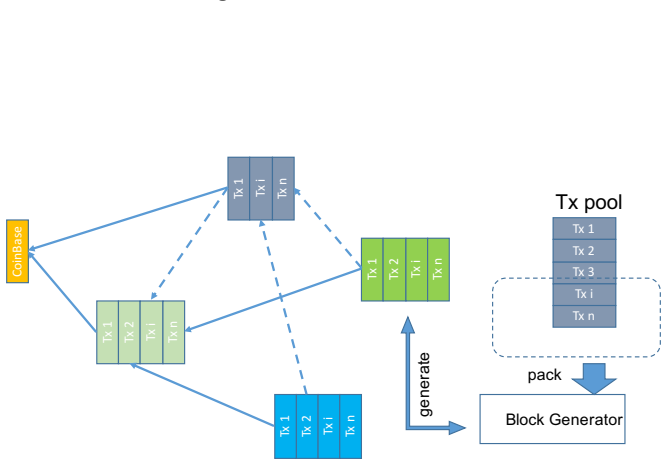
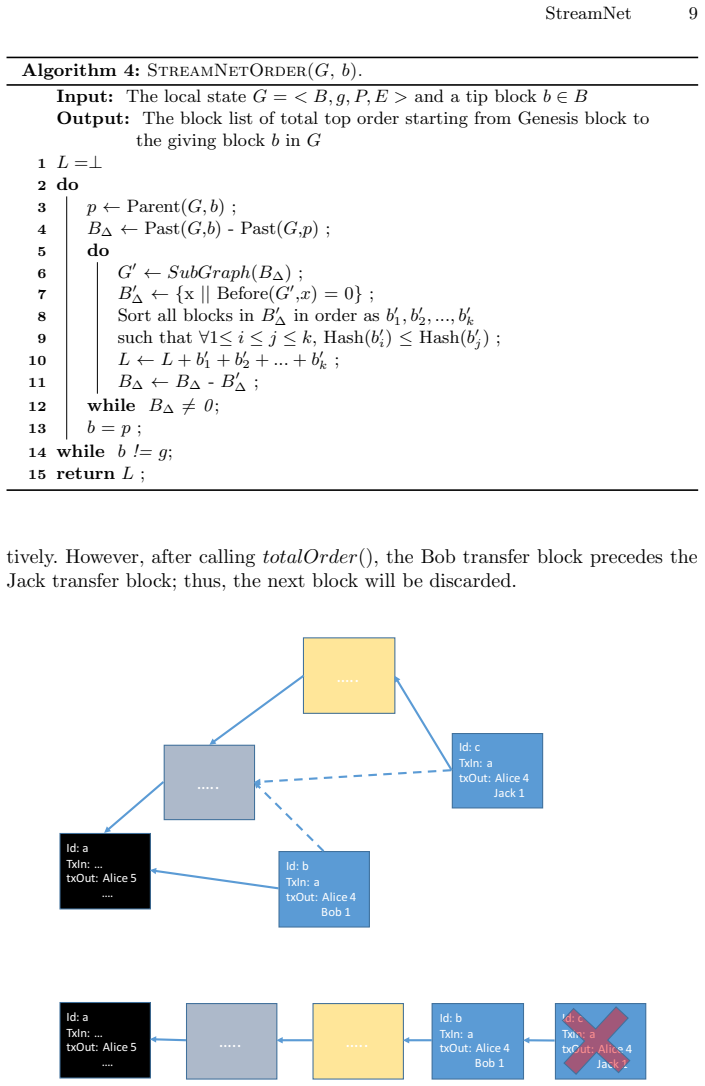
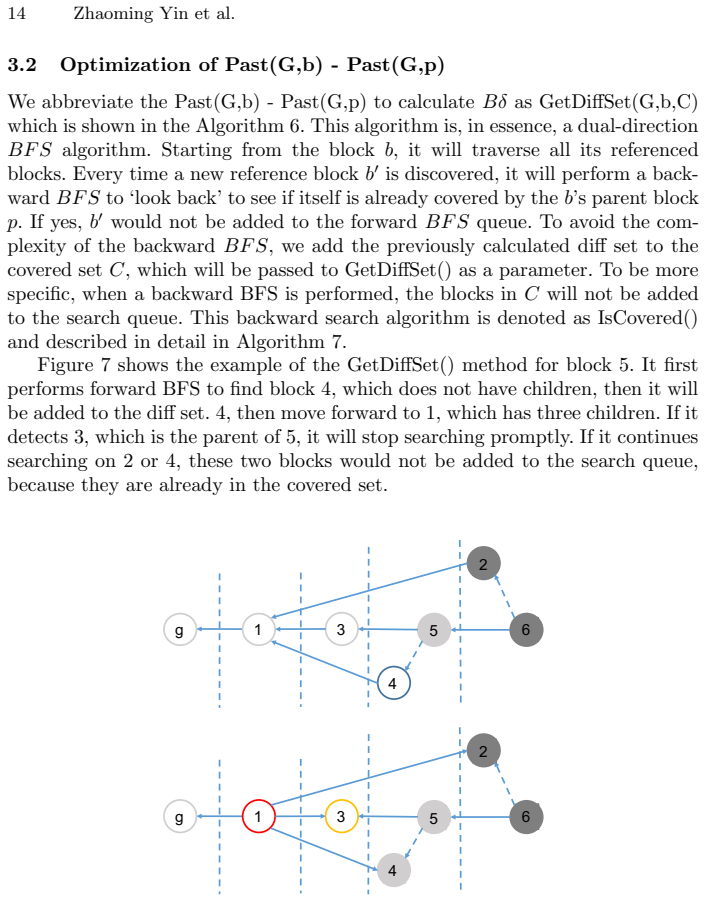
The key machinery is the two-tip attachment rule together with the epoch decomposition of the pivot chain. A new block's parent edge follows the pivot chain, and its reference edge follows an MCMC random walk; the pivot chain partitions the DAG into epochs $Past(G,b)-Past(G,P(b))$, and the ordering algorithm emits earlier epochs first, then topologically sorts the current epoch with hash tie-breaking. The streaming optimizations maintain the required graph properties incrementally: BFS score updates on new blocks, a dual-direction BFS with a covered set for epoch differences, an $O(1)$ topological-position update via $\min(\mathrm{TopScore}(parent),\mathrm{TopScore}(reference))+1$, and a genesis-forwarding threshold that snapshots old history.
What would settle it
Build a small StreamNet testbed, let one miner add blocks whose MCMC reference edges always point into the losing sibling's subtree, and watch whether the pivot chain reorgs more often than the bound in equation (1) predicts; a decay failure or a post-snapshot reorg would refute the inherited-safety claim.
Extended reading notes
Core claim
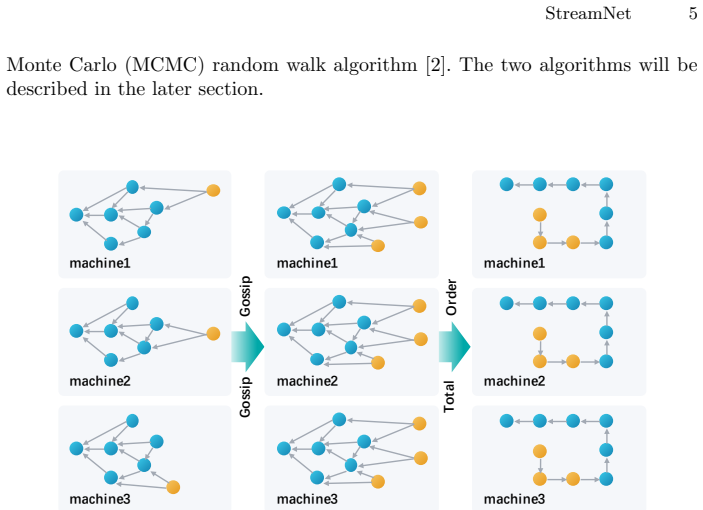
StreamNet's central claim is that the total order of a growing DAG can be computed without a centralized authority, and maintained efficiently, by combining deterministic pivot-chain attachment with randomized reference attachment. Every new block gets one parent edge selected by following the pivot chain (the child with the largest subtree score, hashes breaking ties) and one reference edge selected by an MCMC random walk. The pivot chain divides the graph into epochs; recursively ordering past epochs and topologically sorting each epoch's new blocks yields a total order, with block hashes as tie-breakers. Streaming variants of the score, parent-score, epoch-difference, and topological-order computations turn the per-block cost of updating these structures from repeated full-graph traversals into incremental updates. A genesis-forwarding rule periodically freezes old, deeply confirmed history into a persisted snapshot order, and a hash-first gossip protocol separates block announcements from block bodies so that nodes request content on demand.
Load-bearing premise
The paper assumes the GHOST-style pivot-chain safety proof still holds after adding a second, MCMC-chosen reference edge to every block, because that extra edge changes the subtree structure the proof counts.
Editorial extensions
If this is right
- If the central claim is right, a StreamNet node can keep validating new blocks at a stable rate as the DAG grows, because the expensive graph properties are updated incrementally rather than recomputed from scratch.
- The absence of a coordinator means every node can derive the same total order from its local DAG view, with hash tie-breaking resolving orderings deterministically.
- The hash-first gossip protocol should let block updates spread at per-node cost roughly independent of block size, since only hashes are broadcast and bodies are pulled on demand.
- A periodic genesis forward turns old, approved history into a fixed chain, so applications see a stable prefix of the total order while the new DAG keeps growing.
Reading between the lines
- A testable extension would compare confirmation latency and reorg rates under an adversary that withholds reference edges: the MCMC reference edge changes the subtree shape on which the inherited GHOST-style confirmation bound is proven.
- The choice of the MCMC scaling constant $\alpha$ is likely to control how evenly reference edges spread across tips; in practice, calibrating it to network delay may matter as much as block generation rate, though the paper does not measure that trade-off.
- The genesis-forwarding snapshot introduces a checkpoint; a formal argument that a persisted snapshot cannot later be contradicted would be needed, since the paper's correctness discussion does not cover the interaction between forwarding and reorgs.
Signed reviews
Editorial analysis
A structured set of objections, weighed in public.
Referee Report
Summary. The paper proposes StreamNet, a permissionless DAG-based blockchain protocol. Each new block attaches to two earlier blocks: a deterministic 'parent' chosen by a GHOST-style pivot chain and a random 'reference' chosen by an MCMC walk. The authors define a total order over the DAG using pivot-chain epochs, introduce streaming algorithms to maintain graph properties dynamically, propose a genesis-forwarding mechanism, and design a 'direct signal' gossip protocol. They report an implementation based on IOTA's IRI and experiments on AWS clusters of 3 to 7 nodes with several topologies. The central claims are that StreamNet achieves a decentralized total order, scales to a growing DAG via streaming graph computing, and scales out through its gossip protocol.
Significance. The paper's streaming-maintenance idea and the two-tip attachment rule (one deterministic, one random) are potentially interesting engineering directions, and the authors deserve credit for providing an implementation and releasing the code. However, as written, the core protocol is not well-defined: the MCMC routine in Algorithm 2 cannot terminate as specified, the topological-order update in Eq. (2) is incorrect, and the correctness argument in Section 2.7 is an unsupported assertion that simply transfers Conflux's proof to a different attachment rule. Because these issues affect the central construction, the significance of the paper is currently limited; the experimental evaluation also does not establish the claimed scalability.
major comments (5)
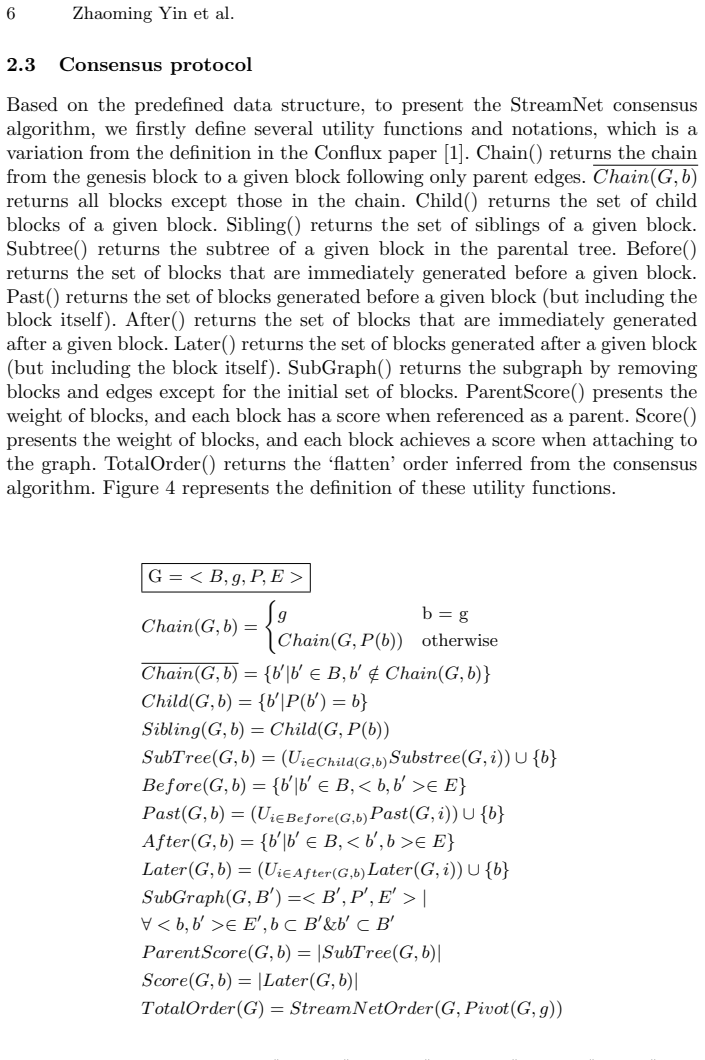
- [Algorithm 2 (Section 2.2/2.3)] Algorithm 2 cannot terminate or return a tip. Score(G,t)=|Later(G,t)| is at least 1 for every block, including tips, because Later includes the block itself (Figure 4), so the loop condition `while Score(G,t) != 0` is never false. In addition, the transition step iterates over Child(G,t)={b'|P(b')=t}, i.e., only parent edges; a vertex whose only children are reference-edge children is not a tip by the definition in Section 2.1 but can be reached and returned by this walk. Since every block generation invokes MCMC for the second edge (Algorithm 1, line 9), the two-tip DAG construction is not specified by the stated protocol.
- [Section 3.3, Eq. (2)] The O(1) TopOrder update in Eq. (2) is incorrect for topological ordering. A valid topological label must be larger than the label of every immediate predecessor, so with two predecessors the correct recurrence is max(TopScore(Parent(b)), TopScore(Reference(b)))+1. The min+1 rule can assign a block a score lower than one of its own ancestors, violating the order relations that StreamNetOrder relies on. Consequently, the TopOrder row of Table 2 does not follow from the presented algorithm.
- [Section 2.7] The correctness argument is an unsupported assertion. The paper states that StreamNet 'shares the same safety and correctness property as Conflux' solely because both use the GHOST pivot rule, but Conflux's proof is tied to its attachment rule (approving all current tips) and to a total order over all blocks. StreamNet's two-tip rule changes the graph and the Past-based epoch structure. In particular, StreamNetOrder (Algorithm 4) returns only blocks in Past(G,Pivot(G,g)); nothing in the protocol guarantees that a block never chosen as the MCMC reference of a pivot-chain block is in that past, so the existence of a total order over the whole DAG is not established. A concrete example of a side block with no path to the pivot tip is not addressed.
- [Section 3.4, Eq. (3)] The genesis forwarding condition in Eq. (3) is not well-formed. For any b on the pivot chain, taking b'=b yields ParentScore(b)>ParentScore(b)+h, which is false for h>0; the intended quantification over 'side chains' is not expressed. Moreover, h is said to be n-m, but n and m are not defined in this section. These problems make Algorithm 8's trigger condition ambiguous and the claim of 'forwarding the genesis' unsupported.
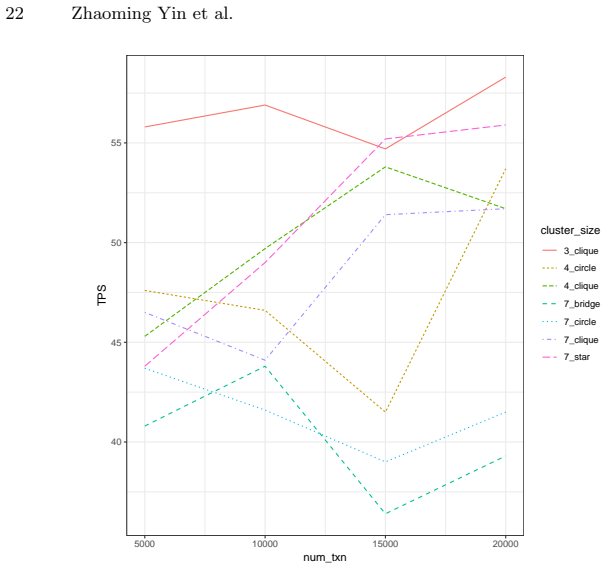
- [Section 4.3] The experiments do not substantiate the scalability claim in the abstract. Figures 11 and 12 show absolute TPS values in narrow ranges (about 21-24 and 40-55) with no error bars, no comparison to the non-streaming IRI baseline, and no comparison to other DAG systems; the clusters have at most 7 nodes, and increasing the transaction count from 5k to 20k is not a test of DAG growth over time. The conclusion that 'our method is proven to be able to tolerate the increasing complexity' is therefore not supported by the reported data.
minor comments (6)
- [Algorithm 2, line 4] The denominator Σ_{z:z→b} is undefined; the summation variable and the direction of the arrow should be specified (presumably over children of t).
- [Section 3.3] The text says the update rule is 'as (1) shows', but the displayed equation is numbered (2).
- [Figure 4] The definition of Chain appears twice on the same line; the second definition seems to be the complement of the chain, but the notation is not clear and should be clarified.
- [Table 2] The TopOrder complexity is recorded as O(|1|); this should be O(1).
- [Algorithm 8] The persistence step computes O−O' where O and O' are total orders; set difference of ordered lists is undefined, and the intended operation should be stated precisely.
- [Eq. (1)] The formula for ζ_k contains a negative mean (-qλh t) and appears to be a garbled version of the Conflux bound; it should be corrected and properly referenced.
Circularity Check
No significant circularity; StreamNet's safety claim imports external Conflux/GHOST theorems and no fitted quantity is renamed as a prediction.
full rationale
StreamNet's derivation chain is not circular. The central total-order construction (Algorithm 4, StreamNetOrder) is defined directly from the pivot chain and epoch sets; the pivot chain is chosen by the GHOST-like ParentScore rule, and the confirmation bound in Section 2.7 is imported from Conflux [1] and Theorem 10 of [30]. These are external results, not self-citations by the StreamNet authors, and the paper does not re-derive them from its own fitted constants. The MCMC parameter α and the genesis-forward threshold h are free design parameters with stated roles; they are not fit to the experimental TPS data and then reported as predictions. The only self-reference is the implementation link [46], which is a code pointer and not load-bearing for any correctness claim. One internal defect exists: Algorithm 2's stopping test 'while Score(G,t) != 0' can never become false because Score(G,b) = |Later(G,b)| and Later(G,b) always includes b, and the walk only traverses parent edges; but that is an algorithmic non-termination/type error, not a circular equivalence between an output and an input. Therefore no step in the paper reduces by construction to its own inputs.
Assumptions & free parameters
free parameters (2)
- alpha (MCMC randomness scale)
- h (genesis forwarding threshold) =
5 (example value in Figure 8)
assumptions (3)
- domain assumption StreamNet inherits the safety and liveness of Conflux/GHOST because it uses the same pivot chain selection rule.
- domain assumption MCMC tip selection with parameter alpha produces an unbiased random tip.
- domain assumption Standard PoW honest-majority assumption.
Cite this review
Pith. "Pith review of StreamNet: A DAG System with Streaming Graph Computing." pith.science (2026). https://pith.science/paper/JBQAOZG7
@misc{pith2026190806405,
  author       = {Pith},
  title        = {Pith review of: StreamNet: A DAG System with Streaming Graph Computing},
  year         = {2026},
  howpublished = {\url{https://pith.science/paper/JBQAOZG7}},
  note         = {Machine review of arXiv:1908.06405}
}
read the original abstract
To achieve high throughput in the POW based blockchain systems, researchers proposed a series of methods, and DAG is one of the most active and promising fields. We designed and implemented the StreamNet, aiming to engineer a scalable and endurable DAG system. When attaching a new block in the DAG, only two tips are selected. One is the parent tip whose definition is the same as in Conflux[1]; another is using Markov Chain Monte Carlo (MCMC) technique by which the definition is the same as IOTA [2]. We infer a pivotal chain along the path of each epoch in the graph, and a total order of the graph could be calculated without a centralized authority. To scale up, we leveraged the graph streaming property; high transaction validation speed will be achieved even if the DAG is growing. To scale out, we designed the direct signal gossip protocol to help disseminate block updates in the network, such that messages can be passed in the network more efficiently. We implemented our system based on IOTA's reference code (IRI) and ran comprehensive experiments over the different sizes of clusters of multiple network topologies.
Figures

Figures from the paper (9 more)



Reference graph
Works this paper leans on
-
[1]
Scal- ing nakamoto consensus to thousands of transactions per second
Chenxing Li, Peilun Li, Wei Xu, Fan Long, and Andrew Chi-chih Yao. Scal- ing nakamoto consensus to thousands of transactions per second. arXiv preprint arXiv:1805.03870, 2018
arXiv 2018
- [2]
-
[3]
Bitcoin: A peer-to-peer electronic cash system
Satoshi Nakamoto. Bitcoin: A peer-to-peer electronic cash system. 2008
2008
-
[4]
JW MICHAEL, ALAN COHN, and JARED R BUTCHER. Blockchain technology. The Journal , 2018
work page 2018
-
[5]
How blockchain is changing finance
Alex Tapscott and Don Tapscott. How blockchain is changing finance. Harvard Business Review, 1, 2017
work page 2017
-
[6]
Digital supply chain transforma- tion toward blockchain integration
Kari Korpela, Jukka Hallikas, and Tomi Dahlberg. Digital supply chain transforma- tion toward blockchain integration. In proceedings of the 50th Hawaii international conference on system sciences , 2017
work page 2017
-
[7]
An agri-food supply chain traceability system for china based on rfid & blockchain technology
Feng Tian. An agri-food supply chain traceability system for china based on rfid & blockchain technology. In Service Systems and Service Management (ICSSSM), 2016 13th International Conference on , pages 1–6. IEEE, 2016. 22 Zhaoming Yin et al. 40 45 50 55 5000 10000 15000 20000 num_txn TPS cluster_size 3_clique 4_circle 4_clique 7_bridge 7_circle 7_clique ...
work page 2016
-
[8]
Blockchain ready manufacturing supply chain using distributed ledger
Saveen A Abeyratne and Radmehr P Monfared. Blockchain ready manufacturing supply chain using distributed ledger. 2016
2016
Show all 49 references
-
[9]
Medrec: Using blockchain for medical data access and permission management
Asaph Azaria, Ariel Ekblaw, Thiago Vieira, and Andrew Lippman. Medrec: Using blockchain for medical data access and permission management. In Open and Big Data (OBD), International Conference on , pages 25–30. IEEE, 2016
2016
-
[10]
Healthcare data gateways: found healthcare intelligence on blockchain with novel privacy risk control
Xiao Yue, Huiju Wang, Dawei Jin, Mingqiang Li, and Wei Jiang. Healthcare data gateways: found healthcare intelligence on blockchain with novel privacy risk control. Journal of medical systems , 40(10):218, 2016
2016
-
[11]
Blockchains and smart con- tracts for the internet of things
Konstantinos Christidis and Michael Devetsikiotis. Blockchains and smart con- tracts for the internet of things. Ieee Access, 4:2292–2303, 2016
2016
-
[12]
Segregated witness, 2015
Eric Lombrozo, Johnson Lau, and P WUILLE. Segregated witness, 2015
2015
-
[13]
The bitcoin lightning network: Scalable off- chain instant payments, 2016
Joseph Poon and Thaddeus Dryja. The bitcoin lightning network: Scalable off- chain instant payments, 2016
2016
-
[14]
Plasma: Scalable autonomous smart contracts
Joseph Poon and Vitalik Buterin. Plasma: Scalable autonomous smart contracts. White paper, pages 1–47, 2017
2017
-
[15]
Dash: A payments-focused cryptocurrency, 2018
Evan Duffield and Daniel Diaz. Dash: A payments-focused cryptocurrency, 2018
2018
-
[16]
Advanced decentralized blockchain platform
TRON Foundation. Advanced decentralized blockchain platform. Whitepaper) https://tron.network/static/doc/white paper v 2 0.pdf, 2018
2018
-
[17]
Ouroboros praos: An adaptively-secure, semi-synchronous proof-of-stake protocol
Bernardo Machado David, Peter Gazi, Aggelos Kiayias, and Alexander Russell. Ouroboros praos: An adaptively-secure, semi-synchronous proof-of-stake protocol. IACR Cryptology ePrint Archive , 2017:573, 2017. StreamNet 23
2017
-
[18]
Ethereum: A secure decentralised generalised transaction ledger
Gavin Wood. Ethereum: A secure decentralised generalised transaction ledger. Ethereum project yellow paper , 151:1–32, 2014
2014
-
[19]
Tezosa self-amending crypto-ledger white paper
LM Goodman. Tezosa self-amending crypto-ledger white paper. URL: https://www. tezos. com/static/papers/white paper. pdf, 2014
2014
-
[20]
Aion: Enabling the decentralized internet
Spoke Matthew and Engineering Team Nuco. Aion: Enabling the decentralized internet. Aion project yellow paper , 151:1–22, 2017
2017
-
[21]
Practical byzantine fault tolerance
Miguel Castro, Barbara Liskov, et al. Practical byzantine fault tolerance. In OSDI, volume 99, pages 173–186, 1999
1999
-
[22]
Bitcoin- ng: A scalable blockchain protocol
Ittay Eyal, Adem Efe Gencer, Emin G¨ un Sirer, and Robbert Van Renesse. Bitcoin- ng: A scalable blockchain protocol. In NSDI, pages 45–59, 2016
2016
-
[23]
The honey badger of bft protocols
Andrew Miller, Yu Xia, Kyle Croman, Elaine Shi, and Dawn Song. The honey badger of bft protocols. In Proceedings of the 2016 ACM SIGSAC Conference on Computer and Communications Security , pages 31–42. ACM, 2016
2016
-
[24]
Enhancing bitcoin security and performance with strong consistency via collective signing
Eleftherios Kokoris Kogias, Philipp Jovanovic, Nicolas Gailly, Ismail Khoffi, Linus Gasser, and Bryan Ford. Enhancing bitcoin security and performance with strong consistency via collective signing. In 25th USENIX Security Symposium (USENIX Security 16), pages 279–296, 2016
2016
-
[25]
Algorand: Scaling byzantine agreements for cryptocurrencies
Yossi Gilad, Rotem Hemo, Silvio Micali, Georgios Vlachos, and Nickolai Zeldovich. Algorand: Scaling byzantine agreements for cryptocurrencies. In Proceedings of the 26th Symposium on Operating Systems Principles , pages 51–68. ACM, 2017
2017
-
[26]
The ripple protocol consensus algorithm
David Schwartz, Noah Youngs, Arthur Britto, et al. The ripple protocol consensus algorithm. Ripple Labs Inc White Paper , 5, 2014
2014
-
[27]
The stellar consensus protocol: A federated model for internet- level consensus
David Mazieres. The stellar consensus protocol: A federated model for internet- level consensus. Stellar Development Foundation , 2015
2015
-
[28]
Cosmos: A network of distributed ledgers
Jae Kwon and Ethan Buchman. Cosmos: A network of distributed ledgers. URL https://cosmos. network/whitepaper, 2016
2016
-
[29]
Accelerating bitcoins transaction process- ing
Yonatan Sompolinsky and Aviv Zohar. Accelerating bitcoins transaction process- ing. Fast Money Grows on Trees, Not Chains , 2013
2013
-
[30]
Secure high-rate transaction processing in bitcoin
Yonatan Sompolinsky and Aviv Zohar. Secure high-rate transaction processing in bitcoin. In International Conference on Financial Cryptography and Data Security , pages 507–527. Springer, 2015
2015
-
[31]
Inclusive block chain pro- tocols
Yoad Lewenberg, Yonatan Sompolinsky, and Aviv Zohar. Inclusive block chain pro- tocols. In International Conference on Financial Cryptography and Data Security , pages 528–547. Springer, 2015
2015
-
[32]
Spectre: Serialization of proof-of-work events: confirming transactions via recursive elections, 2016
Yonatan Sompolinsky, Yoad Lewenberg, and Aviv Zohar. Spectre: Serialization of proof-of-work events: confirming transactions via recursive elections, 2016
2016
-
[33]
Phantom, ghostdag
Yonatan Sompolinsky and Aviv Zohar. Phantom, ghostdag
-
[34]
Byteball: A decentralized system for storage and transfer of value
Anton Churyumov. Byteball: A decentralized system for storage and transfer of value. URL https://byteball. org/Byteball. pdf , 2016
2016
-
[35]
The swirlds hashgraph consensus algorithm: Fair, fast, byzantine fault tolerance
Leemon Baird. The swirlds hashgraph consensus algorithm: Fair, fast, byzantine fault tolerance. Swirlds Tech Reports SWIRLDS-TR-2016-01, Tech. Rep. , 2016
2016
-
[36]
Blockmania: from block dags to consensus
George Danezis and David Hrycyszyn. Blockmania: from block dags to consensus. arXiv preprint arXiv:1809.01620 , 2018
2018 arXiv
-
[37]
Nano: A feeless distributed cryptocurrency network
Colin LeMahieu. Nano: A feeless distributed cryptocurrency network. Nano [On- line resource]. URL: https://nano. org/en/whitepaper (date of access: 24.03. 2018) , 2018
2018
-
[38]
Vite: A high performance asyn- chronous decentralized application platform
Chunming Liu, Daniel Wang, and Ming Wu. Vite: A high performance asyn- chronous decentralized application platform
-
[39]
Tracking structure of streaming social networks
David Ediger, Jason Riedy, David A Bader, and Henning Meyerhenke. Tracking structure of streaming social networks. In 2011 IEEE International Parallel & 24 Zhaoming Yin et al. Distributed Processing Symposium Workshops and PhD Forum , pages 1691–1699. IEEE, 2011
2011
-
[40]
A fast algorithm for incremental betweenness centrality
Oded Green, Robert McColl, and DA Bader. A fast algorithm for incremental betweenness centrality. In Proceeding of SE/IEEE international conference on social computing (SocialCom) , pages 3–5, 2012
2012
-
[41]
Stinger: High per- formance data structure for streaming graphs
David Ediger, Rob McColl, Jason Riedy, and David A Bader. Stinger: High per- formance data structure for streaming graphs. In 2012 IEEE Conference on High Performance Extreme Computing , pages 1–5. IEEE, 2012
2012
-
[42]
Epidemic algorithms for repli- cated database maintenance
Alan Demers, Dan Greene, Carl Houser, Wes Irish, John Larson, Scott Shenker, Howard Sturgis, Dan Swinehart, and Doug Terry. Epidemic algorithms for repli- cated database maintenance. ACM SIGOPS Operating Systems Review , 22(1):8– 32, 1988
1988
-
[43]
bloxroute: A scalable trustless blockchain distribution network whitepaper
Uri Klarman, Soumya Basu, Aleksandar Kuzmanovic, and Emin G¨ un Sirer. bloxroute: A scalable trustless blockchain distribution network whitepaper
-
[44]
Hyperledger fabric: a distributed operating system for permissioned blockchains
Elli Androulaki, Artem Barger, Vita Bortnikov, Christian Cachin, Konstantinos Christidis, Angelo De Caro, David Enyeart, Christopher Ferris, Gennady Lavent- man, Yacov Manevich, et al. Hyperledger fabric: a distributed operating system for permissioned blockchains. In Proceedi...
2018
-
[45]
https://github.com/iotaledger/iri
Iota reference implementation. https://github.com/iotaledger/iri
-
[46]
https://github.com/triasteam/iri
Streamnet reference implementation. https://github.com/triasteam/iri
-
[47]
http://rocksdb.org
Rocksdb reference implementation. http://rocksdb.org
-
[48]
Apache JMeter: A practical beginner’s guide to automated testing and performance measurement for your websites
Emily H Halili. Apache JMeter: A practical beginner’s guide to automated testing and performance measurement for your websites . Packt Publishing Ltd, 2008
2008
-
[49]
Nginx HTTP Server: Adopt Nginx for Your Web Applications to Make the Most of Your Infrastructure and Serve Pages Faster Than Ever
Cl´ ement Nedelcu. Nginx HTTP Server: Adopt Nginx for Your Web Applications to Make the Most of Your Infrastructure and Serve Pages Faster Than Ever . Packt Publishing Ltd, 2010
2010
Reviewed August 14, 2026 · model on record in the stance chip above.
Discussion (0). Continue with ORCID to comment.