REVIEW 3 major objections 4 minor 58 references
Conductivity noise across temperature driven transitions of rare-earth nickelate heterostructures
T0 review · 3 major / 4 minor · reviewed 2026-08-14 · deepseek-v4-flash
Pith's one-line read Suppressing long-range charge ordering in EuNiO3/LaNiO3 superlattices reduces insulating-phase resistance noise by three orders of magnitude, while electronic phase separation remains.
desk verdict Useful comparative noise study with a plausible but unproven headline claim: the 10^3 noise reduction in the charge-order-free superlattice needs a statistical and sample-comparability check before it becomes quantitative. read the letter →
The pith
A machine-rendered reading of the paper's core claim, the machinery that carries it, and where it could break.
The reading
What carries the argument
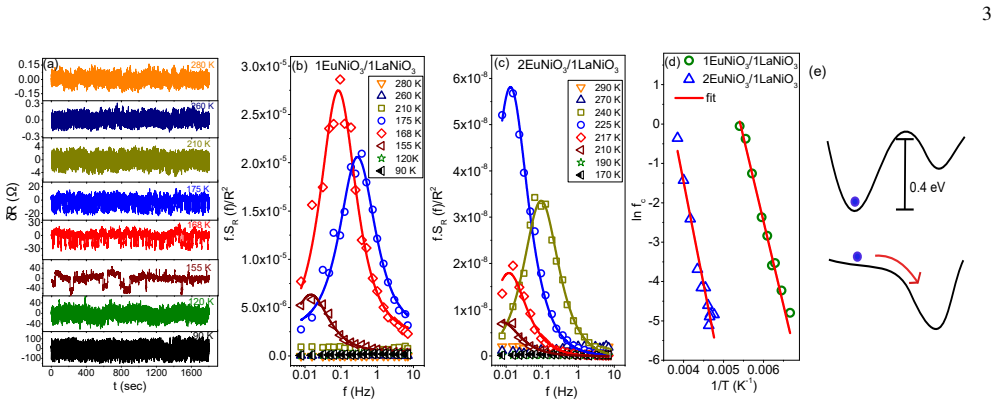
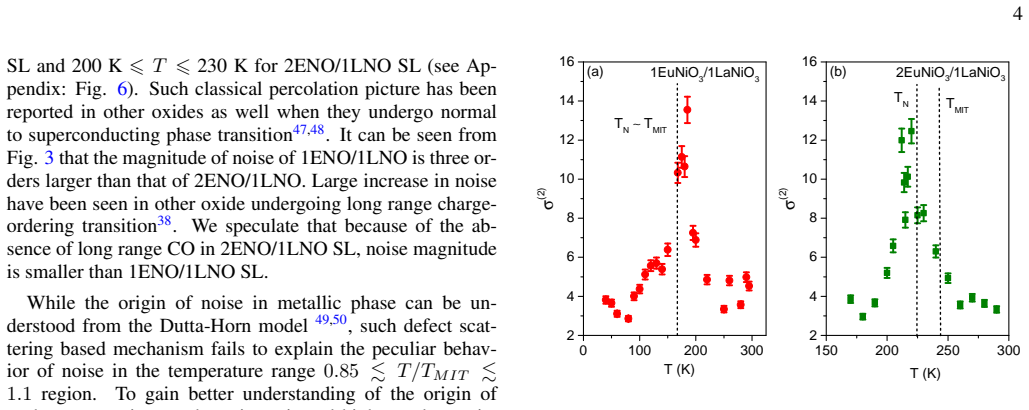
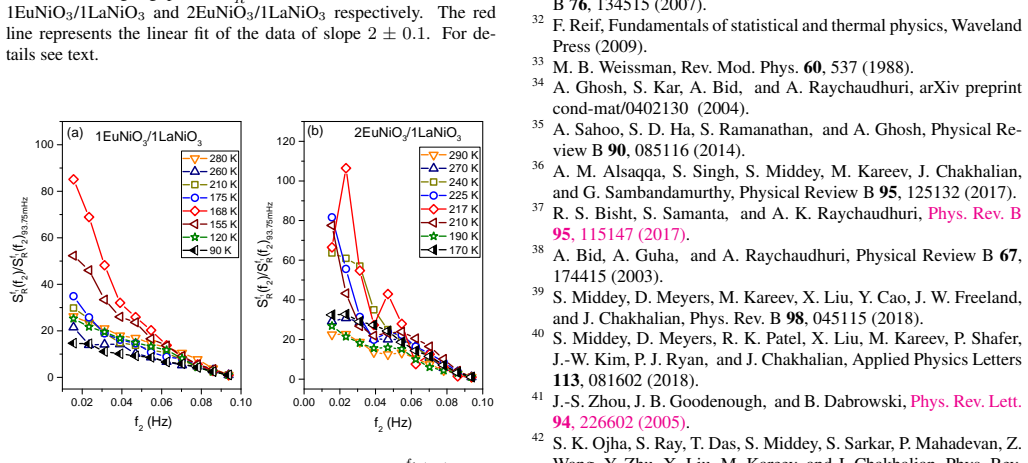
The central object is the low-frequency resistance-noise spectrum, measured with a four-probe lock-in technique as a time series of resistance fluctuations δR(t). From this time series the paper computes the power spectral density S_R(f), which near the transition decomposes into a 1/f component and a Lorentzian component with corner frequency f_c; the Arrhenius behavior of f_c gives the energy barrier E_a between metallic and insulating regions. The second spectrum, a four-point correlation function of the resistance fluctuations, is used to quantify non-Gaussian statistics; its normalized form σ(2) equals 3 for independent Gaussian fluctuators and deviates when correlated fluctuations are present. These tools are applied to a designed pair of superlattices that differ only in whether the superlattice periodicity matches the rock-salt charge-ordering periodicity, making the noise comparison attribution to charge ordering possible.
What would settle it
A definitive test would be to grow a series of [mEuNiO3/nLaNiO3] superlattices with identical total volume and carrier density but differing periodicities, measure the insulating-phase noise, and confirm that it tracks the independently measured presence or absence of long-range charge ordering; if the noise contrast is found to depend on growth-induced disorder or defect density instead, the attribution would collapse.
Extended reading notes
Core claim
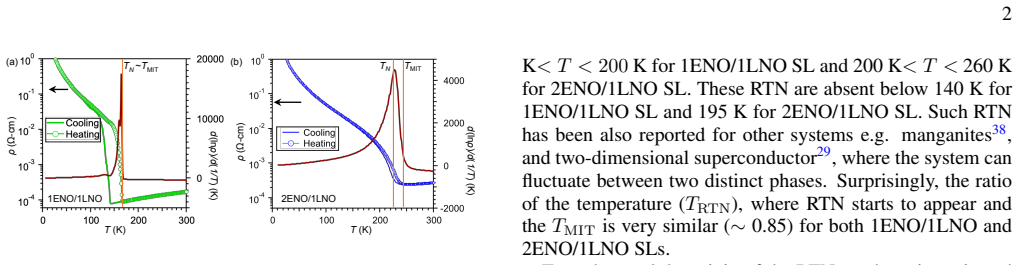
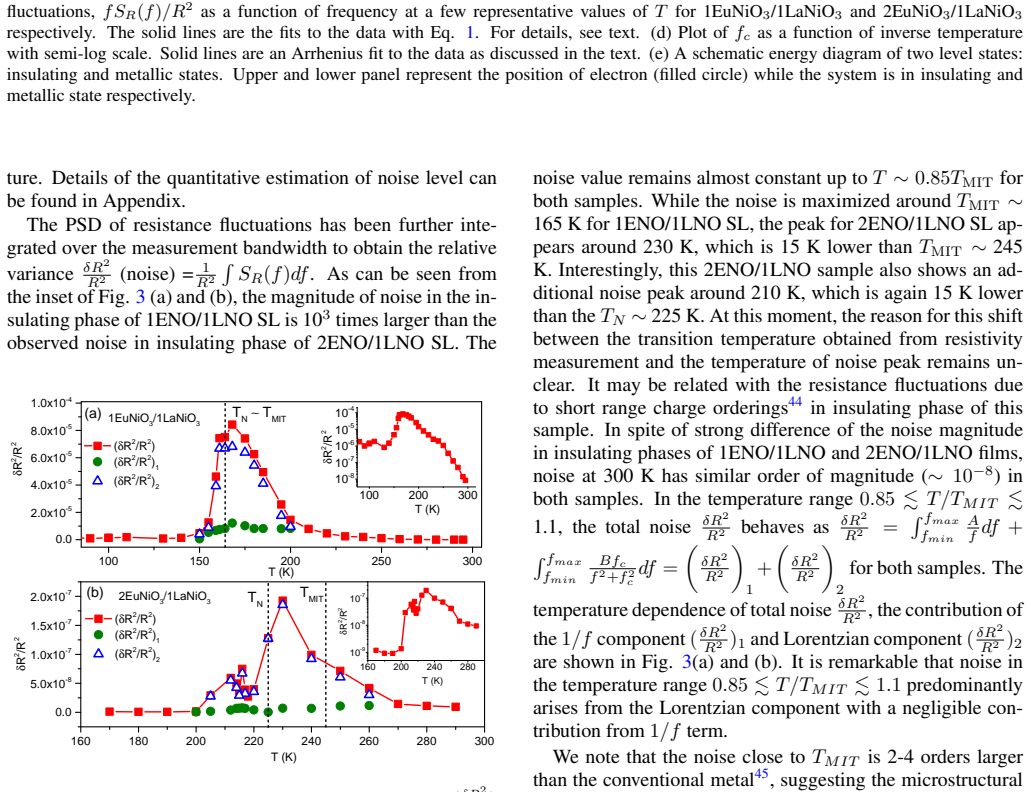
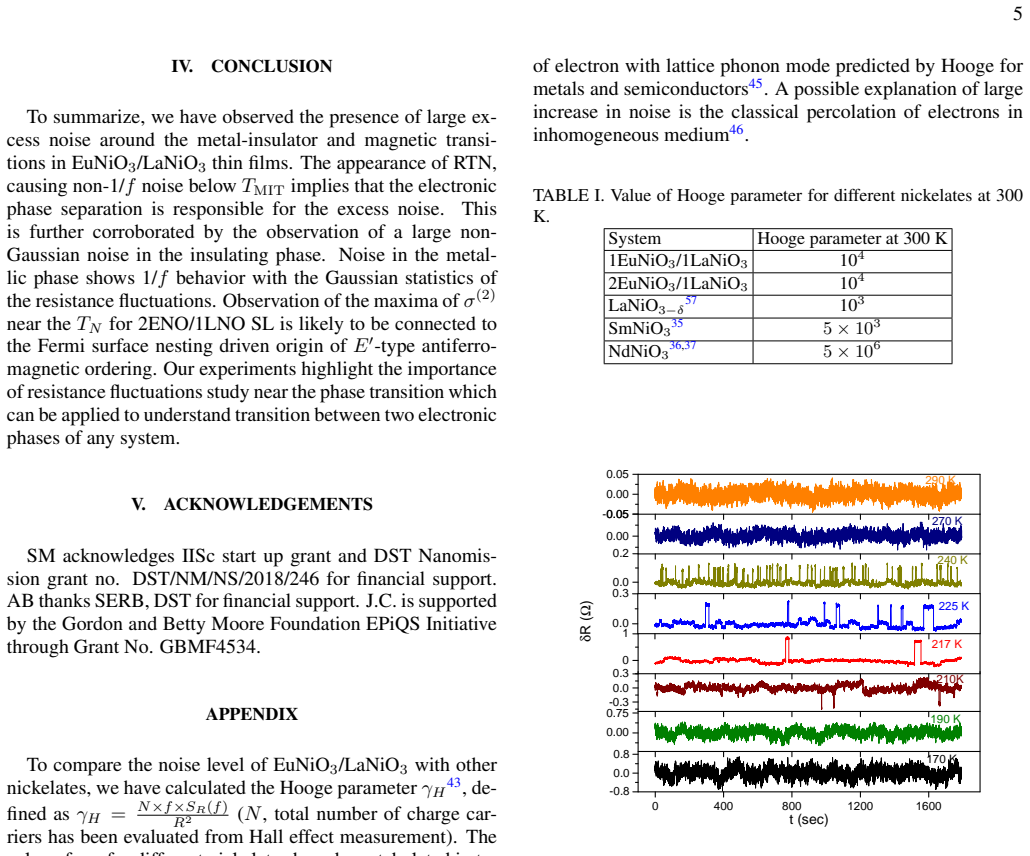
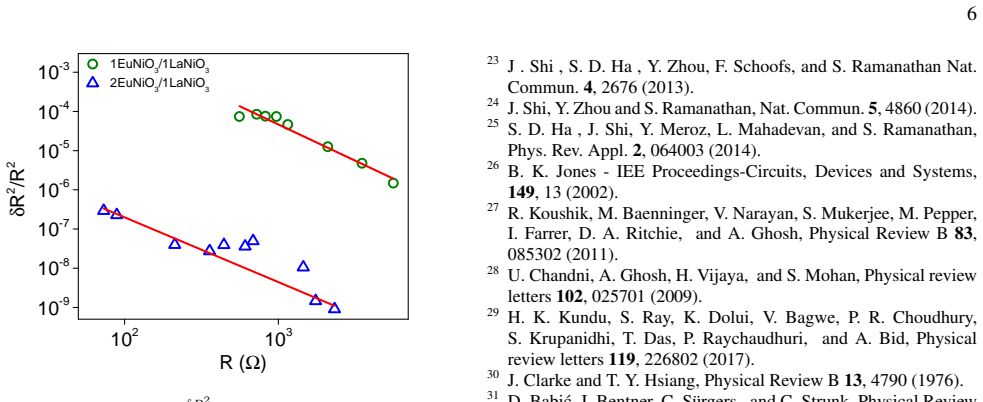
The central discovery is that the presence or absence of long-range charge ordering changes the magnitude of resistance noise near the metal-insulator transition by about three orders of magnitude, while leaving the signatures of electronic phase separation essentially unchanged. In the charge-ordered 1ENO/1LNO superlattice, the integrated noise δR²/R² in the insulating phase is roughly 10³ times larger than in the 2ENO/1LNO superlattice that lacks long-range charge order. Both samples show random telegraphic noise over a comparable reduced-temperature window (T_RTN ~ 0.85 T_MIT), a power spectral density composed of a 1/f term and a Lorentzian with thermally activated corner frequency (E_a ~ 0.42 eV), and a normalized second spectrum σ(2) that deviates strongly from the Gaussian value of 3 near the transition. The noise magnitude scales as R² with exponent ~2, consistent with classical percolation of metallic clusters in an insulating matrix. The authors infer that the microscopic energetics of metallic cluster formation are similar in both cases, but the long-range charge-ordered state introduces additional, much stronger fluctuators.
Load-bearing premise
The three-orders-of-magnitude noise difference is attributed solely to the presence versus absence of long-range charge ordering, which requires that the two films have identical volume, disorder, defect density, and measurement geometry.
Editorial extensions
If this is right
- The 2ENO/1LNO superlattice combines a sharp first-order metal-insulator transition with roughly 10³ times lower insulating-phase noise than its charge-ordered counterpart, making it a better candidate for oxide electronic devices that switch through the MIT.
- Observation of random telegraphic noise and non-Gaussian second spectrum in both samples implies that electronic phase separation is intrinsic to the nickelate MIT even when long-range charge ordering is absent.
- The nearly identical activation energy (~0.42 eV) and domain size (~7 nm) in the two samples suggest that the local energetics of metallic cluster nucleation are set by short-range interactions rather than by the long-range charge-ordered state.
- The noise peak and maximum of σ(2) near the Néel temperature in the 2ENO/1LNO sample indicate that the E'-type antiferromagnetic ordering also contributes to resistance fluctuations, possibly via Fermi surface nesting.
Reading between the lines
- An untested corollary of the similar activation energies is that the energy barrier for metallic cluster formation may be controlled by local epitaxial strain; varying the substrate to tune strain should then shift the noise peak and E_a, a measurement not performed in the paper.
- Because the paper estimates metallic domains of only ~7 nm, far smaller than the ~100–300 nm domains seen by conductive atomic force microscopy in NdNiO3, noise spectroscopy may be uniquely sensitive to the earliest, nanometer-scale stages of phase separation; combining the two techniques on the same sample would test this.
- The demonstrated low noise of the charge-order-free superlattice, if it holds under electrical cycling, suggests a path to using digital synthesis of nickelates in devices such as field-effect transistors or volatile switches, though the paper does not itself fabricate a device.
Signed reviews
Editorial analysis
A structured set of objections, weighed in public.
Referee Report
Summary. This paper reports low-frequency resistance noise measurements on two [EuNiO3/LaNiO3] superlattices: 1ENO/1LNO, which exhibits a simultaneous metal-insulator and charge-ordering transition near 165 K, and 2ENO/1LNO, which undergoes a MIT near 245 K without long-range charge ordering. The authors observe random telegraphic noise, non-1/f power spectra, and non-Gaussian second spectra near the transitions in both samples, extract a common activation energy Ea ≈ 0.42 eV from the Lorentzian corner frequency, and estimate metallic domain diameters of about 7 nm. They also report that the integrated noise in the insulating phase is about three orders of magnitude lower in 2ENO/1LNO than in 1ENO/1LNO, and they suggest that suppressing long-range charge order reduces excess noise and may be beneficial for device applications.
Significance. If the central comparison were properly controlled, the paper would be significant: it would show that noise spectroscopy can distinguish the role of long-range charge order from the generic phase-separation dynamics in nickelate heterostructures, and it would support digital synthesis as a route to low-noise oxide electronics. The experimental methodology is standard for noise spectroscopy, and the concurrent appearance of RTN, non-1/f spectra, and non-Gaussian second spectra is internally consistent evidence for electronic phase separation in both systems. The similar Ea and inferred length scale in the two samples are also valuable observations. However, the main quantitative claim—the 10^3 reduction in insulating-phase noise—currently rests on a single pair of films with no statistical validation, so the significance is conditional on additional control measurements.
major comments (3)
- [Section III, Fig. 3(a),(b) insets and text beginning 'The PSD of resistance fluctuations ...'] The claimed three-orders-of-magnitude difference in insulating-phase noise between 1ENO/1LNO and 2ENO/1LNO is not statistically supported: no error bars are given for the integrated noise values, no repeat measurements on independently grown films are reported, and the two superlattices differ in Eu:La ratio, periodicity, number of interfaces, and TMIT. Since low-frequency noise magnitude is highly sensitive to defect density and interface disorder, these data cannot exclude a growth- or microstructure-related origin for the offset; the authors' own sentence 'We speculate that because of the absence of long range CO in 2ENO/1LNO SL, noise magnitude is smaller than 1ENO/1LNO SL' correctly identifies this as an open point. This comparison is load-bearing for the device-oriented conclusion.
- [Section III, Eq. (1) and Fig. 2(d)] The Arrhenius analysis yielding Ea = 0.42 ± 0.03 eV and the statement that this value is the same for both samples are presented without error bars on the individual fc values or on the fitted amplitudes A and B, and no statistical test of equality is provided. The claim of similar energy barriers in the two samples is used to support the interpretation of common phase-separation physics, so this should be quantified.
- [Section III, paragraph beginning 'The length scale associated with the electronic phase separation ...'] The estimate Lm ≈ 7.0–7.4 nm assumes that Ea is purely elastic energy from the volume mismatch, uses bulk moduli of the two constituents and a 0.2% out-of-plane expansion, and assumes spherical metallic nuclei. These are strong assumptions; Ea could include electronic or magnetic contributions, and the inferred domain size is not independently verified. The sentence 'Our results emphasizes that nucleation of such metallic phase happens at much shorter length scale' should be softened or supported by additional evidence.
minor comments (4)
- [Appendix, Fig. 6 and the percolation paragraph] The exponent w ≈ 2 ± 0.1 is quoted from a log-log fit of δR²/R² versus R, but the fitting range, number of points, and confidence intervals are not stated; please report these details.
- [Section III, Fig. 3 discussion] The sentence 'At this moment, the reason for this shift between the transition temperature obtained from resistivity measurement and the temperature of noise peak remains unclear' leaves an unresolved interpretive point; if the additional noise peak near 210 K in 2ENO/1LNO is presented as a result, a brief discussion of possible systematic offsets would be helpful.
- [Section III, second spectrum definition] The statement that σ(2) = 3 for Gaussian fluctuations is an ideal-limit result; the finite octave bandwidth and measurement noise floor can bias the baseline, so a short comment on the expected Gaussian value under the present measurement conditions would strengthen the non-Gaussian claim.
- [Table I] The Hooge parameter comparison across different nickelate systems should note that the values were obtained under different growth, geometry, and measurement conditions; a direct tabular comparison without this caveat may overstate the differences.
Circularity Check
No significant circularity: the paper is an experimental noise study whose fitted parameters are used for interpretation, not as inputs that define the claimed outcomes.
full rationale
This paper is an experimental investigation of low-frequency resistance noise in two nickelate superlattices. The central measurements—time series, power spectral densities, integrated noise magnitudes, and second spectra—are raw empirical quantities, not quantities constructed from the model that is later invoked to explain them. The PSD is fit to a sum of 1/f and Lorentzian terms (Eq. 1), from which the corner frequency fc and activation energy Ea = 0.42 ± 0.03 eV are extracted; these fits are used for interpretation, not to generate a prediction that is then claimed as independent confirmation. The length-scale estimate (Lm ~ 7 nm) is explicitly model-dependent, combining the fitted Ea with assumed elastic energy and bulk moduli; it is presented as an estimate, not as a test of the model. The claim that 2ENO/1LNO lacks long-range charge order is imported from prior experimental characterization (Refs. 21, 39, 40), which is externally falsifiable structural and transport data rather than an unverified self-citation chain or a uniqueness theorem. The three-orders-of-magnitude difference in insulating-phase noise is a direct comparison of measured integrated noise between two different superlattices, not a fitted parameter renamed as a prediction. The paper explicitly labels the attribution of this difference to charge ordering as speculation ('We speculate that because of the absence of long range CO in 2ENO/1LNO SL, noise magnitude is smaller than 1ENO/1LNO SL'), which is an honest interpretive statement rather than a circular derivation. Weaknesses such as the absence of error bars and the uncontrolled comparison between two compositionally different superlattices are experimental-control and significance concerns, not circularity. No step in the derivation reduces by definition or by self-citation to its own inputs.
Assumptions & free parameters
free parameters (3)
- Activation energy Ea =
0.42 +/- 0.03 eV
- Percolation exponent w =
2.0 +/- 0.1
- PSD fit amplitudes A and B =
temperature dependent, not tabulated
assumptions (5)
- domain assumption The metallic-phase noise follows the Dutta-Horn model of independent two-level fluctuators, giving 1/f spectra and Gaussian statistics.
- domain assumption The random void model predicts noise scaling as R^w with w = 2.1 for a percolating medium.
- domain assumption The two superlattices are directly comparable, with only the charge-ordering state differing; their structure and CO status are as characterized in Refs. 21, 39, and 40.
- domain assumption The activation barrier can be modeled as elastic energy of spherical metallic domains using bulk moduli 320-380 GPa and 0.2% out-of-plane expansion.
- standard math According to the central limit theorem, independent fluctuators yield Gaussian statistics with normalized second spectrum sigma(2) = 3.
Cite this review
Pith. "Pith review of Conductivity noise across temperature driven transitions of rare-earth nickelate heterostructures." pith.science (2026). https://pith.science/paper/CVU5BASA
@misc{pith2026190806413,
  author       = {Pith},
  title        = {Pith review of: Conductivity noise across temperature driven transitions of rare-earth nickelate heterostructures},
  year         = {2026},
  howpublished = {\url{https://pith.science/paper/CVU5BASA}},
  note         = {Machine review of arXiv:1908.06413}
}
abstract
The metal-insulator transition (MIT) of bulk rare-earth nickelates is accompanied by a simultaneous charge ordering (CO) transition. We have investigated low-frequency resistance fluctuations (noise) across the MIT and magnetic transition of [EuNiO$_3$/LaNiO$_3$] superlattices, where selective suppression of charge ordering has been achieved by mismatching the superlattice periodicity with the periodicity of charge ordering. We have observed that irrespective of the presence/absence of long-range CO, the noise magnitude is enhanced by several orders with strong non-1/$f$ ($f$ = frequency) component when the system undergoes MIT and magnetic transition. The higher order statistics of resistance fluctuations reveal the presence of strong non-Gaussian components in both cases, further indicating inhomogeneous electrical transport arising from the electronic phase separation. Specifically, we find almost three orders of magnitude smaller noise in the insulating phase of the sample without long-range CO compared to the sample with CO. These findings suggest that digital synthesis can be a potential route to implement electronic transitions of complex oxides for device application.
Figures
Figures from the paper (4 more)
Reference graph
Works this paper leans on
-
[1]
author author M. Imada , author A. Fujimori , \ and\ author Y. Tokura ,\ 10.1103/RevModPhys.70.1039 journal journal Rev. Mod. Phys. \ volume 70 ,\ pages 1039 ( year 1998 ) NoStop
-
[2]
author author Y. Tokura ,\ 10.1088/0034-4885/69/3/r06 journal journal Reports on Progress in Physics \ volume 69 ,\ pages 797 ( year 2006 ) NoStop
-
[3]
author author S. Middey , author J. Chakhalian , author P. Mahadevan , author J. W. \ Freeland , author A. J. \ Millis , \ and\ author D. D. \ Sarma ,\ 10.1146/annurev-matsci-070115-032057 journal journal Annual Review of Materials Research \ volume 46 ,\ pages 305 ( year 2016 ) NoStop
-
[4]
author author S. Catalano , author M. Gibert , author J. Fowlie , author J. \'I \ n iguez , author J.-M. \ Triscone , \ and\ author J. Kreisel ,\ 10.1088/1361-6633/aaa37a journal journal Reports on Progress in Physics \ volume 81 ,\ pages 046501 ( year 2018 ) NoStop
-
[5]
author author M. L. \ Medarde ,\ @noop journal journal Journal of Physics: Condensed Matter \ volume 9 ,\ pages 1679 ( year 1997 ) NoStop
work page 1997
-
[6]
author author G. Catalan ,\ 10.1080/01411590801992463 journal journal Phase Transitions \ volume 81 ,\ pages 729 ( year 2008 ) NoStop
-
[7]
author author A. Mercy , author J. Bieder , author J. \'I \ n iguez , \ and\ author P. Ghosez ,\ 10.1038/s41467-017-01811-x journal journal Nature Communications \ volume 8 ,\ pages 1667 ( year 2017 ) NoStop
-
[8]
author author M. K. \ Stewart , author J. Liu , author M. Kareev , author J. Chakhalian , \ and\ author D. N. \ Basov ,\ 10.1103/PhysRevLett.107.176401 journal journal Phys. Rev. Lett. \ volume 107 ,\ pages 176401 ( year 2011 ) NoStop
Show all 58 references
-
[9]
Staub , author G
author author U. Staub , author G. I. \ Meijer , author F. Fauth , author R. Allenspach , author J. G. \ Bednorz , author J. Karpinski , author S. M. \ Kazakov , author L. Paolasini , \ and\ author F. d'Acapito ,\ 10.1103/PhysRevLett.88.126402 journal journal Phys. Rev. Lett. ...
-
[10]
author author I. I. \ Mazin , author D. I. \ Khomskii , author R. Lengsdorf , author J. A. \ Alonso , author W. G. \ Marshall , author R. M. \ Ibberson , author A. Podlesnyak , author M. J. \ Mart\' nez-Lope , \ and\ author M. M. \ Abd-Elmeguid ,\ 10.1103/PhysRevLett.98.176406...
-
[11]
author author S. R. \ Barman , author A. Chainani , \ and\ author D. D. \ Sarma ,\ 10.1103/PhysRevB.49.8475 journal journal Phys. Rev. B \ volume 49 ,\ pages 8475 ( year 1994 ) NoStop
1994 doi
-
[12]
Mizokawa , author D
author author T. Mizokawa , author D. I. \ Khomskii , \ and\ author G. A. \ Sawatzky ,\ 10.1103/PhysRevB.61.11263 journal journal Phys. Rev. B \ volume 61 ,\ pages 11263 ( year 2000 ) NoStop
-
[13]
Park , author A
author author H. Park , author A. J. \ Millis , \ and\ author C. A. \ Marianetti ,\ 10.1103/PhysRevLett.109.156402 journal journal Phys. Rev. Lett. \ volume 109 ,\ pages 156402 ( year 2012 ) NoStop
2012 doi
-
[14]
Johnston , author A
author author S. Johnston , author A. Mukherjee , author I. Elfimov , author M. Berciu , \ and\ author G. A. \ Sawatzky ,\ 10.1103/PhysRevLett.112.106404 journal journal Phys. Rev. Lett. \ volume 112 ,\ pages 106404 ( year 2014 ) NoStop
-
[15]
Subedi , author O
author author A. Subedi , author O. E. \ Peil , \ and\ author A. Georges ,\ 10.1103/PhysRevB.91.075128 journal journal Phys. Rev. B \ volume 91 ,\ pages 075128 ( year 2015 ) NoStop
2015 doi
-
[16]
Bisogni , author S
author author V. Bisogni , author S. Catalano , author R. J. \ Green , author M. Gibert , author R. Scherwitzl , author Y. Huang , author V. N. \ Strocov , author P. Zubko , author S. Balandeh , author J.-M. \ Triscone , \ and\ author et al. ,\ 10.1038/ncomms13017 journal jour...
-
[17]
Shamblin , author M
author author J. Shamblin , author M. Heres , author H. Zhou , author J. Sangoro , author M. Lang , author J. Neuefeind , author J. A. \ Alonso , \ and\ author S. Johnston ,\ 10.1038/s41467-017-02561-6 journal journal Nature Communications \ volume 9 ,\ pages 86 ( year 2018 ) NoStop
-
[18]
Lee , author R
author author S. Lee , author R. Chen , \ and\ author L. Balents ,\ 10.1103/PhysRevLett.106.016405 journal journal Phys. Rev. Lett. \ volume 106 ,\ pages 016405 ( year 2011 a ) NoStop
2011 doi
-
[19]
Lee , author R
author author S. Lee , author R. Chen , \ and\ author L. Balents ,\ 10.1103/PhysRevB.84.165119 journal journal Phys. Rev. B \ volume 84 ,\ pages 165119 ( year 2011 b ) NoStop
2011 doi
-
[20]
Hepting , author M
author author M. Hepting , author M. Minola , author A. Frano , author G. Cristiani , author G. Logvenov , author E. Schierle , author M. Wu , author M. Bluschke , author E. Weschke , author H.-U. \ Habermeier , author E. Benckiser , author M. Le Tacon , \ and\ author B. Keime...
-
[21]
Middey , author D
author author S. Middey , author D. Meyers , author M. Kareev , author Y. Cao , author X. Liu , author P. Shafer , author J. W. \ Freeland , author J.-W. \ Kim , author P. J. \ Ryan , \ and\ author J. Chakhalian ,\ 10.1103/PhysRevLett.120.156801 journal journal Phys. Rev. Lett...
-
[22]
Scherwitzl, P
R. Scherwitzl, P. Zubko, I. Gutierrez Lezama, S. Ono, A. F. Morpurgo, G. Catalan, and J.?M. Triscone, Advanced Materials, 22 , 5517 (2010)
2010
-
[23]
J . Shi , S. D. Ha , Y. Zhou, F. Schoofs, and S. Ramanathan Nat. Commun. 4 , 2676 (2013)
2013
-
[24]
J. Shi, Y. Zhou and S. Ramanathan, Nat. Commun. 5 , 4860 (2014)
2014
-
[25]
S. D. Ha , J. Shi, Y. Meroz, L. Mahadevan, and S. Ramanathan, Phys. Rev. Appl. 2 , 064003 (2014)
2014
-
[26]
B. K. Jones - IEE Proceedings-Circuits, Devices and Systems, 149 , 13 (2002)
2002
-
[27]
Koushik , author M
author author R. Koushik , author M. Baenninger , author V. Narayan , author S. Mukerjee , author M. Pepper , author I. Farrer , author D. A. \ Ritchie , \ and\ author A. Ghosh ,\ @noop journal journal Physical Review B \ volume 83 ,\ pages 085302 ( year 2011 ) NoStop
2011
-
[28]
Chandni , author A
author author U. Chandni , author A. Ghosh , author H. Vijaya , \ and\ author S. Mohan ,\ @noop journal journal Physical review letters \ volume 102 ,\ pages 025701 ( year 2009 ) NoStop
2009
-
[29]
author author H. K. \ Kundu , author S. Ray , author K. Dolui , author V. Bagwe , author P. R. \ Choudhury , author S. Krupanidhi , author T. Das , author P. Raychaudhuri , \ and\ author A. Bid ,\ @noop journal journal Physical review letters \ volume 119 ,\ pages 226802 ( yea...
2017
-
[30]
Clarke \ and\ author T
author author J. Clarke \ and\ author T. Y. \ Hsiang ,\ @noop journal journal Physical Review B \ volume 13 ,\ pages 4790 ( year 1976 ) NoStop
1976
-
[31]
Babi \'c , author J
author author D. Babi \'c , author J. Bentner , author C. S \"u rgers , \ and\ author C. Strunk ,\ @noop journal journal Physical Review B \ volume 76 ,\ pages 134515 ( year 2007 ) NoStop
2007
-
[32]
Reif, Fundamentals of statistical and thermal physics, Waveland Press (2009)
F. Reif, Fundamentals of statistical and thermal physics, Waveland Press (2009)
2009
-
[33]
author author M. B. \ Weissman ,\ @noop journal journal Rev. Mod. Phys. \ volume 60 ,\ pages 537 ( year 1988 ) NoStop
1988
-
[34]
Ghosh , author S
author author A. Ghosh , author S. Kar , author A. Bid , \ and\ author A. Raychaudhuri ,\ @noop journal journal arXiv preprint cond-mat/0402130 \ ( year 2004 ) NoStop
2004 arXiv
-
[35]
Sahoo , author S
author author A. Sahoo , author S. D. \ Ha , author S. Ramanathan , \ and\ author A. Ghosh ,\ @noop journal journal Physical Review B \ volume 90 ,\ pages 085116 ( year 2014 ) NoStop
2014
-
[36]
author author A. M. \ Alsaqqa , author S. Singh , author S. Middey , author M. Kareev , author J. Chakhalian , \ and\ author G. Sambandamurthy ,\ @noop journal journal Physical Review B \ volume 95 ,\ pages 125132 ( year 2017 ) NoStop
2017
-
[37]
author author R. S. \ Bisht , author S. Samanta , \ and\ author A. K. \ Raychaudhuri ,\ 10.1103/PhysRevB.95.115147 journal journal Phys. Rev. B \ volume 95 ,\ pages 115147 ( year 2017 ) NoStop
2017 doi
-
[38]
Bid , author A
author author A. Bid , author A. Guha , \ and\ author A. Raychaudhuri ,\ @noop journal journal Physical Review B \ volume 67 ,\ pages 174415 ( year 2003 ) NoStop
2003
-
[39]
Middey , author D
author author S. Middey , author D. Meyers , author M. Kareev , author X. Liu , author Y. Cao , author J. W. \ Freeland , \ and\ author J. Chakhalian ,\ @noop journal journal Phys. Rev. B \ volume 98 ,\ pages 045115 ( year 2018 b ) NoStop
2018
-
[40]
Middey , author D
author author S. Middey , author D. Meyers , author R. K. \ Patel , author X. Liu , author M. Kareev , author P. Shafer , author J.-W. \ Kim , author P. J. \ Ryan , \ and\ author J. Chakhalian ,\ @noop journal journal Applied Physics Letters \ volume 113 ,\ pages 081602 ( year...
2018
-
[41]
\ Zhou , author J
author author J.-S. \ Zhou , author J. B. \ Goodenough , \ and\ author B. Dabrowski ,\ 10.1103/PhysRevLett.94.226602 journal journal Phys. Rev. Lett. \ volume 94 ,\ pages 226602 ( year 2005 ) NoStop
2005 doi
-
[42]
S. K. Ojha, S. Ray, T. Das, S. Middey, S. Sarkar, P. Mahadevan, Z. Wang, Y. Zhu, X. Liu, M. Kareev, and J. Chakhalian, Phys. Rev. B 99 , 235153 (2019)
2019
-
[43]
The value of _H came out to be 10^4 at T=300 K and f=1 Hz for both the samples
To compare the noise level of EuNiO _3 /LaNiO _3 with other nickelates we have calculated the Hooge parameter _H hooge19691 , defined as _H= N f S_R(f) R^2 ( N , total number of charge carriers has been evaluated from Hall effect measurement). The value of _H came out to be 10...
-
[44]
author author F. N. \ Hooge ,\ @noop journal journal Phys. Lett. \ volume 29 ,\ pages 139 ( year 1969 ) NoStop
1969
-
[45]
Piamonteze , author H
author author C. Piamonteze , author H. C. N. \ Tolentino , author A. Y. \ Ramos , author N. E. \ Massa , author J. A. \ Alonso , author M. J. \ Mart\' i nez-Lope , \ and\ author M. T. \ Casais ,\ 10.1103/PhysRevB.71.012104 journal journal Phys. Rev. B \ volume 71 ,\ pages 012...
-
[46]
F. N. Hooge, Physica 60 , 130 (1972)
1972
-
[47]
author author A.-M. S. \ Tremblay , author S. Feng , \ and\ author P. Breton ,\ @noop journal journal Phys. Rev. B \ volume 33 ,\ pages 2077 ( year 1986 ) NoStop
1986
-
[48]
author author L. B. \ Kiss \ and\ author P. Svedlindh ,\ @noop journal journal IEEE Transactions on Electron Devices \ volume 41 ,\ pages 2112 ( year 1994 ) NoStop
1994
-
[49]
author author G. N. \ Daptary , author S. Kumar , author P. Kumar , author A. Dogra , author N. Mohanta , author A. Taraphder , \ and\ author A. Bid ,\ @noop journal journal Physical Review B \ volume 94 ,\ pages 085104 ( year 2016 ) NoStop
2016
-
[50]
Dutta \ and\ author P
author author P. Dutta \ and\ author P. Horn ,\ @noop journal journal Reviews of Modern physics \ volume 53 ,\ pages 497 ( year 1981 ) NoStop
1981
-
[51]
author author G. N. \ Daptary , author C. Sow , author S. Sarkar , author S. Chiniwar , author P. A. \ Kumar , author A. Sil , \ and\ author A. Bid ,\ @noop journal journal Physica B: Condensed Matter \ volume 511 ,\ pages 74 ( year 2017 ) NoStop
2017
-
[52]
Seidler , author S
author author G. Seidler , author S. Solin , \ and\ author A. Marley ,\ @noop journal journal Physical review letters \ volume 76 ,\ pages 3049 ( year 1996 ) NoStop
1996
-
[53]
author author G. N. \ Daptary , author C. Sow , author P. A. \ Kumar , \ and\ author A. Bid ,\ @noop journal journal Physical Review B \ volume 90 ,\ pages 115153 ( year 2014 ) NoStop
2014
-
[54]
Seidler \ and\ author S
author author G. Seidler \ and\ author S. Solin ,\ @noop journal journal Physical Review B \ volume 53 ,\ pages 9753 ( year 1996 ) NoStop
1996
-
[55]
Eguchi , author A
author author R. Eguchi , author A. Chainani , author M. Taguchi , author M. Matsunami , author Y. Ishida , author K. Horiba , author Y. Senba , author H. Ohashi , \ and\ author S. Shin ,\ 10.1103/PhysRevB.79.115122 journal journal Phys. Rev. B \ volume 79 ,\ pages 115122 ( ye...
-
[56]
\ Zhou , author J
author author J.-S. \ Zhou , author J. B. \ Goodenough , \ and\ author B. Dabrowski ,\ 10.1103/PhysRevB.70.081102 journal journal Phys. Rev. B \ volume 70 ,\ pages 081102 ( year 2004 ) NoStop
2004 doi
-
[57]
Preziosi , author L
author author D. Preziosi , author L. Lopez-Mir , author X. Li , author T. Cornelissen , author J. H. \ Lee , author F. Trier , author K. Bouzehouane , author S. Valencia , author A. Gloter , author A. Barthélémy , et al. ,\ @noop journal journal Nano letters \ volume 18 ,\ pa...
2018
-
[58]
Ghosh, A
A. Ghosh, A. K. Raychaudhuri, R. Sreekala, M. Rajeswari, and T. Venkatesan, Journal of Physics D: Applied Physics, 30 , L75 (1997)
1997
Reviewed August 14, 2026 · model on record in the stance chip above.
Discussion (0). Continue with ORCID to comment.