REVIEW 4 major objections 4 minor 12 references
Discovery of the TeV Emission from the JetInteraction Regions of SS 433 with HAWC
T0 review · 4 major / 4 minor · reviewed 2026-08-14 · deepseek-v4-flash
Pith's one-line read Follow-up HAWC measurements with 1,039 days of data and a new energy estimator reproduce the published TeV jet-lobe fluxes of SS 433, strengthening the case that the emission is real and persistent.
desk verdict A short, honest ICRC proceeding that re-processes HAWC data with a new energy estimator and confirms the published SS 433 lobe fluxes, though it adds no new physics and its systematics are still missing. read the letter →
The pith
A machine-rendered reading of the paper's core claim, the machinery that carries it, and where it could break.
The reading
What carries the argument
The analysis is carried by a simultaneous maximum-likelihood fit of three sources: point-source models for the two SS 433 jet lobes and an electron diffusion morphology for MGRO J1908+06, the bright extended TeV source that contaminates the field. A semi-circular region of interest excludes the part of MGRO J1908+06 nearest the Galactic plane, avoiding the need to model diffuse Galactic emission. The new ingredient is the HAWC energy estimator, which uses on-array events (showers whose cores land on the main array) and is designed to be more reliable than the fractional-hit-bin method above about 10 TeV, where most photomultiplier tubes are hit. The fit uses a power-law spectrum with the index fixed at 2.0 and pivot energy 20 TeV.
What would settle it
Compute the energy-estimator systematic uncertainties for the e1 and w1 fits and check whether the flux normalizations at 20 TeV remain within the published values; a shift exceeding the statistical errors would overturn the confirmation claim.
Extended reading notes
Core claim
The central claim is that the TeV gamma-ray emission from the SS 433 jet termination regions is real and persistent, and that it remains consistent with compact, point-like sources at the X-ray-defined positions e1 and w1. The new measurement with the energy estimator yields fluxes that agree with the earlier fractional-hit-bin analysis: at 20 TeV, $dN/dE_{e1} = (2.5^{+1.1}_{-0.8}) \times 10^{-16}$ and $dN/dE_{w1} = (3.5^{+1.2}_{-0.9}) \times 10^{-16}$ TeV$^{-1}$ cm$^{-2}$ s$^{-1}$. Because the lobes appear as point sources and do not show the wide angular spread expected if the gamma rays came from pion decay of spreading protons, the paper argues the measurement supports a leptonic production mechanism, though a hadronic-only model is not completely ruled out.
Load-bearing premise
The measurement stands on the assumption that the new energy estimator and the on-array-only event selection reconstruct energies and exposure with no unaccounted energy-dependent bias large enough to change the fitted fluxes.
Editorial extensions
If this is right
- The e1 and w1 lobes remain detected at TeV energies with an independent event selection and energy reconstruction, so the original discovery is not tied to the fractional-hit-bin method alone.
- The agreement of the flux normalizations means the spectral energy distribution of the lobes is consistent with a power law of index 2.0 around 20 TeV.
- The point-source appearance of the lobes favors in-situ acceleration of electrons at the jet termination regions and disfavors gamma rays from a widely spread hadronic proton population.
- With additional cumulative data, the lobe spectra can be measured in more detail, including the systematic uncertainties currently missing from the energy-estimator results.
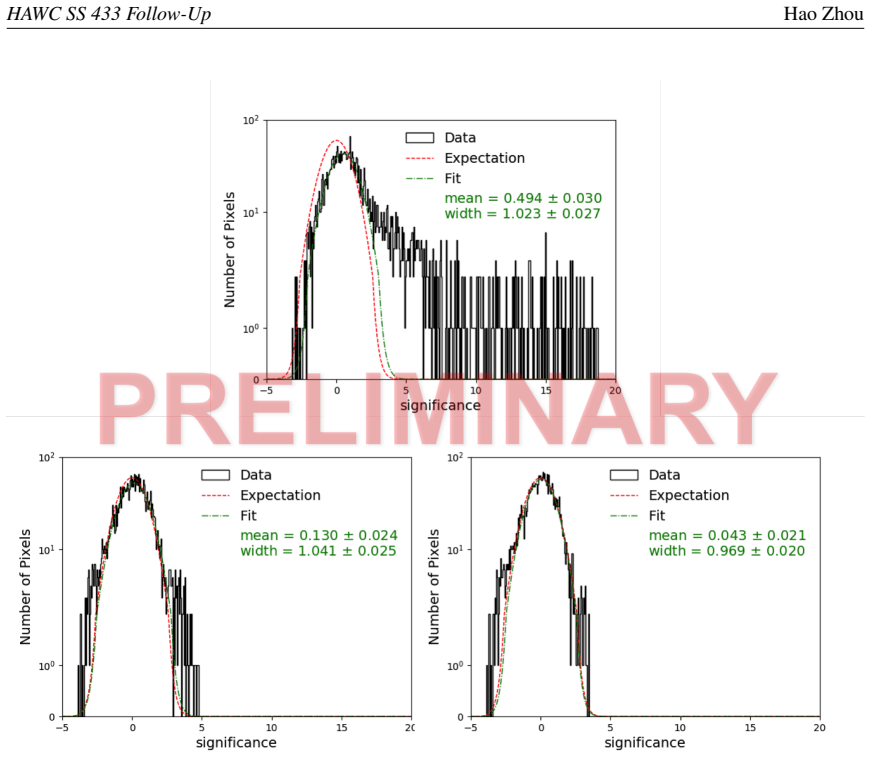
- The residual maps after subtracting the fitted sources are consistent with background, validating the multi-source modeling of the crowded SS 433 and MGRO J1908+06 field.
Reading between the lines
- Editorial inference: If the missing systematic uncertainties on the energy estimator shift the flux normalizations by more than their statistical errors, the apparent agreement with the published values could weaken, so the confirmation is not fully closed until those systematics are reported.
- Editorial inference: A direct comparison of the on-array-only and off-array event samples could reveal whether the energy-estimator selection introduces an energy-dependent exposure that partially mimics the published flux.
- Editorial inference: The same simultaneous-fitting approach with an energy estimator could be applied to other compact TeV sources near the Galactic plane to test whether the point-source, leptonic interpretation for SS 433 is specific to W 50 or more general among microquasars.
Signed reviews
Editorial analysis
A structured set of objections, weighed in public.
Referee Report
Summary. This ICRC 2019 proceedings paper reports a follow-up HAWC measurement of the TeV gamma-ray emission from the jet interaction regions e1 and w1 of the microquasar SS 433. Using 1,039 days of HAWC data and a new energy estimator that uses only on-array events, the authors perform a simultaneous maximum-likelihood fit of the two lobes and the nearby extended source MGRO J1908+06, with power-law spectra of fixed index 2.0 and a pivot energy of 20 TeV. The fitted flux normalizations at 20 TeV are dN/dE_e1 = (2.5^{+1.1}_{-0.8}) x 10^{-16} TeV^{-1} cm^{-2} s^{-1} and dN/dE_w1 = (3.5^{+1.2}_{-0.9}) x 10^{-16} TeV^{-1} cm^{-2} s^{-1}, compared with the published values of 2.4^{+0.6+1.3}_{-0.5-1.3} and 2.1^{+0.6+1.2}_{-0.5-1.2} from Abeysekara et al. 2018. The paper argues that this agreement supports the earlier discovery and the leptonic interpretation of the emission. Residual significance maps and pixel-significance histograms are shown to demonstrate that the fitted source model leaves a residual map consistent with background.
Significance. If the new measurement is taken at face value, it provides a useful cross-check of the only known VHE gamma-ray detection from a microquasar's jet termination regions, and it supports the conclusion that the lobes are point-like at HAWC angular resolution. The paper makes good use of a new, higher-resolution energy estimator that was previously validated on the Crab Nebula, and the residual maps and significance histograms provide a clear visual check that the multi-source fit does not leave obvious unmodeled excess or oversubtraction. However, the significance of the result is limited because the bulk of the data are the same as the earlier publication, the new energy-estimator results are presented without systematic uncertainties, and the w1 flux differs from the published value by more than the wording 'good agreement' implies. These issues must be addressed before the confirmation claim can be considered quantitatively established.
major comments (4)
- [Section 4, Table 1] The Table 1 caption and Section 4 state that the energy-estimator results are currently missing systematic uncertainties. Since the central claim is that the new flux normalizations are in agreement with the published values, and the published values include large systematic uncertainties (e.g., +1.3/-1.3 on e1), a comparison without any estimate of the energy-scale or effective-area systematic uncertainty is incomplete. The authors should either provide a systematic uncertainty for the energy-estimator fluxes or explicitly state which range of agreement can be claimed before systematics are included.
- [Section 3, Section 6] The 'follow-up' dataset is not substantially independent of the earlier detection: 1,017 of the 1,039 days are the same data used in reference [4], with only 22 additional days. Thus the agreement between the two analyses is primarily a reprocessing of the same events with a different energy estimator and event selection, not new evidence that the emission persists on an independent dataset. The language in the abstract and Section 6 ('confirms', 'follow-up measurements') should be tempered, and the overlap of the datasets should be stated explicitly when the comparison is discussed.
- [Table 1, Section 5] The agreement for the w1 lobe is weaker than stated. The new flux is 3.5^{+1.2}_{-0.9} x 10^{-16} TeV^{-1} cm^{-2} s^{-1}, while the published value is 2.1^{+0.6+1.2}_{-0.5-1.2} x 10^{-16} TeV^{-1} cm^{-2} s^{-1}. The central values differ by 1.4 x 10^{-16}, which is about 1 sigma of the new statistical uncertainty and more than 2 sigma of the published statistical uncertainty. Before the missing systematic uncertainties are added, calling this 'good agreement' is an overstatement; a quantitative compatibility statement (e.g., a chi-square or p-value) is needed.
- [Section 3] The comparison between the new and published results changes two analysis ingredients at once: the energy estimator and the event selection (on-array only versus on-array plus off-array). If the on-array selection has an energy-dependent efficiency, the flux normalization at 20 TeV could shift. The authors should either apply the new energy estimator to the same event sample used in [4], or apply the old fractional-hit-bin analysis to the on-array-only sample, to isolate the effect of each change on the fitted normalizations.
minor comments (4)
- [Abstract] The luminosity unit in the abstract, '10^40 erg s^-2', should be 'erg s^-1' (or erg/s).
- [Author list] There is a typo in the author list line: 'F or a complete author list' should read 'For a complete author list'.
- [Section 2] The phrase 'more than 99.9% originating from cosmic rays' would read better as 'more than 99.9% of which originate from cosmic rays'.
- [References] The reference list entries are not in a consistent style; for example, reference [1] mixes a 2004 publication date with a pagination that includes the journal name out of order. A uniform journal formatting would improve readability.
Circularity Check
No significant circularity: the follow-up measurement is an independent re-analysis with a separately validated energy estimator compared against a published result.
full rationale
This paper does not derive its central claim from the quantity it claims to confirm. The new flux normalizations for e1 and w1 are obtained with the HAWC energy-estimator event sample, while the comparison values come from reference [4]; the energy estimator itself is not fitted to SS 433 but was developed and validated on the Crab Nebula in reference [8]. The spectral index and pivot energy are fixed a priori (index 2.0, pivot 20 TeV), and the lobe positions are fixed to the known X-ray termination regions, so no fitted parameter is recycled as a prediction. The agreement with the earlier fractional-hit-bin analysis is an external comparison, not an input to the fit. The paper does rely on the authors' own prior work for the analysis chain, but that is a normal methodological citation rather than a load-bearing circularity: the new analysis uses a different event selection and energy estimator, and the quoted results carry statistical uncertainties only. The explicitly noted absence of systematic uncertainties and the substantial overlap of the 1,039 days with the 1,017 days used in [4] are legitimate concerns about the strength of the confirmation, but they are evidence-quality issues, not cases where the conclusion is equivalent to the premise by construction. No circular step satisfying the quoted-evidence requirement is present.
Assumptions & free parameters
free parameters (4)
- Spectral index alpha (fixed) =
2.0
- Pivot energy E_piv =
20 TeV
- Flux normalization A_e1 =
2.5^{+1.1}_{-0.8} x 1e-16 TeV^-1 cm^-2 s^-1 at 20 TeV
- Flux normalization A_w1 =
3.5^{+1.2}_{-0.9} x 1e-16 TeV^-1 cm^-2 s^-1 at 20 TeV
assumptions (3)
- domain assumption The HAWC maximum-likelihood fitting framework (refs [9,10]) correctly models the detector response and backgrounds.
- ad hoc to paper The MGRO J1908+06 TeV source is modeled with the electron diffusion morphology of Abeysekara et al. 2017 (ref [11]), and the semi-circular region of interest excludes the upper half of this source without biasing the lobe fits.
- domain assumption The new HAWC energy estimator (ref [8]) correctly reconstructs photon energies for on-array events.
Cite this review
Pith. "Pith review of Discovery of the TeV Emission from the JetInteraction Regions of SS 433 with HAWC." pith.science (2026). https://pith.science/paper/YWLESLTE
@misc{pith2026190806429,
  author       = {Pith},
  title        = {Pith review of: Discovery of the TeV Emission from the JetInteraction Regions of SS 433 with HAWC},
  year         = {2026},
  howpublished = {\url{https://pith.science/paper/YWLESLTE}},
  note         = {Machine review of arXiv:1908.06429}
}
abstract
The High Altitude Water Cherenkov (HAWC) observatory recently published the discovery of SS 433 as a TeV source, reporting the observation of multi-TeV gamma-ray emission from the jet interaction regions e1 and w1, suggesting in-situ particle acceleration. This showed the first direct evidence of acceleration in jets at energies greater than a few TeV. SS 433 was the first microquasar to be discovered and is still considered special in that the accretion is supercritical and the luminosity of the system is very high ($\sim10^{40}$ erg s$^{-2}$). The lobes of the supernova remnant W 50 in which the jets terminate, about 40 parsecs from the central binary, are expected to accelerate charged particles, and indeed radio and X-ray emission consistent with electron synchrotron emission in a magnetic field have been observed. SS 433 has also been a strong candidate for hadronic acceleration due to spectroscopic evidence of ionized nuclei in the inner jets. However, multiwavelength fits including the HAWC measurements favor the leptonic production of the observed gamma rays. Here, we present new follow-up measurements of the jet interaction regions of SS 433 using the most recent data from HAWC.
Figures

Reference graph
Works this paper leans on
-
[8]
Abeysekara, A. U. et al. (HAWC Collaboration) (2019) Measurement of the Crab Nebula at the Highest Energies with HAWC, arXiv:1905.12518
arXiv 2019
-
[4]
Abeysekara, A. U. et al. (HAWC Collaboration) (2018) Very high energy particle acceleration powered by the jets of the microquasar SS 433. Nature, 562:82-85
work page 2018
-
[1]
(2006) The jets and and supercritical accretion disk in ss433, Comments Astrophys
Fabrika, S. (2006) The jets and and supercritical accretion disk in ss433, Comments Astrophys. Space Phys., 12:1-153, 2004
work page 2006
-
[2]
Safi-Harb, S. and Ogelman, H. (1997) Rosat and asca observations of w50 associated with the peculiar source ss 433, Astrophys. J., 483(2):868-881
work page 1997
-
[3]
Margon, B. (1984) Observations of SS 433. Ann. Rev. Astron. Astrophys., 22:507-536
work page 1984
-
[5]
Abeysekara, A. U. et al. (HAWC Collaboration) (2017) Observation of the Crab Nebula with the HAWC Gamma-Ray Observatory, arXiv:1701.01778. 6 HA WC SS 433 F ollow-Up Hao Zhou
arXiv 2017
-
[6]
Smith, A. J. et al. (HAWC Collaboration) (2015) HAWC: Design, Operation, Reconstruction, and Analysis, in Proc. 34th ICRC, arXiv:1508.05826v2
arXiv 2015
-
[7]
BenZvi, S. Y . (HAWC Collaboration) (2015) Looking for Gamma-ray Emission from TeV Binary Candidates with HAWC, in Proc. 34th ICRC, arXiv:1508.03589
work page Pith review arXiv 2015
Show all 12 references
-
[9]
Younk, P. W. et al. (HAWC Collaboration) (2016) A high-level analysis framework for HAWC, Proc. Sci. (34th Int. Cosmic Ray Conf.) ICRC2015, https://doi.org/10.22323/1.236.0948
2016 doi
-
[10]
Vianello, G. et al. (HAWC Collaboration) (2016) The multi-mission maximum likelihood framework, Proc. Sci. (34th Int. Cosmic Ray Conf.) ICRC2015, https://doi.org/10.22323/1.236.1042
2016 doi
-
[11]
Abeysekara, A. U. et al. (HAWC Collaboration) (2017) Extended gamma-ray sources around pulsars constrain the origin of the positron flux at Earth, Science, 358(6365):911-914
2017
-
[12]
(1996) ROSAT observations of the W 50/SS 433 system
Brinkmann, W., Aschenbach, B., and Kawai, N. (1996) ROSAT observations of the W 50/SS 433 system. Astron. Astrophys., 323:306-316. 7
1996
Reviewed August 14, 2026 · model on record in the stance chip above.
Discussion (0). Continue with ORCID to comment.