REVIEW 1 major objections 4 minor 8 references
Gaps between consecutive untwisting numbers
T0 review · 1 major / 4 minor · reviewed 2026-08-14 · deepseek-v4-flash
Pith's one-line read Gaps between consecutive untwisting numbers can be arbitrarily large.
desk verdict Theorem 1 is real and the core proof is clean, but the stated generality is slightly over-broad because it relies on Hom's epsilon criterion in a stronger form than cited; trivially fixable. read the letter →
The pith
A machine-rendered reading of the paper's core claim, the machinery that carries it, and where it could break.
The reading
What carries the argument
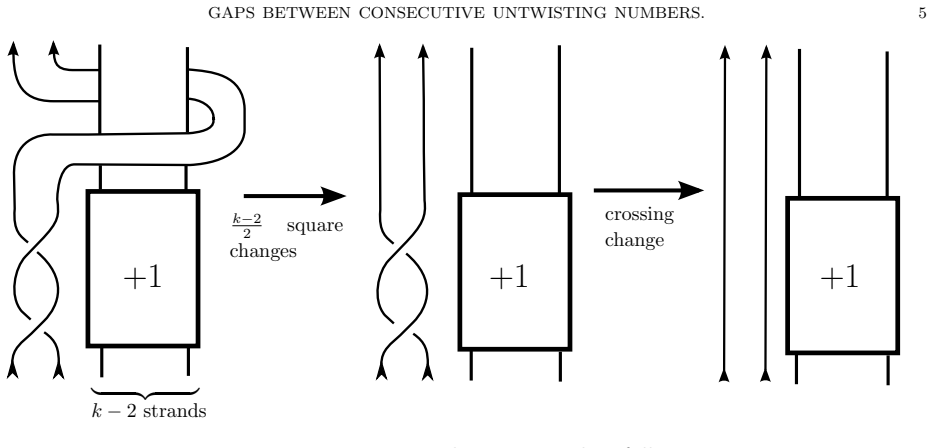
The machinery is cable knots together with the τ-invariant from Heegaard Floer homology. A (p,1)-cable takes p parallel copies of a knot with one full twist; a null-homologous twist on two strands of the companion becomes a twist on 2p strands of the cable. The bordered cable formula for τ gives τ(K_p)=pτ(K), provided an auxiliary invariant ε is 1; here that follows from τ(K)=g_4(K). A satellite inequality transfers untwisting sequences, so the τ computation gives the exact value tu_p(K_p)=n, and the slice-genus bound tu_p ≥ g_4/p converts that into the lower bound on tu_{p-1}.
What would settle it
Compute the second untwisting number of the (2,1)-cable of the trefoil, the case p=2, m=1 of the construction. The theorem predicts tu_2=1 and tu_1-tu_2≥1; finding tu_2=0, or finding any knot in the constructed family with gap smaller than m, would disprove Theorem 1.
Extended reading notes
Core claim
The central result is that for any p≥2 and m≥1, set n=m(p-1) and let K_p be the (p,1)-cable of T_{2,2n+1}. The proof computes τ(K_p)=pn, forcing the chain pn = τ(K_p) ≤ g_4(K_p) ≤ p·tu_p(K_p) ≤ pn, so tu_p(K_p)=n and g_4(K_p)=pn. Then the lower bound gives tu_{p-1}(K_p) ≥ g_4(K_p)/(p-1)= n + n/(p-1)= n+m, so the gap is at least m. For torus knots, a sequence of twists on four strands gives tu_2(T_{p,q}) ≤ 3pq/8, and comparing with u(T_{p,q})=(p-1)(q-1)/2 gives a gap of at least 1/2 floor(q/2)(floor(q/2)-1), which is arbitrarily large.
Load-bearing premise
The load-bearing premise is Hom's cable formula: a (p,1)-cable of a knot with τ equal to its slice genus has τ multiplied by p; if this formula has unstated restrictions for the chosen torus knots, the equality chain tu_p(K_p)=n fails.
Editorial extensions
If this is right
- For every p≥2 and every m, the gap tu_{p-1}-tu_p can be made at least m, so the decreasing sequence of untwisting numbers never becomes constant at any finite stage.
- The constructed knots satisfy equality in the bound tu_p ≥ g_4/p, so they form infinite families where the pth untwisting number is exactly the slice genus divided by p.
- For torus knots T_{p,q} with min{p,q}≥4, tu_2 is strictly smaller than the unknotting number.
- The gap between tu_1 and tu_2 for torus knots grows at least quadratically in the smaller braid index, hence arbitrarily large.
- The uniform bound tu_2(T_{p,q}) ≤ 3pq/8 holds for all p,q>1.
Reading between the lines
- Because the proof only needs a companion K with τ(K)=u(K)=g_4(K), other families such as positive pretzel knots should also yield arbitrarily large consecutive gaps via the same cable construction.
- Since tu_p(K_p)=n and tu_{p-1}(K_p)≥n+m, the constructed knots may have several distinct consecutive untwisting values; computing the intermediate values would show if one knot can realize prescribed gaps at multiple levels.
- The torus-knot trick converts a full twist into parallel strands using about 3k^2/8 twists on four strands; working out the exact minimum for small knots could suggest whether the constant 3/8 can be improved.
Signed reviews
Editorial analysis
A structured set of objections, weighed in public.
Referee Report
Summary. The paper studies the p-th untwisting number tu_p, defined as the minimum number of null-homologous twists on at most 2p strands needed to convert a knot to the unknot. The main result, Theorem 1, asserts that for every p >= 2 and m >= 1 there exists a knot K with tu_{p-1}(K) - tu_p(K) >= m. The proof constructs K as the (p,1)-cable of a knot with tau = u, in particular the torus knot T_{2,2n+1}, and uses a satellite inequality, the slice-genus lower bound tu_p >= g_4/p, and Hom's formula for the tau-invariant of cable knots to force tu_p(K_p) = n while tu_{p-1}(K_p) >= n+m. The paper also proves Theorem 2, showing that torus knots of braid index at least four satisfy tu_2(T_{p,q}) < u(T_{p,q}) and that tu_2(T_{p,q}) <= 3pq/8, so the difference between tu_1 and tu_2 is arbitrarily large for torus knots.
Significance. If the results are correct, they provide the first proof that consecutive untwisting numbers can differ by an arbitrarily large amount, strengthening earlier work of Ince. The paper is concise and well organized, and it proves the central slice-genus estimate Proposition 3 directly from a diagrammatic band-move argument rather than quoting it. The main theorem also gives explicit knots attaining equality in the bound tu_p >= g_4/p, which is a nice feature. The argument relies on standard Heegaard Floer results, especially Hom's tau formula for cables, and the dependence on these tools is clearly identified. The torus-knot statement adds a quantitative upper bound that is interesting in its own right.
major comments (1)
- [Section 2, proof of Theorem 1] The inference 'Since tau(K)=u(K), we have tau(K)=g_4(K). By [Hom14, Corollary 4] this implies that epsilon(K)=1' is load-bearing, but as written it applies the corollary to a knot satisfying tau(K)=g_4(K). If, as is standard, the corollary is stated with the Seifert genus g(K) rather than the smooth slice genus g_4(K), then an arbitrary knot with tau(K)=u(K) does not necessarily satisfy the hypothesis. The proof should either quote the exact statement of [Hom14, Corollary 4] and verify its hypothesis, or, more economically, restrict the construction to the torus knot K=T_{2,2n+1}, for which g(K)=g_4(K)=n. Since Theorem 1 only requires existence, the repair is local, but the proof as printed overstates the class of knots to which the argument applies.
minor comments (4)
- [Section 3, proof of Theorem 2] The displayed sum for the number of null-homologous twists needed to undo a full twist on k strands is written as a sum over i=1 to k/2 of a term independent of i, namely 3k/2 - 2; as written the expression evaluates to (3k^2-4k)/4, not to the claimed (3k^2-2k)/8. The summand should depend on i, e.g. 3(k-2i+2)/2 - 2, in which case the displayed total is correct.
- [Section 1 and Section 3] The unknotting number formula u(T_{p,q}) = (p-1)(q-1)/2 is stated without explicitly saying that p and q are coprime; for non-coprime parameters T_{p,q} is a link rather than a knot. This convention should be stated before Theorem 2.
- [References] The arXiv identifier for [McC19] appears malformed: the text gives 'arXiv:1908.4043', which is missing a digit in the standard arXiv format; it should likely be '1908.04043' or the correct identifier for that paper.
- [Propositions and lemmas] There are several typographical slips: Proposition 3 has 'related related', Lemma 4 reads 'then for any pattern P' where a comma would improve clarity, and the phrase 'the value of the τ-invariant of K_p depends on an auxiliary invariant ε(K)' could be phrased more formally. These do not affect the mathematics.
Circularity Check
No circularity: the main derivation uses independent geometric bounds and external Floer-homology theorems, with no fitted parameters and no definition that assumes the conclusion.
full rationale
The derivation chain for Theorem 1 is self-contained in the respects that matter for circularity. Proposition 3 proves the lower bound tu_p(K) ≥ g_4(K)/p by showing that a null-homologous twist on 2p strands is achieved by 2p oriented band moves and hence by a genus-p concordance; this is an independent geometric argument, not a restatement of the theorem. Lemma 4 proves the satellite inequality tu_{pw}(P(K)) ≤ tu_p(K) + tu_{pw}(P(U)) by tracking the twist curve through the satellite construction, again independently. The upper bound tu_p(K_p) ≤ tu_1(K) = n then follows from the satellite inequality with P the (p,1)-cable pattern. The value τ(K_p) = pτ(K) = pn is imported from Hom's bordered Heegaard Floer cable formula, an external theorem that is not derived from, or defined in terms of, untwisting numbers. The proof then squeezes τ(K_p) = pn ≤ g_4(K_p) ≤ p·tu_p(K_p) ≤ pn, forcing equality; no parameter is fitted to the size of the gap, and no step assumes the conclusion. The only self-citation, [McC19], is offered as an alternative route to the topological slice genus bound (2), which is not used in the proofs of Theorem 1 or Theorem 2, so it is not load-bearing. A possible concern that [Hom14, Corollary 4] is stated for Seifert genus rather than smooth slice genus is a correctness or precision issue about an external cited result, not a circularity; moreover, for the explicit torus knots K = T_{2,2n+1} used in the proof, the Seifert and slice genera agree, so the argument can be read with the stronger hypothesis. No circular step is present.
Assumptions & free parameters
assumptions (4)
- standard math Ozsvath-Szabo inequality |tau(K)| at most g_4(K)
- standard math Hom's formula for tau of cable knots: for a (p,q)-cable with q>0, tau(K_{p,q}) = p tau(K) + (q-1)(epsilon(K)-1)/2, and Corollary 4: if tau(K)=g_4(K) then epsilon(K)=1
- domain assumption Unknotting number and slice genus of torus knots: u(T_{a,b}) = g_4(T_{a,b}) = (a-1)(b-1)/2 for positive a,b
- standard math Known recursion for unknotting number of torus knots: u(T_{p,q}) = q(q-1)/2 + u(T_{p-q,q})
Cite this review
Pith. "Pith review of Gaps between consecutive untwisting numbers." pith.science (2026). https://pith.science/paper/BLYOIQ7K
@misc{pith2026190806447,
  author       = {Pith},
  title        = {Pith review of: Gaps between consecutive untwisting numbers},
  year         = {2026},
  howpublished = {\url{https://pith.science/paper/BLYOIQ7K}},
  note         = {Machine review of arXiv:1908.06447}
}
abstract
For $p\geq 1$ one can define a generalization of the unknotting number $tu_p$ called the $p$th untwisting number which counts the number of null-homologous twists on at most $2p$ strands required to convert the knot to the unknot. We show that for any $p\geq 2$ the difference between the consecutive untwisting numbers $tu_{p-1}$ and $tu_p$ can be arbitrarily large. We also show that torus knots exhibit arbitrarily large gaps between $tu_1$ and $tu_2$.
Figures


Figures from the paper (1 more)
Reference graph
Works this paper leans on
-
[1]
On the algebraic unknotting number
Maciej Borodzik and Stefan Friedl. On the algebraic unknotting number. Trans. London Math. Soc. , 1(1):57--84, 2014
2014
-
[2]
The unknotting number and classical invariants, I
Maciej Borodzik and Stefan Friedl. The unknotting number and classical invariants, I . Algebr. Geom. Topol. , 15(1):85--135, 2015
2015
-
[3]
A note on the topological slice genus of satellite knots
P. Feller, A. N. Miller, and J. Pinzon-Caicedo. A note on the topological slice genus of satellite knots. arXiv:1908.03760 , 2019
work page Pith review arXiv 1908
-
[4]
Bordered H eegaard F loer homology and the tau-invariant of cable knots
Jennifer Hom. Bordered H eegaard F loer homology and the tau-invariant of cable knots. J. Topol. , 7(2):287--326, 2014
work page 2014
-
[5]
The untwisting number of a knot
Kenan Ince. The untwisting number of a knot. Pacific J. Math. , 283(1):139--156, 2016
work page 2016
-
[6]
Untwisting information from H eegaard F loer homology
Kenan Ince. Untwisting information from H eegaard F loer homology. Algebr. Geom. Topol. , 17(4):2283--2306, 2017
work page 2017
-
[7]
Null-homologous twisting and the algebraic genus
Duncan McCoy. Null-homologous twisting and the algebraic genus. arXiv:1908.4043 , 2019
-
[8]
Knot F loer homology and the four-ball genus
Peter Ozsv\' a th and Zolt\' a n Szab\' o . Knot F loer homology and the four-ball genus. Geom. Topol. , 7:615--639, 2003
work page 2003
Reviewed August 14, 2026 · model on record in the stance chip above.
Discussion (0). Continue with ORCID to comment.