REVIEW 2 major objections 3 minor 50 references
Sloshing, Steklov and corners: Asymptotics of Steklov eigenvalues for curvilinear polygons
T0 review · 2 major / 3 minor · reviewed 2026-08-14 · deepseek-v4-flash
Pith's one-line read The Steklov eigenvalues of a curvilinear polygon are determined to within O(m^{-ε}) by an explicitly computable sequence of quasi-eigenvalues built from the side lengths and angles.
desk verdict A genuinely new sharp Steklov asymptotic for curvilinear polygons, but the exceptional-angle enumeration is sketched rather than proved, and that is exactly where a wrong index shift would break the main theorem. read the letter →
The pith
A machine-rendered reading of the paper's core claim, the machinery that carries it, and where it could break.
The reading
What carries the argument
The central object is the transfer matrix product T(α,ℓ,σ) formed by alternating the vertex matrix A(α) = [[csc(π²/2α), -i cot(π²/2α)],[i cot(π²/2α), csc(π²/2α)]] and the side matrix B(ℓ,σ) = diag($e^{{iℓσ}}$, $e^{{-iℓσ}}$) around the boundary. Quasi-eigenvalues are the σ for which T has eigenvalue 1 (non-exceptional case), or for which the exceptional-component condition U X·X⊥ = 0 holds. The proof that these quasi-eigenvalues actually enumerate the Steklov spectrum uses a lift of the transfer matrices to the universal cover of the punctured plane, where their argument is strictly monotone in σ, combined with Dirichlet-Neumann bracketing on auxiliary zigzag domains. The quasimodes themselves are assembled from scattering Peters solutions in sectors, whose existence and decay r = π/α come from the authors' earlier sloshing analysis.
What would settle it
Compute numerically the first several hundred Steklov eigenvalues of a curvilinear triangle with angles (π/3, π/4, 5π/12) and one curved side, then compare them with the roots of the trigonometric polynomial F_P(α,ℓ,σ); if the gap between a true eigenvalue and the nearest quasi-eigenvalue does not shrink like a negative power of m, Theorem 1.4 is false.
Extended reading notes
Core claim
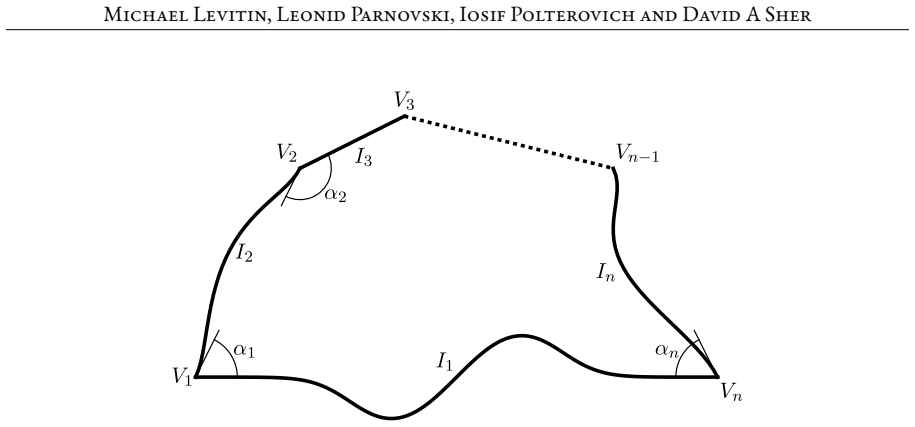
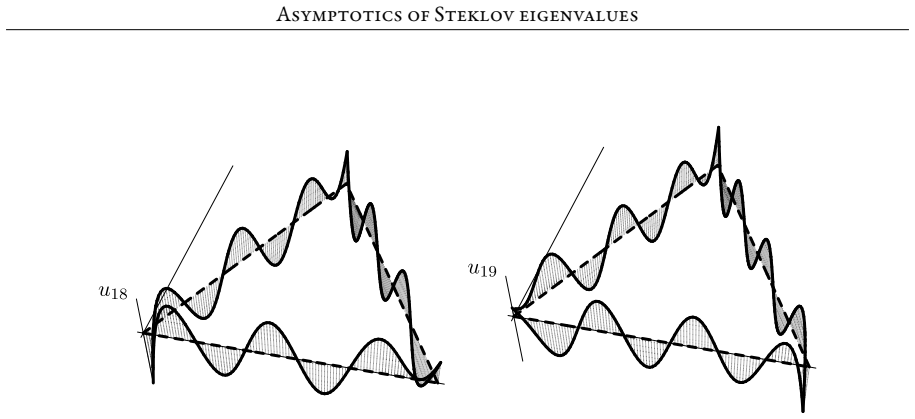
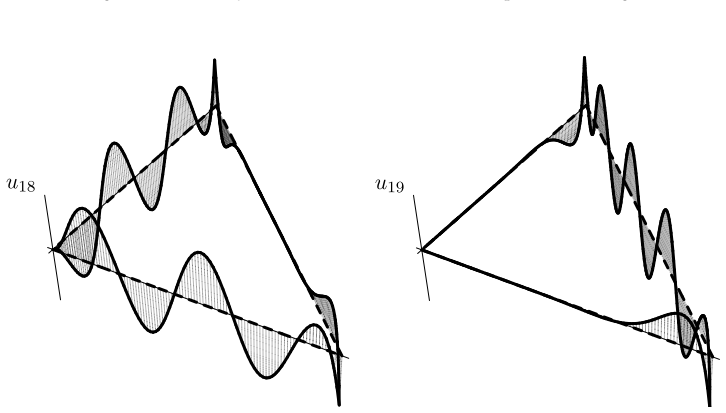
For any curvilinear polygon P with side lengths ℓ and angles α, the Steklov eigenvalues λ_m satisfy λ_m = σ_m + O($m^{{-ε}}$) for some ε>0 depending only on the angles, where σ_m is an explicitly defined sequence of quasi-eigenvalues. The quasi-eigenvalues are defined through products of 2×2 vertex transfer matrices A(α) and side transfer matrices B(ℓ,σ), equivalently as roots of trigonometric polynomials, and also as the square roots of eigenvalues of a quantum graph Laplacian on the boundary with angle-dependent matching conditions. The same construction gives asymptotic control of eigenfunctions: on each side, the boundary trace of u_m is, up to O($m^{{-ε}}$) in $L^{2}$, a trigonometric function of frequency σ_m. The arithmetic dichotomy is sharp: if all angles are special (π/(2k+1)), traces equidistribute; if all angles are exceptional (π/(2k)), each trace concentrates on one side, with a splitting of exceptional components governing which side.
Load-bearing premise
The construction assumes the sector scattering solutions from the earlier sloshing analysis exist with decay rate r = π/α; if those solutions decay more slowly or do not exist, the polygon quasimodes would not be nearly harmonic and the O($m^{{-ε}}$) error would fail.
Editorial extensions
If this is right
- Two curvilinear polygons with the same angles and the same side lengths have Steklov spectra that differ only by O(m^{-ε}), so spectra encode the geometry at this resolution.
- The Weyl law N(λ) = |∂P|/π λ + O(1) and the Riesz mean R(λ) = |∂P|/(2π) λ² + O(λ^{1-ε}) hold for all curvilinear polygons with angles less than π.
- If all angles are special, the quasi-eigenvalues form periodic arithmetic progressions with double multiplicity, matching the smooth-domain pattern; even special angles can be removed without changing quasi-eigenvalues.
- If all angles are exceptional, eigenfunctions concentrate on one side, whereas all-special angles force equidistribution on the boundary.
- Quasi-eigenvalues can be computed explicitly as roots of trigonometric polynomials, giving a practical numerical recipe for the Steklov spectrum of cornered domains.
Reading between the lines
- The quantum-graph formulation suggests an inverse spectral program: since the quasi-eigenvalues are determined by side lengths and angles, a sufficiently long Steklov spectrum should in principle recover the polygon's geometry, as the authors indicate they plan to pursue.
- The exceptional-angle concentration phenomenon could be tested experimentally in sloshing tanks with wedge-shaped corners: the free-surface eigenfunctions would localize on alternating walls depending on angle parity.
- The transfer-matrix enumeration machinery may extend to higher-order Weyl corrections for polygons with rational angle ratios, where the lifts on the universal cover become periodic and a full asymptotic expansion might exist.
- The same construction could be adapted to mixed Dirichlet-Neumann Steklov problems on keyhole domains and other non-simply connected configurations, following the paper's remark on conformal maps.
Signed reviews
Editorial analysis
A structured set of objections, weighed in public.
Referee Report
Summary. The paper studies the asymptotic distribution of Steklov eigenvalues and eigenfunctions on curvilinear polygons, i.e., domains with smooth sides and corners of angle strictly between 0 and π. The main result (Theorem 1.4) asserts that the Steklov eigenvalues λ_m can be approximated, up to an error O(m^{-ε}), by a sequence of quasi-eigenvalues σ_m defined purely in terms of the side lengths and angles via vertex and side transfer matrices. The paper also proves a companion statement (Theorem 1.7) on the trigonometric form of boundary traces of eigenfunctions, and describes qualitatively different behaviour for polygons all of whose angles are 'special' (equidistribution) versus all 'exceptional' (concentration on a subset of sides). The proofs combine scattering Peters solutions in sectors, a quasimode construction, a delicate enumeration argument for quasi-eigenvalues, layer potential estimates for curved boundaries, and numerical illustrations.
Significance. If the results are fully established, this is a major contribution to the spectral geometry of non-smooth domains. The paper gives, for the first time, asymptotics with error tending to zero for Steklov eigenvalues of polygons, and reveals a surprising dependence on arithmetic properties of the angles. The quasi-eigenvalues are defined entirely from the geometry, with no reference to the actual Steklov spectrum, so the argument is not circular. The paper also provides a clean quantum-graph interpretation and, in Section 9, numerical benchmarks that confirm the formulas in concrete examples, including the equilateral triangle, the right isosceles triangle, and regular polygons. The proofs are detailed and mostly self-contained; the exceptional-angle enumeration is the one part that needs further support.
major comments (2)
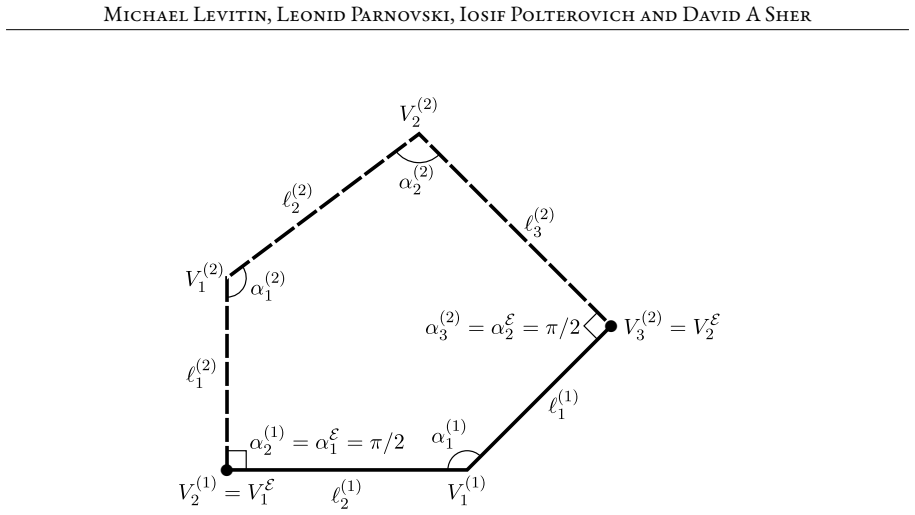
- [5.7, Theorem 5.31 and Proposition 5.32] The proof of the exceptional-case enumeration theorem is incomplete in a way that affects the central claim. After Definition 5.30, the text states that Theorem 5.31 is proved 'similarly to Theorem 2.39' and says 'we outline the main steps ... leave the details to the reader.' Proposition 5.32, which is the base case for two equal straight sides with an exceptional angle, is dismissed with the sentence that the result follows 'by explicitly computing the total loss of quasi-eigenvalues' using [LPPS17]; however, no computation is shown. Since Theorem 5.35 (exceptional polygons) and hence Theorem 1.4 for any polygon with an exceptional angle rely on this enumeration, a parity or sign error in the omitted total-loss computation would change the constant or the index shift between σ_m and λ_m. Please provide the full computation for Proposition 5.32, or at least an explicit derivation of the total-loss formula and its comparison with Definition 5.30.
- [5.7, Propositions 5.33 and 5.34] The gluing propositions for exceptional components are introduced with 'a straightforward adaptation of the proof of Proposition 5.13', but no proof or even a precise statement of the required adaptation is given. These propositions are load-bearing for Theorem 5.31: they propagate the natural enumeration from the basic two-sided case to arbitrary exceptional zigzags, and the half-integer counting functions in Definition 5.30 make the correctness of this propagation non-obvious. Please either give the detailed proofs of Propositions 5.33 and 5.34 or state them as lemmas with the relevant analogue of Lemma 5.13 and its proof.
minor comments (3)
- [2.7, Proposition 2.41] The proof of Proposition 2.41 is omitted with the note that it is 'almost identical' to that of Proposition 2.27. Since this proposition is used later in the proof of Theorem 4.30 for zigzag domains, a brief indication of the differences (e.g., the treatment of the endpoint conditions) would help the reader verify the result without reconstructing the whole argument.
- [9, numerical examples] The numerical tests in Section 9 mostly concern symmetric cases such as the right isosceles triangle or regular polygons, where high multiplicities make index shifts less sensitive. Adding a numerical example with mixed-parity exceptional angles and incommensurable side lengths, where the half-integer shifts in Definition 5.30 are individually observable, would provide additional confidence in the exceptional-case enumeration.
- [2.6, Theorem 2.31] The notation in Theorem 2.31 uses both ε0 (from Theorem 1.4) and a parameter written as '~ε'; the relation between the two is stated but could be made clearer by explicitly defining the admissible range for the exponent in the error term.
Circularity Check
No circularity: quasi-eigenvalues are geometric definitions, and the comparison to Steklov eigenvalues uses quasimode construction and independent sloshing results.
full rationale
The paper's central objects, the quasi-eigenvalues σ_m, are defined purely from the side lengths and angles of the polygon through the vertex and side transfer matrices (Definitions 2.3, 2.10); no Steklov eigenvalue or eigenfunction is used in their definition. Theorem 1.4 is then obtained by an explicit quasimode construction (Section 4) followed by a separate enumeration argument (Section 5) that compares zigzag problems to the sloshing problem asymptotics of [LPPS17]. The reliance on [LPPS17] is substantial but not circular: it is a prior published theorem about a different mixed boundary value problem, not a restatement of the Steklov result being proved, and it is not fitted to the present paper's data. The quantum graph reformulation is presented as an equivalent characterization, not as the source of the quasimode approximation. The main gap noted by a skeptical reader is that the exceptional-angle enumeration (Theorem 5.31, Proposition 5.32) is outlined rather than fully proved; this is a completeness or correctness concern, not a circularity. No equation reduces to its own input by definition, no fitted parameter is renamed as a prediction, and no load-bearing uniqueness assertion is imported solely from the authors' prior work. The derivation chain is therefore self-contained in the sense relevant here, so the circularity score is 0.
Assumptions & free parameters
assumptions (5)
- domain assumption The boundary of the domain is piecewise C^5 (or at least C^M with M>=3) with internal angles alpha_j in (0,pi), and the domain is simply connected.
- domain assumption Peters solutions for sloping beach problems exist with the decay rates stated in [LPPS17, Theorem 2.1]; in particular the remainder in the sector satisfies |R| + rho |grad R| <= C rho^{-r} with r = mu.
- standard math The quantum graph Laplacian Weyl law N(sigma) = (|boundary|/pi) sigma + O(1) applies to the quasi-eigenvalue counting function.
- domain assumption Layer potential operators on curvilinear polygons have kernel estimates sufficient to compare the Dirichlet-to-Neumann map of a curved side with a straight side (following Costabel [Cos83]).
- standard math The Riemann mapping theorem provides conformal maps Theta_j near vertices in the Hoelder class C^{1,gamma} for every gamma < 1.
invented entities (3)
-
Quasi-eigenvalues sigma_m
independent evidence
-
Vertex transfer matrix A(alpha) and side transfer matrix B(ell,sigma)
independent evidence
-
Scattering Peters solutions Phi(h_in,h_out)_alpha
independent evidence
Cite this review
Pith. "Pith review of Sloshing, Steklov and corners: Asymptotics of Steklov eigenvalues for curvilinear polygons." pith.science (2026). https://pith.science/paper/5ZY2QWZR
@misc{pith2026190806455,
  author       = {Pith},
  title        = {Pith review of: Sloshing, Steklov and corners: Asymptotics of Steklov eigenvalues for curvilinear polygons},
  year         = {2026},
  howpublished = {\url{https://pith.science/paper/5ZY2QWZR}},
  note         = {Machine review of arXiv:1908.06455}
}
read the original abstract
We obtain asymptotic formulae for the Steklov eigenvalues and eigenfunctions of curvilinear polygons in terms of their side lengths and angles. These formulae are quite precise: the errors tend to zero as the spectral parameter tends to infinity. The Steklov problem on planar domains with corners is closely linked to the classical sloshing and sloping beach problems in hydrodynamics; as we show it is also related to quantum graphs. Somewhat surprisingly, the arithmetic properties of the angles of a curvilinear polygon have a significant effect on the boundary behaviour of the Steklov eigenfunctions. Our proofs are based on an explicit construction of quasimodes. We use a variety of methods, including ideas from spectral geometry, layer potential analysis, and some new techniques tailored to our problem.
Figures
Figures from the paper (20 more)







Reference graph
Works this paper leans on
-
[1]
M. S. Agranovich, On a mixed Poincare-Steklov type spectral problem in a Lipschitz domain, Russ. J. Math. Phys. 13(3), 281--290 (2006)
work page 2006
-
[2]
M. S. Agranovich, Mixed problems in a Lipschitz domain for strongly elliptic second-order systems, Func. Anal. Appl. 45(2), 81--98 (2011)
work page 2011
-
[3]
Wave Enhancement through Optimization of Boundary Conditions
H. Ammari, O. Bruno, K. Imeri, and N. Nigam, Wave enhancement through optimization of boundary conditions, arXiv:1907.11170
work page Pith review arXiv 1907
-
[4]
Optimization of Steklov-Neumann eigenvalues
H. Ammari, K. Imeri, and N. Nigam, Optimization of Steklov-Neumann eigenvalues, arXiv:1907.11147
work page Pith review arXiv 1907
-
[5]
G. Berkolaiko, An elementary introduction to quantum graphs, in Geometric and Computational Spectral Theory, eds. A. Girouard, D. Jakobson, M. Levitin, N. Nigam, I. Polterovich, and F. Rochon, Contemporary Mathematics 700 , American Mathematical Society, Providence, Rhode Island and Centre de Recherches Math\' e matique, Montr\' e al, Qu\' e bec, 2017, 41--72
work page 2017
-
[6]
G. Berkolaiko and P. Kuchment, Introduction to quantum graphs, Mathematical Surveys and Monographs 186 , American Mathematical Society, Providence, Rhode Island, 2013
work page 2013
-
[7]
J. Bolte and S. Endres, The trace formula for quantum graphs with general self adjoint boundary conditions , Ann. Henri Poincar\'e 10, 189--223 (2009)
work page 2009
-
[8]
Brown, The mixed problem for Laplace's equation in a class of Lipschitz domains, Comm
R. Brown, The mixed problem for Laplace's equation in a class of Lipschitz domains, Comm. PDEs. 19(7--8), 1217--1233 (1994)
work page 1994
Show all 50 references
-
[9]
Costabel, Boundary integral operators on curved polygons, Ann
M. Costabel, Boundary integral operators on curved polygons, Ann. Mat. Pur. Appl. 133(1), 305--326 (1983)
1983
-
[10]
Davis, Short surface waves in a canal: dependence of frequency on the curvatures and their derivatives , Q
A.M.J. Davis, Short surface waves in a canal: dependence of frequency on the curvatures and their derivatives , Q. J. Mech. Appl. Math. 27 , 523--535 (1974)
1974
-
[11]
Duclos, P
P. Duclos, P. Exner, and P. S t ov\' c ek, Curvature-induced resonances in a two-dimensional Dirichlet tube, Annales de l'I.H.P. Section A 62(1), 81--101 (1995)
1995
-
[12]
Edward, An inverse spectral result for the Neumann operator on planar domains, J
J. Edward, An inverse spectral result for the Neumann operator on planar domains, J. Func. Anal. 111, 312--322 (1993)
1993
-
[13]
S. A. Fulling, P. Kuchment, and J. H. Wilson, Index theorems for quantum graphs, J. Phys. A 40 14165--14180 (2007)
2007
-
[14]
E. M. Garau and P. Morin, Convergence and quasi-optimality of adaptive FEM for Steklov eigenvalue problems, IMA J. Num. Anal. 31(3), 914--946 (2011)
2011
-
[15]
Gilkey, The spectral geometry of the higher order Laplacian , Duke Math
P. Gilkey, The spectral geometry of the higher order Laplacian , Duke Math. J. 47(3), 511--528 (1980)
1980
-
[16]
Girouard, J
A. Girouard, J. Lagac\'e, I. Polterovich and A. Savo, The Steklov spectrum of cuboids , Mathematika 65(2), 272--310 (2019)
2019
-
[17]
Girouard, L
A. Girouard, L. Parnovski, I. Polterovich, and D. Sher, The Steklov spectrum of surfaces: asymptotics and invariants , Math. Proc. Cambridge Philos. Soc. 157(3), 379--389 (2014)
2014
-
[18]
Girouard and I
A. Girouard and I. Polterovich, Spectral geometry of the Steklov problem, J. Spectral Theory 7(2), 321--359 (2017)
2017
-
[19]
Gordon, P
C. Gordon, P. Herbrich, and D. Webb, Robin and Steklov isospectral manifolds, arXiv:1808.10741
-
[20]
Grubb and R
G. Grubb and R. Seeley, Zeta and eta functions for Atiyah-Patodi-Singer operators , J. Geom. Anal. 6(1), 31--77 (1996)
1996
-
[21]
Hecht, New development in FreeFem++ , J
F. Hecht, New development in FreeFem++ , J. Numer. Math. 20(3-4), 251--266 (2012)
2012
-
[22]
Ivrii, Spectral asymptotics for Dirichlet to Neumann operator , arXiv:1802.07524
V. Ivrii, Spectral asymptotics for Dirichlet to Neumann operator , arXiv:1802.07524
-
[23]
Khalile, Spectral asymptotics for Robin Laplacians on polygonal domains , J
M. Khalile, Spectral asymptotics for Robin Laplacians on polygonal domains , J. Math. Anal. Appl. 461, 1498--1543 (2018)
2018
-
[24]
Khalile, T
M. Khalile, T. Ourmi\`eres-Bonafos and K. Pankrashkin, Effective operator for Robin eigenvalues in domains with corners , arXiv:1809.04998
-
[25]
Kottos and U
T. Kottos and U. Smilansky, Periodic orbit theory and spectral statistics for quantum graphs , Ann. Physics 274, 76--124 (1999)
1999
-
[26]
Kuchment and L
P. Kuchment and L. A. Kunyansky, Spectral properties of high contrast band-gap materials and operators on graphs , Exp. Math. 8(1), 1--28 (1999)
1999
-
[27]
Kuchment and L
P. Kuchment and L. Kunyansky, Differential operators on graphs and photonic crystals , Adv. in Comput. Math. 16, 263--290 (2002)
2002
-
[28]
Kurasov, Private communication , (2019)
P. Kurasov, Private communication , (2019)
2019
-
[29]
Kurasov and M
P. Kurasov and M. Nowaczyk, Geometric properties of quantum graphs and vertex scattering matrices , Opus. Math. 30(3), 295--309 (2010)
2010
-
[30]
Laptev and A
A. Laptev and A. Hassannezhad, Eigenvalue bounds of mixed Steklov problems , arXiv:1712.00753
-
[31]
Levitin, A very brief introduction to eigenvalue computations with FreeFem++ , electronic notes available at http://michaellevitin.net/FreeFem++.html (2018)
M. Levitin, A very brief introduction to eigenvalue computations with FreeFem++ , electronic notes available at http://michaellevitin.net/FreeFem++.html (2018)
2018
-
[32]
Levitin, L
M. Levitin, L. Parnovski, and I. Polterovich, Isospectral domains with mixed boundary conditions, J. Phys. A: Math. Gen. 39, 2073--2082 (2006)
2006
-
[33]
Levitin, L
M. Levitin, L. Parnovski, I. Polterovich, and D. Sher, Sloshing, Steklov and corners: Asymptotics of sloshing eigenvalues , arXiv:1709.01891
-
[34]
Matou s ek, Lectures on discrete geometry , Graduate Texts in Mathematics 212, Springer-Verlag, New York, 2002
J. Matou s ek, Lectures on discrete geometry , Graduate Texts in Mathematics 212, Springer-Verlag, New York, 2002
2002
-
[35]
Mazzeo and J
R. Mazzeo and J. Rowlett, A heat trace anomaly on polygons , Math. Proc. Cambridge Philos. Soc. 159(2), 303--319 (2015)
2015
-
[36]
L. G. Molinari, Determinants of block tridiagonal matrices , Lin. Algebra Applic. 429, 2221--2226 (2008)
2008
-
[37]
Nursultanov, J
M. Nursultanov, J. Rowlett and D. Sher, The heat kernel on curvilinear polygonal domains in surfaces , arXiv:1905.00259
1905 arXiv
-
[38]
McLean, Strongly elliptic systems and boundary integral equations , Cambridge University Press, 2000
W. McLean, Strongly elliptic systems and boundary integral equations , Cambridge University Press, 2000
2000
-
[39]
Perfekt and M
K.-M. Perfekt and M. Putinar, Spectral bounds for the Neumann-Poincar\'e operator on planar domains with corners , J. d'Anal. Math. 124(1) , 39--57 (2014)
2014
-
[40]
A. S. Peters, The effect of a floating mat on water waves, Comm. Pure and Appl. Math. 3(4), 319--354 (1950)
1950
-
[41]
Polterovich and D
I. Polterovich and D. Sher, Heat invariants of the Steklov problem , J. Geom. Anal. 25(2), 924--950 (2015)
2015
-
[42]
Polterovich, D
I. Polterovich, D. Sher, and J. Toth, Nodal length of Steklov eigenfunctions on real-analytic Riemannian surfaces , J. Reine Angew. Math. 754, 17--47 (2019)
2019
-
[43]
Rellich, Perturbation theory of eigenvalue problems , Courant Inst
F. Rellich, Perturbation theory of eigenvalue problems , Courant Inst. Math. Sci., New York (1954)
1954
-
[44]
Rondi, Continuity properties of Neumann-to-Dirichlet maps with respect to the H -convergence of the coefficient matrices , Inverse Problems 31, 045002 (2015)
L. Rondi, Continuity properties of Neumann-to-Dirichlet maps with respect to the H -convergence of the coefficient matrices , Inverse Problems 31, 045002 (2015)
2015
-
[45]
G. V. Rozenblyum, On the asymptotics of the eigenvalues of certain two-dimensional spectral problems , Sel. Math. Sov. 5, 233--244 (1986)
1986
-
[46]
Rueckriemen, Heat trace asymptotics for quantum graphs , arXiv:1212.2840
R. Rueckriemen, Heat trace asymptotics for quantum graphs , arXiv:1212.2840
-
[47]
Safarov, Riesz means of a function of the distribution of the eigenvalues of an elliptic operator , Zap
Yu. Safarov, Riesz means of a function of the distribution of the eigenvalues of an elliptic operator , Zap. Nauchn. Sem. Leningrad. Otdel. Mat. Inst. Steklov. (LOMI) 163, 143--145 (1987) (Russian); translation in J. Soviet Math. 49(5), 1210--1212 (1990)
1987
-
[48]
Taylor, Partial Differential Equations II: Qualitative Studies of Linear Equations , Springer, New York, 1996
M. Taylor, Partial Differential Equations II: Qualitative Studies of Linear Equations , Springer, New York, 1996
1996
-
[49]
Ursell, Short surface waves in a canal: dependence of frequency on curvature , J
F. Ursell, Short surface waves in a canal: dependence of frequency on curvature , J. Fluid Mech. 63(1), 177--181 (1974)
1974
-
[50]
Verchota, Layer potentials and regularity for the Dirichlet problem for Laplace's equation in Lipschitz domains , J
G. Verchota, Layer potentials and regularity for the Dirichlet problem for Laplace's equation in Lipschitz domains , J. Func. Anal. 59, 572-611 (1984)
1984
Reviewed August 14, 2026 · model on record in the stance chip above.
Discussion (0). Continue with ORCID to comment.