REVIEW 5 major objections 3 minor 66 references
Collimated gamma-ray beams from structured laser-irradiated targets -- how to increase the efficiency without increasing the laser intensity
T0 review · 5 major / 3 minor · reviewed 2026-08-14 · deepseek-v4-flash
Pith's one-line read A pre-filled plasma channel makes a laser's gamma-ray conversion efficiency rise linearly with pulse power, even at fixed peak intensity.
desk verdict A new and plausible fixed-intensity power scaling for gamma-ray generation, but with only three PIC points and no pulse-shape robustness, it's a prediction to test, not a law. read the letter →
The pith
A machine-rendered reading of the paper's core claim, the machinery that carries it, and where it could break.
The reading
What carries the argument
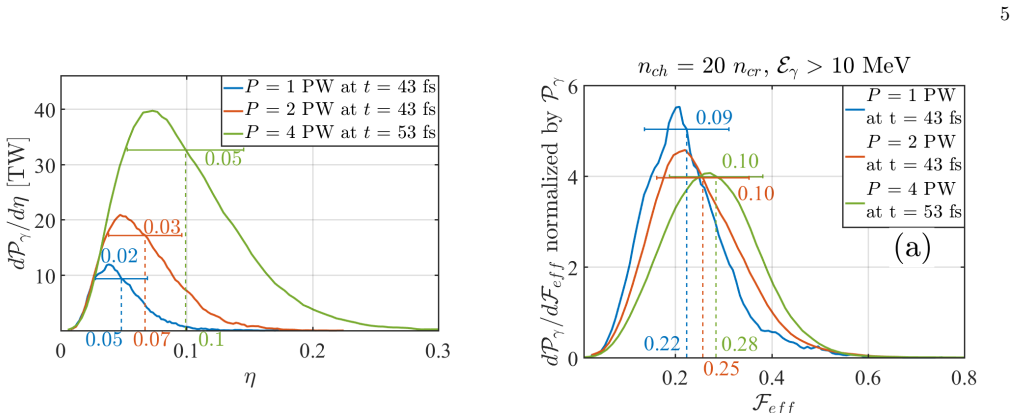
The load-bearing element is the pre-filled cylindrical channel: a plasma column at 10–20 $n_{\rm cr}$ surrounded by a 100 $n_{\rm cr}$ bulk, acting as an optical waveguide for the laser. As the pulse propagates, it drives a longitudinal electron current, which sustains a slowly evolving azimuthal magnetic field of hundreds of kilotesla; this field confines electrons radially, boosting their energy gain, and deflects them so they emit synchrotron gamma-rays. The emission rate is governed by the dimensionless parameter $\eta$, with radiated power proportional to $\eta^2$; the power scan works because both the average $\eta$ of emitting electrons and the number of such electrons increase with $P$.
What would settle it
Measure the conversion efficiency into a 5° cone of $E_\gamma>1$ MeV photons at 1, 2, and 4 PW, keeping peak intensity at $5\times10^{22}\ \mathrm{W/cm^2}$, pulse duration 35 fs, and channel density at 20 $n_{\rm cr}$; if the efficiency does not rise roughly linearly with $P$ (photon number scaling as $P^2$), the claimed scaling fails. Even a single simulation with an experimentally measured temporal pulse profile at 4 PW, compared with 1 PW, would test whether the scaling survives realistic pulses.
Extended reading notes
Core claim
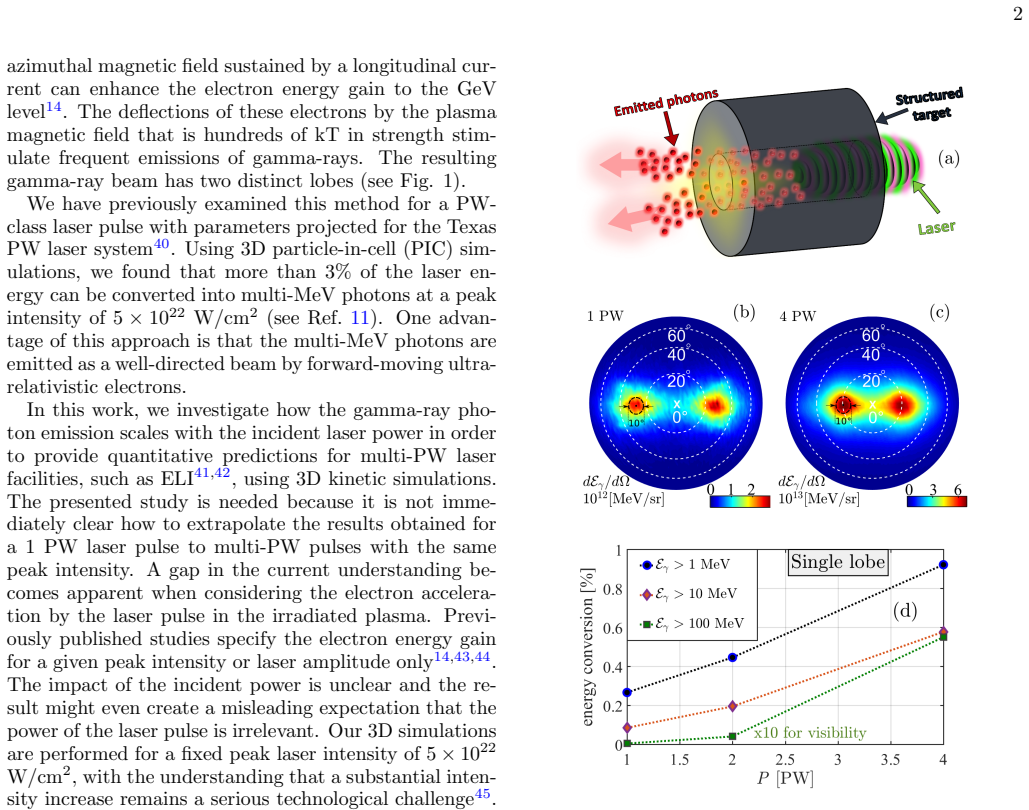
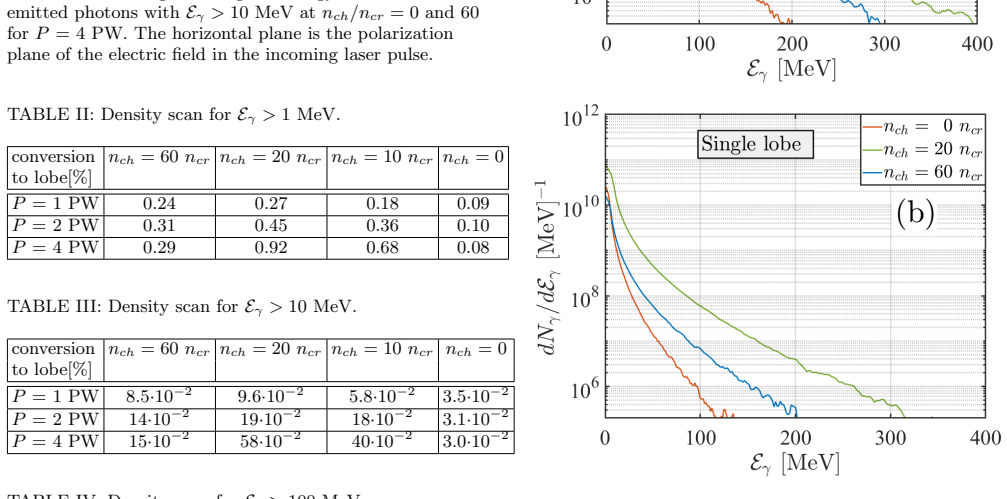
The paper's central discovery is a scaling law: with a properly pre-filled channel (electron density 10–20 $n_{\rm cr}$) in a solid-density target, the conversion efficiency of laser energy into multi-MeV gamma-rays inside a 5° cone grows roughly linearly with incident laser power $P$ while peak intensity is held at $5\times10^{22}\ \mathrm{W/cm^2}$; in the simulations, efficiency for $E_\gamma>1$ MeV rises from 0.27% at 1 PW to 0.92% at 4 PW, and emitted multi-MeV power reaches 143 TW. The mechanism is the laser-driven quasi-static azimuthal magnetic field in the channel, which both enhances electron acceleration (via transverse confinement) and forces synchrotron emission; particle tracking shows that the per-electron emission, measured by the parameter $\eta$ with synchrotron power $\propto\eta^2$, increases with $P$, and the number of properly directed emitting electrons also increases. Empty channels stay nearly flat in efficiency with power, and overdense 60 $n_{\rm cr}$ channels lose collimation, so the optimal density window is a genuine requirement. As a corollary, the number of photons scales as $P^2$, and photon-photon pair production in two colliding beams scales as $P^4$.
Load-bearing premise
The central scaling result rests on idealized 35-fs Gaussian pulses at one wavelength with a fixed peak intensity of $5\times10^{22}\ \mathrm{W/cm^2}$; if real multi-PW pulses differ in temporal shape, the roughly linear efficiency growth may not hold, and the authors themselves caution that quantitative predictions require an experimentally measured pulse profile.
Editorial extensions
If this is right
- At fixed peak intensity of $5\times10^{22}\ \mathrm{W/cm^2}$, increasing power from 1 PW to 4 PW raises the 5°-cone multi-MeV conversion efficiency roughly linearly (e.g., from 0.27% to 0.92% for $E_\gamma>1$ MeV at $n_{\rm ch}=20n_{\rm cr}$).
- The number of multi-MeV photons in one lobe grows as $P^2$ ($1.5\times10^{11}$ at 1 PW, $4.2\times10^{11}$ at 2 PW, $2.8\times10^{12}$ at 4 PW), and emitted multi-MeV power into a 5° cone reaches 143 TW at 4 PW.
- Colliding two such beams at 90° through two-photon pair production gives a pair yield scaling as $P^4$ at fixed geometry: about 15 pairs at 1 PW, 140 at 2 PW, and 3700 at 4 PW for $d=500~\mu$m.
- The scaling requires pre-filled channels in the broad optimal window of 10–20 $n_{\rm cr}$; empty channels and 60 $n_{\rm cr}$ channels show no comparable power increase, so prefilled target fabrication is the practical prerequisite.
Reading between the lines
- Beyond the paper: if the $P^4$ pair scaling extrapolates, a ~10 PW-class shot would produce on the order of $10^5$ pairs in the same 500 $\mu$m collision geometry, making laboratory studies of photon-photon pair creation accessible; the paper computes up to 4 PW only.
- Beyond the paper: because the scan enlarges the channel radius as $\sqrt{P}$ simultaneously with power, the separate roles of radius and power are not isolated; varying the channel size alone at fixed $P$ would test whether the mechanism is geometric confinement or power-driven current.
- Beyond the paper: the authors' warning that empty-channel collimation depends sensitively on pulse shape suggests the filled-channel scaling should also be checked against experimentally measured temporal profiles before facility planning; the paper does not perform that check.
Signed reviews
Editorial analysis
A structured set of objections, weighed in public.
Referee Report
Summary. The manuscript reports 3D PIC (EPOCH) simulations of an intense laser pulse guided by a pre-filled cylindrical channel in a structured target. The authors find that, at fixed peak intensity 5×10^22 W/cm^2, increasing the incident power from 1 to 4 PW by enlarging the focal spot and channel radius improves the conversion efficiency into a 5° gamma-ray lobe, with the number of multi-MeV photons scaling as P^2 and the number of electron-positron pairs produced in colliding gamma-ray beams scaling as P^4. The paper attributes the improvement to stronger quasi-static azimuthal magnetic fields and better electron confinement in the wider channel, and it presents a density scan indicating optimal channel densities around 10–20 n_cr.
Significance. If the scaling holds, it is a practically relevant design rule for multi-PW laser facilities: it would decouple gamma-ray yield and pair-production rate from further intensity increases, and the estimate of 143 TW of collimated multi-MeV radiation is concrete and testable. The manuscript has genuine strengths: it uses a well-established PIC code with synchrotron emission, includes detailed photon-tracking diagnostics, verifies the pair-production calculation with a dedicated kinetic collision code for the 1 PW case, and explicitly identifies sensitivity to the laser temporal profile as a limitation of the empty-channel configuration. The central quantitative claims, however, rest on a small number of simulations without convergence tests or error estimates, so the significance is conditional on additional evidence.
major comments (5)
- [Sec. III, Fig. 1d, Tables II-IV] The 'roughly linear' efficiency scaling is based on only three values of P, giving two intervals, and the data are not uniformly consistent with a linear law. For n_ch=20 n_cr and E>10 MeV the 1→2 PW step is a factor ~2 while the 2→4 PW step is ~3; for E>100 MeV the steps are factors ~1.2 and ~14. This is more suggestive of a threshold effect than of a smooth P-linear scaling. Please either add intermediate power points (e.g., 3 PW) or explicitly downgrade the claim from 'scaling' to an empirical trend with stated uncertainty; at minimum, the abstract should be adjusted to refer to the E>1 MeV data only.
- [Table I, no convergence study] No resolution or particle-number convergence tests are reported. At n_ch=20 n_cr with 30 cells/µm, the electron skin depth is only about one cell, so the quantitative efficiency values, and in particular the factor-14 jump at E>100 MeV for the 4 PW case, could be sensitive to grid resolution. Since the 4 PW efficiency is the anchor of the scaling claim, a convergence study at least at one high-power point is needed.
- [Sec. IV, Tables II-IV] The optimal density range of 10–20 n_cr is inferred from only four channel densities (0, 10, 20, and 60 n_cr). With this sampling, '10 and 20 perform equally well' only shows that both are better than 0 and 60; it does not establish that 10–20 is a wide plateau of similar performance, nor that the true optimum lies in that interval rather than at, say, 30 n_cr. A denser scan (e.g., 15, 30, and 40 n_cr) or a fitted optimum would be needed to support the stated optimal range.
- [Sec. III B, Fig. 5] The conclusion that the number of emitting electrons increases faster than P relies on post-hoc selection of electrons within 0.5 R_ch of the axis and with momentum within a 25° cone, criteria taken from the emission pattern under study. As the authors note, a dedicated study is needed to identify the cause; as presented, the electron-counting argument is not an independent confirmation of the efficiency increase. Please either provide a less circular metric, such as emission-weighted counts or counts before selection, or present the selection explicitly as an illustrative diagnostic only.
- [Sec. VI, pulse-shape robustness] The paper explicitly states that empty-channel results are extremely sensitive to the laser temporal profile and require an experimentally measured profile, then asserts that pre-filled channels are 'robust' without reporting any test of that robustness. All scaling results use a single 35 fs Gaussian pulse at one wavelength and one intensity. Since the experimental and target-fabrication recommendations depend on the pre-filled channel performing under real laser pulses, a sensitivity study with different pulse durations or a measured temporal profile is necessary before the design rule can be considered quantitative.
minor comments (3)
- [Sec. V, Eq. (10)] The pair-production estimate assumes a uniform photon number density across the 5° cone and does not propagate the stated 25% uncertainty from truncating the spectrum at 1 MeV into the quoted P^4 exponent; a brief propagation of uncertainties would help readers judge the robustness of Table V.
- [Table I] The table heading 'Pulse duration (FHWM for intensity)' contains a typo and should read FWHM; additionally, giving the channel radius and focal-spot width explicitly in the table alongside P would aid reproducibility.
- [References] Ref. [14] is cited as an arXiv preprint; if a peer-reviewed version now exists, it should be updated, and similarly for Ref. [15].
Circularity Check
No significant circularity: the P-scaling results are empirical PIC findings, and the P^4 pair scaling is a derived consequence that is checked by direct spectral integration.
full rationale
The paper's central claim—conversion efficiency into a 5-degree gamma-ray lobe increases roughly linearly with P for 10-20 n_cr channels—is presented as an observed trend from three 3D PIC simulations, not as a first-principles derivation from assumed inputs. The renormalized emitted power Pγ = Plobe/P is a diagnostic normalization, not a circular construction. The electron-emission analysis uses standard synchrotron definitions (η, Feff, γe) and particle tracking to explain the trend. The pair-production scaling Npairs ∝ P^4 is derived by substituting the simulated Nγ ~ P^2 scaling into Eq. (10); this is a legitimate mathematical consequence, and the paper then independently checks it by integrating the Breit-Wheeler cross-section over the simulated photon spectra (Table V), obtaining a factor ~247 versus the 256 predicted by the scaling. No load-bearing step reduces to its own inputs by construction. The cited prior work by the same authors (e.g., Ref. [14]) is used for the acceleration mechanism, but the power trend itself is established by the present simulations. The Section VI caveat about temporal-profile sensitivity applies to initially empty channels and is stated as a limitation, not used to justify the filled-channel scaling. The three-point power scan is under-sampled and lacks convergence studies, but that is a robustness/correctness concern, not circularity.
Assumptions & free parameters
free parameters (3)
- photon number scaling exponent =
~2
- conversion efficiency scaling exponent =
~1
- optimal channel density =
10-20 n_cr
assumptions (4)
- domain assumption Relativistically induced transparency condition ne < a0 ncr holds and determines channel and bulk densities.
- domain assumption Classical synchrotron emission with a Monte Carlo algorithm (as implemented in EPOCH) accurately describes the gamma-ray emission in the simulated regime.
- domain assumption The plasma is initialized as fully ionized carbon and ionization dynamics are neglected in the parameter scans.
- ad hoc to paper Power scaling is parameterized by increasing the focal spot (w0 ~ sqrt(P)) with fixed pulse duration and fixed channel radius R_ch = 0.7 w0.
Cite this review
Pith. "Pith review of Collimated gamma-ray beams from structured laser-irradiated targets -- how to increase the efficiency without increasing the laser intensity." pith.science (2026). https://pith.science/paper/SBA37TZE
@misc{pith2026190806467,
  author       = {Pith},
  title        = {Pith review of: Collimated gamma-ray beams from structured laser-irradiated targets -- how to increase the efficiency without increasing the laser intensity},
  year         = {2026},
  howpublished = {\url{https://pith.science/paper/SBA37TZE}},
  note         = {Machine review of arXiv:1908.06467}
}
abstract
Using three-dimensional kinetic simulations, we examine the emission of collimated gamma-ray beams from structured laser-irradiated targets with a pre-filled cylindrical channel. The channel guides the incident laser pulse, enabling generation of a slowly evolving azimuthal plasma magnetic field that serves two key functions: to enhance laser-driven electron acceleration and to induce emission of gamma-rays by the energetic electrons. Our main finding is that the conversion efficiency of the laser energy into a beam of gamma-rays ($5^{\circ}$ opening angle) can be significantly increased without increasing the laser intensity by utilizing channels with an optimal density. The conversion efficiency into multi-MeV photons increases roughly linearly with the incident laser power $P$, as we increase $P$ from 1 PW to 4 PW while keeping the laser peak intensity fixed at $5 \times 10^{22}$ W/cm$^2$. This scaling is achieved by using an optimal range of plasma densities in the channel between 10 and $20 n_{cr}$, where $n_{cr}$ is the classical cutoff density for electromagnetic waves. The corresponding number of photons scales as $P^2$. One application that directly benefits from such a strong scaling is the pair production via two-photon collisions, with the number of generated pairs increasing as $P^4$ at fixed laser intensity.
Figures

Figures from the paper (11 more)




Reference graph
Works this paper leans on
-
[1]
author author C. Pellegrini , author A. Marinelli , \ and\ author S. Reiche ,\ 10.1103/RevModPhys.88.015006 journal journal Reviews of Modern Physics \ volume 88 ,\ pages 015006 ( year 2016 ) NoStop
-
[2]
author author C. Pellegrini ,\ 10.1088/1402-4896/aa5281 journal journal Physica Scripta \ volume T169 ,\ pages 014004 ( year 2016 ) NoStop
-
[3]
author author E. Schneidmiller \ and\ author M. Yurkov ,\ in\ https://doi.org/10.18429/JACoW-FEL2017-MOP033 booktitle Proc. of International Free Electron Laser Conference (FEL'17), Santa Fe, NM, USA, August 20-25, 2017 ,\ series and number number 38 \ ( publisher JACoW ,\ year 2018 )\ pp.\ pages 109--112 NoStop
-
[4]
author author J. Bahrdt \ and\ author E. Gluskin ,\ 10.1016/j.nima.2018.03.069 journal journal Nuclear Instruments and Methods in Physics Research Section A: Accelerators, Spectrometers, Detectors and Associated Equipment \ volume 907 ,\ pages 149 ( year 2018 ) NoStop
-
[5]
author author B. F. \ Lasinski , author A. B. \ Langdon , author S. P. \ Hatchett , author M. H. \ Key , \ and\ author M. Tabak ,\ 10.1063/1.873496 journal journal Physics of Plasmas \ volume 6 ,\ pages 2041 ( year 1999 ) NoStop
-
[6]
author author S. Bulanov , author V. Bychenkov , author V. Chvykov , author G. Kalinchenko , author D. Litzenberg , author T. Matsuoka , author A. Thomas , author L. Willingale , author V. Yanovsky , author K. Krushelnick , et al. ,\ 10.1063/1.3372840 journal journal Physics of Plasmas \ volume 17 ,\ pages 043105 ( year 2010 ) NoStop
-
[7]
author author S. Palaniyappan , author B. Hegelich , author H. Wu , author D. Jung , author D. Gautier , author L. Yin , author B. Albright , author R. Johnson , author T. Shimada , author S. Letzring , et al. ,\ 10.1038/nphys2390 journal journal Nature Physics \ volume 8 ,\ pages 763 ( year 2012 ) NoStop
-
[8]
author author D. Stark , author C. Bhattacharjee , author A. Arefiev , author T. Toncian , author R. D. \ Hazeltine , \ and\ author S. Mahajan ,\ 10.1103/PhysRevLett.115.025002 journal journal Physical Review Letter \ volume 115 ,\ pages 025002 ( year 2015 ) NoStop
Show all 66 references
-
[9]
Fern \'a ndez , author C
author author J. Fern \'a ndez , author C. Gautier , author C. Huang , author S. Palaniyappan , author B. Albright , author W. Bang , author G. Dyer , author A. Favalli , author J. Hunter , author J. Mendez , et al. ,\ 10.1063/1.4983991 journal journal Physics of Plasmas \ vol...
-
[10]
Nakamura , author S
author author T. Nakamura , author S. Bulanov , author T. Esirkepov , \ and\ author M. Kando ,\ 10.1103/PhysRevLett.105.135002 journal journal Physical Review Letters \ volume 105 ,\ pages 135002 ( year 2010 ) NoStop
2010 doi
-
[11]
Stark , author T
author author D. Stark , author T. Toncian , \ and\ author A. Arefiev ,\ 10.1103/PhysRevLett.116.185003 journal journal Physical Review Letters \ volume 116 ,\ pages 185003 ( year 2016 ) NoStop
2016 doi
-
[12]
Jansen , author T
author author O. Jansen , author T. Wang , author D. Stark , author E. d'Humi\`eres , author T. Toncian , \ and\ author A. Arefiev ,\ http://stacks.iop.org/0741-3335/60/i=5/a=054006 journal journal Plasma Physics and Controlled Fusion \ volume 60 ,\ pages 054006 ( year 2018 a ) NoStop
2018
-
[13]
Wang , author T
author author T. Wang , author T. Toncian , author M. S. \ Wei , \ and\ author A. V. \ Arefiev ,\ 10.1063/1.5066109 journal journal Physics of Plasmas \ volume 26 ,\ pages 013105 ( year 2019 a ) NoStop
2019 doi
-
[14]
Gong , author F
author author Z. Gong , author F. Mackenroth , author T. Wang , author X. Yan , author T. Toncian , \ and\ author A. Arefiev ,\ https://arxiv.org/abs/1811.00425 journal journal arXiv preprint, arXiv:1811.00425 \ ( year 2018 ) NoStop
2018 arXiv
-
[15]
Gong , author F
author author Z. Gong , author F. Mackenroth , author X. Yan , \ and\ author A. Arefiev ,\ https://arxiv.org/abs/1905.02152 journal journal arXiv preprint, arXiv:1905.02152 \ ( year 2019 a ) NoStop
1905 arXiv
-
[16]
Liu , author H
author author B. Liu , author H. Wang , author J. Liu , author L. Fu , author Y. Xu , author X. Yan , \ and\ author X. He ,\ 10.1103/PhysRevLett.110.045002 journal journal Physical Review Letters \ volume 110 ,\ pages 045002 ( year 2013 ) NoStop
-
[17]
Vranic , author R
author author M. Vranic , author R. Fonseca , \ and\ author L. Silva ,\ 10.1088/1361-6587/aaa36c journal journal Plasma Physics and Controlled Fusion \ volume 60 ,\ pages 034002 ( year 2018 ) NoStop
2018 doi
-
[18]
Nakamura , author J
author author T. Nakamura , author J. Koga , author T. Esirkepov , author M. Kando , author G. Korn , \ and\ author S. Bulanov ,\ 10.1103/PhysRevLett.108.195001 journal journal Physical Review Letter \ volume 108 ,\ pages 195001 ( year 2012 ) NoStop
-
[19]
Ridgers , author C
author author C. Ridgers , author C. Brady , author R. Duclous , author J. Kirk , author K. Bennett , author T. Arber , author A. Robinson , \ and\ author A. Bell ,\ 10.1103/PhysRevLett.108.165006 journal journal Physical Review Letters \ volume 108 ,\ pages 165006 ( year 2012...
-
[20]
Brady , author C
author author C. Brady , author C. Ridgers , author T. Arber , author A. Bell , \ and\ author J. Kirk ,\ 10.1103/PhysRevLett.109.245006 journal journal Physical Review Letters \ volume 109 ,\ pages 245006 ( year 2012 ) NoStop
2012 doi
-
[21]
Ridgers , author C
author author C. Ridgers , author C. Brady , author R. Duclous , author J. Kirk , author K. Bennett , author T. Arber , \ and\ author A. Bell ,\ 10.1063/1.4801513 journal journal Physics of Plasmas \ volume 20 ,\ pages 056701 ( year 2013 ) NoStop
-
[22]
Ji , author A
author author L. Ji , author A. Pukhov , author I. Kostyukov , author B. Shen , \ and\ author K. Akli ,\ 10.1103/PhysRevLett.112.145003 journal journal Physical Review Letters \ volume 112 ,\ pages 145003 ( year 2014 a ) NoStop
2014 doi
-
[23]
Ji , author A
author author L. Ji , author A. Pukhov , author E. Nerush , author I. Y. \ Kostyukov , author B. Shen , \ and\ author K. Akli ,\ 10.1063/1.4866014 journal journal Physics of Plasmas \ volume 21 ,\ pages 023109 ( year 2014 b ) NoStop
2014 doi
-
[24]
Blackburn , author C
author author T. Blackburn , author C. P. \ Ridgers , author J. G. \ Kirk , \ and\ author A. Bell ,\ 10.1103/PhysRevLett.112.015001 journal journal Physical Review Letters \ volume 112 ,\ pages 015001 ( year 2014 ) NoStop
2014 doi
-
[25]
Li , author K
author author J. Li , author K. Hatsagortsyan , author B. Galow , \ and\ author C. Keitel ,\ 10.1103/PhysRevLett.115.204801 journal journal Physical Review Letters \ volume 115 ,\ pages 204801 ( year 2015 ) NoStop
2015 doi
-
[26]
Chang , author B
author author H. Chang , author B. Qiao , author T. Huang , author Z. Xu , author C. Zhou , author Y. Gu , author X. Yan , author M. Zepf , \ and\ author X. He ,\ 10.1038/srep45031 journal journal Scientific Reports \ volume 7 ,\ pages 45031 ( year 2017 ) NoStop
-
[27]
Huang , author C
author author T. Huang , author C. Zhou , author H. Zhang , author S. Wu , author B. Qiao , author X. He , \ and\ author S. Ruan ,\ 10.1063/1.4973972 journal journal Applied Physics Letters \ volume 110 ,\ pages 021102 ( year 2017 a ) NoStop
-
[28]
Yu , author R
author author J. Yu , author R. Hu , author Z. Gong , author A. Ting , author Z. Najmudin , author D. Wu , author H. Lu , author W. Ma , \ and\ author X. Yan ,\ 10.1063/1.5030942 journal journal Applied Physics Letters \ volume 112 ,\ pages 204103 ( year 2018 ) NoStop
-
[29]
Zhu , author M
author author X. Zhu , author M. Chen , author T. Yu , author S. Weng , author L. Hu , author P. McKenna , \ and\ author Z. Sheng ,\ 10.1063/1.5028555 journal journal Applied Physics Letters \ volume 112 ,\ pages 174102 ( year 2018 ) NoStop
-
[30]
Huang , author C
author author T. Huang , author C. Kim , author C. Zhou , author M. Cho , author K. Nakajima , author C. Ryu , author S. Ruan , \ and\ author C. Nam ,\ 10.1088/1367-2630/aaf8c4 journal journal New Journal of Physics \ volume 21 ,\ pages 013008 ( year 2019 ) NoStop
-
[31]
Di Piazza , author C
author author A. Di Piazza , author C. M \"u ller , author K. Hatsagortsyan , \ and\ author C. Keitel ,\ 10.1103/RevModPhys.84.1177 journal journal Reviews of Modern Physics \ volume 84 ,\ pages 1177 ( year 2012 ) NoStop
2012 doi
-
[32]
Mackenroth \ and\ author A
author author F. Mackenroth \ and\ author A. Di Piazza ,\ 10.1103/PhysRevA.83.032106 journal journal Physical Review A \ volume 83 ,\ pages 032106 ( year 2011 ) NoStop
2011 doi
-
[33]
Gonoskov , author A
author author A. Gonoskov , author A. Bashinov , author I. Gonoskov , author C. Harvey , author A. Ilderton , author A. Kim , author M. Marklund , author G. Mourou , \ and\ author A. Sergeev ,\ 10.1103/PhysRevLett.113.014801 journal journal Physical Review Letters \ volume 113...
-
[34]
Gonoskov , author A
author author A. Gonoskov , author A. Bashinov , author S. Bastrakov , author E. Efimenko , author A. Ilderton , author A. Kim , author M. Marklund , author I. Meyerov , author A. Muraviev , \ and\ author A. Sergeev ,\ 10.1103/PhysRevX.7.041003 journal journal Physical Review ...
-
[35]
Chen , author J
author author Y. Chen , author J. Li , author K. Hatsagortsyan , \ and\ author C. Keitel ,\ 10.1103/PhysRevLett.121.074801 journal journal Physical Review Letters \ volume 121 ,\ pages 074801 ( year 2018 ) NoStop
2018 doi
-
[36]
Magnusson , author A
author author J. Magnusson , author A. Gonoskov , author M. Marklund , author T. Esirkepov , author J. Koga , author K. Kondo , author M. Kando , author S. Bulanov , author G. Korn , \ and\ author S. Bulanov ,\ 10.1103/PhysRevLett.122.254801 journal journal Physical Review Let...
-
[37]
Snyder , author L
author author J. Snyder , author L. Ji , author K. George , author C. Willis , author G. Cochran , author R. Daskalova , author A. Handler , author T. Rubin , author P. Poole , author D. Nasir , et al. ,\ 10.1063/1.5087409 journal journal Physics of Plasmas \ volume 26 ,\ page...
-
[38]
Haid , author L
author author A. Haid , author L. Carlson , author N. Alexander , author B. Russ , author A. Forsman , author J. Oakdale , \ and\ author S. Chenen ,\ @noop title Millimeter-scale seamless 2-photon polymerization additive manufacturing , \ howpublished Poster presentation in th...
2019
-
[39]
Williams, private communications at General Atomics, 2019 NoStop
note J. Williams, private communications at General Atomics, 2019 NoStop
2019
-
[40]
Gaul , author T
author author E. Gaul , author T. Toncian , author M. Martinez , author J. Gordon , author M. Spinks , author G. Dyer , author N. Truong , author C. Wagner , author G. Tiwari , author M. Donovan , author T. Ditmire , \ and\ author B. Hegelich ,\ 10.1088/1742-6596/717/1/012092 ...
-
[41]
@noop title Extreme light infrastructure project , \ howpublished https://eli-laser.eu NoStop
-
[42]
Al\'eonard , author M
author author M. Al\'eonard , author M. Altarelli , author P. Antici , author A. Apolonskiy , author P. Audebert , author A. Bartnik , author C. Barty , author A. Bernstein , author J. Biegert , author P. B\"oni , author N. Booth , author D. Bote , author V. Bulanov , author R...
-
[43]
Pukhov , author Z
author author A. Pukhov , author Z. Sheng , \ and\ author J. Meyer-ter Vehn ,\ 10.1063/1.873242 journal journal Physics of Plasmas \ volume 6 ,\ pages 2847 ( year 1999 ) NoStop
1999 doi
-
[44]
Arefiev , author V
author author A. Arefiev , author V. Khudik , author A. Robinson , author G. Shvets , author L. Willingale , \ and\ author M. Schollmeier ,\ 10.1063/1.4946024 journal journal Physics of Plasmas \ volume 23 ,\ pages 056704 ( year 2016 ) NoStop
-
[45]
Tiwari , author E
author author G. Tiwari , author E. Gaul , author M. Martinez , author G. Dyer , author J. Gordon , author M. Spinks , author T. Toncian , author B. Bowers , author X. Jiao , author R. Kupfer , author L. Lisi , author E. McCary , author R. Roycroft , author A. Yandow , author ...
-
[46]
Ursescu , author G
author author D. Ursescu , author G. Ch\'eriaux , author P. Audebert , author M. Kalashnikov , author T. Toncian , author M. Cerchez , author M. Kaluza , author G. Paulus , author G. Priebe , author R. Dabu , author M. Cernaianu , author M. Dinescu , author T. Asavei , author ...
2016
-
[47]
Huang , author C
author author T. Huang , author C. Zhou , author H. Zhang , author S. Wu , author B. Qiao , author X. He , \ and\ author S. Ruan ,\ 10.1103/PhysRevE.95.043207 journal journal Physical Review E \ volume 95 ,\ pages 043207 ( year 2017 b ) NoStop
-
[48]
Ji , author J
author author L. Ji , author J. Snyder , author A. Pukhov , author R. Freeman , \ and\ author K. Akli ,\ 10.1038/srep23256 journal journal Scientific reports \ volume 6 ,\ pages 23256 ( year 2016 ) NoStop
2016 doi
-
[49]
Gibbon ,\ 10.1142/p116 title Short pulse laser interactions with matter, Chapter 5 \ ( publisher World Scientific Publishing Company ,\ year 2004 ) NoStop
author author P. Gibbon ,\ 10.1142/p116 title Short pulse laser interactions with matter, Chapter 5 \ ( publisher World Scientific Publishing Company ,\ year 2004 ) NoStop
2004 doi
-
[50]
Arber , author K
author author T. Arber , author K. Bennett , author C. Brady , author A. Lawrence-Douglas , author M. Ramsay , author N. Sircombe , author P. Gillies , author R. Evans , author H. Schmitz , author A. Bell , et al. ,\ 10.1088/0741-3335/57/11/113001 journal journal Plasma Physic...
-
[51]
Landau \ and\ author E
author author L. Landau \ and\ author E. Lifshitz ,\ https://www.elsevier.com/books/the-classical-theory-of-fields/landau/978-0-08-050349-3 title The classical Theory of Fields, chapter 9 \ ( publisher Butterworth-Heinemann ,\ year 1987 ) NoStop
1987
-
[52]
Gonoskov , author S
author author A. Gonoskov , author S. Bastrakov , author E. Efimenko , author A. Ilderton , author M. Marklund , author I. Meyerov , author A. Muraviev , author A. Sergeev , author I. Surmin , \ and\ author E. Wallin ,\ 10.1103/PhysRevE.92.023305 journal journal Physical Revie...
-
[53]
Duclous , author J
author author R. Duclous , author J. Kirk , \ and\ author A. Bell ,\ 10.1088/0741-3335/53/1/015009 journal journal Plasma Physics and Controlled Fusion \ volume 53 ,\ pages 015009 ( year 2010 ) NoStop
2010 doi
-
[54]
Sokolov , author J
author author I. Sokolov , author J. Nees , author V. Yanovsky , author N. Naumova , \ and\ author G. Mourou ,\ 10.1103/PhysRevE.81.036412 journal journal Physical Review E \ volume 81 ,\ pages 036412 ( year 2010 ) NoStop
2010 doi
-
[55]
Elkina , author A
author author N. Elkina , author A. Fedotov , author I. Kostyukov , author M. Legkov , author N. Narozhny , author E. Nerush , \ and\ author H. Ruhl ,\ 10.1103/PhysRevSTAB.14.054401 journal journal Physical Review Special Topics-Accelerators and Beams \ volume 14 ,\ pages 0544...
-
[56]
Ridgers , author J
author author C. Ridgers , author J. Kirk , author R. Duclous , author T. Blackburn , author C. Brady , author K. Bennett , author T. Arber , \ and\ author A. Bell ,\ 10.1016/j.jcp.2013.12.007 journal journal Journal of Computational Physics \ volume 260 ,\ pages 273 ( year 20...
2013 doi
-
[57]
Ditmire ,\ http://www.jstor.org/stable/27859566 journal journal American Scientist \ volume 98 ,\ pages 394 ( year 2010 ) NoStop
author author T. Ditmire ,\ http://www.jstor.org/stable/27859566 journal journal American Scientist \ volume 98 ,\ pages 394 ( year 2010 ) NoStop
2010
-
[58]
Wang , author Z
author author T. Wang , author Z. Gong , author K. Chin , \ and\ author A. Arefiev ,\ 10.1088/1361-6587/ab2499 journal journal Plasma Physics and Controlled Fusion \ volume 61 ,\ pages 084004 ( year 2019 b ) NoStop
2019 doi
-
[59]
Ribeyre , author E
author author X. Ribeyre , author E. d'Humi\`eres , author O. Jansen , author S. Jequier , author V. Tikhonchuk , \ and\ author M. Lobet ,\ 10.1103/PhysRevE.93.013201 journal journal Phys. Rev. E \ volume 93 ,\ pages 013201 ( year 2016 ) NoStop
-
[60]
Pike , author F
author author O. Pike , author F. Mackenroth , author E. Hill , \ and\ author S. Rose ,\ 10.1038/nphoton.2014.95 journal journal Nature Photonics \ volume 8 ,\ pages 434 ( year 2014 ) NoStop
2014 doi
-
[61]
Breit \ and\ author J
author author G. Breit \ and\ author J. Wheeler ,\ 10.1103/PhysRev.46.1087 journal journal Physical Review Journals \ volume 46 ,\ pages 1087 ( year 1934 ) NoStop
1934 doi
-
[62]
Jansen , author E
author author O. Jansen , author E. d'Humi\`eres , author X. Ribeyre , author S. Jequier , \ and\ author V. Tikhonchuk ,\ 10.1016/j.jcp.2017.11.021 journal journal Journal of Computational Physics \ volume 355 ,\ pages 582 ( year 2018 b ) NoStop
2017 doi
-
[63]
Willingale , author A
author author L. Willingale , author A. Arefiev , author G. Williams , author H. Chen , author F. Dollar , author A. Hazi , author A. Maksimchuk , author M. Manuel , author E. Marley , author W. Nazarov , author W. Zhao , \ and\ author C. Zulick ,\ 10.1088/1367-2630/aae034 jou...
-
[64]
Yi , author A
author author L. Yi , author A. Pukhov , author P. Luu-Thanh , \ and\ author B. Shen ,\ 10.1103/PhysRevLett.116.115001 journal journal Physical Review Letter \ volume 116 ,\ pages 115001 ( year 2016 ) NoStop
2016 doi
-
[65]
Yu , author H
author author J. Yu , author H. Lu , author T. Takahashi , author R. Hu , author Z. Gong , author W. Ma , author Y. Huang , author C. Chen , \ and\ author X. Yan ,\ 10.1103/PhysRevLett.122.014802 journal journal Physical Review Letter \ volume 122 ,\ pages 014802 ( year 2019 ) NoStop
-
[66]
Gong , author A
author author Z. Gong , author A. Robinson , author X. Yan , \ and\ author A. Arefiev ,\ 10.1088/1361-6587/aaf94b journal journal Plasma Physics and Controlled Fusion \ volume 61 ,\ pages 035012 ( year 2019 b ) NoStop
2019 doi
Reviewed August 14, 2026 · model on record in the stance chip above.
Discussion (0). Continue with ORCID to comment.