REVIEW 2 major objections 6 minor 27 references
The Nuclear Source of the Galactic Wind in NGC 253
T0 review · 2 major / 6 minor · reviewed 2026-08-14 · deepseek-v4-flash
Pith's one-line read The Infrared Core of the nearby starburst galaxy NGC 253 is the main present source of the galactic wind in the galaxy's nuclear region.
desk verdict New high-resolution Brγ kinematics for NGC 253's nucleus, with a plausible but not airtight case that the IRC drives the wind. read the letter →
The pith
A machine-rendered reading of the paper's core claim, the machinery that carries it, and where it could break.
The reading
What carries the argument
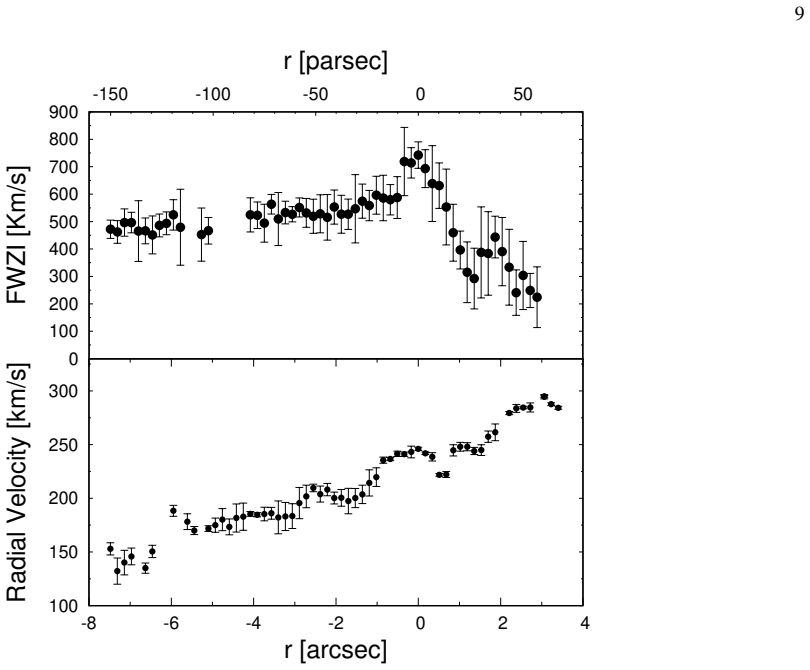
The key object is the infrared core (IRC), identified as the genuine nucleus of NGC 253, and the key observable is the multicomponent Gaussian decomposition of the Brγ line profile—peak, broad, intermediate, left, right, far-left, and far-right components—traced along a 14″ slit aligned with the circumnuclear disk major axis. The broad component (mean FWHM ~325 km/s, reaching ~400 km/s at the IRC) is the carrier of the outflow signature: it is always blueshifted relative to the peak, it dominates the flux only at the IRC, and it displays a non-circular 90 km/s velocity bump at the IRC position that matches a bump in molecular hydrogen. A second piece of machinery is the comparison of the velocity offset between broad and narrow components to the broad component FWHM, giving $(V_{\rm broad} - V_{\rm narrow})/{\rm FWHM}_{\rm broad} \approx 0.22$, which the paper checks against the spherical-expanding-shell model to argue that part of the broadening must come from turbulence or shocks.
What would settle it
A two-dimensional (integral-field) map of the Brγ line at comparable spectral resolution would settle whether the broad component is spatially concentrated at the IRC and whether its velocity field matches an outflow cone along the galaxy's minor axis. If the broad component follows the circular rotation curve, is spread uniformly over the circumnuclear disk, or fails to show a non-circular velocity bump at the IRC, the claim that the IRC is the main wind source would be refuted.
Extended reading notes
Core claim
The paper's central discovery is that the nuclear Brγ line of NGC 253 contains a broad, always-blueshifted component whose extreme properties peak exactly at the Infrared Core, the K-band continuum peak associated with radio source TH7. At the IRC, this broad component has FWHM ≈ 400 km/s—the highest ever detected in a nearby galaxy—and its flux exceeds that of the narrow disk component by a factor of about 1.35, double the ratio seen elsewhere along the slit. The broad component's radial velocity deviates from circular rotation by a ~90 km/s bump at the IRC, a feature previously detected in the molecular hydrogen rotation curve. Interpreting the broad component as outflowing ionized gas, the IRC therefore appears as the main present source of the galactic winds in the central region of NGC 253, with a maximum outflow velocity of about 237 km/s.
Load-bearing premise
The central inference depends on assuming that the broad, blueshifted Gaussian component of the Brγ line is a physically distinct outflowing gas system launched from the infrared core, rather than a consequence of turbulent mixing layers, shocks, or projection of the rotating disk.
Editorial extensions
If this is right
- If the IRC is the main wind source, the nuclear outflow of NGC 253 is launched from a compact region within about 6 pc, which constrains starburst-driven wind models that often assume extended launching zones.
- The broad-to-narrow flux ratio of about 1.35 at the IRC places the nuclear region on par with LIRGs that host an AGN, even though NGC 253 has no strong AGN, suggesting a pure starburst can produce such extreme ratios at kpc scales when viewed at high spatial resolution.
- The maximum outflow velocity of about 237 km/s is nearly twice that measured in NGC 7552 and higher than the average for non-interacting LIRGs, implying that even a moderate-luminosity starburst can drive a powerful wind in its innermost region.
- The coincidence of the 90 km/s velocity bump in the broad Brγ component with the molecular hydrogen bump indicates that the same non-circular phenomenon affects both the ionized and molecular phases at the IRC.
- A high-resolution bidimensional kinematic map of the nuclear region is the necessary next step to verify the connection between the IRC-launched outflow and the large-scale wind cones.
Reading between the lines
- If confirmed with 2D spectroscopy, the IRC-launching result would suggest that compact infrared cores, rather than the entire starburst disk, may be the dominant launch sites of galactic winds in other local starbursts such as M82.
- The ratio of velocity offset to FWHM (≈0.22) being half the spherical-shell expectation implies that at least part of the broad line width comes from turbulence or shocks; a testable extension would be to check whether the broad line width correlates with shock tracers such as H2 emission ratios along the slit.
- The paper's single-slit geometry cannot constrain the outflow's 3D orientation; a natural inference is that the wind axis should align with the southern Hα cone and the X-ray plume, and future observations could test that alignment.
- The detection of far-left and far-right components (-215 km/s and +300 km/s) only toward the NE suggests either an older ejection episode or an extinction effect; comparing their excitation with the main components could date these features and constrain the wind's episodic history.
Signed reviews
Editorial analysis
A structured set of objections, weighed in public.
Referee Report
Summary. The paper presents new long-slit Br-gamma spectroscopy of the nuclear region of NGC 253 obtained with PHOENIX at Gemini-South at an unprecedentedly high spectral resolution (R ~ 74,000). The authors decompose the complex line profiles into multiple Gaussian components (peak, broad, intermediate, left/right, far left/right) and report extreme kinematic widths at the infrared core (IRC): FWZI above 700 km/s and a broad component FWHM of roughly 400 km/s. They find that the broad component is always blueshifted with respect to the peak, that it shows a 90 km/s radial-velocity bump at the IRC position, and that the broad-to-narrow flux ratio is enhanced there (F(B)/F(N) ~ 1.35). From these results they conclude that the IRC is the main present source of the galactic wind in the nuclear region. The paper includes comparisons with M82, NGC 7552, and LIRG samples, and it explicitly acknowledges that the observed velocity-offset-to-FWHM ratio is only about half of what a spherical expanding shell would predict, requiring additional turbulent or shock broadening, and that a bidimensional kinematic map is mandatory.
Significance. If the central inference holds, this paper would identify, at ~6 pc spatial resolution, the launch site of the galactic wind in the nearest starburst galaxy, connecting small-scale energy injection to the well-studied large-scale outflow. The data themselves are valuable and independent of previous work: R ~ 74,000 Br-gamma kinematics of a starburst nucleus are rare, and the comparison to M82 and LIRG samples places the NGC 253 nuclear component in a useful context. The authors are also commendably explicit about the main caveats, including the discrepancy with the spherical-shell model and the need for a 2D map. However, the central claim currently rests on two assumptions that are not fully demonstrated: that the visually selected multi-Gaussian decomposition corresponds to distinct physical components, and that the broad, blueshifted component is a coherent bulk outflow rather than a manifestation of turbulent mixing layers, shocks, or projection effects. The result is therefore plausible but not uniquely determined, and the strength of the conclusion exceeds what the present single-slit analysis can support.
major comments (2)
- [Section 3, Figures 4 and 5] The Gaussian decomposition is chosen without a statistical model comparison and without per-component uncertainties. The text states that the profiles were modeled with 'a certain number of Gaussian components with free parameters' and the adopted number appears to be selected from visual inspection; the physical identity of the components is then inferred from their grouping in the position-FWHM-velocity plane. Because the broad-component FWHM, its velocity offset, and the ratio F(B)/F(N) are the quantitative pillars of the outflow conclusion, the absence of a systematic component-count criterion (e.g., Δchi-square or BIC/AIC) and the lack of individual parameter uncertainties leave the central quantitative claims unverified. I request a reanalysis with a common fitting framework, a stated procedure for adding components, and bootstrap or MCMC uncertainties on the velocities, FWHMs, and fluxes.
- [Section 3, outflow interpretation] The identification of the broad component with a bulk outflow is not unique, and the paper's own analysis demonstrates the difficulty. The ratio (V_broad - V_narrow)/FWHM_broad is about 0.22, roughly half the value expected for a spherical expanding shell, and the authors themselves conclude that 'there should be another widening mechanism such as turbulent mixing layers or shocks producing the broad component width'. If those mechanisms dominate the line width, the broad component can equally well trace turbulent mixing layers or shock-heated gas around the IRC, as the authors also note when discussing the M82 and NGC 1569 results. With a single slit at one position angle, the three-dimensional flow direction is unconstrained, and the paper explicitly states that a bidimensional kinematic map is mandatory. Consequently, the conclusion that the IRC is the main present source of the galactic wind is an overinterpretation of this data set. At minimum, the conclusion should be reframed as one of several viable hypotheses, or the paper should provide a quantitative discriminator between an outflow and a turbulent-mixing/shock scenario, for example by comparing predicted line-profile asymmetries or spatial coherence with existing optical IFU data.
minor comments (6)
- [Section 4, first paragraph] The sentence 'the SW side presents a simpler line profile simpler' contains a duplicated word and should read 'a simpler line profile'.
- [Section 3, Figure 5] The velocity, FWHM, and flux-ratio distributions in Figure 5 are plotted without error bars; given that the paper emphasizes quantitative comparisons such as the 90 km/s bump and the F(B)/F(N) values, per-point uncertainties should be shown or at least reported in a table.
- [Section 3, Keplerian mass estimate] The estimate of a Keplerian mass of (5 +/- 2) x 10^7 solar masses inside 4 arcsec is presented without an explicit deprojection or a model for the extinction-induced solid-body appearance of the rotation curve; this derivation should be justified or removed, as the solid-body gradient is attributed to dust extinction earlier in the same section.
- [Section 2, data reduction] The telluric correction and any relative flux calibration are not described; since broad, low-amplitude components near Br-gamma could be affected by residual telluric features, a brief description of the checks performed (or of why tellurics are negligible at this wavelength) would strengthen confidence in the faint far-left and far-right components.
- [Section 3, comparison to LIRGs] The comparison of the local, ~6-pc-scale broad-component FWHM with global integrated values from LIRG samples covering several kiloparsecs should include an explicit caveat about the different spatial scales; as written, the statement that the NGC 253 nucleus has the highest detected broad-component FWHM may overstate the comparison.
- [Section 3, coordinate conventions] The sign convention for positions along the slit (positive toward SW, negative toward NE) is not consistently applied in the text; for example, the phrase 'from -3.7 arcsec toward SW' appears to contradict the stated convention and should be corrected.
Circularity Check
No significant circularity: the new Brγ measurements are independent, and the self-cited Paper I results are used as corroboration, not as the derivation.
full rationale
The paper's central claim—that the IRC is the main present source of the galactic wind in NGC 253—is based on new, independently obtained Brγ long-slit spectroscopy, not on a quantity defined in terms of the conclusion. The broad and narrow Gaussian components are fitted to the observed line profiles with free parameters, and quantities such as FWZI>700 km/s, FWHM~400 km/s, F(B)/F(N)~1.35, and the ~90 km/s radial velocity bump are measured from these fits. The comparison with Paper I is explicitly corroborative: the bump 'was already observed in the rotation curve of the molecular hydrogen obtained in Paper I' (Section 3), but the Brγ detection is new. Similarly, the IRC-as-genuine-nucleus identification from Paper I is background context and is also supported by an external reference (Davidge 2016). The interpretation of the broad component as an outflow is presented as a hypothesis supported by external benchmarks (Westmoquette et al.; Arribas et al.; Wood et al.), and the paper itself acknowledges an alternative broadening mechanism ('there should be another widening mechanism such as turbulent mixing layers or shocks producing the broad component width'). That is an interpretive limitation, not a circular derivation. No equation or fitted parameter reduces to the paper's conclusion by construction, and no uniqueness theorem or ansatz is smuggled in via self-citation. The derivation chain is therefore self-contained with respect to the new data.
Assumptions & free parameters
free parameters (1)
- Number and initialization of Gaussian components per spectrum =
2 to 5 components per profile, chosen by visual inspection
assumptions (4)
- domain assumption The IRC is the genuine nucleus of NGC 253 and the reference point for the wind source.
- domain assumption Brγ emission traces ionized gas kinematics in the nuclear region without significant contamination from other spectral features at 2.166 µm.
- ad hoc to paper Each fitted Gaussian component corresponds to a distinct kinematic subsystem.
- domain assumption The slit position angle 61 degrees samples the outflow direction and the circumnuclear disk major axis.
Cite this review
Pith. "Pith review of The Nuclear Source of the Galactic Wind in NGC 253." pith.science (2026). https://pith.science/paper/UYPYLLWQ
@misc{pith2026190806538,
  author       = {Pith},
  title        = {Pith review of: The Nuclear Source of the Galactic Wind in NGC 253},
  year         = {2026},
  howpublished = {\url{https://pith.science/paper/UYPYLLWQ}},
  note         = {Machine review of arXiv:1908.06538}
}
abstract
We present Br$\gamma$ emission line kinematics of the nuclear region of NGC 253, recently known to host a strong galactic wind that limits the global star formation of the galaxy. We obtained high-resolution long-slit spectroscopic data with PHOENIX at Gemini-South, positioning the slit on the nucleus Infrared Core (IRC), close to the nuclear disk major axis. The spatial resolution was 0.35"($\sim$6 pc) and the slit length 14"($\sim$240 pc). The spectral resolution was $\sim$74000, unprecedented high for galactic nuclei observations at $\sim$2.1$\mu$m. The line profiles appear highly complex, with blue asymmetry up to 3.5'' away of the IRC, and red asymmetries further away to NE. Several Gaussian components are necessary to fit the profile, nevertheless a narrow and a wide ones predominate. The IRC presents kinematic widths above 700 kms$^{-1}$ (FWZI), and broad component FWHM$\sim$400 kms$^{-1}$, the highest detected in a nearby galaxy. At the IRC, the blue-shifted broad component displays a 90 km s$^{-1}$ bump in radial velocity distribution, a feature we previously detected in molecular gas kinematics. The narrow component velocity dispersion ($\sim$32 kms$^{-1}$) is within the expected for normal galaxies and LIRGs. Intermediate components (FWHM$\sim$150 kms$^{-1}$, red-shifted to NE, blue-shifted to SW) appear at some positions, as well as weaker blue (-215 kms$^{-1}$) and red line wings (+300 kms$^{-1}$). The IRC depicts a large broad vs. narrow line flux-ratio (F(B)/F(N)$\sim$1.35), and the broad component seems only comparable with those observed at very high star-forming rate galaxies. The results indicate that the IRC would be the main source of the galactic winds originated in the central region of NGC 253.
Figures


Figures from the paper (2 more)


Reference graph
Works this paper leans on
- [1]
-
[2]
2014, A&A, 568, A14
Arribas, S., Colina, L., Bellocchi, E., Maiolino, R., & Villar-Martín, M. 2014, A&A, 568, A14
2014
-
[3]
Bauer, M., Pietsch, W., Trinchieri, G., et al. 2008, A&A, 489, 1029
work page 2008
-
[4]
Bendo, G. J., Beswick, R. J., D’Cruze, M. J., et al. 2015, MNRAS, 450, L80
work page 2015
-
[5]
Bolatto, A. D., Warren, S. R., Leroy, A. K., et al. 2013, Nature, 499, 450
work page 2013
-
[6]
2018, PhD thesis, Universidad Nacional de Cordoba
Camperi, J. 2018, PhD thesis, Universidad Nacional de Cordoba
work page 2018
-
[7]
Camperi, J. A., Gunthardt, G., Díaz, R. J., et al. 2011, Boletin de la Asociacion Argentina de Astronomia La Plata Argentina, 54, 377
work page 2011
-
[8]
Davidge, T. J. 2016, ApJ, 818, 142 Díaz, R. J., Carranza, G., & Dottori, H. 2000, Boletin de la Asociacion Argentina de Astronomia La Plata Argentina, 44, 79 Díaz, R. J., Dottori, H., Aguero, M. P., et al. 2006, ApJ, 652, 1122
work page 2016
Show all 27 references
-
[9]
N., et al
Eikenberry, S., Elston, R., Raines, S. N., et al. 2008, in Society of Photo-Optical Instrumentation Engineers (SPIE) Conference
2008
-
[10]
2015, MNRAS, 446, 2468
Emsellem, E., Renaud, F., Bournaud, F., et al. 2015, MNRAS, 446, 2468
2015
-
[11]
2010, MNRAS, 401, 2113 Fernández-Ontiveros, J
Epinat, B., Amram, P., Balkowski, C., & Marcelin, M. 2010, MNRAS, 401, 2113 Fernández-Ontiveros, J. A., Prieto, M. A., & Acosta-Pulido, J. A. 2009, MNRAS, 392, L16
2010
-
[12]
J., Mast, D., et al
Gaspar, G., Díaz, R. J., Mast, D., et al. 2019, AJ, 157, 44
2019
-
[13]
L., Diaz, R., Pessev, P., et al
Gomez, P. L., Diaz, R., Pessev, P., et al. 2012, in American Astronomical Society Meeting Abstracts, V ol. 219, American Astronomical Society Meeting Abstracts #219, 413.07 Günthardt, G. I., Agüero, M. P., Camperi, J. A., et al. 2015, AJ, 150, 139
2012
-
[14]
H., Blum, R
Hinkle, K. H., Blum, R. D., Joyce, R. R., et al. 2003, in Society of Photo-Optical Instrumentation Engineers (SPIE) Conference
2003
-
[15]
2009, ApJL, 698, L125
Kaneda, H., Yamagishi, M., Suzuki, T., & Onaka, T. 2009, ApJL, 698, L125
2009
-
[16]
D., Grebel, E
Karachentsev, I. D., Grebel, E. K., Sharina, M. E., et al. 2003, A&A, 404, 93
2003
-
[17]
J., & Agüero, M
Mast, D., Díaz, R. J., & Agüero, M. P. 2006, AJ, 131, 1394
2006
-
[18]
P., Pérez García, A
Melo, V . P., Pérez García, A. M., Acosta-Pulido, J. A., Muñoz-Tuñón, C., & Rodríguez Espinosa, J. M. 2002, ApJ, 574, 709
2002
-
[19]
Y ., & Takei, Y
Mitsuishi, I., Yamasaki, N. Y ., & Takei, Y . 2013, PASJ, 65, 44
2013
-
[20]
E., Müller, A
Romero, G. E., Müller, A. L., & Roth, M. 2018, A&A, 616, A57
2018
-
[21]
G., & Bland-Hawthorn, J
Sharp, R. G., & Bland-Hawthorn, J. 2010, ApJ, 711, 818
2010
-
[22]
K., Heckman, T
Strickland, D. K., Heckman, T. M., Weaver, K. A., & Dahlem, M. 2000, AJ, 120, 2965
2000
-
[23]
L., & Ho, P
Turner, J. L., & Ho, P. T. P. 1985, ApJL, 299, L77
1985
-
[24]
2004, AJ, 128, 115
Valotto, C., & Giovanelli, R. 2004, AJ, 128, 115
2004
-
[25]
S., Dale, J
Westmoquette, M. S., Dale, J. E., Ercolano, B., & Smith, L. J. 2013, MNRAS, 435, 30
2013
-
[26]
S., Smith, L
Westmoquette, M. S., Smith, L. J., & Gallagher, J. S., I. 2011, MNRAS, 414, 3719
2011
-
[27]
M., Tremonti, C
Wood, C. M., Tremonti, C. A., Calzetti, D., et al. 2015, MNRAS, 452, 2712 8 G ÜNTHARDT ET AL . Figure 1. Top: Nuclear region of NGC 253 (Ks band) obtained with Flamingos-2. The slit is marked, and as can be seen, it covers two conspicuous regions, the most luminous knot contai...
2015
Reviewed August 14, 2026 · model on record in the stance chip above.
Discussion (0). Continue with ORCID to comment.