REVIEW 2 major objections 5 minor 43 references
The index of Lie poset algebras
T0 review · 2 major / 5 minor · reviewed 2026-08-14 · deepseek-v4-flash
Pith's one-line read Frobenius Lie poset algebras attached to posets of height at most two are absolutely rigid, with no infinitesimal deformations.
desk verdict Solid index formulas and a useful Frobenius classification, but the proof of the main rigidity theorem has a concrete error in the discrete Morse extension that is load-bearing. read the letter →
The pith
A machine-rendered reading of the paper's core claim, the machinery that carries it, and where it could break.
The reading
What carries the argument
The load-bearing identity is the index formula for connected height-one and height-two posets, $\operatorname{ind}(g_A(P)) = \operatorname{RelE}(P)-|P|+2C_P-1+\sum_{j\in P\setminus\operatorname{Ext}(P)}UD(P,j)$, where $\operatorname{RelE}(P)$ counts strict relations between extremal elements, $C_P$ counts connected components, and $UD(P,j)$ measures the imbalance between the number of elements below and above $j$. This formula reduces an algebraic invariant to a count of poset relations and yields the Frobenius classification through gluing rules. The rigidity step is carried by the paper's decomposition of $H^2$ into a center term, an $h^*\otimes H^1(\Sigma(P),k)$ term, and $H^2(\Sigma(P),k)$, together with a discrete Morse theory argument that exhibits $\Sigma(P)$ as contractible. Discrete Morse functions assign numbers to simplices so that all but one critical simplex cancel, giving a concrete certificate for contractibility.
What would settle it
Take a small Frobenius height-two poset obtained by one of the index-preserving gluing rules, apply the paper's value assignments to the attached block, and check the two inequalities defining a discrete Morse function at every face. If any non-vertex simplex becomes critical, the contractibility theorem and with it the rigidity theorem collapse; checking all gluing rules and small $n$ settles this directly.
Extended reading notes
Core claim
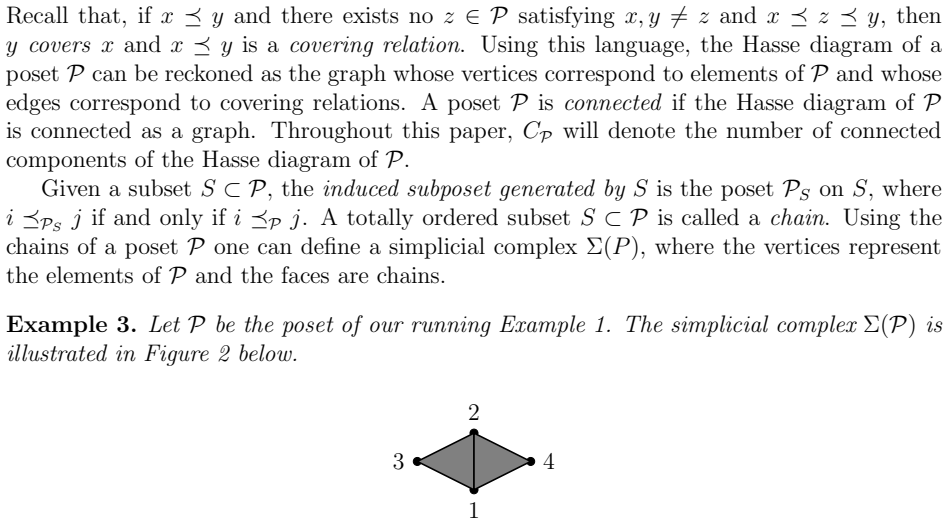
The central claim is that if $P$ is a finite poset of height at most two and the type-A Lie poset algebra $g_A(P)\subset sl(n)$ is Frobenius, meaning its index is zero, then the chain complex $\Sigma(P)$ is contractible. The paper's key cohomology decomposition expresses $H^2(g_A(P),g_A(P))$ as a direct sum of a term built from the center, a term built from $H^1(\Sigma(P),k)$, and $H^2(\Sigma(P),k)$. For Frobenius algebras the center is trivial, and contractibility kills the two simplicial terms, so $H^2(g_A(P),g_A(P))=0$, exactly the obstruction to infinitesimal deformations. For posets of height zero or one, Frobenius is characterized by the Hasse diagram being a tree; for height two, all Frobenius posets are assembled from the building blocks $P(2,1,1)$ and $P(1,1,2)$ by a short list of index-preserving gluing rules.
Load-bearing premise
The induction proving contractibility assumes that the explicitly listed number assignments extend the discrete Morse function when a new building block is glued on, without creating any new critical simplex; this is asserted as routine to verify rather than demonstrated.
Editorial extensions
If this is right
- Every Frobenius Lie poset subalgebra of sl(n) coming from a poset of height zero, one, or two has vanishing $H^2$ with coefficients in itself, so it admits no infinitesimal deformation.
- The index of every type-A Lie poset algebra attached to a height-one or height-two poset is computed by the closed formula, turning an algebraic invariant into a count of relations in the poset.
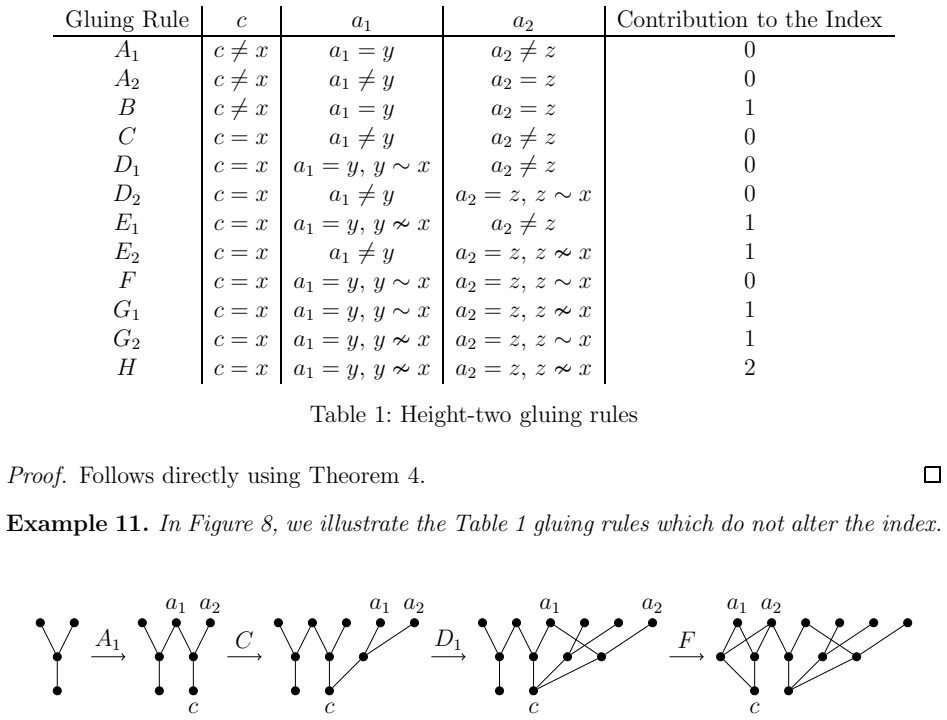
- The Frobenius height-two posets are exactly those assembled from copies of $P(2,1,1)$ and $P(1,1,2)$ by the six gluing rules $A_1,A_2,C,D_1,D_2,F$ in the pure case, subject to four tree-like conditions in the non-pure case.
- For these posets the simplicial complex of chains is contractible, so the associative incidence algebra of $P$ is also rigid, not just the Lie algebra.
- The topological reformulation in the paper says connected height-one Frobenius complexes are wedges of circles, with the index equal to the number of circles in the wedge.
Reading between the lines
- If the paper's conjecture that the same rigidity holds for all heights is true, Frobenius type-A Lie poset algebras would form a large family of rigid solvable Lie algebras, sharply contrasting with the deformable Frobenius examples the paper constructs in types B, C, and D.
- The graph-matching technique used for the lower bound on the index of $P(n,1,m)$ suggests that the index of a general Lie poset algebra may equal the number of unmatched vertices in a maximal matching of its non-commutation graph, a purely combinatorial route to index computations.
- The paper's type B, C, and D example indicates that contractibility and rigidity are not necessary for Frobenius in those types; one could test whether the narrow spectrum of principal elements seen in type A also fails for those deformable examples, linking deformation theory to spectral data.
- The unverified Morse-function extension could be checked mechanically for all gluing rules and small $n$; this is the cheapest way to decide whether a hidden critical simplex appears in the height-two induction.
Signed reviews
Editorial analysis
A structured set of objections, weighed in public.
Referee Report
Summary. The paper studies Lie poset algebras and their index. For type-A Lie poset algebras corresponding to posets of height zero, one, and two, it gives closed-form index formulas (Theorems 2, 3, and 9) and classifies the Frobenius case in combinatorial terms (Theorems 10-12). The main rigidity claim is Theorem 16: a Frobenius type-A Lie poset algebra of height at most two is absolutely rigid. The proof passes through Theorem 14, which asserts contractibility of the simplicial complex of chains of such posets, established by a discrete Morse function, and then applies the Coll-Gerstenhaber cohomology decomposition (Theorem 13). The final sections introduce type B, C, and D poset algebras and give an example claimed to be Frobenius and deformable, resolving a question of Gerstenhaber and Giaquinto.
Significance. If the rigidity theorem is fully established, this is a significant contribution: it gives explicit and checkable combinatorial criteria for Frobeniusness and ties them to absence of deformations via a clean topological argument. The index formulas are supported by explicit upper-bound functionals and matching-theoretic lower bounds, and the Frobenius classification via gluing rules is concrete and usable. The paper also proposes an answer to an open question about the existence of solvable Frobenius Lie algebras that are deformable. However, the proof of the central rigidity step is currently a sketch, and the type B/C/D example relies on unpublished work, so the manuscript needs additional verification before the strongest claims can be accepted.
major comments (2)
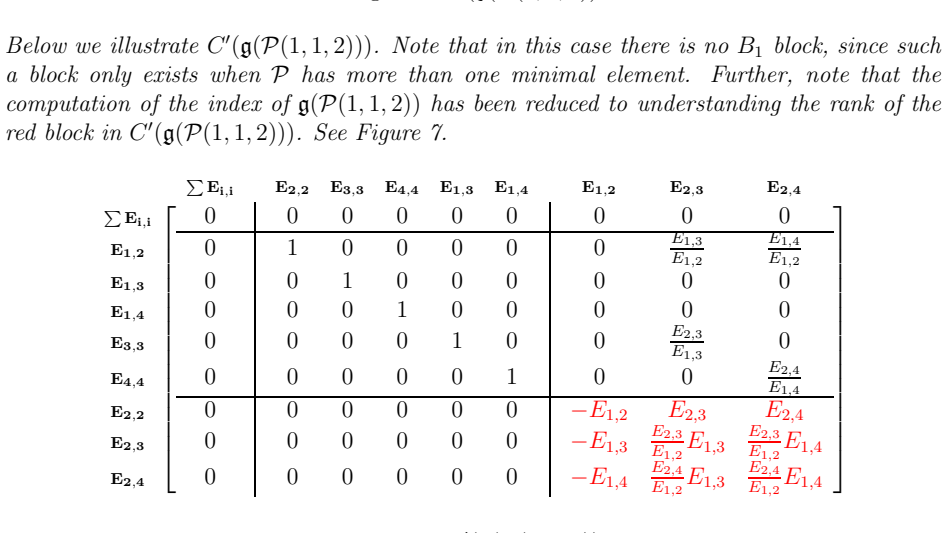
- [Section 5, proof of Theorem 14] The three cases that extend the discrete Morse function f from Σ(P_{n-1}) to Σ(P_n) are asserted to be 'routine to verify', but no verification is provided. This is load-bearing: the induction is exactly what proves contractibility of Σ(P_n), and Theorem 16 depends on it. The proof should either include the verification or state a lemma saying that, when p is larger than the maximum of f on Σ(P_{n-1}), the listed extensions satisfy both clauses of Definition 5 for every simplex of Σ(P_n), including old simplices adjacent to the attached copy K. For completeness: the specific alleged violation at e3 in the 'vertex v2' case does not arise under the face incidences that are consistent with Example 15 and with Case 3's description of e1 as adjacent to e3 and e4; in that incidence the two triangles share e2, and e2 has only f1 as a lower coface. The manuscript as printed, however, leaves these incidences implicit and the verification absent.
- [Section 6, Remark 11] The claimed example of a deformable, solvable, Frobenius Lie algebra in types B, C, and D rests on index formulas from [28], an in-progress thesis. The manuscript says 'From this, one can show' but does not state or prove the relevant formulas. Since resolving the Gerstenhaber-Giaquinto question is one of the paper's stated main contributions, the computation should be included in the paper or replaced by a public reference.
minor comments (5)
- [Appendix A] The ordering assumption on minimal elements is asserted to be always arrangeable; a short proof would eliminate a potential gap in the matrix reduction.
- [Appendix B, Lemma 6] The maximality of the matching is argued via Figure 15; the text should explain why every augmenting path must have the displayed form rather than leaving this to the reader.
- [Remark 8] There are typos: 'Mayor-Vietoris' and 'Mayer-Veotori' should be 'Mayer-Vietoris'.
- [Definition 7] The text contains a corrupted formula, '-j /notprecedesoreql i'; the intended condition for type B/D posets should be stated with correct relation symbols.
- [Throughout] The manuscript has several typographical errors, including 'typ e-A' in the abstract and 'contructed' in Theorem 11; a careful proofreading pass is needed.
Circularity Check
Central type-A rigidity chain is self-contained; only the secondary type-B/C/D Frobenius claim leans on an unpublished self-citation, while the Morse extension gap is a correctness risk, not circularity.
-
self citation load bearing
[Section 6, Remark 11 (with abstract's Gerstenhaber-Giaquinto claim)]
"In [28], Mayers has developed combinatorial index formulas for Lie poset algebras in types B, C, and D with certain height restrictions. From this, one can show that the poset P of Example 16 corresponds to a Frobenius Lie poset algebra of types B, C, and D, but not type A."
The abstract advertises resolution of Gerstenhaber and Giaquinto's existence question for solvable Frobenius Lie algebras. For the type-B/C/D example, the essential Frobenius assertion is not proved here; it is imported from [28], the second author's in-progress dissertation. At the time of writing, this is an unpublished self-citation, so the advertised example's key property terminates in the authors' own unverified claim rather than in an independent computation. This does not infect the type-A rigidity chain, which is derived independently, so it is a minor, localized self-citation.
full rationale
The type-A derivation is not circular. The index formulas (Theorems 2, 3, 4, 9) are computed from the commutator-matrix rank theorem and explicit functional/matching arguments in Appendix B; the Frobenius classifications (Theorems 10-12) are corollaries of those formulas; and Theorem 14 gives a discrete-Morse proof of contractibility for the classified posets. None of these steps assumes H^2 = 0 or absolute rigidity, so there is no self-definitional or fitted-input circularity. The rigidity inference uses Theorem 13, a published theorem of Coll and Gerstenhaber; although one of the present authors is a coauthor, it is an external prior result that does not presuppose this paper's conclusions, so it counts as independent support. The only self-citation that carries weight is the type-B/C/D example: Remark 11 asserts Frobenius-ness of Example 16's algebra in types B, C, and D by appeal to [28], the second author's unpublished thesis, and the abstract's Gerstenhaber-Giaquinto resolution depends on that assertion. This is a minor self-citation because the central type-A theorem does not use it. Separately, the proof of Theorem 14 contains an omitted verification: after listing three Morse-extension cases, the paper says 'It is routine to verify that the resulting f : Σ( Pn) → R is a discrete Morse function, and that no new critical simplices have been added in extending of f.' This is a proof gap, not a circular reduction; the skeptic's objection to the v2 case is a correctness risk that could invalidate the rigidity theorem, but it does not make the argument circular. Overall circularity score: 2.
Assumptions & free parameters
assumptions (4)
- standard math Theorem 13 (Coll-Gerstenhaber): H^2(gA(P),gA(P)) = (Λ^2 h* ⊗ c) ⊕ (h* ⊗ H^1(Σ(P),k)) ⊕ H^2(Σ(P),k).
- standard math Discrete Morse theorem (Theorem 15): a discrete Morse function with one critical vertex implies contractibility.
- standard math Universal Coefficient Theorem for simplicial cohomology.
- ad hoc to paper The ordering assumption in Appendix A: minimal elements of a connected poset can be labeled so that for each j, j ≼ m for some m ∈ M_{j-1}.
Cite this review
Pith. "Pith review of The index of Lie poset algebras." pith.science (2026). https://pith.science/paper/Z7D6IQSV
@misc{pith2026190806573,
  author       = {Pith},
  title        = {Pith review of: The index of Lie poset algebras},
  year         = {2026},
  howpublished = {\url{https://pith.science/paper/Z7D6IQSV}},
  note         = {Machine review of arXiv:1908.06573}
}
read the original abstract
We provide general closed-form formulas for the index of type-A Lie poset algebras corresponding to posets of restricted height. Furthermore, we provide a combinatorial recipe for constructing all posets corresponding to type-A Frobenius Lie poset algebras of heights zero, one, and two. A finite Morse theory argument establishes that the simplicial realization of such posets is contractible. It then follows, from a recent theorem of Coll and Gerstenhaber, that the second Lie cohomology group of the corresponding Lie poset algebra with coefficients in itself is zero. Consequently, the Lie poset algebra is absolutely rigid and cannot be deformed. We also provide matrix representations for Lie poset algebras in the other classical types. By so doing, we are able to give examples of deformable Lie algebras which are both solvable and Frobenius. This resolves a question of Gerstenhaber and Giaquinto about the existence of such algebras.
Figures


Figures from the paper (13 more)






Reference graph
Works this paper leans on
-
[28]
The index of Lie poset algebras
N. Mayers. “The index of Lie poset algebras.” Dissertation, In Progress
-
[1]
Minimum rank of skew-symmetric matrices describ ed by a graph
M. Allison, et al. “Minimum rank of skew-symmetric matrices describ ed by a graph.” Linear Algebra and its Applications 432 (2010)
work page 2010
-
[2]
Solutions of the classical Yang-Baxte r equations for simple Lie algebas
A. Belavin and V. Drindel’d. “Solutions of the classical Yang-Baxte r equations for simple Lie algebas.” Funct. Anal. App. , 16: 159-180, 1982
work page 1982
-
[3]
The unbroken spectrum of Frobenius se aweeds III: type- D
A. Cameron and V. Coll. “The unbroken spectrum of Frobenius se aweeds III: type- D.” Manuscript, 2019
work page 2019
-
[4]
Combinatorial index formulas for Lie algebras of seaweed type
A. Cameron, V. Coll, and M. Hyatt. “Combinatorial index formulas for Lie algebras of seaweed type.” arXiv:1908.03105, August 8, 2019
work page Pith review arXiv 1908
-
[5]
The unbroken spectrum of Frobenius seaweeds II: type-B and type-C
A. Cameron, V. Coll, M. Hyatt, and C. Magnant. “The unbroken s pectrum of Frobe- nius seaweeds II: type-B and type-C.” arXiv:1907.08775, July 20, 2 019
work page Pith review arXiv 1907
-
[6]
Meander grap hs and Frobenius seaweed algebras III
V. Coll, A. Dougherty, M. Hyatt, and N. Mayers. “Meander grap hs and Frobenius seaweed algebras III.” Journal of Generalized Lie Theory and Applications , 11(2), 2017
work page 2017
-
[7]
Cohomology of Lie semidirect prod ucts and poset algebras
V. Coll and M. Gerstenhaber. “Cohomology of Lie semidirect prod ucts and poset algebras.” Journal of Lie Theory , 26: 79-95, 2016
work page 2016
Show all 43 references
-
[8]
Meanders and Frobenius seaw eed Lie algebras
V. Coll, A. Giaquinto, C. Magnant. “Meanders and Frobenius seaw eed Lie algebras.” Journal of Generalized Lie Theory and Applications , 5, 2011. 23
2011
-
[9]
The unbroken spectrum of t ype-A Frobenius seaweeds
V. Coll, M. Hyatt, and C. Magnant. “The unbroken spectrum of t ype-A Frobenius seaweeds.” J. of Alg. Comb , 1-17, 2016
2016
-
[10]
Symplectic meanders
V. Coll, M. Hyatt, and C. Magnant. “Symplectic meanders.” Comm. Algebra , 1-13, 2017
2017
-
[11]
Meander graphs a nd Frobenius seaweed Lie algebras II
V. Coll, M. Hyatt, C. Magnant, and H. Wang. “Meander graphs a nd Frobenius seaweed Lie algebras II.” Journal of Generalized Lie Theory and Applications , 9(1), 2015
2015
-
[12]
Index of Lie algebras of seaweed t ype
V. Dergachev and A. Kirillov. “Index of Lie algebras of seaweed t ype.” J. Lie Theory , 10: 331–343, 2000
2000
-
[13]
On properties of principal elements of Frobenius Lie alge- bras
A. Diatta and B. Manga. “On properties of principal elements of Frobenius Lie alge- bras.” J. Lie Theory , 24: 849-864, 2014
2014
-
[14]
Enveloping Algebras
J. Dixmier. “Enveloping Algebras.” Graduate Studies in Math. vol 2, AMS, 1996
1996
-
[15]
On the index of parabolic subalgebras of semisimple Lie algebras
A. Elashvili. “On the index of parabolic subalgebras of semisimple Lie algebras.” Unpublished preprint, 1990
1990
-
[16]
On regular cohomologies of bipara bolic subalgebras of sl(n)
A. Elashvili and G. Rakviashvili. “On regular cohomologies of bipara bolic subalgebras of sl(n).” Bull. Georg. Natl. Acad. Sci , 10.2: 2016
2016
-
[17]
A user’s guide to discrete Morse theory
R. Forman. “A user’s guide to discrete Morse theory.” S´em. Lothar. Combin , 48, 2002
2002
-
[18]
Boundary solutions of the classical Yang-Baxter equation
M. Gerstenhaber and A. Giaquinto. “Boundary solutions of the classical Yang-Baxter equation.” Letters Math. Physics , 40:337-353, 1997
1997
-
[19]
Graphs, Frobenius funct ionals, and the classical Yang-Baxter equation
M. Gerstenhaber and A. Giaquinto. “Graphs, Frobenius funct ionals, and the classical Yang-Baxter equation.” arXiv:0808.2423v1, August 18, 2008
2008 arXiv
-
[20]
The principal element of a F robenius Lie alge- bra
M. Gerstenhaber and A. Giaquinto. “The principal element of a F robenius Lie alge- bra.” Lett Math. Phys , 88: 333-341, 2009
2009
-
[21]
Simplicial cohomology is Hochs child cohomology
M. Gerstenhaber and S. Schack. “Simplicial cohomology is Hochs child cohomology.” Journal of Pure and Applied Algebra , 30.2: 143-156, 1983
1983
-
[22]
Triangular algebras
M. Gerstenhaber and S. Schack. “Triangular algebras.” Deformation Theory of Alge- bras and Structures and Applications , Springer, Dordrecht, 447-498, 1988
1988
-
[23]
Topics in algebraic deformation theory
A. Giaquinto. “Topics in algebraic deformation theory.” Higher structures in geometry and physics , Birkhauser, Boston, MA: 1-24, 2011
2011
-
[24]
A. Joseph. On semi-invariants and index for biparabolic (Seawee d) Algebras, I. J. Algebras, 305(1):487-515, 2006. 24
2006
-
[25]
Karnauhova
A. Karnauhova. “Meanders: Sturm global attractors, seaw eed Lie algebras and clas- sical Yang-Baxter equation. Walter de Gruyter GmbH & Co KG, 2017
2017
-
[26]
(Co)Homology of poset Lie algebr as
L. Lampret and A. Vavpetic. “(Co)Homology of poset Lie algebr as.” Homology, Ho- motopy and Applications , 19, 2015
2015
-
[27]
Triangularity in Operator Algebras
D.R. Larson. “Triangularity in Operator Algebras.” Surveys of some recent results in operator theory, 2: 121-188, 1988
1988
-
[29]
Rings with several objects
B. Mitchell. “Rings with several objects.” Adv. in Math , 8: 1-161, 1972
1972
-
[30]
On Frobenius Lie algebras
A. Ooms. “On Frobenius Lie algebras.” Comm. Algebra, 8: 13-52, 1980
1980
-
[31]
Inductive formulas for the index of seaweed L ie algebras
D. Panyushev. “Inductive formulas for the index of seaweed L ie algebras.” Moscow Mathematical Journal , 1(2):221-241, 2001
2001
-
[32]
On seaweed subalgebras and m eander graphs in type C
D. Panyushev and O. Yakimova. “On seaweed subalgebras and m eander graphs in type C.” Pacific Journal of Mathematics , 285(2):485-499, 2016
2016
-
[33]
On seaweed subalgebras and m eander graphs in type D
D. Panyushev and O. Yakimova. “On seaweed subalgebras and m eander graphs in type D.” Journal of Pure and Applied Algebra , 2018
2018
-
[34]
On the foundations of combinatorial theory, I: The ory of Mobius functions
G. Rota. “On the foundations of combinatorial theory, I: The ory of Mobius functions” Probability theory and related fields , 2.4: 340-368, 1964. 8 Appendix A - a matrix reduction algorithm In this section, we provide an algorithm for transforming C(g(P)) into the equivalent ma...
1964
-
[35]
perform Ei,mj − Ei,mj Ej,mj Ej,mj at row Ei,mj for i minimal and mj /∈ Mi such that mj ∈ Mj
-
[36]
perform Ej+1,k − Ej+1,k Ej+1,mt Ej+1,mt at row Ej+1,k for k ⁄= mt and mt /∈ Mi such that mt ∈ Mt for 1 ≤ t ≤ j is maximal in P and mt is maximal in Z with this property
-
[37]
multiply row Ej,mj by 1 Ej,mj for mj ∈ Mj; and
-
[38]
Finally, perform the following row operations
multiply row Ej,mt by − 1 Ej,mt for mt /∈ Mj such that mt ∈ Mt for 1 ≤ t ≤ j is maximal in P and mt maximal in Z with this property. Finally, perform the following row operations
-
[39]
perform Emi,mj + Emi,mj Ei,mi Ei,mi − Emi,mj Ej,mj Ej,mj at row Emi,mj for mi ∈ Mi and mj ∈ Mj
-
[40]
multiply row Ei,i by − 1 Ei,i for i maximal in P; 26
-
[41]
squeeze-play
multiply row Ei,i by 1 Ei,mj for i minimal in P and mj /∈ Mi is the maximal element of P which is minimal in Z with this property; Remark 13. Applying the above algorithm to transform C(g(P)) into the equivalent matrix C ′(g(P)) we have the following • row Ei,k of C ′(g(P)) fo...
-
[42]
determine the restrictions F ([xi, B ]) = 0 places on the entries of B for each basis element xi of g; 27
-
[43]
We will work in gl(n) to determine an upper bound on the index of g(P) and then subtract one to determine the corresponding upper bound on the index of gA(P)
solve the resulting system of equations to determine dim ker( BF ) ≥ ind (g). We will work in gl(n) to determine an upper bound on the index of g(P) and then subtract one to determine the corresponding upper bound on the index of gA(P). Performing calcu- lations in gl(n) allow...
Reviewed August 14, 2026 · model on record in the stance chip above.
Discussion (0). Continue with ORCID to comment.