REVIEW 3 major objections 6 minor 12 references
Measurement of the Diffuse Muon Neutrino Flux using Starting Track Events in IceCube
T0 review · 3 major / 6 minor · reviewed 2026-08-14 · deepseek-v4-flash
Pith's one-line read Starting-track selection can deliver a high-purity diffuse muon neutrino sample.
desk verdict A clear, honest Monte Carlo sensitivity study for IceCube's ESTES selection; the title oversells it as a 'measurement' and the negligible-background claim rests on an untested tail extrapolation. read the letter →
The pith
A machine-rendered reading of the paper's core claim, the machinery that carries it, and where it could break.
The reading
What carries the argument
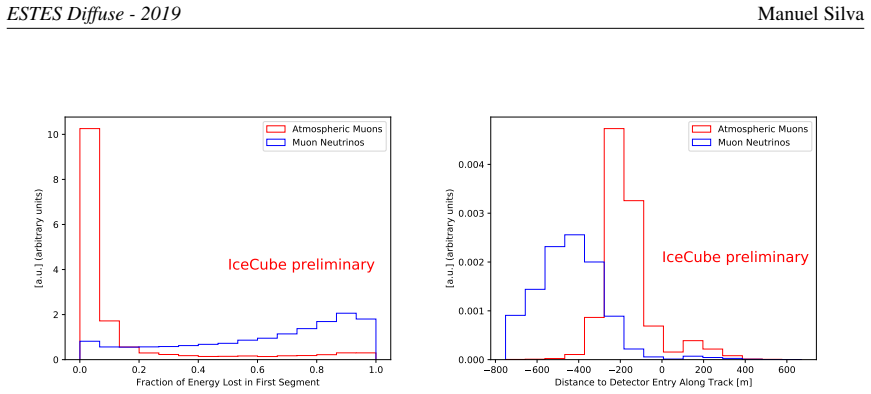
The load-bearing mechanism is a two-stage veto. First, a starting-track veto computes, from the reconstructed Cherenkov-cone geometry, the probability that optical modules in a dark region around the track observe light; a cut on this probability drops the muon rate from over $10^{8}$ to $10^{4}$ per year. Second, an XGBoost boosted decision tree, trained on 15 reconstructed variables, classifies surviving events; the most important variables are the fraction of energy lost in the first track segment and the distance from the vertex to the estimated entry point. The BDT score cut of 0.991, chosen to admit one muon per year, is the point at which the sample becomes neutrino-dominated.
What would settle it
Open the 8 years of IC-86 data to ESTES and count the events passing the 0.991 BDT cut; if the observed total significantly exceeds the simulated expectation of about one atmospheric muon per year plus the predicted neutrino rate, the claim of negligible background is falsified. A direct check is to compare the BDT score distribution and the two most important input variables between data and Monte Carlo before applying the final cut.
Extended reading notes
Core claim
The central claim is that ESTES is a viable path to a diffuse muon neutrino flux measurement. The selection starts with a starting-track veto that lowers the atmospheric muon background from over 100 million to about 10 thousand events per year; a gradient-boosted decision tree then cuts the expected muon rate to roughly one per year at a BDT score of 0.991, while keeping more than 80% of neutrino starting tracks. When the selection is applied to simulated astrophysical neutrinos, the expected event rates depend on the assumed flux: 7.43 per year for the cascade-focused MESE measurement, 16.07 per year for the high-energy starting event HESE sample, 4.15 per year for the northern-sky NuMu analysis, and 7.43 per year for the inelasticity result. The paper therefore establishes sensitivity, not a measurement: no real data are shown, and validation that data match the Monte Carlo is stated as ongoing.
Load-bearing premise
The entire background estimate and the chosen BDT cut rest on Monte Carlo simulation of atmospheric muons and detector response, and the paper states that compatibility checks with real IceCube data are still ongoing.
Editorial extensions
If this is right
- ESTES can yield an essentially background-free southern-sky muon-neutrino sample in the 1-100 TeV range, with expected astrophysical rates of 4-16 events per year depending on the true diffuse spectrum.
- A fit to the final sample's reconstructed energy losses could constrain both the normalization and the spectral index of the diffuse astrophysical flux.
- The large expected atmospheric neutrino component allows the same sample to constrain atmospheric flux models.
- The selected starting-track events could feed a real-time multi-messenger alert stream, since each event carries a well-reconstructed direction.
Reading between the lines
- The BDT's top variable is the fraction of energy released in the first track segment; this makes the sample's effective acceptance depend on where the neutrino's first interaction deposits energy, so an independent cut-based selection would be a useful cross-check that the paper does not report.
- ESTES targets the southern sky, where atmospheric muons are hardest to reject; combining it with the northern-sky NuMu analysis would give nearly full-sky coverage of muon-neutrino starting tracks, though no such combination is attempted here.
- If the real 8-year data match the Monte Carlo, the next step implied by the design is a fit to the reconstructed energy losses to estimate the diffuse flux normalization and spectral index; the paper stops at expected-rate tables, so the fitting procedure and its systematic uncertainties remain open questions.
Signed reviews
Editorial analysis
A structured set of objections, weighed in public.
Referee Report
Summary. The manuscript presents ESTES, an IceCube event selection designed to isolate starting muon-neutrino tracks in the southern sky for a diffuse neutrino flux measurement above 1 TeV. The authors describe a two-step selection: a starting track veto that reduces the atmospheric muon rate from over 100 million to about 10 thousand per year, followed by an XGBoost boosted decision tree that reduces the expected muon rate to about 1 per year at a score cut of 0.991, while retaining over 80% of signal neutrinos. Using Monte Carlo simulations, they compute expected astrophysical neutrino rates for four published diffuse flux models (MESE, HESE, NuMu, and Inelasticity), and report that data-compatibility checks are still ongoing. The paper is explicitly a sensitivity study based on simulations only.
Significance. If the claimed background rejection and neutrino efficiency are confirmed in data, ESTES would provide a valuable new channel for diffuse muon neutrino measurements, complementing the northern-sky-dominated NuMu analysis and the cascade-oriented MESE and HESE selections. The manuscript is transparent about its scope: it presents a Monte Carlo sensitivity study with statistical-only uncertainties, and it openly states that data validation is pending. The expected rates in Table 2 are a useful benchmark for the selection's performance. However, the significance of the current claims is limited by the lack of a quantitative sensitivity estimate, the reliance on an unvalidated Monte Carlo tail for the background, and the absence of systematic uncertainties. The paper is a promising work-in-progress report rather than a completed measurement.
major comments (3)
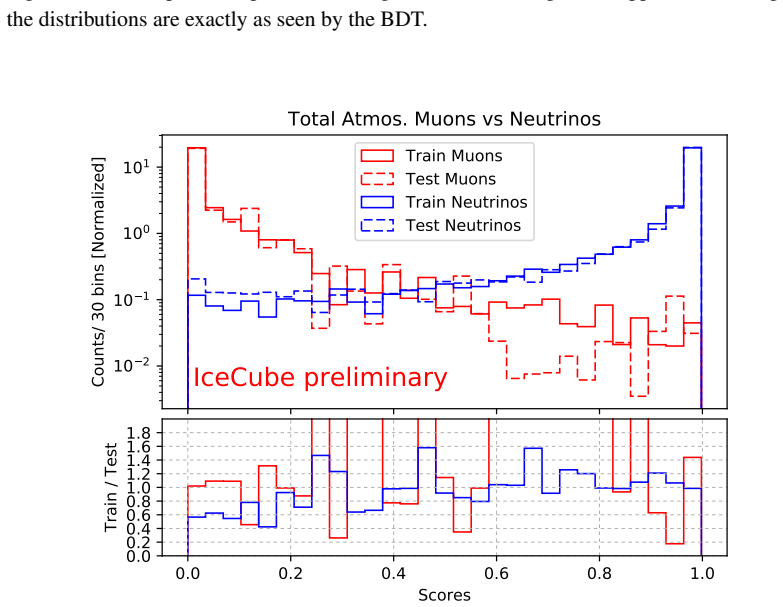
- [3.2, Fig. 4] The central claim that the final ESTES selection has 'negligible amounts of background contamination' rests on extrapolating the atmospheric muon rate from approximately 10^4 events per year at low BDT scores to 1 event per year at the chosen cut of 0.991. This is a four-order-of-magnitude extrapolation into the tail of the BDT score distribution where simulated muon statistics are sparse. The Kolmogorov–Smirnov test (p = 0.30) reported in Sec. 3.2 checks overfitting between training and test Monte Carlo samples; it does not validate the absolute normalization of the tail against real data. The paper itself states in Sec. 5 that data-compatibility checks are ongoing. Until a data sideband check or an explicit systematic uncertainty on the tail rate (including cosmic-ray model variations and MC statistics) is provided, the 'negligible contamination' statement is not supported. This is load-bearing because all subsequent rate predictions assume a negligible background.
- [4, Table 2] The abstract and introduction promise a sensitivity study for the diffuse neutrino flux, but the paper does not present a quantitative sensitivity: there is no expected uncertainty on Φ0 and γ, no confidence interval, and no treatment of background normalization in a fit. The expected event counts in Table 2 are raw rates with statistical uncertainties from the Monte Carlo only; they do not by themselves demonstrate the sensitivity of the measurement. A simple counting-experiment calculation using the quoted signal rates and the 1 event/yr background would be a minimal step, and a full treatment would propagate systematic uncertainties. Without this, the stated goal of showing sensitivity for a diffuse flux measurement is not yet met.
- [2.1, 3.2] The atmospheric muon background is obtained from two different simulations (CORSIKA with multiple muons at 1/10 year livetime and a parametrized single-muon sample at over 10 years livetime) using a single cosmic-ray flux model, Gaisser H4a. The manuscript does not explain how these two samples are combined or cross-normalized in Fig. 4, nor does it discuss the uncertainty in the cosmic-ray flux model. Since the BDT cut is selected to yield exactly 1 muon per year from this simulation, the resulting background estimate is directly tied to these choices. The paper should describe the combination procedure and provide a systematic error estimate on the background rate.
minor comments (6)
- [2.2] The word 'Relevent' should be 'Relevant' in the sentence discussing energy reconstruction.
- [4] There is a typo 'bu northern sky' which should be 'by northern sky' in the comparison with the NuMu and inelasticity analyses.
- [Eq. (4.1)] The equation is typeset poorly and the parameters Φ0 and γ are not defined in the text; the functional form should be written as dΦ/dE = Φ0 × 10^{-18} (Eν/10^5 GeV)^{-γ} with units GeV^{-1} cm^{-2} s^{-1} sr^{-1}.
- [Fig. 1] The caption states 'The dark region is shown in red'; the color terminology is confusing and should be clarified to match the figure.
- [Sec. 5] The paper claims a 'high purity' sample but does not quote an expected purity value; for the MESE flux the signal rate is 7.43/yr versus 1/yr background, and for HESE it is 16.07/yr versus 1/yr; the purity should be stated explicitly.
- [References] References [8] and [11] lack journal volume and page numbers, making them incomplete for a journal-style bibliography.
Circularity Check
No circularity: the analysis is a simulation-based sensitivity study whose background estimate is a design choice, not a fitted input renamed as a prediction.
full rationale
The paper does not derive a target result from its own inputs. The BDT is trained on Monte Carlo with a train/test split and a KS p-value of 0.30 used only to check against overfitting; expected rates are obtained by weighting simulated events to assumed astrophysical fluxes (MESE, HESE, NuMu, Inelasticity). The cut at BDT score 0.991 is chosen to yield 1 simulated atmospheric muon per year under the Gaisser H4a flux, so the quoted 'negligible contamination' and 80% neutrino efficiency are read off from the same simulations. This is a selection criterion based on a simulated background model, not a fitted parameter that is later relabeled as a prediction, and it does not make the derivation circular in the sense of Eq. X = Eq. Y by construction. The acknowledged lack of data-compatibility checks (Section 5: 'checks for compatibility with real data are still ongoing') is an important validation limitation for the background estimate, but it is a correctness or robustness concern, not circularity. Citations to prior IceCube starting-track-veto work are standard use of established analysis steps and are not invoked as an unexamined uniqueness theorem. No circular step is present.
Assumptions & free parameters
free parameters (1)
- BDT score cut =
0.991
assumptions (3)
- domain assumption Monte Carlo simulations accurately represent the IceCube detector response and the atmospheric muon background.
- domain assumption The Gaisser H4a cosmic-ray flux model is a valid input for computing atmospheric muon rates.
- domain assumption The injected astrophysical neutrino spectra (MESE, HESE, NuMu, Inelasticity) are representative of the true diffuse flux.
Cite this review
Pith. "Pith review of Measurement of the Diffuse Muon Neutrino Flux using Starting Track Events in IceCube." pith.science (2026). https://pith.science/paper/TSBGHGII
@misc{pith2026190806586,
  author       = {Pith},
  title        = {Pith review of: Measurement of the Diffuse Muon Neutrino Flux using Starting Track Events in IceCube},
  year         = {2026},
  howpublished = {\url{https://pith.science/paper/TSBGHGII}},
  note         = {Machine review of arXiv:1908.06586}
}
read the original abstract
IceCube measures the diffuse neutrino flux across several neutrino flavors and energy ranges. ESTES focuses on the measurement of the diffuse neutrino flux using high purity astrophysical muon neutrinos with energies above 1 TeV. We use the Enhanced Starting Track Event Selection dataset which selects for tracks starting within the IceCube fiducial volume. We employ a machine learning algorithm to help differentiate between tracks from atmospheric and astrophysical neutrinos. This produces a high purity diffuse neutrino sample that can provide valuable insight into the properties of the atmospheric and astrophysical diffuse neutrino spectrum. Using simulated neutrinos, we show the sensitivity for this measurement of the diffuse neutrino flux with ESTES.
Figures

Figures from the paper (1 more)

Reference graph
Works this paper leans on
-
[1]
write newline
" write newline "" before.all 'output.state := FUNCTION blank.sep after.quote 'output.state := FUNCTION fin.entry output.state after.quoted.block = 'skip 'add.period if write newline FUNCTION new.block output.state before.all = 'skip output.state after.quote = after.quoted.block 'output.state := after.block 'output.state := if if FUNCTION new.sentence out...
-
[2]
IceCube Collaboration, S. Mancina and M. Silva, PoS(ICRC2019)954 (2019)
work page 2019
-
[3]
T. K. Gaisser, Astroparticle Physics 35 (2012) 801 -- 806
work page 2012
-
[4]
IceCube Collaboration, Physical Review D (2014) 102004
work page 2014
-
[5]
IceCube Collaboration, JINST Instrumentation and Detectors (2014) P03009
work page 2014
-
[6]
Jero, Journal of Physics: Conference Series 888 (2017) 012107
IceCube Collaboration, K. Jero, Journal of Physics: Conference Series 888 (2017) 012107
work page 2017
-
[7]
Mancina Presented at Neutrino Parallel TeVPA 2017 in Columbus, OH, 2017
IceCube Collaboration, S. Mancina Presented at Neutrino Parallel TeVPA 2017 in Columbus, OH, 2017
work page 2017
-
[8]
T. Chen and C. Guestrin in Proceedings of the 22nd ACM SIGKDD International Conference on Knowledge Discovery and Data Mining , KDD '16, (New York, NY, USA), pp. 785--794, ACM, 2016
work page 2016
Show all 12 references
-
[9]
IceCube Collaboration, Physical Review D (2015) 022001
2015
-
[10]
Schneider, PoS(ICRC2019)1004 (2019)
IceCube Collaboration, A. Schneider, PoS(ICRC2019)1004 (2019)
2019
-
[11]
Stettner, PoS(ICRC2019)1017 (2019)
IceCube Collaboration, J. Stettner, PoS(ICRC2019)1017 (2019)
2019
-
[12]
IceCube Collaboration, Physical Review D (2019) 032004
2019
Reviewed August 14, 2026 · model on record in the stance chip above.
Discussion (0). Continue with ORCID to comment.