REVIEW 3 major objections 4 minor 20 references
Chromatic nonsymmetric polynomials of Dyck graphs are slide-positive
T0 review · 3 major / 4 minor · reviewed 2026-08-14 · deepseek-v4-flash
Pith's one-line read The chromatic nonsymmetric polynomial of every Dyck graph expands positively into fundamental slide polynomials.
desk verdict The slide-positivity theorem is real and cleanly motivated, but the proof's main pivot, Lemma 3.1, has a hand-waved reverse direction that the authors need to fill in. read the letter →
The pith
A machine-rendered reading of the paper's core claim, the machinery that carries it, and where it could break.
The reading
What carries the argument
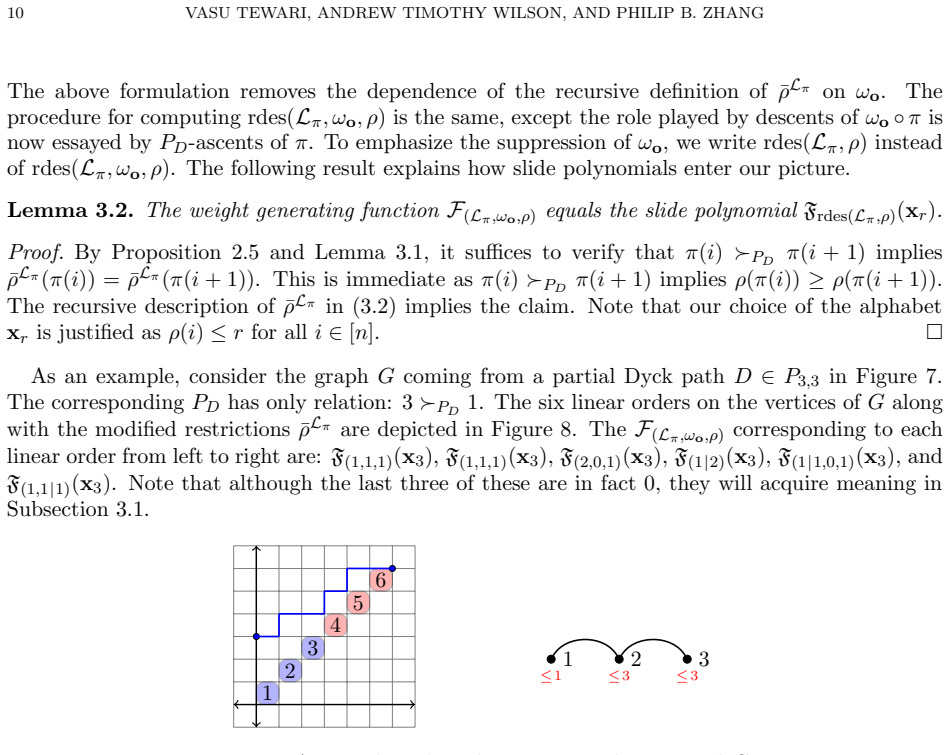
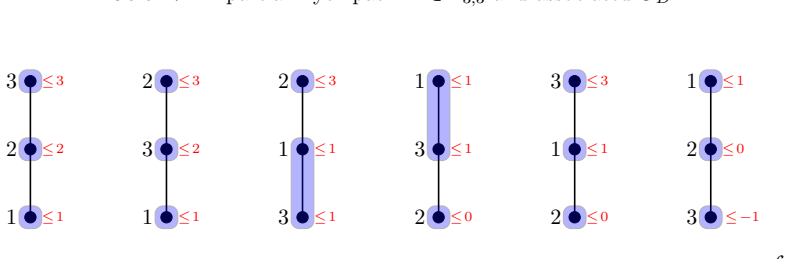
The load-bearing device is the reduced weak descent composition $\operatorname{rdes}(L_\pi,\rho)$, built from a linear order on the vertices, the Dyck-graph restriction $\rho$, and the tight restriction map $\overline{\rho}_{L_\pi}$ obtained by replacing each color bound by the tightest one implied by the inequalities. Lemma 3.1 shows that descents of $\pi$ relative to the incomparability poset $P_D$ coincide with ascents of the constructed labeling $\omega_o$, and Lemma 3.2 uses this to turn each generating function $F(L_\pi,\omega_o,\rho)$ into the single fundamental slide polynomial $F_{\operatorname{rdes}(L_\pi,\rho)}(x_r)$. Theorem 3.3 then sums these contributions over all permutations, with the $t$-power recording $G$-inversions.
What would settle it
Compute both sides of Theorem 3.3 symbolically for a small Dyck graph—for example, every partial Dyck path $D\in P_{4,4}$, enumerating all 24 permutations and all proper colorings with $f(i)\le \rho_D(i)$—and compare the monomials of $X_D(x_4;t)$ with $\sum_{\pi\in S_4} t^{\operatorname{inv}_G(\pi)}F_{\operatorname{rdes}(L_\pi,\rho)}(x_4)$. Any mismatch, or any negative coefficient in the slide expansion of the left side, refutes the central claim.
Extended reading notes
Core claim
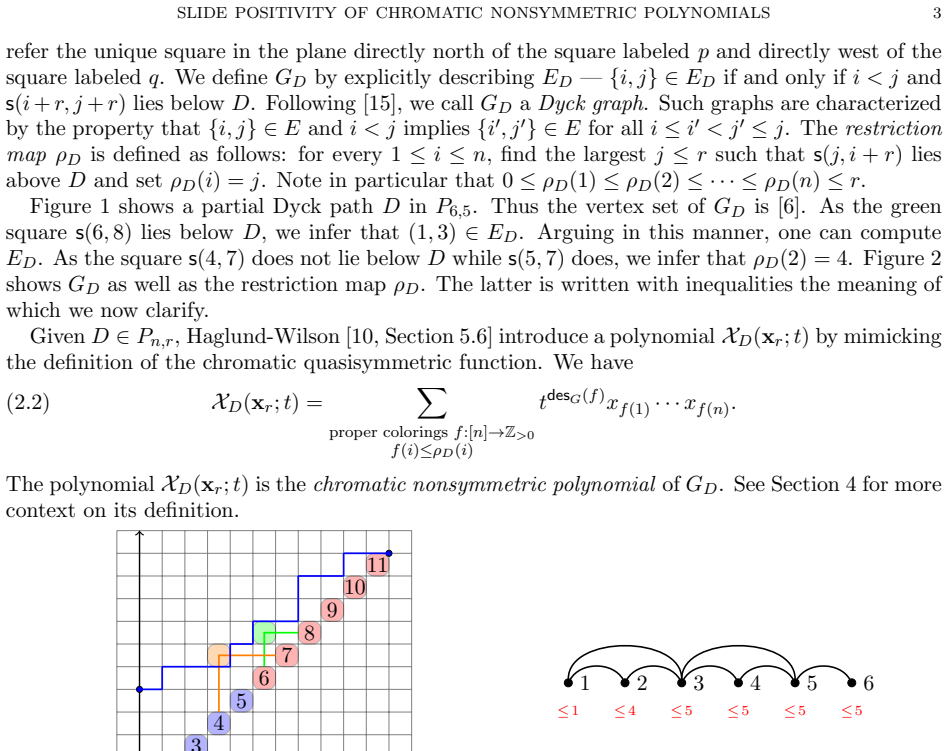
The central result, Theorem 3.3, states that $$X_D(x_r;t)=\sum_{\pi\in S_n} $t^{{\operatorname{inv}}$_G(\pi)}F_{\operatorname{rdes}(L_\pi,\rho)}(x_r),$$ where $G=G_D$ is the Dyck graph of the partial Dyck path $D$, $\operatorname{inv}_G(\pi)$ counts edges of $G$ whose endpoints appear in decreasing order in $\pi$, and $\operatorname{rdes}(L_\pi,\rho)$ is the reduced weak descent composition of the linear order $L_\pi$ with the restriction map $\rho$ after tightening. Every summand is a fundamental slide polynomial with coefficient a power of $t$, so the expansion is positive and integral. In the backstable limit, the same expansion yields the known formula for the chromatic quasisymmetric function of $D$ in terms of fundamental quasisymmetric functions, indexed by the complement of the $P_D$-descent set of $\pi$. The authors also record that a stronger positivity property in the key basis fails for some six-vertex Dyck graphs, which sets slide-positivity apart as the correct level of generality.
Load-bearing premise
The expansion stands or falls on Lemma 3.1's equivalence between $P_D$-descents of $\pi$ and ascents of the labeling $\omega_o$, whose reverse direction is only sketched in the paper; if that equivalence fails in the omitted case, Lemma 3.2 and Theorem 3.3 lose their footing.
Editorial extensions
If this is right
- Every Dyck graph has a cancellation-free slide expansion of its chromatic nonsymmetric polynomial, so the polynomial's coefficients can be read directly from the Dyck path without enumerating colorings.
- The known expansion of the chromatic quasisymmetric function of a Dyck graph in the fundamental quasisymmetric basis is a direct corollary, obtained by setting positive-indexed variables to zero in the backstable limit.
- Because each permutation contributes exactly one slide polynomial (possibly zero), the expansion gives a finite combinatorial model for $X_D(x_r;t)$ indexed by $S_n$.
- Slide-positivity is preserved under the backstable limit, so the same positivity transfers to the associated formal power series $\overleftarrow{X}_D(x;t)$.
Reading between the lines
- The same collapse mechanism could plausibly prove slide-positivity for other graph families whose incomparability posets satisfy a Dyck-like interval condition, provided the labeling algorithm of Lemma 3.1 can be adapted; testing unit interval orders outside the Dyck class would show where the boundary lies.
- Because the expansion is indexed by permutations, it suggests a dynamic-programming recurrence along the Dyck path for the coefficients of $F_a(x_r)$; such a recurrence could be verified computationally for all partial Dyck paths with $n\le 6$.
- The backstable limit opens a connection to the theory of stable limits for nonsymmetric polynomials, and one could ask whether the backstable expansion is itself positive in some basis of formal power series beyond quasisymmetric functions.
- The paper's six-vertex counterexamples to key-positivity make the slide basis a natural target for a refined conjecture: characterize which partial Dyck paths yield key-positive chromatic nonsymmetric polynomials, or identify a coarser basis than slides in which positivity always holds.
Editorial analysis
A structured set of objections, weighed in public.
Referee Report
Summary. The paper studies X_D(x_r;t), the chromatic nonsymmetric polynomial of a Dyck graph introduced by Haglund and Wilson, and proves that it expands positively in the basis of fundamental slide polynomials. The proof decomposes proper colorings according to the compatible acyclic orientation, identifies each orientation's contribution with a flagged (P,omega)-partition generating function in the sense of Assaf-Bergeron, and then uses Lemma 3.1 to show that each linear-extension piece collapses to a single slide polynomial indexed by a reduced weak descent composition depending only on the permutation pi and the restriction rho. The main result, Theorem 3.3, states that X_D(x_r;t) equals the sum over pi in S_n of t^{inv_G(pi)} F_{rdes(L_pi,rho)}(x_r). The paper then defines a backstable limit of slide polynomials, uses Lemma 3.5 to express backstable slides in terms of fundamental quasisymmetric functions, and derives the known Shareshian-Wachs expansion for the chromatic quasisymmetric function of Dyck graphs as Corollary 3.6. A final remark claims that Haglund-Wilson's key-positivity conjecture fails for some Dyck graphs on six vertices, though no example is given.
Significance. If the main theorem is fully established, the paper gives a uniform, parameter-free positive integral expansion of every chromatic nonsymmetric polynomial of a Dyck graph in the fundamental slide basis, a genuinely nonsymmetric analogue of fundamental-quasisymmetric expansions. The proof route through Assaf-Bergeron's flagged (P,rho)-partitions is natural and, modulo the gaps noted below, transparent. The backstable-limit argument also provides a new derivation of a known expansion for chromatic quasisymmetric functions, and the claimed counterexample to key-positivity would be a useful addition to the literature if it were explicitly exhibited. The derivation is not circular: the expansion is proved from external definitions, and the symmetric-function result is recovered as a consequence rather than assumed.
major comments (3)
- [Section 3, Lemma 3.1] The reverse implication of Lemma 3.1 is incomplete. After ruling out the cases pi(i) not comparable to pi(i+1) in P_D and {pi(i),pi(i+1)} in E, the remaining case pi(i+1) succ_{P_D} pi(i) is dismissed with the sentence 'The argument for this is very similar to that presented in the proof of the forward direction. We omit the details.' This case is not a formal consequence of the forward direction, because the roles of pi(i) and pi(i+1) are not symmetric: the hypothesis is omega_o(pi(i)) < omega_o(pi(i+1)), and the forward proof uses the Dyck-graph interval property in a way that depends on which of the two vertices has the larger natural label. Since Lemma 3.1 is used in equation (3.2) to replace descents of omega_o composed with pi by P_D-descents, and since Lemma 3.2 and Theorem 3.3 depend on that replacement, the missing case must be proved in full.
- [Section 3.1, Lemma 3.5] The proof of Lemma 3.5 is omitted entirely, with the explanation that it is 'simply a matter of unraveling the definitions'. This lemma is the bridge from the backstable slide expansion to the fundamental-quasisymmetric-function expansion used in Corollary 3.6, so it is load-bearing for the paper's recovery of the Shareshian-Wachs result. A reader cannot verify the claimed gamma circle-dot delta and gamma dot delta decomposition from the text; please include a complete proof or a detailed derivation of the displayed expansion.
- [Section 4, Remark (2)] The paper states that 'we found counterexamples with Dyck graphs on 6 vertices' to Haglund-Wilson's key-positivity conjecture, but no counterexample is displayed or described. Because this assertion directly contradicts a published conjecture and is presented as a finding of the paper, the manuscript should include at least one explicit Dyck path D and the corresponding polynomial X_D(x_r;t) together with its key expansion. This example is not needed for Theorem 3.3, but it is needed for the remark to be verifiable.
minor comments (4)
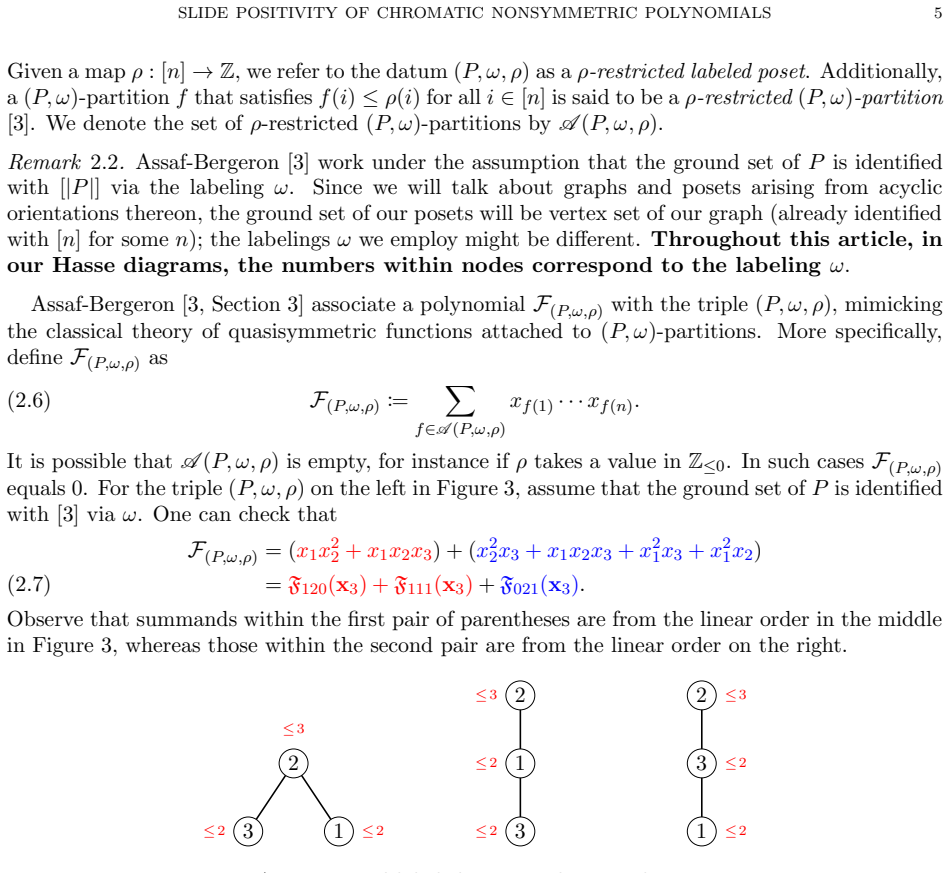
- [Section 2.5, equation (2.10)] The equality F(L,omega,rho) = F_{2021}(x_4) + F_{1121}(x_4) is stated without explaining how the two slide polynomials arise from the linear extensions in Figure 4; a short indication of the two descent sets would help the reader check the definition of rdes.
- [Theorem 3.3] The theorem statement writes X_D(x;t) while the defining equation (2.2) and the expansion use the finite alphabet x_r; please reconcile the notation throughout the section.
- [Section 3, equation (3.5)] In the displayed expansion, the weak compositions F_{1|2}, F_{1|101}, and F_{11|1} are written without commas; although the convention is stated in Remark 2.1, using fully separated notation in this central example would improve readability.
- [Remark 2.4] The 'folklore bijective correspondence' between strong compositions and subsets of [n-1] is invoked without a reference; citing a standard source, such as Stanley's Enumerative Combinatorics, would be helpful.
Circularity Check
No circularity: the slide expansion is proved against the external Assaf-Bergeron theory, and the omitted reverse case of Lemma 3.1 is a proof gap, not a circular reduction.
full rationale
The paper's central derivation is self-contained against external frameworks. The chromatic nonsymmetric polynomial XD(xr;t) is defined directly in equation (2.2) from the partial Dyck path D, with no dependence on slide polynomials or on the theorem being proved. Theorem 3.3 partitions proper colorings by acyclic orientations, applies Assaf-Bergeron's Proposition 2.5 and Corollary 3.15 to express each F(Lπ,ωo,ρ) as a slide polynomial, and sums the result. No fitted parameter is introduced, and no quantity in Lemma 3.2 or Theorem 3.3 is defined in terms of the claimed expansion. Lemma 3.1, which relates PD-descents of π to ascents of ωo∘π, is the pivotal combinatorial input, and the proof of the reverse direction omits one case with the sentence: 'The argument for this is very similar to that presented in the proof of the forward direction. We omit the details.' This is an explicit proof gap: the omitted case must rule out π(i+1)≻PD π(i) using the Dyck graph interval property in the opposite direction. However, a missing case in a combinatorial proof is not circularity; it does not reduce the conclusion to its own input. The known Shareshian-Wachs expansion is recovered in Corollary 3.6 as a consequence of the backstable limit, not assumed as a premise. Self-citations to Haglund-Wilson are used only for the definition and motivation of the object under study, and the load-bearing results on flagged (P,ρ)-partitions and slide polynomials come from the external papers of Assaf-Bergeron and Assaf-Searles. Therefore no pattern of self-definition, fitted-input-as-prediction, or self-citation load-bearing circularity is present; the appropriate finding is no significant circularity, with the Lemma 3.1 omission noted as a correctness risk rather than a circularity score.
Assumptions & free parameters
assumptions (3)
- standard math F(P,ω,ρ) expands as a sum of F(L,ω,ρ) over linear extensions L of P (Assaf-Bergeron Corollary 3.15).
- standard math Proposition 2.5 of Assaf-Bergeron: for a rho-restricted linear order satisfying the equality condition on consecutive labels, F(L,ω,ρ) equals a single slide polynomial indexed by the reduced weak descent composition.
- standard math Definitions and triangularity of slide polynomials from Assaf-Searles are taken as background.
Cite this review
Pith. "Pith review of Chromatic nonsymmetric polynomials of Dyck graphs are slide-positive." pith.science (2026). https://pith.science/paper/6B5YN54S
@misc{pith2026190806598,
  author       = {Pith},
  title        = {Pith review of: Chromatic nonsymmetric polynomials of Dyck graphs are slide-positive},
  year         = {2026},
  howpublished = {\url{https://pith.science/paper/6B5YN54S}},
  note         = {Machine review of arXiv:1908.06598}
}
abstract
Motivated by the study of Macdonald polynomials, J. Haglund and A. Wilson introduced a nonsymmetric polynomial analogue of the chromatic quasisymmetric function called the \emph{chromatic nonsymmetric polynomial} of a Dyck graph. We give a positive expansion for this polynomial in the basis of fundamental slide polynomials using recent work of Assaf-Bergeron on flagged $(P,\rho)$-partitions. We then derive the known expansion for the chromatic quasisymmetric function of Dyck graphs in terms of Gessel's fundamental basis by taking a backstable limit of our expansion.
Figures

Figures from the paper (4 more)


Reference graph
Works this paper leans on
-
[1]
P. Alexandersson , Non-symmetric Macdonald polynomials and Demazure-Lusztig operators , arxiv: https: //arxiv.org/abs/1602.05153
-
[2]
P. Alexandersson and G. Panova , LLT polynomials, chromatic quasisymmetric functions and graphs with cycles, Disc. Math. 343 (2018) 3453–3482
work page 2018
-
[3]
Flagged $(\mathcal{P},\rho)$-partitions
S. Assaf and N. Bergeron , Flagged (P,ρ )-partitions, arxiv: https://arxiv.org/abs/1904.06630
work page Pith review arXiv 1904
-
[4]
S. Assaf and D. Searles , Schubert polynomials, slide polynomials, Stanley symmetric functions and quasi- Yamanouchi pipe dreams, Adv. Math. 306 (2017) 89–122
work page 2017
-
[5]
Athanasiadis, Power sum expansion of chromatic quasisymmetric functions , Electron
C. Athanasiadis, Power sum expansion of chromatic quasisymmetric functions , Electron. J. Combin. 22 (2015) 9pp
work page 2015
-
[6]
P. Brosnan and T. Chow , Unit Interval Orders and the Dot Action on the Cohomology of Regular Semisimple Hessenberg Varieties, Adv. Math. 329 (2018) 955–1001
work page 2018
-
[7]
Birkhoff, A determinant formula for the number of ways of coloring a map , Ann
G.D. Birkhoff, A determinant formula for the number of ways of coloring a map , Ann. Math. 14 (1912) 42–46
work page 1912
-
[8]
E. Carlsson and A. Mellit , A proof of the shuffle conjecture , J. Amer. Math. Soc. 31 (2018) 661–697
work page 2018
Show all 20 references
-
[9]
Chow , Descents, quasi-symmetric functions, Robinson-Schensted for posets, and the chromatic symmetric function, J
T. Chow , Descents, quasi-symmetric functions, Robinson-Schensted for posets, and the chromatic symmetric function, J. Algebraic Combin. 10 (1999), 227–240
1999
-
[10]
Haglund and A
J. Haglund and A. Wilson , Macdonald polynomials and chromatic quasisymmetric functions , arxiv: https: //arxiv.org/abs/1701.05622
-
[11]
Guay-Paquet, A second proof of the Shareshian-Wachs conjecture, by way of a new Hopf algebra , arxiv: https://arxiv.org/abs/1601.05498
M. Guay-Paquet, A second proof of the Shareshian-Wachs conjecture, by way of a new Hopf algebra , arxiv: https://arxiv.org/abs/1601.05498
-
[12]
Lam, S.J
T. Lam, S.J. Lee and M. Shimozono , Back stable Schubert calculus , arxiv: https://arxiv.org/abs/1806. 11233
-
[13]
Pechenik and D
O. Pechenik and D. Searles , Asymmetric function theory , arxiv: https://arxiv.org/abs/1904.01358
1904 arXiv
-
[14]
I. G. Macdonald , Symmetric functions and Hall polynomials , Oxford Classic Texts in the Physical Sciences, The Clarendon Press, New York (1995)
1995
-
[15]
Novelli and J.-Y
J.-C. Novelli and J.-Y. Thibon , Noncommutative unicellular LLT polynomials , arxiv: https://arxiv.org/ abs/1907.00077
1907 arXiv
-
[16]
Sagan, The symmetric group
B. Sagan, The symmetric group. Representations, combinatorial algorithms, and symmetric functions, Graduate Texts in Mathematics 203, Springer-Verlag, New York (2001)
2001
-
[17]
Shareshian and M
J. Shareshian and M. W achs , Chromatic quasisymmetric functions , Adv. Math. 295 (2016) 497–551
2016
-
[18]
R. P. Stanley , A symmetric function generalization of the chromatic polynomial of a graph , Adv. Math. 111 (1995) 166–194
1995
-
[19]
R. P. Stanley , Enumerative Combinatorics. Vol. 2 , Cambridge Studies in Advanced Mathematics, Cambridge University Press, Cambridge (1999)
1999
-
[20]
Whitney , The coloring of graphs , Ann
H. Whitney , The coloring of graphs , Ann. Math. 33 (1932) 688–718. SLIDE POSITIVITY OF CHROMATIC NONSYMMETRIC POLYNOMIALS 15 Department of Mathematics, University of Pennsylvania, Philadelphia, PA 19104, USA E-mail address: vvtewari@math.upenn.edu Department of Mathematics, P...
1932
Reviewed August 14, 2026 · model on record in the stance chip above.
Discussion (0). Continue with ORCID to comment.