REVIEW 3 major objections 4 minor 126 references
Discontinuous Galerkin approximations in computational mechanics: hybridization, exact geometry and degree adaptivity
T0 review · 3 major / 4 minor · reviewed 2026-08-14 · deepseek-v4-flash
Pith's one-line read The paper argues that degree-adaptive error decreases monotonically to the tolerance only when the curved boundary is represented exactly (NURBS-enhanced HDG); a frozen polynomial geometry lets the loop stop on the wrong solution.
desk verdict Useful consolidation of the authors' HDG variants, but the key new p-adaptivity claim rests on an undefined 'exact error' reference and needs a reproducibility pass before I'd trust the strong version. read the letter →
The pith
A machine-rendered reading of the paper's core claim, the machinery that carries it, and where it could break.
The reading
What carries the argument
The engine of the paper is the pairing of three existing constructions. First, the hybridizable discontinuous Galerkin (HDG) formulation rewrites a second-order PDE into local element problems whose only globally coupled unknowns live on mesh faces, which makes the degrees of freedom cheap and enables a local postprocessing step, Eqs. (5)–(6), that produces a superconvergent approximation $u^\star$ of degree $k+1$ and accuracy order $k+2$. Second, the NURBS-enhanced finite element method (NEFEM) represents the domain boundary by the exact CAD NURBS curves and adapts the functional space near the boundary to that geometry, so changing the polynomial degree never requires re-approximating or regenerating the curved boundary. Third, the superconvergent $u^\star$ feeds the elementwise error indicator $E_u^e$ of Eq. (7), and the a priori estimate of Eq. (8), $\varepsilon_e \le C h_e^{k_e+1+n_{\mathrm{sd}}/2}$, combined with Richardson extrapolation of $C$, produces the degree-update rule $\Delta k_e = \left\lceil \log(\varepsilon/E_u^e)/\log(h_e) \right\rceil$ of Eq. (9). The HDG-Voigt formulation replaces the stress tensor by its independent entries in Voigt notation, enforcing symmetry of the mixed variable pointwise and yielding optimal convergence with nodal equal-order spaces; FCFV then appears as the constant-degree limit of the same HDG machinery, where all local unknowns admit closed-form expressions in terms of the face unknowns.
What would settle it
Run the degree-adaptive loop of Section 3 on a smooth domain with a known analytic solution (for example, a harmonic function on a circular-arc domain representable both by NURBS and by polynomials) and compare, at every iteration, the estimated error from Eq. (7) with the true error against the manufactured solution, under both HDG-NEFEM and fixed-cubic subparametric geometry. If at any iteration the NEFEM path shows a true error far above the estimate, or fails to decrease monotonically to the prescribed tolerance, the central claim is refuted; if the fixed-cubic path again stops with a large true error while its estimate claims success, the claimed failure mode of polynomial-frozen adaptivity is reproduced.
Extended reading notes
Core claim
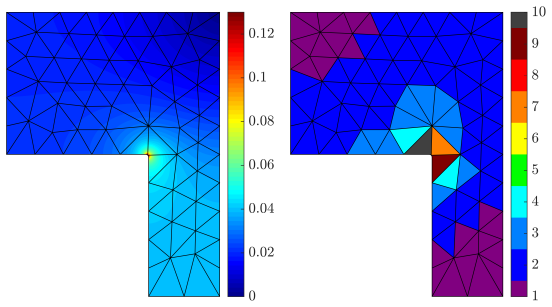
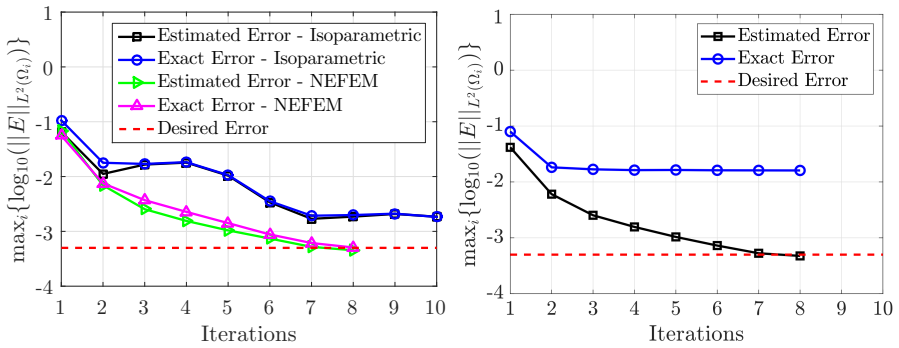
The central claim is that in a degree-adaptive HDG process the geometry of the computational domain must be represented exactly for the iteration to converge to the intended solution. Using the electrostatic problem of a square inclusion with rounded corners, the paper shows that an isoparametric approach with a fixed cubic polynomial description of the rounded fillet stops after eight iterations because the estimated error reaches the tolerance, while the exact error remains far above it—the method is solving a problem with a slightly different, non-smooth geometry. With HDG-NEFEM, in which the NURBS description of the fillet is kept regardless of the polynomial degree of the functional approximation, the exact and estimated errors both decrease monotonically until the desired tolerance of $0.5\times10^{-3}$ is achieved. The mechanism is the superconvergent postprocessed solution $u^\star$, which yields a cheap elementwise error indicator; an a priori bound of the form $\varepsilon_e \le C h_e^{k_e+1+n_{\mathrm{sd}}/2}$, with $C$ fixed by Richardson extrapolation, then dictates how much to raise the local polynomial degree. Supporting results establish an HDG-Voigt formulation for linear elasticity whose pointwise symmetric strain-rate variable converges optimally (order $k+1$) even for $k=1,2,3$ and drives error indicators based on either displacement or strain rate, as well as a lowest-order face-centered finite volume method that is LBB-stable, reconstruction-free, and insensitive to mesh distortion and cell stretching.
Load-bearing premise
The whole degree-adaptive loop rests on the assumption that the error bound $\varepsilon_e \le C h_e^{k_e+1+n_{\mathrm{sd}}/2}$, with the constant $C$ obtained by Richardson extrapolation from two computed polynomial degrees, correctly predicts how the error will fall when the degree is raised; the paper itself shows this prediction failing badly in Figure 3 (right) whenever the boundary is frozen as cubic polynomials, and it never independently verifies the reliability of the indicator for the NEFEM case.
Editorial extensions
If this is right
- Degree-adaptive HDG on a fixed coarse mesh can reach a user-prescribed tolerance in electrostatics without mesh regeneration, provided the curved boundary is the exact NURBS geometry; with a frozen cubic boundary it stops prematurely.
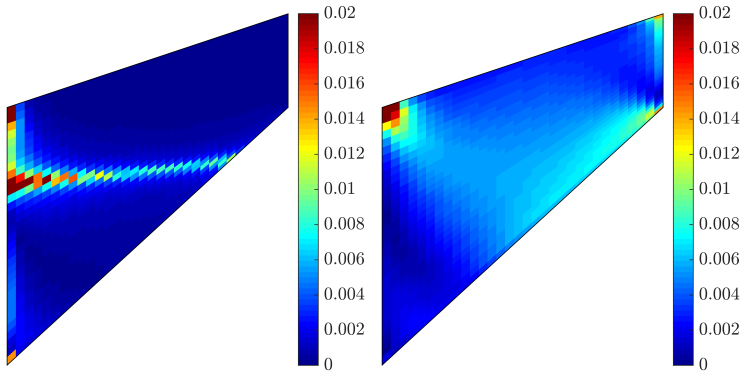
- The superconvergent postprocessed displacement provides an inexpensive elementwise error indicator that drives p-adaptivity in linear elasticity for both displacement- and stress-accuracy goals, the strain-rate indicator localizing stress concentrations.
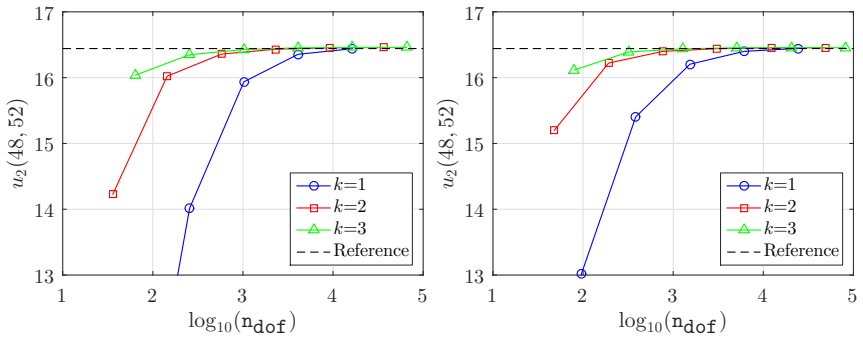
- HDG-Voigt supplies a pointwise symmetric stress and strain-rate approximation that is optimally convergent for $k=1,2,3$ and free of volumetric locking for nearly incompressible materials, as demonstrated on Cook's membrane with $\nu=0.499999975$.
- The same HDG rationale, taken to constant degree, yields FCFV: a first-order, LBB-stable, reconstruction-free finite volume method insensitive to distorted and stretched cells, exercised here on a 61-million-unknown Stokes problem in a serial Matlab implementation.
- Because the NEFEM boundary is degree-independent, the degree-adaptive strategy composes directly with h-refinement, yielding hp-adaptive processes that keep the exact CAD geometry throughout.
Reading between the lines
- A practical diagnostic suggested by Figure 3 (right) but not stated in the paper: any existing p-adaptive code with a subparametric boundary could monitor the gap between its estimated and exact error on a representatively curved test case, and a persistent gap is a cheap signal that geometric error, not functional error, is dominating the iteration.
- The clean separation NEFEM provides between geometric and functional approximation suggests a parameter-free way to size curved meshes: let the CAD model alone determine the boundary representation, so the geometry error is exactly zero rather than balanced against the functional error.
- The HDG-Voigt strain-rate indicator could be carried into shape-optimization or fracture-preconditioning loops, where the quantity of interest is the stress concentration at a rounded notch—exactly the region the displacement-based indicator misses; this is an extension the paper motivates but does not perform.
- If FCFV's closed-form local elimination is the reason for its cheap assembly, the same decoupling should make the global face system amenable to algebraic multigrid or domain-decomposition preconditioning at scales far beyond the reported serial experiment, a direct but untested consequence of the block structure in Eq. (26).
Signed reviews
Editorial analysis
A structured set of objections, weighed in public.
Referee Report
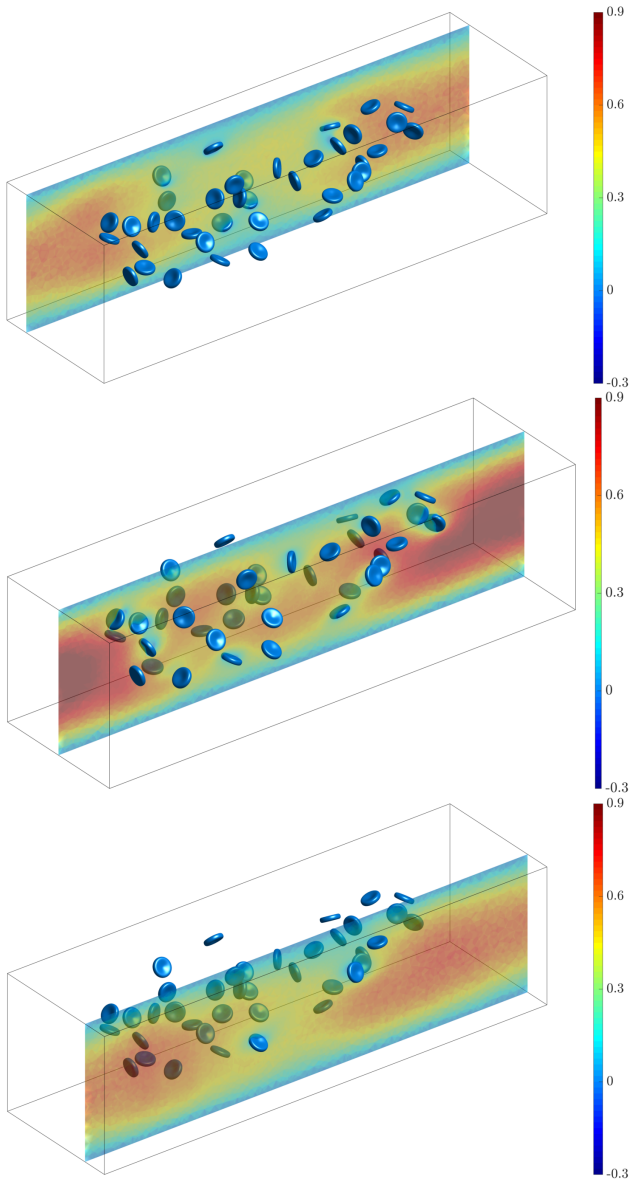
Summary. The paper revisits hybridizable discontinuous Galerkin (HDG) methods combined with exact geometry representation via NURBS-enhanced finite elements (NEFEM), degree adaptivity, a Voigt-based symmetric-tensor HDG formulation for linear elasticity, and the lowest-order face-centered finite volume (FCFV) method for large-scale Stokes flows. The central numerical claim is in Section 3: on a filleted-square electrostatic problem, degree adaptivity with HDG-NEFEM reduces the exact error monotonically to a prescribed tolerance, whereas degree adaptivity on a fixed cubic polynomial geometry converges instead to the solution of a different problem. The other sections summarize the authors' prior HDG-Voigt and FCFV developments and show representative benchmark results, including Cook's membrane and a 39-particle red-blood-cell Stokes flow.
Significance. If the monotonic-decrease and reliability claims hold, the HDG-NEFEM degree-adaptive strategy would be a practically valuable alternative to isoparametric or fixed-polynomial-geometry adaptivity for problems requiring tolerance-driven p-refinement on curved domains. The paper is clearly written and the formulations are standard. However, the central new evidence is a single numerical example whose reference ('exact') error is never defined, and the local error indicator's reliability for NEFEM elements is not independently verified. The manuscript also does not ship code or machine-checked proofs, so the numerical claims cannot be reproduced from the text alone. The contribution is best assessed as a well-structured survey plus one promising but under-validated numerical demonstration.
major comments (3)
- [Section 3, Figure 3] The exact-error curves in Figure 3 are not defined. The filleted-square problem has no known analytic solution, and the text does not state whether the reference solution is an overkill HDG-NEFEM computation, a different discretization, or a manufactured solution. Without this definition, the central claim that the HDG-NEFEM exact error decreases monotonically to the tolerance, and the contrast with the fixed-cubic-geometry case, cannot be independently checked. Please specify the reference solution, the discretization parameters used, and how the exact error is computed element-wise.
- [Section 3, Eqs. (8)-(9) and Figure 3] The degree-update formula (9) presumes that the local indicator E_u^e defined in Eq. (7) is a faithful proxy for the true local error and that the a priori estimate (8), with the constant C estimated by Richardson extrapolation from two polynomial degrees, correctly predicts the error reduction when the degree is increased. No effectivity indices or per-iteration estimated-versus-exact error tables are given for the NEFEM run. This matters because Figure 3 (right) demonstrates that the same assumption can fail badly when the geometry is represented by fixed cubic polynomials. Please provide effectivity indices for both the NEFEM and cubic-geometry runs, and justify the validity of the exponent k+1+nsd/2 and the Richardson extrapolation over the degree range actually used.
- [Sections 4-5, Figures 4, 6-7] The quantitative support for the HDG-Voigt and FCFV contributions is thin: the optimal-convergence claim for HDG-Voigt is illustrated only by the value of the displacement at one point of Cook's membrane, and the FCFV claim of first-order accuracy is not accompanied by any convergence table on a problem with a known solution. If these sections are intended as original numerical contributions rather than as summaries of prior published work, please add computed-versus-exact error tables and measured convergence rates. At minimum, state clearly that these are review sections and provide pointers to the original papers containing the full convergence studies.
minor comments (4)
- [Section 5, Eq. (26)] The incompressibility constraint is written as ∫_{∂Ω_e\Γ_D} υ̂·n dΓ = -∫_{∂Ω_e∩Γ_D} u_D·n dΓ = 0, but the final “= 0” is not true in general because the Dirichlet data u_D need not vanish on Γ_D. The equality should be just ∫_{∂Ω_e\Γ_D} υ̂·n dΓ = -∫_{∂Ω_e∩Γ_D} u_D·n dΓ.
- [Section 5, large-scale simulation paragraph] The text says “the evaluation of the element-by-element solution in all 61 millions elements,” but the mesh consists of about 8.97 million tetrahedral elements; 61.5 million is the number of unknowns in the global system. Please correct this wording.
- [Section 3, Eq. (9)] In the degree-update formula, log(h_e) is negative when the nondimensional element size h_e is less than 1, so the sign convention in the ceiling expression should be explained explicitly, together with the nondimensionalization used to define h_e.
- [General] The figures (Figures 1-7) are referenced in the captions but the images are not present in the manuscript text provided; please ensure the final version contains all figures with clearly readable axis labels and legends.
Circularity Check
No circularity found: the paper is an overview with self-citations to prior methods, but its claims are not forced by definition or by the cited results.
full rationale
The paper is a review-style account of previously developed HDG, HDG-NEFEM, HDG-Voigt and FCFV methods, and it frequently cites the authors' own prior papers ([57], [82], [83], [106], [107], [118]). Self-citation alone is not circular, and here it is not the load-bearing mechanism: the formulations are restated in the manuscript and the numerical demonstrations are anchored to external benchmarks, e.g. the Cook's membrane reference value taken from [120]. The Section 3 degree-adaptivity procedure does use the error indicator (7) and the degree update (9), and the 'estimated error' curves reaching the tolerance are, in part, a consequence of the stopping criterion; however, the paper does not present that as a prediction, and the central comparison is made with the separate 'exact error' curves. The fixed-cubic-geometry failure shown in Figure 3 (right) is a numerical observation about a particular subparametric strategy, not an implication of Eq. (9) by construction. No equation in the derivation is equivalent by definition to its input, no fitted parameter is renamed as a prediction, and no uniqueness theorem is imported from the authors' earlier work to force a choice. The unspecified reference solution for the 'exact error' curves is a reproducibility weakness rather than a circular step. Overall, the derivation chain is self-contained enough that no specific circular reduction can be exhibited.
Assumptions & free parameters
free parameters (2)
- Stabilization parameter τ =
Unspecified for examples
- Per-element constant C in error estimate =
Estimated per element by Richardson extrapolation from two polynomial degrees
assumptions (3)
- domain assumption Local a priori error estimate ε_e ≤ C h_e^(k_e+1+n_sd/2) (Eq. (8)) holds elementwise.
- domain assumption HDG postprocessing u* superconverges with order k+2 and provides a reliable error indicator (Eq. (7)).
- domain assumption FCFV inherits LBB stability and first-order convergence from the lowest-order HDG framework.
Cite this review
Pith. "Pith review of Discontinuous Galerkin approximations in computational mechanics: hybridization, exact geometry and degree adaptivity." pith.science (2026). https://pith.science/paper/N3NHTPB4
@misc{pith2026190806604,
  author       = {Pith},
  title        = {Pith review of: Discontinuous Galerkin approximations in computational mechanics: hybridization, exact geometry and degree adaptivity},
  year         = {2026},
  howpublished = {\url{https://pith.science/paper/N3NHTPB4}},
  note         = {Machine review of arXiv:1908.06604}
}
read the original abstract
Discontinuous Galerkin (DG) discretizations with exact representation of the geometry and local polynomial degree adaptivity are revisited. Hybridization techniques are employed to reduce the computational cost of DG approximations and devise the hybridizable discontinuous Galerkin (HDG) method. Exact geometry described by non-uniform rational B-splines (NURBS) is integrated into HDG using the framework of the NURBS-enhanced finite element method (NEFEM). Moreover, optimal convergence and superconvergence properties of HDG-Voigt formulation in presence of symmetric second-order tensors are exploited to construct inexpensive error indicators and drive degree adaptive procedures. Applications involving the numerical simulation of problems in electrostatics, linear elasticity and incompressible viscous flows are presented. Moreover, this is done for both high-order HDG approximations and the lowest-order framework of face-centered finite volumes (FCFV).
Figures

Figures from the paper (4 more)

Reference graph
Works this paper leans on
-
[1]
Hesthaven and T
J.S. Hesthaven and T. Warburton. Nodal high-order methods on unstructured grids: I. time-domain solution of Maxwell’s equations. J. Comput. Phys. , 181(1):186–221, 2002
2002
-
[2]
Dawson, R
M. Dawson, R. Sevilla, and K. Morgan. The application of a high-order discontinu- ous Galerkin time-domain method for the computation of electromagnetic resonant modes. Appl. Math. Model. , 55:94–108, 2018
2018
-
[3]
Bassi and S
F. Bassi and S. Rebay. High-order accurate discontinuous finite element solution of the 2D Euler equations. J. Comput. Phys. , 138(2):251–285, 1997
1997
-
[4]
Abgrall and M
R. Abgrall and M. Ricchiuto. High-order methods for CFD. In Encyclopedia of Computational Mechanics Second Edition , pages 1–54. Wiley, 2017
2017
-
[5]
Cockburn, G
B. Cockburn, G. E. Karniadakis, and C.-W. Shu. The development of discontin- uous Galerkin methods. In Discontinuous Galerkin methods (Newport, RI, 1999) , volume 11 of Lect. Notes Comput. Sci. Eng. , pages 3–50. Springer, Berlin, 2000
1999
-
[6]
Rivi` ere.Discontinuous Galerkin Methods for Solving Elliptic and Parabolic Equa- tions
B. Rivi` ere.Discontinuous Galerkin Methods for Solving Elliptic and Parabolic Equa- tions. Society for Industrial and Applied Mathematics, 2008
2008
-
[7]
Di Pietro and A
D.A. Di Pietro and A. Ern. Mathematical aspects of discontinuous Galerkin methods, volume 69. Springer, Heidelberg, 2012
2012
-
[8]
Cangiani, Z
A. Cangiani, Z. Dong, E.H. Georgoulis, and P. Houston. hp-Version Discontinu- ous Galerkin Methods on Polygonal and Polyhedral Meshes . Springer International Publishing, 2017
2017
Show all 126 references
-
[9]
Crivellini and F
A. Crivellini and F. Bassi. An implicit matrix-free discontinuous Galerkin solver for viscous and turbulent aerodynamic simulations. Comput. Fluids, 50(1):81 – 93, 2011
2011
-
[10]
Frank and C.-D
H.M. Frank and C.-D. Munz. Direct aeroacoustic simulation of acoustic feedback phenomena on a side-view mirror. J. Sound Vib. , 371:132 – 149, 2016
2016
-
[11]
Fehn, W.A
N. Fehn, W.A. Wall, and M. Kronbichler. A matrix-free high-order discontinuous Galerkin compressible Navier-Stokes solver: A performance comparison of compress- ible and incompressible formulations for turbulent incompressible flows. Int. J. Nu- mer. Methods Fluids , 89(3):71–102, 2019
2019
-
[12]
R.J. Guyan. Reduction of stiffness and mass matrices. AIAA Journal, 3(2):380–380, 1965
1965
-
[13]
Fraeijs de Veubeke
B. Fraeijs de Veubeke. Displacement and equilibrium models in the finite element method. In O.C. Zienkiewicz and G.S. Holister, editor, Stress Analysis, pages 145–
-
[14]
Cockburn
B. Cockburn. Static condensation, hybridization, and the devising of the HDG meth- ods. In G. R. Barrenechea, F. Brezzi, A. Cangiani, and E.H. Georgoulis, editors, Building Bridges: Connections and Challenges in Modern Approaches to Numeri- cal Partial Differential Equations, p...
2016
-
[15]
Brezzi and M
F. Brezzi and M. Fortin. Mixed and hybrid finite elements methods . Springer series in computational mathematics. Springer-Verlag, 1991
1991
-
[16]
Huerta, A
A. Huerta, A. Angeloski, X. Roca, and J. Peraire. Efficiency of high-order elements for continuous and discontinuous Galerkin methods. Int. J. Numer. Methods Eng. , 96(9):529–560, 2013
2013
-
[17]
Kirby, S.J
R. Kirby, S.J. Sherwin, and B. Cockburn. To CG or to HDG: A comparative study. J. Sci. Comput. , 51(1):183–212, 2011
2011
-
[18]
Woopen, A
M. Woopen, A. Balan, G. May, and J. Sch¨ utz. A comparison of hybridized and standard DG methods for target-based hp-adaptive simulation of compressible flow. Comput. Fluids, 98:3 – 16, 2014
2014
-
[19]
Egger and J
H. Egger and J. Sch¨ oberl. A hybrid mixed discontinuous Galerkin finite-element method for convection-diffusion problems. IMA J. Numer. Anal. , 30(4):1206–1234, 2009
2009
-
[20]
Egger and C
H. Egger and C. Waluga. A hybrid mortar method for incompressible flow. Int. J. Numer. Anal. Model., 9(4):793–812, 2012
2012
-
[21]
Egger and C
H. Egger and C. Waluga. hp analysis of a hybrid DG method for Stokes flow. IMA J. Numer. Anal. , 33(2):687–721, 2012
2012
-
[22]
I. Oikawa. A hybridized discontinuous Galerkin method with reduced stabilization. J. Sci. Comput. , 65(1):327–340, 2015
2015
-
[23]
I. Oikawa. Analysis of a reduced-order HDG method for the Stokes equations. J. Sci. Comput., 67(2):475–492, 2016
2016
-
[24]
Di Pietro, A
D.A. Di Pietro, A. Ern, and S. Lemaire. An arbitrary-order and compact-stencil discretization of diffusion on general meshes based on local reconstruction operators. Comput. Methods Appl. Math. , 14(4):461–472, 2014
2014
-
[25]
Di Pietro and A
D.A. Di Pietro and A. Ern. A hybrid high-order locking-free method for linear elasticity on general meshes. Comput. Methods Appl. Mech. Eng. , 283:1–21, 2015
2015
-
[26]
Cockburn, D.A
B. Cockburn, D.A. Di Pietro, and A. Ern. Bridging the hybrid high-order and hybridizable discontinuous Galerkin methods. ESAIM: M2AN, 50(3):635–650, 2016. 21
2016
-
[27]
Cockburn and C.-W
B. Cockburn and C.-W. Shu. The local discontinuous Galerkin method for time- dependent convection-diffusion systems. SIAM J. Numer. Anal. , 35(6):2440–2463, 1998
1998
-
[28]
A superconvergent LDG- hybridizable Galerkin method for second-order elliptic problems
Bernardo Cockburn, Bo Dong, and Johnny Guzm´ an. A superconvergent LDG- hybridizable Galerkin method for second-order elliptic problems. Mathematics of Computation, 77(264):1887–1916, 2008
1916
-
[29]
Cockburn and J
B. Cockburn and J. Gopalakrishnan. A characterization of hybridized mixed methods for second order elliptic problems. SIAM J. Numer. Anal. , 42(1):283–301, 2004
2004
-
[30]
Cockburn and J
B. Cockburn and J. Gopalakrishnan. The derivation of hybridizable discontinuous Galerkin methods for Stokes flow. SIAM J. Numer. Anal. , 47(2):1092–1125, 2009
2009
-
[31]
Cockburn, J
B. Cockburn, J. Gopalakrishnan, and R. Lazarov. Unified hybridization of discon- tinuous Galerkin, mixed, and continuous Galerkin methods for second order elliptic problems. SIAM J. Numer. Anal. , 47(2):1319–1365, 2009
2009
-
[32]
Nguyen, J
N.C. Nguyen, J. Peraire, and B. Cockburn. An implicit high-order hybridizable discontinuous Galerkin method for linear convection-diffusion equations. J. Comput. Phys., 228(9):3232–3254, 2009
2009
-
[33]
Nguyen, J
N.C. Nguyen, J. Peraire, and B. Cockburn. An implicit high-order hybridizable dis- continuous Galerkin method for nonlinear convection-diffusion equations.J. Comput. Phys., 228(23):8841–8855, 2009
2009
-
[34]
Cockburn, N.C
B. Cockburn, N.C. Nguyen, and J. Peraire. A comparison of HDG methods for Stokes flow. J. Sci. Comput. , 45(1-3):215–237, 2010
2010
-
[35]
Nguyen, J
N.C. Nguyen, J. Peraire, and B. Cockburn. A hybridizable discontinuous Galerkin method for Stokes flow. Comput. Methods Appl. Mech. Eng. , 199(9-12):582–597, 2010
2010
-
[36]
Nguyen, J
N.C. Nguyen, J. Peraire, and B. Cockburn. An implicit high-order hybridizable discontinuous Galerkin method for the incompressible Navier-Stokes equations. J. Comput. Phys., 230(4):1147–1170, 2011
2011
-
[37]
S.-C. Soon, B. Cockburn, and H.K. Stolarski. A hybridizable discontinuous Galerkin method for linear elasticity. Int. J. Numer. Methods Eng. , 80(8):1058–1092, 2009
2009
-
[38]
G. Fu, B. Cockburn, and H. Stolarski. Analysis of an HDG method for linear elas- ticity. Int. J. Numer. Methods Eng. , 102(3-4):551–575, 2015
2015
-
[39]
Sch¨ utz and G
J. Sch¨ utz and G. May. A hybrid mixed method for the compressible Navier-Stokes equations. J. Comput. Phys. , 240:58 – 75, 2013. 22
2013
-
[40]
Cesmelioglu, B
A. Cesmelioglu, B. Cockburn, and W. Qiu. Analysis of a hybridizable discontinuous Galerkin method for the steady-state incompressible Navier-Stokes equations. Math. Comp., 86(306):1643–1670, 2017
2017
-
[41]
Qiu and K
W. Qiu and K. Shi. A superconvergent HDG method for the incompressible Navier- Stokes equations on general polyhedral meshes. IMA J. Numer. Anal. , 36(4):1943– 1967, 2016
1943
-
[42]
Di Pietro and S
D.A. Di Pietro and S. Krell. A hybrid high-order method for the steady incompress- ible Navier–Stokes problem. J. Sci. Comput. , 74(3):1677–1705, Mar 2018
2018
-
[43]
Botti, D.A
L. Botti, D.A. Di Pietro, and J. Droniou. A hybrid high-order method for the incompressible Navier-Stokes equations based on Temam’s device. J. Comput. Phys., 376:786 – 816, 2019
2019
-
[44]
Lehrenfeld and J
C. Lehrenfeld and J. Sch¨ oberl. High order exactly divergence-free hybrid discontin- uous Galerkin methods for unsteady incompressible flows. Comput. Methods Appl. Mech. Eng., 307:339 – 361, 2016
2016
-
[45]
Rhebergen and G.N
S. Rhebergen and G.N. Wells. A hybridizable discontinuous Galerkin method for the Navier–Stokes equations with pointwise divergence-free velocity field. J. Sci. Comput., 76(3):1484–1501, 2018
2018
-
[46]
Lederer, C
P. Lederer, C. Lehrenfeld, and J. Sch¨ oberl. Hybrid discontinuous Galerkin methods with relaxed H(div)-conformity for incompressible flows. Part I. SIAM J. Numer. Anal., 56(4):2070–2094, 2018
2018
-
[47]
Lederer, C
P.L. Lederer, C. Lehrenfeld, and J. Sch¨ oberl. Hybrid Discontinuous Galerkin methods with relaxed H(div)-conformity for incompressible flows. Part II. ESAIM: M2AN , 53(2):503–522, 2019
2019
-
[48]
Fernandez, N.C
P. Fernandez, N.C. Nguyen, and J. Peraire. The hybridized discontinuous Galerkin method for implicit large-eddy simulation of transitional turbulent flows. J. Comput. Phys., 336:308 – 329, 2017
2017
-
[49]
Moro, N.C
D. Moro, N.C. Nguyen, and J. Peraire. Navier-Stokes solution using hybridizable discontinuous Galerkin methods. In 20th AIAA Computational Fluid Dynamics Con- ference. AIAA, 2011
2011
-
[50]
Peters and J.A
E.L. Peters and J.A. Evans. A divergence-conforming hybridized discontinuous Galerkin method for the incompressible Reynolds-averaged Navier-Stokes equations. Int. J. Numer. Methods Fluids , 0(0), 2019
2019
-
[51]
Gatica and F.A
G.N. Gatica and F.A. Sequeira. Analysis of an augmented HDG method for a class of quasi-Newtonian Stokes flows. J. Sci. Comput. , 65(3):1270–1308, 2015. 23
2015
-
[52]
Cascavita, J
K.L. Cascavita, J. Bleyer, X. Chateau, and A. Ern. Hybrid discretization meth- ods with adaptive yield surface detection for Bingham pipe flows. J. Sci. Comput. , 77(3):1424–1443, 2018
2018
-
[53]
Peraire, N.C
J. Peraire, N.C. Nguyen, and B. Cockburn. A hybridizable discontinuous Galerkin method for the compressible Euler and Navier-Stokes equations. AIAA paper , 363:2010, 2010
2010
-
[54]
D. M. Williams. An entropy stable, hybridizable discontinuous Galerkin method for the compressible Navier-Stokes equations. Math. Comp., 87(309):95–121, 2018
2018
-
[55]
W. Qiu, J. Shen, and K. Shi. An HDG method for linear elasticity with strong symmetric stresses. Math. Comput., 87(309):69–93, 2018
2018
-
[56]
Cockburn and G
B. Cockburn and G. Fu. Devising superconvergent HDG methods with symmetric approximate stresses for linear elasticity by M-decompositions. IMA J. Numer. Anal., 38(2):566–604, 2017
2017
-
[57]
Sevilla, M
R. Sevilla, M. Giacomini, A. Karkoulias, and A. Huerta. A superconvergent hybridis- able discontinuous Galerkin method for linear elasticity.Int. J. Numer. Methods Eng., 116(2):91–116, 2018
2018
-
[58]
Abbas, A
M. Abbas, A. Ern, and N. Pignet. Hybrid High-Order methods for finite deformations of hyperelastic materials. Comput. Mech., 62(4):909–928, 2018
2018
-
[59]
Abbas, A
M. Abbas, A. Ern, and N. Pignet. A Hybrid High-Order method for incremental associative plasticity with small deformations. Comput. Methods Appl. Mech. Eng. , 346:891 – 912, 2019
2019
-
[60]
Abbas, A
M. Abbas, A. Ern, and N. Pignet. A hybrid high-order method for finite elastoplastic deformations within a logarithmic strain framework. Int. J. Numer. Methods Eng. , 0(0), 2019
2019
-
[61]
Kabaria, A.J
H. Kabaria, A.J. Lew, and B. Cockburn. A hybridizable discontinuous galerkin formulation for non-linear elasticity. Compu. Methods Appl. Mech. Eng. , 283:303 – 329, 2015
2015
-
[62]
Cockburn and J
B. Cockburn and J. Shen. An algorithm for stabilizing hybridizable discontinuous Galerkin methods for nonlinear elasticity. Results Appl. Math. , 1:100001, 2019
2019
-
[63]
Terrana, N.C
S. Terrana, N.C. Nguyen, J. Bonet, and J. Peraire. A hybridizable discontinuous Galerkin method for both thin and 3d nonlinear elastic structures. Comput. Methods Appl. Mech. Eng. , 352:561 – 585, 2019
2019
-
[64]
Sheldon, S.T
J.P. Sheldon, S.T. Miller, and J.S. Pitt. A hybridizable discontinuous Galerkin method for modeling fluid-structure interaction. J. Comput. Phys. , 326:91 – 114, 2016. 24
2016
-
[65]
Fidkowski
K.J. Fidkowski. A hybridized discontinuous Galerkin method on mapped deforming domains. Comput. Fluids, 139:80 – 91, 2016
2016
-
[66]
Fabien, M.G
M.S. Fabien, M.G. Knepley, and B.M. Rivi` ere. A hybridizable discontinuous Galerkin method for two-phase flow in heterogeneous porous media. Int. J. Numer. Methods Eng., 116(3):161–177, 2018
2018
-
[67]
Costa-Sol´ e, E
A. Costa-Sol´ e, E. Ruiz-Giron´ es, and J. Sarrate. An HDG formulation for incompress- ible and immiscible two-phase porous media flow problems. Int. J. Comput. Fluid Dyn., 33(4):137–148, 2019
2019
-
[68]
Fernandez, A
P. Fernandez, A. Christophe, S. Terrana, N. C. Nguyen, and J. Peraire. Hybridized discontinuous Galerkin methods for wave propagation. J. Sci. Comput. , 77(3):1566– 1604, 2018
2018
-
[69]
Bonnasse-Gahot, H
M. Bonnasse-Gahot, H. Calandra, J. Diaz, and S. Lanteri. Hybridizable discontinuous Galerkin method for the 2-D frequency-domain elastic wave equations. Geophys. J. Int., 213(1):637–659, 2017
2017
-
[70]
Terrana, J.P
S. Terrana, J.P. Vilotte, and L. Guillot. A spectral hybridizable discontinuous Galerkin method for elastic-acoustic wave propagation. Geophys. J. Int., 213(1):574– 602, 2017
2017
-
[71]
Hungria, D
A. Hungria, D. Prada, and F.-J. Sayas. HDG methods for elastodynamics. Comput. Math. Appl., 74(11):2671 – 2690, 2017
2017
-
[72]
Samii and C
A. Samii and C. Dawson. An explicit hybridized discontinuous Galerkin method for Serre-Green-Naghdi wave model. Comput. Methods Appl. Mech. Eng., 330:447 – 470, 2018
2018
-
[73]
Christophe, S
A. Christophe, S. Descombes, and S. Lanteri. An implicit hybridized discontinuous Galerkin method for the 3D time-domain Maxwell equations. Appl. Math. Comput. , 319:395 – 408, 2018
2018
-
[74]
Schoeder, M
S. Schoeder, M. Kronbichler, and W.A. Wall. Arbitrary high-order explicit hybridiz- able discontinuous Galerkin methods for the acoustic wave equation.J. Sci. Comput., 76(2):969–1006, 2018
2018
-
[75]
L. Li, S. Lanteri, N.A. Mortensen, and M. Wubs. A hybridizable discontinuous Galerkin method for solving nonlocal optical response models. Comput. Phys. Com- mun., 219:99 – 107, 2017
2017
-
[76]
Vidal-Codina, N.C
F. Vidal-Codina, N.C. Nguyen, S.-H. Oh, and J. Peraire. A hybridizable discon- tinuous Galerkin method for computing nonlocal electromagnetic effects in three- dimensional metallic nanostructures. J. Comput. Phys. , 355:548 – 565, 2018. 25
2018
-
[77]
Vidal-Codina, N.C
F. Vidal-Codina, N.C. Nguyen, and J. Peraire. Computing parametrized solutions for plasmonic nanogap structures. J. Comput. Phys. , 366:89 – 106, 2018
2018
-
[78]
Samii, C
A. Samii, C. Michoski, and C. Dawson. A parallel and adaptive hybridized discontin- uous Galerkin method for anisotropic nonhomogeneous diffusion. Comput. Methods Appl. Mech. Eng. , 304:118 – 139, 2016
2016
-
[79]
Woopen, G
M. Woopen, G. May, and J. Sch¨ utz. Adjoint-based error estimation and mesh adapta- tion for hybridized discontinuous Galerkin methods. Int. J. Numer. Methods Fluids , 76(11):811–834, 2014
2014
-
[80]
Ainsworth and G
M. Ainsworth and G. Fu. Fully computable a posteriori error bounds for hybridizable discontinuous Galerkin finite element approximations. J. Sci. Comput. , 77(1):443– 466, 2018
2018
-
[81]
Hoermann, C
J.M. Hoermann, C. Bertoglio, M. Kronbichler, M.R. Pfaller, R. Chabiniok, and W.A. Wall. An adaptive hybridizable discontinuous Galerkin approach for cardiac electro- physiology. Int. J. Numer. Methods Biomedical Engineering , 34(5):e2959, 2018
2018
-
[82]
Sevilla and A
R. Sevilla and A. Huerta. HDG-NEFEM with degree adaptivity for Stokes flows. J. Sci. Comput., 77(3):1953–1980, 2018
1953
-
[83]
R. Sevilla. HDG-NEFEM for two dimensional linear elasticity. Comput. Struct. , 220:69–80, 2019
2019
-
[84]
Cockburn and M
B. Cockburn and M. Solano. Solving Dirichlet boundary-value problems on curved domains by extensions from subdomains. SIAM J. Sci. Comput. , 34(1):A497–A519, 2012
2012
-
[85]
Cockburn and M
B. Cockburn and M. Solano. Solving convection-diffusion problems on curved do- mains by extensions from subdomains. J. Sci. Comput. , 59(2):512–543, 2014
2014
-
[86]
Solano and F
M. Solano and F. Vargas. A high order HDG method for stokes flow in curved domains. J. Sci. Comput. , 79(3):1505–1533, 2019
2019
-
[87]
S´ anchez-Vizuet and M.E
T. S´ anchez-Vizuet and M.E. Solano. A hybridizable discontinuous Galerkin solver for the Grad-Shafranov equation. Comput. Phys. Commun. , 235:120 – 132, 2019
2019
-
[88]
Botti and D.A
L. Botti and D.A. Di Pietro. Assessment of hybrid high-order methods on curved meshes and comparison with discontinuous Galerkin methods. J. Comput. Phys. , 370:58 – 84, 2018
2018
-
[89]
H. Dong, B. Wang, Z. Xie, and L.-L. Wang. An unfitted hybridizable discontinuous Galerkin method for the Poisson interface problem and its error analysis. IMA J. Numer. Anal., 37(1):444–476, 2016. 26
2016
-
[90]
W. Qiu, M. Solano, and P. Vega. A high order HDG method for curved-interface prob- lems via approximations from straight triangulations. J. Sci. Comput. , 69(3):1384– 1407, 2016
2016
-
[91]
G¨ urkan, E
C. G¨ urkan, E. Sala-Lardies, M. Kronbichler, and S. Fern´ andez-M´ endez. eXtended Hybridizable Discontinous Galerkin (X-HDG) for void problems. J. Sci. Comput. , 66(3):1313–1333, 2016
2016
-
[92]
G¨ urkan, M
C. G¨ urkan, M. Kronbichler, and S. Fern´ andez-M´ endez. eXtended Hybridizable Dis- continuous Galerkin with Heaviside enrichment for heat bimaterial problems. J. Sci. Comput., 72(2):542–567, 2017
2017
-
[93]
G¨ urkan, M
C. G¨ urkan, M. Kronbichler, and S. Fern´ andez-M´ endez. eXtended hybridizable dis- continuous Galerkin for incompressible flow problems with unfitted meshes and in- terfaces. Int. J. Numer. Methods Eng. , 117(7):756–777, 2019
2019
-
[94]
Burman and A
E. Burman and A. Ern. An unfitted hybrid high-order method for elliptic interface problems. SIAM J. Numer. Anal. , 56(3):1525–1546, 2018
2018
-
[95]
Paipuri, C
M. Paipuri, C. Tiago, and S. Fern´ andez-M´ endez. Coupling of continuous and hy- bridizable discontinuous Galerkin methods: Application to conjugate heat transfer problem. J. Sci. Comput. , 78(1):321–350, 2019
2019
-
[96]
La Spina, M
A. La Spina, M. Giacomini, and A. Huerta. Hybrid coupling of CG and HDG discretizations based on Nitsche’s method, 2019. Submitted
2019
-
[97]
Gander and S
M.J. Gander and S. Hajian. Analysis of Schwarz methods for a hybridizable discontin- uous Galerkin discretization: the many-subdomain case. Math. Comp., 87(312):1635– 1657, 2018
2018
-
[98]
Sch¨ utz and V
J. Sch¨ utz and V. Aizinger. A hierarchical scale separation approach for the hybridized discontinuous Galerkin method. J. Comput. Appl. Math. , 317:500 – 509, 2017
2017
-
[99]
Kronbichler and W
M. Kronbichler and W. Wall. A performance comparison of continuous and dis- continuous Galerkin methods with fast multigrid solvers. SIAM J. Sci. Comput. , 40(5):A3423–A3448, 2018
2018
-
[100]
Fabien, M
M. Fabien, M. Knepley, R. Mills, and B. Rivi` ere. Manycore parallel computing for a hybridizable discontinuous Galerkin nested multigrid method. SIAM J. Sci. Comput., 41(2):C73–C96, 2019
2019
-
[101]
Muralikrishnan, M
S. Muralikrishnan, M. Tran, and T. Bui-Thanh. iHDG: An iterative HDG framework for partial differential equations. SIAM J. Sci. Comput. , 39(5):S782–S808, 2017
2017
-
[102]
Muralikrishnan, M
S. Muralikrishnan, M. Tran, and T. Bui-Thanh. An improved iterative HDG ap- proach for partial differential equations. J. Comput. Phys. , 367:295 – 321, 2018. 27
2018
-
[103]
Rhebergen and G.N
S. Rhebergen and G.N. Wells. Preconditioning of a hybridized discontinuous Galerkin finite element method for the Stokes equations. J. Sci. Comput. , 77(3):1936–1952, 2018
1936
-
[104]
Barrenechea, M
G.R. Barrenechea, M. Bosy, V. Dolean, F. Nataf, and P.-H. Tournier. Hybrid dis- continuous Galerkin discretisation and domain decomposition preconditioners for the Stokes problem. Comput. Methods Appl. Math. , 2018
2018
-
[105]
Fish and T
J. Fish and T. Belytschko. A First Course in Finite Elements . John Wiley & Sons, 2007
2007
-
[106]
Sevilla, M
R. Sevilla, M. Giacomini, and A. Huerta. A face-centred finite volume method for second-order elliptic problems. Int. J. Numer. Methods Eng. , 115(8):986–1014, 2018
2018
-
[107]
Sevilla, M
R. Sevilla, M. Giacomini, and A. Huerta. A locking-free face-centred finite volume (FCFV) method for linear elastostatics. Comput. Struct., 212:43–57, 2019
2019
-
[108]
Sevilla and A
R. Sevilla and A. Huerta. Tutorial on Hybridizable Discontinuous Galerkin (HDG) for second-order elliptic problems. In J. Schr¨ oder and P. Wriggers, editors,Advanced Finite Element Technologies, volume 566 of CISM International Centre for Mechan- ical Sciences, pages 105–129....
2016
-
[109]
Montlaur, S
A. Montlaur, S. Fern´ andez-M´ endez, and A. Huerta. Discontinuous Galerkin meth- ods for the Stokes equations using divergence-free approximations. Int. J. Numer. Methods Fluids, 57(9):1071–1092, 2008
2008
-
[110]
Stenberg
R. Stenberg. A family of mixed finite elements for the elasticity problem. Numer. Math., 53(5):513–538, 1988
1988
-
[111]
Cockburn, B
B. Cockburn, B. Dong, and J. Guzm´ an. A superconvergent LDG-hybridizable Galerkin method for second-order elliptic problems. Math. Comput., 77(264):1887– 1916, 2008
1916
-
[112]
Giorgiani, S
G. Giorgiani, S. Fern´ andez-M´ endez, and A. Huerta. Hybridizable discontinuous Galerkin p-adaptivity for wave propagation problems.Int. J. Numer. Methods Fluids, 72(12):1244–1262, 2013
2013
-
[113]
Giorgiani, S
G. Giorgiani, S. Fern´ andez-M´ endez, and A. Huerta. Hybridizable discontinuous Galerkin with degree adaptivity for the incompressible Navier–Stokes equations. Comp. Fluids, 98:196–208, 2014
2014
-
[114]
Sevilla, S
R. Sevilla, S. Fern´ andez-M´ endez, and A. Huerta. NURBS-enhanced finite element method (NEFEM). Int. J. Numer. Methods Eng. , 76(1):56–83, 2008
2008
-
[115]
D´ ıez and A
P. D´ ıez and A. Huerta. A unified approach to remeshing strategies for finite element h-adaptivity. Compu. Methods Appl. Mech. Eng. , 176(1-4):215–229, 1999. 28
1999
-
[116]
Kr¨ ahenb¨ uhl, F
L. Kr¨ ahenb¨ uhl, F. Buret, R. Perrussel, D. Voyer, P. Dular, V. P´ eron, and C. Poignard. Numerical treatment of rounded and sharp corners in the modeling of 2D electrostatic fields. J. Microw. Optoelectron. Electromagn. Appl., 10:66–81, 2011
2011
-
[117]
Cockburn, G
B. Cockburn, G. Fu, and W. Qiu. A note on the devising of superconvergent HDG methods for Stokes flow byM-decompositions. IMA J. Numer. Anal., 37(2):730–749, 2017
2017
-
[118]
Giacomini, A
M. Giacomini, A. Karkoulias, R. Sevilla, and A. Huerta. A superconvergent HDG method for Stokes flow with strongly enforced symmetry of the stress tensor. J. Sci. Comp., 77(3):1679–1702, 2018
2018
-
[119]
Cook, D.S
R.D. Cook, D.S. Malkus, M.E. Plesha, and R.J. Witt. Concepts and applications of finite element analysis . Wiley, 2002
2002
-
[120]
Auricchio, L.B
F. Auricchio, L.B. da Veiga, C. Lovadina, and A. Reali. An analysis of some mixed- enhanced finite element for plane linear elasticity. Comput. Methods Appl. Mech. Eng., 194(27-29):2947–2968, 2005
2005
-
[121]
Allaire and C
G. Allaire and C. Dapogny. A linearized approach to worst-case design in parametric and geometric shape optimization. Math. Models Methods Appl. Sci. , 24(11):2199– 2257, 2014
2014
-
[122]
Z.Q. Xie, R. Sevilla, O. Hassan, and K. Morgan. The generation of arbitrary order curved meshes for 3D finite element analysis. Comput. Mech., 51(3):361–374, 2013
2013
-
[123]
Donea and A
J. Donea and A. Huerta. Finite Element Methods for Flow Problems . Finite Element Methods for Flow Problems. John Wiley & Sons, 2003
2003
-
[124]
Diskin, J.L./ Thomas, E.J
B. Diskin, J.L./ Thomas, E.J. Nielsen, H. Nishikawa, and J.A. White. Comparison of node-centered and cell-centered unstructured finite-volume discretizations: viscous fluxes. AIAA journal, 48(7):1326, 2010
2010
-
[125]
Diskin and J.L
B. Diskin and J.L. Thomas. Comparison of node-centered and cell-centered unstruc- tured finite-volume discretizations: inviscid fluxes. AIAA journal , 49(4):836–854, 2011. 29
2011
-
[197]
John Wiley & Sons, 1965. 20
1965
Reviewed August 14, 2026 · model on record in the stance chip above.
Discussion (0). Continue with ORCID to comment.