REVIEW 4 major objections 4 minor 24 references
Taming two interacting particles with disorder
T0 review · 4 major / 4 minor · reviewed 2026-08-14 · deepseek-v4-flash
Pith's one-line read Two interacting particles in a disordered one-dimensional chain localize up to 15 times farther than a single particle, and the gain is governed by a nonlinear scaling function that grows sublinearly in the weak-disorder limit.
desk verdict Solid numerical claim of a sublinear scaling crossover in TIP localization, but the finite-size extrapolation at large u needs tighter validation before I'd bet on the exact shape of F. read the letter →
The pith
A machine-rendered reading of the paper's core claim, the machinery that carries it, and where it could break.
The reading
What carries the argument
The central object is the projected two-particle Green's function $\tilde G=\tilde G_0/(1-u\tilde G_0)$ restricted to doubly occupied sites, whose exponential decay defines ξ2 via $1/\xi_2=-\lim_{|n-m|\to\infty}\ln|\langle n,n|\tilde G|m,m\rangle|/|n-m|$. The computation is made feasible by a tridiagonal-structure reduction that turns the O($N^{4}$) evaluation of $\langle n,n|G_0|m,m\rangle$ into O($N^{3}$) sums over single-particle eigenfunctions. Finite-size scaling $\xi_2(N)=\xi_2+a/N$ is benchmarked against the known u=0 case, giving thresholds N*(W) up to about 6000. The key mechanism is the Fock-space coupling ratio $R=|uI_{\mu,\nu}^{\mu',\nu'}/(E_{\mu'}+E_{\nu'}-E_\mu-E_\nu)|$: for W<1, energy conservation plus emerging momentum conservation leaves only resonant pairs with ν=-μ, yielding effective scales $t_{\rm eff}\approx u/\xi_1$ and $W_{\rm eff}\approx\Delta_1/\xi_1^2$, and hence the scaling variable uξ1.
What would settle it
A decisive test is to repeat the extraction at the record point W=0.5, u=3 using system sizes beyond the u=0 threshold, for example N=40000 with more disorder realizations, and to extrapolate ξ2(N) with a threshold determined at u=3 independently. If the extrapolated ratio ξ2/ξ1 then exceeds the reported value of about 16, or if the curve of F(uξ1) bends upward rather than saturating, the claim of a sublinear asymptotic scaling function is falsified. Equally, an independent transfer-matrix or exact-diagonalization computation at N>6000 that yields ξ2/ξ1≫16 at the same parameters would settle the question.
Extended reading notes
Core claim
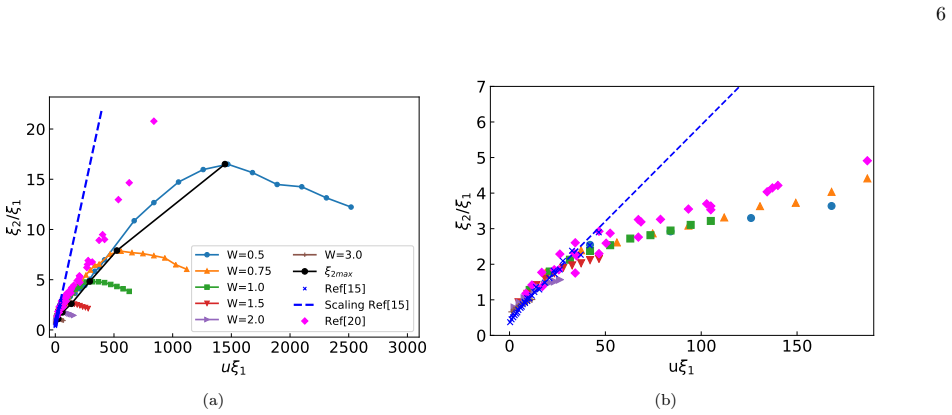
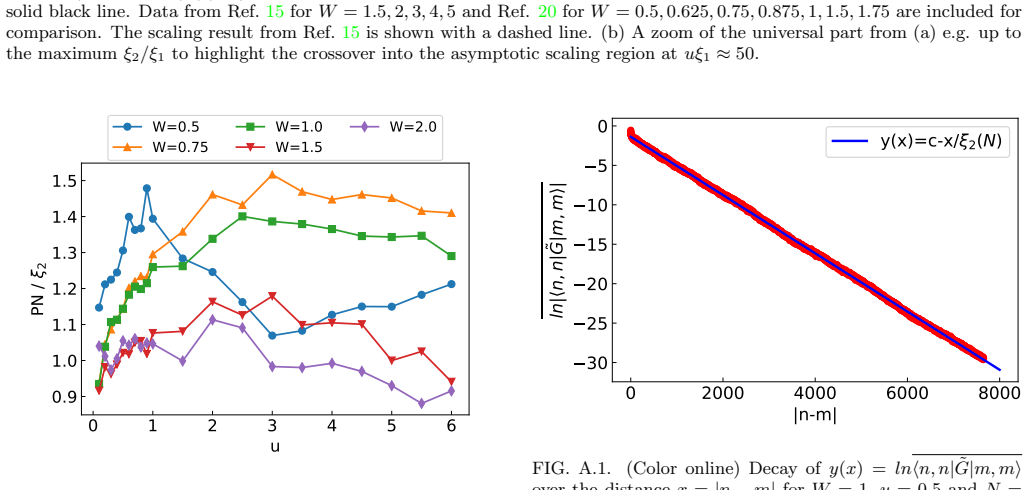
The claim is that, in the asymptotic weak-disorder regime (ξ1>100), the ratio of the two-particle to single-particle localization length obeys ξ2/ξ1=F(uξ1), with F(x) linear for small x but growing sublinearly for x>50. The authors report record values F=15 at ξ1=400, u=3, and they attribute the slowdown to the recovery of translational invariance and momentum conservation in the Fock-space matrix elements when W<1: resonantly coupled Fock states form fragile groups of only about ξ1 states, not $ξ1^{2}$, so the effective hopping and effective disorder scale differently than earlier estimates assumed. They also identify the largest enhancement at energy E=0 and interaction strength u≈3t, and they confirm single-parameter scaling by showing that the participation number PN is of the same order as ξ2.
Load-bearing premise
The load-bearing assumption is that the finite-size extrapolation formula ξ2(N)=ξ2+a/N and the system-size threshold N*(W) calibrated on the non-interacting u=0 benchmark remain valid for every interaction strength, including the large-u cases where the reported localization length is tens of times larger; if that extrapolation breaks down, the observed sublinear growth of the scaling function would be an artifact.
Editorial extensions
If this is right
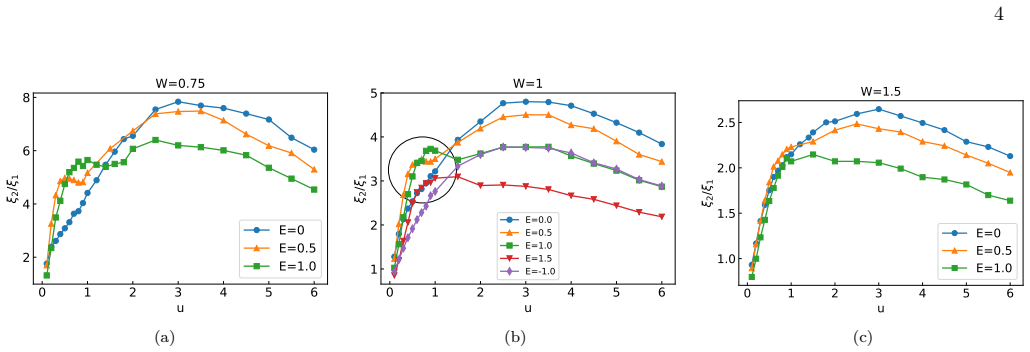
- At fixed disorder, the largest two-particle localization length occurs at spectrum center E=0 and interaction strength u≈3t, the order of the single-particle bandwidth; the enhancement decreases for larger u as doubly occupied states leave the two-particle continuum.
- Earlier power-law scalings such as ξ2∝ξ1^2 or ξ2∝ξ1^{1.6} do not describe the asymptotic regime; extrapolating the old linear scaling overestimates ξ2/ξ1 by at least a factor of six at uξ1=1500.
- Finite-size corrections materially reduce earlier estimates: the Green's function result of Ref. 20, which reported ξ2≈9ξ1 at ξ1≈400, is corrected down to about ξ2≈6ξ1 once the same extrapolation is applied.
- Single-parameter scaling holds: the participation number PN stays within 1 to 1.5 times ξ2 across all studied disorder strengths and interactions, so ξ2 controls both the exponential decay and the wavefunction extent.
- The mechanism predicts that breaking the particle-hole symmetry of the clean chain, for example by next-nearest-neighbour hopping, shrinks the resonant Fock-state groups and further reduces ξ2/ξ1.
Reading between the lines
- The reported N*(W) is calibrated from u=0 data; at u≈3 the extracted ξ2 is about 30 times larger, so the same system-size threshold may be too small to resolve the exponential tail. A direct check would be to re-extract ξ2 at large u with a u-dependent N*, and the sublinear part of F(x) would be invalid if the values rise substantially.
- One testable extension is to treat the resonant Fock group as an effective one-dimensional chain with hopping teff≈u/ξ1 and disorder Weff≈Δ1/ξ1^2, and compare its exact localization length with the paper's F(uξ1); any discrepancy would isolate corrections beyond the effective-chain picture.
- The energy anomaly at E≈1 and u≈t, where ξ2 is enhanced over the band center, suggests that F(uξ1) may need an additional energy argument; computing F at fixed nonzero E would test whether the collapse to a single variable survives away from E=0.
- If the sublinear F(x) continues to grow without saturation, then in the limit W→0 even the two-particle system is still localized, just with a slowly increasing length; observing F(x) at uξ1 beyond 3000 would discriminate between slow growth and a logarithmic saturation.
Signed reviews
Editorial analysis
A structured set of objections, weighed in public.
Referee Report
Summary. The paper studies the localization length ξ2 of two interacting particles in a one-dimensional Anderson chain using a projected Green's function method combined with finite-size scaling, for system sizes up to N=20000 and disorder strengths down to W=0.5. It reports that for weak disorder (ξ1>100) the ratio ξ2/ξ1 becomes a nonlinear function F(uξ1) of the single variable uξ1, with sublinear growth for large arguments, and claims record values ξ2/ξ1≈16 (F≈15 at ξ1=400, u=3). The paper also analyzes Fock-space connectivity to argue that momentum conservation becomes relevant in this regime and derives an effective model with Weff≈Δ1/ξ1^2 and teff≈u/ξ1.
Significance. If established, the result would supersede earlier claims of a constant scaling exponent for the two-interacting-particle problem and would provide a quantitative, falsifiable scaling prediction. The paper's strengths are its record system sizes, the systematic treatment of energy and interaction strength, and a parameter-free effective-model argument that motivates the scaling variable uξ1 rather than fitting it. However, the central data set rests on a finite-size extrapolation that is validated only at u=0, and the paper does not yet demonstrate convergence of the record ξ2 values or a clean collapse of the purported scaling function.
major comments (4)
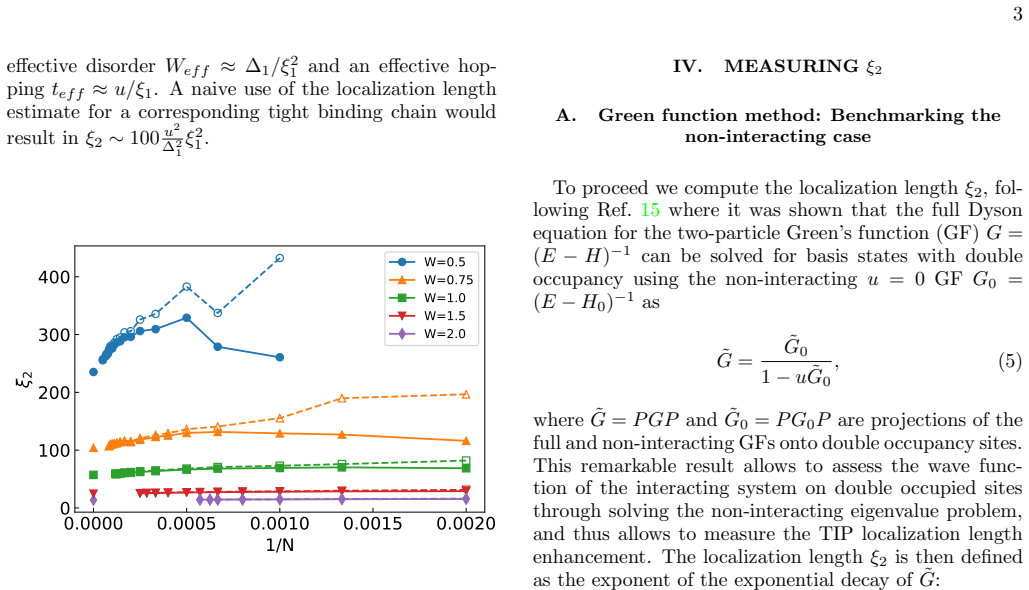
- [Sec. IV A, Step 2; Fig. 5(a)] The extrapolation protocol is benchmarked only at u=0, where N*(W) is defined. For the record point W=0.5, u=3, the fitted interval (0.05N to 0.95N) spans at most 0.9N=18000 sites, while the claimed ξ2≈16ξ1≈6400, so the interval covers only about 2.8ξ2. A linear fit of ln|G| over less than three localization lengths cannot establish the asymptotic exponential tail, so the extracted ξ2(N) is a lower bound. Show ξ2(N) versus 1/N for W=0.5 and several u values, including u=3, over a range of N that enters the asymptotic tail, or determine an N*(W,u) from the convergence of the slope, and report the resulting uncertainty. Without this, the reported sublinear saturation of F(x) at large uξ1 could be an artifact of underestimating ξ2.
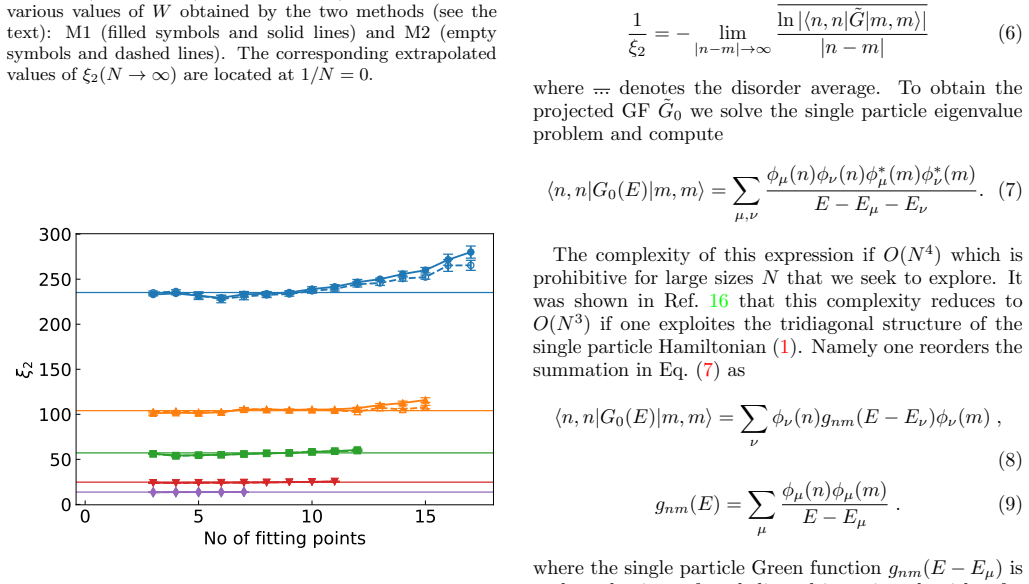
- [Sec. IV A, Step 2; Appendix A] The main text states that the extrapolation uses ξ2(N)=ξ2+a/N, while the appendix reports that the constant fit f(x)=c was used systematically. These are not the same procedure: the constant fit sets a=0 and returns an average over the available N, not the 1/N→0 limit. In the appendix example the two fits differ by 5% (272.52 vs 267.59), and for the much larger ξ2 at u=3 the difference can be larger. Specify which fit produced the data in Fig. 5(a) and give both extrapolated values for the record points; if the constant fit was used, the quoted ξ2(N→∞) is biased downward whenever ξ2(N) has a positive 1/N tail.
- [Sec. V; Fig. 5] The central claim that ξ2/ξ1=F(uξ1) is a single-parameter scaling function is not demonstrated by a collapse test. Fig. 5(a) plots curves for different W without showing that data points with the same uξ1 but different W agree within error, and the solid black line connects the maxima rather than representing F. Please include a collapse plot or a table of pairs (W,u) with comparable uξ1 and their measured ξ2/ξ1, with error bars, to distinguish a true scaling function from a family of curves.
- [Sec. IV A; Fig. 2] The u=0 benchmark yields ξ2/ξ1≈0.56 instead of the known 0.5, a 10% systematic discrepancy acknowledged in the text. Because the same fitting and extrapolation protocol is used for all u, this discrepancy sets a systematic floor for every F value. State how a 0.56→0.5 correction would propagate to the reported record F≈15 and to the fitted sublinear behavior; if the correction is not constant in uξ1, it could change the shape of F.
minor comments (4)
- [Sec. IV A, Eq. (6)] The notation 'where ... denotes the disorder average' is incomplete; define the averaging explicitly, for example as ξ2^{-1} = -lim_{|n-m|→∞} ⟨ln|⟨n,n|Ĝ|m,m⟩|⟩/|n-m|, and use the same notation consistently in Step 1.
- [Fig. 3] Several error bars are not visible; please use larger markers or provide the numerical values of the extrapolated ξ2 and its error for each W, otherwise the claimed insensitivity of the extrapolation to the fitting method cannot be checked.
- [Fig. 5(a)] The legend entry '2max' is undefined; state explicitly that it denotes the maximal ξ2 for the optimal u and W shown by the solid line, or relabel it in a self-explanatory way.
- [Sec. III] The statement 'for weak disorder W<1 the asymptotic connectivity regime of Fock states is observed' uses 'asymptotic' in a different sense from the later 'asymptotic scaling for ξ1>100'; define the two uses to avoid ambiguity.
Circularity Check
No material circularity: the reported ξ2/ξ1=F(uξ1) curve is an independently measured numerical result; the only same-group citation (Ref. 13) frames the interpretation without forcing the data.
full rationale
The central claim is a numerical measurement, not a derivation from its own inputs. The scaling variable uξ1 is obtained in Section III from the in-text effective scales Weff≈Δ1/ξ1² and teff≈u/ξ1, while the localization lengths ξ2/ξ1 are computed independently via the projected Green's function (Eqs. 5–9) and a finite-size extrapolation benchmarked on the u=0 case. The comparison with external Refs. 15 and 20, which the present results contradict, gives the claim independent content. The only self-citation is Ref. 13 (Krimer and Flach, with Flach as coauthor), which is used to justify the momentum-conservation selection rule and the choice of the weak-disorder regime; however, this cited result is not an input to the measured F(x) values, so it is minor and non-load-bearing. The finite-size extrapolation ξ2(N)=ξ2+a/N, validated only at u=0 and then applied systematically (Appendix A, 'We used the constant fit systematically'), is a genuine correctness risk for the large-uξ1 record points, since ξ2 is up to 30 times larger there; but that is a methodological assumption rather than a circular reduction, because the extrapolated values are not equivalent by construction to any fitted parameter used to define F(uξ1).
Assumptions & free parameters
free parameters (2)
- Exponential-fit slope 1/ξ2(N)
- Finite-size extrapolation constant c in ξ2(∞)=c
assumptions (5)
- domain assumption Single-particle eigenfunctions at weak disorder are approximated as plane waves normalized in a box of size ξ1
- standard math The projected Green's function reduction G̃ = G̃0/(1 - u G̃0) fully captures the interacting two-particle problem on double-occupied sites
- domain assumption Finite-size scaling ansatz ξ2(N) = ξ2 + a/N
- domain assumption Single-parameter scaling: the exponential decay length ξ2 controls the overall wavefunction extension
- domain assumption The sign of interaction u and particle statistics do not affect the asymptotic scaling of the most extended states
Cite this review
Pith. "Pith review of Taming two interacting particles with disorder." pith.science (2026). https://pith.science/paper/5XBN2U2F
@misc{pith2026190806643,
  author       = {Pith},
  title        = {Pith review of: Taming two interacting particles with disorder},
  year         = {2026},
  howpublished = {\url{https://pith.science/paper/5XBN2U2F}},
  note         = {Machine review of arXiv:1908.06643}
}
abstract
We compute the scaling properties of the localization length $\xi_2$ of two interacting particles in a one-dimensional chain with diagonal disorder, and the connectivity properties of the Fock states. We analyze record large system sizes (up to $N=20000$) and disorder strengths (down to $W=0.5$). We vary the energy $E$ and the on-site interaction strength $u$. At a given disorder strength the largest enhancement of $\xi_2$ occurs for $u$ of the order of the single particle band width, and for two-particle states with energies at the center of the spectrum, $E=0$. We observe a crossover in the scaling of $\xi_2$ with the single particle localization length $\xi_1$ into the asymptotic regime for $\xi_1 > 100$ ($W < 1.0$). This happens due to the recovery of translational invariance and momentum conservation rules in the matrix elements of interconnected Fock eigenstates for $u=0$. The entrance into the asymptotic scaling is manifested through a nonlinear scaling function $\xi_2/\xi_1=F(u\xi_1)$.
Figures

Figures from the paper (3 more)
Reference graph
Works this paper leans on
-
[1]
author author P. W. \ Anderson ,\ title title Absence of diffusion in certain random lattices , \ 10.1103/PhysRev.109.1492 journal journal Phys. Rev. \ volume 109 ,\ pages 1492--1505 ( year 1958 ) NoStop
-
[2]
author author L. Fleishman \ and\ author P. W. \ Anderson ,\ title title Interactions and the anderson transition , \ 10.1103/PhysRevB.21.2366 journal journal Phys. Rev. B \ volume 21 ,\ pages 2366--2377 ( year 1980 ) NoStop
-
[3]
author author T. V. \ Shahbazyan \ and\ author M. E. \ Raikh ,\ title title Surface plasmon in a two-dimensional anderson insulator with interactions , \ 10.1103/PhysRevB.53.7299 journal journal Phys. Rev. B \ volume 53 ,\ pages 7299--7307 ( year 1996 ) NoStop
-
[4]
author author V. I. \ Kozub , author S. D. \ Baranovskii , \ and\ author I. Shlimak ,\ title title Fluctuation-stimulated variable-range hopping , \ 10.1016/S0038-1098(99)00537-2 journal journal Solid State Comm. \ volume 113 ,\ pages 587--591 ( year 2000 ) NoStop
-
[5]
author author Ziqiang \ Wang , author Matthew P. A. \ Fisher , author S. M. \ Girvin , \ and\ author J. T. \ Chalker ,\ title title Short-range interactions and scaling near integer quantum hall transitions , \ 10.1103/PhysRevB.61.8326 journal journal Phys. Rev. B \ volume 61 ,\ pages 8326--8333 ( year 2000 ) NoStop
-
[6]
author author Thomas \ Nattermann , author Thierry \ Giamarchi , \ and\ author Pierre \ Le Doussal ,\ title title Variable-range hopping and quantum creep in one dimension , \ 10.1103/PhysRevLett.91.056603 journal journal Phys. Rev. Lett. \ volume 91 ,\ pages 056603 ( year 2003 ) NoStop
-
[7]
author author D.M. \ Basko , author I.L. \ Aleiner , \ and\ author B.L. \ Altshuler ,\ title title Metal–insulator transition in a weakly interacting many-electron system with localized single-particle states , \ 10.1016/j.aop.2005.11.014 journal journal Ann. Phys. \ volume 321 ,\ pages 1126 -- 1205 ( year 2006 ) NoStop
-
[8]
author author Rudolf A. \ R\"omer \ and\ author Michael \ Schreiber ,\ title title No enhancement of the localization length for two interacting particles in a random potential , \ 10.1103/PhysRevLett.78.515 journal journal Phys. Rev. Lett. \ volume 78 ,\ pages 515--518 ( year 1997 ) NoStop
Show all 24 references
-
[9]
\ R \" o mer , author M
author author R.A. \ R \" o mer , author M. Schreiber , \ and\ author T. Vojta ,\ title title Two interacting particles in a random potential: Numerical calculations of the interaction matrix elements , \ 10.1002/(SICI)1521-3951(199902)211:2<681::AID-PSSB681>3.0.CO;2-I journal...
-
[10]
author author D. L. \ Shepelyansky ,\ title title Coherent propagation of two interacting particles in a random potential , \ 10.1103/PhysRevLett.73.2607 journal journal Phys. Rev. Lett. \ volume 73 ,\ pages 2607--2610 ( year 1994 ) NoStop
-
[11]
author author Y Imry ,\ title title Coherent propagation of two interacting particles in a random potential , \ 10.1209/0295-5075/30/7/005 journal journal Europhys. Lett. ( EPL ) \ volume 30 ,\ pages 405--408 ( year 1995 ) NoStop
1995 doi
-
[12]
author author I. V. \ Ponomarev \ and\ author P. G. \ Silvestrov ,\ title title Coherent propagation of interacting particles in a random potential: The mechanism of enhancement , \ 10.1103/PhysRevB.56.3742 journal journal Phys. Rev. B \ volume 56 ,\ pages 3742--3759 ( year 19...
-
[13]
author author D. O. \ Krimer \ and\ author S. Flach ,\ title title Interaction-induced connectivity of disordered two-particle states , \ 10.1103/PhysRevB.91.100201 journal journal Phys. Rev. B \ volume 91 ,\ pages 100201(R) ( year 2015 ) NoStop
-
[14]
author author K Frahm , author A Müller-Groeling , author J.-L \ Pichard , \ and\ author D Weinmann ,\ title title Scaling in interaction-assisted coherent transport , \ 10.1209/0295-5075/31/3/008 journal journal Europhys. Lett. ( EPL ) \ volume 31 ,\ pages 169--174 ( year 199...
-
[15]
author author Felix \ von Oppen , author Tilo \ Wettig , \ and\ author Jochen \ M\"uller ,\ title title Interaction-induced delocalization of two particles in a random potential: Scaling properties , \ 10.1103/PhysRevLett.76.491 journal journal Phys. Rev. Lett. \ volume 76 ,\ ...
-
[16]
author author K.M. \ Frahm ,\ title title Interaction induced delocalization of two particles: large system size calculations and dependence on interaction strength , \ 10.1007/s100510050866 journal journal Eur. Phys. J. B \ volume 10 ,\ pages 371--378 ( year 1999 ) NoStop
-
[17]
author author S De Toro \ Arias , author Xavier \ Waintal , \ and\ author J-L \ Pichard ,\ title title Two interacting particles in a disordered chain iii: Dynamical aspects of the interplay disorder-interaction , \ @noop journal journal The European Physical Journal B-Condens...
1999
-
[18]
Waintal , author D
author author X. Waintal , author D. Weinmann , \ and\ author J.-L. \ Pichard ,\ title title Two interacting particles in a disordered chain ii: Critical statistics and maximum mixing of the one body states , \ 10.1007/s100510050633 journal journal The European Physical Journa...
-
[19]
author author D. O. \ Krimer , author R. Khomeriki , \ and\ author S. Flach ,\ title title Two interacting particles in a random potential , \ 10.1134/S0021364011170097 journal journal JETP Lett. \ volume 94 ,\ pages 406--412 ( year 2011 ) NoStop
-
[20]
\ Frahm ,\ title title Eigenfunction structure and scaling of two interacting particles in the one-dimensional anderson model , \ 10.1140/epjb/e2016-70114-7 journal journal Eur
author author Klaus M. \ Frahm ,\ title title Eigenfunction structure and scaling of two interacting particles in the one-dimensional anderson model , \ 10.1140/epjb/e2016-70114-7 journal journal Eur. Phys. J. B \ volume 89 ,\ pages 115 ( year 2016 ) NoStop
-
[21]
author author P. H. \ Song \ and\ author Doochul \ Kim ,\ title title Localization of two interacting particles in a one-dimensional random potential , \ 10.1103/PhysRevB.56.12217 journal journal Phys. Rev. B \ volume 56 ,\ pages 12217--12220 ( year 1997 ) NoStop
-
[22]
author author Filippo \ Stellin \ and\ author Giuliano \ Orso ,\ title title Mobility edge of two interacting particles in three-dimensional random potentials , \ 10.1103/PhysRevB.99.224209 journal journal Phys. Rev. B \ volume 99 ,\ pages 224209 ( year 2019 ) NoStop
-
[23]
\ Jacquod , author D
author author Ph. \ Jacquod , author D. L. \ Shepelyansky , \ and\ author O. P. \ Sushkov ,\ title title Breit-wigner width for two interacting particles in a one-dimensional random potential , \ 10.1103/PhysRevLett.78.923 journal journal Phys. Rev. Lett. \ volume 78 ,\ pages ...
-
[24]
Kramer \ and\ author A
author author B. Kramer \ and\ author A. MacKinnon ,\ title title Localization: theory and experiment , \ 10.1088/0034-4885/56/12/001 journal journal Rep. Prog. Phys. \ volume 56 ,\ pages 1469--1564 ( year 1993 ) NoStop
1993 doi
Reviewed August 14, 2026 · model on record in the stance chip above.
Discussion (0). Continue with ORCID to comment.