REVIEW 3 major objections 5 minor 57 references
The beamed jet and quasar core of the distant blazar 4C 71.07
T0 review · 3 major / 5 minor · reviewed 2026-08-14 · deepseek-v4-flash
Pith's one-line read A two-year multiwavelength campaign finds that the high-redshift blazar 4C 71.07 accretes at 66 percent of the Eddington limit while its jet radiates one to four times the disc luminosity, extending the jet–disc correlation to the most…
desk verdict Solid multiwavelength campaign on an extreme FSRQ; the headline disc/jet numbers are plausible but rest on a hand-set subtraction the authors admit is arbitrary, so the claimed precision is overconfident. read the letter →
The pith
A machine-rendered reading of the paper's core claim, the machinery that carries it, and where it could break.
The reading
What carries the argument
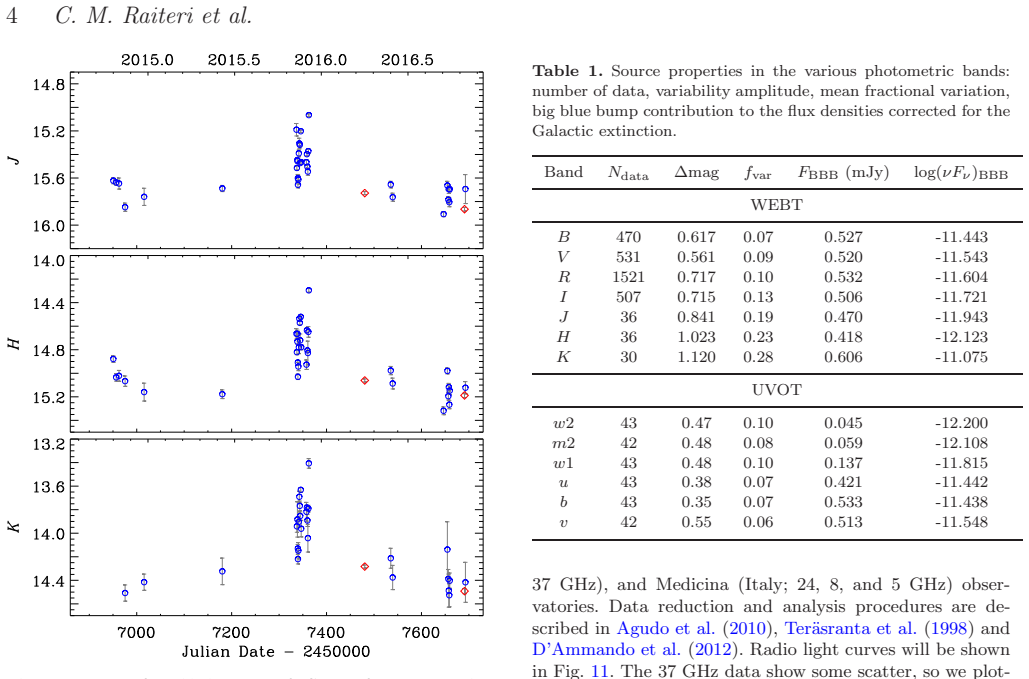
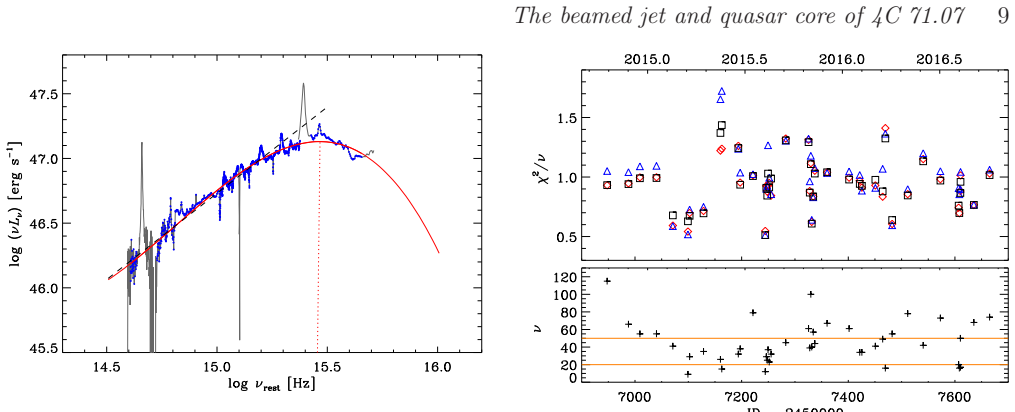
The load-bearing object is the empirical big blue bump template: a model of the thermal continuum from the accretion disc and broad-line region, built by subtracting a power-law jet component from the campaign's average optical and near-infrared spectra and then joining the result to a type-1 quasar template at long wavelengths and a stacked ultraviolet quasar spectrum at short wavelengths. Convolving the template with filter transmission curves gives the thermal flux in each photometric band; subtracting those values from observed photometry isolates the pure jet SED, while integrating the template's polynomial fit gives $L_{\rm disc}$ and, through thin-disc relations, $\dot M$ and $M_{\rm BH}$. The secondary mechanism is the intergalactic-medium correction: effective optical depths estimated from two independent stacked-spectrum prescriptions are applied to the ultraviolet data before the SED is used.
What would settle it
Take a high-signal-to-noise optical spectrum during a deep jet-quiescent state and fit it with the paper's assumed jet power law plus the big blue bump template: if the required non-thermal normalization is much higher than adopted here, the template is too bright and $L_{\rm disc}$, $\dot M$, and the Eddington ratio are overestimated. Independently, a virial black-hole mass from the broad Balmer lines that disagrees with $1.6\times10^9\,M_\odot$ by more than the usual factor of two would falsify the disc-based mass.
Extended reading notes
Core claim
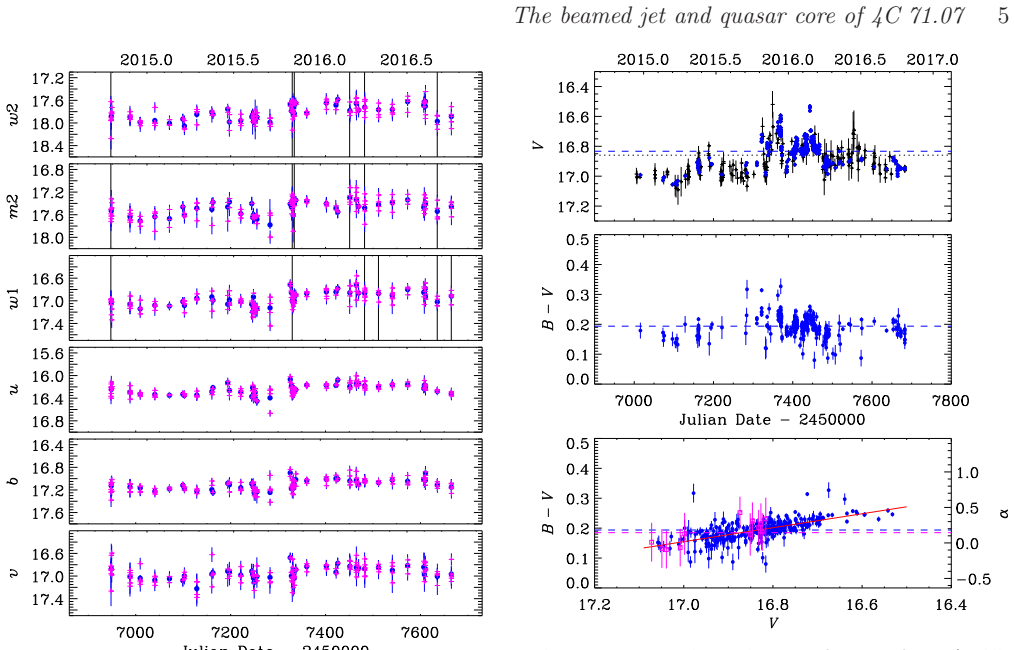
On the paper's own terms, 4C 71.07 hosts a quasar core that radiates at 66 percent of the Eddington limit and a beamed jet whose radiative power is comparable to, and possibly four times, the disc luminosity. Integrating the empirical big blue bump template gives $L_{\rm disc}=2.45\times10^{47}\,\mathrm{erg\,s^{-1}}$; assuming a thin accretion disc with radiative efficiency between 0.06 and 0.32 leads to $\dot M\simeq18\,M_\odot\,\mathrm{yr^{-1}}$ and $M_{\rm BH}\simeq1.6\times10^9\,M_\odot$, hence an Eddington ratio of 0.66. Integrating the nuclear-subtracted SED at a representative epoch gives $L_{\rm jet}=9.42\times10^{49}\,\mathrm{erg\,s^{-1}}$, and converting this to radiative power with bulk Lorentz factor $\Gamma=14$–$28$ via $P_{\rm rad}\simeq2L_{\rm jet}/\Gamma^2$ yields $P_{\rm rad}=(2.40\text{–}9.61)\times10^{47}\,\mathrm{erg\,s^{-1}}$, i.e. one to four times $L_{\rm disc}$. The near-infrared-to-ultraviolet SEDs show a strong Compton dominance, with the high-energy peak exceeding the synchrotron peak by factors of roughly 70 to 200. The paper presents this as extending to the highest blazar energies the previously established correlation between jet radiative power and disc luminosity. It also reports that after correcting the observed polarization for dilution by the big blue bump, the jet polarization still shows no correlation with flux, and large rotations of the polarization angle occur without accompanying flares.
Load-bearing premise
The load-bearing premise is that the jet's contribution to the mean optical and near-infrared spectra is a power law whose brightness level is set by hand so that the thermal component dominates the B and V bands; if the real jet contribution there is larger, the big blue bump template and all quantities derived from it are overestimated.
Editorial extensions
If this is right
- If the numbers are correct, 4C 71.07 is an example where the jet's radiated power is of the same order as the disc luminosity, so the jet is not a small by-product of accretion but an energetically comparable output channel.
- An Eddington ratio of 0.66 at redshift $z\simeq2.2$ indicates rapid black-hole growth in the early universe, a state that growth models must reproduce.
- The tabulated big blue bump contributions and intergalactic-medium opacities give observers a working recipe for removing thermal and absorption effects from photometry of high-redshift flat-spectrum radio quasars.
- The absence of a persistent correlation between polarization and flux, even after dilution correction, supports jet models in which magnetic-field structure evolves independently of total emitting power.
Reading between the lines
- Because the paper itself flags the normalization of the jet power law as 'somewhat arbitrary,' the central numbers are best read as conditional on that choice; an independent constraint on the thermal fraction at B and V would settle how much they can move.
- If the jet's radiative power is already one to four times the disc luminosity, the total jet power (including kinetic and magnetic contributions) is likely even larger, suggesting these high-redshift jets could inject more energy into their environments than the disc supplies.
- The dilution-corrected polarization reaching about 47 percent, near the theoretical synchrotron limit, suggests a test: high-cadence polarimetry during the faintest states could verify the big blue bump template's thermal fractions, since an undervalued thermal component would push $P_{\rm jet}$ even higher.
- The reported lack of inter-band correlation at such extreme luminosities implies that simultaneous multi-epoch SED decompositions, rather than single-epoch snapshots, are needed to test whether the jet and disc are in fact causally connected.
Signed reviews
Editorial analysis
A structured set of objections, weighed in public.
Referee Report
Summary. The paper presents a two-year multiwavelength campaign on the high-redshift FSRQ 4C 71.07, combining WEBT optical/NIR/radio monitoring with Swift-UVOT/XRT and Fermi-LAT data. The central aim is to separate the beamed jet emission from the unbeamed accretion-disc (big blue bump) emission. The authors construct an empirical quasar-core template by subtracting a power-law jet component from the average optical and NIR spectra, completing the template with the Polletta et al. (2007) and Lusso et al. (2015) quasar templates, and applying Galactic and IGM absorption corrections. From this template they derive a disc bolometric luminosity L_disc = 2.45e47 erg/s, an accretion rate of about 18 Msun/yr, a black hole mass of about 1.6e9 Msun, and an Eddington ratio of 0.66. From the nuclear-subtracted SED they estimate L_jet = 9.42e49 erg/s and a radiative jet power P_rad = (2.40-9.61)e47 erg/s, about 1-4 L_disc, which they interpret as confirming the Ghisellini et al. (2014) jet-disc relation at the highest blazar energies. The paper also reports X-ray spectral fits, IGM opacity values, a best-guess NH = 6.3e20 cm^-2, and optical polarimetry showing no flux-polarisation correlation and large EVPA rotations.
Significance. If the decomposition is correct, the paper provides a rare measurement of both the accretion-disc and jet properties for a z~2.2 blazar, and it would extend the empirical jet-disc luminosity relation to the highest luminosities. The observational campaign is substantial, the photometric and spectroscopic material is rich, and the practical prescriptions for correcting UVOT data for IGM absorption and for subtracting the big blue bump contribution are potentially reusable by the community. The paper is also explicit about several of its limitations, which is helpful. However, the quantitative headline claims are conditional on a jet-subtraction normalisation that the authors themselves describe as 'somewhat arbitrary', and the agreement with earlier estimates is not by itself an independent check of that normalisation. The significance of the central result therefore hinges on whether the sensitivity of L_disc, M_BH, P_rad, and the polarisation dilution correction to this choice can be quantified.
major comments (3)
- [Section 6, Table 1, Section 7] The disc luminosity, accretion rate, black hole mass, and Eddington ratio are all derived from the big blue bump template, but the normalisation of the jet power-law subtracted from the average optical/NIR spectra is set by hand. The text in Section 6 states that 'we set the brightness level to have a very strong thermal contribution to the B and V-band fluxes' and that 'the model normalisation is somewhat arbitrary'. This is a load-bearing degree of freedom: an upward error in the assumed jet contribution at B and V directly lowers the thermal flux and therefore lowers L_disc, M_BH, and the Eddington ratio, and it also changes the jet-subtracted SEDs used for L_jet and P_rad. The authors should provide a sensitivity test, e.g. varying the power-law normalisation by a factor of two (or within a range consistent with the observed B/V variability and with the requirement that the thermal component remain dominant), and recompute the derived quantities and the claimed 1-4 L_disc ratio. Without such a propagated uncertainty, the central quantitative claims are not yet established.
- [Section 6, Section 10] The consistency check using a simulated high brightness state is not an independent validation of the jet-subtraction normalisation. The log-parabola used to represent the flaring-state jet emission is added to the thermal template and compared with the highest observed fluxes, but the log-parabola normalisation is effectively chosen to match those maxima. The statement in Section 6 that the log-parabolic shape of the thermal-subtracted SED 'suggests that we are not far from the real, elusive solution' is a plausibility argument, not a test that can constrain the normalisation. The same applies to the use of the broad-band SED shape: because the thermal template is subtracted before fitting the synchrotron component, the resulting log-parabolic shape is partly built into the procedure. An external constraint, for example from the polarisation limit (Pjet <= ~75%) or from independent spectroscopic estimates of the disc component, would be needed to break this degeneracy.
- [Section 6, Section 7, Table 2] The uncertainty in L_disc is stated to be dominated by the poorly constrained high-energy part of the spectrum, but no error budget is given for the integration. The high-energy side of the template depends on the choice between the two IGM correction prescriptions (Ghisellini et al. 2010 vs. Lusso et al. 2015), which the paper shows give noticeably different opacity values, and on the ad hoc shift applied to the w2 template contribution. Since Section 7 quotes L_disc to three significant figures and then derives M_BH and the Eddington ratio to two, the absence of a quantified uncertainty is disproportionate. The authors should estimate the range of L_disc obtained by (i) using the alternative IGM opacity set, (ii) omitting or varying the w2 correction, and (iii) the jet-normalisation variation requested above, and report how the Eddington ratio and the P_rad/L_disc ratio change.
minor comments (5)
- [Introduction] There is a typo in the Introduction: 'in their analys of high-redshift blazars' should read 'in their analysis of high-redshift blazars'.
- [Section 6, footnote 7] The description of the w2 correction is vague: 'The correction was done by shifting the w2 thermal contribution to match the template.' Please specify the size of the shift, in flux or magnitude units, and how it was determined.
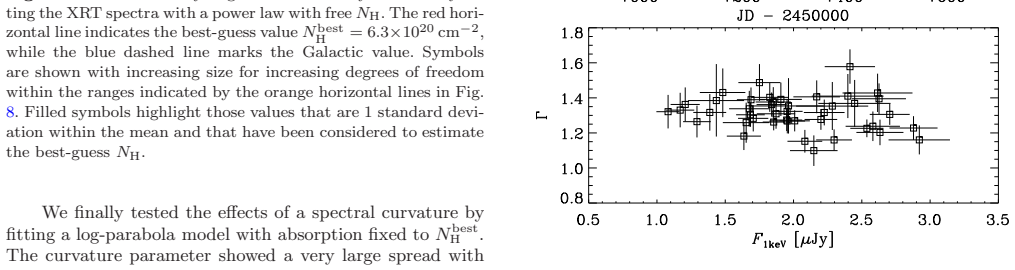
- [Section 8, Figure 9] The method for deriving the best-guess NH by discarding values more than 1 sigma from the mean is not a standard robust estimator; the authors should also report the median and the dispersion of the full sample, since with a small number of spectra the truncated mean can be sensitive to the specific cutoff.
- [Section 10, Figure 12] The four-epoch SEDs would benefit from a statement of the simultaneous flux uncertainties, especially for the near-infrared points where the sampling is sparse, as the log-parabolic fits and the derived L_jet are presented without error bars.
- [Section 11] The definition of Pjet = (Ftot x Pobs)/Fjet should be stated more explicitly: it assumes that the observed polarisation is entirely due to the jet and that the big blue bump is unpolarised; this assumption is reasonable but should be flagged in the text.
Circularity Check
The hand-set jet-subtraction normalization fixes the scale of the BBB template, so the integrated disc luminosity and the 'predicted' flaring-state SED are reconstructions of the same chosen input rather than independent outcomes.
-
fitted input called prediction
[Section 6, 'An empirical model for the quasar core', jet-subtraction paragraph; propagated to Table 1, Section 7, and Section 10]
"We use the relative difference in flux variability in the various bands to determine the slope of the power-law and set the brightness level to have a very strong thermal contribution to the B and V -band fluxes, as suggested by their observed smaller variability (see Figs. 1–3 and Table 1). Although the model normalisation is somewhat arbitrary, the log-parabolic shape of the thermal-subtracted SED that we will discuss in Section 9 suggests that we are not far from the real, elusive solution."
The normalization of the jet power law subtracted from the mean optical/NIR spectra is not fixed by an independent constraint; it is chosen by hand so that the big blue bump dominates B and V. This template then produces the FBBB values in Table 1, the integrated Ldisc = 2.45e47 erg/s, Mdot, MBH, and the Eddington ratio 0.66 in Section 7, and the 'pure jet' SEDs and Prad = (1-4) Ldisc comparison in Section 10. The only stated justification for the arbitrary normalization is that the residual has a log-parabolic shape, which presumes the very jet SED that is being derived. The agreement with Ghisellini et al. (2010) is an external comparison, but it does not constrain this normalization; the paper itself acknowledges the scale is 'somewhat arbitrary'.
-
fitted input called prediction
[Section 6, 'To further check the consistency of our procedure...', and Fig. 5]
"By summing the log-parabola and nuclear thermal template fluxes, we obtain what we should observe in flaring states. These predictions can then be compared to the highest observed flux levels. In Fig. 5 we see that the optical maxima are satisfactorily reproduced, while the near-infrared maxima are somewhat overproduced."
The 'prediction' of flaring-state fluxes is not an out-of-sample test: the log-parabola is added to the same thermal template constructed from the same campaign photometry and spectra, and the text does not state that the log-parabola parameters are derived from an independent fit or epoch. The violet points in Fig. 5 are produced by this sum, so a match to the observed maxima is a reconstruction rather than a falsifiable prediction. The NIR discrepancy is explained post hoc by missing NIR coverage at the optical peaks. This consistency check therefore re-inserts the same data into the model and cannot independently validate the template or its derived core properties.
full rationale
The paper's derivation chain is largely empirical: WEBT, Swift, and Fermi data are fitted with standard models, and several external references (Polletta et al. 2007; Lusso et al. 2015; Ghisellini et al. 2010, 2014) provide genuinely independent templates and relations. The self-citations to Raiteri et al. (2014, 2019) are not by themselves load-bearing circularity, since the present analysis uses new photometric and spectroscopic data. However, the key step that sets the scale of the big blue bump template is explicitly underdetermined: the jet power-law normalization is chosen by hand to make the thermal contribution strong in B and V, and the paper calls the normalization 'somewhat arbitrary'. Every headline core quantity derived from the template - Ldisc, Mdot, MBH, Eddington ratio, and the (1-4) Ldisc jet-radiation comparison - inherits this arbitrary scale. The high-state 'prediction' is similarly built from the same template and from a log-parabola whose parameters are not shown to come from an independent determination, so the agreement with observed maxima is partly by construction. This is partial circularity rather than complete: the Prad estimate is dominated by the gamma-ray inverse-Compton bump, which is largely independent of the optical BBB subtraction, and the Ghisellini et al. (2014) relation is an external benchmark. The paper honestly flags the arbitrariness, and its X-ray/IGM and gamma-ray analyses are independent, but the central disc-jet confirmation is conditional on an unconstrained normalization, warranting a score of 6.
Assumptions & free parameters
free parameters (3)
- Jet power-law normalisation for optical/NIR spectra =
not specified
- Jet power-law spectral slope =
not specified
- w2 template correction shift =
not specified
assumptions (5)
- domain assumption The thermal (big blue bump) emission is steady during the 2014-2016 campaign.
- domain assumption The average quasar templates by Polletta et al. (2007) and Lusso et al. (2015) are representative of the 4C 71.07 disc in the unobserved wavelength ranges.
- ad hoc to paper The jet contribution to the average spectra is a power law whose slope and normalisation can be fixed from variability amplitudes and the assumption that B and V are thermal-dominated.
- domain assumption IGM absorption in the UV can be corrected by multiplying by exp(tau_eff) using mean opacities from Ghisellini et al. (2010) or Lusso et al. (2015).
- domain assumption Shakura and Sunyaev disc equations with isotropic luminosity about half the bolometric luminosity apply, and the radiative efficiency is in the adopted range.
Cite this review
Pith. "Pith review of The beamed jet and quasar core of the distant blazar 4C 71.07." pith.science (2026). https://pith.science/paper/H5ZZQOZJ
@misc{pith2026190806644,
  author       = {Pith},
  title        = {Pith review of: The beamed jet and quasar core of the distant blazar 4C 71.07},
  year         = {2026},
  howpublished = {\url{https://pith.science/paper/H5ZZQOZJ}},
  note         = {Machine review of arXiv:1908.06644}
}
read the original abstract
The object 4C 71.07 is a high-redshift blazar whose spectral energy distribution shows a prominent big blue bump and a strong Compton dominance. We present the results of a two-year multiwavelength campaign led by the Whole Earth Blazar Telescope (WEBT) to study both the quasar core and the beamed jet of this source. The WEBT data are complemented by ultraviolet and X-ray data from Swift, and by gamma-ray data by Fermi. The big blue bump is modelled by using optical and near-infrared mean spectra obtained during the campaign, together with optical and ultraviolet quasar templates. We give prescriptions to correct the source photometry in the various bands for the thermal contribution, in order to derive the non-thermal jet flux. The role of the intergalactic medium absorption is analysed in both the ultraviolet and X-ray bands. We provide opacity values to deabsorb ultraviolet data, and derive a best-guess value for the hydrogen column density through the analysis of X-ray spectra. We estimate the disc and jet bolometric luminosities, accretion rate, and black hole mass. Light curves do not show persistent correlations among flux changes at different frequencies. We study the polarimetric behaviour and find no correlation between polarisation degree and flux, even when correcting for the dilution effect of the big blue bump. Similarly, wide rotations of the electric vector polarisation angle do not seem to be connected with the source activity.
Figures

Figures from the paper (8 more)





Reference graph
Works this paper leans on
-
[1]
Agudo I., Thum C., Wiesemeyer H., Krichbaum T. P., 2010, @doi [ ] 10.1088/0067-0049/189/1/1 , http://adsabs.harvard.edu/abs/2010ApJS..189....1A 189, 1
-
[2]
Akyuz A., et al., 2013, @doi [ ] 10.1051/0004-6361/201321721 , http://adsabs.harvard.edu/abs/2013A
-
[3]
Arcodia R., Campana S., Salvaterra R., Ghisellini G., 2018, @doi [ ] 10.1051/0004-6361/201732322 , https://ui.adsabs.harvard.edu/abs/2018A&A...616A.170A 616, A170
-
[4]
Asada K., Nakamura M., Inoue M., Kameno S., Nagai H., 2010, @doi [ ] 10.1088/0004-637X/720/1/41 , http://adsabs.harvard.edu/abs/2010ApJ...720...41A 720, 41
-
[5]
Atwood W. B., et al., 2009, @doi [ ] 10.1088/0004-637X/697/2/1071 , http://adsabs.harvard.edu/abs/2009ApJ...697.1071A 697, 1071
-
[6]
Atwood W. B., et al., 2013, @doi [ ] 10.1088/0004-637X/774/1/76 , http://adsabs.harvard.edu/abs/2013ApJ...774...76A 774, 76
-
[7]
Bessell M. S., Castelli F., Plez B., 1998, , http://adsabs.harvard.edu/cgi-bin/nph-bib_query?bibcode=1998A 333, 231
work page 1998
-
[8]
Blinov D., et al., 2018, @doi [ ] 10.1093/mnras/stx2786 , http://adsabs.harvard.edu/abs/2018MNRAS.474.1296B 474, 1296
Show all 57 references
-
[9]
A., Landsman W., Holland S
Breeveld A. A., Landsman W., Holland S. T., Roming P., Kuin N. P. M., Page M. J., 2011, in McEnery J. E., Racusin J. L., Gehrels N., eds, American Institute of Physics Conference Series Vol. 1358, American Institute of Physics Conference Series. pp 373--376
2011
-
[10]
Calderone G., Ghisellini G., Colpi M., Dotti M., 2013, @doi [ ] 10.1093/mnras/stt157 , https://ui.adsabs.harvard.edu/abs/2013MNRAS.431..210C 431, 210
2013 doi
-
[11]
A., Clayton G
Cardelli J. A., Clayton G. C., Mathis J. S., 1989, @doi [ ] 10.1086/167900 , http://adsabs.harvard.edu/cgi-bin/nph-bib_query?bibcode=1989ApJ...345..245C&db_key=AST 345, 245
1989 doi
-
[12]
I., et al., 2015, @doi [ ] 10.1093/mnras/stv823 , http://adsabs.harvard.edu/abs/2015MNRAS.450.2677C 450, 2677
Carnerero M. I., et al., 2015, @doi [ ] 10.1093/mnras/stv823 , http://adsabs.harvard.edu/abs/2015MNRAS.450.2677C 450, 2677
2015 doi
-
[13]
D'Ammando F., et al., 2012, @doi [ ] 10.1111/j.1365-2966.2012.21707.x , http://adsabs.harvard.edu/abs/2012MNRAS.426..317D 426, 317
2012
-
[14]
T., Efimov Y
Doroshenko V. T., Efimov Y. S., Borman G. A., Pulatova N. G., 2014, @doi [Astrophysics] 10.1007/s10511-014-9324-y , http://adsabs.harvard.edu/abs/2014Ap.....57..176D 57, 176
2014 doi
-
[15]
Ghisellini G., Tavecchio F., 2015, @doi [ ] 10.1093/mnras/stv055 , https://ui.adsabs.harvard.edu/abs/2015MNRAS.448.1060G 448, 1060
2015 doi
-
[16]
Ghisellini G., et al., 2010, @doi [ ] 10.1111/j.1365-2966.2010.16449.x , http://adsabs.harvard.edu/abs/2010MNRAS.405..387G 405, 387
2010
-
[17]
Ghisellini G., Tavecchio F., Maraschi L., Celotti A., Sbarrato T., 2014, @doi [ ] 10.1038/nature13856 , https://ui.adsabs.harvard.edu/abs/2014Natur.515..376G 515, 376
2014 doi
-
[18]
F., Lee C
Gu M. F., Lee C. U., Pak S., Yim H. S., Fletcher A. B., 2006, @doi [ ] 10.1051/0004-6361:20054271 , https://ui.adsabs.harvard.edu/abs/2006A&A...450...39G 450, 39
2006 doi
-
[19]
H., 2000, @doi [ ] 10.1086/308708 , https://ui.adsabs.harvard.edu/abs/2000ApJ...533..710H 533, 710
Hubeny I., Agol E., Blaes O., Krolik J. H., 2000, @doi [ ] 10.1086/308708 , https://ui.adsabs.harvard.edu/abs/2000ApJ...533..710H 533, 710
2000 doi
-
[20]
Kalberla P. M. W., Burton W. B., Hartmann D., Arnal E. M., Bajaja E., Morras R., P \"o ppel W. G. L., 2005, @doi [ ] 10.1051/0004-6361:20041864 , http://adsabs.harvard.edu/cgi-bin/nph-bib_query?bibcode=2005A 440, 775
2005 doi
-
[21]
S., Netzer H., Maoz D., Jannuzi B
Kaspi S., Smith P. S., Netzer H., Maoz D., Jannuzi B. T., Giveon U., 2000, @doi [ ] 10.1086/308704 , http://adsabs.harvard.edu/cgi-bin/nph-bib_query?bibcode=2000ApJ...533..631K&db_key=AST 533, 631
2000 doi
-
[22]
J., Liodakis I., 2017, @doi [ ] 10.1093/mnras/stx2167 , 472, 3589
Kiehlmann S., Blinov D., Pearson T. J., Liodakis I., 2017, @doi [ ] 10.1093/mnras/stx2167 , 472, 3589
2017 doi
-
[23]
M., et al., 2016, @doi [ ] 10.1093/mnras/stw1516 , http://adsabs.harvard.edu/abs/2016MNRAS.461.3047L 461, 3047
Larionov V. M., et al., 2016, @doi [ ] 10.1093/mnras/stw1516 , http://adsabs.harvard.edu/abs/2016MNRAS.461.3047L 461, 3047
2016 doi
-
[24]
R., Zucker J
Lawrence C. R., Zucker J. R., Readhead A. C. S., Unwin S. C., Pearson T. J., Xu W., 1996, @doi [ ] 10.1086/192375 , http://adsabs.harvard.edu/cgi-bin/nph-bib_query?bibcode=1996ApJS..107..541L&db_key=AST 107, 541
1996 doi
-
[25]
F., Prochaska J
Lusso E., Worseck G., Hennawi J. F., Prochaska J. X., Vignali C., Stern J., O'Meara J. M., 2015, @doi [ ] 10.1093/mnras/stv516 , https://ui.adsabs.harvard.edu/abs/2015MNRAS.449.4204L 449, 4204
2015 doi
-
[26]
V., 2017, @doi [ ] 10.1093/mnras/stx359 , http://adsabs.harvard.edu/abs/2017MNRAS.467.3876L 467, 3876
Lyutikov M., Kravchenko E. V., 2017, @doi [ ] 10.1093/mnras/stx359 , http://adsabs.harvard.edu/abs/2017MNRAS.467.3876L 467, 3876
2017 doi
-
[27]
P., 2014, @doi [ ] 10.1088/0004-637X/780/1/87 , http://adsabs.harvard.edu/abs/2014ApJ...780...87M 780, 87
Marscher A. P., 2014, @doi [ ] 10.1088/0004-637X/780/1/87 , http://adsabs.harvard.edu/abs/2014ApJ...780...87M 780, 87
2014 doi
-
[28]
Massaro E., Perri M., Giommi P., Nesci R., 2004, @doi [ ] 10.1051/0004-6361:20031558 , http://adsabs.harvard.edu/abs/2004A
2004 doi
-
[29]
H., Rieke M
McIntosh D. H., Rieke M. J., Rix H.-W., Foltz C. B., Weymann R. J., 1999, @doi [ ] 10.1086/306936 , http://adsabs.harvard.edu/abs/1999ApJ...514...40M 514, 40
1999 doi
-
[30]
P., Hardee P
Perucho M., Mart \' -Vidal I., Lobanov A. P., Hardee P. E., 2012a, @doi [ ] 10.1051/0004-6361/201219785 , http://adsabs.harvard.edu/abs/2012A
-
[31]
Y., Lobanov A
Perucho M., Kovalev Y. Y., Lobanov A. P., Hardee P. E., Agudo I., 2012b, @doi [ ] 10.1088/0004-637X/749/1/55 , http://adsabs.harvard.edu/abs/2012ApJ...749...55P 749, 55
-
[32]
M., 2001, in Aretxaga I., Kunth D., M \'u jica R., eds, Advanced Lectures on the Starburst-AGN Connection
Peterson B. M., 2001, in Aretxaga I., Kunth D., M \'u jica R., eds, Advanced Lectures on the Starburst-AGN Connection. Singapore: World Scientific, p. 3
2001
-
[33]
Polletta M., et al., 2007, @doi [ ] 10.1086/518113 , http://adsabs.harvard.edu/abs/2007ApJ...663...81P 663, 81
2007 doi
-
[34]
S., et al., 2008, @doi [ ] 10.1111/j.1365-2966.2007.12563.x , http://adsabs.harvard.edu/abs/2008MNRAS.383..627P 383, 627
Poole T. S., et al., 2008, @doi [ ] 10.1111/j.1365-2966.2007.12563.x , http://adsabs.harvard.edu/abs/2008MNRAS.383..627P 383, 627
2008
-
[35]
M., et al., 2010, @doi [ ] 10.1051/0004-6361/201015191 , http://adsabs.harvard.edu/abs/2010A
Raiteri C. M., et al., 2010, @doi [ ] 10.1051/0004-6361/201015191 , http://adsabs.harvard.edu/abs/2010A
2010 doi
-
[36]
M., et al., 2014, @doi [ ] 10.1093/mnras/stu886 , http://adsabs.harvard.edu/abs/2014MNRAS.442..629R 442, 629
Raiteri C. M., et al., 2014, @doi [ ] 10.1093/mnras/stu886 , http://adsabs.harvard.edu/abs/2014MNRAS.442..629R 442, 629
2014 doi
-
[37]
M., et al., 2017a, @doi [ ] 10.1093/mnras/stw3333 , http://adsabs.harvard.edu/abs/2017MNRAS.466.3762R 466, 3762
Raiteri C. M., et al., 2017a, @doi [ ] 10.1093/mnras/stw3333 , http://adsabs.harvard.edu/abs/2017MNRAS.466.3762R 466, 3762
-
[38]
M., et al., 2017b, @doi [ ] 10.1038/nature24623 , http://adsabs.harvard.edu/abs/2017Natur.552..374R 552, 374
Raiteri C. M., et al., 2017b, @doi [ ] 10.1038/nature24623 , http://adsabs.harvard.edu/abs/2017Natur.552..374R 552, 374
-
[39]
M., Acosta-Pulido J
Raiteri C. M., Acosta-Pulido J. A., Villata M., et al. 2019, in preparation
2019
-
[40]
B., Lightman A
Rybicki G. B., Lightman A. P., 1979, Radiative processes in astrophysics . New York, Wiley-Interscience
1979
-
[41]
C., Hovatta T., Kadler M., Kovalev Y
Savolainen T., Homan D. C., Hovatta T., Kadler M., Kovalev Y. Y., Lister M. L., Ros E., Zensus J. A., 2010, @doi [ ] 10.1051/0004-6361/200913740 , http://adsabs.harvard.edu/abs/2010A
2010 doi
-
[42]
Scott J., Bechtold J., Dobrzycki A., 2000, @doi [ ] 10.1086/317339 , https://ui.adsabs.harvard.edu/\#abs/2000ApJS..130...37S 130, 37
2000 doi
-
[43]
I., Sunyaev R
Shakura N. I., Sunyaev R. A., 1973, , http://adsabs.harvard.edu/cgi-bin/nph-bib_query?bibcode=1973A 24, 337
1973
-
[44]
S., 1996, in Miller H
Smith P. S., 1996, in Miller H. R., Webb J. R., Noble J. C., eds, Astronomical Society of the Pacific Conference Series Vol. 110, Blazar Continuum Variability. p. 135
1996
-
[45]
Stickel M., Kuehr H., 1993, Astronomy and Astrophysics Supplement Series, https://ui.adsabs.harvard.edu/\#abs/1993A&AS..100..395S 100, 395
1993
-
[46]
W., Kuehr H., Padovani P., Urry C
Stickel M., Fried J. W., Kuehr H., Padovani P., Urry C. M., 1991, @doi [ ] 10.1086/170133 , http://adsabs.harvard.edu/cgi-bin/nph-bib_query?bibcode=1991ApJ...374..431S&db_key=AST 374, 431
1991 doi
-
[47]
Ter \"a sranta H., et al., 1998, , http://adsabs.harvard.edu/cgi-bin/nph-bib_query?bibcode=1998A 132, 305
1998
-
[48]
M., Padovani P., 1995, , http://adsabs.harvard.edu/cgi-bin/nph-bib_query?bibcode=1995PASP..107..803U&db_key=AST 107, 803
Urry C. M., Padovani P., 1995, , http://adsabs.harvard.edu/cgi-bin/nph-bib_query?bibcode=1995PASP..107..803U&db_key=AST 107, 803
1995
-
[49]
Vercellone S., et al., 2019, @doi [ ] 10.1051/0004-6361/201732532 , https://ui.adsabs.harvard.edu/abs/2019A&A...621A..82V 621, A82
2019 doi
-
[50]
Villata M., et al., 1997, , http://adsabs.harvard.edu/cgi-bin/nph-bib_query?bibcode=1997A 121, 119
1997
-
[51]
Villata M., et al., 2006, @doi [ ] 10.1051/0004-6361:20064817 , http://adsabs.harvard.edu/cgi-bin/nph-bib_query?bibcode=2006A 453, 817
2006 doi
-
[52]
Villata M., et al., 2008, @doi [ ] 10.1051/0004-6361:200809552 , http://adsabs.harvard.edu/abs/2008A
2008 doi
-
[53]
Wilms J., Allen A., McCray R., 2000, @doi [ ] 10.1086/317016 , http://adsabs.harvard.edu/cgi-bin/nph-bib_query?bibcode=2000ApJ...542..914W&db_key=AST 542, 914
2000 doi
-
[54]
write newline
" write newline "" before.all 'output.state := FUNCTION fin.entry write newline FUNCTION new.block output.state before.all = 'skip after.block 'output.state := if FUNCTION new.sentence output.state after.block = 'skip output.state before.all = 'skip after.sentence 'output.stat...
-
[55]
@esa (Ref
\@ifclassloaded agu2001 natbib The agu2001 class already includes natbib coding, so you should not add it explicitly Type <Return> for now, but then later remove the command natbib from the document \@ifclassloaded aguplus natbib The aguplus class already includes natbib codin...
-
[56]
@stdbsttrue NAT@ctr \@lbibitem[ NAT@ctr ] \@lbibitem[#1]#2 \@extra@b@citeb \@ifundefined br@#2\@extra@b@citeb \@namedef br@#2 \@nameuse br@#2\@extra@b@citeb \@ifundefined b@#2\@extra@b@citeb @num @parse #2 [ @natanchorstart #2\@extra@b@citeb \@biblabel @num @natanchorend] @ifc...
-
[57]
`zcat \@p@sfile.Z
@open @close @open @close and [1] URL: #1 \@ifundefined chapter * \@mkboth \@ifundefined NAT@sectionbib * \@mkboth * \@mkboth\@gobbletwo \@ifclassloaded amsart * \@ifclassloaded amsbook * \@ifundefined bib@heading @heading NAT@ctr thebibliography [1] @ \@biblabel NAT@ctr \@bib...
1984
Reviewed August 14, 2026 · model on record in the stance chip above.
Discussion (0). Continue with ORCID to comment.