REVIEW 2 major objections 4 minor 38 references
On the edge-biclique graph and the iterated edge-biclique operator
T0 review · 2 major / 4 minor · reviewed 2026-08-14 · deepseek-v4-flash
Pith's one-line read The edge-biclique operator: convergence, divergence, connectivity
desk verdict A paper with a genuinely new and elegant burgeon/line-graph commutation result, but the main connectivity theorem is false as stated because the defining condition is impossible for edge-containing vertex sets, so Section 3 needs a rethink. read the letter →
The pith
A machine-rendered reading of the paper's core claim, the machinery that carries it, and where it could break.
The reading
What carries the argument
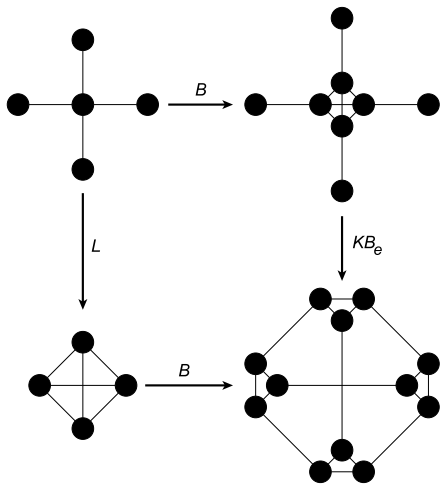
Three constructions carry the argument. The bicliques of $G$—maximal induced complete bipartite subgraphs—are the vertices of $KB_e(G)$, so adjacency means sharing an actual edge rather than just a vertex. The 'good neighbors' condition says that any vertex outside an induced cycle that sees both neighbors of a cycle vertex must also see that cycle vertex; the paper shows this property survives iteration and keeps the cycle induced in every $KB_e^k(G)$. The $(n,m)$-necklace, an induced $C_n$ with a $K_m$ attached to one edge, supplies the growth engine: under $KB_e$, the attached clique expands, so the graph cannot converge. The burgeon graph $B(G)$ replaces each vertex $v$ of $G$ by a clique of size $d(v)$, and the identity $KB_e(B(G))=B(L(G))$ is what transfers the line-graph classification to the edge-biclique setting.
What would settle it
Take the triangle $K_3$: its three edges are its three bicliques, no two share an edge, so $KB_e(K_3)$ consists of three isolated vertices and is disconnected, while no proper subset of vertices has equal internal neighborhoods and an internal edge. That single example contradicts the stated 'if and only if'.
Extended reading notes
Core claim
On the paper's own terms, the central discovery is a structural bridge between the edge-biclique operator and line-graph dynamics, plus a set of sufficient conditions that sort graphs into convergent and divergent regimes. The connectivity theorem states that for a connected $G$, $KB_e(G)$ is connected if and only if there is no proper vertex subset $S$ with all restricted neighborhoods $N_S(v)$ equal and with at least one edge inside $G[S]$; the accompanying algorithm decomposes $E(G)$ into edge sets that lie in the same connected component of $KB_e(G)$. The iteration results show that girth-five graphs converge to the graph spanned by cycles and the paths joining them, that complete graphs die in two steps, and that any graph containing an induced $(n,m)$-necklace whose cycle has good neighbors is divergent because the necklace reappears with a larger clique after two or three iterations. For burgeon graphs, the equality $KB_e(B(G)) = B(L(G))$ imports the known line-graph divergence criterion, so $B(G)$ diverges unless $G$ is a cycle, a path, or $K_{1,3}$.
Load-bearing premise
The characterization assumes that a proper vertex subset can have all internal neighborhoods equal and still contain an edge, yet for any edge $uv$ in the subset, $u$ lies in $N_S(v)$ but not in $N_S(u)$, so no such subset exists.
Editorial extensions
If this is right
- If $G$ has girth at least five, repeated application of $KB_e$ drives $G$ to the subgraph induced by its cycles and the paths connecting them; with no degree-one vertices, $KB_e(G)=G$.
- Complete graphs $K_n$ converge to the empty graph in exactly two steps, and trees converge to the empty graph.
- Any graph containing an induced $(n,m)$-necklace with good neighbors ($n\ge 5$, $m\ge 1$) diverges: the necklace's clique size increases through iterations, so the number of vertices grows without bound.
- For burgeon graphs, behavior under $KB_e$ matches line graphs: $B(G)$ diverges exactly when $G$ is not a cycle, a path, or $K_{1,3}$, and otherwise converges to itself, to the empty graph, or to $C_6$.
- Connectivity of $KB_e(G)$ is claimed to be decidable in $O(nm)$ time without listing all bicliques, by propagating edges through shared bicliques.
Reading between the lines
- The burgeon identity $KB_e(B(G))=B(L(G))$ suggests a transfer principle: once iterated line-graph behavior is understood for any class of base graphs, the same classification holds for the corresponding burgeon graphs under $KB_e$.
- The necklace-growth mechanism could serve as a practical divergence certificate: to certify that a graph diverges, one only needs to find an induced necklace with good neighbors at some iterate, rather than track the whole evolution.
- A natural testable extension is whether the 'good neighbors' invariance can be relaxed to shorter cycles; if it survives in a weak form, the necklace-divergence theorem might extend from girth-five settings to graphs with triangles or squares.
Signed reviews
Editorial analysis
A structured set of objections, weighed in public.
Referee Report
Summary. The manuscript studies the edge-biclique graph operator KB_e, whose vertices are the maximal induced complete bipartite subgraphs (bicliques) of a graph and whose edges indicate that two bicliques share an edge. It claims a characterization of when KB_e(G) is connected (Theorem 3.1) and gives a polynomial-time algorithm for this connectivity test (Algorithm 1 and Proposition 3.2). It then gives sufficient conditions for convergence and divergence under iterating KB_e, including a convergence theorem for girth-at-least-five graphs and a divergence theorem for graphs containing certain necklace graphs with good neighbors. Section 6 proves a commutation relation KB_e(B(G)) = B(L(G)) between the edge-biclique, burgeon, and line-graph operators, and uses it to characterize the dynamics of burgeon graphs. Section 7 states four conjectures about periodic, fixed, and divergent graphs.
Significance. The paper's setting is natural, and the results are stated explicitly in terms of graph substructures, making them directly testable. The most valuable part is Theorem 6.2, which gives an elegant commutation between the edge-biclique operator and the burgeon/line-graph construction and yields a clean dichotomy for burgeon graphs. However, the central connectivity result of Section 3 is false as stated, and because the algorithm and its correctness proof are presented as consequences of that theorem, the main algorithmic claim of the paper is unsupported. The divergence machinery in Sections 4 and 5 is plausible but does not compensate for the failure of the stated core result.
major comments (2)
- [Section 3, Theorem 3.1] Theorem 3.1 is false as stated. For any set S containing an edge uv, the vertex u belongs to N_S(v) but not to N_S(u), so N_S(v) cannot equal N_S(u). Hence the uniform-neighborhood condition cannot hold for any S with |E(G[S])| >= 1. The right-hand side of the equivalence is therefore automatically true for every connected graph with at least one edge, while the left-hand side is not: the paper itself observes that KB_e(K_n) consists of n(n-1)/2 isolated vertices. The proof of the converse direction attempts to prove exactly the impossible equality N_{SV(B)}(u) = N_{SV(B)}(u') for an edge-containing connected set SV(B). In addition, even if the equality were not impossible, the argument that every u' is adjacent to one endpoint of a chosen edge would only show a common neighbor, not equal restricted neighborhoods; a star is a counterexample to that inference.
- [Section 3, Proposition 3.2 and Algorithm 1] The correctness proof of Algorithm 1 is invalid as written. It relies on Claim 1 of Theorem 3.1, and its final step uses the false Theorem 3.1 to conclude that when the algorithm outputs k > 1 parts, KB_e(G) is disconnected. The algorithm may be salvageable with a different proof, but the present paper does not supply one. Moreover, on K_3 the algorithm outputs three singleton parts, which matches the actual disconnectedness of KB_e(K_3) but contradicts the statement of Theorem 3.1; this internal inconsistency reinforces that the connectivity characterization is not correct.
minor comments (4)
- [Section 7, Conjecture 7.2] The note following Conjecture 7.2 reverses the logical direction: Corollary 4.3 proves that the girth-at-least-five plus no-degree-one-vertices condition is sufficient for KB_e(G) = G, so it supports the "if" direction of the conjecture, not the "only if" direction as stated in the text.
- [Section 4, Theorem 4.2] The statement that the operator "converges towards the graph induced by the union of all the cycles and paths connecting cycles" is not made precise: the proof should define the limiting graph explicitly and justify that iterating KB_e deletes degree-one vertices exactly until that subgraph remains.
- [Section 6, Definition 6.1 and Theorem 6.2] The definition of B(G) does not specify how to handle vertices of degree zero. Since L(K_2) = K_1, the statement of Theorem 6.2 for n = 2 should address this edge case, otherwise the isomorphism KB_e(B(G)) = B(L(G)) is unclear for graphs with isolated vertices in L(G).
- [Throughout] There are several typographical errors, including "veryfing" for "verifying" in the proof of Theorem 3.1 and "neigborhood" in Section 2; the manuscript would benefit from a careful proofreading pass.
Circularity Check
No significant circularity: the derivation chain is definitional and self-contained; self-citations are background, not load-bearing.
full rationale
The paper's central results are derived directly from the definitions of bicliques, edge-biclique graphs, and the KBe operator. Theorem 3.1 is an attempted characterization with a proof from first principles; although the condition it states is in fact unsatisfiable for any edge-containing set S, so the theorem is false as written, this is a mathematical validity defect, not a circular reduction: the proof does not assume the connectivity conclusion, fit any parameter, or rely on the authors' prior work. Algorithm 1's correctness is argued through Claim 1 inside Theorem 3.1, an internal lemma of the same proof, and again involves no fitted or pre-supplied data. Sections 4 and 5 build on elementary observations about girth, stars, and necklace graphs. Section 6 proves KBe(B(G)) = B(L(G)) directly from the definitions of burgeon graphs, line graphs, and edge-bicliques; Corollaries 6.3-6.5 then apply the external, non-author theorem [38] on line-graph divergence. The authors' own earlier works ([12,14,15,16,17,31]) are cited for background and definitional context, including the biclique graph, the edge-biclique graph, and the fact that KB(G) preserves connectivity; none of these citations is the justification for the new claims. Thus no step reduces to its own inputs, no fitted quantity is renamed as a prediction, and no uniqueness or ansatz is smuggled in through self-citation. The paper is therefore assessed as having no significant circularity, regardless of the separate correctness concerns in Section 3.
Assumptions & free parameters
assumptions (4)
- standard math Standard definitions of graphs, bicliques, and intersection graphs (Section 2), including the assumption that graphs are simple and connected unless stated.
- domain assumption The known result of van Rooij and Wilf [38] that a graph diverges under the line graph operator if and only if it is not a cycle, path, or K_{1,3}.
- standard math For finite graphs the family of maximal bicliques is finite, so the edge-biclique operator is well-defined on finite graphs.
- domain assumption The empty graph is considered convergent under the KB_e operator (stated in Section 2).
Cite this review
Pith. "Pith review of On the edge-biclique graph and the iterated edge-biclique operator." pith.science (2026). https://pith.science/paper/6D3SE6YT
@misc{pith2026190806656,
  author       = {Pith},
  title        = {Pith review of: On the edge-biclique graph and the iterated edge-biclique operator},
  year         = {2026},
  howpublished = {\url{https://pith.science/paper/6D3SE6YT}},
  note         = {Machine review of arXiv:1908.06656}
}
abstract
A biclique of a graph $G$ is a maximal induced complete bipartite subgraph of $G$. The edge-biclique graph of $G$, $KB_e(G)$, is the edge-intersection graph of the bicliques of $G$. A graph $G$ diverges (resp. converges or is periodic) under an operator $H$ whenever $\lim_{k \rightarrow \infty}|V(H^k(G))|=\infty$ (resp. $\lim_{k \rightarrow \infty}H^k(G)=H^m(G)$ for some $m$ or $H^k(G)=H^{k+s}(G)$ for some $k$ and $s \geq 2$). The iterated edge-biclique graph of $G$, $KB_e^k(G)$, is the graph obtained by applying the edge-biclique operator $k$ successive times to $G$. In this paper, we first study the connectivity relation between $G$ and $KB_e(G)$. Next, we study the iterated edge-biclique operator $KB_e$. In particular, we give sufficient conditions for a graph to be convergent or divergent under the operator $KB_e$, we characterize the behavior of \textit{burgeon graphs} and we propose some general conjectures on the subject.
Figures


Figures from the paper (12 more)




Reference graph
Works this paper leans on
-
[1]
L. Alc´ on, L. Faria, C. M. H. de Figueiredo, and M. Gutierrez. The complexity of clique graph recognition. Theoret. Comput. Sci., 410(21- 23):2072–2083, 2009. 24
work page 2009
- [2]
-
[3]
H.-J. Bandelt and E. Prisner. Clique graphs and Helly graphs. J. Com- bin. Theory Ser. B , 51(1):34–45, 1991
work page 1991
-
[4]
K. Booth and G. Lueker. Testing for the consecutive ones property, interval graphs, and graph planarity usingPQ -tree algorithms. J. Com- put. System Sci. , 13(3):335–379, 1976
work page 1976
-
[5]
A. Brandst¨ adt, V. Le, and J. P. Spinrad. Graph Classes: a Survey . SIAM Monographs on Discrete Mathematics and Applications. Soci- ety for Industrial and Applied Mathematics (SIAM), Philadelphia, PA, 1999
work page 1999
-
[6]
D. Bu, Y. Zhao, L. Cai, H. Xue, X. Zhu, H. Lu, J. Zhang, S. Sun, L. Ling, N. Zhang, G. Li, and R. Chen. Topological structure analysis of the protein-protein interaction network in budding yeast. Nucleic Acids Research, 31(9):2443–2450, 2003
work page 2003
-
[7]
C. P. de Mello, A. Morgana, and M. Liverani. The clique operator on graphs with few P4’s. Discrete Appl. Math. , 154(3):485–492, 2006
work page 2006
- [8]
Show all 38 references
-
[9]
M. E. Fr´ ıas-Armenta, V. Neumann-Lara, and M. A. Piza˜ na. Disman- tlings and iterated clique graphs. Discrete Math. , 282(1-3):263–265, 2004
2004
-
[10]
D. R. Fulkerson and O. A. Gross. Incidence matrices and interval graphs. Pacific J. Math. , 15:835–855, 1965
1965
-
[11]
F. Gavril. The intersection graphs of subtrees in trees are exactly the chordal graphs. J. Combinatorial Theory Ser. B , 16:47–56, 1974
1974
-
[12]
Groshaus, A
M. Groshaus, A. L. Guedes, and L. Montero. Almost every graph is divergent under the biclique operator. Discrete Appl. Math. , 201:130 – 140, 2016. 25
2016
-
[13]
Groshaus, P
M. Groshaus, P. Hell, and J. Stacho. On edge-sets of bicliques in graphs. Discrete Appl. Math. , 160(18):2698 – 2708, 2012
2012
-
[14]
Groshaus and L
M. Groshaus and L. Montero. On the iterated biclique operator. J. Graph Theory, 73(2):181–190, 2013
2013
-
[15]
Groshaus and L
M. Groshaus and L. Montero. Structural properties of biclique graphs and the distance formula. CoRR, abs/1708.09686v5, 2021
2021 arXiv
-
[16]
Groshaus and J
M. Groshaus and J. L. Szwarcfiter. Biclique graphs and biclique matri- ces. J. Graph Theory, 63(1):1–16, 2010
2010
-
[17]
M. E. Groshaus. Bicliques, cliques, neighborhoods y la propiedad de Helly. PhD thesis, Universidad de Buenos Aires, 2006
2006
-
[18]
W. H. Haemers. Bicliques and eigenvalues. J. Combinatorial Theory Ser. B, 82(1):56 – 66, 2001
2001
-
[19]
R. C. Hamelink. A partial characterization of clique graphs. J. Combi- natorial Theory, 5:192–197, 1968
1968
-
[20]
S. T. Hedetniemi and P. J. Slater. Line graphs of triangleless graphs and iterated clique graphs. In Graph theory and applications (Proc. Conf., Western Michigan Univ., Kalamazoo, Mich., 1972; dedicated to the memory of J. W. T. Youngs) , pages 139–147. Lecture Notes in Math.,...
1972
-
[21]
Kumar, P
R. Kumar, P. Raghavan, S. Rajagopalan, and A. Tomkins. Trawling the web for emerging cyber-communities. In Proceeding of the 8th in- ternational conference on World Wide Web, pages 1481–1493, 1999. , 2000
1999
-
[22]
Larri´ on, C
F. Larri´ on, C. P. de Mello, A. Morgana, V. Neumann-Lara, and M. A. Piza˜ na. The clique operator on cographs and serial graphs. Discrete Math., 282(1-3):183–191, 2004
2004
-
[23]
Larri´ on and V
F. Larri´ on and V. Neumann-Lara. A family of clique divergent graphs with linear growth. Graphs Combin., 13(3):263–266, 1997
1997
-
[24]
Larri´ on and V
F. Larri´ on and V. Neumann-Lara. Clique divergent graphs with un- bounded sequence of diameters. Discrete Math., 197/198:491–501, 1999. 16th British Combinatorial Conference (London, 1997). 26
1999
-
[25]
Larri´ on and V
F. Larri´ on and V. Neumann-Lara. Locally C6 graphs are clique diver- gent. Discrete Math., 215(1-3):159–170, 2000
2000
-
[26]
Larri´ on, V
F. Larri´ on, V. Neumann-Lara, and M. A. Piza˜ na. Whitney triangu- lations, local girth and iterated clique graphs. Discrete Math., 258(1- 3):123–135, 2002
2002
-
[27]
Larri´ on, M
F. Larri´ on, M. A. Piza˜ na, and R. Villarroel-Flores. Equivariant col- lapses and the homotopy type of iterated clique graphs. Discrete Math., 308:3199–3207, 2008
2008
-
[28]
P. G. H. Lehot. An optimal algorithm to detect a line graph and output its root graph. J. ACM, 21(4):569–575, 1974
1974
-
[29]
G. Liu, K. Sim, and J. Li. Efficient mining of large maximal bicliques
-
[30]
T. A. McKee and F. R. McMorris. Topics in Intersection Graph The- ory. SIAM Monographs on Discrete Mathematics and Applications. Society for Industrial and Applied Mathematics (SIAM), Philadelphia, PA, 1999
1999
-
[31]
L. Montero. Convergencia y divergencia del grafo biclique iterado. Mas- ter’s thesis, Departamento de Computaci´ on, Facultad de Ciencias Ex- actas y Naturales, Universidad de Buenos Aires, 2008
2008
-
[32]
Nagarajan and C
N. Nagarajan and C. Kingsford. Uncovering genomic reassortments among influenza strains by enumerating maximal bicliques. 2012 IEEE International Conference on Bioinformatics and Biomedicine , 0:223– 230, 2008
2012
-
[33]
Neumann Lara
V. Neumann Lara. Clique divergence in graphs. In Algebraic methods in graph theory, Vol. I, II (Szeged, 1978) , volume 25 of Colloq. Math. Soc. J´ anos Bolyai, pages 563–569. North-Holland, Amsterdam, 1981
1978
-
[34]
M. A. Piza˜ na. The icosahedron is clique divergent. Discrete Math. , 262(1-3):229–239, 2003
2003
-
[35]
E. Prisner. Bicliques in graphs i: Bounds on their number. Combina- torica, 20(1):109–117, 2000
2000
-
[36]
F. S. Roberts and J. H. Spencer. A characterization of clique graphs. J. Combinatorial Theory Ser. B , 10:102–108, 1971. 27
1971
-
[37]
Szpilrajn-Marczewski
E. Szpilrajn-Marczewski. Sur deux propri´ et´ es des classes d’ensembles. Fund. Math., 33:303–307, 1945
1945
-
[38]
A. C. M. van Rooij and H. S. Wilf. The interchange graph of a finite graph. Acta Math. Acad. Sci. Hungar. , 16:263–269, 1965. 28
1965
Reviewed August 14, 2026 · model on record in the stance chip above.
Discussion (0). Continue with ORCID to comment.