REVIEW 1 major objections 6 minor 60 references
Vortices with massive cores in a binary mixture of Bose-Einstein condensates
T0 review · 1 major / 6 minor · reviewed 2026-08-14 · deepseek-v4-flash
Pith's one-line read This paper establishes that in an immiscible rotating two-species Bose-Einstein condensate, atoms trapped inside vortex cores act as point masses: adding core atoms increases the equilibrium separation of a corotating vortex pair, while…
desk verdict Interesting physics, but Eq. (4) is internally inconsistent and the central d(N_b) curve is not reproducible from the printed manuscript. read the letter →
The pith
A machine-rendered reading of the paper's core claim, the machinery that carries it, and where it could break.
The reading
What carries the argument
The central object is the massive point-vortex Lagrangian (3), which adds a kinetic term $\sum_j \frac{m_j}{2}(\dot{x}_j^2+\dot{y}_j^2)$ to the usual point-vortex Hamiltonian in a circular box, together with the circulation term $\sum_j \frac{k_j\rho_*}{2}(y_j\dot{x}_j-x_j\dot{y}_j)$. This Lagrangian is formally the same as that of charged particles in a planar domain under a transverse magnetic field, with vortex strengths playing the role of charges and $\rho_*$ the role of the magnetic field. Its equations of motion admit a symmetric precessing solution whose equilibrium distance $d$ and angular frequency $\Omega$ are linked by Eq. (4), and the substitutions $k=h/m_a$, $\rho_*=N_a m_a/(\pi R^2)$, and $m=N_b m_b/2$ connect the model to the coupled Gross-Pitaevskii parameters. The no-entrainment claim is carried by a rotating-frame computation of the species-b mass current density, which shows the cores behave as almost rigid bodies rotating at $-\Omega$ in the rotating frame, together with a phase-field argument that a soliton-like distribution cannot spin in the laboratory frame without a phase singularity at its center.
What would settle it
A concrete test would be to track the orientation of an initially anisotropic species-b core over one full precession period: the paper predicts its long axis remains fixed in the laboratory frame, so any observed rotation of that axis would falsify the no-tangential-entrainment claim. Separately, computing $d_{\mathrm{vor}}$ from coupled Gross-Pitaevskii equations well beyond the explored range $N_b\in[5,1000]$, or in a miscible regime with $g_{ab}<\sqrt{g_a g_b}$, should reveal a growing deviation from the point-mass prediction of Eq. (4) if the central model is wrong.
Extended reading notes
Core claim
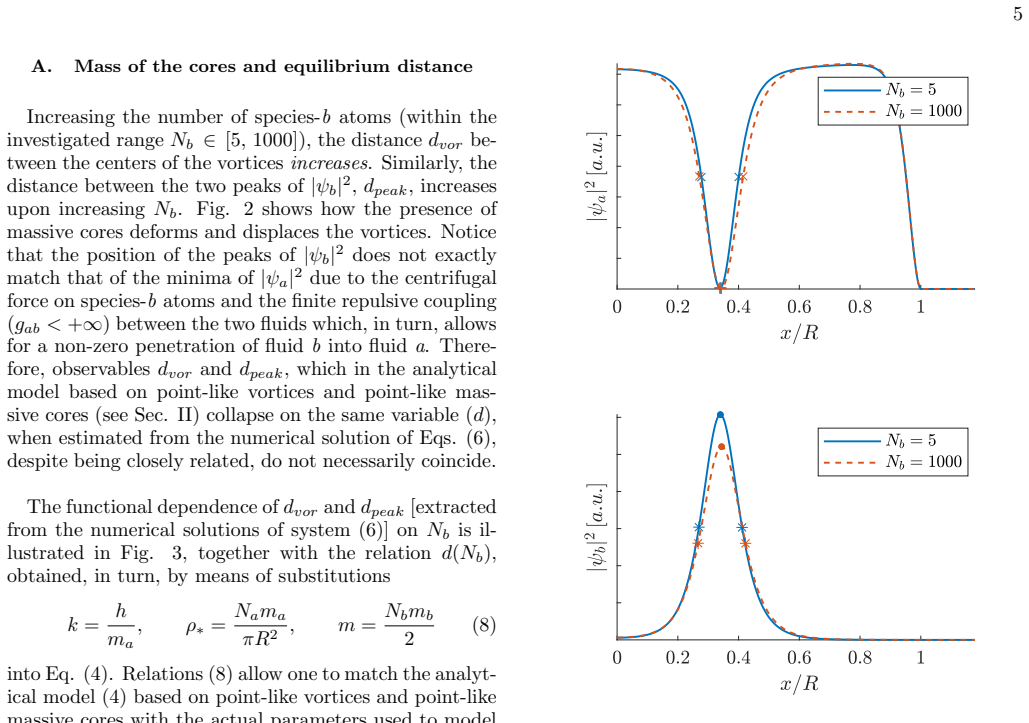
In an immiscible binary Bose-Einstein condensate in a rotating circular box, the authors claim that a state with two corotating vortices in species a, each filled by species-b atoms, is accurately described by a massive point-vortex Lagrangian. From this model they derive Eq. (4), which relates the precession angular frequency $\Omega$ to the symmetric equilibrium separation $d$ of the two vortices; through the mapping in Eq. (8), $d$ grows with the core mass $m = N_b m_b/2$, and the predicted values match the numerical distances $d_{\mathrm{vor}}$ and $d_{\mathrm{peak}}$ extracted from coupled Gross-Pitaevskii solutions to within about two percent. Using a rotating-frame analysis of the mass current density, they show that the species-b cores orbit the trap center with the vortices but rotate at angular velocity $-\Omega$ relative to the rotating frame, so their orientation in the laboratory frame stays constant: the cores revolve like rigid bodies without spinning about their own centers. The paper also derives simple formulas for the angular momentum of each species, with species a obeying $\langle L_{z,a}\rangle/(N_a\hbar)=2[1-(r_{\mathrm{vor}}/R)^2]$, and gives heuristic equations for the vortex healing length and the characteristic core size as functions of the core mass.
Load-bearing premise
The load-bearing premise is that each species-b core can be treated as a point mass $m=N_b m_b/2$ sitting exactly at the vortex center, with no size, deformation, or internal circulation; the paper itself notes that this approximation loses validity when the cores become soft or the two fluids become miscible.
Editorial extensions
If this is right
- If the model is correct, the equilibrium separation of a corotating vortex pair in a circular box becomes a controlled function of the minority-species atom number, giving a direct experimental knob for vortex-pair geometry.
- The Lorentz-like form of the massive vortex equations makes the system an analog simulator for planar charged particles in a transverse magnetic field, with tunable effective mass and charge-to-mass ratio.
- The simple angular-momentum formula for species a means that a single measured vortex orbit radius determines the majority-component angular momentum per particle without solving the full Gross-Pitaevskii equations.
- The heuristic equations (18) predict how the vortex healing length and core radius respond to added core atoms, so core profile measurements can directly test the interspecies-repulsion mechanism.
- The demonstration that cores orbit without rotating implies that any observed lab-frame rotation of a bright-soliton core would signal tangential entrainment between the two fluids beyond the present model.
Reading between the lines
- Editorial inference: because the core mass enters the equations in the same way a particle mass enters magnetic-field dynamics, tuning $N_b$ across the explored range should effectively scan a continuous mass-to-charge ratio, which could be used to probe cyclotron-like orbits and Hall-type behavior in a cold-atom setting.
- Editorial inference: the point-mass mapping assumes a uniform majority density, so at smaller $N_a$ or stronger interspecies coupling the two-percent agreement should degrade; a position-dependent effective mass or an additional Magnus-like force is a natural next-order correction.
- Editorial inference: a finite-core-size expansion in the ratio of core radius to healing length could extend Eq. (4) into the miscible or soft-core regime where the paper itself says the point-like model partially loses validity, producing testable deviations from the current prediction.
- Editorial inference: the no-entrainment claim can be probed by imaging an initially anisotropic, elliptical core during precession; the paper predicts its long axis stays fixed in the laboratory frame, so any measurable rotation of that axis would require relaxing the zero-entrainment conclusion.
Signed reviews
Editorial analysis
A structured set of objections, weighed in public.
Referee Report
Summary. The manuscript studies an immiscible 23Na-39K mixture in a rotating circular-box trap, in which two corotating vortices of species a are filled by species-b atoms. The authors model each filled vortex as a point vortex carrying a point mass (Lagrangian (3)), derive an equation for the precession frequency as a function of vortex separation (Eq. (4)), map the model parameters to GPE parameters via Eq. (8), and compare the predicted equilibrium distance d(Nb) with imaginary-time GPE solutions, reporting agreement within 2%. They also compute angular momenta of both species (Eqs. (10) and (14)), show from rotating-frame currents, local angular velocity, and phase-field circulation that the cores are dragged along the precession but do not rotate, and propose heuristic equations for the vortex healing length and core size (Eq. (18)).
Significance. If the central analytical relation is corrected, the paper offers a parameter-free prediction for how core mass changes the equilibrium distance of a corotating vortex pair, validated against independent GPE numerics, and a multi-diagnostic demonstration of the absence of tangential entrainment. The rotating-frame velocity analysis and the circulation argument are convincing and go beyond earlier work on vortex-bright soliton complexes. The authors are also appropriately explicit about the regime of validity: the point-mass model is only reliable for immiscible, narrow cores (Sec. IV C). The main quantitative claim, however, currently rests on Eq. (4), which as printed is internally inconsistent and cannot reproduce the reported agreement; the result is therefore not yet usable in its present form.
major comments (1)
- [Sec. II B, Eq. (4)] Equation (4) is inconsistent with the printed model and with the stated limit Eq. (5). Directly from Eqs. (2)-(3) and the symmetric ansatz x1=(d/2)(cos Ωt, sin Ωt), x2=-x1, I obtain π d²(16R⁴−d⁴)Ω(kρ*−mΩ)=ρ*k²(16R⁴+3d⁴), which reduces exactly to Eq. (5) in the R→∞ limit. The printed Eq. (4) is dimensionally inconsistent because the terms 3d⁴k²ρ*/(d−2R) and 16k²ρ*R⁴/(d−2R) scale as length⁵ while all other terms scale as length⁶; after rearrangement it becomes πd²(16R⁴−d⁴)Ω(kρ*−mΩ)=k²ρ*(3d⁴−16R⁴)/(d−2R), whose right-hand side grows as R³ for fixed d and Ω, so no R→∞ limit exists and Eq. (5) cannot follow from it. Since the analytical curve in Fig. 3 is stated to come from Eq. (4), the reported <2% agreement with GPE numerics cannot be independently reproduced from the manuscript as written. The authors should correct Eq. (4), provide the resulting d(Nb) curve, and verify that the comparison in Fig. 3 refers to the corrected formula.
minor comments (6)
- [Abstract] The word 'previsions' should be 'predictions'; the same typo appears in the first paragraph of Sec. IV.
- [Eq. (1)] The notation 'H∞ = (z1,...,zN) =' appears to be missing the function name; it should read H∞(z1,...,zN) =.
- [Sec. IV A, Fig. 3] The statement 'offset < 2%' should specify the error metric (maximum or mean relative deviation over the Nb sweep) and should be recomputed after correcting Eq. (4).
- [Sec. V B, Eq. (13)] Near x=0 the assignment of a point to the left or right core is ambiguous; the text should state that the local angular velocity diagnostic is applied only in the bulk of each core, excluding a strip around x=0.
- [Sec. VI, Fig. 8] The conversion factors 1.30 and 1.15 are calibrated from the Nb=1 numerical solution; the text already calls the model heuristic, but the figure caption should remind readers that these factors are fitted, not derived.
- [Sec. II B, Eq. (3)] The physical origin of the point mass m in the Lagrangian could be stated more explicitly: m is the total mass of the bright-soliton core in one vortex, and Eq. (8) sets m=Nb mb/2; a clarifying sentence would prevent confusion with the atomic mass mb.
Circularity Check
Central d(N_b) prediction is independent against GPE numerics, but the healing-length curves are calibrated at N_b=1 and the L_z,b model is constructed from the no-rotation result it corroborates.
-
fitted input called prediction
[Sec. VI, after Eq. (18), Fig. 8]
"From the analytical side, the estimates of quantities λa and λb are given by the solutions of system (18), ξa and σb, multiplied by two suitable constant conversion factors, 1.30 and 1.15 respectively, which are determined from their numerical counterpart in the case Nb = 1, that means in a scenario where species-b cores have a negligible impact on species-a vortices."
The HWHM observables λa and λb are the very quantities compared with the GPE numerics in Fig. 8, yet the analytical estimates are rescaled by constants fixed to the N_b=1 numerical solution. Hence the vertical offset of the analytical curves is not predicted from the model; it is imported from the data being compared. The N_b-dependence still comes from Eq. (18), so this is a partial calibration rather than an independent prediction, and it affects the healing-length/size section rather than the central equilibrium-distance result.
-
other
[Sec. V B b, Eqs. (14)-(17), Fig. 7]
"we show that the functional dependence of quantity (11) on model parameter Nb can be well fitted by the semi-analytical model ... where terms ... are introduced to take into account that, in the lab frame, the two species-b cores revolve but keep their orientation fixed."
Formula (14) is not an independent first-principles prediction of the species-b angular momentum: the two subtracted terms (16)-(17) are explicitly introduced to encode the already-claimed conclusion that the cores revolve without changing orientation. The subsequent agreement with the numerical L_z,b is therefore a self-consistency bookkeeping of the no-tangential-entrainment hypothesis, not an independent test of it. The independent evidence for that claim is the phase-field/circulation argument of Sec. V B c, so the circularity here is limited to a corroborating consistency display.
full rationale
The central quantitative claim—the equilibrium distance d(N_b) obtained by substituting (8) into the massive-vortex relation (4)—is a parameter-free prediction checked against direct imaginary-time GPE solutions. No fitted value of d enters the analytical relation, and the GPE comparison is independent of the point-vortex model, so that chain is not circular. The authors' self-citations, including Refs. [48] and [54], supply a standard circular-box vortex Hamiltonian and a Thomas-Fermi angular-momentum estimate; they are not uniqueness theorems and do not forbid alternative derivations, so they are not load-bearing in a circular sense. Two secondary items do show calibration or consistency circularity: (i) the HWHM analytical curves in Sec. VI are rescaled by constants fitted at N_b=1 to the numerical solution, making the vertical offset of Fig. 8 partly imported from the compared data; (ii) the L_z,b model of Eqs. (14)-(17) is constructed by explicitly subtracting the no-rotation kinematics it is meant to corroborate, so its <4% agreement is a consistency check rather than an independent prediction. I also note, without scoring it as circularity, that Eq. (4) as printed appears algebraically inconsistent with the Euler-Lagrange equations of Sec. II B and does not reduce to Eq. (5) in the R→∞ limit; this is an internal-consistency/reproducibility issue, not a reduction of a prediction to its inputs. Overall, the central result is self-contained against external numerics, and the circularity burden is confined to auxiliary fits and consistency displays.
Assumptions & free parameters
free parameters (2)
- HWHM conversion factor for vortices =
1.30
- HWHM conversion factor for cores =
1.15
assumptions (7)
- domain assumption Immiscibility condition g_ab > sqrt(g_a g_b) holds for the main sample.
- ad hoc to paper The two-species mixture reduces to two point-like massive vortices with Lagrangian (3).
- standard math The circular-box boundary is represented by virtual vortices, giving Hamiltonian (2).
- ad hoc to paper Mapping (8): k=h/m_a, rho*=N_a m_a/(pi R^2), m=N_b m_b/2 connects point-vortex quantities to GPE parameters.
- domain assumption Thomas-Fermi and uniform-density approximation for condensate a in the box, used in Eq. (10).
- standard math A quantum fluid is irrotational except at phase singularities, so a bright soliton without a phase singularity cannot rotate about its own axis.
- domain assumption Stationary solutions of the rotating-frame GPEs correspond to uniformly precessing states in the lab frame.
Cite this review
Pith. "Pith review of Vortices with massive cores in a binary mixture of Bose-Einstein condensates." pith.science (2026). https://pith.science/paper/TRCUT5JE
@misc{pith2026190806668,
  author       = {Pith},
  title        = {Pith review of: Vortices with massive cores in a binary mixture of Bose-Einstein condensates},
  year         = {2026},
  howpublished = {\url{https://pith.science/paper/TRCUT5JE}},
  note         = {Machine review of arXiv:1908.06668}
}
read the original abstract
We analyze a notable class of states relevant to an immiscible bosonic binary mixture loaded in a rotating box-like circular trap, i.e. states where vortices in one species host the atoms of the other species, which thus play the role of massive cores. Within a fully-analytical framework, we calculate the equilibrium distance distinguishing the motion of precession of two corotating massive vortices, the angular momentum of each component, the vortices healing length and the characteristic size of the cores. We then compare these previsions with the measures extracted from the numerical solutions of the associated coupled Gross-Pitaevskii equations. Interestingly, making use of a suitable change of reference frame, we show that vortices drag the massive cores which they host thus conveying them their same motion of precession, but that there is no evidence of tangential entrainment between the two fluids, since the cores keep their orientation constant while orbiting.
Figures


Figures from the paper (5 more)


Reference graph
Works this paper leans on
-
[1]
Onsager, Il Nuovo Cimento (1943-1954) 6, 279 (1949)
L. Onsager, Il Nuovo Cimento (1943-1954) 6, 279 (1949)
1949
-
[2]
L. M. Pismen and L. M. Pismen, Vortices in nonlin- ear fields: from liquid crystals to superfluids, from non- equilibrium patterns to cosmic strings , Vol. 100 (Oxford University Press, Oxford, UK, 1999)
work page 1999
-
[3]
R. P. Feynman, in Progress in low temperature physics , Vol. 1 (Elsevier, 1955) pp. 17–53
work page 1955
-
[4]
R. J. Donnelly, Quantized vortices in helium II , Vol. 2 (Cambridge University Press, 1991)
work page 1991
-
[5]
M. Brambilla, L. A. Lugiato, V. Penna, F. Prati, C. Tamm, and C. O. Weiss, Phys. Rev. A 43, 5114 (1991)
work page 1991
-
[6]
Carusotto and C
I. Carusotto and C. Ciuti, Rev. Mod. Phys. 85, 299 (2013)
2013
-
[7]
Blatter, M
G. Blatter, M. V. Feigel’man, V. B. Geshkenbein, A. I. Larkin, and V. M. Vinokur, Rev. Mod. Phys. 66, 1125 (1994)
1994
-
[8]
R. P. Huebener, Magnetic flux structures in superconduc- tors: extended reprint of a classic text , Vol. 6 (Springer Science & Business Media, 2013)
work page 2013
Show all 60 references
-
[9]
Cardeira and S.R
Vortex dynamics and quantum effects in Josephson junc- tion arrays are reviewd in the Proceedings of the ICTP Workshop on Josephson Junction Arrays, edited by H.A. Cardeira and S.R. Shenoy [Physica B 222 (1996) 336],
1996
-
[10]
Fazio and H
R. Fazio and H. Van Der Zant, Physics Reports 355, 235 (2001)
2001
-
[11]
C. F. Barenghi, R. J. Donnelly, and W. Vinen, Quan- tized vortex dynamics and superfluid turbulence , Vol. 571 (Springer Science & Business Media, 2001)
2001
-
[12]
J. M. Kosterlitz and D. J. Thouless, Journal of Physics C: Solid State Physics 6, 1181 (1973)
1973
-
[13]
R. Y. Chiao, A. Hansen, and A. A. Moulthrop, Phys. Rev. Lett. 54, 1339 (1985)
1985
-
[14]
A. L. Fetter, Phys. Rev. 162, 143 (1967). 11
1967
-
[15]
Rasetti and T
M. Rasetti and T. Regge, Physica A: Statistical Mechan- ics and its Applications 80, 217 (1975)
1975
-
[16]
Penna, M
V. Penna, M. Rasetti, and M. Spera, Contemporary Mathematics 219, 173 (1998)
1998
-
[17]
A. L. Fetter, Rev. Mod. Phys. 81, 647 (2009)
2009
-
[18]
R. Dum, J. I. Cirac, M. Lewenstein, and P. Zoller, Phys. Rev. Lett. 80, 2972 (1998)
1998
-
[19]
Butts and D
D. Butts and D. Rokhsar, Nature 397, 327 (1999)
1999
-
[20]
Dalfovo and S
F. Dalfovo and S. Stringari, Physical Review A 53, 2477 (1996)
1996
-
[21]
Pismen and J
L. Pismen and J. Rubinstein, Physica D: Nonlinear Phe- nomena 47, 353 (1991)
1991
-
[22]
Cozzini and S
M. Cozzini and S. Stringari, Phys. Rev. A 67, 041602 (2003)
2003
-
[23]
Castin and R
Y. Castin and R. Dum, The European Physical Journal D - Atomic, Molecular, Optical and Plasma Physics 7, 399 (1999)
1999
-
[24]
M. R. Matthews, B. P. Anderson, P. Haljan, D. Hall, C. Wieman, and E. A. Cornell, Physical Review Letters 83, 2498 (1999)
1999
-
[25]
Recati, F
A. Recati, F. Zambelli, and S. Stringari, Phys. Rev. Lett. 86, 377 (2001)
2001
-
[26]
Sinha and Y
S. Sinha and Y. Castin, Phys. Rev. Lett. 87, 190402 (2001)
2001
-
[27]
K. W. Madison, F. Chevy, V. Bretin, and J. Dalibard, Phys. Rev. Lett. 86, 4443 (2001)
2001
-
[28]
Onofrio, C
R. Onofrio, C. Raman, J. M. Vogels, J. R. Abo-Shaeer, A. P. Chikkatur, and W. Ketterle, Phys. Rev. Lett. 85, 2228 (2000)
2000
-
[29]
D. R. Scherer, C. N. Weiler, T. W. Neely, and B. P. Anderson, Phys. Rev. Lett. 98, 110402 (2007)
2007
-
[30]
P. G. Drazin and R. S. Johnson, Solitons: an introduc- tion, Vol. 2 (Cambridge university press, Cambridge, UK, 1989)
1989
-
[31]
Burger, L
S. Burger, L. D. Carr, P. ¨Ohberg, K. Sengstock, and A. Sanpera, Phys. Rev. A 65, 043611 (2002)
2002
-
[32]
Frantzeskakis, Journal of Physics A: Mathematical and Theoretical 43, 213001 (2010)
D. Frantzeskakis, Journal of Physics A: Mathematical and Theoretical 43, 213001 (2010)
2010
-
[33]
Becker, S
C. Becker, S. Stellmer, P. Soltan-Panahi, S. D¨ orscher, M. Baumert, E.-M. Richter, J. Kronj¨ ager, K. Bongs, and K. Sengstock, Nature Physics 4, 496 (2008)
2008
-
[34]
Hamner, J
C. Hamner, J. Chang, P. Engels, and M. Hoefer, Physical review letters 106, 065302 (2011)
2011
-
[35]
Middelkamp, J
S. Middelkamp, J. Chang, C. Hamner, R. Carretero- Gonz´ alez, P. Kevrekidis, V. Achilleos, D. Frantzeskakis, P. Schmelcher, and P. Engels, Physics Letters A 375, 642 (2011)
2011
-
[36]
Busch and J
T. Busch and J. R. Anglin, Phys. Rev. Lett. 87, 010401 (2001)
2001
-
[37]
V. M. P´ erez-Garc´ ıa and J. B. Beitia, Phys. Rev. A72, 033620 (2005)
2005
-
[38]
B. P. Anderson, P. C. Haljan, C. E. Wieman, and E. A. Cornell, Phys. Rev. Lett. 85, 2857 (2000)
2000
-
[39]
K. J. H. Law, P. G. Kevrekidis, and L. S. Tuckerman, Phys. Rev. Lett. 105, 160405 (2010)
2010
-
[40]
Mukherjee, S
K. Mukherjee, S. Mistakidis, P. Kevrekidis, and P. Schmelcher, arXiv preprint arXiv:1904.06208 (2019)
2019 arXiv
-
[41]
Gallem´ ı, L
A. Gallem´ ı, L. P. Pitaevskii, S. Stringari, and A. Recati, Phys. Rev. A 97, 063615 (2018)
2018
-
[42]
E. G. Charalampidis, P. G. Kevrekidis, D. J. Frantzeskakis, and B. A. Malomed, Phys. Rev. E 94, 022207 (2016)
2016
-
[43]
M. Pola, J. Stockhofe, P. Schmelcher, and P. G. Kevrekidis, Phys. Rev. A 86, 053601 (2012)
2012
-
[44]
P. G. Saffman, Vortex dynamics (Cambridge university press, Cambridge, UK, 1992)
1992
-
[45]
Henderson, C
K. Henderson, C. Ryu, C. MacCormick, and M. Boshier, New J. Phys. 11, 043030 (2009)
2009
-
[46]
Muldoon, L
C. Muldoon, L. Brandt, J. Dong, D. Stuart, E. Brainis, M. Himsworth, and A. Kuhn, New J. Phys. 14, 073051 (2012)
2012
-
[47]
Gauthier, I
G. Gauthier, I. Lenton, N. M. Parry, M. Baker, M. J. Davis, H. Rubinsztein-Dunlop, and T. W. Neely, Optica 3, 1136 (2016)
2016
-
[48]
Penna, in Quantized Vortex Dynamics and Superfluid Turbulence, edited by C.F
V. Penna, in Quantized Vortex Dynamics and Superfluid Turbulence, edited by C.F. Barenghi, R.J.Donnelly, and W.F. Vinen (Springer-Verlag, Berlin 2001), pp 445-452,
2001
-
[49]
Penna, Phys
V. Penna, Phys. Rev. B 59, 7127 (1999)
1999
-
[50]
T. A. Schulze, T. Hartmann, K. K. Voges, M. W. Gem- pel, E. Tiemann, A. Zenesini, and S. Ospelkaus, Phys. Rev. A 97, 023623 (2018)
2018
-
[51]
Richaud, A
A. Richaud, A. Zenesini, and V. Penna, Sci. Rep. 9, 6908 (2019)
2019
-
[52]
Coppens, F
F. Coppens, F. Ancilotto, M. Barranco, N. Halberstadt, and M. Pi, Physical Chemistry Chemical Physics 19, 24805 (2017)
2017
-
[53]
Computational resources provided by HPC@POLITO (http://www.hpc.polito.it),
-
[54]
Guilleumas and R
M. Guilleumas and R. Graham, Phys. Rev. A 64, 033607 (2001)
2001
-
[55]
Andreev and E
A. Andreev and E. Bashkin, J. Exp. Theor. Fisica 42, 164 (1976)
1976
-
[56]
Babaev, Phys
E. Babaev, Phys. Rev. D 70, 043001 (2004)
2004
-
[57]
Shevchenko and D
S. Shevchenko and D. Fil, J. Exp. Theor. Fisica 105, 135 (2007)
2007
-
[58]
vortex healing length
and, for our sample condition, we expect it to be negligible, as the off-diagonal matrix elements ρab and ρba, which depend on the the overlap between ψa and ψb, should be small, given that the two discussed fluids are immiscible. In view of its complexity, the possible presence...
-
[59]
Nespolo, G
J. Nespolo, G. E. Astrakharchik, and A. Recati, New J. Phys. 19, 125005 (2017)
2017
-
[60]
Pitaevskii and S
L. Pitaevskii and S. Stringari, Bose-Einstein condensa- tion and superfluidity, Vol. 164 (Oxford University Press, 2016)
2016
Reviewed August 14, 2026 · model on record in the stance chip above.
Discussion (0). Continue with ORCID to comment.