REVIEW 3 major objections 5 minor 28 references
Balanced Schnyder woods for planar triangulations: an experimental study with applications to graph drawing and graph separators
T0 review · 3 major / 5 minor · reviewed 2026-08-14 · deepseek-v4-flash
Pith's one-line read A balance heuristic for Schnyder woods improves planar drawings and separators
desk verdict A careful, well-scoped experimental study of a new balance heuristic for Schnyder woods; the causal claim about balance itself is plausible but not isolated from confounds. read the letter →
The pith
A machine-rendered reading of the paper's core claim, the machinery that carries it, and where it could break.
The reading
What carries the argument
The load-bearing mechanism is a priority-based vertex conquest. The standard shelling maintains a boundary cycle and repeatedly removes a free vertex, assigning colors and orientations to its incident edges; the heuristic gives each boundary vertex a priority equal to the number of incoming edges already assigned to it, stores vertices in a small number of queues by priority, and always removes the highest-priority free vertex. This retards vertices with few incoming edges, so they accumulate edges of several colors before being removed, which is what keeps defects small. A post-processing reversal of oriented triangles can further raise the fraction of balanced vertices on regular graphs, at extra cost.
What would settle it
Take a single near-regular triangulation with about a million vertices, run the balanced heuristic over many random seeds, and compare the worst-case separator boundary and drawing edge-length metric to a minimal Schnyder wood; if the worst balanced result is no better than the minimal one, the claim that balance drives quality is falsified.
Extended reading notes
Core claim
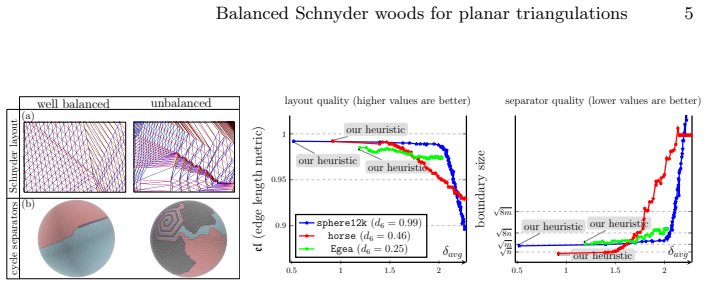
A Schnyder wood is an edge coloring and orientation of a rooted planar triangulation in which every inner vertex has one outgoing edge of each of three colors; the paper measures its balance by a defect $\delta(v)$, the spread between the most- and least-frequent incoming colors (with a small correction when the degree is not divisible by 3). The central discovery is that retarding the removal of vertices that have accumulated few incoming edges during the incremental shelling produces woods in which most vertices are balanced, and that this balance is strongly associated with drawing quality and separator quality. On a fixed seed, the paper generates a sequence of woods from balanced to unbalanced by randomly reversing oriented triangles, and both the edge-length layout metric and separator boundary size worsen as the average defect increases.
Load-bearing premise
The measured correlation between balance and quality is causal, and the tested triangulations are representative enough to generalize the in-practice claim.
Editorial extensions
If this is right
- On regular meshes, a large majority of vertices become balanced (about 79% for a spherical grid-type graph), whereas minimal Schnyder woods leave most vertices with large defect.
- Schnyder drawings obtained from balanced woods have higher edge-length uniformity and capture regular structure; unbalanced woods show long edges and flat triangles.
- Cycle separators extracted from balanced woods have boundary sizes well below the $\sqrt{8m}$ bound on most tested graphs, often close to $\sqrt{m}$, with balanced partitions meeting the $2/3$ ratio.
- Separator extraction after the drawing is computed is near-instantaneous (about 0.01 seconds for graphs with around a million vertices).
- The choice of initial seed has limited effect on balance, but for high-diameter graphs it can materially change separator length.
Reading between the lines
- I infer the likely mechanism behind the empirical correlation: balanced woods spread the three color classes evenly around each vertex, preventing the long spiraling paths that both stretch edges and inflate separator boundaries; this suggests the same balancing should help other Schnyder-wood applications such as compact encodings and spanners.
- A natural testable extension is to apply the priority rule to non-triangulated planar graphs (after a preprocessing triangulation) or to higher-genus maps, and check whether balance still predicts layout and separator quality.
- To separate balance from other shelling effects, one could run a control that perturbates the shelling order while keeping priority structure fixed; if quality does not track the defect, the causal claim would need revision.
Signed reviews
Editorial analysis
A structured set of objections, weighed in public.
Referee Report
Summary. The paper studies balanced Schnyder woods for planar triangulations. It defines a vertex defect measure δ(v), global balance metrics δ0 and δavg, and proposes a linear-time heuristic based on a retarded vertex-conquest shelling procedure with k priority queues, optionally followed by a post-processing phase that reverses oriented triangles. The heuristic is used in two applications: Schnyder straight-line drawings, evaluated by the edge-length aesthetic metric, and simple cycle separators, evaluated by boundary size and partition balance. The experiments cover real-world meshes (aim@shape, Thingi10k), synthetic grids, random planar triangulations, and Delaunay triangulations, with hundreds of random seeds. The paper explicitly disclaims theoretical guarantees and claims only empirical evidence that balanced Schnyder woods improve layout quality and separator quality compared with minimal Schnyder woods.
Significance. If the empirical claim is correct, the paper offers a cheap and practical preprocessing step for two well-studied problems: higher-quality Schnyder drawings and short balanced cycle separators. The paper's strengths are the breadth of its test suite, the repetition over hundreds of seeds, the availability of datasets and code, and the honest framing that no worst-case guarantees are provided. The balance metric is computed independently of the heuristic's objective, and the separator selection scans all vertices, so there is no obvious fitting-to-target circularity. However, the causal link between balance and quality is not yet established: the experiment intended to isolate balance is confounded, and the comparisons lack statistical support. The contribution is therefore plausible and useful, but it needs strengthening before the abstract's causal wording is justified.
major comments (3)
- [Section 2.3, Fig. 3] The experiment designed to isolate the effect of balance is confounded. Starting from a heuristic balanced wood and randomly reversing ccw-oriented triangles changes not only δavg but also the full orientation pattern, the three paths P_i(v) used by the drawing and separator routines, the number and location of ccw faces, and the region sizes Int(R_i(v)) on which separator balance is evaluated. Consequently, the monotone relationships in the middle and right charts of Fig. 3 could be driven by these correlated structural changes rather than by the balance defect itself. To support the paper's central claim, the manuscript should include a control that varies balance while holding other structural features roughly fixed (for example, comparing heuristic and minimal woods with matched δavg values, or performing a regression that includes path-length and ccw-face counts as covariates), or it should explicitly weaken the abstract's causal wording to a correlation statement.
- [Section 2.3, Figs. 1, 3, 4, 6, 7] The main empirical claims are reported without statistical tests or effect-size measures. The paper states conclusions such as "our heuristic leads to well balanced Schnyder woods" and "the layout quality tends to deteriorate" based on whisker plots, but no confidence intervals, standard errors, sample sizes per graph, or paired tests (e.g., Wilcoxon signed-rank over seeds) are given. Because the entire contribution is an empirical improvement claim, the authors should quantify the significance and magnitude of the differences between heuristic and minimal woods for balance, layout, and separator size.
- [Section 2.3, Fig. 4] The separator results are summarized with aggregate charts and a few per-graph labels, but the reader cannot determine how many seeds and graphs produced a valid α=2/3 separator or stayed under the √8m bound. Since the paper's second application is the claim that balanced woods provide an efficient tool for computing separators, the authors should report per-graph success rates and the distribution of boundary sizes (for instance, a table of medians and IQRs over seeds), and state explicitly whether every tested instance satisfied the stated bound.
minor comments (5)
- [Abstract and Section 2] The abstract says "planar graphs," but the paper actually studies planar triangulations; the terminology should be aligned throughout.
- [Section 2.1] The notion "well balanced if a majority of vertices have a small defect" is not formalized; the authors should specify a threshold (e.g., δ(v) ≤ 1) or state the exact cutoff used in the plots.
- [Section 2.3, Fig. 2] The runtime comparison against previous C implementations is not apples-to-apples: the present Java implementation runs on an i7-5600U with 1GB RAM, while the cited C implementations run on a Xeon X5650 with 48.4GB RAM. The authors should either run a controlled comparison on the same machine or explicitly label the comparison as indicative only.
- [Appendix A.2] The queue list is written as "Q0, Q2, ..., Qk−1," which appears to omit Q1; it should be "Q0, Q1, ..., Qk−1." In addition, the text mentions processing "more than 3 M vertices per second" for random triangulations, while Section 2.3 reports 1.43M–1.92M vertices per second; these numbers should be reconciled.
- [Fig. 3] In the right chart, the axis labeled "boundary size" should state whether the value is normalized by √m, √n, or an absolute count; the caption lists √n, √m, √8n, and √8m without making the normalization explicit.
Circularity Check
No significant circularity: the experimental results are not forced by construction, and the paper's self-citations are not load-bearing.
full rationale
The paper makes no first-principles derivation; its claims are explicitly empirical and are accompanied by the caveat that no theoretical guarantees are provided. The heuristic's objective (increasing balance by retarding vertices with few incoming edges during shelling, with a fixed queue count k=5) is distinct from the evaluation metrics (edge-length evenness el, separator boundary size, and separator balance), which are computed only after the Schnyder wood is produced. No parameter is fitted to the target quantities: the separator procedure scans all vertices and selects the one minimizing cycle length subject to the balance ratio, rather than fitting a parameter to observed separator sizes. The Fig. 3 correlation between average defect and quality is a potential validity concern because reversing oriented triangles changes more than the balance metric, but that is a causal-interpretation issue, not circularity: balance is neither defined in terms of layout quality nor used to compute it. The author's self-citations ([8], [9]) appear only as background references for compact data structures and higher-genus generalizations, and they do not justify the paper's central experimental claims. Thus no circular step can be exhibited from the paper's own equations or definitions.
Assumptions & free parameters
free parameters (1)
- k, number of priority queues =
5
assumptions (4)
- standard math Every planar triangulation admits a Schnyder wood, and vertex shelling computes one.
- domain assumption The retarded conquest priority rule still yields a valid Schnyder wood.
- domain assumption The tested graph collection is representative of the planar triangulations for which the practical claim is intended.
- domain assumption The edge-length metric el and the balance ratio alpha=2/3 are valid quality criteria for drawings and separators.
Cite this review
Pith. "Pith review of Balanced Schnyder woods for planar triangulations: an experimental study with applications to graph drawing and graph separators." pith.science (2026). https://pith.science/paper/ZNXAXNY4
@misc{pith2026190806688,
  author       = {Pith},
  title        = {Pith review of: Balanced Schnyder woods for planar triangulations: an experimental study with applications to graph drawing and graph separators},
  year         = {2026},
  howpublished = {\url{https://pith.science/paper/ZNXAXNY4}},
  note         = {Machine review of arXiv:1908.06688}
}
read the original abstract
In this work we consider balanced Schnyder woods for planar graphs, which are Schnyder woods where the number of incoming edges of each color at each vertex is balanced as much as possible. We provide a simple linear-time heuristic leading to obtain well balanced Schnyder woods in practice. As test applications we consider two important algorithmic problems: the computation of Schnyder drawings and of small cycle separators. While not being able to provide theoretical guarantees, our experimental results (on a wide collection of planar graphs) suggest that the use of balanced Schnyder woods leads to an improvement of the quality of the layout of Schnyder drawings, and provides an efficient tool for computing short and balanced cycle separators.
Figures


Figures from the paper (4 more)


Reference graph
Works this paper leans on
-
[1]
Journal of Combinatorial Theory, Series A 116(1), 55–75 (2009), https://hal
Bernardi, O., Bonichon, N.: Catalan’s intervals and realizers of triangulations. Journal of Combinatorial Theory, Series A 116(1), 55–75 (2009), https://hal. archives-ouvertes.fr/hal-00143870, 22 pages
work page 2009
-
[2]
Discrete Mathematics 298, 104–114 (2005), https: //hal.archives-ouvertes.fr/hal-00307593
Bonichon, N.: A Bijection between realizers of maximal plane graphs and pairs of non-crossing Dyck paths. Discrete Mathematics 298, 104–114 (2005), https: //hal.archives-ouvertes.fr/hal-00307593
work page 2005
-
[3]
Algorithmica 47(4), 399–420 (2007), https://doi.org/10.1007/ s00453-006-0177-6
Bonichon, N., Felsner, S., Mosbah, M.: Convex drawings of 3-connected plane graphs. Algorithmica 47(4), 399–420 (2007), https://doi.org/10.1007/ s00453-006-0177-6
work page 2007
-
[4]
In: Graph Theoretic Con- cepts in Computer Science - 36th International Workshop, WG 2010
Bonichon, N., Gavoille, C., Hanusse, N., Ilcinkas, D.: Connections between theta- graphs, delaunay triangulations, and orthogonal surfaces. In: Graph Theoretic Con- cepts in Computer Science - 36th International Workshop, WG 2010. pp. 266–278 (2010), https://doi.org/10.1007/978-3-642-16926-7_25
-
[5]
In: Automata, Languages and Programming, 37th Interna- tional Colloquium, ICALP 2010
Bonichon, N., Gavoille, C., Hanusse, N., Perkovic, L.: Plane spanners of max- imum degree six. In: Automata, Languages and Programming, 37th Interna- tional Colloquium, ICALP 2010. pp. 19–30 (2010), https://doi.org/10.1007/ 978-3-642-14165-2_3
work page 2010
-
[6]
Borradaile, G., Iglesias, J., Migler, T., Ochoa, A., Wilfong, G.T., Zhang, L.: Egal- itarian graph orientations. J. Graph Algorithms Appl. 21(4), 687–708 (2017), https://doi.org/10.7155/jgaa.00435
-
[7]
Master’s Thesis, FB Mathematik und Informatik, Freie Universit¨ at Berlin (2000)
Brehm, E.: 3-orientations and Schnyder 3-tree-decompositions. Master’s Thesis, FB Mathematik und Informatik, Freie Universit¨ at Berlin (2000)
work page 2000
-
[8]
JoCG 9(1), 247–289 (2018), https://doi.org/10.20382/jocg.v9i1a8
Castelli Aleardi, L., Devillers, O.: Array-based compact data structures for tri- angulations: Practical solutions with theoretical guarantees. JoCG 9(1), 247–289 (2018), https://doi.org/10.20382/jocg.v9i1a8
Show all 28 references
-
[9]
Discrete & Computational Geometry 42(3), 489–516 (2009), https://hal.inria.fr/hal-00712046v1
Castelli Aleardi, L., Fusy, ´E., Lewiner, T.: Schnyder woods for higher genus triangu- lated surfaces, with applications to encoding. Discrete & Computational Geometry 42(3), 489–516 (2009), https://hal.inria.fr/hal-00712046v1
2009
-
[10]
Discrete & Computational Geometry 57(3), 507–544 (2017), https://doi.org/10.1007/ s00454-016-9832-0
Despr´ e, V., Gon¸ calves, D., L´ evˆ eque, B.: Encoding toroidal triangulations. Discrete & Computational Geometry 57(3), 507–544 (2017), https://doi.org/10.1007/ s00454-016-9832-0
2017
-
[11]
Discrete & Computational Geometry 43(2), 375–392 (2010), https://doi.org/10.1007/s00454-009-9235-6
Dhandapani, R.: Greedy drawings of triangulations. Discrete & Computational Geometry 43(2), 375–392 (2010), https://doi.org/10.1007/s00454-009-9235-6
2010 doi
-
[12]
Felsner, S.: Lattice structures from planar graphs. Electr. J. Comb. 11(1) (2004), http://www.combinatorics.org/Volume_11/Abstracts/v11i1r15.html
2004
-
[13]
Felsner, S., Zickfeld, F.: On the number of planar orientations with prescribed degrees. Electr. J. Comb. 15(1) (2008)
2008
-
[14]
In: Graph Drawing - 20th International Symposium
Fowler, J.J., Kobourov, S.G.: Planar preprocessing for spring embedders. In: Graph Drawing - 20th International Symposium. pp. 388–399 (2012)
2012
-
[15]
ACM Journal of Experimental Algorithmics 21(1), 2.2:1–2.2:24 (2016)
Fox-Epstein, E., Mozes, S., Phothilimthana, P.M., Sommer, C.: Short and simple cycle separators in planar graphs. ACM Journal of Experimental Algorithmics 21(1), 2.2:1–2.2:24 (2016)
2016
-
[16]
Combinatorica 10(1), 41–51 (1990)
de Fraysseix, H., Pach, J., Pollack, R.: How to draw a planar graph on a grid. Combinatorica 10(1), 41–51 (1990)
1990
-
[17]
Discrete & Computational Geometry 51(1), 67– 131 (2014), http://dx.doi.org/10.1007/s00454-013-9552-7 8 L
Gon¸ calves, D., L´ evˆ eque, B.: Toroidal maps: Schnyder woods, orthogonal surfaces and straight-line representations. Discrete & Computational Geometry 51(1), 67– 131 (2014), http://dx.doi.org/10.1007/s00454-013-9552-7 8 L. Castelli Aleardi
2014 doi
-
[18]
Com- put
Gotsman, C.: On the optimality of valence-based connectivity coding. Com- put. Graph. Forum 22(1), 99–102 (2003), https://doi.org/10.1111/1467-8659. t01-1-00649
2003 doi
-
[19]
ACM Journal of Experimental Algorithmics 14 (2009), https://doi.org/10.1145/1498698.1571635
Holzer, M., Schulz, F., Wagner, D., Prasinos, G., Zaroliagis, C.D.: Engineering pla- nar separator algorithms. ACM Journal of Experimental Algorithmics 14 (2009), https://doi.org/10.1145/1498698.1571635
2009
-
[20]
In: Encyclopedia of Algorithms, pp
Kobourov, S.G.: Canonical orders and schnyder realizers. In: Encyclopedia of Algorithms, pp. 277–283. Springer (2016), http://dblp.uni-trier.de/rec/bib/ reference/algo/Kobourov16
2016
-
[21]
Li, Y., Sun, X., Watson, S.S.: Schnyder woods, sle(16), and liouville quantum gravity. Tech. Rep. arXiv:1705.03573v1 [math.PR], ArXiV (May 2016), https: //arxiv.org/abs/1705.03573
2016 arXiv
-
[22]
Lipton, R.J., Tarjan, R.E.: A separator theorem for planar graphs. SIAM J. Applied Math. 36(2), 177–189 (1979)
1979
-
[23]
Lipton, R.J., Tarjan, R.E.: Applications of a planar separator theorem. SIAM J. Comput. 9(3), 615–627 (1980), https://doi.org/10.1137/0209046
1980 doi
-
[24]
Miller, G.L.: Finding small simple cycle separators for 2-connected planar graphs. J. Comput. Syst. Sci. 32(3), 265–279 (1986), https://doi.org/10.1016/ 0022-0000(86)90030-9
1986
-
[25]
PIGALE, Public Implementation of a Graph Algorithm Library and Editor, http://pigale.sourceforge.net/
-
[26]
Al- gorithmica 46(3-4), 505–527 (2006)
Poulalhon, D., Schaeffer, G.: Optimal coding and sampling of triangulations. Al- gorithmica 46(3-4), 505–527 (2006)
2006
-
[27]
In: Proceedings of the Annual ACM-SIAM Symposium on Discrete Algorithms
Schnyder, W.: Embedding planar graphs on the grid. In: Proceedings of the Annual ACM-SIAM Symposium on Discrete Algorithms. vol. 90, pp. 138–148 (1990),http: //departamento.us.es/dma1euita/PAIX/Referencias/schnyder.pdf
1990
-
[28]
In: Proceedings of the Twelfth Annual Symposium on Computational Geometry, 1996
Spielman, D.A., Teng, S.: Disk packings and planar separators. In: Proceedings of the Twelfth Annual Symposium on Computational Geometry, 1996. pp. 349–358 (1996), https://doi.org/10.1145/237218.237404 A Appendix: computation of balanced Schnyder woods A.1 Incremental vertex c...
1996
Reviewed August 14, 2026 · model on record in the stance chip above.
Discussion (0). Continue with ORCID to comment.