REVIEW 2 major objections 7 minor 17 references
Searches for counterparts of gravitational waves at very high energies with H.E.S.S
T0 review · 2 major / 7 minor · reviewed 2026-08-14 · deepseek-v4-flash
Pith's one-line read The H.E.S.S. gamma-ray array shows a working gravitational-wave follow-up chain, covering 90% of GW170814's localization and responding within five minutes.
desk verdict A well-written conference proceedings that clearly describes H.E.S.S.'s GW follow-up system, but the only new element is an O3 technical trial with no scientific result; the quantitative limits are under-specified in the text alone. read the letter →
The pith
A machine-rendered reading of the paper's core claim, the machinery that carries it, and where it could break.
The reading
What carries the argument
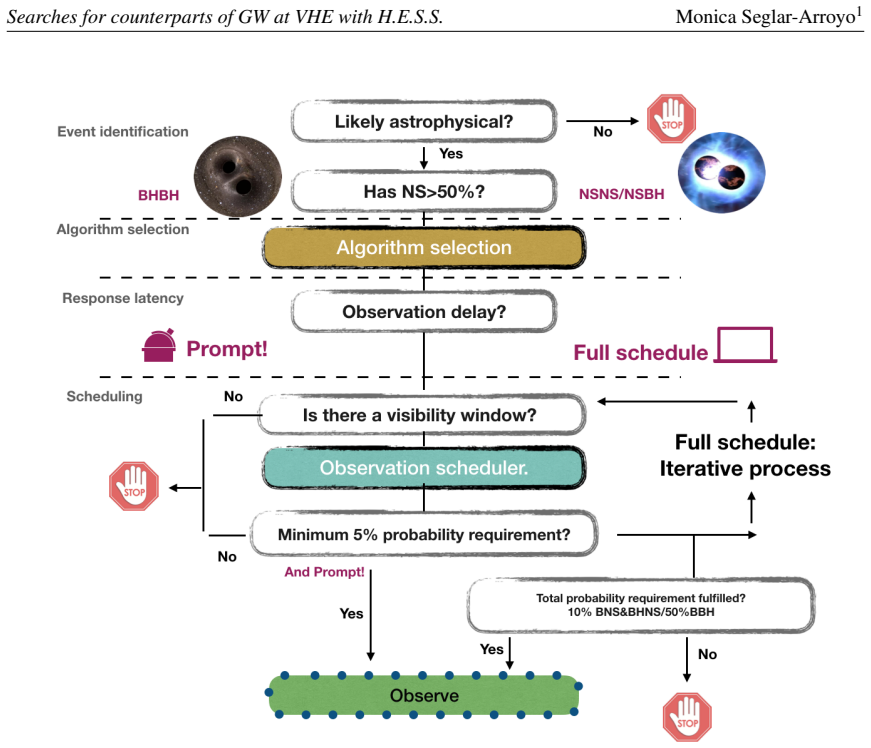
The carrying mechanism is the scheduling engine inside the H.E.S.S. online alert system, named VoAlerter. It converts a gravitational-wave localization into an ordered list of pointings: a 2D algorithm uses the sky probability map directly, while a 3D algorithm combines the distance estimate with the positions of known galaxies. The engine favors low zenith angles so that observations reach the lowest possible energy threshold, a choice justified by the expectation that neutron-star merger counterparts are gamma-ray bursts with soft spectra. For the results quoted here, the analysis uses monoscopic data from the 28-meter telescope to concentrate on low energies, and the flux limits are derived assuming a power-law spectrum $E^{-2}$.
What would settle it
Replay the archived H.E.S.S. pointing and slewing logs for GW170814 or GW170817 against the published gravitational-wave localization maps: if the first pointings do not track the highest-probability regions, or if a future compact-merger counterpart emits a hard-spectrum very-high-energy signal that the scheduler deprioritizes, the strategy's optimality claim would be refuted.
Extended reading notes
Core claim
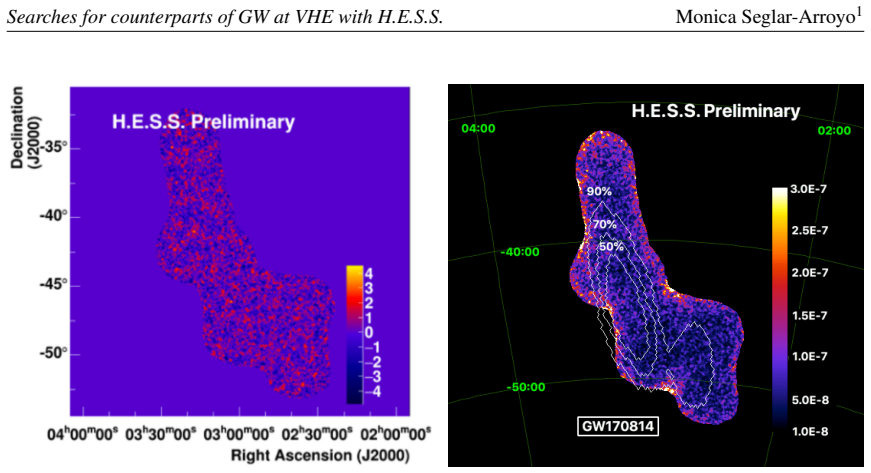
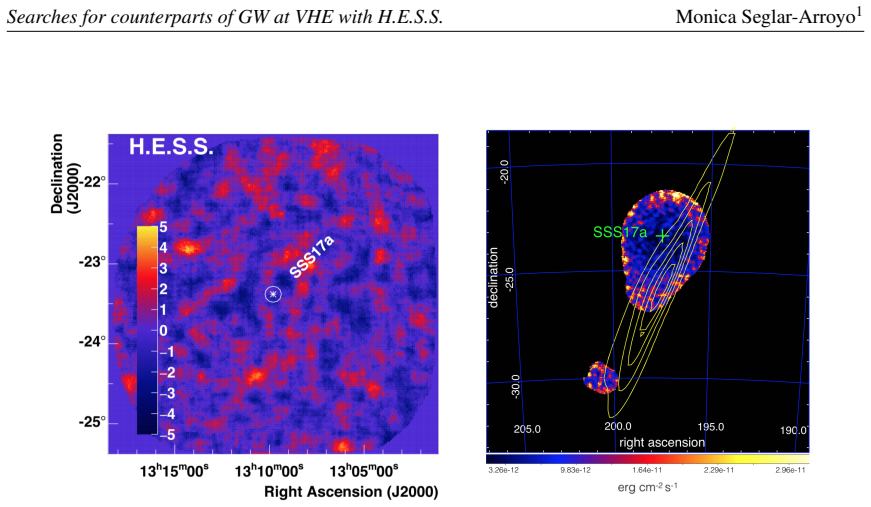
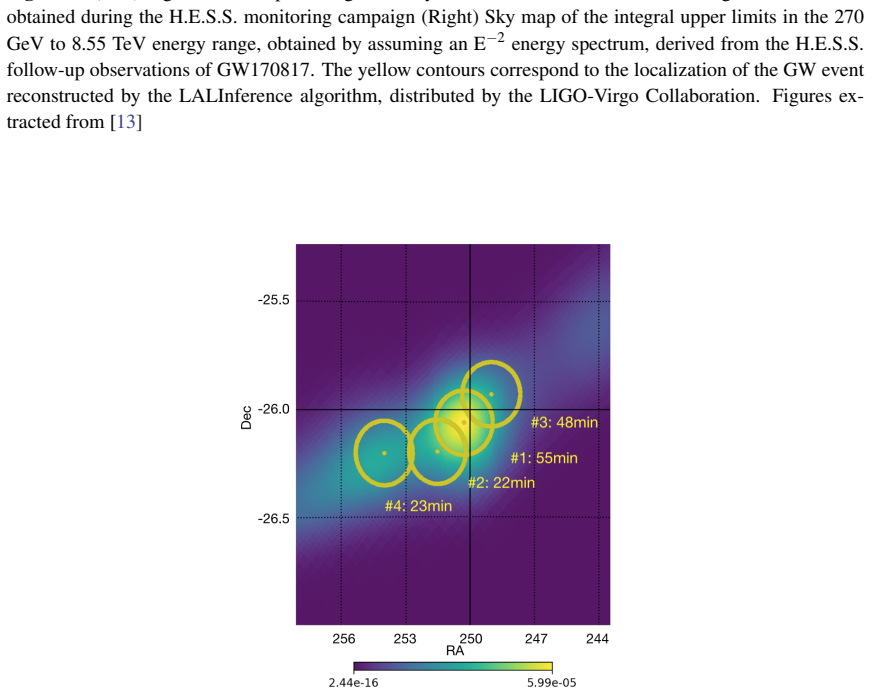
On its own terms, the paper claims that H.E.S.S. now has a working gravitational-wave follow-up chain: the alert system receives a localization, selects a scheduling algorithm, and re-points the telescopes within minutes. The evidence is the O2 campaign, where H.E.S.S. observed about 90% of the final localization region of the binary black hole merger GW170814 over three nights and began observing the neutron star merger GW170817 five minutes after the updated localization was issued. No significant very-high-energy gamma-ray emission was found in either follow-up. The paper therefore presents integral upper limits on the flux between roughly 250 GeV and 10 TeV for GW170814 and between 270 GeV and 8.55 TeV for GW170817, both computed under an assumed $E^{-2}$ power-law spectrum, and it treats a successful O3 trial follow-up of the black hole merger S190512at as confirmation that the alert chain operates under current conditions.
Load-bearing premise
The quantitative limits and the decision to favor low-energy, low-zenith observations both assume that any very-high-energy counterpart to a compact merger has a soft spectrum like $E^{-2}$; if the true spectrum is different, the quoted constraints and pointing priorities may not represent the source.
Editorial extensions
If this is right
- Ground-based gamma-ray observatories can participate in gravitational-wave alerts as prompt responders, with reaction times of minutes rather than hours.
- A single IACT array can cover the dominant part of a gravitational-wave localization; H.E.S.S. reports about 90% coverage of GW170814's final 90% credible region.
- Null detections from well-timed observations turn into quantitative flux upper limits across roughly 250 GeV to 10 TeV, constraining non-thermal emission models of compact mergers.
- The O3 trial on a distant binary black hole merger shows that the same chain functions under current alert conditions, including false-alarm-rate screening.
- Extended monitoring of the GW170817 remnant between 120 and 250 days after merger probes the late-time behavior of the source, beyond the prompt phase.
Reading between the lines
- Editorial inference: the scheduler's optimality claim is testable in hindsight; replaying H.E.S.S. pointing logs against the published localization maps would quantify how much probability is covered per minute compared with unoptimized pointing.
- Editorial inference: because the quoted limits assume $E^{-2}$, the same dataset can in principle be recast for other spectral indices, so the constraint is broader than the single quoted number.
- Editorial inference: the low-zenith priority depends on the soft-spectrum gamma-ray burst picture; a future hard-spectrum counterpart detection would motivate a scheduler that optimizes over multiple spectral hypotheses.
- Editorial inference: with the smaller localization regions expected from future detector networks, the probability-ordered pipeline becomes relatively more efficient, so the demonstrated capability is likely to become more valuable.
Editorial analysis
A structured set of objections, weighed in public.
Referee Report
Summary. The paper describes the very-high-energy (VHE) gravitational-wave follow-up strategy developed for the H.E.S.S. instrument, focusing on the optimized scheduling algorithms and their implementation in the VoAlerter alert system. It reports on the H.E.S.S. observations of the binary black hole merger GW170814 and the binary neutron star merger GW170817 during LIGO/Virgo O2, and of the binary black hole event S190512at during O3. For GW170814, the text states that no significant gamma-ray emission was found and that the observations covered about 90% of the final localization, with integral flux upper limits derived for 250 GeV < E < 10 TeV assuming an E^-2 spectrum. For GW170817, H.E.S.S. began observations five minutes after receiving the updated localization, subsequently monitored the remnant over several nights, and again found no significant VHE emission, with upper limits between 270 GeV and 8.55 TeV assuming an E^-2 spectrum. The S190512at observations are presented as a technical trial of the alert chain. The central claim is that the optimized follow-up strategy was proven successful during O2, demonstrating prompt response and VHE constraints on compact binary mergers.
Significance. If the reported results are taken at face value, the paper demonstrates two things of interest to the multi-messenger community: H.E.S.S. can react to a GW alert within minutes and tile a meaningful fraction of the localization region, and the resulting observations place the first constraints on VHE emission from two O2 mergers. The paper's strengths are that the significance maps and upper limits come from established H.E.S.S. analysis chains (the Model analysis with ImPACT as an independent cross-check), that the quantitative response metrics (five-minute latency, roughly 90% coverage, 11 and 3 observation runs) are concrete and falsifiable, and that the paper explicitly refers to the externally published collaboration analyses [10] and [13] for the underlying results. The scheduling algorithms themselves are not new conceptually but their integration into an operational alert system is a useful practical contribution. The main weakness, as detailed below, is that the quantitative upper limits are under-specified as presented, so the constraints cannot be fully interpreted from this text alone.
major comments (2)
- [Section 4.1 and Figure 4 (Section 4.2)] The integral upper limits quoted for GW170814 (250 GeV < E < 10 TeV) and for GW170817 (270 GeV < E < 8.55 TeV) are presented without stating the confidence level at which they are set and without quoting the systematic uncertainties of the IACT analysis. The text says the limits are derived assuming an E^-2 power-law spectrum, but a reader cannot tell whether these are 95% or 99% credible limits, and Figure 4's caption repeats the spectral assumption without adding the confidence level. Because these limits are the paper's central quantitative constraints on VHE emission, their missing confidence level makes them not independently interpretable; the authors should state the confidence level explicitly and either give the systematic uncertainties or explicitly defer to the full analyses in [10] and [13].
- [Section 4.1] The statement that 'The H.E.S.S. observations cover around 90% of the localisation of the final reconstruction' is not defined or demonstrated quantitatively. It is unclear whether 'coverage' means the fraction of the 90% credible region's area, the fraction of its probability mass, or the fraction of the sky map within the instrument FoVs, and Figure 3 does not show a coverage map or a quantitative overlay. Since this figure is central to the claim that the scheduling strategy was successful, the authors should define the coverage metric and provide the corresponding map or cumulative-probability curve.
minor comments (7)
- [Abstract] The word 'Unverse' in the abstract is a typo for 'Universe'.
- [Section 2] The phrase 'from ∼ 30 GeVs to about 100 TeV' should read 'from ∼ 30 GeV to about 100 TeV'.
- [Section 3.1, visibility constraints] The phrase 'including neither sun light nor moon light, and reduced values of light pollution' is ungrammatical; consider 'including no sunlight or moonlight and low levels of light pollution'.
- [Figure 1 caption] The caption contains the garbled phrase 'orange corresponds illustrates a the minimum angular distance'; it should be rewritten for clarity.
- [Section 4.1] The sentence 'Each of the observations reached a sensitivity of about 20% of the flux from the Crab nebula at 5 sigma' should specify the energy range and the analysis configuration for which this sensitivity is quoted.
- [Section 4.2] The sentence 'More information on the H.E.S.S. results of this follow-up observations' should be 'More information on the H.E.S.S. results of these follow-up observations'.
- [Section 5] The false alarm rate is typeset as '1/16.6 years −1'; it should be '1/16.6 yr^-1' or similar.
Circularity Check
No significant circularity: the paper reports externally published H.E.S.S. analyses and explicitly stated assumptions; the coverage and upper-limit claims are not constructed from their own outputs.
full rationale
This ICRC proceedings is descriptive rather than derivational. The central claims are (i) H.E.S.S. can schedule prompt follow-up and covered ~90% of the final GW170814 localization, and (ii) no significant VHE emission was found, with integral upper limits. Claim (i) is a geometric/scheduling report tied to the LIGO/Virgo localization maps and logged observations, not a fitted prediction. Claim (ii) is quoted from the collaboration's published analyses, cited as [10] (Ashkar et al., arXiv:1906.10426) and [13] (Abdalla et al., ApJ 850), which are externally available analyses rather than premises assumed inside this text. The only quantitative spectral input is the E^-2 power-law assumed for the upper limits (Section 4.1 and Figure 4), which is stated explicitly and motivated by external references [5],[6]; it is not fitted from the H.E.S.S. data and is not used to define the detection. A completeness caveat, not a circularity, is that the proceedings do not state the confidence level or systematics for the quoted upper limits, and the reader must consult [10]/[13] for those details. No step reduces to its own inputs by construction, no fitted parameter is renamed as a prediction, and no self-citation chain is used to forbid alternatives. Hence the circularity score is 0.
Assumptions & free parameters
free parameters (1)
- Assumed photon spectral index for upper limits =
-2 (assumed, not fitted)
assumptions (3)
- domain assumption LIGO/Virgo localization maps (BAYESTAR/LALInference) correctly represent source position and distance probability.
- domain assumption VHE emission from NS-NS mergers is GRB-like with a soft spectrum, motivating low-energy observations.
- domain assumption H.E.S.S. Model and ImPACT reconstruction chains correctly identify gamma-ray showers and estimate event energies and fluxes.
Cite this review
Pith. "Pith review of Searches for counterparts of gravitational waves at very high energies with H.E.S.S." pith.science (2026). https://pith.science/paper/RHP255PB
@misc{pith2026190806705,
  author       = {Pith},
  title        = {Pith review of: Searches for counterparts of gravitational waves at very high energies with H.E.S.S},
  year         = {2026},
  howpublished = {\url{https://pith.science/paper/RHP255PB}},
  note         = {Machine review of arXiv:1908.06705}
}
read the original abstract
The recent milestones in multi-messenger astronomy have opened new ways to study the Unverse. The unprecedented gravitational wave (GW) follow-up campaigns established the power that the combination of different messengers has to identify and study the nature and evolution of astrophysical phenomena. Here we focus on the search for high-energy gamma ray emission as electromagnetic counterpart of compact binary coalescences with the H.E.S.S. Imaging Air Cherenkov Telescopes (IACTs). In this contribution, the optimized strategies developed specifically for the prompt follow-up of gravitational wave events with H.E.S.S are presented. As illustration, the successful observation campaigns up to this time will be described, including the ones during Observation Run O2 on the binary black hole (BH-BH) merger GW170814 and the binary neutron star (NS-NS) merger GW170817, and an update on recent events occurring during O3. Results of these searches are presented and the constraints that prompt observations can put on very-high-energy, non-thermal emission, are briefly discussed. Finally, an outlook on further improvements for the gravitational waves follow-up program with H.E.S.S. will be provided.
Figures

Figures from the paper (2 more)
Reference graph
Works this paper leans on
-
[10]
Ashkar, H. et al. arXiV:1906.10426
work page Pith review arXiv 1906
- [13]
-
[1]
Living Reviews in Relativity, 2018, vol
Abbott, Benjamin P., et al. Living Reviews in Relativity, 2018, vol. 21, no 1, p. 3
work page 2018
-
[2]
Astroparticle Physics 32.5 (2009): 231-252
De Naurois, Mathieu, and Loïc Rolland. Astroparticle Physics 32.5 (2009): 231-252
work page 2009
- [3]
-
[4]
Patricelli, B., Razzano, M., Cella, G., et al., 2018 (figshare)
work page 2018
-
[5]
I., Novikov, I
Blinnikov, S. I., Novikov, I. D., Perevodchikova, T. V ., et al.,1984, Sov. Astron. Lett. , 10, 177-179
1984
- [6]
Show all 17 references
-
[7]
A&A, 2012, vol
Abadie, J., et al. A&A, 2012, vol. 539, p. A124
2012
-
[8]
ApJ, 2016, vol
Singer, Leo P., et al. ApJ, 2016, vol. 829, no 1, p. L15
2016
-
[9]
PRL 119.14 (2017): 141101
Abbott, Benjamin P., et al. PRL 119.14 (2017): 141101
2017
-
[11]
PRL 119.16 (2017): 161101
Abbott, Benjamin P., et al. PRL 119.16 (2017): 161101
2017
-
[12]
P., Price, L
Singer, L. P., Price, L. R., Farr, B., et al. 2014, ApJ 795, 105
2014
-
[14]
Veitch, J., Raymond, V ., Farr, B. et al. 2015, Phys. Rev. D 91, 042003
2015
-
[15]
Rodrigues, Xavier et al. (2019). Astroparticle Physics 106, pp. 10-17
2019
-
[16]
Ohm, S. et al. these proceedings
-
[17]
LIGO Collaboration and Virgo Collaboration, GCN Circular #24503 7
Reviewed August 14, 2026 · model on record in the stance chip above.
Discussion (0). Continue with ORCID to comment.