REVIEW 3 major objections 5 minor 121 references
UV bright red-sequence galaxies: how do UV upturn systems evolve in redshift and stellar mass?
T0 review · 3 major / 5 minor · reviewed 2026-08-14 · deepseek-v4-flash
Pith's one-line read The proportion of UV upturn galaxies among red-sequence galaxies rises with stellar mass and peaks near z≈0.25.
desk verdict A plausible but not secure measurement of UV upturn prevalence among field red-sequence galaxies; the mass trend is the robust part, while the claimed redshift infall and uncorrected selection need work. read the letter →
The pith
A machine-rendered reading of the paper's core claim, the machinery that carries it, and where it could break.
The reading
What carries the argument
The analysis rests on a Bayesian logistic regression for the binary outcome 'UV upturn versus UV weak'. The logit of the probability is modelled as a second-degree polynomial in redshift and stellar mass, with a hierarchical term for WHAN emission-line classes, so the dependence on $z$ and $\log M_\star$ is estimated jointly rather than in bins. The other load-bearing piece is the adopted colour-class cut: $(NUV-r)>5.4$ picks UV-bright red-sequence galaxies, and $(FUV-NUV)<0.9$ with $(FUV-r)<6.6$ separates UV upturn hosts from UV weak ones. Stratifying by WHAN classes (star-forming, strong and weak AGN, retired/passive, unclassified) is what lets the paper attribute the overall trends to quiescent galaxies.
What would settle it
Re-run the same sample and model after applying the paper's own internal-extinction corrections ($A_{\rm FUV}=2.536A_V$, $A_{\rm NUV}=2.045A_V$, $A_r=0.8695A_V$, with $A_V\approx0.2$ for UV weak systems and lower for UV upturn systems) and after adding a term for GALEX FUV detection probability. If the $z\approx0.25$ peak and the rising mass trend in retired/passive galaxies disappear or reverse under these corrections, the central claim fails; if they persist, it would be corroborated.
Extended reading notes
Core claim
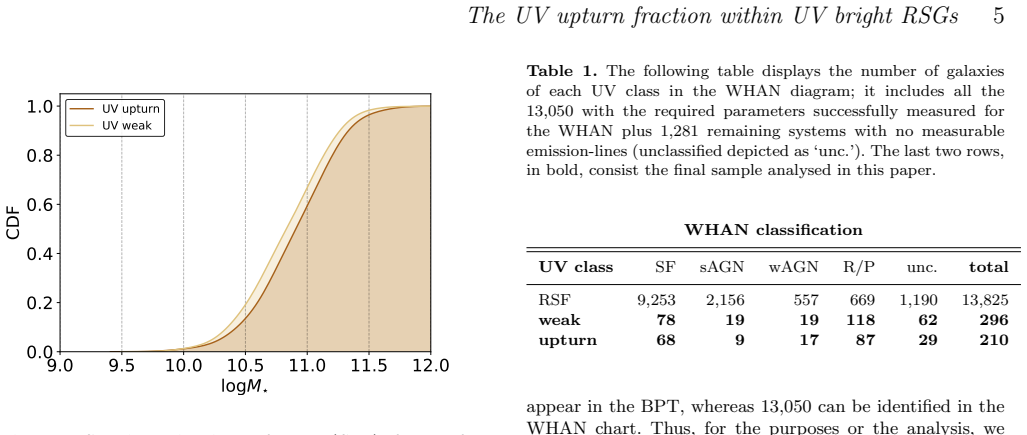
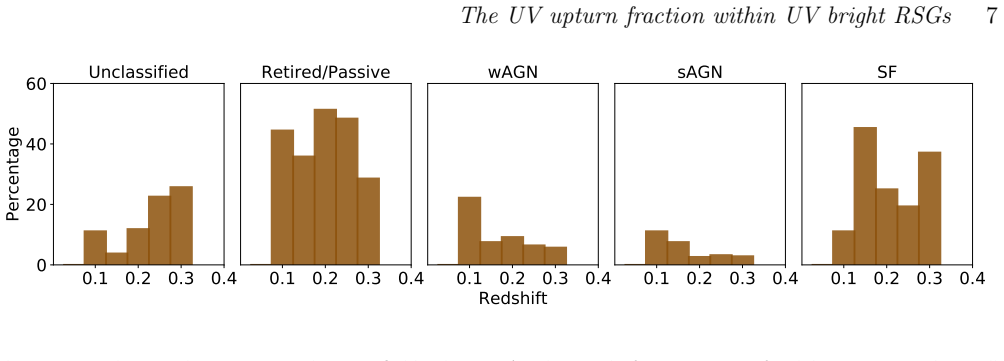
The central claim is that the probability that a UV-bright red-sequence galaxy manifests the UV upturn is not constant: it depends on both stellar mass and redshift, and the cleanest, most statistically reliable trend is in retired/passive (quiescent, lineless) systems. In those systems the upturn fraction increases with stellar mass over roughly $\log M_\star \approx 10$–$11.5$ and, in redshift, rises to a maximum around $z\approx0.20$–$0.25$ before declining out to $z\approx0.35$; the paper states that this decline is clearly seen. Broadly, the same shape appears in the runs without emission-line stratification, while star-forming and unclassified galaxies show weaker or less certain trends, and weak/strong AGN classes are too scarce and boundary-affected to support a claim. The authors also report that the photometric criteria they use are robust against bona fide AGN contamination, and that even within a volume-limited subsample the same qualitative trends survive.
Load-bearing premise
The claim stands or falls on the assumption that the adopted colour cuts, applied to k-corrected GALEX/SDSS photometry without correcting for each galaxy's own dust, correctly separate true UV upturn galaxies from UV weak ones at every redshift and mass, and that FUV detection does not selectively exclude red-sequence galaxies.
Editorial extensions
If this is right
- If the rising-with-mass trend is real, the UV upturn is more frequent in more massive quiescent galaxies, which points toward hot evolved stellar populations becoming more prominent in deep potential wells.
- The redshift peak near $z\approx0.20$–$0.25$ implies the occurrence rate of the UV upturn within UV-bright red-sequence galaxies changes over a lookback time of roughly 2.5–3 Gyr, so it is an evolutionary quantity, not a fixed galaxy property.
- The absence of a reliable trend for weak and strong AGN classes means the adopted UV classification is not being driven by AGN activity; any explanation of the UV upturn does not need an AGN component.
- The paper's fractions are likely underestimated, not overestimated, if internal extinction is corrected for, because more UV weak systems migrate into the UV upturn class than leave it.
Reading between the lines
- Beyond the paper, one testable extension is to replace stellar mass with central velocity dispersion in the same logistic model; if the mass trend is really about the depth of the potential well, the dispersion version should show a tighter or steeper relation than seen here.
- The redshift peak could partly reflect GALEX MIS depth and large UV k-corrections; a direct check is to repeat the analysis with a sample from the deeper GALEX DIS fields, where FUV detectability is higher at fixed $z$ and mass.
- The analysis only covers UV-bright red-sequence galaxies. The same Bayesian machinery applied to the full red sequence, including FUV non-detections modelled through survival analysis or a detection-probability term, would tell whether the reported trends hold for the whole quiescent population or only the UV-bright tail.
- If the in-fall after $z\approx0.25$ is physical, it would predict that the hot stellar populations responsible for the upturn were more common or hotter at lookback times of roughly 3 Gyr; a stellar-population synthesis model with an evolving fraction of extreme horizontal branch stars could be fit to the observed fractions to quantify that evolution.
Signed reviews
Editorial analysis
A structured set of objections, weighed in public.
Referee Report
Summary. The paper estimates the incidence of UV upturn among UV-bright red-sequence galaxies (RSGs) selected from GAMA-DR3 with GALEX MIS and SDSS photometry, using the Yi et al. (2011) colour criteria and WHAN emission-line classifications. A Bayesian logistic regression models the probability that a UV-bright RSG is classed as UV upturn as a quadratic function of redshift and stellar mass, with a second version stratified by emission-line class. The main claims are that the UV-upturn fraction rises with stellar mass, particularly for retired/passive systems, and that for retired/passive systems the fraction rises with redshift up to z ~ 0.20-0.25 and then declines.
Significance. If the trends are real, the paper provides a statistically framed measurement of how UV-upturn incidence depends on stellar mass and redshift among quiescent UV-bright galaxies, complementing cluster-based studies such as Ali et al. (2018c). The analysis is transparent in its use of public GAMA/GALEX/SDSS data, makes the statistical model explicit, and includes supplementary material: a volume-limited subsample and a discussion of internal-extinction effects. These strengths make the paper a potentially useful contribution to the study of evolved stellar populations in early-type galaxies. However, the central claims rest on the assumption that the FUV-detection-based sample is not biased by UV class in a redshift- or mass-dependent way, and this assumption is not tested; the paper itself also hedges the post-peak decline in Sec. 5.1 while asserting it clearly in the abstract and conclusions.
major comments (3)
- [§2.4, §5.1, Appendix C] The sample requires FUV detection in GALEX MIS, while the UV-upturn class is defined by bluer (FUV-NUV) and hence brighter FUV at fixed r and NUV. At higher redshift, the apparent FUV flux limit removes UV-weak galaxies preferentially, which would inflate the estimated UV-upturn fraction. Including log M* in the logistic regression does not correct for this because the selection is in FUV apparent magnitude, not in stellar mass. The volume-limited test in Appendix C cuts on M_r rather than absolute FUV magnitude, so it does not remove the bias. The paper should either model the FUV detection probability as a function of redshift, magnitude, and colour, or restrict the analysis to a region of absolute FUV magnitude where the sample is complete, and then re-fit the logistic model.
- [§5.1 versus Summary & Conclusions, point 5] There is an internal inconsistency about the post-peak redshift trend. Section 5.1 states that 'one cannot safely affirm whether the probability decreases, increases, or plateaus' after the peak, but the abstract and the conclusions state that an in-fall 'can be clearly seen'. The conclusions should be reworded to match the stated statistical uncertainty, or the authors should provide an additional test (e.g., a comparison of model evidence for a declining versus a plateauing trend) that supports the stronger claim.
- [Appendix A2.2, Eq. (A2)] Internal extinction is not corrected, and the paper's own estimate is that roughly 30 per cent of UV-weak systems would migrate to another UV class and about 6 per cent of UV-upturn systems would migrate out if extinction were accounted for. Since the UV class is the binary response variable in the logistic regression, this level of classification migration can directly change the fitted fraction surface. The paper does not show that the migration is symmetric in redshift and stellar mass; if it is not, the claimed mass and redshift trends could be partly driven by misclassification. A robustness test using extinction-corrected classifications, or explicitly propagating the classification uncertainty into the regression, is needed before the central trends can be considered secure.
minor comments (5)
- [§2.1] There is a typo: 'restrictions on the quality ofz measurements ware taken into account' should read 'were taken into account'.
- [§3.1] The text says the WHAN diagram 'segragates' galaxies into five groups; 'segregates' is meant.
- [§6.2] The phrase 'one must consider the a few issues' contains a stray article and should be edited.
- [Fig. 6 and Fig. 7] The bar charts display fractions without error bars or credible intervals. Given the small counts in the highest-redshift bins, adding Poisson or binomial error bars would help the reader judge the significance of the apparent trends.
- [Appendix C] The text says the volume-limited subsample shows 'very similar trends' to Figs. 9 and 10, but it would be useful to state explicitly whether the peak redshift and the mass-dependence slope are consistent within the credible intervals, rather than only visually similar.
Circularity Check
No significant circularity: the UV-upturn fraction is an externally defined photometric class regressed on redshift and stellar mass, and the reported trends are empirical fits rather than derivations from their own inputs.
full rationale
The paper is an observational statistical analysis, not a first-principles derivation. The response variable is defined by the external Yi et al. (2011) colour cuts applied to GALEX/SDSS photometry, and the predictors are redshift, stellar mass, and WHAN emission-line class. The Bayesian logistic regression is explicitly fitted to the observed sample to estimate the probability that a UV-bright red-sequence galaxy is classified as UV upturn; these estimates are then presented as trends, not as independent predictions. No equation defines the inputs in terms of the output, and the classification is not derived from the fitted fractions. The only self-citations (De Souza et al. 2015, 2016, 2017) are used for methodological motivation and for the interpretation of LINERs as weak AGN; they are not load-bearing for the central mass or redshift results, and no uniqueness theorem or ansatz is imported from the authors' prior work. The paper's own caveats about the FUV detection limit, internal extinction, and the widened credible intervals after the inferred peak (Sec. 5.1, Sec. 2.4, Appendix A2.2) are selection-systematic and robustness limitations, not circularity: they weaken external validity but do not make the fitted fractions equivalent to the inputs by construction. The volume-limited Appendix C check is a robustness test, not a prediction drawn from the same fitted parameters in a way that would force the conclusion. Therefore no self-definitional, fitted-input-as-prediction, or self-citation-chain reduction is present, and the derivation chain is self-contained relative to its stated empirical goal.
Assumptions & free parameters
free parameters (1)
- Logistic regression coefficients per class (intercept, log M*, log M*^2, z, z^2) =
Posterior values not tabulated
assumptions (7)
- domain assumption Yi et al. (2011) colour cuts classify UV upturn and UV weak galaxies reliably.
- domain assumption The GAMA/GALEX/SDSS matched sample, selected by FUV and NUV detection, is representative of UV-bright red-sequence galaxies.
- domain assumption GAMA k-corrections are accurate in the UV.
- domain assumption Internal extinction is small enough not to alter the conclusions.
- domain assumption Stellar masses from Taylor et al. (2011) are accurate and complete enough for the regression.
- ad hoc to paper Second-degree polynomial in z and log M* is the correct functional form.
- standard math Bernoulli/logistic regression with Normal(0,10) priors and HMC convergence is adequate.
Cite this review
Pith. "Pith review of UV bright red-sequence galaxies: how do UV upturn systems evolve in redshift and stellar mass?." pith.science (2026). https://pith.science/paper/6L6Z62QG
@misc{pith2026190806775,
  author       = {Pith},
  title        = {Pith review of: UV bright red-sequence galaxies: how do UV upturn systems evolve in redshift and stellar mass?},
  year         = {2026},
  howpublished = {\url{https://pith.science/paper/6L6Z62QG}},
  note         = {Machine review of arXiv:1908.06775}
}
read the original abstract
The so-called ultraviolet (UV) upturn of elliptical galaxies is a phenomenon characterised by the up-rise of their fluxes in bluer wavelengths, typically in the 1,200-2,500A range. This work aims at estimating the rate of occurrence of the UV upturn over the entire red-sequence population of galaxies that show significant UV emission. This assessment is made considering it as function of three parameters: redshift, stellar mass, and -- what may seem counter-intuitive at first -- emission-line classification. We built a multiwavelength spectro-photometric catalogue from the Galaxy Mass Assembly survey, together with aperture-matched data from Galaxy Evolution Explorer Medium-Depth Imaging Survey (MIS) and Sloan Digital Sky Survey, covering the redshift range between 0.06 and 0.40. From this sample, we analyse the UV emission among UV bright galaxies, by selecting those that occupy the red-sequence locus in the (NUV-r) x (FUV-NUV) chart; then, we stratify the sample by their emission-line classes. To that end, we make use of emission-line diagnostic diagrams, focusing the analysis in retired/passive lineless galaxies. Then, a Bayesian logistic model was built to simultaneously deal with the effects of all galaxy properties (including emission-line classification or lack thereof). The main results show that retired/passive systems host an up-rise in the fraction of UV upturn or redshifts between 0.06 and 0.25, followed by an in-fall up to 0.35. Additionally, we show that the fraction of UV upturn hosts rises with increasing stellar mass.
Figures


Figures from the paper (9 more)




Reference graph
Works this paper leans on
-
[1]
write newline
" write newline "" before.all 'output.state := FUNCTION fin.entry write newline FUNCTION new.block output.state before.all = 'skip after.block 'output.state := if FUNCTION new.sentence output.state after.block = 'skip output.state before.all = 'skip after.sentence 'output.state := if if FUNCTION not #0 #1 if FUNCTION and 'skip pop #0 if FUNCTION or pop #1...
-
[2]
write newline
" write newline "" before.all 'output.state := FUNCTION fin.entry write newline FUNCTION new.block output.state before.all = 'skip after.block 'output.state := if FUNCTION new.sentence output.state after.block = 'skip output.state before.all = 'skip after.sentence 'output.state := if if FUNCTION not #0 #1 if FUNCTION and 'skip pop #0 if FUNCTION or pop #1...
-
[3]
Abazajian K. N., et al., 2009, @doi [ ] 10.1088/0067-0049/182/2/543 , http://adsabs.harvard.edu/abs/2009ApJS..182..543A 182, 543
-
[4]
Ali S. S., Bremer M. N., Phillipps S., De Propris R., 2018a, @doi [ ] 10.1093/mnras/sty227 , https://ui.adsabs.harvard.edu/\#abs/2018MNRAS.476.1010A 476, 1010
-
[5]
Ali S. S., Bremer M. N., Phillipps S., De Propris R., 2018b, @doi [ ] 10.1093/mnras/sty1160 , https://ui.adsabs.harvard.edu/\#abs/2018MNRAS.478..541A 478, 541
-
[6]
Ali S. S., Bremer M. N., Phillipps S., De Propris R., 2018c, @doi [ ] 10.1093/mnras/sty1988 , https://ui.adsabs.harvard.edu/\#abs/2018MNRAS.480.2236A 480, 2236
-
[7]
Ali S. S., Bremer M. N., Phillipps S., De Propris R., 2019, @doi [Monthly Notices of the Royal Astronomical Society] 10.1093/mnras/stz1502 , 487, 3021
-
[8]
Antonucci R., 1993, @doi [Annual Review of Astronomy and Astrophysics] 10.1146/annurev.aa.31.090193.002353 , https://ui.adsabs.harvard.edu/\#abs/1993ARA&A..31..473A 31, 473
arXiv 1993
Show all 121 references
-
[9]
Astropy Collaboration et al., 2013, @doi [ ] 10.1051/0004-6361/201322068 , http://adsabs.harvard.edu/abs/2013A
2013 doi
-
[10]
K., et al., 2018, @doi [ ] 10.1093/mnras/stx3042 , http://adsabs.harvard.edu/abs/2018MNRAS.474.3875B 474, 3875
Baldry I. K., et al., 2018, @doi [ ] 10.1093/mnras/stx3042 , http://adsabs.harvard.edu/abs/2018MNRAS.474.3875B 474, 3875
2018 doi
-
[11]
A., Phillips M
Baldwin J. A., Phillips M. M., Terlevich R., 1981, @doi [ ] 10.1086/130766 , http://adsabs.harvard.edu/abs/1981PASP...93....5B 93, 5
1981 doi
-
[12]
E., 1988, @doi [ ] 10.1086/166593 , https://ui.adsabs.harvard.edu/\#abs/1988ApJ...331..699B 331, 699
Barnes J. E., 1988, @doi [ ] 10.1086/166593 , https://ui.adsabs.harvard.edu/\#abs/1988ApJ...331..699B 331, 699
1988 doi
-
[13]
S., Csabai I., 2016, @doi [ ] 10.1093/mnras/stv2986 , https://ui.adsabs.harvard.edu/\#abs/2016MNRAS.457..362B 457, 362
Beck R., Dobos L., Yip C.-W., Szalay A. S., Csabai I., 2016, @doi [ ] 10.1093/mnras/stv2986 , https://ui.adsabs.harvard.edu/\#abs/2016MNRAS.457..362B 457, 362
2016 doi
-
[14]
Belfiore F., et al., 2016, @doi [ ] 10.1093/mnras/stw1234 , https://ui.adsabs.harvard.edu/\#abs/2016MNRAS.461.3111B 461, 3111
2016 doi
-
[15]
arXiv:1403.5237
Benitez N., et al., 2014, arXiv e-prints, https://ui.adsabs.harvard.edu/\#abs/2014arXiv1403.5237B p. arXiv:1403.5237
2014 arXiv
-
[16]
M., 2014, @doi [ ] 10.1007/s10509-014-1973-0 , https://ui.adsabs.harvard.edu/abs/2014Ap&SS.354...83B 354, 83
Bettoni D., Mazzei P., Rampazzo R., Marino A., Galletta G., Buson L. M., 2014, @doi [ ] 10.1007/s10509-014-1973-0 , https://ui.adsabs.harvard.edu/abs/2014Ap&SS.354...83B 354, 83
2014 doi
-
[17]
Bianchi L., 2014, @doi [ ] 10.1007/s10509-014-1935-6 , http://adsabs.harvard.edu/abs/2014Ap
2014 doi
-
[18]
R., Roweis S., 2007, @doi [ ] 10.1086/510127 , http://adsabs.harvard.edu/abs/2007AJ....133..734B 133, 734
Blanton M. R., Roweis S., 2007, @doi [ ] 10.1086/510127 , http://adsabs.harvard.edu/abs/2007AJ....133..734B 133, 734
2007 doi
-
[19]
Boissier S., Cucciati O., Boselli A., Mei S., Ferrarese L., 2018, @doi [ ] 10.1051/0004-6361/201731795 , https://ui.adsabs.harvard.edu/\#abs/2018A&A...611A..42B 611, A42
2018 doi
-
[20]
Chapman & Hall/CRC Handbooks of Modern Statistical Methods, CRC Press, https://books.google.es/books?id=qfRsAIKZ4rIC
Brooks S., Gelman A., Jones G., Meng X., 2011, Handbook of Markov Chain Monte Carlo. Chapman & Hall/CRC Handbooks of Modern Statistical Methods, CRC Press, https://books.google.es/books?id=qfRsAIKZ4rIC
2011
-
[21]
M., 1999, in Hubeny I., Heap S., Cornett R., eds, Astronomical Society of the Pacific Conference Series Vol
Brown T. M., 1999, in Hubeny I., Heap S., Cornett R., eds, Astronomical Society of the Pacific Conference Series Vol. 192, Spectrophotometric Dating of Stars and Galaxies. p. 315 ( @eprint astro-ph/9905377 )
1999 arXiv
-
[22]
M., 2004, @doi [Astrophysics and Space Science] 10.1023/B:ASTR.0000044324.60467.d2 , 291, 215
Brown T. M., 2004, @doi [Astrophysics and Space Science] 10.1023/B:ASTR.0000044324.60467.d2 , 291, 215
2004
-
[23]
M., Ferguson H
Brown T. M., Ferguson H. C., Stanford S. A., Deharveng J.-M., 1998, @doi [ ] 10.1086/306079 , http://adsabs.harvard.edu/abs/1998ApJ...504..113B 504, 113
1998 doi
-
[24]
M., Bowers C
Brown T. M., Bowers C. W., Kimble R. A., Sweigart A. V., Ferguson H. C., 2000, @doi [ ] 10.1086/308566 , http://adsabs.harvard.edu/abs/2000ApJ...532..308B 532, 308
2000 doi
-
[25]
Bruzual G., Charlot S., 2003, @doi [ ] 10.1046/j.1365-8711.2003.06897.x , https://ui.adsabs.harvard.edu/\#abs/2003MNRAS.344.1000B 344, 1000
2003
-
[26]
M., Faber S
Burstein D., Bertola F., Buson L. M., Faber S. M., Lauer T. R., 1988, @doi [ ] 10.1086/166304 , https://ui.adsabs.harvard.edu/\#abs/1988ApJ...328..440B 328, 440
1988 doi
-
[27]
C., Kinney A
Calzetti D., Armus L., Bohlin R. C., Kinney A. L., Koornneef J., Storchi-Bergmann T., 2000, @doi [ ] 10.1086/308692 , https://ui.adsabs.harvard.edu/abs/2000ApJ...533..682C 533, 682
2000 doi
-
[28]
A., Clayton G
Cardelli J. A., Clayton G. C., Mathis J. S., 1989, @doi [ ] 10.1086/167900 , https://ui.adsabs.harvard.edu/abs/1989ApJ...345..245C 345, 245
1989 doi
-
[29]
Carpenter B., et al., 2017, @doi [Journal of Statistical Software] 10.18637/jss.v076.i01 , 76
2017 doi
-
[30]
Chabrier G., 2003, @doi [ ] 10.1086/376392 , https://ui.adsabs.harvard.edu/abs/2003PASP..115..763C 115, 763
2003 doi
-
[31]
Chung C., Yoon S.-J., Lee Y.-W., 2017, @doi [ ] 10.3847/1538-4357/aa6f19 , https://ui.adsabs.harvard.edu/\#abs/2017ApJ...842...91C 842, 91
2017 doi
-
[32]
L., Vieira da Silva Jr
Cid Fernandes R., Sodr \'e Jr. L., Vieira da Silva Jr. L., 2000, @doi [ ] 10.1086/317207 , http://adsabs.harvard.edu/abs/2000ApJ...544..123C 544, 123
2000 doi
-
[35]
D., 1969, @doi [Publications of the Astronomical Society of the Pacific] 10.1086/128809 , https://ui.adsabs.harvard.edu/\#abs/1969PASP...81..475C 81, 475
Code A. D., 1969, @doi [Publications of the Astronomical Society of the Pacific] 10.1086/128809 , https://ui.adsabs.harvard.edu/\#abs/1969PASP...81..475C 81, 475
1969 doi
-
[36]
D., Welch G
Code A. D., Welch G. A., 1979, @doi [ ] 10.1086/156825 , https://ui.adsabs.harvard.edu/\#abs/1979ApJ...228...95C 228, 95
1979 doi
-
[38]
Da Cunha E., Charlot S., Elbaz D., 2008, @doi [ ] 10.1111/j.1365-2966.2008.13535.x , https://ui.adsabs.harvard.edu/abs/2008MNRAS.388.1595D 388, 1595
2008
-
[39]
I., et al., 2019, @doi [ ] 10.1051/0004-6361/201935547 , https://ui.adsabs.harvard.edu/abs/2019A&A...626A..63D 626, A63
Davies J. I., et al., 2019, @doi [ ] 10.1051/0004-6361/201935547 , https://ui.adsabs.harvard.edu/abs/2019A&A...626A..63D 626, A63
2019 doi
-
[40]
A., et al., 2015, @doi [ ] 10.1093/mnras/stv597 , http://adsabs.harvard.edu/abs/2015MNRAS.449.3503D 449, 3503
Davis T. A., et al., 2015, @doi [ ] 10.1093/mnras/stv597 , http://adsabs.harvard.edu/abs/2015MNRAS.449.3503D 449, 3503
2015 doi
-
[42]
De Meulenaer P., Narbutis D., Mineikis T., Vansevi c ius V., 2013, @doi [ ] 10.1051/0004-6361/201220674 , https://ui.adsabs.harvard.edu/abs/2013A&A...550A..20D 550, A20
2013 doi
-
[43]
S., et al., 2015, @doi [Astronomy and Computing] http://dx.doi.org/10.1016/j.ascom.2015.04.002 , 12, 21
De Souza R. S., et al., 2015, @doi [Astronomy and Computing] http://dx.doi.org/10.1016/j.ascom.2015.04.002 , 12, 21
2015 doi
-
[44]
S., et al., 2016, @doi [ ] 10.1093/mnras/stw1459 , http://adsabs.harvard.edu/abs/2016MNRAS.461.2115D 461, 2115
De Souza R. S., et al., 2016, @doi [ ] 10.1093/mnras/stw1459 , http://adsabs.harvard.edu/abs/2016MNRAS.461.2115D 461, 2115
2016 doi
-
[45]
S., et al., 2017, @doi [ ] 10.1093/mnras/stx2156 , http://adsabs.harvard.edu/abs/2017MNRAS.472.2808D 472, 2808
De Souza R. S., et al., 2017, @doi [ ] 10.1093/mnras/stx2156 , http://adsabs.harvard.edu/abs/2017MNRAS.472.2808D 472, 2808
2017 doi
-
[46]
Deharveng J.-M., Boselli A., Donas J., 2002, @doi [AeA] 10.1051/0004-6361:20021082 , http://adsabs.harvard.edu/abs/2002A
2002 doi
-
[47]
Doi M., et al., 2010, @doi [ ] 10.1088/0004-6256/139/4/1628 , http://adsabs.harvard.edu/abs/2010AJ....139.1628D 139, 1628
2010 doi
-
[48]
Donahue M., et al., 2010, @doi [ ] 10.1088/0004-637X/715/2/881 , http://adsabs.harvard.edu/abs/2010ApJ...715..881D 715, 881
2010 doi
-
[49]
T., O'Connell R
Dorman B., Rood R. T., O'Connell R. W., 1993, @doi [ ] 10.1086/173511 , https://ui.adsabs.harvard.edu/\#abs/1993ApJ...419..596D 419, 596
1993 doi
-
[50]
Elitzur M., Shlosman I., 2006, @doi [ ] 10.1086/508158 , https://ui.adsabs.harvard.edu/abs/2006ApJ...648L.101E 648, L101
2006 doi
-
[51]
C., Davidsen A
Ferguson H. C., Davidsen A. F., 1993, @doi [ ] 10.1086/172572 , http://adsabs.harvard.edu/abs/1993ApJ...408...92F 408, 92
1993 doi
-
[52]
L., 1999, @doi [ ] 10.1086/316293 , http://adsabs.harvard.edu/abs/1999PASP..111...63F 111, 63
Fitzpatrick E. L., 1999, @doi [ ] 10.1086/316293 , http://adsabs.harvard.edu/abs/1999PASP..111...63F 111, 63
1999 doi
-
[53]
B., 1992, @doi [Statist
Gelman A., Rubin D. B., 1992, @doi [Statist. Sci.] 10.1214/ss/1177011136 , 7, 457
1992
-
[54]
Gil de Paz A., et al., 2007, @doi [ ] 10.1086/516636 , http://adsabs.harvard.edu/abs/2007ApJS..173..185G 173, 185
2007 doi
-
[55]
Greggio L., Renzini A., 1990, @doi [ ] 10.1086/169384 , http://adsabs.harvard.edu/abs/1990ApJ...364...35G 364, 35
1990 doi
-
[56]
Greggio L., Renzini A., 1999, , http://adsabs.harvard.edu/abs/1999MmSAI..70..691G 70, 691
1999
-
[57]
H., S \'a nchez S
Haines T., McIntosh D. H., S \'a nchez S. F., Tremonti C., Rudnick G., 2015, @doi [ ] 10.1093/mnras/stv989 , http://adsabs.harvard.edu/abs/2015MNRAS.451..433H 451, 433
2015 doi
-
[59]
Heinis S., et al., 2016, @doi [ ] 10.3847/0004-637X/826/1/62 , https://ui.adsabs.harvard.edu/\#abs/2016ApJ...826...62H 826, 62
2016 doi
-
[60]
Hern \' a ndez-P \' e rez F., Bruzual G., 2014, @doi [Monthly Notices of the Royal Astronomical Society] 10.1093/mnras/stu1627 , 444, 2571
2014 doi
-
[61]
Herpich F., Stasi \'n ska G., Mateus A., Vale Asari N., Cid Fernandes R., 2018, @doi [ ] 10.1093/mnras/sty2391 , http://adsabs.harvard.edu/abs/2018MNRAS.481.1774H 481, 1774
2018 doi
-
[62]
Cambridge University Press, https://books.google.com.br/books?id=7D2wDgAAQBAJ
Hilbe J., de Souza R., Ishida E., 2017, Bayesian Models for Astrophysical Data: Using R, JAGS, Python, and Stan. Cambridge University Press, https://books.google.com.br/books?id=7D2wDgAAQBAJ
2017
-
[63]
M., et al., 2013, @doi [ ] 10.1093/mnras/stt030 , https://ui.adsabs.harvard.edu/\#abs/2013MNRAS.430.2047H 430, 2047
Hopkins A. M., et al., 2013, @doi [ ] 10.1093/mnras/stt030 , https://ui.adsabs.harvard.edu/\#abs/2013MNRAS.430.2047H 430, 2047
2013 doi
-
[64]
P., 1926, @doi [ ] 10.1086/143018 , https://ui.adsabs.harvard.edu/\#abs/1926ApJ....64..321H 64, 321
Hubble E. P., 1926, @doi [ ] 10.1086/143018 , https://ui.adsabs.harvard.edu/\#abs/1926ApJ....64..321H 64, 321
1926 doi
-
[65]
K., Malkan M
Hunt L. K., Malkan M. A., 1999, @doi [The Astrophysical Journal] 10.1086/307150 , 516, 660
1999 doi
-
[66]
Kauffmann G., et al., 2003, @doi [ ] 10.1111/j.1365-2966.2003.07154.x , http://adsabs.harvard.edu/abs/2003MNRAS.346.1055K 346, 1055
2003
-
[67]
Kennicutt Jr. R. C., 1998, @doi [ ] 10.1146/annurev.astro.36.1.189 , http://adsabs.harvard.edu/abs/1998ARA26A..36..189K 36, 189
1998 doi
-
[68]
J., Dopita M
Kewley L. J., Dopita M. A., Sutherland R. S., Heisler C. A., Trevena J., 2001, @doi [ ] 10.1086/321545 , http://adsabs.harvard.edu/abs/2001ApJ...556..121K 556, 121
2001 doi
-
[69]
G., 2016, @doi [ ] 10.1093/mnras/stw1024 , http://adsabs.harvard.edu/abs/2016MNRAS.461..766L 461, 766
Le Cras C., Maraston C., Thomas D., York D. G., 2016, @doi [ ] 10.1093/mnras/stw1024 , http://adsabs.harvard.edu/abs/2016MNRAS.461..766L 461, 766
2016 doi
-
[70]
Lee Y.-W., et al., 2005, @doi [ ] 10.1086/428944 , http://adsabs.harvard.edu/abs/2005ApJ...621L..57L 621, L57
2005 doi
-
[71]
Liske J., et al., 2015, @doi [ ] 10.1093/mnras/stv1436 , http://adsabs.harvard.edu/abs/2015MNRAS.452.2087L 452, 2087
2015 doi
-
[72]
L \'o pez-Corredoira M., Vazdekis A., 2018, @doi [ ] 10.1051/0004-6361/201731647 , https://ui.adsabs.harvard.edu/\#abs/2018A&A...614A.127L 614, A127
2018 doi
-
[73]
I., Sánchez-Blázquez P., 2011, @doi [Monthly Notices of the Royal Astronomical Society] 10.1111/j.1365-2966.2010.17666.x , 410, 2679
Loubser S. I., Sánchez-Blázquez P., 2011, @doi [Monthly Notices of the Royal Astronomical Society] 10.1111/j.1365-2966.2010.17666.x , 410, 2679
2011
-
[74]
A., 2015, @doi [ ] 10.1051/0004-6361/201323152 , http://adsabs.harvard.edu/abs/2015A
Luridiana V., Morisset C., Shaw R. A., 2015, @doi [ ] 10.1051/0004-6361/201323152 , http://adsabs.harvard.edu/abs/2015A
2015 doi
-
[75]
Madau P., Dickinson M., 2014, @doi [Annual Review of Astronomy and Astrophysics] 10.1146/annurev-astro-081811-125615 , 52, 415
2014 doi
-
[76]
C., Dickinson M
Madau P., Ferguson H. C., Dickinson M. E., Giavalisco M., Steidel C. C., Fruchter A., 1996, @doi [ ] 10.1093/mnras/283.4.1388 , https://ui.adsabs.harvard.edu/abs/1996MNRAS.283.1388M 283, 1388
1996 doi
-
[77]
G., 1922, Meddelanden fran Lunds Astronomiska Observatorium Serie I, http://adsabs.harvard.edu/abs/1922MeLuF.100....1M 100, 1
Malmquist K. G., 1922, Meddelanden fran Lunds Astronomiska Observatorium Serie I, http://adsabs.harvard.edu/abs/1922MeLuF.100....1M 100, 1
1922
-
[78]
Maraston C., 2005, @doi [ ] 10.1111/j.1365-2966.2005.09270.x , http://adsabs.harvard.edu/abs/2005MNRAS.362..799M 362, 799
2005
-
[79]
C., et al., 2005, @doi [The Astrophysical Journal] 10.1086/426387 , 619, L1
Martin D. C., et al., 2005, @doi [The Astrophysical Journal] 10.1086/426387 , 619, L1
2005 doi
-
[80]
Mendes de Oliveira C., et al., 2019, @doi [Monthly Notices of the Royal Astronomical Society] 10.1093/mnras/stz1985
2019 doi
-
[81]
Morrissey P., et al., 2007, @doi [ ] 10.1086/520512 , https://ui.adsabs.harvard.edu/abs/2007ApJS..173..682M 173, 682
2007 doi
-
[82]
Naab T., et al., 2014, @doi [Monthly Notices of the Royal Astronomical Society] 10.1093/mnras/stt1919 , 444, 3357
2014 doi
-
[83]
Netzer H., 2015, @doi [ ] 10.1146/annurev-astro-082214-122302 , https://ui.adsabs.harvard.edu/abs/2015ARA&A..53..365N 53, 365
2015 doi
-
[84]
W., 1999, @doi [ ] 10.1146/annurev.astro.37.1.603 , http://adsabs.harvard.edu/abs/1999ARA
O'Connell R. W., 1999, @doi [ ] 10.1146/annurev.astro.37.1.603 , http://adsabs.harvard.edu/abs/1999ARA
1999 doi
-
[85]
G., et al., 1998, @doi [ ] 10.1086/311605 , http://adsabs.harvard.edu/abs/1998ApJ...505L..11O 505, L11
Ohl R. G., et al., 1998, @doi [ ] 10.1086/311605 , http://adsabs.harvard.edu/abs/1998ApJ...505L..11O 505, L11
1998 doi
-
[87]
Padovani P., et al., 2017, @doi [Astronomy and Astrophysics Review] 10.1007/s00159-017-0102-9 , https://ui.adsabs.harvard.edu/\#abs/2017A&ARv..25....2P 25, 2
2017 doi
-
[88]
B., Zepf S
Peacock M. B., Zepf S. E., Maccarone T. J., Kundu A., Knigge C., Dieball A., Strader J., 2018, @doi [ ] 10.1093/mnras/sty2461 , https://ui.adsabs.harvard.edu/\#abs/2018MNRAS.481.3313P 481, 3313
2018 doi
-
[89]
Peng F., Nagai D., 2009, @doi [ ] 10.1088/0004-637X/705/1/L58 , https://ui.adsabs.harvard.edu/\#abs/2009ApJ...705L..58P 705, L58
2009 doi
-
[90]
Piotto G., et al., 2007, @doi [ ] 10.1086/518503 , http://adsabs.harvard.edu/abs/2007ApJ...661L..53P 661, L53
2007 doi
-
[92]
H., et al., 2007, The Astrophysical Journal Supplement Series, 173, 607
Ree C. H., et al., 2007, The Astrophysical Journal Supplement Series, 173, 607
2007
-
[93]
M., et al., 2005, @doi [ ] 10.1086/426939 , http://adsabs.harvard.edu/abs/2005ApJ...619L.107R 619, L107
Rich R. M., et al., 2005, @doi [ ] 10.1086/426939 , http://adsabs.harvard.edu/abs/2005ApJ...619L.107R 619, L107
2005 doi
-
[94]
Riddell A., et al., 2018, stan-dev/pystan: v2.18.0.0, @doi 10.5281/ZENODO.1456206 , https://zenodo.org/record/1456206
2018
-
[95]
M., 2010, @doi [ ] 10.1088/2041-8205/714/2/L290 , http://adsabs.harvard.edu/abs/2010ApJ...714L.290S 714, L290
Salim S., Rich R. M., 2010, @doi [ ] 10.1088/2041-8205/714/2/L290 , http://adsabs.harvard.edu/abs/2010ApJ...714L.290S 714, L290
2010 doi
-
[96]
Salim S., et al., 2007, @doi [ ] 10.1086/519218 , http://adsabs.harvard.edu/abs/2007ApJS..173..267S 173, 267
2007 doi
-
[97]
K., Kawata D., Cardiel N., Balcells M., 2009a, @doi [ ] 10.1111/j.1365-2966.2009.15557.x , https://ui.adsabs.harvard.edu/\#abs/2009MNRAS.400.1264S 400, 1264
S \'a nchez-Bl \'a zquez P., Gibson B. K., Kawata D., Cardiel N., Balcells M., 2009a, @doi [ ] 10.1111/j.1365-2966.2009.15557.x , https://ui.adsabs.harvard.edu/\#abs/2009MNRAS.400.1264S 400, 1264
2009
-
[98]
S \'a nchez-Bl \'a zquez P., et al., 2009b, @doi [ ] 10.1051/0004-6361/200811355 , https://ui.adsabs.harvard.edu/\#abs/2009A&A...499...47S 499, 47
-
[99]
Institute of Physics Publishing: Bristol, @doi 10.1888/0333750888/1940
Sandage A., 2000, Malmquist Bias and Completeness Limits . Institute of Physics Publishing: Bristol, @doi 10.1888/0333750888/1940
2000 doi
-
[100]
K., Silk J., 2007, @doi [ ] 10.1111/j.1365-2966.2007.12487.x , http://adsabs.harvard.edu/abs/2007MNRAS.382.1415S 382, 1415
Schawinski K., Thomas D., Sarzi M., Maraston C., Kaviraj S., Joo S.-J., Yi S. K., Silk J., 2007, @doi [ ] 10.1111/j.1365-2966.2007.12487.x , http://adsabs.harvard.edu/abs/2007MNRAS.382.1415S 382, 1415
2007
-
[101]
M., Edmondson E., 2010, @doi [ ] 10.1088/2041-8205/714/1/L108 , https://ui.adsabs.harvard.edu/\#abs/2010ApJ...714L.108S 714, L108
Schawinski K., Dowlin N., Thomas D., Urry C. M., Edmondson E., 2010, @doi [ ] 10.1088/2041-8205/714/1/L108 , https://ui.adsabs.harvard.edu/\#abs/2010ApJ...714L.108S 714, L108
2010 doi
-
[102]
Schawinski K., et al., 2014, @doi [ ] 10.1093/mnras/stu327 , https://ui.adsabs.harvard.edu/abs/2014MNRAS.440..889S 440, 889
2014 doi
-
[103]
P., et al., 2012, @doi [ ] 10.1088/0004-6256/143/5/121 , https://ui.adsabs.harvard.edu/\#abs/2012AJ....143..121S 143, 121
Schiavon R. P., et al., 2012, @doi [ ] 10.1088/0004-6256/143/5/121 , https://ui.adsabs.harvard.edu/\#abs/2012AJ....143..121S 143, 121
2012 doi
-
[104]
J., Finkbeiner D
Schlegel D. J., Finkbeiner D. P., Davis M., 1998, @doi [ ] 10.1086/305772 , http://adsabs.harvard.edu/abs/1998ApJ...500..525S 500, 525
1998 doi
-
[105]
M., 2016, @doi [ ] 10.3847/0004-6256/152/6/214 , http://adsabs.harvard.edu/abs/2016AJ....152..214S 152, 214
Schombert J. M., 2016, @doi [ ] 10.3847/0004-6256/152/6/214 , http://adsabs.harvard.edu/abs/2016AJ....152..214S 152, 214
2016 doi
-
[106]
K., Ree C
Sheen Y.-K., Yi S. K., Ree C. H., Jaff \'e Y., Demarco R., Treister E., 2016, @doi [ ] 10.3847/0004-637X/827/1/32 , http://adsabs.harvard.edu/abs/2016ApJ...827...32S 827, 32
2016 doi
-
[107]
Singh R., et al., 2013, @doi [ ] 10.1051/0004-6361/201322062 , http://adsabs.harvard.edu/abs/2013A
2013 doi
-
[108]
Smol c i \'c V., 2009, @doi [ ] 10.1088/0004-637X/699/1/L43 , https://ui.adsabs.harvard.edu/\#abs/2009ApJ...699L..43S 699, L43
2009 doi
-
[109]
A., 2013, @doi [Monthly Notices of the Royal Astronomical Society] 10.1093/mnras/stt1188 , 434, 2503
Sodré L., Ribeiro da Silva A., Santos W. A., 2013, @doi [Monthly Notices of the Royal Astronomical Society] 10.1093/mnras/stt1188 , 434, 2503
2013 doi
-
[110]
Springel V., White S. D. M., Tormen G., Kauffmann G., 2001, @doi [ ] 10.1046/j.1365-8711.2001.04912.x , https://ui.adsabs.harvard.edu/\#abs/2001MNRAS.328..726S 328, 726
2001
-
[111]
Springel V., Di Matteo T., Hernquist L., 2005, @doi [ ] 10.1086/428772 , https://ui.adsabs.harvard.edu/\#abs/2005ApJ...620L..79S 620, L79
2005 doi
-
[112]
C., Mateus a., Sodre L., Asari N
Stasinska G., Fernandes R. C., Mateus a., Sodre L., Asari N. V., 2006, @doi [Monthly Notices of the Royal Astronomical Society] 10.1111/j.1365-2966.2006.10732.x , 371, 972
2006
-
[113]
V., Vale Asari N., Cid Fernandes R., Sodr \'e L., 2015, @doi [ ] 10.1093/mnras/stv078 , http://adsabs.harvard.edu/abs/2015MNRAS.449..559S 449, 559
Stasi \'n ska G., Costa-Duarte M. V., Vale Asari N., Cid Fernandes R., Sodr \'e L., 2015, @doi [ ] 10.1093/mnras/stv078 , http://adsabs.harvard.edu/abs/2015MNRAS.449..559S 449, 559
2015 doi
-
[114]
Stoppacher D., et al., 2019, @doi [ ] 10.1093/mnras/stz797 , https://ui.adsabs.harvard.edu/abs/2019MNRAS.486.1316S 486, 1316
2019 doi
-
[115]
Strateva I., et al., 2001, @doi [ ] 10.1086/323301 , http://adsabs.harvard.edu/abs/2001AJ....122.1861S 122, 1861
2001 doi
-
[116]
Tantalo R., Chiosi C., Bressan A., Fagotto F., 1996, , https://ui.adsabs.harvard.edu/abs/1996A&A...311..361T 311, 361
1996
-
[117]
N., et al., 2011, @doi [ ] 10.1111/j.1365-2966.2011.19536.x , https://ui.adsabs.harvard.edu/\#abs/2011MNRAS.418.1587T 418, 1587
Taylor E. N., et al., 2011, @doi [ ] 10.1111/j.1365-2966.2011.19536.x , https://ui.adsabs.harvard.edu/\#abs/2011MNRAS.418.1587T 418, 1587
2011
-
[118]
W., 1977, Exploratory data analysis
Tukey J. W., 1977, Exploratory data analysis . Addison-Wesley
1977
-
[119]
Ucci G., Ferrara A., Pallottini A., Gallerani S., 2018, @doi [ ] 10.1093/mnras/sty804 , https://ui.adsabs.harvard.edu/\#abs/2018MNRAS.477.1484U 477, 1484
2018 doi
-
[120]
Vazdekis A., Koleva M., Ricciardelli E., R \"o ck B., Falc \'o n-Barroso J., 2016, @doi [ ] 10.1093/mnras/stw2231 , http://adsabs.harvard.edu/abs/2016MNRAS.463.3409V 463, 3409
2016 doi
-
[121]
S., 2018, @doi [ ] 10.1051/0004-6361/201832773 , https://ui.adsabs.harvard.edu/abs/2018A&A...615A.119V 615, A119
Vink J. S., 2018, @doi [ ] 10.1051/0004-6361/201832773 , https://ui.adsabs.harvard.edu/abs/2018A&A...615A.119V 615, A119
2018 doi
-
[122]
R., 2019, @doi [ ] 10.1093/mnras/sty3264 , https://ui.adsabs.harvard.edu/abs/2019MNRAS.483.2382W 483, 2382
Werle A., Cid Fernandes R., Vale Asari N., Bruzual G., Charlot S., Gonzalez Delgado R., Herpich F. R., 2019, @doi [ ] 10.1093/mnras/sty3264 , https://ui.adsabs.harvard.edu/abs/2019MNRAS.483.2382W 483, 2382
2019 doi
-
[123]
Worthey G., 1994, @doi [ ] 10.1086/192096 , https://ui.adsabs.harvard.edu/abs/1994ApJS...95..107W 95, 107
1994 doi
-
[124]
K., 2008, in Heber U., Jeffery C
Yi S. K., 2008, in Heber U., Jeffery C. S., Napiwotzki R., eds, Astronomical Society of the Pacific Conference Series Vol. 392, Hot Subdwarf Stars and Related Objects. p. 3 ( @eprint arXiv 0808.0254 )
2008 arXiv
-
[125]
Yi S., Lee Y.-W., Woo J.-H., Park J.-H., Demarque P., Augustus Oemler J., 1999, @doi [The Astrophysical Journal] 10.1086/306856 , 513, 128
1999 doi
-
[126]
K., et al., 2005, @doi [ ] 10.1086/422811 , http://adsabs.harvard.edu/abs/2005ApJ...619L.111Y 619, L111
Yi S. K., et al., 2005, @doi [ ] 10.1086/422811 , http://adsabs.harvard.edu/abs/2005ApJ...619L.111Y 619, L111
2005 doi
-
[127]
K., Lee J., Sheen Y.-K., Jeong H., Suh H., Oh K., 2011, @doi [The Astrophysical Journal Supplement Series] 10.1088/0067-0049/195/2/22 , 195, 22
Yi S. K., Lee J., Sheen Y.-K., Jeong H., Suh H., Oh K., 2011, @doi [The Astrophysical Journal Supplement Series] 10.1088/0067-0049/195/2/22 , 195, 22
2011 doi
-
[128]
H., Yi S
Yoon S.-J., Lee Y.-W., Rey S.-C., Ree C. H., Yi S. K., 2004, @doi [Astrophysics and Space Science] 10.1023/B:ASTR.0000044325.31072.4d , 291, 223
2004
Reviewed August 14, 2026 · model on record in the stance chip above.
Discussion (0). Continue with ORCID to comment.