REVIEW 3 major objections 6 minor 23 references
An Accurate Measurement System Comprising of Wireless Thermometers for Neonate Body Temperature Monitoring
T0 review · 3 major / 6 minor · reviewed 2026-08-14 · deepseek-v4-flash
Pith's one-line read Two wireless thermometers with built-in IDs can monitor neonate temperature in an ICU.
desk verdict A workmanlike prototype description whose central accuracy claim is contradicted by its own on-body data; the paper needs a proper clinical comparison before any acceptance. read the letter →
The pith
A machine-rendered reading of the paper's core claim, the machinery that carries it, and where it could break.
The reading
What carries the argument
The mechanism that carries the argument is the pairing of the DS18B20's 1-wire unique ID with a TDMA time-slot MAC. The ID lets the receiver attribute each temperature reading to a specific thermometer without extra bookkeeping, and the TDMA slot plus RSSI carrier check prevents two nodes from transmitting at the same time. Around this packet layer, the design stacks the 915 MHz HM-TR transceiver, the ATmega8 microcontroller, and a PC-side software display with high-temperature and rapid-rise alerts; the sensor's 750 ms conversion time is the dominant term in the reported end-to-end delay.
What would settle it
Place a wireless thermometer next to a calibrated clinical reference thermometer in a stirred water bath held at 37 °C, then on the abdomens of several neonates in a NICU for 60 minutes; if the mean difference or the limits of agreement exceed roughly ±0.3 °C, or if wrist or skin readings drift away from the reference during fever swings, the claimed monitoring accuracy would not be established.
Extended reading notes
Core claim
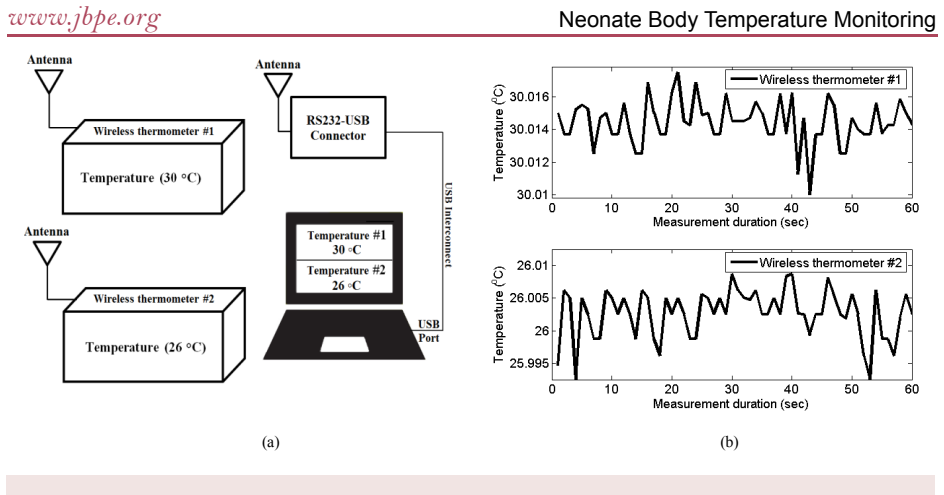
The paper's claim is that a monitoring system assembled from commodity parts can track a neonate's body temperature continuously enough for ICU use. Each wireless thermometer carries a DS18B20 semiconductor sensor whose factory-assigned unique ID is embedded in every packet via the 1-wire protocol, so an access point can tell the thermometers apart; a TDMA medium-access scheme with a pre-transmission RSSI check then lets an array of thermometers share the 915 MHz channel without collisions. The authors built two thermometers and tested them in free space, immersed in water, and on a volunteer's wrist, and report that the readings agree reasonably well with real temperatures, with the on-body agreement described as significant. They also report delay and energy-consumption figures for the node, treating these as evidence that real-time continuous monitoring is practical.
Load-bearing premise
The load-bearing premise is that the DS18B20 sensor's factory calibration and adult-wrist testing can stand in for clinical accuracy on a neonate; the paper never measures against a calibrated reference thermometer, so if sensor error or wrist-to-core temperature differences are larger than expected, the central claim collapses.
Editorial extensions
If this is right
- A two-node array can share one 915 MHz channel without packet collisions by giving each thermometer its own TDMA slot with an RSSI check before transmission.
- The built-in 1-wire ID means the receiving computer can tell which thermometer sent each reading, so a caregiver sees each neonate's temperature separately.
- The in-house software displays readings in real time and can alert for both high temperature and rapid temperature rise, which addresses the manual-rounds failure mode.
- The total packet delay is dominated by the sensor's 750 ms conversion time, so the system can report fresh temperatures many times per minute, comfortably within ICU monitoring needs.
- Continuous wireless temperature logging could reduce human error and staff workload compared with periodic manual recordings.
Reading between the lines
- The same packet-ID layer could carry other 1-wire sensors, such as skin moisture or heart-rate patches, turning the thermometer array into a general vital-sign body network without changing the medium-access scheme.
- Because on-body testing was on an adult wrist, clinical adoption would require mapping wrist or skin temperature to neonate core temperature, a mapping the paper does not supply.
- The alerting software flags high temperature and rapid rise, but the paper does not define false-alarm rates; tuning and testing alarm thresholds under realistic fever curves is an obvious next step.
- Since the sensor's 750 ms conversion time is the delay bottleneck, the TDMA frame could likely support more than two nodes by lengthening the frame, with the actual scaling limit set by frame length and alert latency, which the paper does not compute.
Signed reviews
Editorial analysis
A structured set of objections, weighed in public.
Referee Report
Summary. The manuscript describes the design and implementation of a wireless thermometer system intended for continuous neonate body temperature monitoring in an ICU. The hardware consists of a DS18B20 temperature sensor, an HM-TR 915 MHz transceiver, an Atmega8 microcontroller, and a TDMA-style medium access scheme with packet tagging via the 1-Wire protocol ID. The authors report tests in free space, water, and on a volunteer's wrist, along with system delay and energy consumption measurements, and conclude that the agreement between experimental data and real temperature values is reasonably acceptable and that the on-body testing is significant. The paper also presents an in-house developed visualization and alerting software.
Significance. If the system's accuracy were properly established, the contribution would be a low-cost, ID-tagged wireless thermometer array with real-time alerting for ICU use, and the hardware description plus delay and energy consumption data would provide a useful starting point for replication. However, the central accuracy claim is not supported by the reported evidence: no reference thermometer is described, no quantitative error or agreement statistics are provided, and the only on-body data fluctuate between 26 and 30 degrees Celsius, which is inconsistent with the paper's own statement that normal human body temperature is approximately 37 degrees Celsius. The paper's current value is therefore limited to a preliminary design description rather than a validated measurement system.
major comments (3)
- [Thermometers Evaluation (Figure 4)] The only on-body experiment reports temperature values fluctuating between 26 degrees Celsius and 30 degrees Celsius, while the Introduction states that normal human body temperature is approximately 37 degrees Celsius. The abstract's claim that 'the agreement between the experimental data and real temperature values is reasonably acceptable' is unsupported because the 'real temperature values' are never quantified, and no reference thermometer or calibration procedure is described. The reported data are 7-11 degrees Celsius below the physiological target, which directly contradicts the central accuracy claim.
- [Thermometers Evaluation] The three test scenarios (free-space, water, and volunteer's wrist) do not validate accuracy for neonatal body temperature monitoring. Water and free-space tests cannot reproduce neonatal skin contact, perfusion, or thermal environment, and the wrist test lacks any reference measurement, error bars, bias estimate, or limits-of-agreement analysis. To support the claimed accuracy, the authors need a comparison against a calibrated traceable thermometer with reporting of bias, standard deviation, and ideally Bland-Altman analysis, plus a clinically representative testing scenario.
- [System Delay and Node Energy Consumption] The delay and energy consumption analysis in Equations (1)-(5) and Figures 6-8 is not connected to the central accuracy claim and contains apparent mathematical or typographical errors: Equation (2) reads '1T(microcontroller Clock) 8000=' and Equation (5) reads 'T(5) 0.013ms19200=', both of which are not valid equations. Even if corrected, these measurements of timing and power do not establish measurement accuracy, so the title's word 'accurate' remains unsubstantiated.
minor comments (6)
- [General] Figure numbering is inconsistent: the text refers to Figure 4 as a TDMA flow chart and then later as the measurement results, while Figures 5, 6, and 8 are also referenced out of sequence.
- [Wireless Thermometer] The sensor is named 'DSI8B20' in the text; the correct part name is DS18B20.
- [Wireless Thermometer] The protocol is described as 'I-wire protocol'; the standard name is 1-Wire protocol.
- [References] References 15-17 and 21-23 are duplicated entries with different numbering, which should be consolidated.
- [System Delay] Equation (2) needs proper formatting; it likely intends T1 = 1/8000 seconds per clock cycle but is currently unreadable.
- [Node Energy Consumption] Table 2 lists 'Battery Primary Power Battery Watt 500' and 'Battery primary voltage battery Volt 9'; the power value appears unrealistic for a 9 V battery and should be clarified or corrected.
Circularity Check
No significant circularity: the accuracy claim is empirical and unsupported, but it is not derived from its own inputs.
full rationale
The paper's central claim is that the realized wireless thermometer array measures neonate body temperature accurately. That claim is asserted from the test scenarios in 'Thermometers Evaluation' rather than derived from assumptions that contain the conclusion, so it is not circular in the definitional sense. No parameter is fitted and then renamed as a prediction, and the delay and energy calculations (Equations 1-5 and 6-7) are direct applications of datasheet values to the hardware design. The accuracy of the DS18B20 is delegated to the manufacturer's datasheet, which is an external source, not a self-citation. The only self-citations are Refs. [18] and [19], which appear in the background sentence 'A number of media access control (MAC) protocols have been proposed for medical sensor networks [5,17–20]'; they are contextual references and are not load-bearing for the accuracy claim. The reported on-body data in Figure 4, fluctuating between 26 °C and 30 °C, directly undermines the abstract's statement that 'the agreement between the experimental data and real temperature values is reasonably acceptable and that of the on-body testing is significant,' but lack of support is a correctness problem, not circularity. No equation-level reduction or fitted-input-as-prediction pattern can be exhibited, so the circularity score is minimal.
Assumptions & free parameters
assumptions (4)
- domain assumption The DS18B20 sensor's factory calibration is accurate enough for clinical neonatal temperature measurement.
- domain assumption Measurements on a volunteer's wrist in air replicate the conditions of neonatal body temperature monitoring.
- domain assumption HM-TR transceiver datasheet values for current consumption and timing apply to the tested units.
- domain assumption The wireless link remains reliable at the power levels and distances tested, so lost packets do not bias the temperature readings.
Cite this review
Pith. "Pith review of An Accurate Measurement System Comprising of Wireless Thermometers for Neonate Body Temperature Monitoring." pith.science (2026). https://pith.science/paper/JTSTBCZJ
@misc{pith2026190806800,
  author       = {Pith},
  title        = {Pith review of: An Accurate Measurement System Comprising of Wireless Thermometers for Neonate Body Temperature Monitoring},
  year         = {2026},
  howpublished = {\url{https://pith.science/paper/JTSTBCZJ}},
  note         = {Machine review of arXiv:1908.06800}
}
read the original abstract
This paper addresses the design and implementation of a real-time monitoring system consisting of wireless thermometers for continuous recording of neonate body temperature in an intensive care unit (ICU). Each wireless thermometer incorporates an accurate semiconductor temperature sensor, a transceiver operating on ISM frequency band (i.e., 915 MHz) as well as a microcontroller which is used to control the thermometers functionalities including wireless medium access (e.g., free space or body channel), transmission and reception. A voltage regulator and a low-pass filter were also used for removing spurious signals and environmental noise from the thermometer feed line. In order to distinguish the reading of each thermometer from measurements performed by other thermometers, the I-wire protocol was used. This protocol can securely tag the temperature value by incorporating a unique ID (provided by the manufacturer) into the packet sent wirelessly. An array of two thermometers was implemented and successfully tested in different scenarios, namely free-space, water (immersed thermometers) and on a volunteers wrist. Moreover, an in-house developed computer software was used in order to visualize the readings in addition to alerting rapid increase and high body temperature. The software also compares the measurement results with actual values. The agreement between the experimental data and real temperature values is reasonably acceptable and that of the on-body testing is significant. Keywords : Temperature measurement, Wireless thermometer, Temperature sensors, Wireless sensor networks, Wireless communication, Monitoring, Protocols, Time measurement
Figures


Figures from the paper (5 more)



Reference graph
Works this paper leans on
-
[1]
A WSN-based system for real-time electro- magnetic monitoring
Viani F, Donelli M, Oliveri G, Massa A, Trinchero D, editors. A WSN-based system for real-time electro- magnetic monitoring. Antennas and Propagation (APSURSI), 2011 IEEE International Symposium on; 2011: IEEE
work page 2011
-
[2]
A communication server for telemedicine applications
Bai J, Hu B, Zhang Y, Ye D. A communication server for telemedicine applications. IEEE Transac- tions on Information Technology in Biomedicine. 1997;1:205-9. doi.org/10.1109/4233.654863
-
[3]
Applications of wire- less sensors in medicine
Furtado H, Trobec R, editors. Applications of wire- less sensors in medicine. MIPRO, 2011 Proceed- ings of the 34th International Convention; 2011: IEEE
work page 2011
-
[4]
Study of Wireless Sensor Network (WSN) using for slope stability monitoring
Chang DTT, Guo LL, Yang KC, Tsai Y-S, editors. Study of Wireless Sensor Network (WSN) using for slope stability monitoring. Electric Technology and Civil Engineering (ICETCE), 2011 International Conference on; 2011: IEEE
work page 2011
-
[5]
Olivares A, Olivares G, Mula F, Górriz J, Ramírez J. Wagyromag: Wireless sensor network for moni- toring and processing human body movement in healthcare applications. Journal of systems archi- tecture. 2011;57:905-15. doi.org/10.1016/j.sys- arc.2011.04.001
-
[6]
Implementation of wireless body area networks for healthcare systems
Yuce MR. Implementation of wireless body area networks for healthcare systems. Sensors and Actuators A: Physical. 2010;162:116-29. doi. org/10.1016/j.sna.2010.06.004
-
[7]
Bal G, Daldal N, editors. Design and implemen- tation of microcontroller based temperature mea- surement and control system using powerline communication. Power Engineering, Energy and Electrical Drives (POWERENG), 2013 Fourth Inter- national Conference on; 2013: IEEE
work page 2013
-
[8]
Design of multi- point wireless temperature measuring system
Ni S, Su J, Nie L, Qu S, editors. Design of multi- point wireless temperature measuring system. Modelling, Identification & Control (ICMIC), 2012 Proceedings of International Conference on; 2012: IEEE
work page 2012
Show all 23 references
-
[9]
HM-TR Series UHF Wireless Trans- parent Data Transceiver: HM-TR v2.2
In: Hope RF. HM-TR Series UHF Wireless Trans- parent Data Transceiver: HM-TR v2.2. Available from: http://www.dragonwake.com/download/RF/ HM-TR_EN.pdf
-
[10]
Atmel AVR ATmega8 Microcon- troller - DIP
In: Kanda.com. Atmel AVR ATmega8 Microcon- troller - DIP. Available from:https://www.kanda. com/products /Atmel/ATmega8.html
-
[11]
A wireless body area network of intelligent mo- tion sensors for computer assisted physical re- habilitation
Jovanov E, Milenkovic A, Otto C, de Groen PC. A wireless body area network of intelligent mo- tion sensors for computer assisted physical re- habilitation. J Neuroeng Rehabil. 2005;2:6. doi. org/10.1186/1743-0003-2-6. PubMed PMID: 15740621. PubMed PMCID: 552302
2005 doi
-
[12]
A hybrid body sensor network for continuous and long-term measurement of arterial blood pressure
Chan C, Poon C, Wong RC, Zhang Y, editors. A hybrid body sensor network for continuous and long-term measurement of arterial blood pressure. 2007 4th IEEE/EMBS International Summer School and Symposium on Medical Devices and Biosen- sors; 2007: IEEE
2007
-
[13]
Low data rate ultra wide- band ECG monitoring system
Keong HC, Yuce MR. Low data rate ultra wide- band ECG monitoring system. Conf Proc IEEE Eng Med Biol Soc. 2008;2008:3413-6. PubMed PMID: 19163442
2008
-
[14]
Analyzing medium access techniques in wireless body area networks
Javaid N, Israr I, Khan M, Javaid A, Bouk SH, Khan Z. Analyzing medium access techniques in wireless body area networks. arXiv preprint arX- iv:1304.1047. 2013.”
2013 arXiv
-
[15]
A survey on futuristic health care sys- tem: WBANs
Baskaran K. A survey on futuristic health care sys- tem: WBANs. Procedia Engineering. 2012;30:889-
2012
-
[18]
A wearable medical sensor for provisional healthcare
Javadpour A, Memarzadeh-Tehran H, editors. A wearable medical sensor for provisional healthcare. Physics and Technology of Sensors (ISPTS), 2015 2nd International Symposium on; 2015: IEEE
2015
-
[19]
A temperature monitoring system incorpo- rating an array of precision wireless thermometers
Javadpour A, Memarzadeh-Tehran H, Saghafi F, editors. A temperature monitoring system incorpo- rating an array of precision wireless thermometers. Smart Sensors and Application (ICSSA), 2015 In- ternational Conference on; 2015: IEEE
2015
-
[20]
Low data rate ultra wideband ECG monitoring system
Keong HC, Yuce MR, editors. Low data rate ultra wideband ECG monitoring system. Engineering in Medicine and Biology Society, 2008. EMBS 2008. 30th Annual International Conference of the IEEE; 2008: IEEE
2008
-
[21]
A survey on futuristic health care system: WBANs
GK R, Baskaran K. A survey on futuristic health care system: WBANs. Procedia Engineer- ing. 2012;30:889-96. doi.org/10.1016/j.pro- eng.2012.01.942
2012 doi
-
[22]
Synchronous contention-based MAC protocols for delay-sensitive wireless sensor networks: A review and taxonomy
Doudou M, Djenouri D, Badache N, Bouabdallah A. Synchronous contention-based MAC protocols for delay-sensitive wireless sensor networks: A review and taxonomy. Journal of Network and Computer Applications. 2014;38:172-84. doi.org/10.1016/j. jnca.2013.03.012
2014 doi
-
[23]
Cellular radio telecommunication for health care: benefits and risks
Sneiderman CA, Ackerman MJ. Cellular radio telecommunication for health care: benefits and risks. J Am Med Inform Assoc. 2004;11(6):479-
2004
-
[81]
PubMed PMCID: 524627
PubMed PMID: 15298996. PubMed PMCID: 524627. doi.org/10.1197/jamia.M1532. Javadpour Amir et al VIII
-
[96]
doi.org/10.1016/j.proeng.2012.01.942
2012 doi
Reviewed August 14, 2026 · model on record in the stance chip above.
Discussion (0). Continue with ORCID to comment.