REVIEW 4 major objections 6 minor 52 references
Boomerang: Real-Time I/O Meets Legacy Systems
T0 review · 4 major / 6 minor · reviewed 2026-08-14 · deepseek-v4-flash
Pith's one-line read Boomerang guarantees end-to-end I/O delays for pipelines that span a real-time OS and legacy Linux, and its evaluation keeps measured delays inside the bounds.
desk verdict Solid systems paper extending tuned pipes across a partitioning hypervisor, but the end-to-end 'guarantee' rests on unvalidated pre-profiled WCETs and the ACRN comparison isn't clean; still deserves peer review. read the letter →
The pith
A machine-rendered reading of the paper's core claim, the machinery that carries it, and where it could break.
The reading
What carries the argument
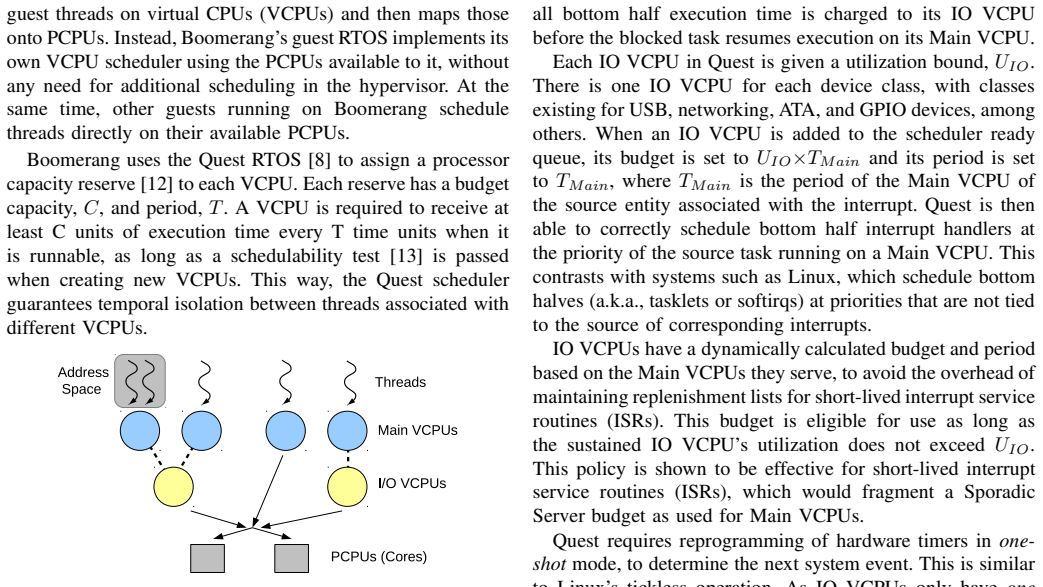
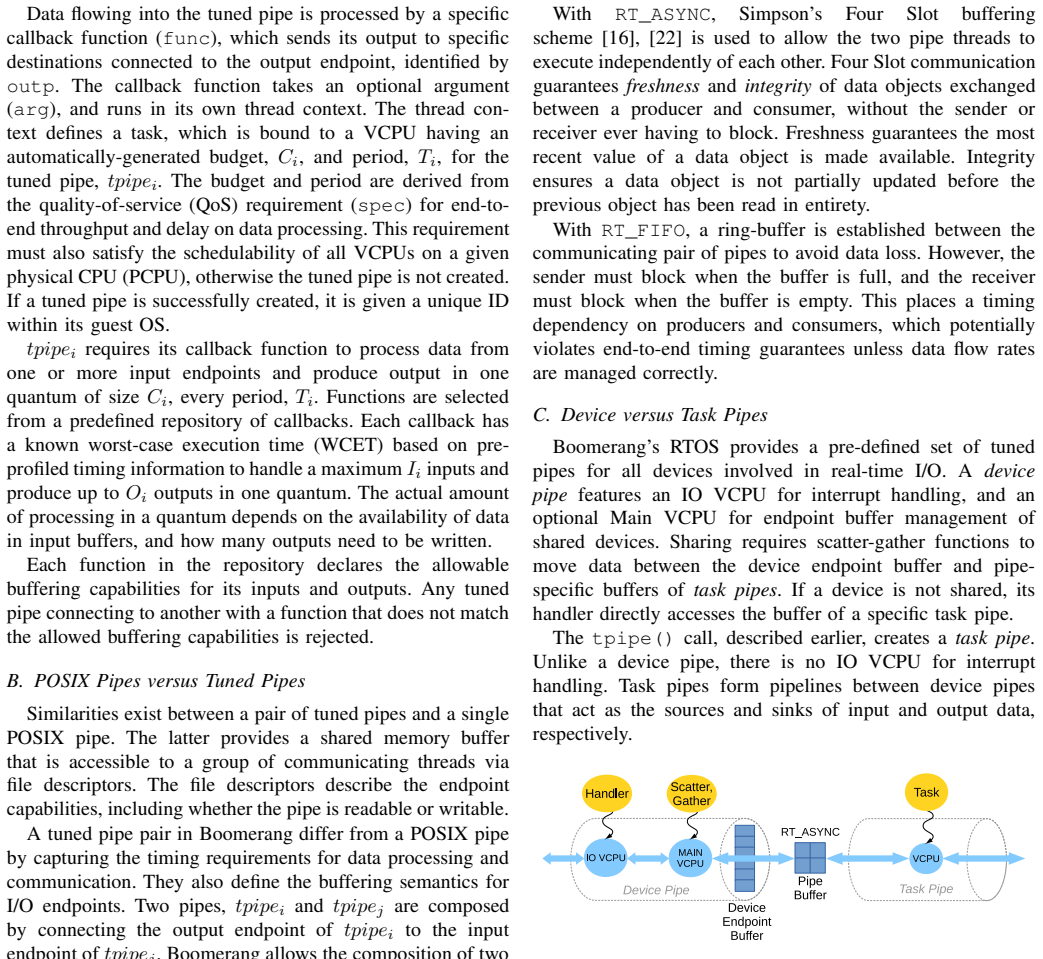
The central object is the composable tuned pipe (tpipe): a pipeline stage bound to a VCPU with an automatically computed budget $C_i$ and period $T_i$, connected to other pipes through either Simpson's four-slot asynchronous buffers (for freshness without blocking) or FIFO ring buffers (for lossless, rate-matched communication). The load-bearing identity is the end-to-end delay bound: for the longest path $l$, $\sum_{i\in l} T_i \le \text{e2e delay}$, with throughput bounded by $\min_i \{m_i/T_i\}$ and four-slot loss bounded by $\max\{1 - T_p/T_c\}$. The solver adjusts periods and budgets, halving producer periods and doubling consumer budgets, until the path meets the bound and all VCPUs pass a schedulability test on their PCPUs.
What would settle it
Run the paper's CAN-bus pipelines on an Up Squared board while forcing one callback to exceed its profiled worst-case execution time, for example by using a slower USB device or injecting cache misses; if any packet's end-to-end delay goes above the sum of the tuned-pipe periods on its path, the guarantee as stated has failed.
Extended reading notes
Core claim
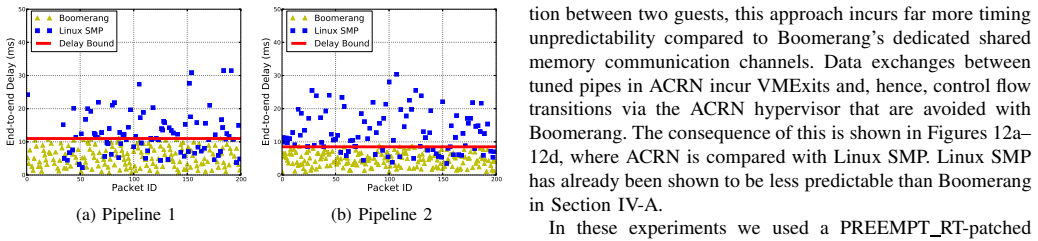
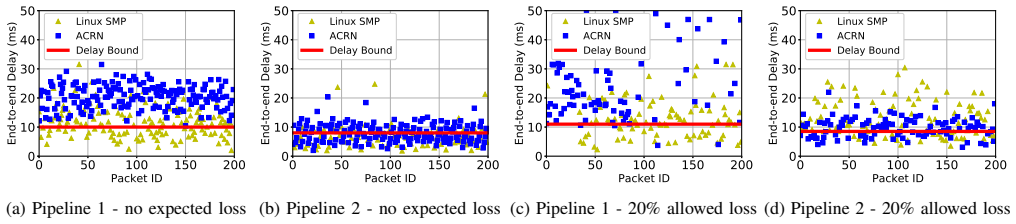
The paper's central claim is that composable tuned pipes can give end-to-end timing guarantees to I/O paths that cross the boundary between an RTOS and a non-real-time legacy OS. A tuned pipe is a VCPU with a budget $C_i$ and period $T_i$; for a pipeline, Boomerang's constraint solver sets these parameters so that the sum of the periods on the longest path is no larger than the required end-to-end delay, with buffers sized so that blocking is avoided, and with all VCPUs satisfying a schedulability test (RMS or EDF) on their assigned physical cores. Interrupt handling in the RTOS is charged to IO VCPUs tied to the Main VCPU that issued the I/O, so bottom-half handlers run at the priority of the task they serve; in the Linux guest, tasks run under SCHED_DEADLINE with interrupts demoted to lower priority. The paper reports that for two CAN-bus pipelines spanning Quest and Linux, measured end-to-end delays stayed within bounds (for example, a maximum of 9.57 ms against a 10 ms bound), loss stayed within the allowed 20 percent, and throughput matched arrival rates, while Linux-only pipelines frequently exceeded the bounds and lost 28 to 56 percent of packets.
Load-bearing premise
The end-to-end guarantee rests on each callback's worst-case execution time being known from pre-profiling; if a callback ever runs longer than its profiled budget on real hardware, the solver's CPU budgets are too small and the delay bound no longer holds.
Editorial extensions
If this is right
- Mixed-criticality automotive and avionics systems can run safety-critical sensing and actuation on an RTOS while offloading rich services such as cameras, GPUs, and machine-learning libraries to Linux, without dedicating separate hardware.
- A legacy OS can be made part of a hard real-time path if its tasks use reservation scheduling and its interrupts are demoted below task priority; the bottleneck is interrupt handling, not the OS itself.
- Boomerang-style partitioning removes the hypervisor from runtime resource management, shrinking the trusted code base and avoiding VMExits during inter-guest communication.
- Pipeline QoS specifications can express throughput, loss, and delay together: a four-slot pipeline tolerates known loss rates for sensor data, while a FIFO pipeline enforces lossless throughput.
- The design extends to multiple-input, multiple-output pipelines, since the delay constraint is applied per longest path and the throughput constraint per bottleneck output.
Reading between the lines
- The same composition mechanism should carry over to any legacy guest that offers reservation-based scheduling and lets interrupt handling be demoted or isolated; Windows or Android guests would be natural next targets, though the paper only demonstrates Linux.
- Because the guarantee rests on profiled worst-case execution times, Boomerang would benefit from coupling each tpipe callback to a runtime enforcement mechanism such as budget exhaustion traps that convert a WCET violation into a detectable pipeline failure rather than a silent deadline miss.
- The endpoint capability model left as future work could turn Boomerang into a substrate for secure information-flow control: if pipe connectivity is restricted by access policies, the same delay analysis would bound leakage channels, an idea the paper mentions but does not develop.
- A testable extension is to use the same tuning equations with different schedulers, such as global EDF or partitioned EDF across many cores, and derive the analogous sum-of-periods bound; the paper's single-core-per-path analysis may understate the complexity on heterogeneous hardware.
Signed reviews
Editorial analysis
A structured set of objections, weighed in public.
Referee Report
Summary. The paper presents Boomerang, a partitioning hypervisor that co-locates the Quest RTOS and a Linux guest on separate cores of a multicore machine, partitioning CPU cores, memory, and I/O devices between the guests. The main contribution is a composable 'tuned pipe' abstraction: each pipeline stage is a callback bound to a VCPU or server with a budget C_i and period T_i, and a constraint solver sets these parameters from pre-profiled per-callback WCETs so that the sum of periods along the longest path is within a user-specified end-to-end delay, while throughput and loss requirements are handled for FIFO and four-slot buffering. The evaluation on an Up Squared board with CAN bus traffic compares Boomerang against standalone Linux using SCHED_DEADLINE and against the ACRN hypervisor, for asynchronous, synchronous (FIFO), and MIMO pipelines. The measurements show Boomerang staying within the computed delay bounds in the tested runs, while Linux SMP and ACRN do not.
Significance. If the end-to-end guarantees are taken as validated, Boomerang offers a useful integration point for mixed-criticality systems that need legacy Linux services alongside RTOS-timed I/O. The design strength is that the delay bound is computed a priori by the constraint solver and then checked by measurement, so the evaluation is a genuine check of the design rather than a post-hoc fit. The RTOS-side handling of interrupt bottom-halves via IO VCPUs addresses a real priority-inversion problem in Linux. However, the validity of the guarantee rests on pre-profiled WCETs, which are not shown to be safe upper bounds, and the Linux-side pipeline stage is subject to unmodeled interrupt interference. The ACRN comparison is also not apples-to-apples. These issues affect the central claims enough that revision is required, but the core ideas are defensible.
major comments (4)
- [Section III-A and III-E] The end-to-end guarantee is built on the assumption in Section III-A that each callback has a known worst-case execution time based on pre-profiled timing information, and Section III-E states that C_i is derived from this WCET. Profiling alone does not establish a worst-case bound: it cannot capture rare cache, TLB, or microarchitectural states or input-dependent path variations unless the profiling campaign exhaustively exercises them. Table I sets the tightest budgets at 0.1 ms, yet no per-callback execution-time measurements or profiling methodology are reported. If any callback occasionally exceeds C_i, the server throttles that pipe and the affected message is deferred to a later period, so the sum-of-periods bound in Section III-E is no longer valid. As written, the 'guarantee' is conditional on an unverified WCET bound; the paper should either provide evidence that the profiled values are safe upper bounds (for example, a measurement methodology with margins, or static WCET analysis) or soften the guarantee claim accordingly.
- [Section IV (setup) and Section II] Pipeline 1's Linux-side stage ProcData (τ4) runs on Core 1, where Section IV states that all device interrupts other than xHCI are redirected, and where 11 background tasks generate disk and network I/O. Section II explicitly conditions SCHED_DEADLINE scheduling guarantees on the absence of interrupt interference. The delay bound in Table I therefore does not account for interrupt-induced delays on the cross-guest path, which is exactly the path the paper claims as its principal new capability. The measurements show the bound is met in these runs, but a guarantee requires that the interference source be modeled or excluded; without that, the cross-guest delay claim is empirical rather than assured.
- [Section IV-B] The ACRN comparison is confounded: Boomerang and Linux SMP use Yocto Linux kernel 4.9.99 with PREEMPT_RT, while the ACRN SOS and UOS use ClearOS Linux kernel 4.19.73 (as recommended by the ACRN developers). The paragraph also states that Quest was intentionally not ported to ACRN. Because the compared systems differ in both the hypervisor and the guest OS, the observed latency differences cannot be attributed to Boomerang's design. The Abstract's claim that Boomerang 'outperforms' ACRN is not supported by a controlled comparison.
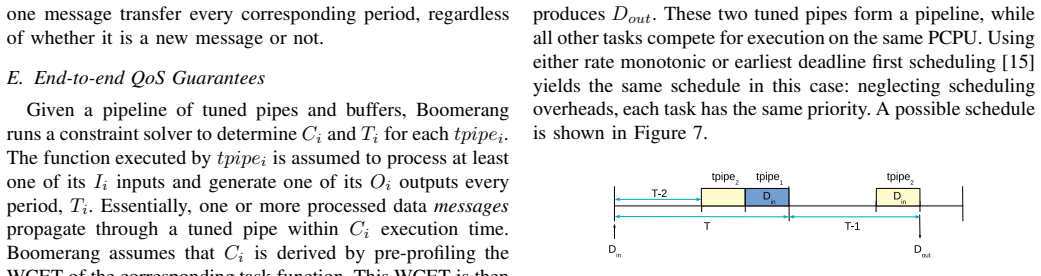
- [Section III-E] The bound stating that worst-case end-to-end delay equals the sum of the tuned-pipe periods is justified only by the special-case example in Figure 7, in which all tasks have the same service time and period. No proof is given for pipelines with different C_i/T_i, arbitrary phase offsets, multi-CPU paths, or mixed Quest/Linux scheduling. If the bound is intended as a formal guarantee, the authors should state the assumptions (e.g., each stage consumes at most one quantum per period, no release jitter, no scheduling overhead) and provide a concise derivation; otherwise the reader cannot verify the central claim for the general pipelines used in the evaluation.
minor comments (6)
- [Section III-B] The terms 'RT_ASYNC' and 'RT_FIFO' are introduced before the buffering modes are explained; consider defining them at first use.
- [Section III-E] In the toy example, the symbol T is used both for the number of tasks and the common period, which is confusing; use n for the number of tasks.
- [Section IV-A] The caption of Figures 10a and 10b contains a typo: 'show the the performance' should read 'show the performance'.
- [Section IV-A] End-to-end delay results are limited to the first 200 packets, and the claim that 'similar behavior was observed for more extensive runs' is not supported by data; consider showing a longer trace or a summary statistic.
- [Section IV-B] The statement 'As Boomerang already outperforms Linux SMP, it follows that ACRN's lack of timing predictability makes it inferior' is a non-sequitur; the ACRN comparison needs explicit data.
- [Section VI] The source-code release is promised as 'will be made available' at www.questos.org; if code is not available at the time of review, reproducibility would be strengthened by including the experimental configuration and raw data in a supplement.
Circularity Check
No significant circularity: the delay bound is a design-time sum of VCPU periods, and the measured end-to-end delays are an independent empirical check; the main caveat is the assumed pre-profiled WCET, which is a soundness assumption, not a circular fit.
full rationale
The paper's central derivation (Section III-E) sets each tuned pipe's budget C_i and period T_i via a constraint solver before execution, with C_i assumed equal to a pre-profiled WCET, and then defines the worst-case end-to-end delay as the sum of the T_i on the longest path. The evaluation (Section IV) measures packet round-trip delays and compares them against these pre-computed sums (e.g., Table II: Boomerang max 9.57 ms vs. 10 ms bound). Because the periods are selected before the measurements and are not fit to the measured delay curves, the measurements are a genuine validation rather than a renamed prediction. The paper does invoke the authors' own prior systems (Quest [8], Quest-V [10], tuned pipes [7]), but these are used as implementation infrastructure and background; the end-to-end delay argument is self-contained and does not reduce to those citations. The explicit assumption that each callback has a known WCET 'based on pre-profiled timing information' (Section III-A) and that 'Ci is derived by pre-profiling the WCET' (Section III-E) is a real soundness limitation: profiling is not proof of a worst-case bound, and if a callback overruns C_i the sum-of-periods guarantee can fail. However, that is an unsupported assumption about the environment, not a circular step: the derivation would be valid if the WCET bounds were true, and the evaluation is an independent test of the design. No equation in the paper is identical by construction to a fitted or measured output; the delay bound is not defined in terms of the measured delays. Accordingly, no circularity is present.
Assumptions & free parameters
free parameters (2)
- Per-tpipe budget C_i and period T_i =
e.g., C=0.1ms, T=2ms for CanRead (Table I)
- IO VCPU utilization bound U_IO =
not specified
assumptions (8)
- domain assumption Pre-profiled WCET values for each callback are safe upper bounds for all executions
- standard math Sporadic Server VCPUs receive at least C units of execution every T when runnable if the schedulability test passes
- standard math Rate-monotonic schedulability bound sum(C_i/T_i) <= n(2^{1/n}-1) and EDF bound sum(C_i/T_i) <= 1 apply to the VCPU set
- domain assumption The partitioning hypervisor provides spatial isolation and no runtime VMExits during normal guest operation
- standard math Four-slot communication guarantees freshness and integrity without blocking
- domain assumption The loss-rate bound for four-slot pipelining is max(1 - T_p/T_c) for stages with T_c > T_p
- domain assumption FIFO buffers sized by the solver prevent blocking delays
- domain assumption Linux SCHED_DEADLINE tasks receive their reserved CPU budgets if interrupts are demoted
Cite this review
Pith. "Pith review of Boomerang: Real-Time I/O Meets Legacy Systems." pith.science (2026). https://pith.science/paper/A7IAHD5P
@misc{pith2026190806807,
  author       = {Pith},
  title        = {Pith review of: Boomerang: Real-Time I/O Meets Legacy Systems},
  year         = {2026},
  howpublished = {\url{https://pith.science/paper/A7IAHD5P}},
  note         = {Machine review of arXiv:1908.06807}
}
read the original abstract
This paper presents Boomerang, an I/O system that integrates a legacy non-real-time OS with one that is customized for timing-sensitive tasks. A relatively small RTOS benefits from the pre-existing libraries, drivers and services of the legacy system. Additionally, timing-critical tasks are isolated from less critical tasks by securely partitioning machine resources among the separate OSes. Boomerang guarantees end-to-end processing delays on input data that requires outputs to be generated within specific time bounds. We show how to construct composable task pipelines in Boomerang that combine functionality spanning a custom RTOS and a legacy Linux system. By dedicating time-critical I/O to the RTOS, we ensure that complementary services provided by Linux are sufficiently predictable to meet end-to-end service guarantees. While Boomerang benefits from spatial isolation, it also outperforms a standalone Linux system using deadline-based CPU reservations for pipeline tasks. We also show how Boomerang outperforms a virtualized system called ACRN, designed for automotive systems.
Figures


Figures from the paper (10 more)






Reference graph
Works this paper leans on
-
[1]
A Co mparison of Partitioning Operating Systems for Integrated Systems,
R. O. Bernhard Leiner, Martin Schlager and B. Huber, “A Co mparison of Partitioning Operating Systems for Integrated Systems,” i n Proceedings of the 26th International Conference on Computer Safety, Re liability and Security (SAFECOMP) , Nuremberg, Germany, 18-21 September 2007
work page 2007
-
[2]
G. Niedrist, “Deterministic Architecture and Middlewa re for Domain Control Units and Simplified Integration Process Applied to ADAS,” 2016, https://www.tttech.com/technologies/adas
work page 2016
-
[3]
LynxSecure Embedded Hypervisor and Separation Kernel, 2019, https://info.lynx.com/products/lynxsecure-programmable-processor- partitioning-system
work page 2019
-
[4]
AUTOSAR, 2019, AUTomotive Open System ARchitecture – http://www.autosar.org
work page 2019
-
[5]
Wind River Systems, August 2008, ARINC 653 - An Avionics S tandard for Safe, Partitioned Systems
work page 2008
-
[6]
Jailhouse Partitionin g Hypervisor,
Siemens Corporate Technology, “Jailhouse Partitionin g Hypervisor,” October 2014, https://github.com/siemens/jailhouse
work page 2014
-
[7]
Tuned Pipes: End-to-E nd Through- put and Delay Guarantees for USB Devices,
A. Golchin, Z. Cheng, and R. West, “Tuned Pipes: End-to-E nd Through- put and Delay Guarantees for USB Devices,” in Proceedings of the 39th IEEE Real-Time Systems Symposium (RTSS) , Dec 2018, pp. 196 – 207
work page 2018
-
[8]
Virtual-CPU Scheduling in the Quest Operating System,
M. Danish, Y . Li, and R. West, “Virtual-CPU Scheduling in the Quest Operating System,” in 2011 17th IEEE Real-Time and Embedded Technology and Applications Symposium . IEEE, 2011, pp. 169–179
work page 2011
Show all 52 references
-
[9]
Process-Aware Interrupt Scheduli ng and Ac- counting,
Y . Zhang and R. West, “Process-Aware Interrupt Scheduli ng and Ac- counting,” in Proceedings of the 27th IEEE International Real-Time Systems Symposium , ser. RTSS ’06. Washington, DC, USA: IEEE Computer Society, 2006, pp. 191–201
2006
-
[10]
A Virtualize d Separation Kernel for Mixed-Criticality Systems,
R. West, Y . Li, E. Missimer, and M. Danish, “A Virtualize d Separation Kernel for Mixed-Criticality Systems,” ACM Transactions on Computer Systems, vol. 34, no. 3, pp. 8:1–8:41, Jun. 2016
2016
-
[11]
Loo k Mum, No VM Exits! (Almost),
R. Ramsauer, J. Kiszka, D. Lohmann, and W. Mauerer, “Loo k Mum, No VM Exits! (Almost),” in Proceedings of the 13th W orkshop on Operating Systems Platforms for Embedded Real-time Applications (OS PERT), 2017
2017
-
[12]
Processor Capac ity Reserves for Multimedia Operating Systems,
C. W. Mercer, S. Savage, and H. Tokuda, “Processor Capac ity Reserves for Multimedia Operating Systems,” in Proceedings of the IEEE Inter- national Conference on Multimedia Computing and Systems , 1994
1994
-
[13]
The Rate Monotonic Sch eduling Algorithm: Exact Characterization and Average Case Behavi or,
J. Lehoczky, L. Sha, and Y . Ding, “The Rate Monotonic Sch eduling Algorithm: Exact Characterization and Average Case Behavi or,” in Proceedings of the IEEE Real-Time Systems Symposium (RTSS) , 1989
1989
-
[14]
Scheduling Sporadic and Aperiodic Events i n a Hard Real- Time System,
B. Sprunt, “Scheduling Sporadic and Aperiodic Events i n a Hard Real- Time System,” Software Engineering Institute, Carnegie Me llon, Tech. Rep., 1989
1989
-
[15]
Scheduling Algorithms for M ultiprogram- ming in a Hard Real-Time Environment,
C. L. Liu and J. W. Layland, “Scheduling Algorithms for M ultiprogram- ming in a Hard Real-Time Environment,” Journal of the ACM , vol. 20, no. 1, pp. 46–61, 1973
1973
-
[16]
Four-slot Fully Asynchronous Communicat ion Mechan- ism,
H. Simpson, “Four-slot Fully Asynchronous Communicat ion Mechan- ism,” IEEE Computers and Digital Techniques , vol. 137, pp. 17–30, January 1990
1990
-
[17]
Commu- nication Centric Design in Complex Automotive Embedded Sys tems,
A. Hamann, D. Dasari, S. Kramer, M. Pressler, and F. Wurs t, “Commu- nication Centric Design in Complex Automotive Embedded Sys tems,” in Proceedings of the 29th Euromicro Conference on Real-Time S ystems, Dagstuhl, Germany, 2017
2017
-
[18]
ISO 26262-3: Road vehicles - Functional safety - P art 3: Concept phase ,
ISO, “ISO 26262-3: Road vehicles - Functional safety - P art 3: Concept phase ,” 2011
2011
-
[19]
Making information flow explicit in histar,
N. Zeldovich, S. Boyd-Wickizer, E. Kohler, and D. Mazie res, “Making information flow explicit in histar,” in OSDI ’06: Proceedings of the second USENIX symposium on Operating systems design and imp le- mentation, 2006, pp. 263–278
2006
-
[20]
Labels and Event Processes in the Asbestos Operating System,
P . Efstathopoulos, M. Krohn, S. V anDeBogart, C. Frey, D . Ziegler, E. Kohler, D. Mazi` eres, F. Kaashoek, and R. Morris, “Labels and Event Processes in the Asbestos Operating System,” in SOSP ’05: Proceedings of the twentieth ACM symposium on Operating systems princip les. N...
2005
-
[21]
Secure Computer System: U nified Exposition and Multics Interpretation,
D. E. Bell and L. J. LaPadula, “Secure Computer System: U nified Exposition and Multics Interpretation,” Mitre Corporatio n, Bedford, MA, Tech. Rep. ESD-TR-75-306, March 1976
1976
-
[22]
Model Checking Simpson’s Four-slot Fully A synchronous Communication Mechanism,
J. Rushby, “Model Checking Simpson’s Four-slot Fully A synchronous Communication Mechanism,” Computer Science Laboratory–SRI Inter- national, Tech. Rep. Issued , 2002
2002
-
[23]
Integrating Multimedia Appl ications in Hard Real-Time Systems,
L. Abeni and G. Buttazzo, “Integrating Multimedia Appl ications in Hard Real-Time Systems,” in Proceedings of the 19th IEEE Real-time Systems Symposium, 1998, pp. 4–13
1998
-
[24]
Arduino Homepage, 2019, http://arduino.cc
2019
-
[25]
A Paravi rtualized Android for Next Generation Interactive Automotive System s,
S. Sinha, A. Golchin, C. Einstein, and R. West, “A Paravi rtualized Android for Next Generation Interactive Automotive System s,” in Pro- ceedings of the 21st International W orkshop on Mobile Compu ting Systems and Applications (HotMobile 2020) , Austin, Texas, USA, March 3–4 2020
2020
-
[26]
A Feedback-driven Proportion Allocator for Real-rate Sch eduling,
D. C. Steere, A. Goel, J. Gruenberg, D. McNamee, C. Pu, an d J. Walpole, “A Feedback-driven Proportion Allocator for Real-rate Sch eduling,” in Proceedings of the Third Symposium on Operating Systems Des ign and Implementation, ser. OSDI ’99. USENIX Association, 1999, pp. 145–...
1999
-
[27]
PREEMPT RT, 2019, https://rt.wiki.kernel.org/index.php/Main Page
2019
-
[28]
SCHED DEADLINE Policy,
Linux, “SCHED DEADLINE Policy,” 2019, https://www.kernel.org/doc/Documentation/scheduler/sched- deadline.txt
2019
-
[29]
LitmusRT : A Testbed for Empirically Comparing Real- time Multiprocessor Schedulers,
J. M. Calandrino, H. Leontyev, A. Block, U. C. Devi, and J . H. Anderson, “ LitmusRT : A Testbed for Empirically Comparing Real- time Multiprocessor Schedulers,” in 2006 27th IEEE International Real- Time Systems Symposium (RTSS’06) . IEEE, 2006, pp. 111–126
2006
-
[30]
VxWorks, 2019, https://www.windriver.com/products /vxworks/
2019
-
[31]
MERT-A Multi-environment Re al-time Operating System,
D. Bayer and H. Lycklama, “MERT-A Multi-environment Re al-time Operating System,” in ACM SIGOPS Operating Systems Review , vol. 9, no. 5. ACM, 1975, pp. 33–42
1975
-
[32]
J. J. Labrosse, MicroC/OS-II: The Real Time Kernel . CRC Press, 2002
2002
-
[33]
Y odaiken, The RT Linux Manifesto , 1999
V . Y odaiken, The RT Linux Manifesto , 1999
1999
-
[34]
Wind River Systems, 2019, https://www.windriver.com/products/linux/
2019
-
[35]
Linux Real Time Applicatio n Interface (RTAI) in Low Cost High Performance Motion Control,
L. Dozio and P . Mantegazza, “Linux Real Time Applicatio n Interface (RTAI) in Low Cost High Performance Motion Control,” Motion Con- trol, vol. 2003, no. 1, pp. 1–15, 2003
2003
-
[36]
Xenomai, Last Released: 2018, https://xenomai.org/
2018
-
[37]
cfsLinux,
NASA, “cfsLinux,” 2019, https://cfs.gsfc.nasa.gov/
2019
-
[38]
Embedded Configurable Operating System,
eCos, “Embedded Configurable Operating System,” http://ecos.sourceware.org/, 2019
2019
-
[39]
OAR Corporation, “ RTEMS,” Last Release: 2016, https://www.rtems.org/
2016
-
[40]
FreeRTOS,
Real Time Engineers Ltd., “FreeRTOS,” 2019, https://w ww.freertos.org/
2019
-
[41]
Wind River Hypervisor,
W. R. Systems, “Wind River Hypervisor,” 2019, https://www.windriver.com/products/operating-systems/virtualization/
2019
-
[42]
Mentor Embedded Hypervisor,
Mentor, “Mentor Embedded Hypervisor,” 2019, https://www.mentor.com/embedded-software/hypervisor/
2019
-
[43]
eVM for Windows,
Tenasys, “eVM for Windows,” 2019, https://www.tenasys.com/products/evm-for-windows/
2019
-
[44]
Xtratum : a Hyper- visor for Safety Critical Embedded Systems,
M. Masmano, I. Ripoll, A. Crespo, and J. Metge, “Xtratum : a Hyper- visor for Safety Critical Embedded Systems,” in 11th Real-Time Linux W orkshop. Citeseer, 2009, pp. 263–272
2009
-
[45]
RT-Xen: Towards Rea l-time Hypervisor Scheduling in Xen,
S. Xi, J. Wilson, C. Lu, and C. Gill, “RT-Xen: Towards Rea l-time Hypervisor Scheduling in Xen,” in Proceedings of the ninth ACM international conference on Embedded software . ACM, 2011, pp. 39– 48
2011
-
[46]
Xen and the Art of Virtualiz ation,
P . Barham, B. Dragovic, K. Fraser, S. Hand, T. Harris, A. Ho, R. Neuge- bauer, I. Pratt, and A. Warfield, “Xen and the Art of Virtualiz ation,” in ACM SIGOPS operating systems review , vol. 37, no. 5. ACM, 2003, pp. 164–177
2003
-
[47]
The Design and V erification of Secure System s,
J. Rushby, “The Design and V erification of Secure System s,” in Eighth ACM Symposium on Operating System Principles (SOSP) , Asilomar, CA, Dec. 1981, pp. 12–21, (ACM Operating Systems Review , V ol. 15, No. 5)
1981
-
[48]
SYSGO, “PikeOS,” Last release: V ersion 4.2, April 2017 , http://www.sysgo.com/products/pikeos-rtos-and-virtualization-concept
2017
-
[49]
Muen - An x86/64 Separ ation Kernel for High Assurance,
R. Buerki and A.-K. Rueegsegger, “Muen - An x86/64 Separ ation Kernel for High Assurance,” University of Applied Sciences Rapperswil (HSR), Tech. Rep, 2013
2013
-
[50]
Project ACRN, 2019, https://projectacrn.org/
2019
-
[51]
Making Paths Explicit in the Scout Operating System,
D. Mosberger and L. L. Peterson, “Making Paths Explicit in the Scout Operating System,” in Proceedings of the Second USENIX Symposium on Operating Systems Design and Implementation , ser. OSDI ’96. New Y ork, NY , USA: ACM, 1996, pp. 153–167
1996
-
[52]
RAD– FLOWS: Buffering For Predictable Communication,
R. Pineiro, K. Ioannidou, S. A. Brandt, and C. Maltzahn, “RAD– FLOWS: Buffering For Predictable Communication,” in Proceedings of the 17th IEEE Real-Time and Embedded Technology and Applica tions Symposium, April 2011, pp. 23–33. 13
2011
Reviewed August 14, 2026 · model on record in the stance chip above.
Discussion (0). Continue with ORCID to comment.