REVIEW 3 major objections 4 minor 62 references
Hermione and the Secretary: How gendered task division in introductory physics labs can disrupt equitable learning
T0 review · 3 major / 4 minor · reviewed 2026-08-14 · deepseek-v4-flash
Pith's one-line read Everyday task division in mixed-gender physics lab groups channels women into Secretary and Hermione roles, and both routes limit their physics and science identity growth.
desk verdict Useful taxonomy, overreaching identity-growth claim: the Hermione-Slacker archetype is a real contribution, but the 'stunted growth' language needs either softer wording or longitudinal data. read the letter →
The pith
A machine-rendered reading of the paper's core claim, the machinery that carries it, and where it could break.
The reading
What carries the argument
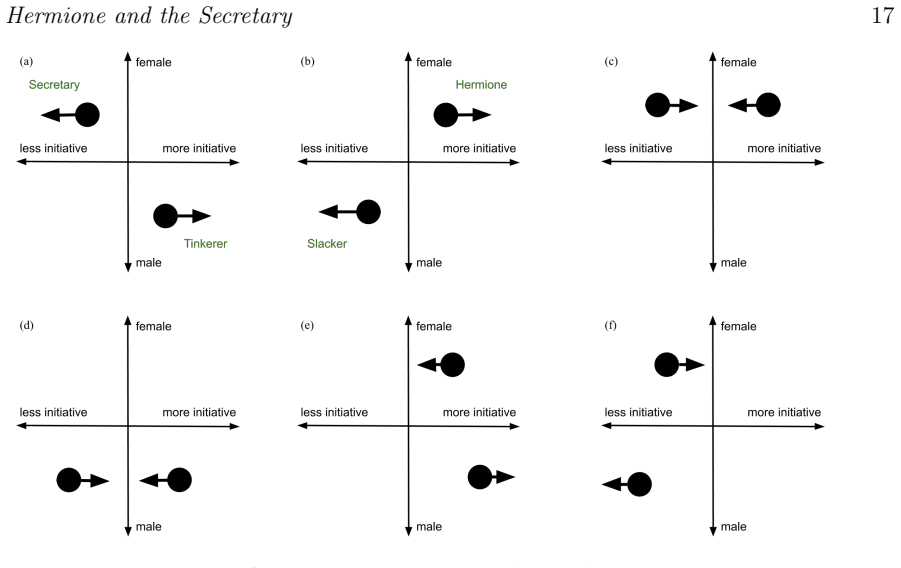
The load-bearing machinery is the physics identity framework, with its three constructs — perceived recognition, interest, and self-efficacy — applied to the two newly named archetypes, Secretary (and Tinkerer) and Hermione (and Slacker). The paper pairs these archetypes with a proposed dynamics model in which a student's initiative and gender identification act as inputs: a small initiative gap in a mixed-gender pair is amplified over time into asymmetric roles, while same-gender pairs, having less psychological distance, converge on equitable work. This machinery converts observed task division into claims about identity trajectories: each archetype blocks a specific identity input, for instance by denying the Secretary apparatus-time or by making the Hermione's recognition non-genuine.
What would settle it
A direct test would be to code, in a semester of mixed-gender introductory lab groups, who actually touches the apparatus and who records data, and to measure physics identity with a validated instrument before and after the course. If women who spend most of their lab time in Secretary or Hermione roles show the same identity growth as men who tinker, the paper's central mechanism fails; if their identity growth is also unrelated to the amount of hands-on time, the proposed link between task division and identity would need major revision.
Extended reading notes
Core claim
The central claim is that students who negotiate "doing gender" while "doing physics" in a traditional mixed-gender introductory lab often fall into two gendered modes of work, and both limit physics and science identity development. In the Secretary-Tinkerer mode, men monopolize the apparatus and hands-on construction while women are relegated to data entry and analysis; in the Hermione-Slacker mode, women take on disproportionate managerial, preparatory, and compensatory labor while partners disengage. Using an identity framework built on perceived recognition, interest, and self-efficacy, the authors argue that Secretaries miss out on low-stakes tinkering that builds experimental self-efficacy, and Hermiones spend their time on managerial work, receive recognition that they do not internalize as physics competence, and therefore also fail to grow as physics people. The authors claim this stunted growth perpetuates societal stereotypes about who belongs in physics.
Load-bearing premise
The load-bearing premise is that the roles students describe in interviews and the task divisions observers see in a single lab course can be read directly as stunted identity growth, without a longitudinal, behavioral, or independent measure of identity change.
Editorial extensions
If this is right
- Secretary and Hermione students are likely to leave the introductory lab with less growth in physics and science identity than their Tinkerer male partners, even when grades are equal.
- In the observation phase, none of the roughly twenty students identified as playing the Hermione role were men, indicating that these inequitable modes of work are strongly gendered in practice.
- Same-gender lab groups tend to divide work equitably regardless of differences in initiative, while mixed-gender groups tend to separate into asymmetric roles over the course of the semester.
- Instructional moves such as rotating group composition, assigning rotating experimenter/recorder roles, avoiding isolation of underrepresented students, building in individual tinkering time, and using structured task scaffolding can reduce these inequities, but only when teaching assistants genuinely support them.
- A division of labor that looks fair on its surface — one person handles the data, the other the apparatus — can still be inequitable in identity terms because it denies one student the chance to develop hands-on experimental skills.
Reading between the lines
- An implication the paper leaves implicit is that the Secretary and Hermione archetypes likely generalize beyond gender to any pairing where an identity difference creates psychological distance, so similar dynamics may appear along lines of race, ethnicity, or first-generation status; the authors note race as future work.
- A testable consequence follows for lab instruction: if the mechanism is correct, structured role rotation plus individual tinkering time should reduce gender gaps on attitude and identity surveys even when the lab content stays the same.
- The same archetypes may persist into upper-division and research labs, where women are known to take on more housekeeping and managerial work; the paper's vocabulary gives researchers a way to name and measure that division.
- The initiative-based model predicts that interventions should target the first hour of group formation, when the authors observe role solidification to be most pronounced.
Signed reviews
Editorial analysis
A structured set of objections, weighed in public.
Referee Report
Summary. The paper reports a qualitative study of introductory physics laboratory courses, drawing on more than 100 hours of reflexive ethnographic observation and 18 end-of-semester interviews. It identifies two gendered modes of task division in mixed-gender groups: the Secretary-Tinkerer mode, in which women are relegated to data recording and note-taking while men monopolize the apparatus, and the Hermione-Slacker mode, in which women take on a disproportionate managerial role while male partners contribute minimally. Using a physics identity framework built on perceived recognition, interest, and self-efficacy, the authors argue that these roles stunt women's physics and science identity development. They propose a model in which initial differences in 'initiative' plus gender-based psychological distance lead to role solidification, and they offer five instructional strategies aimed at reducing these inequitable patterns.
Significance. If the descriptive taxonomy and the proposed mechanisms hold, the paper provides a valuable and actionable vocabulary for discussing equity in undergraduate physics labs. The extensive ethnographic observation, the transparent discussion of researcher positionality, the rich interview excerpts, and the concrete teaching implications are genuine strengths. The identity-stunting claim, however, is central to the title and general discussion and is not directly supported by the study design. The paper is best understood as a preliminary qualitative model of gendered task division and its likely consequences; its contribution would be stronger if the causal language were calibrated to the evidence.
major comments (3)
- [Sec. 5 (General Discussion); Sec. 4.1; Fig. 1] The central claim that Secretary and Hermione roles 'stunt' physics and science identity development is a claim about within-person change over time, but the study provides no longitudinal or baseline identity data. All interviews were conducted at the end of the semester (Sec. 3.3), and identity growth is inferred from retrospective narratives. The data are equally consistent with a selection explanation: students who already have lower physics self-efficacy or interest may preferentially settle into these roles. The paper itself makes this point for Leah in Sec. 4.1 and encodes it in Fig. 1, where initial initiative drives role adoption. As written, the title and General Discussion overstate what the evidence can establish. The authors should either soften the language to 'limited opportunities for identity development' or explicitly frame the identity-stunting mechanism as a hypothesis requiring longitudinal or baseline-comparison data.
- [Sec. 3.3 and Table 1; end of Sec. 4.2] The paper compares identity growth of Secretaries and Hermiones 'in comparison with their peers in same-gender groups,' but Table 1 shows that all but one interviewed student worked in a mixed-gender group for at least part of the course, and no same-gender-group interviews are reported. The sole basis for the comparison is the observational statement in Sec. 3.3 that same-gender groups 'tended to collaborate much more effectively and equitably.' That observation concerns collaboration patterns, not identity outcomes, and it is not accompanied by comparable interview or identity data from same-gender groups. The same-gender comparison should be either removed or explicitly labeled as an observational impression rather than an empirical result.
- [Sec. 4.2 (Zara and Kamala interviews)] The step from task division to identity harm relies on a specific interpretive move: when students such as Zara and Kamala dismiss or fail to internalize praise from partners, the authors read this as evidence of unrecognized competence and therefore stunted identity growth. This is a plausible reading, but it is not the only one. Students may simply be offering a realistic assessment of their managerial role, or they may be expressing modesty rather than a deficit in identity. Because the interview transcripts are used both to define the archetypes and to demonstrate their identity consequences, the analysis risks confirmatory interpretation. The authors should acknowledge this interpretive step explicitly and, ideally, triangulate it with a non-self-report measure or an independent coding scheme.
minor comments (4)
- [Sec. 5] There is a typo in the sentence about Secretaries: 'physics or science science people' should read 'physics or science people.'
- [Sec. 3.3] The description of the interview analysis is brief. A short paragraph explaining how themes were generated, how the two investigators reconciled differences in coding, and whether any intercoder agreement check was used would improve the transparency of the qualitative analysis and help readers evaluate the robustness of the taxonomy.
- [Fig. 1] The text refers to panels 1a through 1f, but the figure caption describes only a general model. Please add panel labels to the figure and a corresponding sentence in the caption so that each panel's scenario is identifiable.
- [Sec. 5] The prevalence statement that 'of approximately 20 students in the Hermione role we identified during the observation phase... none of them were men' would be easier to evaluate if the paper reported the number of observed Secretary, Tinkerer, Hermione, and Slacker roles by gender, rather than only the Hermione count.
Circularity Check
No significant circularity: the archetypes are induced from observations and interviews, and the identity-framework interpretation is applied from external prior literature rather than being equivalent to the input by construction.
full rationale
This paper is a qualitative, interpretive study rather than a derivation chain, so the circularity patterns based on equations or fitted parameters do not apply. The Secretary/Tinkerer and Hermione/Slacker archetypes are built from ethnographic observations and interview excerpts (Sections 3.2-3.3 and 4.1-4.2), and the identity-framework constructs of perceived recognition, interest, and self-efficacy are taken from prior external literature (Section 2). The central claim that these roles stunt physics and science identity growth is an inference from the interview narratives and observational field notes, not a restatement of the definitions: the definitions describe task division, while the conclusion adds the identity-framework interpretation. A reviewer might question the lack of longitudinal or baseline identity measures, and the possibility of reverse causality (e.g., Leah's low self-efficacy leading her into a secretarial role), but those are validity or causal-direction concerns, not circularity. Self-citations such as refs [23], [40], [44], and [53] supply background empirical findings about self-efficacy and recognition gaps and are not load-bearing for the paper's taxonomy or its main interpretive conclusion. No uniqueness theorem, ansatz, or fitted parameter is imported via self-citation. Accordingly, no circular step can be exhibited by quoting a reduction of the conclusion to the input by construction.
Assumptions & free parameters
assumptions (4)
- domain assumption The identity framework's three constructs (recognition, interest, self-efficacy) are sufficient to characterize physics identity development.
- domain assumption Students actively 'do gender' while 'doing physics', causing gendered role negotiation.
- domain assumption Self-reported interview narratives reflect actual identity trajectories rather than post-hoc rationalizations.
- domain assumption Observational coding of archetypes is reliable across observers.
Cite this review
Pith. "Pith review of Hermione and the Secretary: How gendered task division in introductory physics labs can disrupt equitable learning." pith.science (2026). https://pith.science/paper/3WAEDWSI
@misc{pith2026190806827,
  author       = {Pith},
  title        = {Pith review of: Hermione and the Secretary: How gendered task division in introductory physics labs can disrupt equitable learning},
  year         = {2026},
  howpublished = {\url{https://pith.science/paper/3WAEDWSI}},
  note         = {Machine review of arXiv:1908.06827}
}
read the original abstract
Physics labs provide a unique opportunity for students to grow their physics identity and science identity in general since they provide students with opportunity to tinker with experiments and analyze data in a low-stakes environment. However, it is important to ensure that all students are benefiting from the labs equally and have a positive growth trajectory. Through interviews and reflexive ethnographic observations, we identify and analyze two common modes of work that may disadvantage female students in introductory physics labs. Students who adopt the Secretary archetype are relegated to recording and analyzing data, and thus miss out on much of the opportunity to grow their physics and science identities by engaging fully in the experimental work. Meanwhile, students in the Hermione mode shoulder a disproportionate amount of managerial work, and also do not get adequate opportunity to engage with different aspects of the experimental work that are essential for helping them develop their physics and science identities. Using a physics identity framework, we analyze interviews and observational data to investigate how students under these modes of work may experience stunted growth in their physics and science identity trajectories in their physics lab course. This stunted growth then perpetuates and reinforces societal stereotypes and biases about who does physics. This categorization not only gives a vocabulary to discussions about equity in the lab, but can also serve as a useful touchstone for those who seek to center equity in efforts to transform physics instruction.
Figures
Reference graph
Works this paper leans on
-
[1]
Gee J P 2000 Identity as an analytic lens for research in education Rev. Res. Educ. 25 99–125
work page 2000
-
[2]
Bergin S D, Murphy C and Shuilleabhain A N 2018 Exploring problem-based cooperative learning in undergraduate physics labs: student perspectives Eur. J. Phys. 39 025703
work page 2018
-
[3]
Galan D, Heradio R, de la Torre L, Dormido S and Esquembre F 2017 The experiment editor: supporting inquiry-based learning with virtual labs Eur. J. Phys. 38 035702
work page 2017
-
[4]
Sobhanzadeh M, Kalman C S and Thompson R I 2017 Labatorials in introductory physics courses Eur. J. Phys. 38 065702
work page 2017
-
[5]
Dunnett K, Gorman M N and Bartlett P A 2018 Assessing first-year undergraduate physics students’ laboratory practices: seeking to encourage research behaviours Eur. J. Phys. 40 015702
work page 2018
-
[6]
Kirkup L, Johnson S, Hazel E, Cheary R W, Green D C, Swift P and Holliday W 1998 Designing a new physics laboratory programme for first-year engineering students Phys. Educ 33 258–265
work page 1998
-
[7]
Neumann K and Welzel M 2007 A new labwork course for physics students: Devices, methods and research projects Eur. J. Phys. 28 S61–S69
work page 2007
-
[8]
Sokoloff D R, Laws P W and Thornton R K 2007 RealTime Physics: Active learning labs transforming the introductory laboratory Eur. J. Phys. 28
work page 2007
Show all 62 references
-
[9]
Koenig K, Wood K E, Bortner L J and Bao L 2019 Modifying traditional labs to target scientific reasoning J. of Coll. Sci. Teach. 48 28–35
2019
-
[10]
AAPT Committee on Laboratories 2015 AAPT Recommendations for the Undergraduate Physics Laboratory Curriculum (AAPT) Hermione and the Secretary 21
2015
-
[11]
Sharma M D, Mendez A, Sefton I M and Khachan J 2014 Student evaluation of research projects in a first-year physics laboratory Eur. J. Phys. 35 025004
2014
-
[12]
Parappilly M, Schmidt L and Ritter S D 2015 Ready to learn physics: a team-based learning model for first year university Eur. J. Phys. 36 055052
2015
-
[13]
Kortemeyer G and Kortemeyer A F 2018 The nature of collaborations on programming assignments in introductory physics courses: a case study Eur. J. Phys. 39 055705
2018
-
[14]
Nieminen P, Savainainen A, Nurkka N and Viiri J 2011 An intervention for using multiple representation of mechanics in upper secondary school courses Proceedings of the ESERA 2011 Conference ed Bruguire C, Tiberghien A and Clment P (Lyon)
2011
-
[15]
Johnson D W, Johnson R T and Smith K A 2014 Cooperative learning: Improving university instruction by basing practice on validated theory Journal on Excellence in University Teaching 25 1–26
2014
-
[16]
Singh C 2005 Impact of peer interaction on conceptual test performance Am. J. Phys. 73 446–451
2005
-
[17]
Cochran G L and Sabella M S 2008 Understanding and encouraging effective collaboration in introductory physics courses AIP Conference Proceedings vol 1064 (AIP) pp 95–98
2008
-
[18]
Heller P and Heller K 2001 Cooperative Group Problem Solving in Physics (Brooks/Cole Publishing Company)
2001
-
[19]
Karim N I, Maries A and Singh C 2018 Do evidence-based active-engagement courses reduce the gender gap in introductory physics? Eur. J. Phys. 39 025701
2018
-
[20]
Maries A, Karim N I and Singh C 2018 Is agreeing with a gender stereotype correlated with the performance of female students in introductory physics? Phys. Rev. Phys. Educ. Res. 14 020119
2018
-
[21]
Hazari Z, Sonnert G, Sadler P M and Shanahan M C 2010 Connecting high school physics experiences, outcome expectations, physics identity, and physics career choice: A gender study J. Res. Sci. Teach. 47 978–1003
2010
-
[22]
Aycock L M, Hazari Z, Brewe E, Clancy K B H, Hodapp T and Goertzen R M 2019 Sexual harassment reported by undergraduate female physicists Phys. Rev. Phys. Educ. Res. 15(1) 010121
2019
-
[23]
Marshman E M, Kalender Z Y, Nokes-Malach T, Schunn C and Singh C 2018 Female students with A’s have similar physics self-efficacy as male students with C’s in introductory courses: A cause for alarm? Phys. Rev. Phys. Educ. Res. 14 020123
2018
-
[24]
Porter A M and Ivie R 2019 Women in physics and astronomy, 2019 Tech. rep. Statistical Research Center of the American Institute of Physics
2019
-
[25]
Wilcox B R and Lewandowski H 2016 Research-based assessment of students’ beliefs about experimental physics: When is gender a factor? Phys. Rev. Phys. Educ. Res. 12 020130
2016
-
[26]
Holmes N, Roll I and Bonn D 2014 Participating in the physics lab: Does gender matter? Physics in Canada, Special Issue on Physics Education Research 70 84–86
2014
-
[27]
Quinn K N, McGill K L, Kelley M M, Smith E M and Holmes N 2018 Who does what now? How physics lab instruction impacts student behaviors Physics Education Research Conference 2018 (Washington, DC)
2018
-
[28]
Gonsalves A J, Danielsson A and Pettersson H 2016 Masculinities and experimental practices in physics: The view from three case studies Phys. Rev. Phys. Educ. Res. 12 020120
2016
-
[29]
Danielsson A T and Linder C 2009 Learning in physics by doing laboratory work: Towards a new conceptual framework Gend. Educ. 21 129–144
2009
-
[30]
Allie S, Armien M N, Burgoyne N, Case J M, Collier-Reed B I, Craig T S, Deacon A, Fraser D M, Geyer Z, Jacobs C, Jawitz J, Kloot B, Kotta L, Langdon G, le Roux K, Marshall D, Mogashana D, Shaw C, Sheridan G and Wolmarans N 2009 Learning as acquiring a discursive identity throu...
2009
-
[31]
West C and Zimmerman D H 1987 Doing gender Gend. Soc. 1 125–151
1987
-
[32]
Bug A 2003 Has feminism changed physics? Signs 28 881–899 ISSN 00979740, 15456943
2003
-
[33]
Schiebinger L 2000 Has feminism changed science? Signs 25 1171–1175 Hermione and the Secretary 22
2000
-
[34]
Freier M P 2014 The librarian in rowlings harry potter series CLCWeb: Comparative Literature and Culture 16 6
2014
-
[35]
Carlone H B and Johnson A 2007 Understanding the science experiences of successful women of color: Science identity as an analytic lens J. Res. Sci. Teach. 44 1187–1218
2007
-
[36]
Marriage Fam
Stryker S 1968 Identity salience and role performance: The relevance of symbolic interaction theory for family research J. Marriage Fam. 30 558–564
1968
-
[37]
Hyater-Adams S, Fracchiolla C, Finkelstein N and Hinko K 2018 Critical look at physics identity: An operationalized framework for examining race and physics identity Phys. Rev. Phys. Educ. Res. 14 010132
2018
-
[38]
Traxler A L, Cid X C, Blue J and Barthelemy R 2016 Enriching gender in physics education research: A binary past and a complex future Phys. Rev. Phys. Educ. Res. 12 020114
2016
-
[39]
Gosling C 2018 Identity as a research lens in science and physics education Journal of Belonging, Identity, Language, and Diversity 1 62–74
2018
-
[40]
Kalender Z Y, Marshman E, Schunn C D, Nokes-Malach T J and Singh C 2019 Gendered patterns in the construction of physics identity from motivational factors Phys. Rev. Phys. Educ. Res. 15(2) 020119
2019
-
[41]
Bandura A 1991 Social cognitive theory of self-regulation Organ. Behav. Hum. Decis. Process 50 248–287
1991
-
[42]
Bandura A 1982 Self-efficacy mechanism in human agency. Am. Psychol 37 122
1982
-
[43]
Godwin A, Potvin G, Hazari Z and Lock R 2016 Identity, critical agency, and engineering: An affective model for predicting engineering as a career choice J. Eng. Educ. 105 312–340
2016
-
[44]
Kalender Z Y, Marshman E, Schunn C D, Nokes-Malach T J and Singh C 2019 Why female science, technology, engineering, and mathematics majors do not identify with physics: They do not think others see them that way Phys. Rev. Phys. Educ. Res. 15(2) 020148
2019
-
[45]
Dounas-Frazer D R, Stanley J T and Lewandowski H J 2017 Student ownership of projects in an upper-division optics laboratory course: A multiple case study of successful experiences Phys. Rev. Phys. Educ. Res. 13(2) 020136
2017
-
[46]
Schwartzstein R M, Rosenfeld G C, Hilborn R, Oyewole S H and Mitchell K 2013 Redesigning the MCAT exam: Balancing multiple perspectives Acad. Med. 88 560–567
2013
-
[47]
Laws P W, Rosborough P J and Poodry F J 1999 Women’s responses to an activity-based introductory physics program Am. J. Phys. 67 32–37
1999
-
[48]
Milto E, Rogers C and Portsmore M 2002 Gender differences in confidence levels, group interactions, and feelings about competition in an introductory robotics course 32nd Annual Frontiers in Education vol 2 (IEEE)
2002
-
[49]
Day J, Stang J B, Holmes N G, Kumar D and Bonn D A 2016 Gender gaps and gendered action in a first-year physics laboratory Phys. Rev. Phys. Educ. Res. 12(2) 020104
2016
-
[50]
Buscatto M 1997 Practising reflexivity in ethnography Qualitative Research ed Silverman D (Sage) chap 9, pp 137–151
1997
-
[51]
Otero V K and Harlow D B 2009 Getting started in qualitative physics education research Reviews in PER Vol 2 1–67
2009
-
[52]
Banaji M R and Greenwald A G 2016 Blindspot: Hidden biases of good people (Bantam)
2016
-
[53]
Whitcomb K M, Kalender Z Y, Nokes-Malach T J, Schunn C and Singh C 2019 Inconsistent gender differences in self-efficacy and performance for engineering majors in physics and other disciplines: A cause for alarm? Physics Education Research Conference 2019 PER Conference (Provo, UT)
2019
-
[54]
Barthelemy R S, McCormick M and Henderson C 2016 Gender discrimination in physics and astronomy: Graduate student experiences of sexism and gender microaggressions Phys. Rev. Phys. Educ. Res. 12 020119
2016
-
[55]
Kreth M L 2000 A survey of the co-op writing experiences of recent engineering graduates IEEE Trans. Prof. Commun. 43 137–152
2000
-
[56]
Camacho M M and Lord S M 2011 Microaggressions in engineering education: Climate for asian, Hermione and the Secretary 23 latina and white women 2011 Frontiers in Education Conference (FIE) (IEEE)
2011
-
[57]
Trope Y and Liberman N 2010 Construal-level theory of psychological distance Psychol. Rev. 117 440
2010
-
[58]
Part 2: Designing problems and structuring groups Am
Heller P and Hollabaugh M 1992 Teaching problem solving through cooperative grouping. Part 2: Designing problems and structuring groups Am. J. Phys. 60 637–644
1992
-
[59]
Crowley K, Callanan M A, Tenenbaum H R and Allen E 2001 Parents explain more often to boys than to girls during shared scientific thinking Psychol. Sci. 12 258–261
2001
-
[60]
Goertzen R M, Scherr R E and Elby A 2009 Accounting for tutorial teaching assistants’ buy-in to reform instruction Phys. Rev. ST Phys. Educ. Res. 5(2) 020109
2009
-
[61]
Wilcox M, Yang Y and Chini J J 2016 Quicker method for assessing influences on teaching assistant buy-in and practices in reformed courses Phys. Rev. Phys. Educ. Res. 12(2) 020123
2016
-
[62]
Doucette D, Clark R and Singh C to be published All aboard! Challenges and successes in training lab TAs Physics Education Research Conference 2019
2019
Reviewed August 14, 2026 · model on record in the stance chip above.
Discussion (0). Continue with ORCID to comment.