REVIEW 3 major objections 5 minor 46 references
Non-Abelian gauge potential driven localization transition in quasiperiodic optical lattices
T0 review · 3 major / 5 minor · reviewed 2026-08-14 · deepseek-v4-flash
Pith's one-line read The central claim is that adding a non-Abelian SU(2) gauge potential to a quasiperiodic AAH optical lattice makes the model self-dual and yields four localization phases — pure delocalization, two coexistence phases, and pure localization.
desk verdict A genuinely new self-dual non-Abelian AAH model, but the four-phase diagram rests on an unvalidated 1e-7 band-width cutoff and needs stronger numerics before I'd trust it. read the letter →
The pith
A machine-rendered reading of the paper's core claim, the machinery that carries it, and where it could break.
The reading
What carries the argument
The central object is the non-Abelian AAH Hamiltonian obtained from the Hofstadter Hamiltonian with a constant SU(2) gauge potential $\mathbf{A} = (q\sigma_y,\, 2\pi\Omega m\,\sigma_0 + q\sigma_x,\, 0)$ via Peierls substitution. The argument is carried by the exact Fourier duality between the real-space Hamiltonian Eq. (6) and its dual Eq. (7): the two are the same form with $\lambda$ replaced by $1/\lambda$, so a state extended at $(\lambda,q)$ maps to a state localized at $(1/\lambda,q)$. The phase diagram is extracted from the total band widths $W_r$ and $W^*$ of the real- and dual-space spectra, computed on Fibonacci superlattice approximants; a coexistence phase is identified when both widths remain above a numerical threshold of $1.0\times10^{-7}$.
What would settle it
Perform a finite-size scaling study at a point inside the claimed coexistence region (for example, $\lambda = 1.2$, $q = 0.3\pi$): compute $W_r$ and $W^*$ for Fibonacci approximants with increasing period $F_l$; if either width decays to zero as the period grows, the coexistence phase is a finite-size artifact and the central claim fails. Alternatively, directly search for an energy-resolved mobility edge in the density of participation ratios at that point; if no energy separates localized from extended states in the thermodynamic limit, the claim fails.
Extended reading notes
Core claim
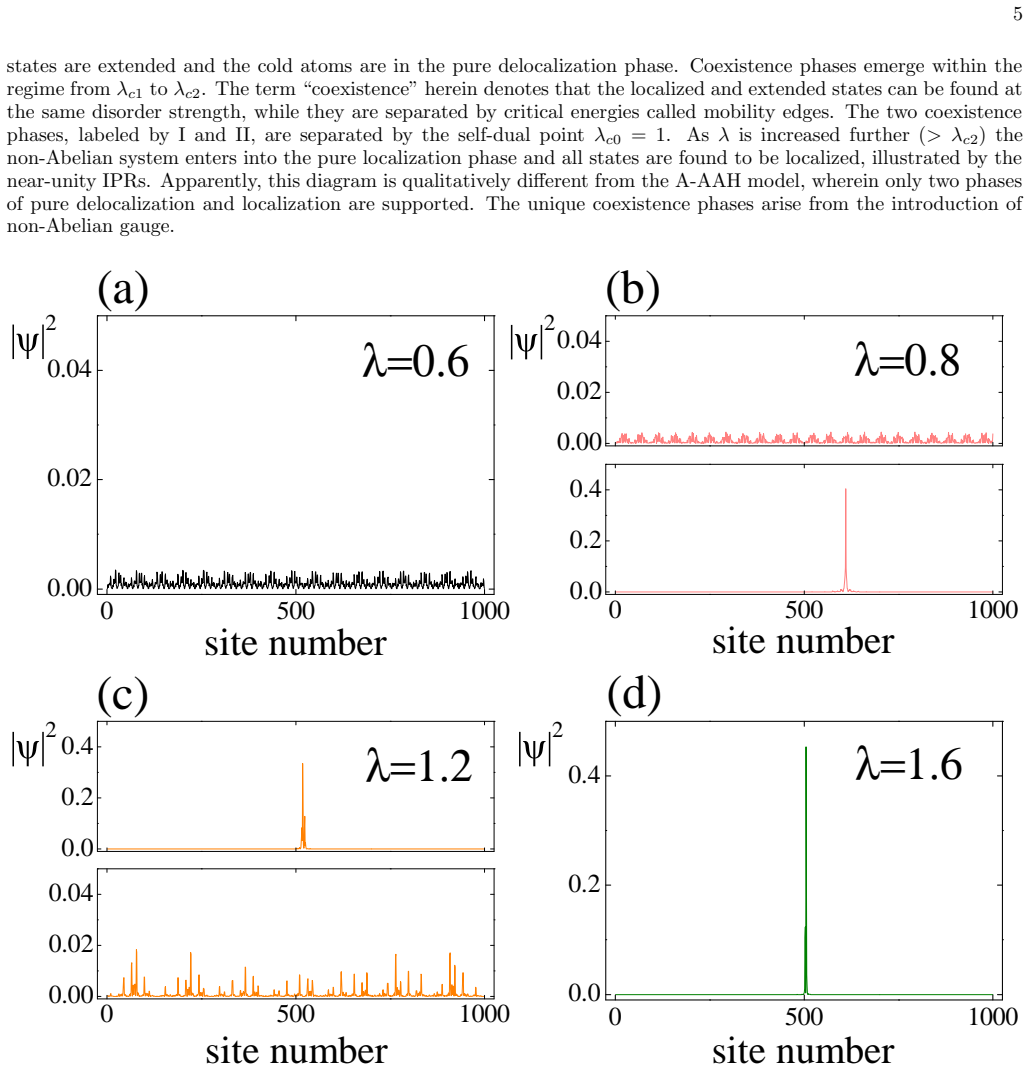
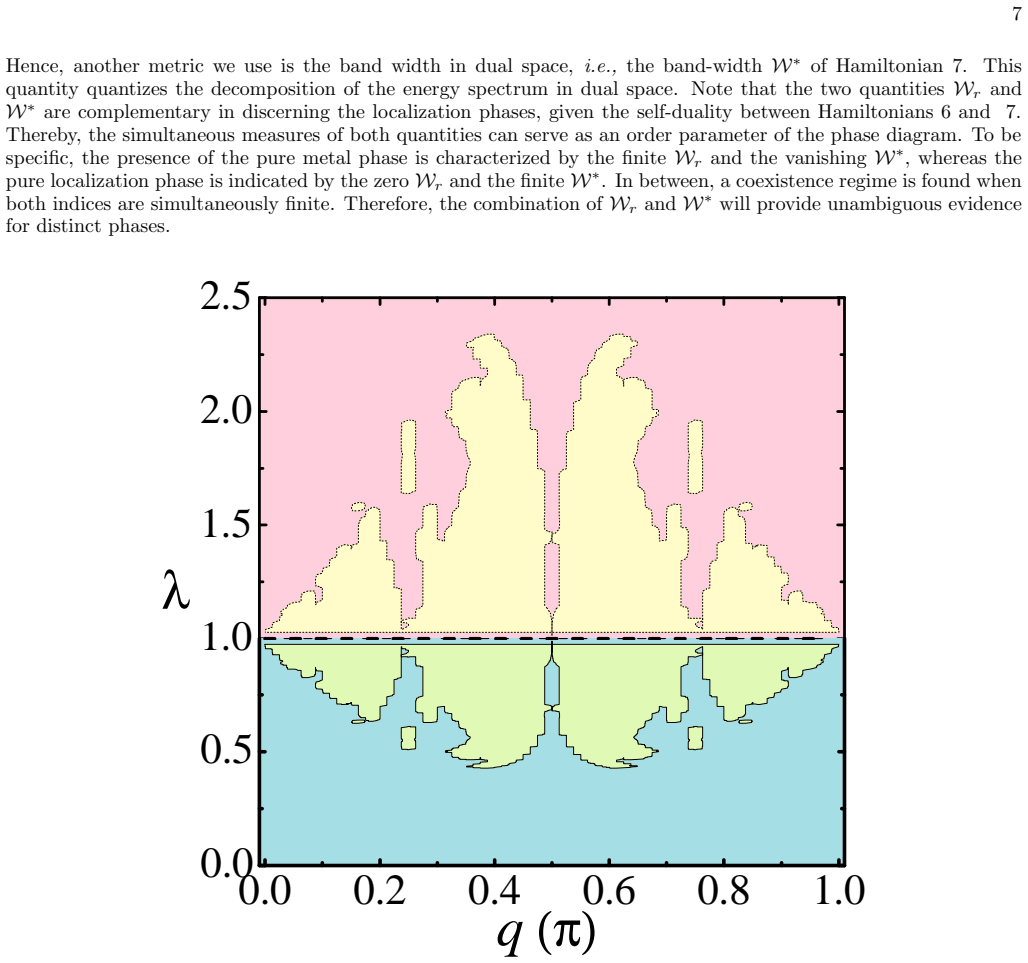
The central claim is that the non-Abelian AAH Hamiltonian of Eq. (6) is self-dual under Fourier transformation: its dual, Eq. (7), has the same matrix structure with the hopping and modulation strengths interchanged, so $\lambda \leftrightarrow 1/\lambda$ is a symmetry. This fixes $\lambda_{c0}=1$ as a transition line, but unlike the Abelian AAH model, the phase diagram is not simply metal versus insulator. Numerical IPR and spectral band-width calculations show four regions in the $(\lambda,q)$ plane — pure delocalization, coexistence I, coexistence II, and pure localization — where the coexistence regions are diagnosed by simultaneously nonzero real-space and dual-space band widths. The paper concludes that the non-Abelian gauge drives a metal-to-coexistence-to-insulator transition and that the $q = 0$, $\pi/2$, and $\pi$ limits reproduce the Abelian behavior.
Load-bearing premise
The existence and location of the coexistence phases rest on the numerical criterion that a phase is coexisting only when both the real-space and dual-space band widths exceed $1.0\times10^{-7}$ at the largest Fibonacci approximant studied, together with the assumption that these approximants have converged to the infinite quasiperiodic limit.
Editorial extensions
If this is right
- For $0<q<\pi/2$ and $\pi/2<q<\pi$, tuning $\lambda$ across the two critical lines switches the system between pure metal, coexistence with mobility edges, and pure insulator, so the non-Abelian gauge acts as a tunable source of mobility edges.
- The self-dual line $\lambda_{c0}=1$ separates two distinct coexistence phases, meaning the same physical parameters support two different mixed phases that can be probed separately.
- At $q=0$, $\pi/2$, and $\pi$, the model reduces to decoupled Abelian replicas or an Abelian flux model, so the coexistence phases disappear and the standard AAH transition is recovered.
- The simultaneous band-width criterion ($W_r>0$ and $W^*>0$) provides a practical, general diagnostic for identifying coexistence phases in other quasiperiodic systems.
Reading between the lines
- If the $\lambda\leftrightarrow 1/\lambda$ symmetry of the phase diagram is exact, then the two coexistence boundaries should satisfy $\lambda_{c2}(q) = 1/\lambda_{c1}(q)$; measuring one boundary would determine the other.
- In a cold-atom implementation, the coexistence phases should appear in time-of-flight images as a mixture of ballistic and localized components, with the ratio controlled by $\lambda$ and $q$.
- The same construction — adding a constant SU(2) gauge to a self-dual quasiperiodic model — may generate coexistence phases in other self-dual families (e.g., power-law hopping), offering a general route to mobility-edge engineering.
Signed reviews
Editorial analysis
A structured set of objections, weighed in public.
Referee Report
Summary. The manuscript studies a non-Abelian generalization of the Aubry-André-Harper (AAH) model, obtained from a two-component Hofstadter Hamiltonian with an SU(2) gauge potential. The authors derive a Fourier self-duality (Sec. III A), and then use inverse participation ratios and the total band widths of the real-space and dual-space spectra, Wr and W*, to construct a λ–q phase diagram (Fig. 4). They claim that increasing λ at fixed q drives the system through pure delocalization, coexistence phase I, coexistence phase II, and pure localization, with the two coexistence phases separated by the self-dual line λc0=1 and absent at q=0, π/2, and π.
Significance. The self-duality derivation is clean, and the physical motivation in terms of non-Abelian gauge potentials for ultracold atoms is sound. If the phase diagram is correct, the paper establishes a qualitatively new localization scenario relative to the Abelian AAH model and makes falsifiable predictions that could be probed in cold-atom experiments. The numerical calculations are deterministic and contain no fitted parameters, and the use of spectral band widths in both real and dual space is a sensible diagnostic idea. However, the central phase diagram is only as reliable as the convergence and threshold assumptions behind the Wr/W* classification, and those assumptions are not established in the manuscript.
major comments (3)
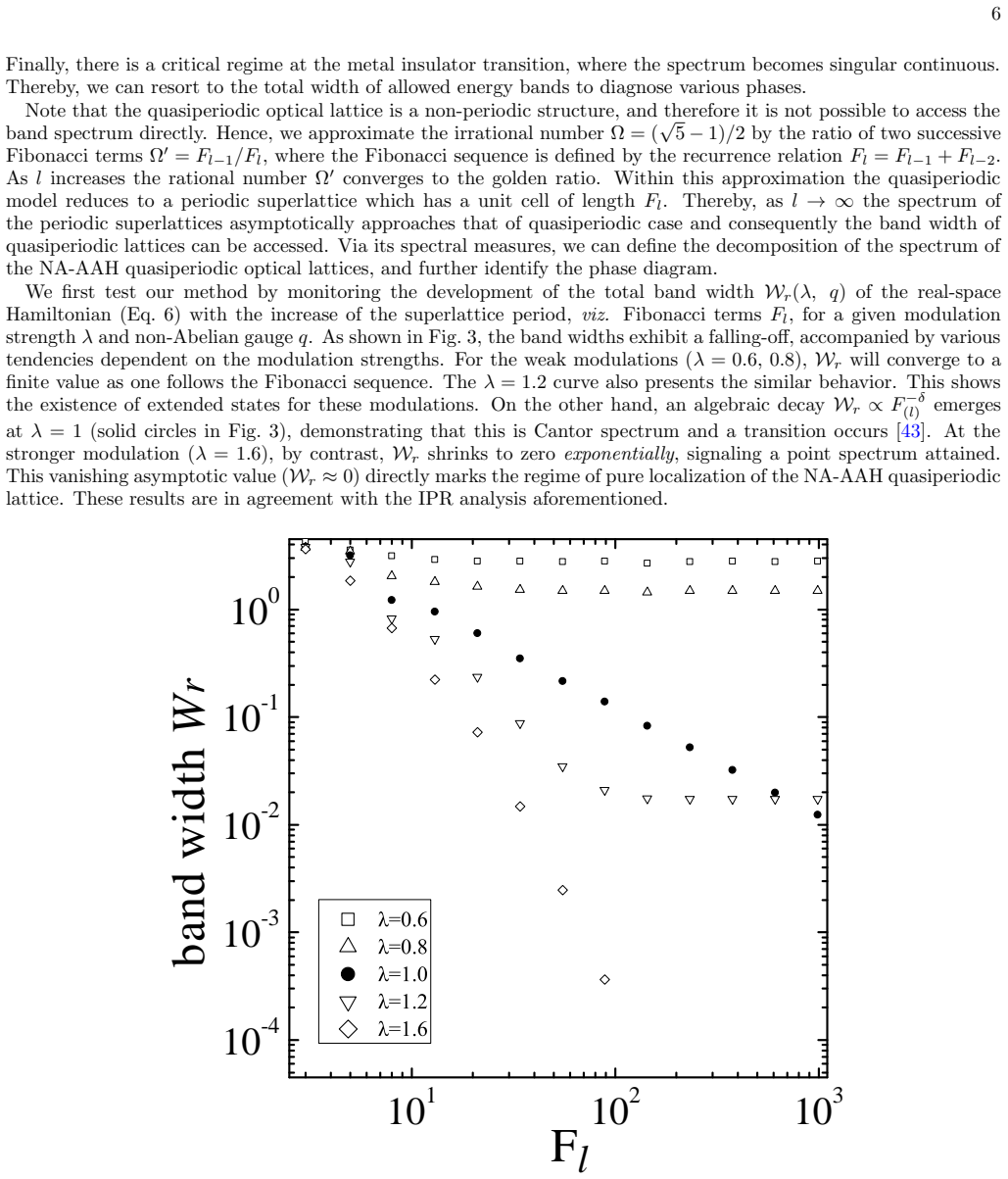
- [Sec. III B, Fig. 4] The phase diagram is obtained by declaring Wr > 1.0×10^{-7} and W* > 1.0×10^{-7} to define the coexistence region, with the threshold described only as a matter of computational accuracy. This threshold is not tested for sensitivity. Because the band widths in Fig. 3 fall by many orders of magnitude over the Fibonacci sequence, a tail that is merely small at the largest computed Fl would be classified as zero, moving the boundaries of the yellow coexistence region; the isolated reentrant islands in Fig. 4 are exactly the kind of fine structure that a hard cutoff can create or remove. The authors should provide threshold-sweep results (for example, thresholds of 10^{-6} and 10^{-8}) and finite-size scaling or extrapolation of Wr and W* to establish the coexistence regions.
- [Sec. III B, Fig. 3] Convergence of the Fibonacci superlattice approximants to the quasiperiodic limit is asserted but not quantified. The text states that Wr for λ = 0.6, 0.8, and 1.2 converges to a finite value, that λ = 1 shows algebraic decay, and that λ = 1.6 shows exponential decay, but no largest Fibonacci index, no fitting form, and no extrapolation rule are given. The same convergence analysis is not shown for W*, although the phase diagram depends on both quantities. Without this information, the classification of a band width as finite or vanishing is not reproducible.
- [Sec. III B, p. 6] The criterion that simultaneously finite Wr and W* serves as an order parameter for coexistence is an assumption rather than a proven equivalence. A finite total real-space band width together with a vanishing dual-space width is claimed to indicate a pure metal, but the text does not directly verify this diagnostic against the actual presence of mobility edges. The authors should validate the criterion on a model with a known mobility edge, or against their own IPR data at fixed λ, before using it to locate the phase boundaries.
minor comments (5)
- [Eq. (3)] The IPR definition does not specify how the two-component spinor wave function is normalized; please state explicitly the norm and the summation over spin components and lattice sites.
- [Sec. III B] The symbol W* is introduced verbally but never defined precisely; please state whether it is the total band width of Eq. (7) computed with the same Fibonacci approximants and boundary conditions used for Wr.
- [Fig. 1] Figure 1 labels λc1 and λc2, but the text does not give their numerical values for q = 0.3π; please quote the values obtained from the spectral analysis.
- [Sec. III B, q = π/2] The statement that q = π/2 reduces Eq. (5) to the Abelian flux model is asserted without derivation; a short demonstration or a precise reference to [39] would make the special-case argument self-contained.
- [General] The manuscript contains several grammatical and typographical issues (for example, 'separatively', 'firstly', and 'the non-Abelian gauge involved drives'); a careful language edit is needed.
Circularity Check
No significant circularity: the self-duality is derived from the Hamiltonian, and the phase diagram is obtained by direct spectral computation.
full rationale
The paper's central derivations are self-contained. The NA-AAH Hamiltonian (Eq. 6) is transformed by Fourier transformation into Eq. 7, and the paper explicitly notes that Eq. 7 takes the same form as Eq. 6 with coefficient interchange, establishing self-duality without importing any target result. The phase diagram (Fig. 4) is extracted from computed total band widths Wr and W* of the real- and dual-space Hamiltonians, using a stated numerical threshold of 1.0e-7. This threshold is a diagnostic convention ('Due to the computational accuracy we take 1.0×10⁻⁷'), not a parameter fitted to reproduce the claimed phases; the existence of extended and localized states is independently supported by the IPR data (Fig. 1) and typical-state plots (Fig. 2). The only overlapping self-citation is Ref. [30] (Sun, Wang, Li, Nakayama), which appears in a list of prior works on coexistence phases in one-dimensional quasiperiodic models; it is not used as the basis for any conclusion here. No uniqueness theorem or ansatz is imported from the authors' prior work, and no known empirical result is renamed as a new prediction. The arbitrary threshold and the lack of explicit Fibonacci-convergence analysis are numerical-robustness concerns, not circularity.
Assumptions & free parameters
free parameters (1)
- band-width threshold epsilon =
1.0e-7
assumptions (4)
- domain assumption Peierls substitution with the non-Abelian gauge A = (qσ_y, 2πΩm σ0 + qσ_x, 0) yields the tight-binding Hamiltonian in Eq. (5), and this Hamiltonian describes ultracold atoms in a laser-assisted optical superlattice.
- domain assumption Spectral decomposition: absolutely continuous spectrum corresponds to extended states, pure point spectrum to localized states, and singular continuous spectrum to the transition, as in Refs [43,44].
- ad hoc to paper Simultaneously finite Wr and W* implies coexistence of extended and localized states in the same spectrum.
- standard math Fibonacci rational approximants Omega' = F_{l-1}/F_l converge to the golden ratio so that the band widths of periodic superlattices asymptotically reproduce the quasiperiodic spectrum.
Cite this review
Pith. "Pith review of Non-Abelian gauge potential driven localization transition in quasiperiodic optical lattices." pith.science (2026). https://pith.science/paper/KXTJQ4VY
@misc{pith2026190806839,
  author       = {Pith},
  title        = {Pith review of: Non-Abelian gauge potential driven localization transition in quasiperiodic optical lattices},
  year         = {2026},
  howpublished = {\url{https://pith.science/paper/KXTJQ4VY}},
  note         = {Machine review of arXiv:1908.06839}
}
read the original abstract
Gauge potential is an emergent concept in systems of ultracold atomic gases. Derived from quantum waves immersed in an \emph{Abelian} gauge, the quasiperiodic Aubry-Andre-Harper (AAH) model is a simple yet powerful Hamiltonian to study the Anderson localization of ultracold atoms. In this work, we investigate the localization properties of ultracold atoms trapped in quasiperiodic optical lattices subject to a non-Abelian gauge, which can be depicted by a family of non-Abelian AAH models. We identify that the non-Abelian AAH models can bear the self-duality under the Fourier transformation. We thus analyze the localization transition of this self-dual non-Abelian quasiperiodic optical lattices, revealing that the non-Abelian gauge involved drives a transition from a pure delocalization phase, then to coexistence phases, and then finally to a pure localization phase. This is in stark contrast to the Abelian AAH model that does not support the coexistence phases. Our results thus comprise a new insight on the fundamental aspects of Anderson localization in quasiperiodic systems, from the perspective of non-Abelian gauge.
Figures

Figures from the paper (1 more)
Reference graph
Works this paper leans on
-
[45]
Phase diagram of a non-Abelian Aubry-Andr´ e-Harper model with p-wave superfluidity,
Jun Wang, Xia-Ji Liu, Gao Xianlong, and Hui Hu, “Phase diagram of a non-Abelian Aubry-Andr´ e-Harper model with p-wave superfluidity,” Phys. Rev. B 93, 104504 (2016)
work page 2016
-
[46]
Metal-Insulator Transition Revisited for Cold Atoms in Non-Abelian Gauge Potentials,
I. Satija, D. Dakin, and C. Clark, “Metal-Insulator Transition Revisited for Cold Atoms in Non-Abelian Gauge Potentials,” Phys Rev. Lett. 97, 216401 (2006)
work page 2006
-
[1]
Significance of electromagnetic potentials in the quantum theory,
Y. Aharonov and D. Bohm, “Significance of electromagnetic potentials in the quantum theory,” Phys. Rev. 115, 485 (1959)
work page 1959
-
[2]
Artifical Gauge Fields with Ultracold Atoms,
V. Galitski, Ian Spielman, and G. Juzeli¯ unas, “Artifical Gauge Fields with Ultracold Atoms,” Physics Today72, 39 (2019)
work page 2019
-
[3]
D. Jaksch and P. Zoller, “Creation of effective magnetic fields in optical lattices: the Hofstadter butterfly for cold neutral atoms,” New J. Phys. 5, 56 (2003)
work page 2003
-
[4]
Cold Atoms in Non-Abelian Gauge Potentials: From the Hofstadter Moth to Lattice Gauge,
K. Osterloh, M. Baig, L. Santos, P. Zoller, and M. Lewenstein, “Cold Atoms in Non-Abelian Gauge Potentials: From the Hofstadter Moth to Lattice Gauge,” Phys. Rev. Lett. 95, 010403 (2005)
work page 2005
-
[5]
Non-Abelian Gauge Potentials for Ultracold Atoms with Degenerate Dark States,
J. Ruseckas, G. Juzeli¯ unas, P. ¨Ohberg, and M. Fleischhauer, “Non-Abelian Gauge Potentials for Ultracold Atoms with Degenerate Dark States,” Phys. Rev. Lett. 95, 010404 (2005)
work page 2005
-
[6]
Artificial gauge potentials for neutral atoms,
Jean Dalibard, Fabrice Gerbier, Gediminas Juzeli¯ unas, and Patrik¨Ohberg, “Artificial gauge potentials for neutral atoms,” Rev. Mod. Phys. 83, 1523 (2011)
work page 2011
Show all 46 references
-
[7]
Light-induced gauge fields for ultracold atoms,
N. Goldman, G. Juzeli¯ unas, P.¨Ohberg, I. B. Spielman, “Light-induced gauge fields for ultracold atoms,” Rep. Prog. Phys. 77, 126401 (2014)
2014
-
[8]
Artificial gauge fields in materials and engineered systems,
M. Aidelsburger, S. Nascimbene, and N. Goldman, “Artificial gauge fields in materials and engineered systems,” C. R. Phys. 19, 394 (2018)
2018
-
[9]
Appearance of Gauge Structure in Simple Dynamical Systems,
F. Wilczek and A. Zee, “Appearance of Gauge Structure in Simple Dynamical Systems,” Phys. Rev. Lett. 52, 2111 (1984)
1984
-
[10]
Absence of Diffusion in Certain Random Lattices,
P. W. Anderson, “Absence of Diffusion in Certain Random Lattices,” Phys. Rev. 109, 1492 (1958)
1958
-
[11]
Scaling Theory of Localization: Absence of Quantum Diffusion in Two Dimensions,
E. Abrahams, P. W. Anderson, D. C. Licciardello, and T. V. Ramakrishnan, “Scaling Theory of Localization: Absence of Quantum Diffusion in Two Dimensions,” Phys. Rev. Lett. 42, 673 (1979)
1979
-
[12]
Disordered electronic systems,
P. A. Lee and T. V. Ramakrishnan, “Disordered electronic systems,” Rev. Mod. Phys. 57, 287 (1985)
1985
-
[13]
Localization theory and experiment,
B. Kramer and A. MacKinnon, “Localization theory and experiment,” Rep. Prog. Phys. 56, 1469 (1993)
1993
-
[14]
Anderson transitions,
F. Evers and A. D. Mirlin, “Anderson transitions,” Rev. Mod. Phys. 80, 1355 (2008)
2008
-
[15]
Many-body physics with ultracold gases,
I. Bloch, J. Dalibard, and W. Zwerger, “Many-body physics with ultracold gases,” Rev. Mod. Phy. 80, 885 (2008). 9
2008
-
[16]
Coherent Backscattering of Ultracold Atoms,
F. Jendrzejewski et al ., “Coherent Backscattering of Ultracold Atoms,” Phys. Rev. Lett. 109, 195302 (2012)
2012
-
[17]
Suppression and Revival of Weak Localization through Control of Time-Reversal Symmetry,
K. M¨ ulleret al., “Suppression and Revival of Weak Localization through Control of Time-Reversal Symmetry,” Phys. Rev. Lett. 114, 205301 (2015)
2015
-
[18]
Direct observation of Anderson localization of matter waves in a controlled disorder ,
J. Billy et al ., “Direct observation of Anderson localization of matter waves in a controlled disorder ,” Nature 453, 891 (2008)
2008
-
[19]
Anderson localization of a non-interacting Bose Einstein condensate,
G. Roati et al ., “Anderson localization of a non-interacting Bose Einstein condensate,” Nature 453, 895 (2008)
2008
-
[20]
Three-Dimensional Anderson Localization of Ultracold Matter,
S. S. Kondov, W. R. McGehee, J. J. Zirbel, and B. DeMarco, “Three-Dimensional Anderson Localization of Ultracold Matter,” Science 334, 66 (2011)
2011
-
[21]
Three-dimensional localization of ultracold atoms in an optical disordered potential,
F. Jendrzejewski et al ., “Three-dimensional localization of ultracold atoms in an optical disordered potential,” Nature Phys. 8, 398 (2012)
2012
-
[22]
Measurement of the mobility edge for 3D Anderson localization,
G. Semeghini et al ., “Measurement of the mobility edge for 3D Anderson localization,” Nat. Phys. 11, 554 (2015)
2015
-
[23]
Analyticity breaking and Anderson localization in incommensurate lattices,
S. Aubry and G. Andr´ e, “Analyticity breaking and Anderson localization in incommensurate lattices,” Ann. Isr. Phys. Soc. 3, 133 (1980)
1980
-
[24]
Single Band Motion of Conduction Electrons in a Uniform Magnetic Field,
P. G. Harper, “Single Band Motion of Conduction Electrons in a Uniform Magnetic Field,” Proc. Phys. Soc. A 68, 874 (1955)
1955
-
[25]
Mobility Edge in a Model One-Dimensional Potential,
S. Das Sarma, S. He, and X. C. Xie, “Mobility Edge in a Model One-Dimensional Potential,” Phys.Rev. Lett. 61, 2144 (1988)
1988
-
[26]
Localization by a Potential with Slowly Varying Period,
D. J. Thouless, “Localization by a Potential with Slowly Varying Period,” Phys. Rev. Lett. 61, 2141 (1988)
1988
-
[27]
Mobility edges in bichromatic optical lattices,
Dave J. Boers, Benjamin Goedeke, Dennis Hinrichs, and Martin Holthaus, “Mobility edges in bichromatic optical lattices,” Phys. Rev. A. 75, 063404 (2007)
2007
-
[28]
Predicted Mobility Edges in One-Dimensional Incommensurate Optical Lattices: An Exactly Solvable Model of Anderson Localization,
J. Biddle and S. Das Sarma, “Predicted Mobility Edges in One-Dimensional Incommensurate Optical Lattices: An Exactly Solvable Model of Anderson Localization,” Phys. Rev. Lett. 104, 070601 (2010)
2010
-
[29]
Nearest Neighbor Tight Binding Models with an Exact Mobility Edge in One Dimension,
S. Ganeshan, J. H. Pixley, and S. Das Sarma, “Nearest Neighbor Tight Binding Models with an Exact Mobility Edge in One Dimension,” Phys. Rev. Lett. 114, 146601 (2015)
2015
-
[30]
Localization-delocalization transition in self-dual quasiperiodic lattices,
M. L. Sun, G. Wang, N. B. Li, and T. Nakayama, “Localization-delocalization transition in self-dual quasiperiodic lattices,” Europhys. Lett. 110, 57003 (2015)
2015
-
[31]
Self-dual model for one dimensional incommensurate crystals including next-nearest- neighbor hopping, and its relation to the Hofstadter model,
M. Johansson and R. Riklund, “Self-dual model for one dimensional incommensurate crystals including next-nearest- neighbor hopping, and its relation to the Hofstadter model,” Phys. Rev. B 43, 13468 (1991)
1991
-
[32]
Self-dual quasiperiodic systems with power-law hopping,
S. Gopalakrishnan, “Self-dual quasiperiodic systems with power-law hopping,” Phys. Rev. B 96, 054202 (2017)
2017
-
[33]
Quantum nonergodicity and fermion localization in a system with a single-particle mobility edge,
X. Li, J. H. Pixley, D. L. Deng, S. Ganeshan, and S. Das Sarma, “Quantum nonergodicity and fermion localization in a system with a single-particle mobility edge,” Phys. Rev. B 93, 184204 (2016)
2016
-
[34]
Mobility edges in one-dimensional bichromatic incommensurate potentials,
X. Li, X. Li and S. Das Sarma, “Mobility edges in one-dimensional bichromatic incommensurate potentials,” Phys. Rev. B 96, 085119 (2017)
2017
-
[35]
Anderson localization in one-dimensional quasiperiodic lattice models with nearest- and next-nearest-neighbor hopping,
L. Gong, Y. Feng, and Y. Ding, “Anderson localization in one-dimensional quasiperiodic lattice models with nearest- and next-nearest-neighbor hopping,” Phys. Lett. A 381, 588 (2017)
2017
-
[36]
Single-Particle Mobility Edge in a One-Dimensional Quasiperiodic Optical Lattice,
H. P. L¨ uschenet al., “Single-Particle Mobility Edge in a One-Dimensional Quasiperiodic Optical Lattice,” Phys. Rev. Lett. 120, 160404 (2018)
2018
-
[37]
Engineering a Flux-Dependent Mobility Edge in Disordered Zigzag Chains,
F. A. An, E. J. Meier, and B. Gadway, “Engineering a Flux-Dependent Mobility Edge in Disordered Zigzag Chains,” Phys. Rev. X 8, 031045 (2018)
2018
-
[38]
Energy levels and wave functions of Bloch electrons in rational and irrational magnetic fields,
D. R. Hofstadter, “Energy levels and wave functions of Bloch electrons in rational and irrational magnetic fields,” Phys. Rev. B 14, 2239 (1976)
1976
-
[39]
Non-Abelian Optical Lattices: Anomalous Quantum Hall Effect and Dirac Fermions,
N. Goldman, A. Kubasiak, A. Bermudez, P. Gaspard, M. Lewenstein, and M. A. Martin-Delgado, “Non-Abelian Optical Lattices: Anomalous Quantum Hall Effect and Dirac Fermions,” Phys. Rev. Lett. 103, 035301 (2009)
2009
-
[40]
Ultracold atomic gases in non-Abelian gauge potentials: The case of constant Wilson loop,
N. Goldman, A. Kubasiak, P. Gaspard, and M. Lewenstein, “Ultracold atomic gases in non-Abelian gauge potentials: The case of constant Wilson loop,” Phys. Rev. A 79, 023624 (2009)
2009
-
[41]
Massless Dirac fermions in a square optical lattice,
J. M. Hou, W. X. Yang, and X. J. Liu, “Massless Dirac fermions in a square optical lattice,” Phys. Rev. A 79, 043621 (2009)
2009
-
[42]
Wilson Fermions and Axion Electrodynamics in Optical Lattices,
A. Bermudez et al. , “Wilson Fermions and Axion Electrodynamics in Optical Lattices,” Phys. Rev. Lett. 105, 190404 (2010)
2010
-
[43]
Metal-Insulator Transition and Scaling for Incommensurate Systems,
M. Kohmoto, “Metal-Insulator Transition and Scaling for Incommensurate Systems,” Phys. Rev. Lett. 51, 1198 (1983)
1983
-
[44]
New Localization in a Quasiperiodic System,
H. Hiramoto and M. Kohmoto, “New Localization in a Quasiperiodic System,” Phys. Rev. Lett. 62, 2714 (1989)
1989
Reviewed August 14, 2026 · model on record in the stance chip above.
Discussion (0). Continue with ORCID to comment.