REVIEW 4 major objections 6 minor 22 references
Dynamic characterization of an alkali-ion battery as a source for laser-cooled atoms
T0 review · 4 major / 6 minor · reviewed 2026-08-14 · deepseek-v4-flash
Pith's one-line read This paper shows that a solid-state alkali-ion battery can act as a voltage-controlled source and sink of rubidium atoms for laser-cooled atom experiments, with MOT atom number set by loading time and sourcing voltage.
desk verdict Useful, incremental characterization of a reversible alkali-ion battery for cold-atom sources; the main trends hold up, but the charge-based electrochemistry claims rest on an unverified Faradaic-current assumption and five-point fits without error bars. read the letter →
The pith
A machine-rendered reading of the paper's core claim, the machinery that carries it, and where it could break.
The reading
What carries the argument
The central object is the alkali-ion battery (AIB): a sandwich of ion-conducting Rb-$\beta''$-alumina between an upper electrode array and a graphite reservoir that stores neutral Rb. Applying a positive voltage ionizes Rb in the graphite, drives Rb$^+$ through the alumina, and deposits neutral Rb on the upper surface, where it evaporates; reversing the voltage collects Rb from the vapor back into the reservoir. The argument couples the measured device current to atom transfer through chronoamperometry (integrating Faradaic charge) and explains the voltage dependence with the Butler-Volmer equation, with $1/\sqrt{t}$ current decay marking the diffusion-limited regime.
What would settle it
A control experiment in which the battery is assembled without rubidium in the reservoir, or with a blocked upper electrode, and the same voltage is applied: if a comparable current flows, or if the MOT atom number changes without Rb available, the integrated-charge model fails. Alternatively, an absolute measurement of the rubidium flux into the vapor (for example, with a hot-wire detector or absorption imaging calibrated against the MOT) that disagrees with the charge-derived atom count would falsify the claim.
Extended reading notes
Core claim
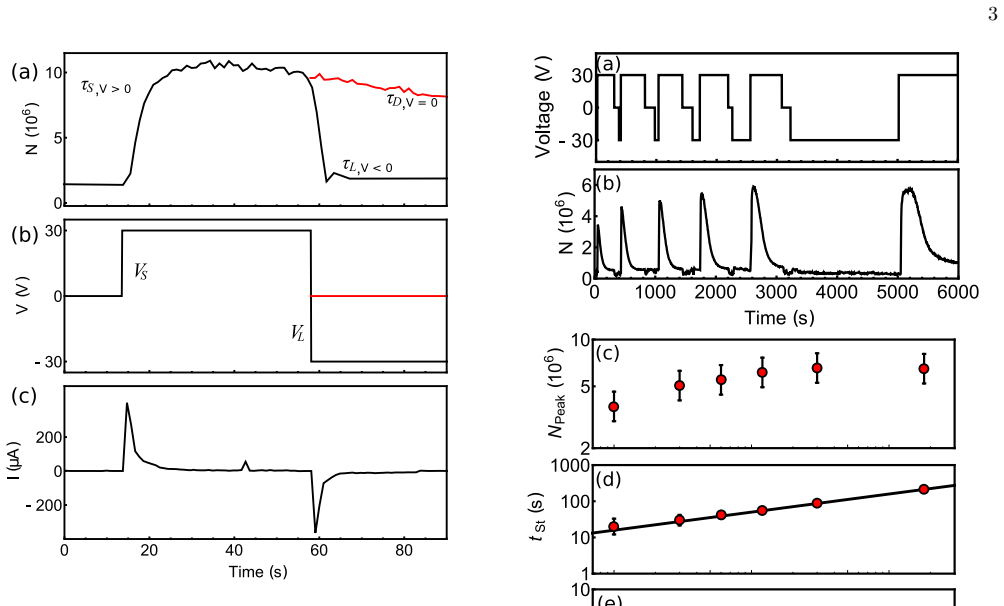
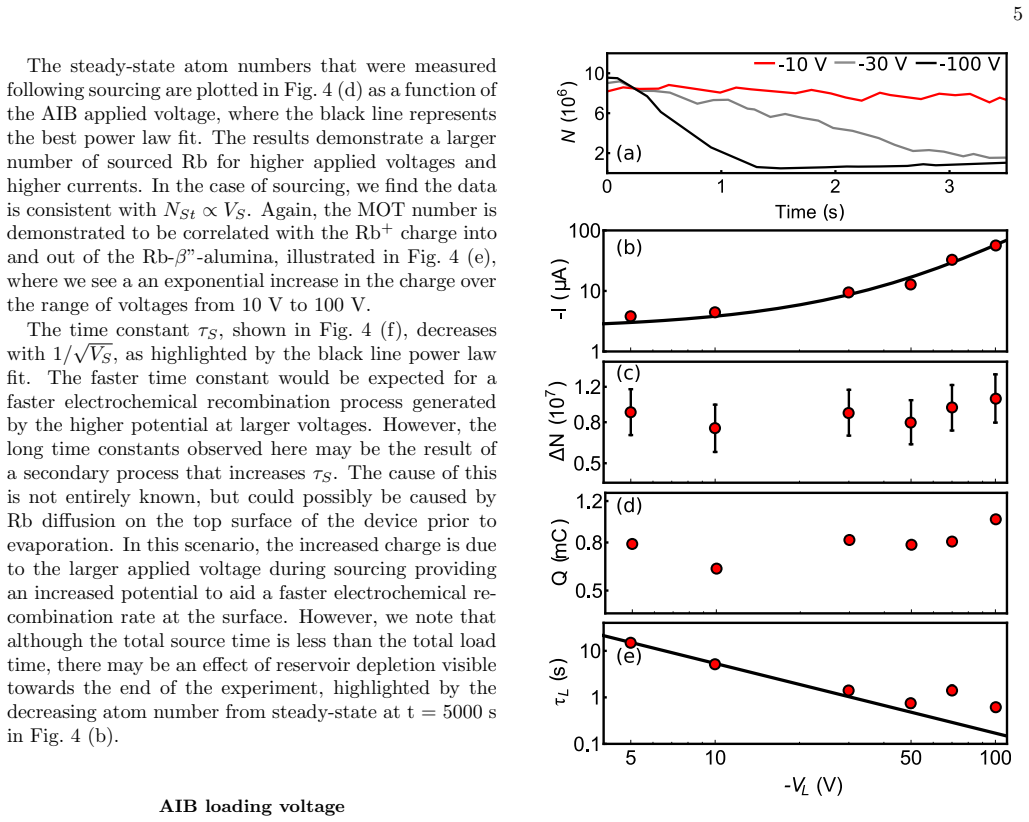
The central claim is that the MOT atom number is governed by two independently controllable battery parameters: the loading time $t_L$ (how long a negative voltage stores Rb from the vapor) and the sourcing voltage $V_S$ (the positive voltage that drives Rb out). Longer loading gives higher peak atom numbers and longer steady-state times, with the peak atom number, the steady-state duration, and the sourcing time constant $\tau_S$ all growing roughly as $\sqrt{t_L}$. Higher sourcing voltages give larger steady-state MOT numbers and faster sourcing, with $N_{St} \propto V_S$ and $\tau_S \propto 1/\sqrt{V_S}$. The response is a combined reaction-diffusion process: the current decays as $1/\sqrt{t}$, and the steady-state current rises exponentially with voltage as expected from Butler-Volmer kinetics. The same device actively removes Rb from the vapor on a 540 ms time scale at $-100$ V, much faster than the passive decay of about 130 s.
Load-bearing premise
The current measured through the battery is entirely carried by Rb$^+$ ions, with no significant electronic or leakage current, so that the time-integrated charge accurately equals the number of rubidium atoms transferred.
Editorial extensions
If this is right
- Combining a long loading time with a high sourcing voltage should give both a large MOT atom number and a fast sourcing time constant, since the atom number grows with $t_L$ and $V_S$ while $\tau_S$ falls with $V_S$.
- The AIB can actively pump alkali vapor from the cell on a sub-second timescale, enabling fast MOT loading at high density followed by rapid vapor removal for long trap lifetimes.
- Because the battery survives atmospheric exposure, alkali reservoirs can be pre-loaded before vacuum sealing, simplifying assembly of portable cold-atom instruments.
- The exponential voltage-current relation and $1/\sqrt{t}$ current decay indicate both reaction and diffusion limits, so electrode design changes could improve the achievable time constants.
Reading between the lines
- One could test whether the $\sqrt{t_L}$ scaling of source charge reflects bulk diffusion in the graphite reservoir; measuring $\tau_S$ versus loading time with different reservoir thicknesses would separate surface diffusion from bulk storage.
- The charge-to-atom calibration could be cross-checked by comparing the MOT fluorescence with an independent absolute rubidium density measurement; agreement would validate Faradaic charge as a true atom counter.
- A natural next step is closing the feedback loop with the MOT fluorescence signal as the sensor, letting the battery stabilize atom number against environmental drift rather than merely respond to open-loop voltage steps.
Signed reviews
Editorial analysis
A structured set of objections, weighed in public.
Referee Report
Summary. The manuscript reports an experimental study of a solid-state, reversible alkali-ion battery (AIB) used as a voltage-controlled source and sink of Rb atoms for a magneto-optical trap (MOT). The authors load Rb into the AIB from the background vapor, then apply positive or negative voltages to source or sink atoms, using MOT fluorescence as an in-situ diagnostic. They find that increasing the initial loading time increases the peak MOT number, steady-state duration, sourced charge, and sourcing time constant (all roughly as the square root of loading time); increasing the sourcing voltage increases the steady-state MOT number with a shorter sourcing time constant; and increasing the loading voltage decreases the loading time constant, with a floor near 540 ms. They also demonstrate storage of Rb through atmospheric exposure. The paper interprets the current transients and steady-state current-voltage behavior as evidence for a combined reaction-diffusion-limited regime.
Significance. The qualitative trends are plausible and directly visible in the raw traces, and the atmospheric-exposure resilience is a practical advance for compact cold-atom instruments. The use of the MOT itself as a chronoamperometric diagnostic is creative and gives time-resolved information on how operating parameters govern cold-atom number. However, the quantitative power-law claims (e.g., τL ∝ V_L^-1.5, NSt ∝ V_S) rest on fits to a small number of points with no reported uncertainties, and the electrochemical interpretation depends heavily on the unverified assumption that the measured current is purely Faradaic.
major comments (4)
- [Results, paragraph after Fig. 2] The paper states that "In these measurements, only the flow of Faradaic current is analyzed [18,19]" but no measurement or control experiment is reported that bounds leakage, capacitive, or electronic current. Because the manuscript integrates current to obtain charge Q and uses Q to support correlations with MOT atom number (Figs. 3(e), 4(e), 5(d)) and to infer Rb+ transport through the β''-alumina, the Faradaic assumption is load-bearing for the electrochemical characterization and the Butler-Volmer interpretation. Please add a leakage-current control (e.g., a depleted reservoir or an inert-gas blank) or explicitly weaken the claims that depend on absolute charge.
- [AIB sourcing voltage (Figs. 4(d), 4(f))] The scaling relations NSt∝V_S and τS∝V_S^{-1/2} are presented as best power law fits to what appear to be five data points (the text says five voltages were used), but no fit parameters, uncertainties, or goodness-of-fit are reported. The reader cannot judge whether a power law is actually preferred over, for example, a linear or exponential dependence. Please report the fitted exponents, confidence intervals, R² values or residuals, and the number of points for each fit.
- [AIB loading voltage (Fig. 5(e))] The claim τL∝V_L^{-1.5} is stated as a best power law fit, but the number of points, the fitted exponent's uncertainty, and the goodness-of-fit are not given; the data in Fig. 5(e) also appear to show saturation at high voltage that is not captured by a pure power law. Since this scaling is used to support the conclusion that loading is limited by a process prior to electrochemical dissociation, the fit must be documented and the saturation discussed quantitatively.
- [Results, Figs. 2-5] The time constants τS, τL, and τD are central quantitative outputs, but the extraction procedure is not described. It is not stated whether the MOT number traces are fit to exponentials, over what time window, with what weighting, or how uncertainties are obtained. Without that information, the stated ranges (0.5 s-40 s) and the 540 ms floor cannot be evaluated. Please specify the fitting method and include error bars on all time constants.
minor comments (6)
- [References] Reference [1] contains a typo: "Competes Rendus" should be "Comptes Rendus"; reference [6] contains "feasability", which should be "feasibility".
- [Results] In the sentence "the response of the MOT atom number at t = 14 s is somewhat slower that the corresponding decay", "that" should be "than".
- [AIB loading time] The definition of tSt (time for the peak atom number to decrease by 25%) appears only in the figure caption; it should be defined in the text, and its interpretation as a "steady-state" time should be clarified since it is a plateau-width diagnostic rather than a physical decay constant.
- [AIB loading voltage] The correlation coefficient of 0.82 is reported without specifying which two quantities are correlated, the number of points, or whether it is a linear or rank correlation; please clarify.
- [AIB loading voltage] The "47% fluctuation" and "34% fluctuation" values are reported without defining the basis (standard deviation, peak-to-peak, or other) or the number of repetitions; please specify.
- [AIB sourcing voltage] The statement that an "exponential relation" between steady-state current and applied voltage was observed does not give fit parameters or a comparison to the Butler-Volmer equation; please provide at least the extracted characteristic voltage or transfer coefficient.
Circularity Check
No significant circularity: the reported trends are directly measured and fitted, not derived from their own outputs.
full rationale
No significant circularity found. The paper is an experimental characterization: the central observations (MOT atom number increases with longer AIB loading time and with higher sourcing voltage; time constants range from 0.5 s to 40 s) are directly measured traces, not derived quantities. The scaling statements are explicitly presented as fits to the data ('Black lines represent power law fits to the data'; 'consistent with a √tL dependence'), so the fitted exponents are descriptive summaries of the measurements rather than predictions generated from independent inputs. The Butler-Volmer exponential current-voltage relation [21] is a standard external model used to interpret the measured I-V trend, not a self-citation or an ansatz smuggled in to force the result. Self-citations [11,12,15] are prior demonstrations and consistency checks, and none is used as the sole justification for the new scaling or time-constant claims. The assumption that analyzed current is Faradaic ('only the flow of Faradaic current is analyzed [18,19]') is an unverified experimental assumption that is load-bearing for the charge-correlation and electrochemical interpretation, but it is not a circular derivation: it does not define the MOT-number response in terms of itself. If that assumption failed, those interpretive claims would weaken, but the direct empirical trends would remain. Therefore the derivation chain is self-contained; any concerns are about assumption validity or fit reporting, not circularity.
Assumptions & free parameters
free parameters (8)
- Peak MOT number vs loading time power law
- Steady-state time vs loading time power law =
sqrt(t_L) dependence
- Sourced charge vs loading time power law =
sqrt(t_L) dependence
- Sourcing time constant vs loading time power law =
sqrt(t_L) dependence
- Butler-Volmer parameters for steady-state current vs voltage
- Steady-state MOT number vs source voltage power law
- Sourcing time constant vs source voltage power law =
1/sqrt(V_S)
- Loading time constant vs loading voltage power law =
V_L^-1.5 with 540 ms floor
assumptions (4)
- domain assumption MOT atom number is proportional to background Rb density under the operating conditions.
- domain assumption The measured device current is entirely Faradaic Rb+ transport, with negligible electronic or leakage current.
- domain assumption Neutral Rb formed at the upper electrode diffuses across the AIB surface and evaporates into the vacuum.
- domain assumption The current decays as 1/sqrt(t), indicating diffusion-limited Cottrell behavior in the graphite reservoir.
Cite this review
Pith. "Pith review of Dynamic characterization of an alkali-ion battery as a source for laser-cooled atoms." pith.science (2026). https://pith.science/paper/MVC7YE5U
@misc{pith2026190806898,
  author       = {Pith},
  title        = {Pith review of: Dynamic characterization of an alkali-ion battery as a source for laser-cooled atoms},
  year         = {2026},
  howpublished = {\url{https://pith.science/paper/MVC7YE5U}},
  note         = {Machine review of arXiv:1908.06898}
}
read the original abstract
We investigate a solid-state, reversible, alkali-ion battery (AIB) capable of regulating the density of alkali atoms in a vacuum system used for the production of laser-cooled atoms. The cold-atom sample can be used with in-vacuum chronoamperometry as a diagnostic for the voltage-controlled electrochemical reaction that sources or sinks alkali atoms into the vapor. In a combined reaction-diffusion-limited regime, we show that the number of laser-cooled atoms in a magneto-optical trap can be increased both by initially loading the AIB from the vapor for longer, and by using higher voltages across the AIB when atoms are subsequently sourced back into the vapor. The time constants associated with the change in atom number in response to a change in AIB voltage are in the range of 0.5 s - 40 s. The AIB alkali reservoir is demonstrated to survive oxidization during atmospheric exposure, simplifying reservoir loading prior to vacuum implementation as a replacement for traditional resistively-heated dispensers. The AIB capabilities may provide an improved atom number stability in next-generation atomic clocks and sensors, while also facilitating fast loading and increased interrogation times.
Figures


Figures from the paper (2 more)

Reference graph
Works this paper leans on
-
[1]
Progress on the optical lattice clock
A. D. Ludlow, and J. Ye, “Progress on the optical lattice clock” Competes Rendus Physique 16 499-505 (2015)
work page 2015
-
[2]
M. Takamoto, F. L. Hong, R. Higashi, and H. Katori, “An optical lattice clock” Nature 435 321-324 (2005)
work page 2005
-
[3]
Testing atom and neutron neutrality with atom interferometry
A. Arvanitaki, S. Dimopoulos, A. A. Geraci, J. Hogan, and M. Kasevich, “Testing atom and neutron neutrality with atom interferometry” Phys. Rev. Lett. 100 120407 (2008)
work page 2008
-
[4]
Precision measurement of the New- tonian gravitational constant using cold atoms
A. G. Rosi, F. Sorrentino, L. Cacciapuoti, M. Prevedelli, and G. M. Tino, “Precision measurement of the New- tonian gravitational constant using cold atoms” Nature 510 518-521 (2014)
work page 2014
-
[5]
Talbot-enhanced, maximum- visibility imaging of condensate interference
Y. Zhai, C. H. Carson, V. A. Henderson, P. F. Griffin, E. Riis, and A. S. Arnold, “Talbot-enhanced, maximum- visibility imaging of condensate interference” Optica 5 80-85 (2018)
work page 2018
-
[6]
J. A. Rushton, M. Aldous, and M. D. Himsworth, “Con- tributed Review: The feasability of a fully miniatur- ized magneto-optical trap for portable ultracold quantum technology” Rev. Sci. Rep. 85, 121501 (2014). 7
work page 2014
-
[7]
Chip-scale MOT for microsystems technology
A. T. Dellis, M. T. Hummon, S. Kang, E. A. Donley, and J. E. Kitching, “Chip-scale MOT for microsystems technology” Frontiers in Optics (2016)
work page 2016
-
[8]
Grating Chips for Quantum Technologies
J. P. McGilligan, P. F. Griffin, R. Elvin, S. J. Ingleby, E. Riis, and A. S. Arnold, “Grating Chips for Quantum Technologies” Scientific Reports 7, 384 (2017)
work page 2017
Show all 22 references
-
[9]
Light-induced atomic desorption in a compact system for ultracold atoms
L. Torralbo-Campo, G. D. Bruce, G. Smirne, and D. Cas- settari, “Light-induced atomic desorption in a compact system for ultracold atoms” Scientific Reports 5, 14729 (2015)
2015
-
[10]
Controlling atomic vapor density in paraffin-coated cells using light-induced atomic desorption
T. Karaulanov, M. T. Graf, D. English, S. M. Rochester, Y. J. Rosen, K. Tsigutkin, D. Budker, E. B. Alexan- drov, M. V. Balabas, D. F. J. Kimball, F. A. Narducci, S. Pustelny, and V. V. Yashchuk, “Controlling atomic vapor density in paraffin-coated cells using light-induced atom...
2009
-
[11]
A Low-Power, Reversible Alkali Atom Source
S. Kang, R. P. Mott, K. A. Gilmore, L. D. Sorenson, M. T. Rakher, E. A. Donley, J. E. Kitching, and C. S. Roper, “A Low-Power, Reversible Alkali Atom Source” Appl. Phys. Lett. 110, 244101 (2017)
2017
-
[12]
Active stabilization of alkali-atom vapor density with a solid-state electrochemical alkali- atom source
S. Kang, R. P. Mott, A. Mis, C. S. Roper, E. A. Donley, and J. E. Kitching, “Active stabilization of alkali-atom vapor density with a solid-state electrochemical alkali- atom source” Opt. Express 26, 3696-3701 (2018)
2018
-
[13]
Elec- trolytic fabrication of atomic clock cells
F. Gong, Y. Y. Jau, K. Jensen, and W. Happer, “Elec- trolytic fabrication of atomic clock cells” Rev. Sci. In- strum. 77 076101 (2006)
2006
-
[14]
J. J. Bernstein, S. Feller, A. Ramm, J. North, J. Mal- donis, M. Mescher, W. Robbins, R. Stoner, and B. Tim- mons, Solid State Ionics 198 47 (2011)
2011
-
[15]
A magneto-optic trap using a reversible, solid-state alkali- metal source
S. Kang, K. R. Moore, J. P. McGilligan, R. P. Mott, A. Mis, C. S. Roper, E. A. Donley, and J. E. Kitching, “A magneto-optic trap using a reversible, solid-state alkali- metal source” Opt. Lett. 44, 3002-3005 (2019)
2019
-
[16]
Experi- mental and theoretical study of the vapor-cell Zeeman optical trap
K. Lindquist, M. Stephens, and C. Wieman, “Experi- mental and theoretical study of the vapor-cell Zeeman optical trap” Phys. Rev. A 46, 7 (1992)
1992
-
[17]
The Handbook of Graphene Electrochemistry
D. A. C. Brownson, and C. E. Banks, “The Handbook of Graphene Electrochemistry” Springer (2015)
2015
-
[18]
Pulse Voltammetry in Physical Electrochemistry and Electroanalysis: Theory and Applications
A. Molina, and J. Gonzalez, “Pulse Voltammetry in Physical Electrochemistry and Electroanalysis: Theory and Applications” Springer (2015)
2015
-
[19]
Innovations in the study of adsorbed re- actants by chronocoulometry
F. C. Anson, “Innovations in the study of adsorbed re- actants by chronocoulometry” Anal. Chem 38 (1966)
1966
-
[20]
Graphite Interca- lation Compounds and Applications
T. Enoki, M. Suzuki, and M. Endo, “Graphite Interca- lation Compounds and Applications” Oxford University Press (2003)
2003
-
[21]
Electrochemical Meth- ods: Fundamentals and Applications
A. J. Bard, and L. R. Faulkner, “Electrochemical Meth- ods: Fundamentals and Applications” Wiley, Second Edition (2001)
2001
-
[22]
Active stabilization of a magneto- optical trap with an electro-chemical device
K. R. Moore, et. al., “Active stabilization of a magneto- optical trap with an electro-chemical device” In Prep (2019)
2019
Reviewed August 14, 2026 · model on record in the stance chip above.
Discussion (0). Continue with ORCID to comment.