REVIEW 3 major objections 5 minor 31 references
Spectroscopic studies of stellar populations in globular clusters and field stars: implications for globular cluster and Milky Way halo formation
T0 review · 3 major / 5 minor · reviewed 2026-08-14 · deepseek-v4-flash
Pith's one-line read According to this review, the initial cluster mass, not metallicity, controls the fraction of second-generation stars in globular clusters, and the phenomenon begins near $10^5$--$3\times10^5$ solar masses.
desk verdict The mass-dependent second-generation fraction claim is well grounded; the mass budget conclusion is a preview, not a result. read the letter →
The pith
A machine-rendered reading of the paper's core claim, the machinery that carries it, and where it could break.
The reading
What carries the argument
The load-bearing machinery is the comparison between the chromosome diagram and abundance anti-correlations, joined to cluster mass estimates. The chromosome diagram plots each star by two pseudo-colors, one sensitive to helium and one to nitrogen, splitting a cluster into first-generation (nitrogen-poor) and second-generation (nitrogen-rich) stars; the index $d_{\rm RGB}$ measures the nitrogen spread. The paper correlates this index, and the interquartile ranges of [Na/O] and [Mg/Al] from spectroscopy, with current and initial masses from dynamical modeling. The mass-budget argument then re-estimates the required ratio of initial first-generation mass to cluster mass assuming that intermediate and extreme second-generation stars are polluted by different mechanisms and that both the second-generation fraction and dilution factor vary with cluster mass, with three choices of initial mass function slope. This machinery turns the observed mass threshold and lithium pattern into a claim about cluster formation: only massive clusters need a large starting mass of first-generation stars.
What would settle it
A census of globular clusters with reliable initial masses below $10^5$ solar masses that found a substantial Na/O spread or a large second-generation fraction in several of them would falsify the claimed onset threshold; likewise, a cluster with initial mass above $3\times10^5$ solar masses and no detectable second-generation stars would break the mass relation. On the polluter side, measuring lithium in extreme second-generation stars across many clusters could distinguish fast-rotating massive stars from supermassive stars if the two models predict measurably different lithium yields.
Extended reading notes
Core claim
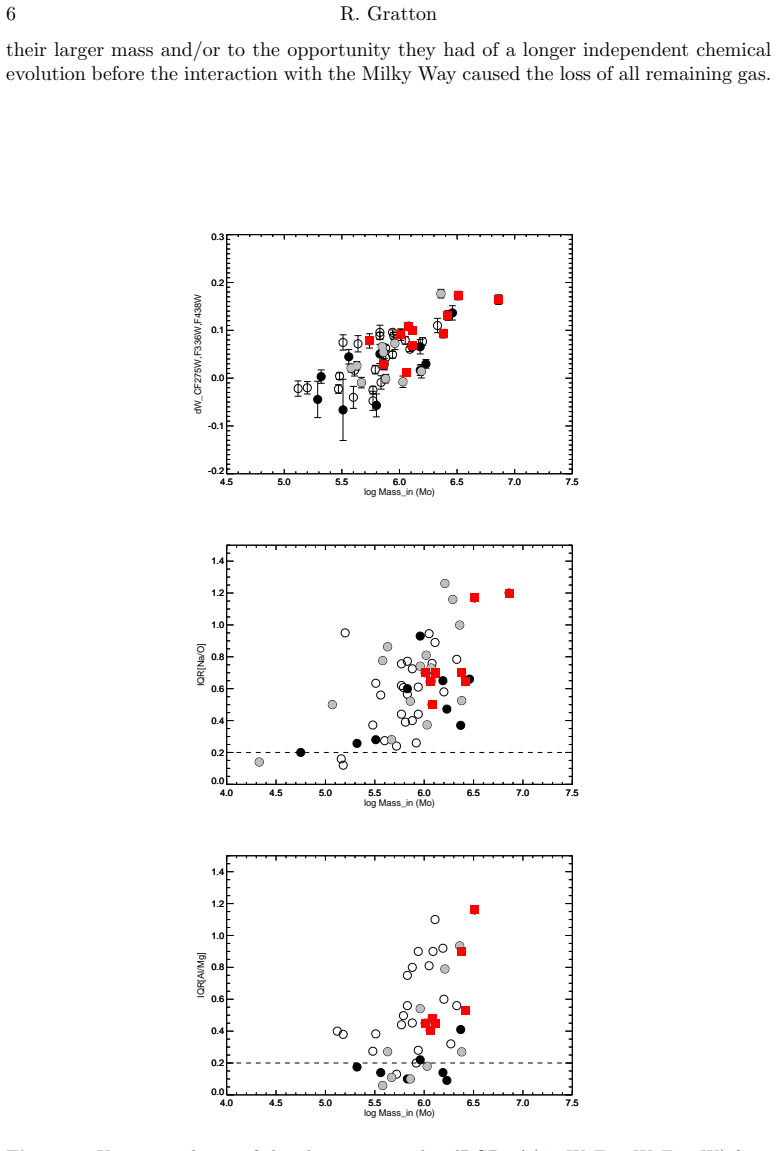
The paper's central claim is that globular clusters formed in two or more episodes of star formation, and that the extent of this phenomenon is set primarily by the initial cluster mass, not by metallicity or current mass. Using photometric indices that trace nitrogen spreads and spectroscopic interquartile ranges of Na/O and Mg/Al, the author shows a tight correlation between the fraction of first-generation stars and the initial mass of the cluster, with the multiple-population phenomenon turning on near $10^5$ solar masses and becoming fully established above about $3\times10^5$ solar masses. While the presence of second-generation stars is mass-driven, the exact abundance patterns are metallicity-driven, with metal-poor clusters showing more extended Na/O and Mg/Al anti-correlations. The lithium data play a discriminating role: intermediate second-generation stars are lithium-rich enough that their polluters must have synthesized lithium, pointing to intermediate-mass AGB stars, whereas lithium-poor extreme stars allow fast-rotating massive stars or supermassive stars as polluters. The paper concludes that the mass budget factor is not universal but grows with cluster mass, exceeding five only in the most massive systems.
Load-bearing premise
The conclusion that the mass budget factor is large only in the most massive clusters is not measured directly; it follows from a model that assumes intermediate-mass AGB stars pollute the intermediate second-generation stars, fast rotators or supermassive stars pollute the extreme ones, and assumes particular cluster-mass-dependent dilution factors and initial mass function slopes, so if those assumptions are wrong the claim would not follow from the data.
Editorial extensions
If this is right
- If initial mass is the driver, clusters born below roughly 100,000 solar masses should show no chemical multiple populations, while clusters born above roughly 300,000 solar masses should develop them readily.
- Metallicity should modulate the abundance patterns but not the fraction of second-generation stars, so metal-rich and metal-poor clusters of similar initial mass should differ in Na/O and Mg/Al spreads but not in the presence of multiple populations.
- The lithium-richness of intermediate second-generation stars implies that their polluters must produce lithium, favouring intermediate-mass AGB stars and ruling out pollution without lithium production for the bulk of second-generation stars.
- The mass budget factor being large only in massive clusters means that most type I clusters can form with modest first-generation masses, while the complex type II clusters, likely formed farther from the Milky Way centre, require a much larger starting mass.
- Globular clusters retained less than about 3 percent of core-collapse supernova ejecta even in the most massive cases, indicating shallow proto-cluster potential wells.
Reading between the lines
- If the initial-mass threshold is physical, young massive clusters in the local Universe just below 100,000 solar masses should lack chemical multiple populations; current integral-field spectroscopy could test this directly, which the review does not do.
- The lithium contrast between intermediate and extreme second-generation stars suggests a sharp diagnostic: because the two proposed polluters for extreme stars make different lithium and helium yields, a systematic lithium survey of extreme stars could separate the fast-rotating massive star and supermassive star models.
- The large first-generation masses required for the most massive clusters imply that a substantial reservoir of processed stellar mass was lost; some of that mass may now be in the Milky Way halo field-star population, connecting cluster formation to the halo abundance patterns the paper mentions but does not develop.
- The correlation between initial mass and second-generation fraction could be inverted into a dynamical clock: comparing current and initial masses of clusters with and without multiple populations may calibrate how much mass clusters lose over a Hubble time.
Signed reviews
Editorial analysis
A structured set of objections, weighed in public.
Referee Report
Summary. This proceedings contribution reviews spectroscopic evidence on multiple stellar populations in globular clusters. The paper argues that the cluster initial mass is the most important parameter controlling the fraction of second-generation (SG) stars, with a threshold for the onset of the phenomenon at roughly 1–3 × 10^5 M_sun. It further claims that metallicity modulates the nucleosynthetic patterns (Na/O, Mg/Al anticorrelations) but not the overall SG fraction, that Li abundances in intermediate SG stars favor intermediate-mass AGB stars as polluters, and that the mass budget factor is a function of cluster mass and needs to be large only in the most massive clusters. The last point is presented as a new model-dependent calculation in Section 5, while most of the other material is a synthesis of previously published work.
Significance. If the mass-budget result is correct, it would sharpen constraints on globular cluster formation scenarios by tying the required initial mass of the first generation to the current cluster mass. The threshold claim and the emphasis on initial rather than current cluster mass are useful reframings of existing data, and the lithium discussion provides a clear, well-argued constraint on polluter classes. The paper is largely a competent review. Its main value-added claim, however, is the mass-dependent mass budget factor, and that claim is currently not independently evaluable from the manuscript because the model inputs, equations, and uncertainties are deferred to a submitted companion paper.
major comments (3)
- [§5, Figure 5] The central claim in the abstract and conclusions that 'the mass budget factor ... needs to be large only in massive clusters' is not supported by the material presented. Section 5 states that f(SG) and the dilution factors are functions of cluster mass and that I-stars are polluted by intermediate-mass AGB stars and E-stars by fast rotators, but it gives no equations for M_start/M_in, no explicit dilution function, no adopted numerical values, and no uncertainties. The quantitative inputs are deferred to 'Gratton et al. 2019, submitted', which is not available to the reader. Since f(SG) is observed to increase with mass (Fig. 2), a mass-dependent budget factor that rises with mass is qualitatively expected; the nontrivial content is the normalization and the statement that it exceeds 5 only above roughly 10^6 M_sun, and that content is not shown. The authors should either present the key equations and inputs of the calculation, add error or model-variation estimates, or explicitly label the statement as a preliminary model-dependent expectation rather than a derived result.
- [§3.1, Figures 2–3] The threshold for the onset of multiple populations is given as about 10^5 M_sun, with a range up to 3 × 10^5 M_sun, based on visual inspection of plots with considerable scatter, and the claimed correlation between SG fraction and initial mass is not quantified. Because this threshold is one of the two headline conclusions, the authors should provide a quantitative measure such as a rank correlation coefficient, a scatter estimate, or a fitted relation, or state more cautiously that the threshold is a visual impression. This is not a fatal issue, but the current presentation is under-quantified for a claim of this prominence.
- [§3.2 and §5] The inference that type II clusters are among the most massive and likely formed at large R_apo (Fig. 4) is acknowledged in the text to be affected by a possible selection bias, since type I/II classification requires HST observations that may preferentially cover more massive or specific clusters. This bias also underlies the statement in Section 5 that most of the high-budget clusters are type II. The authors should quantify or at least discuss the selection effect in more detail, or soften the corresponding conclusions.
minor comments (5)
- [Abstract] The word 'par ameter' in the abstract should be 'parameter'.
- [Figure 3 caption] The caption contains the typo 'IGQR[Al/Mg]'; this should be 'IQR[Al/Mg]'.
- [§3.1 and §5] The notation M_in is used in Section 3.1 for the initial cluster mass and in Section 5 for the mass of the cluster at the end of SG formation; these quantities should be defined more consistently.
- [References] The citation 'Gratton et al. 2019' appears in Figures 2 and 5 and in Section 3, but this work is not included in the reference list; it should be listed as the submitted paper or the in-text citation should be clarified.
- [§5] The text states that an IMF slope of 2.3 is the Salpeter value; the Salpeter slope is usually quoted as 2.35, so either use 2.35 or note that 2.3 is an approximation.
Circularity Check
Mass-budget claim in Section 5 tracks the observed SG-fraction relation; the rest of the review is externally grounded.
-
fitted input called prediction
[Section 5 ('Mass budget for clusters of different mass'), Figure 5]
"We then re-estimated the mass budget fraction with values of f(SG) and dilution that are function of the cluster mass. ... This calculation shows that the mass budget factor needs to be very large ( > 5) only in the most massive globular clusters."
The paper defines the mass budget factor through the SG fraction and dilution, and explicitly inputs f(SG) as a function of cluster mass. Since the budget factor M_start/M_in is, in the accounting described in this section, essentially f_SG divided by the dilution factor and an efficiency, the mass-dependence of the output is forced by the observed f_SG-mass relation shown in Figure 2. The dilution function is asserted to be mass-dependent but no functional form or independent derivation is given, so the conclusion that the budget factor is large only in massive clusters is a rescaled restatement of the input relation rather than an independent prediction. The >5 normalization depends on unstated parameters and is not derived in the paper.
full rationale
The paper is primarily a review of external spectroscopic and photometric datasets (Milone et al. 2017; Baumgardt & Hilker 2018; Baumgardt et al. 2019; Carretta et al. 2010; Marino et al. 2019). The threshold mass for the multiple-population phenomenon and the metallicity dependence of the Na/O and Mg/Al anticorrelations are direct readings of those external data, so those parts are not circular. The one partially circular element is the mass-budget conclusion in Section 5. There the author inputs the observed mass-dependent SG fraction f(SG)(M) from Figure 2 and an unspecified mass-dependent dilution factor, then presents the resulting mass budget factor as a new calculation. Because the budget factor is defined through exactly these inputs, the mass-dependence of the output tracks the input f_SG(M) relation; the only potentially independent content is the normalization, which is neither derived nor error-quantified. The repeated references to the companion paper 'Gratton et al. 2019, submitted' are self-citations, but they refer to observational data and are not used to forbid alternative explanations, so they are not load-bearing circularity. Overall, most of the review is self-contained against external data; the mass-budget claim is a mild definitional circularity rather than a full one.
Assumptions & free parameters
free parameters (2)
- IMF slope alpha =
1.7, 2.0, and 2.3
- Mass-dependent f(SG) and dilution factors =
not specified in the preprint
assumptions (4)
- domain assumption The observed abundance anti-correlations (C-N, Na-O, Mg-Al) are produced by high-temperature H-burning in polluter stars with subsequent dilution.
- domain assumption The initial cluster masses from Baumgardt & Hilker (2018) and Baumgardt et al. (2019) are accurate.
- ad hoc to paper For the mass budget calculation, polluters for intermediate SG stars are intermediate-mass AGB stars and for extreme SG stars are fast rotating massive stars, with mass-dependent dilution.
- domain assumption FG/SG classification from the chromosome diagram (Milone et al. 2017) correctly tracks N-poor versus N-rich stars.
Cite this review
Pith. "Pith review of Spectroscopic studies of stellar populations in globular clusters and field stars: implications for globular cluster and Milky Way halo formation." pith.science (2026). https://pith.science/paper/CDPS4DEB
@misc{pith2026190806905,
  author       = {Pith},
  title        = {Pith review of: Spectroscopic studies of stellar populations in globular clusters and field stars: implications for globular cluster and Milky Way halo formation},
  year         = {2026},
  howpublished = {\url{https://pith.science/paper/CDPS4DEB}},
  note         = {Machine review of arXiv:1908.06905}
}
read the original abstract
We review spectroscopic results concerning multiple stellar populations in globularclusters. The cluster initial mass is the most important parameter determining the fraction of second generation stars. The threshold for the onset of the multiple population phenomenon is 1-3x10^5 MSun. Nucleosynthesis is influenced by metallicity: Na/O and Mg/Al anti-correlations are more extended in metal-poor than in metal-rich clusters. Massive clusters are more complex systems than the smaller ones, with several populations characterized by different chemical compositions. The high Li abundance observed in the intermediate second generation stars strongly favours intermediate mass AGB stars as polluters for this class of stars; however, it is well possible that the polluters of extreme second generation stars, that often do not have measurable Li, may be fast rotating massive stars or super-massive stars. The mass budget factor should be a function of the cluster mass, and needs to be large only in massive clusters.
Figures


Figures from the paper (2 more)


Reference graph
Works this paper leans on
-
[1]
& Lardo, C
Bastian, N. & Lardo, C. 2018, ARA&A, 56, 83
2018
-
[2]
& Hilker, M
Baumgardt, H. & Hilker, M. 2018, MNRAS, 478, 1520
2018
-
[3]
2019, M NRAS, 482, 5138
Baumgardt, H., Hilker, M., Sollima, A., & Bellini, A. 2019, M NRAS, 482, 5138
2019
-
[4]
& Freeman, K
Bekki, K. & Freeman, K. C. 2003, MNRAS, 346, L11
2003
-
[5]
Beuther, H., Churchwell, E. B., McKee, C. F., & Tan, J. C. 2007 , Protostars and Planets V, 165
work page 2007
- [6]
- [7]
-
[8]
Decressin, T., Meynet, G., Charbonnel, C., Prantzos, N., & E kstr¨ om, S. 2007, A&A, 464, 1029
work page 2007
Show all 31 references
-
[9]
Denisenkov, P. A. & Denisenkova, S. N. 1989, Astronomichesk ij Tsirkulyar, 1538, 11
1989
-
[10]
Denissenkov, P. A. & Hartwick, F. D. A. 2014, MNRAS, 437, L21 D’Ercole, A., Vesperini, E., D’Antona, F., McMillan, S. L. W ., & Recchi, S. 2008, MNRAS, 391, 825 D’Orazi, V., Angelou, G. C., Gratton, R. G., et al. 2014, ApJ, 791, 39 D’Orazi, V., Gratton, R. G., Angelou, G. C., ...
2014
-
[11]
Gieles, M., Charbonnel, C., Krause, M. G. H., et al. 2018, MNR AS, 478, 2461
2018
-
[12]
2004, ARA&A, 42, 385
Gratton, R., Sneden, C., & Carretta, E. 2004, ARA&A, 42, 385
2004
-
[13]
G., Bonifacio, P., Bragaglia, A., et al
Gratton, R. G., Bonifacio, P., Bragaglia, A., et al. 2001, A& A, 369, 87
2001
-
[14]
G., Carretta, E., & Bragaglia, A
Gratton, R. G., Carretta, E., & Bragaglia, A. 2012, A&AR, 20, 50 10 R. Gratton
2012
-
[15]
G., Johnson, C
Gratton, R. G., Johnson, C. I., Lucatello, S., D’Orazi, V., & Pilachowski, C. 2011, A&A, 534, A72
2011
-
[16]
Gruyters, P., Nordlander, T., & Korn, A. J. 2014, A&A, 567, A7 2
2014
-
[17]
W., Lu, J
Hosek, Jr., M. W., Lu, J. R., Anderson, J., et al. 2019, ApJ, 87 0, 44
2019
-
[18]
E., Hoffman, R., & Sneden, C
Langer, G. E., Hoffman, R., & Sneden, C. 1993, PASP, 105, 301
1993
-
[19]
2009, A&A, 503, 545
Lind, K., Primas, F., Charbonnel, C., Grundahl, F., & Asplun d, M. 2009, A&A, 503, 545
2009
-
[20]
F., Milone, A
Marino, A. F., Milone, A. P., Renzini, A., et al. 2019, MNRAS, 487, 3815
2019
-
[21]
P., Marino, A
Milone, A. P., Marino, A. F., Bedin, L. R., et al. 2017, MNRAS, 469, 800
2017
-
[22]
P., Piotto, G., Bedin, L
Milone, A. P., Piotto, G., Bedin, L. R., et al. 2012, ApJ, 744, 58
2012
-
[23]
2012, A&A, 5 39, A157
Monaco, L., Villanova, S., Bonifacio, P., et al. 2012, A&A, 5 39, A157
2012
-
[24]
2012, MNRAS, 4 19, 2195
Mucciarelli, A., Salaris, M., & Bonifacio, P. 2012, MNRAS, 4 19, 2195
2012
-
[25]
2011, MNRAS , 412, 81
Mucciarelli, A., Salaris, M., Lovisi, L., et al. 2011, MNRAS , 412, 81
2011
-
[26]
M., Wyse, R
Nataf, D. M., Wyse, R. F. G., Schiavon, R. P., et al. 2019, AJ, 1 58, 14
2019
-
[27]
2005, A&A, 44 1, 549
Pasquini, L., Bonifacio, P., Molaro, P., et al. 2005, A&A, 44 1, 549
2005
-
[28]
& Charbonnel, C
Prantzos, N. & Charbonnel, C. 2006, A&A, 458, 135
2006
-
[29]
2017, A&A, 608, A 28
Prantzos, N., Charbonnel, C., & Iliadis, C. 2017, A&A, 608, A 28
2017
-
[30]
2015, MNRAS, 4 54, 4197 Suntzeff, N
Renzini, A., D’Antona, F., Cassisi, S., et al. 2015, MNRAS, 4 54, 4197 Suntzeff, N. B. & Kraft, R. P. 1996, AJ, 111, 1913
2015
-
[31]
Vanbeveren, D., Mennekens, N., & De Greve, J. P. 2012, A&A, 54 3, A4
2012
Reviewed August 14, 2026 · model on record in the stance chip above.
Discussion (0). Continue with ORCID to comment.