REVIEW 3 major objections 4 minor 87 references
Power-law entanglement growth from typical product states
T0 review · 3 major / 4 minor · reviewed 2026-08-14 · deepseek-v4-flash
Pith's one-line read Typical product states make the entanglement entropy of a quenched wave function and the entanglement entropy of the time-evolution operator grow with the same power-law exponent.
desk verdict A useful numerical resolution of the exponent discrepancy, provided you accept visual plateaus as evidence; the core idea is right but needs quantitative teeth. read the letter →
The pith
A machine-rendered reading of the paper's core claim, the machinery that carries it, and where it could break.
The reading
What carries the argument
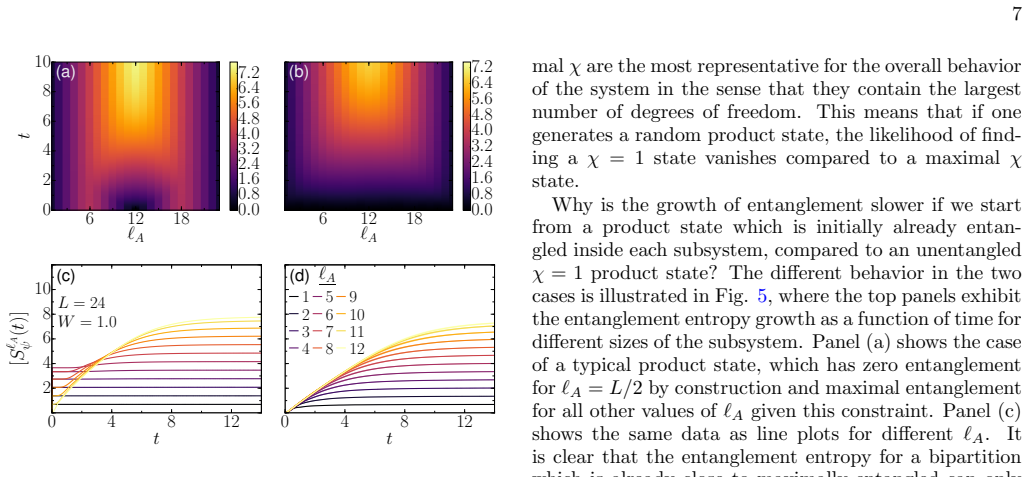
The load-bearing object is the family of product initial states generated by the matrix-product-state ansatz in Eq. (13), with random Gaussian matrices $M^\sigma$ of bond dimension $\chi$ connecting the two halves; $\chi=1$ gives $\sigma_z$-type product states, while the typical product states used in the main comparison are the maximal-bond-dimension case $\chi = 2^{\ell_A/2}$. Two further ingredients carry the argument: the operator entanglement entropy of $U(t)$, computed by vectorizing the unitary into a rectangular matrix $u$ (Eq. 11) and taking its entanglement spectrum, and the monogamy of entanglement, which says the entanglement a subsystem shares with the rest is constrained by how much is already stored inside each half. The wave-function and operator entropies are compared at system sizes $L$ and $L/2$, respectively, so that both live in Hilbert spaces of the same dimension. Together these ingredients show why typical wave-function growth tracks $S_U(t)$: $U(t)$ must account for all initial states, and typical product states dominate the uniform measure over separable states.
What would settle it
For the static model at $W=2.0$, compare the logarithmic-derivative plateau for $S_\psi$ at $L=26$ with that for $S_U$ at $L=13$ over a common time window extended by a factor of two; if the plateau values differ by more than the variation already seen across available system sizes, or if either plateau moves monotonically with $L$ at a fixed time, the claimed exponent equality is not established.
Extended reading notes
Core claim
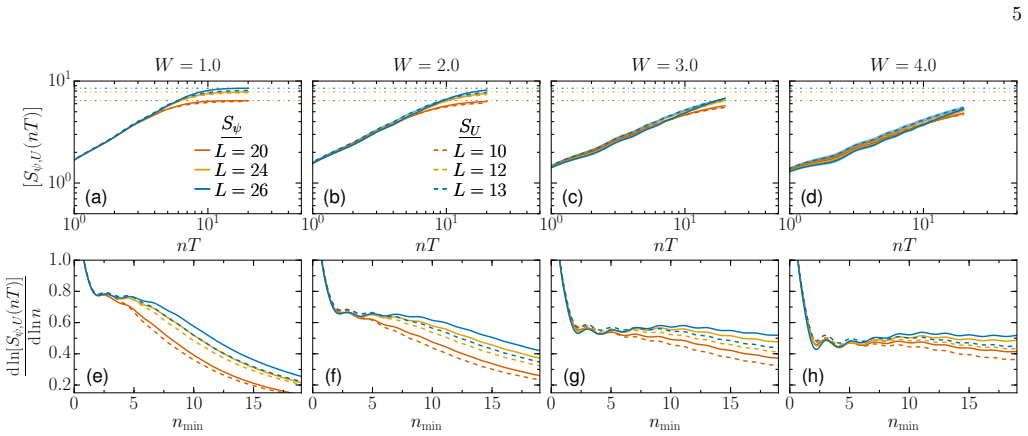
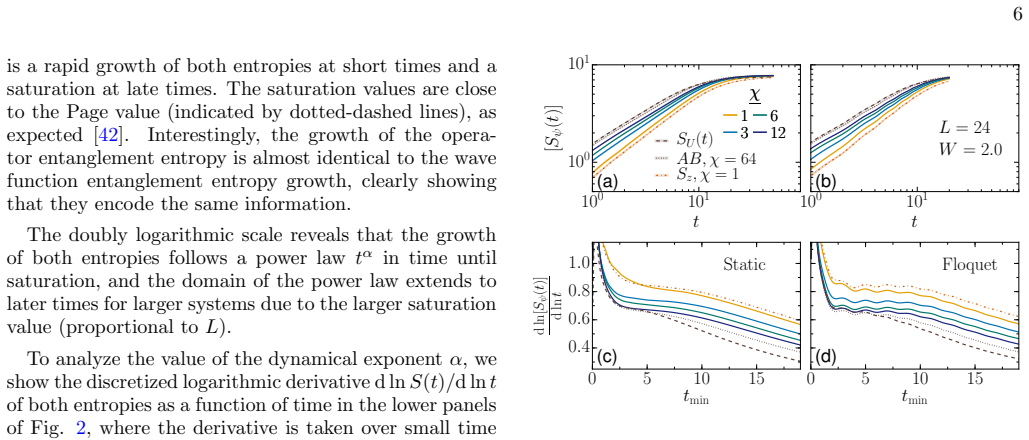
The central claim is a correspondence: for a disordered XYZ spin chain in the ergodic phase (disorder $W \leq 4$), the disorder-averaged wave-function entanglement entropy $S_\psi(t)$ after a quench from a typical product state—defined as a tensor product of random Haar states on the two subsystems, equivalently the maximal-bond-dimension limit of the paper's MPS ansatz in Eq. (13)—grows as $t^\alpha$ with the same exponent $\alpha$ as the operator entanglement entropy $S_U(t)$ of the time-evolution operator $U(t)$. The same power-law equality holds in the periodically driven Floquet version, where no energy conservation remains. The paper shows that $\sigma_z$ product states (bond dimension $\chi=1$) and other intermediate states can entangle faster, and explains the difference through monogamy of entanglement: a typical product state is already maximally entangled within each subsystem, so degrees of freedom must be freed before they can entangle across the central cut, which slows growth; the time-evolution operator, which must encode entanglement production for every initial state, reflects the typical, not the special, behavior.
Load-bearing premise
The central assumption is that the plateau in the slope of log-entropy versus log-time, seen within the simulated time window and for the studied system sizes, already equals the true thermodynamic-limit power-law exponent; no scaling collapse or quantitative finite-size extrapolation is used to confirm that the wave-function and operator plateaus converge to the same number.
Editorial extensions
If this is right
- The operator entanglement entropy of $U(t)$ can serve as a state-independent proxy for the entanglement growth seen from generic initial states in the ergodic phase of these disordered chains.
- Quenches from $\sigma_z$ basis states can entangle faster than typical states, so results based on such special initial states do not reflect the behavior encoded in the time-evolution operator.
- Slow, disorder-dependent power-law entanglement growth occurs even with no conserved densities, in both static and Floquet settings, so it is a generic precursor of many-body localization rather than a transport signature.
- The exponent $\alpha$ decreases continuously as disorder grows toward the MBL transition and approaches the ballistic value $\alpha=1$ for weak disorder, and this behavior shows up identically in wave-function and operator entanglement.
- Because the time-evolution operator's entropy grows with the same exponent as typical wave functions, $S_U(t)$ can be used to estimate the entanglement growth expected from a generic quench without choosing an initial state.
Reading between the lines
- The monogamy mechanism implies a quantitative ordering by initial bond dimension: the more entanglement stored inside each half at $t=0$, the slower the growth across the central cut; this could be tested by collapsing $S_\psi(t)$ curves for several $\chi$ values onto a master curve.
- The same correspondence may hold for other entanglement measures: the appendix shows operator Rényi entropies with $0.4 \leq \alpha \leq 2$ share the exponent, which suggests a family of universal exponents rather than a special property of the von Neumann entropy.
- A cold-atom or trapped-ion experiment that prepares single-site Haar-random product states could test the prediction that the measured entanglement growth matches the operator entanglement entropy, estimated from randomized measurements of the evolution over equivalent times.
- Because the models lack conserved densities, the exponent cannot be tied to subdiffusive transport; the paper's constraint picture points instead to the cost of untying intra-subsystem entanglement, which one would expect to persist in higher-dimensional slow-thermalizing systems.
Signed reviews
Editorial analysis
A structured set of objections, weighed in public.
Referee Report
Summary. The paper studies entanglement growth after quenches from "typical" product states (random Haar states on each half of the bipartition, corresponding to maximal bond dimension in the MPS ansatz of Eq. (13)) in a disordered static XYZ chain and a Floquet counterpart, both chosen to lack conserved densities beyond energy (and energy in the Floquet case). The central claim is that the wave-function entanglement entropy S_psi(t) and the operator entanglement entropy S_U(t) of the time-evolution operator grow as power laws with the same disorder-dependent exponent alpha across the ergodic phase (W <= 4), whereas sigma_z basis states grow faster. The paper interprets this as resolving an apparent discrepancy between previous wave-function and operator entanglement studies and as evidence for slow information spreading on the ergodic side of the MBL transition.
Significance. If established, the claimed correspondence between state and operator entanglement growth would clarify an important conceptual point: the time-evolution operator's complexity is captured by typical product-state wave-function entanglement, not by special low-entanglement initial states. The paper has real strengths: it studies both a static and a driven model with no conserved densities, uses exact Krylov evolution up to L=26 for wave functions and exact operator evolution up to L=14, includes a Rényi-entropy appendix showing the robustness of the power-law behavior over Rényi indices, and proposes a physical mechanism (monogamy of entanglement) for the initial-state dependence. However, the central quantitative claim of identical exponents is supported only by visual inspection of plateaus in logarithmic derivatives, with no exponent values, error bars, fitting ranges, or finite-size extrapolation reported. The claim is therefore not yet established to the standard expected for a numerical demonstration.
major comments (3)
- [Sec. IV A, Figs. 2(e-h), 3(e-h)] The paper's headline claim that S_psi(t) and S_U(t) have identical power-law exponents is based entirely on visual overlap of plateaus in the discretized logarithmic derivative. No exponent values, uncertainties, fitting-window choices, or system-size dependence of the exponent are reported anywhere. At W=1 the useful window before saturation is barely one decade, so the extracted exponent is sensitive to the fitting range and to finite-size effects. Without a quantitative comparison, 'identical exponents' cannot be distinguished from 'close but drifting with L'. I request a table or plot of alpha_psi(L,W) and alpha_U(L,W) with fits and error bars, plus a finite-size extrapolation (or a scaling collapse) to support the equality claim.
- [Sec. III, comparison of L and L/2] The comparison between S_psi for chains of length L and S_U for chains of length L/2 is justified in the text only by the equality of the maximal entanglement entropies (Hilbert-space dimensions). This is necessary but not sufficient: the power-law growth regime depends on the dynamics, not only on the saturation value. The wave-function and operator data are never shown on a common scale (for example, time normalized by the saturation time), and no finite-size extrapolation of alpha is made for either quantity. The apparent agreement of plateaus could therefore be an artifact of the different accessible system sizes and time windows. Please provide a quantitative finite-size comparison, e.g., alpha as a function of L for both quantities, or a collapse of d ln S/d ln t versus t/t_sat.
- [Sec. IV C, Fig. 4] The additional claim that sigma_z product states grow faster and have a different exponent than typical product states is also read visually from the logarithmic-derivative plateaus in Fig. 4(c,d), without quoting exponents or uncertainties. Since this distinction is central to the paper's resolution of the earlier discrepancy, it requires the same quantitative fitting and uncertainty analysis as the main claim.
minor comments (4)
- [Eq. (13)] The MPS ansatz in Eq. (13) is not written cleanly: the bulk matrices M^{sigma_k} in C^{chi x chi} and the boundary vectors in C^chi are not distinguished in the notation, and the case chi=1 (including the pure sigma_z state) is not explicitly represented. Please clarify the definition of the state for all chi values.
- [Fig. 6 caption] The caption of Fig. 6 states that the Rényi operator entanglement entropies are for L=24, but the methods section limits exact operator evolution to L<=14. This appears to be a typo (likely L=12); please correct it or clarify the system size.
- [Sec. II B and Sec. IV A] The text says results are averaged over '50-100 disorder realizations' in Sec. II B but over 'approximately 100 realizations' in Sec. IV A. Please make the number of realizations consistent and specify it separately for the static and Floquet cases.
- [Sec. IV A, Fig. 2] The statement that 'These results appear to be converged with system size at short enough times' is not supported by any quantitative measure of convergence (for example, comparing alpha at different L in a common time window). Please either add such a measure or soften the claim.
Circularity Check
No circularity: S_psi(t) and S_U(t) are independently computed and compared; prior self-citations are context, not inputs.
full rationale
No load-bearing circular reduction is present. The paper's central claim is an empirical comparison of two independently computed quantities: the wave-function entanglement entropy S_psi(t) of typical product states and the operator entanglement entropy S_U(t) of the time-evolution operator, both obtained from the same models by exact Krylov time evolution and SVD. The choice of typical product states is justified by a measure argument (maximal-bond-dimension states dominate the space of product states), not by fitting to S_U(t). The matching of wave-function size L with operator size L/2 is stated explicitly as a Hilbert-space-dimension/Page-value correspondence, not as a fit or as an input that enforces the exponent equality. Prior works by the authors (Refs. 42, 65, 66) are used as background describing an apparent discrepancy; the resolution is produced by new simulations with different initial states, not by importing the claimed conclusion from those citations. The main quantitative weakness is that the exponent equality is read from visual plateaus of the logarithmic derivative without reported exponent values, error bars, or finite-size extrapolation; that is a correctness/evidence-strength concern, not circularity. Therefore the derivation chain is self-contained with respect to the circularity patterns, and the appropriate score is 0.
Assumptions & free parameters
assumptions (5)
- domain assumption Models with W ≤ 4 are in the ergodic phase.
- domain assumption Logarithmic-derivative plateaus represent asymptotic power-law exponents.
- domain assumption Haar-random product states are the typical separable states.
- domain assumption Wavefunction on L sites should be compared with operator on L/2 sites.
- domain assumption Krylov and Trotter numerics are converged for the shown timescales.
Cite this review
Pith. "Pith review of Power-law entanglement growth from typical product states." pith.science (2026). https://pith.science/paper/LXGOQC64
@misc{pith2026190807010,
  author       = {Pith},
  title        = {Pith review of: Power-law entanglement growth from typical product states},
  year         = {2026},
  howpublished = {\url{https://pith.science/paper/LXGOQC64}},
  note         = {Machine review of arXiv:1908.07010}
}
abstract
Generic quantum many-body systems typically show a linear growth of the entanglement entropy after a quench from a product state. While entanglement is a property of the wave function, it is generated by the unitary time evolution operator and is therefore reflected in its increasing complexity as quantified by the operator entanglement entropy. Using numerical simulations of a static and a periodically driven quantum spin chain, we show that there is a robust correspondence between the entanglement entropy growth of typical product states with the operator entanglement entropy of the unitary evolution operator, while special product states, e.g. $\sigma_z$ basis states, can exhibit faster entanglement production. In the presence of a disordered magnetic field in our spin chains, we show that both the wave function and operator entanglement entropies exhibit a power-law growth with the same disorder-dependent exponent, and clarify the apparent discrepancy in previous results. These systems, in the absence of conserved densities, provide further evidence for slow information spreading on the ergodic side of the many-body localization transition.
Figures


Figures from the paper (3 more)

Reference graph
Works this paper leans on
-
[1]
= 1 and therefore SU(t = 0) = 0), we are free to choose any wave function |ψ(t = 0)⟩ as an initial state for the time evolution. Since we are interested in the production of entanglement, it is natural to require that the initial state be a product state |ψ(t = 0)⟩ =|ψA⟩⊗ |ψB⟩ which has minimal entanglement Sψ(t = 0) = 0. In this work, we mostly focus on ...
-
[2]
An area law for one-dimensional quan- tum systems,
M B Hastings, “An area law for one-dimensional quan- tum systems,” Journal of Statistical Mechanics: Theory and Experiment 2007, P08024–P08024 (2007)
2007
-
[3]
Colloquium: Area laws for the entanglement entropy,
J. Eisert, M. Cramer, and M. B. Plenio, “Colloquium: Area laws for the entanglement entropy,” Rev. Mod. Phys. 82, 277–306 (2010)
2010
-
[4]
Quantum entanglement in con- densed matter systems,
Nicolas Laflorencie, “Quantum entanglement in con- densed matter systems,” Physics Reports 646, 1 – 59 (2016), quantum entanglement in condensed matter sys- tems
2016
-
[5]
Quantum statistical mechanics in a closed system,
J M Deutsch, “Quantum statistical mechanics in a closed system,” Phys. Rev. A 43, 2046–2049 (1991)
1991
-
[6]
Chaos and quantum thermalization,
Mark Srednicki, “Chaos and quantum thermalization,” Phys. Rev. E 50, 888–901 (1994)
1994
-
[7]
Thermalization and its mechanism for generic isolated quantum systems,
Marcos Rigol, Vanja Dunjko, and Maxim Olshanii, “Thermalization and its mechanism for generic isolated quantum systems,” Nature 452, 854–858 (2008)
2008
-
[8]
Equilibrium states of generic quantum systems subject to periodic driving,
Achilleas Lazarides, Arnab Das, and Roderich Moessner, “Equilibrium states of generic quantum systems subject to periodic driving,” Phys. Rev. E 90, 012110 (2014)
work page 2014
Show all 87 references
-
[9]
Long-time behavior of isolated periodically driven interacting lattice systems,
Luca D’Alessio and Marcos Rigol, “Long-time behavior of isolated periodically driven interacting lattice systems,” Phys. Rev. X 4, 041048 (2014)
2014
-
[10]
Quantum chaos and thermalization in iso- lated systems of interacting particles,
F. Borgonovi, F. M. Izrailev, L. F. Santos, and V. G. Zelevinsky, “Quantum chaos and thermalization in iso- lated systems of interacting particles,” Physics Reports 626, 1–58 (2016)
2016
-
[11]
Entropy of isolated quantum systems after a quench,
Lea F. Santos, Anatoli Polkovnikov, and Marcos Rigol, “Entropy of isolated quantum systems after a quench,” Phys. Rev. Lett. 107, 040601 (2011)
2011
-
[12]
Micro- scopic origin of thermodynamic entropy in isolated sys- tems,
J. M. Deutsch, Haibin Li, and Auditya Sharma, “Micro- scopic origin of thermodynamic entropy in isolated sys- tems,” Phys. Rev. E 87, 042135 (2013)
2013
-
[13]
Global characteristics of all eigenstates of local many- body hamiltonians: participation ratio and entanglement entropy,
W Beugeling, A Andreanov, and Masudul Haque, “Global characteristics of all eigenstates of local many- body hamiltonians: participation ratio and entanglement entropy,” Journal of Statistical Mechanics: Theory and Experiment 2015, P02002 (2015)
2015
-
[14]
Does a single eigenstate encode the full hamiltonian?
James R. Garrison and Tarun Grover, “Does a single eigenstate encode the full hamiltonian?” Phys. Rev. X 8, 021026 (2018)
2018
-
[15]
Long tail distributions near the many- body localization transition,
David J. Luitz, “Long tail distributions near the many- body localization transition,” Phys. Rev. B 93, 134201 (2016)
2016
-
[16]
Eigenstate thermalization, random matrix theory, and behemoths,
Ivan M. Khaymovich, Masudul Haque, and Paul A. McClarty, “Eigenstate thermalization, random matrix theory, and behemoths,” Phys. Rev. Lett. 122, 070601 (2019)
2019
-
[17]
Evolution of en- tanglement entropy in one-dimensional systems,
Pasquale Calabrese and John Cardy, “Evolution of en- tanglement entropy in one-dimensional systems,” Journal of Statistical Mechanics: Theory and Experiment 2005, P04010 (2005)
2005
-
[18]
Entanglement entropy dy- namics of heisenberg chains,
Gabriele De Chiara, Simone Montangero, Pasquale Cal- abrese, and Rosario Fazio, “Entanglement entropy dy- namics of heisenberg chains,” Journal of Statistical Me- chanics: Theory and Experiment 2006, P03001–P03001 (2006)
2006
-
[19]
Ballistic spread- ing of entanglement in a diffusive nonintegrable system,
Hyungwon Kim and David A. Huse, “Ballistic spread- ing of entanglement in a diffusive nonintegrable system,” Phys. Rev. Lett. 111, 127205 (2013)
2013
-
[20]
Thermalization of entanglement,
Liangsheng Zhang, Hyungwon Kim, and David A. Huse, “Thermalization of entanglement,” Phys. Rev. E 91, 062128 (2015)
2015
-
[21]
Quantum ther- malization through entanglement in an isolated many-body system,
Adam M. Kaufman, M. Eric Tai, Alexander Lukin, Matthew Rispoli, Robert Schittko, Philipp M. Preiss, and Markus Greiner, “Quantum ther- malization through entanglement in an isolated many-body system,” Science 353, 794–800 (2016), https://science.sciencemag.org/content/353/6301/794
2016
-
[22]
Absence of diffusion in certain random lattices,
P. W. Anderson, “Absence of diffusion in certain random lattices,” Phys. Rev. 109, 1492–1505 (1958)
1958
-
[23]
Metal–insulator transition in a weakly interacting many-electron system with localized single-particle states,
D M Basko, I L Aleiner, and B L Altshuler, “Metal–insulator transition in a weakly interacting many-electron system with localized single-particle states,” Ann. Phys. 321, 1126–1205 (2006)
2006
-
[24]
Interact- ing Electrons in Disordered Wires: Anderson Localiza- tion and Low-T Transport,
I V Gornyi, A D Mirlin, and D G Polyakov, “Interact- ing Electrons in Disordered Wires: Anderson Localiza- tion and Low-T Transport,” Phys. Rev. Lett. 95, 206603 (2005)
2005
-
[25]
Many-body lo- calization and thermalization in quantum statistical me- chanics,
Rahul Nandkishore and David A. Huse, “Many-body lo- calization and thermalization in quantum statistical me- chanics,” Annual Review of Condensed Matter Physics 6, 15–38 (2015), https://doi.org/10.1146/annurev- conmatphys-031214-014726
2015 doi
-
[26]
Many- body localization: An introduction and selected topics,
Fabien Alet and Nicolas Laflorencie, “Many- body localization: An introduction and selected topics,” Comptes Rendus Physique (2018), https://doi.org/10.1016/j.crhy.2018.03.003
2018 doi
-
[27]
Colloquium: Many-body localization, thermalization, and entanglement,
Dmitry A. Abanin, Ehud Altman, Immanuel Bloch, and Maksym Serbyn, “Colloquium: Many-body localization, thermalization, and entanglement,” Rev. Mod. Phys. 91, 021001 (2019)
2019
-
[28]
Diagonalization and Many-Body Local- ization for a Disordered Quantum Spin Chain,
John Z. Imbrie, “Diagonalization and Many-Body Local- ization for a Disordered Quantum Spin Chain,” Phys. Rev. Lett. 117, 027201 (2016)
2016
-
[29]
Many-body energy localization transition in periodically driven sys- tems,
Luca D’Alessio and Anatoli Polkovnikov, “Many-body energy localization transition in periodically driven sys- tems,” Annals of Physics 333, 19 – 33 (2013)
2013
-
[30]
Fate of many-body localization under periodic driving,
Achilleas Lazarides, Arnab Das, and Roderich Moessner, “Fate of many-body localization under periodic driving,” Phys. Rev. Lett. 115, 030402 (2015)
2015
-
[31]
Periodically driven ergodic and many-body localized quantum systems,
Pedro Ponte, Anushya Chandran, Z. Papi´ c, and Dmitry A. Abanin, “Periodically driven ergodic and many-body localized quantum systems,” Annals of Physics 353, 196 – 204 (2015)
2015
-
[32]
Many-body localization in period- ically driven systems,
Pedro Ponte, Z. Papi´ c, Franois Huveneers, and Dmitry A. Abanin, “Many-body localization in period- ically driven systems,” Phys. Rev. Lett. 114, 140401 (2015)
2015
-
[33]
Theory of many-body localization in peri- odically driven systems,
Dmitry A. Abanin, Wojciech De Roeck, and Franois Huveneers, “Theory of many-body localization in peri- odically driven systems,” Annals of Physics 372, 1 – 11 10 (2016)
2016
-
[34]
Obser- vation of many-body localization of interacting fermions in a quasirandom optical lattice,
Michael Schreiber, Sean S Hodgman, Pranjal Bordia, Henrik P L¨ uschen, Mark H Fischer, Ronen Vosk, Ehud Altman, Ulrich Schneider, and Immanuel Bloch, “Obser- vation of many-body localization of interacting fermions in a quasirandom optical lattice,” Science 349, 842–845 (2015)
2015
-
[35]
Many- body localization in a quantum simulator with pro- grammable random disorder,
J Smith, A Lee, P Richerme, B Neyenhuis, P W Hess, P Hauke, M Heyl, D A Huse, and C Monroe, “Many- body localization in a quantum simulator with pro- grammable random disorder,” Nature Physics (2016), 10.1038/nphys3783
2016 doi
-
[36]
Many-body localization in the Heisenberg XXZ magnet in a random field,
Marko ˇZnidariˇ c, Tomaˇ z Prosen, and Peter Prelovˇ sek, “Many-body localization in the Heisenberg XXZ magnet in a random field,” Phys. Rev. B 77, 064426 (2008)
2008
-
[37]
Unbounded Growth of Entanglement in Models of Many-Body Localization,
Jens H Bardarson, Frank Pollmann, and Joel E Moore, “Unbounded Growth of Entanglement in Models of Many-Body Localization,” Phys. Rev. Lett. 109, 017202 (2012)
2012
-
[38]
Lo- cal Conservation Laws and the Structure of the Many- Body Localized States,
Maksym Serbyn, Z. Papi´ c, and Dmitry A. Abanin, “Lo- cal Conservation Laws and the Structure of the Many- Body Localized States,” Phys. Rev. Lett. 111, 127201 (2013)
2013
-
[39]
Universal Slow Growth of Entanglement in Interact- ing Strongly Disordered Systems,
Maksym Serbyn, Z. Papi´ c, and Dmitry A. Abanin, “Universal Slow Growth of Entanglement in Interact- ing Strongly Disordered Systems,” Phys. Rev. Lett. 110, 260601 (2013)
2013
-
[40]
Phenomenology of fully many-body- localized systems,
David A. Huse, Rahul Nandkishore, and Vadim Oganesyan, “Phenomenology of fully many-body- localized systems,” Phys. Rev. B 90, 174202 (2014)
2014
-
[41]
Entanglement of quantum evolutions,
Paolo Zanardi, “Entanglement of quantum evolutions,” Phys. Rev. A 63, 040304 (2001)
2001
-
[42]
Operator space entan- glement entropy in a transverse ising chain,
Tomaˇ z Prosen and Iztok Piˇ zorn, “Operator space entan- glement entropy in a transverse ising chain,” Phys. Rev. A 76, 032316 (2007)
2007
-
[43]
Operator entanglement entropy of the time evolution operator in chaotic sys- tems,
Tianci Zhou and David J. Luitz, “Operator entanglement entropy of the time evolution operator in chaotic sys- tems,” Phys. Rev. B 95, 094206 (2017)
2017
-
[44]
Entanglement scaling of operators: a confor- mal field theory approach, with a glimpse of simulability of long-time dynamics in 1+1d,
J Dubail, “Entanglement scaling of operators: a confor- mal field theory approach, with a glimpse of simulability of long-time dynamics in 1+1d,” Journal of Physics A: Mathematical and Theoretical 50, 234001 (2017)
2017
-
[45]
Entangling power of time-evolution operators in integrable and non- integrable many-body systems,
Rajarshi Pal and Arul Lakshminarayan, “Entangling power of time-evolution operators in integrable and non- integrable many-body systems,” Phys. Rev. B98, 174304 (2018)
2018
-
[46]
Anomalous ther- malization in ergodic systems,
David J. Luitz and Yevgeny Bar Lev, “Anomalous ther- malization in ergodic systems,” Phys. Rev. Lett. 117, 170404 (2016)
2016
-
[47]
Anomalous thermalization and transport in disordered interacting floquet systems,
Sthitadhi Roy, Yevgeny Bar Lev, and David J. Luitz, “Anomalous thermalization and transport in disordered interacting floquet systems,” Phys. Rev. B 98, 060201 (2018)
2018
-
[48]
Multiscale entanglement clusters at the many-body lo- calization phase transition,
Lo¨ ıc Herviou, Soumya Bera, and Jens H. Bardarson, “Multiscale entanglement clusters at the many-body lo- calization phase transition,” Phys. Rev. B 99, 134205 (2019)
2019
-
[49]
Multifractal dimensions for random matrices, chaotic quantum maps, and many-body systems,
Arnd B¨ acker, Masudul Haque, and Ivan M. Khaymovich, “Multifractal dimensions for random matrices, chaotic quantum maps, and many-body systems,” Phys. Rev. E 100, 032117 (2019)
2019
-
[50]
Statistics of correlations across the many-body localization transition,
Luis Colmenarez, Paul A. McClarty, Masudul Haque, and David J. Luitz, “Statistics of correlations across the many-body localization transition,” arXiv e-prints , arXiv:1906.10701 (2019), arXiv:1906.10701 [cond- mat.dis-nn]
2019 arXiv
-
[51]
Dynamics of many-body localization,
Yevgeny Bar Lev and David R. Reichman, “Dynamics of many-body localization,” Phys. Rev. B 89, 220201 (2014)
2014
-
[52]
Absence of diffusion in an interacting system of spinless fermions on a one-dimensional disordered lattice,
Yevgeny Bar Lev, Guy Cohen, and David R. Reichman, “Absence of diffusion in an interacting system of spinless fermions on a one-dimensional disordered lattice,” Phys. Rev. Lett. 114, 100601 (2015)
2015
-
[53]
Anomalous diffu- sion and griffiths effects near the many-body localization transition,
Kartiek Agarwal, Sarang Gopalakrishnan, Michael Knap, Markus M¨ uller, and Eugene Demler, “Anomalous diffu- sion and griffiths effects near the many-body localization transition,” Phys. Rev. Lett. 114, 160401 (2015)
2015
-
[54]
Universal properties of many-body de- localization transitions,
Andrew C. Potter, Romain Vasseur, and S. A. Parameswaran, “Universal properties of many-body de- localization transitions,” Phys. Rev. X 5, 031033 (2015)
2015
-
[55]
The- ory of the many-body localization transition in one- dimensional systems,
Ronen Vosk, David A. Huse, and Ehud Altman, “The- ory of the many-body localization transition in one- dimensional systems,” Phys. Rev. X 5, 031032 (2015)
2015
-
[56]
Diffusive and subdiffusive spin transport in the ergodic phase of a many-body localizable system,
Marko ˇZnidariˇ c, Antonello Scardicchio, and Vipin Ker- ala Varma, “Diffusive and subdiffusive spin transport in the ergodic phase of a many-body localizable system,” Phys. Rev. Lett. 117, 040601 (2016)
2016
-
[57]
How periodic driving heats a dis- ordered quantum spin chain,
Jorge Rehn, Achilleas Lazarides, Frank Pollmann, and Roderich Moessner, “How periodic driving heats a dis- ordered quantum spin chain,” Phys. Rev. B 94, 020201 (2016)
2016
-
[58]
Trans- port in quasiperiodic interacting systems: From superdif- fusion to subdiffusion,
Yevgeny Bar Lev, Dante M. Kennes, Christian Klckner, David R. Reichman, and Christoph Karrasch, “Trans- port in quasiperiodic interacting systems: From superdif- fusion to subdiffusion,” EPL (Europhysics Letters) 119, 37003 (2017)
2017
-
[59]
Absence of dynamical localization in inter- acting driven systems,
David J. Luitz, Yevgeny Bar Lev, and Achilleas Lazarides, “Absence of dynamical localization in inter- acting driven systems,” SciPost Phys. 3, 029 (2017)
2017
-
[60]
Density propagator for many-body lo- calization: Finite-size effects, transient subdiffusion, and exponential decay,
Soumya Bera, Giuseppe De Tomasi, Felix Weiner, and Ferdinand Evers, “Density propagator for many-body lo- calization: Finite-size effects, transient subdiffusion, and exponential decay,” Phys. Rev. Lett.118, 196801 (2017)
2017
-
[61]
The ergodic side of the many-body localization transition,
David J. Luitz and Yevgeny Bar Lev, “The ergodic side of the many-body localization transition,” Annalen der Physik 529, 1600350–n/a (2017), 1600350
2017
-
[62]
Rare-region effects and dynamics near the many- body localization transition,
Kartiek Agarwal, Ehud Altman, Eugene Demler, Sarang Gopalakrishnan, David A. Huse, and Michael Knap, “Rare-region effects and dynamics near the many- body localization transition,” Annalen der Physik 529, 1600326–n/a (2017), 1600326
2017
-
[63]
Spin subdiffusion in the disordered hub- bard chain,
Maciej Kozarzewski, Peter Prelovˇ sek, and Marcin Mierzejewski, “Spin subdiffusion in the disordered hub- bard chain,” Phys. Rev. Lett. 120, 246602 (2018)
2018
-
[64]
Energy transport in a disordered spin chain with broken u(1) symmetry: Diffusion, subdiffusion, and many-body localization,
M. Schulz, S. R. Taylor, C. A. Hooley, and A. Scardic- chio, “Energy transport in a disordered spin chain with broken u(1) symmetry: Diffusion, subdiffusion, and many-body localization,” Phys. Rev. B 98, 180201 (2018)
2018
-
[65]
Many-body localization and delocalization in large quantum chains,
Elmer V. H. Doggen, Frank Schindler, Konstantin S. Tikhonov, Alexander D. Mirlin, Titus Neupert, Dmitry G. Polyakov, and Igor V. Gornyi, “Many-body localization and delocalization in large quantum chains,” Phys. Rev. B 98, 174202 (2018)
2018
-
[66]
Extended slow dynamical regime close to the many- body localization transition,
David J. Luitz, Nicolas Laflorencie, and Fabien Alet, “Extended slow dynamical regime close to the many- body localization transition,” Phys. Rev. B 93, 060201 (2016). 11
2016
-
[67]
Apparent slow dynamics in the ergodic phase of a driven many-body localized system without extensive conserved quantities,
Tal´ ıa L. M. Lezama, Soumya Bera, and Jens H. Bar- darson, “Apparent slow dynamics in the ergodic phase of a driven many-body localized system without extensive conserved quantities,” Phys. Rev. B 99, 161106 (2019)
2019
-
[68]
Con- ductivity of disordered quantum lattice models at infinite temperature: Many-body localization,
Timothy C. Berkelbach and David R. Reichman, “Con- ductivity of disordered quantum lattice models at infinite temperature: Many-body localization,” Phys. Rev. B 81, 224429 (2010)
2010
-
[69]
Many-body localization phase transition,
Arijeet Pal and David A Huse, “Many-body localization phase transition,” Phys. Rev. B 82, 174411 (2010)
2010
-
[70]
Many-body localization edge in the random-field Heisenberg chain,
David J Luitz, Nicolas Laflorencie, and Fabien Alet, “Many-body localization edge in the random-field Heisenberg chain,” Phys. Rev. B 91, 081103(R) (2015)
2015
-
[71]
Many-body localiza- tion characterized from a one-particle perspective,
Soumya Bera, Henning Schomerus, Fabian Heidrich- Meisner, and Jens H. Bardarson, “Many-body localiza- tion characterized from a one-particle perspective,” Phys. Rev. Lett. 115, 046603 (2015)
2015
-
[72]
New Approach to Many-State Quantum Dynamics: The Recursive- Residue-Generation Method,
Andr´ e Nauts and Robert E. Wyatt, “New Approach to Many-State Quantum Dynamics: The Recursive- Residue-Generation Method,” Phys. Rev. Lett.51, 2238– 2241 (1983)
1983
-
[73]
Analysis of some krylov subspace approx- imations to the matrix exponential operator,
Y. Saad, “Analysis of some krylov subspace approx- imations to the matrix exponential operator,” SIAM Journal on Numerical Analysis 29, 209–228 (1992), https://doi.org/10.1137/0729014
1992 doi
-
[74]
Nineteen Dubious Ways to Compute the Exponential of a Matrix, Twenty-Five Years Later,
C. Moler and C. Van Loan, “Nineteen Dubious Ways to Compute the Exponential of a Matrix, Twenty-Five Years Later,” SIAM Rev. 45, 3–49 (2003)
2003
-
[75]
Localization of interacting fermions at high temperature,
Vadim Oganesyan and David A. Huse, “Localization of interacting fermions at high temperature,” Phys. Rev. B 75, 155111 (2007)
2007
-
[76]
Averaged over 10 5 random GUE matrices of size N = 100
-
[77]
Distribution of the ratio of consecutive level spacings in random matrix ensembles,
Y. Y. Atas, E. Bogomolny, O. Giraud, and G. Roux, “Distribution of the ratio of consecutive level spacings in random matrix ensembles,” Phys. Rev. Lett.110, 084101 (2013)
2013
-
[78]
We note that for large matrices, CUE and GUE ensem- bles are identical, which is not the case for smaller ma- trices [8]
-
[79]
Average entropy of a subsystem,
Don N. Page, “Average entropy of a subsystem,” Phys. Rev. Lett. 71, 1291–1294 (1993)
1993
-
[80]
The finite group velocity of quantum spin systems,
Elliott H. Lieb and Derek W. Robinson, “The finite group velocity of quantum spin systems,” Communications in Mathematical Physics 28, 251–257 (1972)
1972
-
[81]
Coarse-grained dynamics of operator and state en- tanglement,
Cheryne Jonay, David A. Huse, and Adam Nahum, “Coarse-grained dynamics of operator and state en- tanglement,” arXiv e-prints , arXiv:1803.00089 (2018), arXiv:1803.00089 [cond-mat.stat-mech]
2018 arXiv
-
[82]
Entanglement spreading in a many-body localized sys- tem,
Arun Nanduri, Hyungwon Kim, and David A. Huse, “Entanglement spreading in a many-body localized sys- tem,” Phys. Rev. B 90, 064201 (2014)
2014
-
[83]
Distributed entanglement,
Valerie Coffman, Joydip Kundu, and William K. Woot- ters, “Distributed entanglement,” Phys. Rev. A 61, 052306 (2000)
2000
-
[84]
General monogamy inequality for bipartite qubit entanglement,
Tobias J. Osborne and Frank Verstraete, “General monogamy inequality for bipartite qubit entanglement,” Phys. Rev. Lett. 96, 220503 (2006)
2006
-
[85]
Quantum entanglement growth un- der random unitary dynamics,
Adam Nahum, Jonathan Ruhman, Sagar Vijay, and Jeongwan Haah, “Quantum entanglement growth un- der random unitary dynamics,” Phys. Rev. X 7, 031016 (2017)
2017
-
[86]
Dynamics of entanglement and transport in one- dimensional systems with quenched randomness,
Adam Nahum, Jonathan Ruhman, and David A. Huse, “Dynamics of entanglement and transport in one- dimensional systems with quenched randomness,” Phys. Rev. B 98, 035118 (2018)
2018
-
[87]
Information prop- agation in isolated quantum systems,
David J. Luitz and Yevgeny Bar Lev, “Information prop- agation in isolated quantum systems,” Phys. Rev. B 96, 020406 (2017)
2017
Reviewed August 14, 2026 · model on record in the stance chip above.
Discussion (0). Continue with ORCID to comment.