REVIEW 4 major objections 5 minor 40 references
Digraphs are different: Why directionality matters in complex systems
T0 review · 4 major / 5 minor · reviewed 2026-08-14 · deepseek-v4-flash
Pith's one-line read This paper argues that the most distinctive features of directed networks—trophic coherence, non-normality, spectral radius, strong connectivity, and cycle counts—share one origin: how strongly edge directions align with a global direction.
desk verdict The unifying story is appealing but the central theorem is not proven: Eq. (6) treats the trace as a Gelfand norm, and the one visible counterexample in the tables shows rho != e^tau for at least one network. read the letter →
The pith
A machine-rendered reading of the paper's core claim, the machinery that carries it, and where it could break.
The reading
What carries the argument
The workhorse is the coherence ensemble: a random directed graph ensemble with fixed in- and out-degree sequences and a prescribed trophic coherence $q$, together with the basal ensemble in which each non-basal vertex receives the same fraction of basal in-edges. From that ensemble comes the identity $\mathrm{tr}(A^k)=\frac{\tilde\alpha \tilde q}{\alpha q}e^{\tau k}$, which turns the loop exponent $\tau$ into the spectral radius via Gelfand's formula. The sign of $\tau$ then acts as an order parameter: positive $\tau$ means exponentially growing counts of directed circuits and a giant strongly connected component; negative $\tau$ means exponentially suppressed circuits and a vanishing SCC. The non-normality theorem needs only this spectral-radius result plus the bound $|\lambda_i|\le\rho$, and the majority-rule stability calculation uses the basal-ensemble ratio $k_i^{\mathrm n}/k_i^{\mathrm b}=L/L_B-1\equiv\lambda$ to reduce flips to a binomial probability, yielding $q_c=1$.
What would settle it
Measure the spectral radius and SCC fraction on empirical directed networks with measured trophic coherence; any network with $\tau<0$ that still has a giant strongly connected component, or whose spectral radius stays far above $e^{\tau}$, would refute the regime split. In generated networks, pushing $q\to 0$ and finding $\rho$ not collapsing to $e^{\tau}$ would directly falsify Eq. (3).
Extended reading notes
Core claim
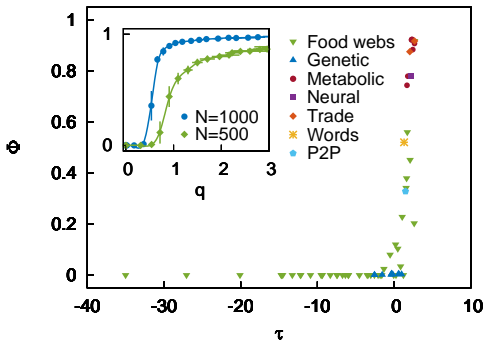
The central claim is that a single number, the loop exponent $\tau = \ln\alpha + \frac{1}{2}\tilde q^2 - \frac{1}{2}q^2$, with branching factor $\alpha=\langle k^{\mathrm{in}}k^{\mathrm{out}}\rangle/\langle k\rangle$ and trophic incoherence $q$, governs whether a directed network lives in a loopful or loopless regime. In the coherence ensemble the expected trace of $A^k$ is a single exponential, so Gelfand's formula gives the spectral radius $\rho=e^{\tau}$. The paper proves that the normalized departure from normality tends to $1$ as $q\to 0$, and exceeds $\sqrt{1-1/\langle k\rangle}$ whenever $\tau<0$; coherent networks are therefore highly non-normal, with spectral radius and strongly connected component both collapsing. It further derives, from a mean-field basal-ensemble calculation, a critical value $q_c=1$ for majority-rule dynamics: below that coherence the mean activity flips sign persistently, above it the dynamics is stable. The empirical networks included in the paper line up with the predicted regime split, and the C. elegans connectome shows the predicted coherence-dependent bistability.
Load-bearing premise
The argument depends on Eq. (3)—that in the coherence ensemble closed walks of length $k$ are exponentially numerous at rate $e^{\tau k}$—an assumption imported from earlier work without derivation here, so if real directed networks deviate from that ensemble expectation the spectral-radius, non-normality, and strong-connectivity conclusions lose their quantitative grounding.
Editorial extensions
If this is right
- If the coherence-ensemble description is correct, the sign of $\tau$ is a regime label: trophically coherent networks with $\tau<0$ should have near-zero spectral radii and no giant strongly connected component, while $\tau>0$ networks should be loopful and strongly connected.
- Since $d_F\to 1$ as $q\to 0$, trophic coherence and non-normality are not independent properties; a mechanism that aligns edge directions automatically makes the adjacency matrix far from normal, so explanations of stability invoking one implicitly involve the other.
- The majority-rule result implies that coherence can reverse the direction of stability: the same degree sequence is dynamically stable when incoherent and unstable when coherent, so degree statistics alone are insufficient to predict dynamical outcomes on directed networks.
- The mean-field transition at $q_c=1$ gives a quantitative target: real networks with $q$ below 1 should exhibit persistent sign flips under majority-rule updates, while those above 1 should settle into a stable consensus.
Reading between the lines
- A natural extension the author does not pursue: because the same exponent controls cycle counts and SCC size, one could use measured directed-cycle distributions as a proxy for trophic coherence, avoiding the need to solve for trophic levels in networks without basal vertices.
- A natural extension the author does not pursue: because non-normality is known to cause transient amplification, coherent directed networks should show strong transient responses before reaching their stable state; this could be tested with linearized dynamics on the same empirical networks.
- The basal-ensemble derivation assumes each non-basal vertex receives the same fraction of basal inputs; breaking that assumption in the preferential-preying model should shift or smear the predicted $q_c=1$, giving a controlled test of the mean-field logic.
- The $q_c=1$ transition suggests a design rule for engineered information-flow networks: tuning coherence through rewiring should let one switch between stable consensus and sensitive novelty detection, a trade-off directly relevant to sensory and regulatory systems.
Signed reviews
Editorial analysis
A structured set of objections, weighed in public.
Referee Report
Summary. The paper argues that a single property of directed networks, trophic coherence, controls a cluster of apparently unrelated features: spectral radius, non-normality, the size of the strongly connected component, cycle abundance, and the stability of majority-rule dynamics. The central theoretical result is a theorem stating that the normalized departure from normality tends to 1 with increasing trophic coherence and exceeds sqrt(1 - 1/<k>) in the loopless regime. The proof proceeds by combining the coherence-ensemble formula for tr(A^k), Eq. (3), with Gelfand's formula to obtain the spectral radius rho = e^tau, and then bounding the sum of squared eigenvalue moduli. The author validates the predictions on 62 empirical networks and with simulations of a preferential preying model, and illustrates the dynamical consequences on the C. elegans neural network.
Significance. If the central derivation were correct, the paper would provide a valuable unification of several directed-network phenomena and strengthen the case that edge-direction alignment is a fundamental organizing principle. The manuscript is clearly written, the data set is diverse, and the stated data/code availability is a strength. However, the key mathematical step linking Eq. (3) to the spectral radius is invalid as stated, so the theorem and its bounds are not currently proven. The empirical observations remain suggestive, but the main quantitative claim needs a rigorous derivation or a clear rephrasing as a conjecture supported by numerics.
major comments (4)
- [Results, 'Graph ensembles' and 'Non-normality', Eqs. (5)-(6)] The step 'taking the norm in Eq. (5) to be the trace' is not a legitimate application of Gelfand's formula. The trace functional is not a matrix norm: it is not submultiplicative and does not satisfy the axioms required for the formula. For a directed cycle of length n, tr(A^k) is n when n divides k and 0 otherwise, so the limit in Eq. (5) does not exist even though rho = 1. Moreover, Eq. (3) supplies only the ensemble expectation of tr(A^k), and no argument justifies interchanging the expectation with the limit and the k-th root before taking k to infinity. Since the proof of the theorem and the bounds in Eqs. (16)-(19) rely on rho = e^tau, the central theoretical result is not established.
- [Results, 'Graph ensembles', Eq. (3) and its citation] The theorem's proof hinges entirely on Eq. (3), which is imported from the author's prior work without derivation or a statement of the conditions under which it holds. The main text attributes this result to 'Ref. [1]', but in the reference list [1] is Newman's review article; the intended source appears to be Johnson and Jones (2017), listed as [9]. As it stands, the proof is not self-contained, and the reader cannot verify the key formula on which all subsequent claims rest.
- [Results, 'Strong connectivity' and 'Non-normality', Figures 2-3] The empirical validation in Figures 2 and 3 uses the same 62 networks on which the coherence-ensemble machinery was developed and tested in the prior work. This does not invalidate the theorem, but it weakens the claim that the bounds 'hold for these empirical cases too' as an independent confirmation. The preferential preying model simulations provide some independent support, but the main theoretical claim would benefit from out-of-sample tests on networks not used to calibrate the ensemble.
- [Methods 0.2, 'Majority rule dynamics on basal ensemble networks'] The derivation of the critical value q_c = 1 assumes that the ratio k_i^n/k_i^b equals the constant lambda for every non-basal vertex, which is a property of the basal ensemble but only approximately true for the preferential preying model used in the simulations. The text appropriately notes that the mean-field analysis is for the basal ensemble and that the extension to other ensembles is heuristic, but the phrasing 'the same critical value may also apply' makes the status of q_c = 1 for general networks less definite than the abstract suggests.
minor comments (5)
- [References throughout] The main text repeatedly cites 'Ref. [1]' for the coherence ensemble and the basal ensemble, but reference [1] in the main-text list is Newman (2003). The intended reference is presumably Johnson and Jones (2017), which is listed as [9]. Please correct all such citations.
- [Section 'Strong connectivity'] The abbreviation 'SSC' is introduced for the strongly connected component, but 'SCC' is used everywhere else, including in the tables and figure captions. Please standardize.
- [Figure 1 caption] The caption contains a repeated article: 'the the C. elegans neural network' should be 'the C. elegans neural network'.
- [Author affiliation] The affiliation line contains spacing errors: 'Edgbasto n' and 'Lo ndon' should be 'Edgbaston' and 'London'.
- [Table S1] For Bridge Brook Lake, tau = -0.53 gives e^tau approx 0.59, but the table reports rho = 1. The paper does not comment on this discrepancy between the actual spectral radius and the coherence-ensemble expectation, which is relevant because Figures 2 and 3 use tau to place networks on the horizontal axis.
Circularity Check
Central non-normality theorem rests on the author's prior coherence-ensemble expectation rather than an independent derivation; empirical checks reuse the same networks.
-
self citation load bearing
[Results: Graph ensembles, Eq. (3); Results: Trophic coherence and non-normality, Eqs. (6), (16)-(19); Supplementary Material data note]
"In the coherence ensemble, we have shown that, in expectation, tr(Ak) = ˜α ˜q / α q e^{τ k}, (3) ... Taking the norm in Eq. (5) to be the trace, we can use Eq. (3) to find the expected value of the spectral radius in the coherence ensemble: ρ = e^τ . (6)"
The theorem's bounds (Eqs. 16-19) are obtained by inserting Eq. (6) into the definition of dF. Eq. (6) is not derived from first principles in this paper; it is obtained by substituting Eq. (3), a same-author coherence-ensemble expectation, into Gelfand's formula via the trace. Thus the theorem's content reduces to the prior self-cited result plus algebra, and the empirical validation reuses the same 62 networks from that prior work instead of providing independent evidence.
full rationale
The paper's new theorem on non-normality is not itself a fitted prediction: the dF bounds are algebraic consequences once Eq. (6) is granted, and no free parameters are adjusted to the data. The circularity burden is that Eq. (6) is not independently derived here. It is obtained by applying Gelfand's formula to Eq. (3), a same-author coherence-ensemble result that is cited ('In Ref. [1] we present results...') rather than proved in this paper. All subsequent claims about spectral radius, strong connectivity, and non-normality inherit that citation, and the empirical plots use the same 62 networks on which the prior machinery was developed, so they do not provide an external test. The majority-rule q_c = 1 result is a self-contained mean-field calculation from the basal-ensemble definition, so it is not circular. The trace-as-Gelfand step is mathematically suspect (the trace is not a matrix norm, and the limit may not exist as written), but that is a correctness problem rather than a circularity and is not counted in the score. Overall, the central claim has independent content, but it is partly load-bearing on a self-citation; hence score 4.
Assumptions & free parameters
assumptions (5)
- domain assumption At least one basal vertex is required for trophic levels (Eq. 1)
- domain assumption Coherence-ensemble expectation Eq. (3): tr(A^k) = (\tilde α \tilde q)/(α q) e^{τ k}
- standard math Gelfand's spectral radius formula and eigenvalue bounds
- domain assumption Basal ensemble homogeneity: all non-basal vertices have the same ratio k_i^n/k_i^b = λ
- domain assumption Mean-field approximation |m_n| ≈ 1
Cite this review
Pith. "Pith review of Digraphs are different: Why directionality matters in complex systems." pith.science (2026). https://pith.science/paper/3XKN4RRX
@misc{pith2026190807025,
  author       = {Pith},
  title        = {Pith review of: Digraphs are different: Why directionality matters in complex systems},
  year         = {2026},
  howpublished = {\url{https://pith.science/paper/3XKN4RRX}},
  note         = {Machine review of arXiv:1908.07025}
}
read the original abstract
Many networks describing complex systems are directed: the interactions between elements are not symmetric. Recent work has shown that these networks can display properties such as trophic coherence or non-normality, which in turn affect stability, percolation and other dynamical features. I show here that these topological properties have a common origin, in that the edges of directed networks can be aligned - or not - with a global direction. And I illustrate how this can lead to rich and unexpected dynamical behaviour even in the simplest of models.
Figures


Figures from the paper (2 more)


Reference graph
Works this paper leans on
-
[1]
Looplessness in networks is linked t o trophic coherence,
S. Johnson and N. S. Jones, “Looplessness in networks is linked t o trophic coherence,” Proc. Natl. Acad. Sci. USA , vol. 114, no. 22, pp. 5618–5623, 2017
work page 2017
-
[9]
Interaction strength c ombinations and the over- fishing of a marine food web,
J. Bascompte, C. Meli´ an, and E. Sala, “Interaction strength c ombinations and the over- fishing of a marine food web,” Proceedings of the National Academy of Sciences of the United States of America , vol. 102, no. 15, pp. 5443–5447, 2005
work page 2005
-
[2]
Local trophodynamics and the interaction of marine mammals and fisheries in the benguela ecosystem,
P. Yodzis, “Local trophodynamics and the interaction of marine mammals and fisheries in the benguela ecosystem,” Journal of Animal Ecology , vol. 67, no. 4, pp. 635–658, 1998
work page 1998
-
[3]
Impacts on stream food w ebs of native and exotic forest: An intercontinental comparison,
R. M. Thompson and C. R. Townsend, “Impacts on stream food w ebs of native and exotic forest: An intercontinental comparison,” Ecology, vol. 84, pp. 145–161, 2003
work page 2003
-
[4]
Energy availability, spatial hetero geneity and ecosystem size predict food-web structure in stream,
R. M. T. andC. R. Townsend, “Energy availability, spatial hetero geneity and ecosystem size predict food-web structure in stream,” Oikos, vol. 108, p. 137–148, 2005
work page 2005
-
[6]
Scale and structure in natural food webs,
K. Havens, “Scale and structure in natural food webs,” Science, vol. 257, no. 5073, pp. 1107–1109, 1992
work page 1992
-
[7]
Disturbance, re- source supply, and food-web architecture in streams,
Townsend, Thompson, McIntosh, Kilroy, Edwards, and Scarsb rook, “Disturbance, re- source supply, and food-web architecture in streams,” Ecology Letters , vol. 1, no. 3, pp. 200–209, 1998
work page 1998
-
[8]
Trophic interactions in Caribbean coral reefs,
S. Opitz, “Trophic interactions in Caribbean coral reefs,” ICLARM Tech. Rep. , vol. 43, p. 341, 1996
work page 1996
Show all 40 references
-
[10]
Nutrient controls on ecosystem d ynamics: the chesapeake mesohaline community,
R. E. Ulanowicz and D. Baird, “Nutrient controls on ecosystem d ynamics: the chesapeake mesohaline community,” Journal of Marine Systems , vol. 19, no. 1–3, pp. 159 – 172, 1999
1999
-
[11]
The effects of taxo nomic aggregation on network analysis,
L. G. Abarca-Arenas and R. E. Ulanowicz, “The effects of taxo nomic aggregation on network analysis,” Ecological Modelling, vol. 149, no. 3, pp. 285 – 296, 2002
2002
-
[12]
Complex trophic interactions in deserts: an empirical c ritique of food-web theory,
G. Polis, “Complex trophic interactions in deserts: an empirical c ritique of food-web theory,” Am. Nat. , vol. 138, pp. 123–125, 1991
1991
-
[13]
R. B. Waide and W. B. R. ( eds.), The Food Web of a Tropical Rainforest . Chicago: University of Chicago Press, 1996
1996
-
[14]
Artifacts or attributes? Effects of resolutio n on the Little Rock Lake food web,
N. D. Martinez, “Artifacts or attributes? Effects of resolutio n on the Little Rock Lake food web,” Ecol. Monogr., vol. 61, pp. 367–392, 1991. 16
1991
-
[15]
Stepping in Elton’s footprints: a general scaling model for body ma sses and trophic levels across ecosystems,
J. Riede, U. Brose, B. Ebenman, U. Jacob, R. Thompson, C. To wnsend, and T. Jonsson, “Stepping in Elton’s footprints: a general scaling model for body ma sses and trophic levels across ecosystems,” Ecology Letters, vol. 14, pp. 169–178, 2011
2011
-
[16]
The dimension ality of ecological networks,
A. Ekl¨ of, U. Jacob, J. Kopp, J. Bosch, R. Castro-Urgal, B. D alsgaard, N. Chacoff, C. de- Sassi, M. Galetti, P. Guimaraes, S. Lom´ ascolo, A. Mart ´ ın Gonz´ alez, M. Pizo, R. Rader, A. Rodrigo, J. Tylianakis, D. Vazquez, and S. Allesina, “The dimension ality of ecological ne...
2013
-
[17]
Does food web theory work for marine ecosystems?,
J. Link, “Does food web theory work for marine ecosystems?,” Mar. Ecol. Prog. Ser. , vol. 230, pp. 1–9, 2002
2002
-
[18]
Predators, pa rasitoids and pathogens: species richness, trophic generality and body sizes in a natural foo d web,
J. Memmott, N. D. Martinez, and J. E. Cohen, “Predators, pa rasitoids and pathogens: species richness, trophic generality and body sizes in a natural foo d web,” J. Anim. Ecol. , vol. 69, pp. 1–15, 2000
2000
-
[19]
Spatial and temporal variation in the structur e of a freshwater food web,
P. H. Warren, “Spatial and temporal variation in the structur e of a freshwater food web,” Oikos, vol. 55, pp. 299–311, 1989
1989
-
[20]
Organizing and understa nding a winter’s Seagrass foodweb network through effective trophic levels,
R. R. Christian and J. J. Luczkovich, “Organizing and understa nding a winter’s Seagrass foodweb network through effective trophic levels,” Ecol. Model., vol. 117, pp. 99–124, 1999
1999
-
[21]
Construction of a larg e Caribbean food web,
L. Goldwasser and J. A. Roughgarden, “Construction of a larg e Caribbean food web,” Ecology, vol. 74, pp. 1216–1233, 1993
1993
-
[22]
Disturbance, re- source supply, and food-web architecture in streams,
Townsend, Thompson, McIntosh, Kilroy, Edwards, and Scars brook, “Disturbance, re- source supply, and food-web architecture in streams,” Ecology Letters , vol. 1, no. 3, pp. 200–209, 1998
1998
-
[23]
Effects of sampling effort on characterization of food-web structure,
N. D. Martinez, B. A. Hawkins, H. A. Dawah, and B. P. Feifarek, “Effects of sampling effort on characterization of food-web structure,” Ecology, vol. 80, p. 1044–1055, 1999
1999
-
[24]
The role of body size in complex food webs,
U. Jacob, A. Thierry, U. Brose, W. Arntz, S. Berg, T. Brey, I . Fetzer, T. Jonsson, K. Mintenbeck, C. M¨ ollmann, O. Petchey, J. Riede, and J. Dunne, “ The role of body size in complex food webs,” Advances in Ecological Research, vol. 45, pp. 181–223, 2011
2011
-
[25]
Do parasites reduce th e chances of triangulation in a real food web?,
M. Huxham, S. Beaney, and D. Raffaelli, “Do parasites reduce th e chances of triangulation in a real food web?,” Oikos, vol. 76, pp. 284–300, 1996
1996
-
[26]
Architecture of the human regulatory network derived from encode data,
M. B. Gerstein, A. Kundaje, M. Hariharan, S. G. Landt, K.-K. Y an, C. Cheng, X. J. Mu, E. Khurana, J. Rozowsky, R. Alexander, et al. , “Architecture of the human regulatory network derived from encode data,” Nature, vol. 489, no. 7414, pp. 91–100, 2012
2012
-
[27]
Buffered Qualitat ive Stability explains the robustness and evolvability of transcriptional networks,
L. Albergante, J. J. Blow, and T. J. Newman, “Buffered Qualitat ive Stability explains the robustness and evolvability of transcriptional networks,” eLife, vol. 3, p. e02863, 2014
2014
-
[28]
Regulondb v8. 0: omics data sets, evolutionary conservation, re gulatory phrases, cross- validated gold standards and more,
H. Salgado, M. Peralta-Gil, S. Gama-Castro, A. Santos-Zavale ta, L. Mu˜ niz-Rascado, J. S. Garc ´ ıa-Sotelo, V. Weiss, H. Solano-Lira, I. Mart ´ ınez-Flores, A. Medina-Rivera, et al. , “Regulondb v8. 0: omics data sets, evolutionary conservation, re gulatory phrases, cross- va...
2013
-
[29]
From specific gene reg- ulation to genomic networks: a global analysis of transcriptional re gulation in escherichia coli,
D. Thieffry, A. M. Huerta, E. P´ erez-Rueda, and J. Collado-Vid es, “From specific gene reg- ulation to genomic networks: a global analysis of transcriptional re gulation in escherichia coli,” Bioessays, vol. 20, no. 5, pp. 433–440, 1998
1998
-
[30]
Superfamilies of evolved and designed networks,
R. Milo, S. Itzkovitz, N. Kashtan, R. Levitt, S. Shen-Orr, I. A yzenshtat, M. Sheffer, and U. Alon, “Superfamilies of evolved and designed networks,” Science, vol. 303, no. 5663, pp. 1538–1542, 2004. 17
2004
-
[31]
Transcriptional regulatory code of a eukaryotic genome,
C. T. Harbison, D. B. Gordon, T. I. Lee, N. J. Rinaldi, K. D. Macis aac, T. W. Danford, N. M. Hannett, J.-B. Tagne, D. B. Reynolds, J. Yoo, et al. , “Transcriptional regulatory code of a eukaryotic genome,” Nature, vol. 431, no. 7004, pp. 99–104, 2004
2004
-
[32]
Ypd TM, pombepd TM and wormpd TM: model organism volumes of the bioknowledge TM library, an integrated resource for protein information,
M. C. Costanzo, M. E. Crawford, J. E. Hirschman, J. E. Kranz , P. Olsen, L. S. Robertson, M. S. Skrzypek, B. R. Braun, K. L. Hopkins, P. Kondu, et al. , “Ypd TM, pombepd TM and wormpd TM: model organism volumes of the bioknowledge TM library, an integrated resource for protein...
2001
-
[33]
The regulatory network of pseu- domonas aeruginosa,
E. Gal´ an-V´ asquez, B. Luna, and A. Mart ´ ınez-Antonio, “The regulatory network of pseu- domonas aeruginosa,” Microb Inform Exp , vol. 1, no. 1, pp. 3–3, 2011
2011
-
[34]
The tran- scriptional regulatory network of mycobacterium tuberculosis,
J. Sanz, J. Navarro, A. Arbu´ es, C. Mart ´ ın, P. C. Mariju´ an, and Y. Moreno, “The tran- scriptional regulatory network of mycobacterium tuberculosis,” PloS one , vol. 6, no. 7, p. e22178, 2011
2011
-
[35]
The large-scale organization of metabolic networks,
H. Jeong, B. Tombor, R. Albert, Z. N. Oltvai, and A.-L. Barab´ a si, “The large-scale organization of metabolic networks,” Nature, vol. 407, no. 6804, pp. 651–654, 2000
2000
-
[36]
The structure of the nervous system of the nematode caenorhabditis elegans,
J. G. White, E. Southgate, J. N. Thompson, and S. Brenner, “ The structure of the nervous system of the nematode caenorhabditis elegans,” Phil. Trans. R. Soc. London , vol. 314, pp. 1–340, 1986
1986
-
[37]
Collective dynamics of ‘small-wo rld’ networks,
D. J. Watts and S. H. Strogatz, “Collective dynamics of ‘small-wo rld’ networks,” Nature, vol. 393, pp. 440–442, 1998
1998
-
[38]
Graph evolution : Densification and shrinking diameters,
J. Leskovec, J. Kleinberg, and C. Faloutsos, “Graph evolution : Densification and shrinking diameters,” ACM Transactions on Knowledge Discovery from Data , vol. 1, 2007
2007
-
[39]
Mapping the gnutella n etwork: Properties of large-scale peer-to-peer systems and implications for system d esign,
M. Ripeanu, I. Foster, and A. Iamnitchi, “Mapping the gnutella n etwork: Properties of large-scale peer-to-peer systems and implications for system d esign,” IEEE Internet Computing Journal , 2002
2002
-
[40]
de Nooy, A
W. de Nooy, A. Mrvar, and V. Batagelj, Exploratory Social Network Analysis with Pajek . Cambridge: Cambridge University Press, 2004
2004
-
[41]
Random House, 1960
Dr Seuss, Green Eggs and Ham . Random House, 1960. 18
1960
Reviewed August 14, 2026 · model on record in the stance chip above.
Discussion (0). Continue with ORCID to comment.