REVIEW 4 major objections 5 minor 19 references
Measurement of the high-energy all-flavor neutrino-nucleon cross section with IceCube
T0 review · 4 major / 5 minor · reviewed 2026-08-14 · deepseek-v4-flash
Pith's one-line read Using the 7.5-year high-energy starting events sample, IceCube measures the all-flavor neutrino-nucleon cross section from 60 TeV to 10 PeV and finds the result consistent with Standard Model predictions.
desk verdict A legitimate all-flavor extension of IceCube's Earth-attenuation cross-section measurement, but the two lowest bins are partly degenerate with the astrophysical flux normalization and the paper is a proceeding with no released numbers. read the letter →
The pith
A machine-rendered reading of the paper's core claim, the machinery that carries it, and where it could break.
The reading
What carries the argument
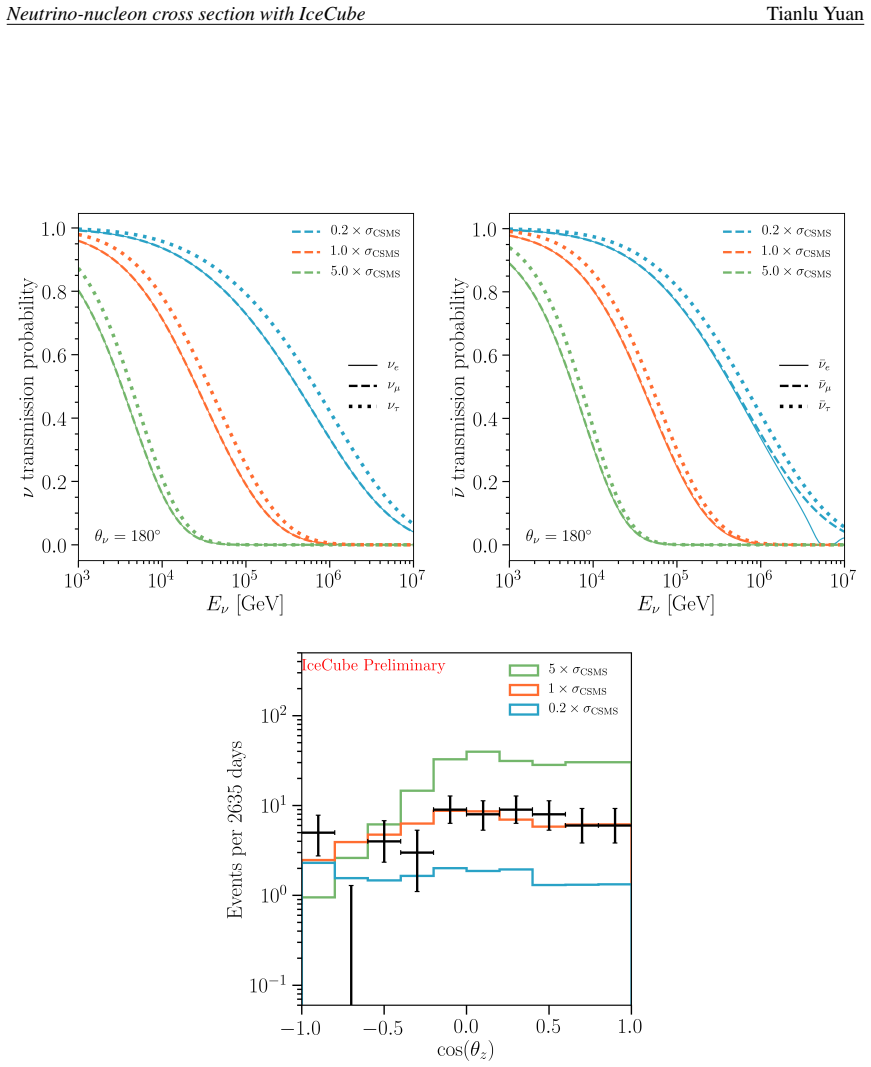
The load-bearing object is the Earth itself, treated as an attenuator: neutrinos that pass through the planet have a transmission probability set by the interaction cross section, so a larger cross section suppresses the flux arriving from the northern sky at high energies. The tunable handle is a four-dimensional vector of scaling parameters, one per energy bin from 60 TeV to 10 PeV, applied identically to charged-current and neutral-current interactions and to all flavors on top of the CSMS cross-section template. A forward-folded likelihood over reconstructed deposited energy and cosine zenith angle, with a separate term for double cascades, is then maximized for the frequentist intervals and sampled with an MCMC for Bayesian credible intervals, while the Glashow-resonance contribution is held fixed at its Standard Model value.
What would settle it
Split the 60 HESE events into track-like and cascade-like subsamples and fit the four scaling parameters separately for each class; the paper's single-scaling assumption predicts the two fits should agree within statistical uncertainty, so a significant divergence would show that the assumed charged-current to neutral-current and flavor ratios are not the real ones and that the reported cross section is an artifact of the template.
Extended reading notes
Core claim
The paper's central claim is that the energy-dependent absorption of astrophysical neutrinos inside the Earth can be converted into a measurement of the neutrino-nucleon cross section using only starting events, which are sensitive to all three neutrino flavors and to both the northern and southern skies. Fitting the four scaling parameters to the 60 HESE events yields a cross section that tracks the CSMS prediction across the full range, and the authors present this as an all-flavor, both-sky extension of earlier single-channel IceCube results. They report the result in both a frequentist and a Bayesian framework and state that the two are consistent with each other and with Standard Model calculations, while noting that none of the four bins is in significant tension with the models.
Load-bearing premise
The measurement assumes that the relative balance between neutrino-absorbing and neutrino-scattering interactions, and the balance among the three flavors, are exactly as the Standard Model predicts; if either balance is wrong, the fitted scaling factors no longer represent the neutrino-nucleon cross section.
Editorial extensions
If this is right
- A single IceCube sample of starting events now constrains the neutrino-nucleon cross section up to 10 PeV, an energy range far above accelerator-based measurements.
- Because the four fitted bin normalizations are consistent with the Standard Model template within uncertainties, the current data show no sign of the large cross-section enhancements proposed at and above a PeV.
- The HESE selection includes events from both sky hemispheres and all flavors, so the result is more general than the upgoing-muon measurement and improves in a direct way as more livetime is accumulated.
- The pattern of a low lowest-energy bin and a high highest-energy bin, while not statistically significant, is the feature to watch: if it grows with future data it would indicate an energy-dependent departure from the CSMS prediction.
Reading between the lines
- A testable consequence the authors do not develop: if a single scaling applies to every channel and flavor, the ratio of track-like to cascade-like events in the northern sky should match the Standard Model charged-current to neutral-current template, so fitting the two event classes separately would expose any flavor- or channel-dependent new physics.
- The upward pull in the highest-energy bin could be cross-checked by freeing the Glashow-resonance normalization near 6.3 PeV, which this analysis fixes; if the high-bin scaling shifts when the resonance is free, part of the reported cross-section enhancement is resonance physics rather than a genuine rise in deep-inelastic scattering.
- The same Earth-attenuation logic could be applied to a lower-energy threshold through-going-muon sample; agreement between that extraction and the starting-event extraction would validate the template-dependent systematics, while disagreement would localize the failure of the single-scaling assumption.
Signed reviews
Editorial analysis
A structured set of objections, weighed in public.
Referee Report
Summary. The paper reports a measurement of the all-flavor neutrino-nucleon cross section using 7.5 years of IceCube high-energy starting events (HESE), selecting 60 events with reconstructed energy above 60 TeV. The analysis divides the CSMS deep-inelastic-scattering cross section into four energy bins between 60 TeV and 10 PeV and fits a multiplicative scaling parameter in each bin, using nuSQuIDS to propagate the cross-section change through Earth attenuation, tau regeneration, and neutral-current regeneration. A forward-folded likelihood is built from reconstructed energy and zenith distributions for tracks, cascades, and double cascades, with nuisance parameters for the astrophysical and atmospheric neutrino fluxes. The authors present frequentist 68.3% confidence regions and Bayesian 68.3% credible intervals, finding consistency with Standard Model predictions within large uncertainties.
Significance. If the claimed constraints are valid, this is the first all-flavor, both-sky high-energy neutrino-nucleon cross-section measurement from IceCube starting events, complementing the upgoing-muon result of Ref. [7] and the Bayesian analysis of Ref. [9]. The forward-folding framework using nuSQuIDS and publicly available flux models is a useful contribution, and the explicit use of both frequentist and Bayesian methods is a strength. The qualitative conclusion that the data are consistent with the Standard Model is credible. However, the quantitative significance of the measurement is undermined by the strong degeneracy between the lower-energy cross-section bins and the free astrophysical flux normalization, and by the absence of numerical best-fit values and interval boundaries, which makes the result difficult to evaluate or use for model comparison.
major comments (4)
- [Section 2, reweighting paragraph and Table 1] The lower-energy scaling parameters x0 and x1 (60-100 TeV and 100-200 TeV) are strongly degenerate with the astrophysical flux normalization Phi_astro and spectral index gamma_astro. As the paper itself states, in the southern sky (cos(theta_z) > 0) the Earth absorption is negligible and the effect of rescaling the cross section is linear; the southern sky is transparent at these energies. Because Phi_astro is free over [0, infinity) and gamma_astro has a broad prior, the product Phi(E)*sigma(E) is what is constrained by the southern-sky events, so x0 and x1 trade off against the flux parameters. The northern-sky attenuation, the only handle that breaks this degeneracy, is weak for 60-200 TeV neutrinos. The paper does not report the correlation between x_i and Phi_astro/gamma_astro, nor does it test the sensitivity of the lower-bin results to the assumed single-power-law flux shape. This is load-bearing for the central claim that the paper measures the cross section in these bins; the authors should quantify the degeneracy and either report the constrained combination or relax the interpretation of x0 and x1.
- [Section 3 and Figure 3] The paper presents the measurement only as error bars in a figure and gives no numerical best-fit values, interval boundaries, or covariance/correlation matrices. Without these numbers, the reader cannot verify the statement that "both frequentist and Bayesian results are consistent with Standard Model calculations," cannot compare the result with other measurements in a quantitative way, and cannot propagate the measurement into astrophysical or particle-physics interpretations. A measurement paper must report the actual fitted values and their uncertainties in a machine-readable or tabulated form.
- [Section 3, frequentist confidence intervals] The frequentist confidence regions are obtained by a four-dimensional likelihood scan assuming Wilks' theorem, with at least six additional nuisance parameters and a sample of only 60 events. The asymptotic chi-squared approximation is unlikely to be accurate in this regime, especially because the dependence of the expected event rate on x_i is nonlinear in the northern sky. The authors should validate the coverage of the confidence intervals with Monte Carlo pseudo-experiments, or use a likelihood-ratio calibration, before presenting the frequentist intervals as reliable.
- [Section 2 and Figure 3, axis label] The analysis assumes that the ratio of CC to NC cross section is fixed and that there is no additional flavor dependence, so the fitted scaling x_i applies identically to all flavors and channels. The text says the NC cross section is fixed relative to the CSMS prediction, yet Figure 3 labels the result as the "CC cross section." This label is misleading: the quantity actually constrained is the total neutrino-nucleon cross-section scale under the assumed CSMS CC/NC ratio and flavor composition. The paper should explicitly state this interpretation, or relabel the figure and text to avoid implying a model-independent CC cross-section measurement.
minor comments (5)
- [Section 4, Summary] There is a typo: "norther" should be "northern" in the final paragraph.
- [Section 3, first paragraph] The phrase "the measurement from from [9]" contains a duplicated "from".
- [Section 2, reweighting paragraph] The notation "xxx" for the vector of scaling parameters is unusual and visually awkward; please use a bold or arrow notation, e.g., x_vec, and define "1" explicitly as a vector of ones in the denominator of the reweighting ratio.
- [Section 2, likelihood description] The paper states that "a likelihood scan over four dimensions was performed" but does not describe the scan method or the convergence of the emcee sampler; a brief description of the scan grid, chain length, and convergence checks would improve reproducibility.
- [Figure 3] The figure shows only 68% intervals; please mark the best-fit point in each bin and clearly indicate the energy bin boundaries on the horizontal axis, as the bin edges are central to interpreting the result.
Circularity Check
No significant circularity: the cross-section scalings are fitted to observed attenuation and are not equivalent to their inputs by construction.
full rationale
The paper measures neutrino-nucleon cross-section normalization factors x_i by fitting a nuSQuIDS-based forward-folded likelihood to the HESE 7.5-year data. The CSMS cross section [2] enters only as a template whose per-bin normalization is floated; the fit does not impose the CSMS value as an output. The reweighting xi*Phi(x)/Phi(1) correctly separates the increased interaction probability at the detector from the propagation effect, and no equation in the paper defines x_i in terms of the measured event rate alone. The assumptions that the CC/NC ratio is fixed and flavor independent are explicit modeling choices, not circular reductions. The use of IceCube self-citations ([7], [8], [12]) supplies data samples, likelihood treatments, and previous measurements, but the central extraction is based on the external CSMS prediction [2], nuSQuIDS [15], PREM [16], and Honda/BERSS fluxes [17,18], so the citation chain does not contain the target result. The skeptic's concern that the two lowest bins are nearly degenerate with the free astrophysical flux normalization is a statistical identification and systematic issue, not a logical circularity: the reported x_i are not equal to the flux parameters by definition, and the northern-sky attenuation provides an independent handle. Therefore no circular step is exhibited.
Assumptions & free parameters
free parameters (12)
- x0, cross-section scale in the 60-100 TeV bin
- x1, cross-section scale in the 100-200 TeV bin
- x2, cross-section scale in the 200-500 TeV bin
- x3, cross-section scale in the 500-10000 TeV bin
- Phi_astro, astrophysical neutrino flux normalization
- gamma_astro, astrophysical spectral index
- Phi_conv, conventional atmospheric neutrino flux normalization
- Phi_prompt, prompt atmospheric neutrino flux normalization
- pi/K, pion to kaon atmospheric flux ratio
- 2nu/(nu+nu_bar)_atmo, atmospheric neutrino flavor ratio
- Delta_gamma_CR, cosmic ray spectral index change
- Phi_mu, atmospheric muon background normalization
assumptions (8)
- standard math Wilks' theorem applies to the four-dimensional likelihood scan with 60 events and constrained nuisance parameters.
- domain assumption The PREM Earth density profile accurately describes the Earth along all neutrino trajectories.
- domain assumption The CSMS deep-inelastic scattering cross sections and the Glashow resonance cross section are correct as templates; only the overall normalization is scaled.
- domain assumption The astrophysical neutrino flux is described by a single power law in energy.
- ad hoc to paper The cross-section scaling x is identical across all flavors and across charged-current and neutral-current channels.
- domain assumption nuSQuIDS correctly propagates neutrinos through the Earth, including tau regeneration, neutral-current secondaries, and the Glashow resonance.
- domain assumption The detector Monte Carlo accurately maps true neutrino energy, zenith angle, and flavor to reconstructed quantities.
- domain assumption Atmospheric neutrino and muon backgrounds are described by the Honda flux, BERSS prompt flux, and the nuisance parameter priors in Table 1.
Cite this review
Pith. "Pith review of Measurement of the high-energy all-flavor neutrino-nucleon cross section with IceCube." pith.science (2026). https://pith.science/paper/2GQ4VCHG
@misc{pith2026190807027,
  author       = {Pith},
  title        = {Pith review of: Measurement of the high-energy all-flavor neutrino-nucleon cross section with IceCube},
  year         = {2026},
  howpublished = {\url{https://pith.science/paper/2GQ4VCHG}},
  note         = {Machine review of arXiv:1908.07027}
}
read the original abstract
The flux of high-energy neutrinos passing through the Earth is attenuated due to their interactions with matter. Their transmission probability is modulated by the neutrino interaction cross section and affects the arrival flux at the IceCube Neutrino Observatory, a cubic-kilometer neutrino detector embedded in the South Pole ice sheet. We present a measurement of the neutrino-nucleon cross section between 60 TeV--10 PeV using the high-energy starting events (HESE) sample from IceCube with 7.5 years of data.
Figures


Reference graph
Works this paper leans on
-
[7]
IceCube Collaboration, M. G. Aartsen et al., Nature 551 (2017) 596–600
work page 2017
- [9]
- [1]
-
[2]
Cooper-Sarkar, P
A. Cooper-Sarkar, P. Mertsch, and S. Sarkar, JHEP 08 (2011) 042
2011
-
[3]
C. A. Argüelles, F. Halzen, L. Wille, M. Kroll, and M. H. Reno, Phys. Rev. D92 (2015) 074040
work page 2015
-
[4]
P. Jain, D. W. McKay, S. Panda, and J. P. Ralston, Phys. Lett. B484 (2000) 267–274
work page 2000
- [5]
-
[6]
IceCube Collaboration, M. G. Aartsen et al., JINST 12 (2017) P03012
2017
Show all 19 references
-
[8]
IceCube Collaboration, PoS(ICRC2019)1004 (these proceedings)
-
[10]
M. Usner. PhD thesis, Humboldt U., Berlin (main), 2018-09-21
2018
-
[11]
C. A. Argüelles, S. Palomares-Ruiz, A. Schneider, L. Wille, and T. Yuan, JCAP 1807 (2018) 047
2018
-
[12]
C. A. Argüelles, A. Schneider, and T. Yuan, JHEP 06 (2019) 030
2019
-
[13]
A. C. Vincent, C. A. Argüelles, and A. Kheirandish, JCAP 1711 (2017) 012
2017
-
[14]
S. L. Glashow, Phys. Rev. 118 (1960) 316–317
1960
-
[15]
C. A. Argüelles Delgado, J. Salvado, and C. N. Weaver,Comput. Phys. Commun. 196 (2015) 569–591
2015
-
[16]
A. M. Dziewonski and D. L. Anderson, Phys. Earth Planet. Interiors 25 (1981) 297–356
1981
-
[17]
Honda, T
M. Honda, T. Kajita, K. Kasahara, S. Midorikawa, and T. Sanuki, Phys. Rev. D75 (2007) 043006
2007
-
[18]
Bhattacharya, R
A. Bhattacharya, R. Enberg, M. H. Reno, I. Sarcevic, and A. Stasto, JHEP 06 (2015) 110
2015
-
[19]
Foreman-Mackey, D
D. Foreman-Mackey, D. W. Hogg, D. Lang, and J. Goodman, Publ. Astron. Soc. Pac. 125 (2013) 306–312. 7
2013
Reviewed August 14, 2026 · model on record in the stance chip above.
Discussion (0). Continue with ORCID to comment.