REVIEW 3 major objections 5 minor 2 references
Widely color-temperature low-luminosity-loss electrochromic-tuned white light-emitting diodes
T0 review · 3 major / 5 minor · reviewed 2026-08-14 · deepseek-v4-flash
Pith's one-line read An electrochromic cell tunes white LED color temperature from about 3,200 K to 6,900 K along the black-body locus while losing under 16 percent of the light.
desk verdict Tunable white LED demo using an electrochromic cell, with honest loss numbers and a real range, but the black-body-locus claim is softer than the abstract implies. read the letter →
The pith
A machine-rendered reading of the paper's core claim, the machinery that carries it, and where it could break.
The reading
What carries the argument
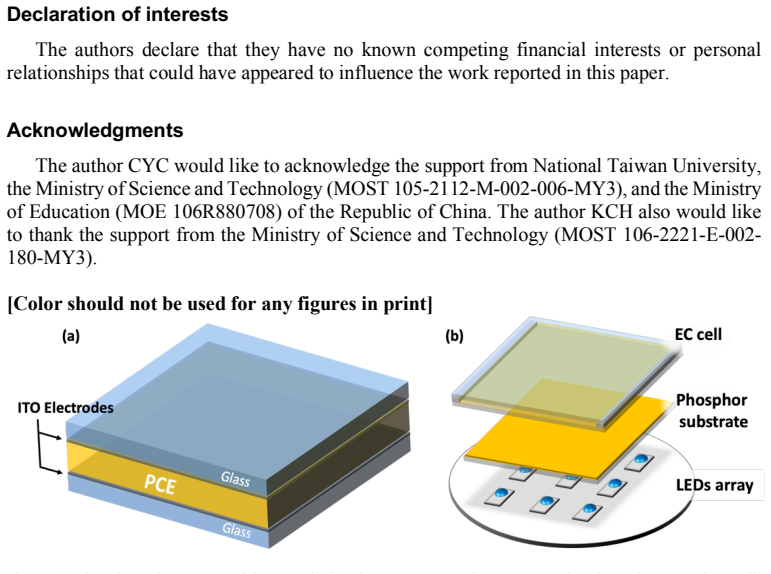
The load-bearing component is the electrochromic cell: two indium-tin-oxide (ITO) glass electrodes sandwich a solution of PCE, an electrochromic compound, with lithium perchlorate in N-methyl-2-pyrrolidinone. When the cell is driven, PCE develops an absorption peak near 460 nm, so the cell acts as an electrically controllable blue-light filter between the LED array and a diffuser. Its key advantage is that it attenuates the blue part of the spectrum rather than the whole beam, which is what lets the color temperature move along the black-body locus without the large luminosity penalty that polarizer-based liquid-crystal filters incur.
What would settle it
Put the assembled EC cell in a spectrophotometer and record its optical density from 400 to 700 nm at 0 V and at 2.4 V. The central claim would be falsified if the field-induced absorption peak is absent or lies outside roughly 460 to 480 nm, because that peak is the stated reason the CCT shifts along the black-body locus rather than merely dimming the bulb.
Extended reading notes
Core claim
The central claim is that an electrochromic cell built from the material 4,4'-biphenyl dicarboxylic acid diethyl ester (PCE) tunes a phosphor-converted white LED's correlated color temperature from about 3,200 K to 6,900 K while keeping the chromaticity track almost on the black-body locus. The mechanism is electrical: raising the cell voltage creates an absorption band near 460 nm that preferentially removes the blue component of the LED spectrum, and the remaining red-enriched light reads as warmer white. The authors report a driving voltage below 2.4 V and a luminous-flux loss of 15.9 percent at 2.4 V, compared with liquid-crystal-based tuners whose polarizers absorb more than half of the light. The paper's claim is that this polarizer-free EC approach gives a wider CCT range than previous tunable systems while preserving most of the original brightness.
Load-bearing premise
The tuning effect rests on the electrochromic material PCE really absorbing blue light near 460 nm when the cell is switched on; the paper cites an earlier study for that behavior instead of measuring it on this exact cell.
Editorial extensions
If this is right
- A single LED bulb can be switched continuously from warm to cool white by varying one low-voltage control signal, with no mechanical filter or polarizer in the optical path.
- Because the driving voltage stays below 2.4 V, the tuning electronics can be powered by the same low-voltage supply that drives the LED, making the approach compatible with ordinary bulb form factors.
- Keeping at least 84 percent of the original luminous flux means tunable white lighting no longer has to trade away most of its brightness, a barrier that earlier liquid-crystal designs did not clear.
- The demonstrated 3,200 K to 6,900 K range spans warm indoor lighting to cooler daylight-like illumination, the range relevant to circadian and mood-related lighting applications.
Reading between the lines
- If PCE's absorption peak can be shifted by chemical modification, the same cell architecture could target other spectral bands, opening a route to independently tunable color-rendering index or saturated color output rather than CCT alone.
- The paper demonstrates the working principle on a freshly assembled cell; long-term cycling of the EC cell would show whether the 3,200 K to 6,900 K range and 84 percent brightness retention persist over the lifetime of a commercial bulb.
- A direct absorption measurement of the assembled cell under drive would isolate the PCE contribution from the combined LED-plus-phosphor spectrum, strengthening the mechanism claim and making the approach easier to reproduce.
Signed reviews
Editorial analysis
A structured set of objections, weighed in public.
Referee Report
Summary. The manuscript reports an electrochromic (EC) cell based on 4,4'-biphenyl dicarboxylic acid diethyl ester (PCE) used to tune the correlated color temperature (CCT) of a phosphor-converted white LED. The device is claimed to vary the CCT from about 3,200 K to 6,900 K almost along the black-body locus (BBL), with driving voltage below 2.4 V and luminous flux loss of 15.9%. The study presents CIE chromaticity coordinates, spectra, and luminous flux measurements for different EC-cell voltages, and compares the performance with previous liquid-crystal-based tuners.
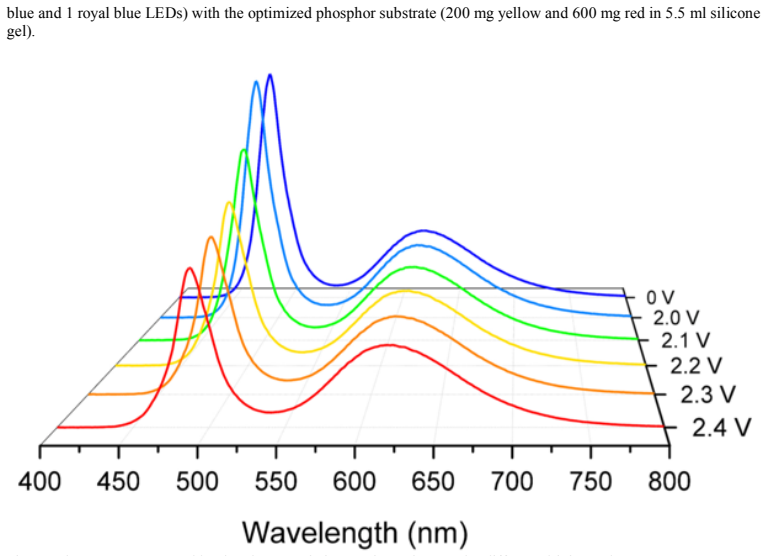
Significance. The potential significance is in demonstrating a polarizer-free CCT-tuning method for white LEDs with a wider tuning range and lower luminosity loss than previously reported LC-based approaches, which could be relevant for human-centric lighting applications. The paper benefits from system-level spectral data (Fig. 4) and a clear comparison to prior LC devices. However, the headline claims about BBL tracking and luminosity loss are not yet quantitatively supported: Duv values are absent, and luminous-flux numbers have no uncertainty. The mechanism evidence is consistent but not isolated from other voltage-dependent effects. These issues are addressable and do not invalidate the core concept.
major comments (3)
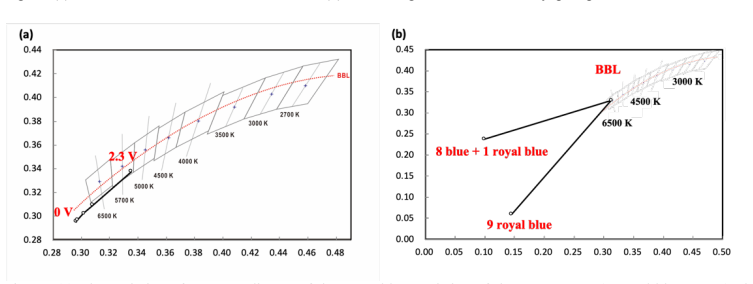
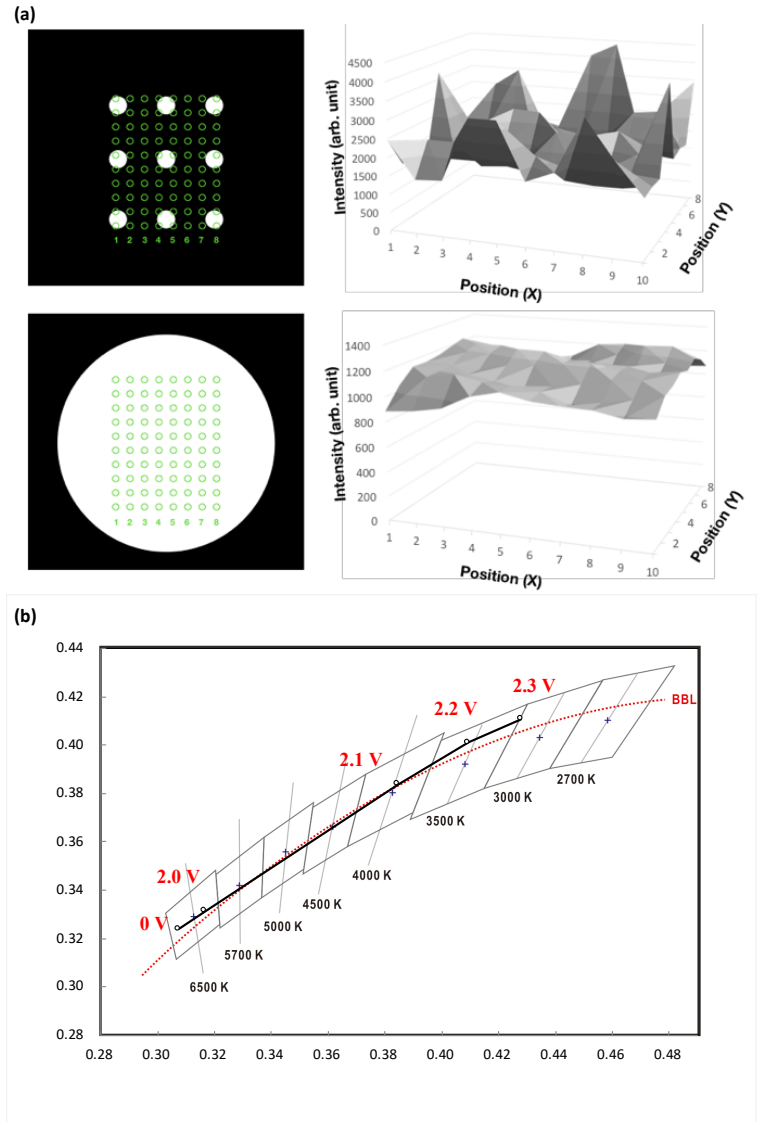
- [Section 3, Fig. 3(b) and Abstract] The claim that the CCT varies 'almost along the black-body locus' from about 3,200 K to 6,900 K is not quantified. The body text only states that in the region between 4,000 K and 5,700 K the track moves 'almost alongside the BBL'; no Duv values or other distance-from-Planckian-locus metrics are reported for the endpoints or intermediate points. Without these, the reader cannot distinguish a true BBL-following tune from a blue-yellow shift that merely crosses the locus in mid-range. Please report Duv or equivalent for each driving voltage (or plot the BBL and iso-CCT lines on Fig. 3(b)), and reconcile the abstract's full-range claim with the 4,000–5,700 K statement.
- [Table 1 and Section 3] The luminous flux values in Table 1 are single measurements with no stated uncertainty, repeat count, or instrument accuracy. The non-monotonic entry at 2.0 V (131.32 lm versus 130.86 lm at 0 V) suggests that the 15.9% drop at 2.4 V could be comparable to measurement variability. Because the low-luminosity-loss claim is a central advertised advantage, repeated measurements with standard deviations (and ideally a description of the integrating-sphere calibration) are needed.
- [Section 3, Fig. 4 and Section 2.2] The tuning mechanism is attributed to a PCE absorption peak near 460–480 nm based on Ref. [19], but the present study does not show an absorption or transmittance spectrum of the fabricated EC cell. The decrease around 480 nm in Fig. 4 is consistent with the mechanism, but it is measured on the assembled bulb and could include other voltage-dependent effects such as LED drive changes or thermal drift. A direct transmittance measurement of the EC cell under the same driving conditions would substantiate the mechanism and rule out alternative explanations.
minor comments (5)
- [Abstract] The phrase 'with profound effect on their psychological and physiological state subtly and deeply' is awkward and redundant; consider simplifying.
- [Section 3] The sentence 'It shows a novel potential for the artificial light to simulate distinct natural light sources with the aid of EC system besides the cholesteric films [20]' is missing a period and is grammatically incomplete; also clarify the comparison with cholesteric films.
- [Fig. 3 caption] The caption for Fig. 3(b) appears truncated after 'LEDs array (8'; please complete the caption and ensure it matches the text.
- [Section 3, Fig. 2(b) discussion] The statement that the connection segment to 6,500 K 'matches the tangential slope over the BBL curve' is vague; please define the criterion quantitatively, for example by reporting the angle or slope difference between the segment and the BBL tangent at a specified CCT.
- [Section 2.1] The phosphor amounts (200 mg yellow, 600 mg red) are given, but the spin-coating parameters and resulting film thickness/concentration are not reported, which limits reproducibility.
Circularity Check
No circularity: the paper is a direct experimental measurement study with no predictive derivation that reduces to its own inputs.
full rationale
The paper reports an experimental demonstration: an electrochromic (EC) cell containing PCE tunes the correlated color temperature (CCT) of a phosphor-converted white LED from about 3,200 K to 6,900 K, with the CIE track described as running 'almost alongside the BBL' between 4,000 K and 5,700 K, and with luminous flux loss of 15.9% at 2.4 V. There is no derivation chain in the sense that the circularity pass targets: no parameter is fitted to a subset of data and then renamed as a prediction, no quantity is defined in terms of the quantity it is claimed to explain, and no uniqueness theorem from the authors' own prior work is invoked to force a choice. The material property that PCE develops an absorption peak near 460 nm under electrical driving is attributed to an external reference [19] (Imaizumi et al., PCCP 2011), not to the present authors' prior work, and the assembled-bulb spectra in Fig. 4 independently show a voltage-dependent decrease near 480 nm, providing system-level evidence for the operating mechanism. The only self-citation is Ref. [16], the authors' earlier liquid-crystal-based CCT-tunable LED paper, from which they adopt the dome-shaped diffuser and initial parameters; this is an engineering reuse of a known component, not a load-bearing theoretical premise. The claim that the tuning track lies 'almost along the black-body locus' is asserted without reporting Duv values, but that is a quantitative-reporting gap or correctness risk, not circularity; it does not involve the paper deriving a result from its own assumptions. There is no fitted model, no predicted quantity that was used as an input, and no self-referential justification of the central claims. The experimental measurements stand as independent evidence for the stated CCT range and luminosity retention. Therefore the appropriate circularity score is 0.
Assumptions & free parameters
free parameters (3)
- Yellow phosphor mass =
200 mg
- Red phosphor mass =
600 mg
- LED array configuration =
8 blue + 1 royal blue
assumptions (3)
- standard math CIE 1931 color matching functions correctly compute chromaticity coordinates and correlated color temperature
- domain assumption PCE electrochromic material absorbs blue light near 460-480 nm when electrically reduced
- domain assumption The integrating sphere and spectrometer provide accurate luminous flux and spectral measurements
Cite this review
Pith. "Pith review of Widely color-temperature low-luminosity-loss electrochromic-tuned white light-emitting diodes." pith.science (2026). https://pith.science/paper/GK3QGTTS
@misc{pith2026190807043,
  author       = {Pith},
  title        = {Pith review of: Widely color-temperature low-luminosity-loss electrochromic-tuned white light-emitting diodes},
  year         = {2026},
  howpublished = {\url{https://pith.science/paper/GK3QGTTS}},
  note         = {Machine review of arXiv:1908.07043}
}
read the original abstract
Light-emitting diodes (LEDs) are efficient light sources extensively applied in people's daily life nowadays, with profound effect on their psychological and physiological state subtly and deeply. The correlated color temperature (CCT) the eyes perceive is a key parameter, but the CCT tuning technology of LEDs remains in the development stage. In this study, an electrochromic (EC) material is employed in the tuning device, exhibiting a wide CCT tuning range from 3,200 K to 6,900 K, varying almost along the black-body locus. The driving voltage is lower than 2.4 V, with luminosity loss less than 16%. Using the EC materials, the performance of CCT tuning technology is able to be further enhanced.
Figures
Figures from the paper (1 more)
Reference graph
Works this paper leans on
-
[3]
2(a), with the driving voltage of the EC cell from 0 to 2.3 V
Results and Discussions Employing the parameters of our previous work [16], the 1931 Commission Internationale de L'éclairage (CIE 1931) chromaticity coordinates of the assembly was measured by a spectrometer (SD1200, OTO Photonics) and shown in Fig. 2(a), with the driving voltage of the EC cell from 0 to 2.3 V. The phosphor substrate was prepared with 3,...
-
[12]
S. M. Pauley, Lighting for the human circadian clock: recent research indicates that lighting has become a public health issue, Med. Hypotheses 63 (2004) 588-596. https://doi.org/10.1016/j.mehy.2004.03.020. [13] F. Falchi, P. Cinzano, C. D. Elvidge, D. M. Keith, A. Haim, Limiting the impact of light pollution on human health, environment and stellar visib...
Reviewed August 14, 2026 · model on record in the stance chip above.
Discussion (0). Continue with ORCID to comment.