REVIEW 3 major objections 4 minor 64 references
Efficient low-order refined preconditioners for high-order matrix-free continuous and discontinuous Galerkin methods
T0 review · 3 major / 4 minor · reviewed 2026-08-14 · deepseek-v4-flash
Pith's one-line read This paper constructs a matrix-free preconditioner whose condition number stays bounded as mesh size, polynomial degree, and DG penalty vary.
desk verdict Solid, honest paper on matrix-free high-order preconditioning, but the headline p-robustness rests on an explicit unproved assumption about the local ILU-smoothed V-cycle. read the letter →
The pith
A machine-rendered reading of the paper's core claim, the machinery that carries it, and where it could break.
The reading
What carries the argument
The load-bearing object is the low-order refined operator $K_h$: a $p=1$ finite element stiffness matrix on the mesh obtained by subdividing each high-order element into parallelepipeds whose vertices are adjacent Gauss-Lobatto nodes. FEM-SEM equivalence (Proposition 2) makes $K_h$ spectrally equivalent to the high-order $K_p$, so a uniform solver for $K_h$ is a uniform preconditioner for $K_p$. The solver is the additive Schwarz preconditioner $B=\sum_j R_j Q_j$ from (13), with one coarse space and one subspace per overlapping vertex patch; the local $R_j$ are geometric multigrid V-cycles on the structured Gauss-Lobatto hierarchy using minimum-discarded-fill ordered ILU(0) smoothing, which plays the role of line relaxation on unstructured meshes. Lemma 2 is the key technical step: it bounds the energy of the interpolated partition-of-unity pieces by $h^{-2}\|w\|_{L^2}^2 + |w|_{H^1}^2$ with constants independent of element aspect ratio, which is what lets the Schwarz theory survive the $O(p)$ anisotropy. For DG, the machinery is the decomposition $V_{DG} = V_B + V_p$, with a point Jacobi solve on the bubble space $V_B$ and the conforming additive Schwarz solver on $V_p$; norm equivalence of IP and BR2 (Proposition 3) transfers the bound.
What would settle it
Fix a $2\times2$ coarse mesh with constant coefficient and a single patch covering the whole domain, then run the proposed preconditioner on the Poisson problem at $p=40, 80, 160$ and count conjugate gradient iterations to a fixed residual reduction, say $10^{-8}$. If the count grows without bound as $p$ increases, the uniform condition number bound of Corollary 1 is false, since the only unproved ingredient is the uniform local-solver assumption (17). Equivalently, compute the extreme eigenvalues of $R_j A_j$ on one patch and check whether they stay within fixed bounds as $p$ grows.
Extended reading notes
Core claim
On its own terms, the paper establishes two uniform bounds. For continuous Galerkin, Corollary 1 asserts that the additive Schwarz preconditioner $B$ defined by (13) satisfies $\kappa(B A_p) \le C$ with $C$ independent of $h$ and $p$, where $A_p$ is the high-order stiffness operator. For discontinuous Galerkin, Corollary 2 asserts $\kappa(B_{DG} A_{BR2}) \le C$ independent of $h$, $p$, and the penalty $\eta$, and Theorem 2 gives the same for the interior penalty form. The argument chains three ingredients: FEM-SEM spectral equivalence between $K_p$ and the low-order refined $K_h$; a Schwarz space decomposition whose stability is proved in Lemma 2 despite the non-shape-regular refined mesh; and uniform local solvers whose uniformity is assumed in (17) and verified numerically.
Load-bearing premise
Everything rests on the assumption that the local approximate solve on each overlapping patch is uniformly accurate as the mesh is refined and the polynomial degree grows; the paper demonstrates this by experiment, but does not prove it.
Editorial extensions
If this is right
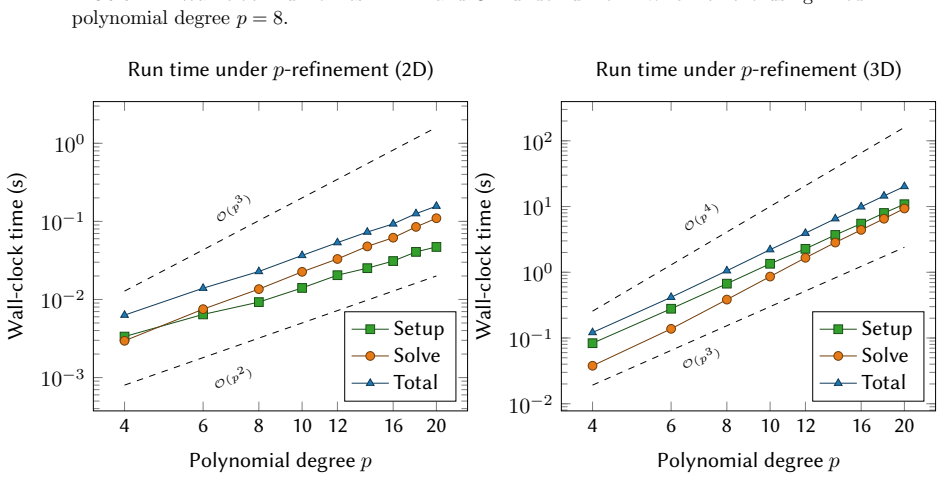
- For continuous Galerkin, a bounded $\kappa(BA_p)$ means the number of conjugate gradient iterations is bounded as $h\to 0$ and $p\to\infty$, so total solve time is $O(p\,n_{\rm dof})$ with $O(n_{\rm dof})$ memory.
- For interior penalty and BR2 discontinuous Galerkin methods, the same boundedness holds as the penalty $\eta$ grows, so the stabilization parameter can be chosen for accuracy rather than solver convenience.
- The low-order refined matrices are sparse with a constant number of nonzeros per row, independent of $p$, which is what makes forming them cheap in time and memory.
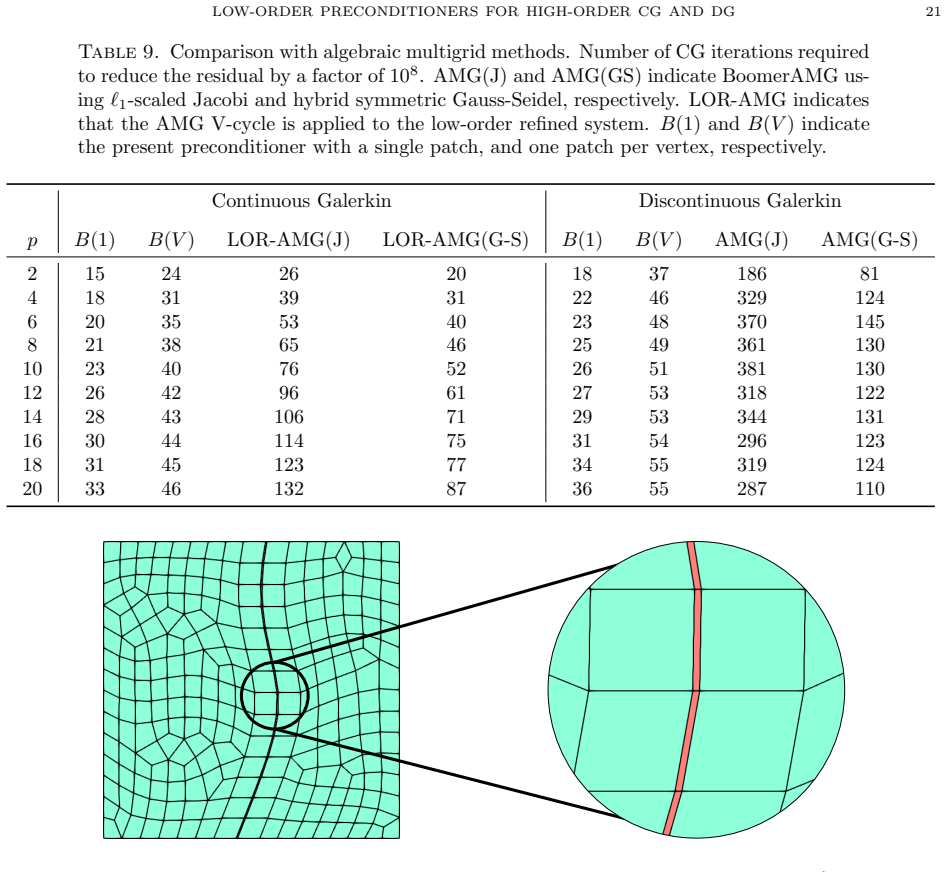
- The vertex-patch additive Schwarz version parallelizes the local solves, with iteration counts roughly 1.5 to 2 times the single-patch case in the reported tables.
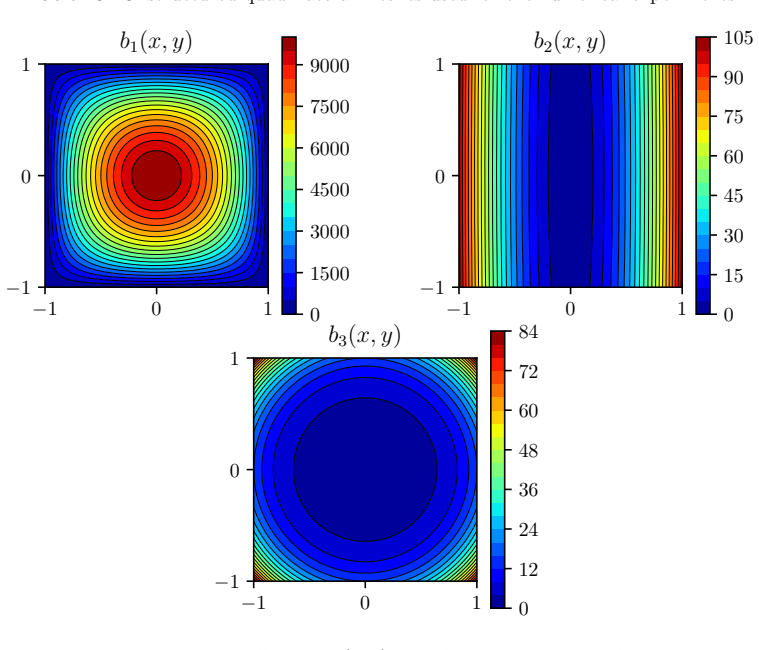
- Numerical tests on variable coefficients, curved unstructured meshes, and anisotropic element strips show the same bounded iteration counts, provided subdomain overlap is made isotropic on anisotropic meshes as described in Section 4.5.
Reading between the lines
- Editorial extension: the unproved uniformity assumption on the ILU-smoothed multigrid V-cycle, equation (17), is the only step separating the theorem from a fully rigorous $h$-$p$ bound; replacing ILU with exact line solves on the structured patches, or proving a smoothing property for MDF-ordered ILU, would close the gap.
- Editorial extension: Lemma 2 needs only isotropic overlap, not shape regularity, so the same additive Schwarz construction should apply to hp-adaptive meshes, boundary-layer meshes, and other anisotropic refinements beyond Gauss-Lobatto grids.
- Editorial extension: because the preconditioner never sees the high-order matrix entries, it is natural to test it on high-contrast variable coefficients and on vector-valued systems such as elasticity or Maxwell equations, where the scalar Schwarz theory does not directly apply.
- Editorial extension: the paper's cost model assumes one geometric multigrid V-cycle per patch; on massively parallel hardware, the overlap factor and coarse-solve communication could change the practical balance, so a distributed-memory implementation study would test whether the bounded iteration count translates to bounded wall-clock time.
Signed reviews
Editorial analysis
A structured set of objections, weighed in public.
Referee Report
Summary. The paper designs and analyzes a matrix-free preconditioner for high-order continuous and discontinuous Galerkin discretizations of elliptic problems. The method is based on the FEM-SEM equivalence: a high-order operator is preconditioned by a low-order (p=1) finite element operator on a refined mesh of Gauss-Lobatto points. The resulting anisotropic low-order system is solved by an overlapping additive Schwarz method with vertex patches, using an element-structured geometric multigrid V-cycle with ordered ILU(0) smoothing as local solvers. The analysis proves stability of the Schwarz decomposition on the p-anisotropic mesh (Lemma 2) and derives a condition-number bound (Theorem 1) that is uniform in h and p conditional on assumption (17), namely that each local solver R_j is a uniform preconditioner for its subspace operator. The method is extended to interior-penalty and BR2 DG discretizations, where a norm-equivalence argument yields a bound independent of the penalty parameter (Proposition 3 and Corollary 2). Extensive numerical experiments on Cartesian, unstructured, variable-coefficient, and anisotropic meshes, as well as DG penalty studies and timing scalings, support the practical claims.
Significance. If the local-solver uniformity in (17) holds, the paper delivers a practical, matrix-free solver achieving bounded iteration counts under h- and p-refinement and under DG penalty variation, with near-optimal setup and application costs. The analysis of the Schwarz decomposition on p-anisotropic meshes in Lemma 2 is a genuine technical contribution, and the DG norm-equivalence argument in Proposition 3 is clean. The numerical study is unusually thorough for a solver paper, covering many of the regimes that matter in practice. The main caveat is that the key uniformity of the ILU-smoothed multigrid local solver is assumed rather than proved; this is the single load-bearing assumption on which the headline robustness claims rest.
major comments (3)
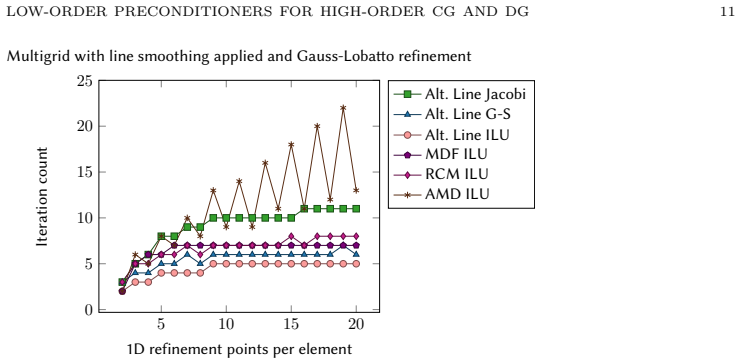
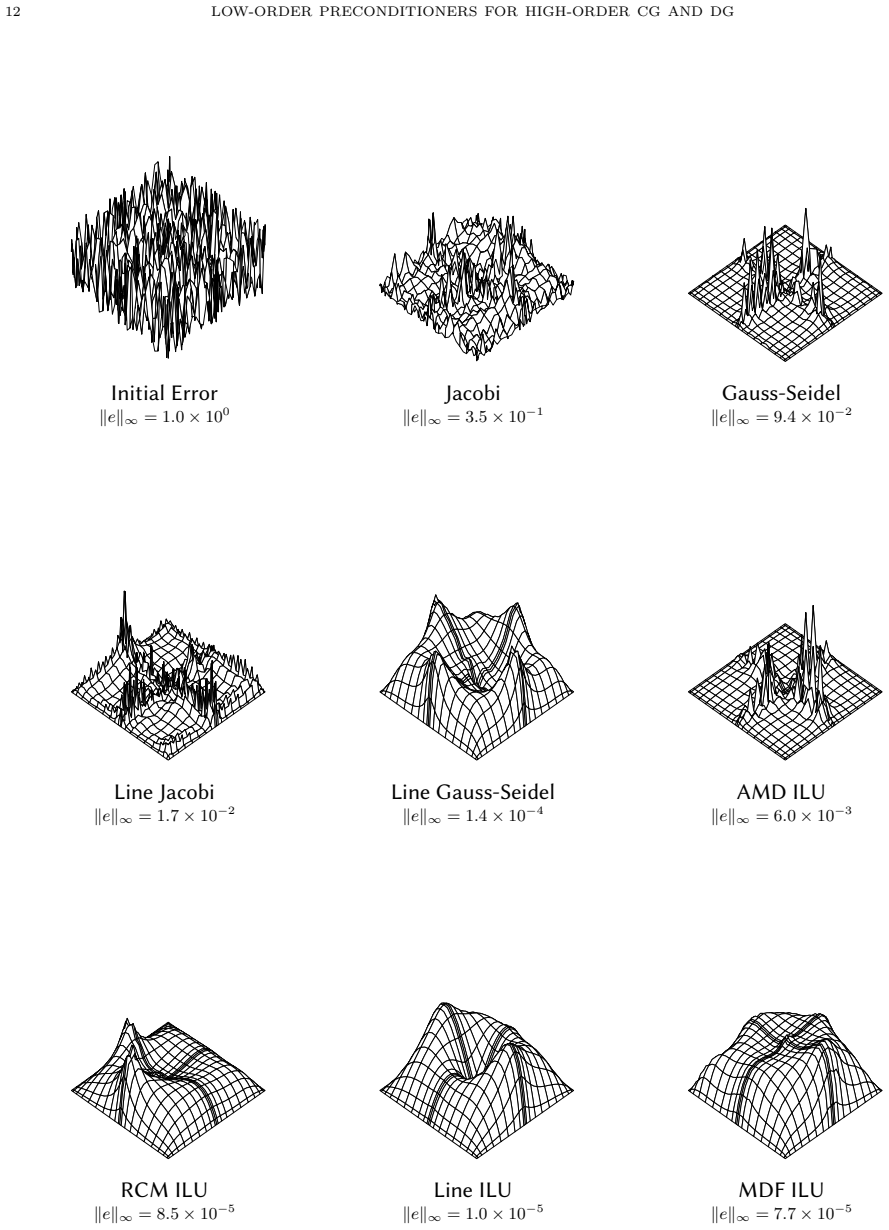
- [Section 3.2, Eq. (17); Theorem 1; Corollary 1] The p-robust bound κ(BA_p) ≤ C in Corollary 1 is obtained from Theorem 1 together with the FEM-SEM equivalence, but Theorem 1 is conditional on assumption (17): each local solver R_j must satisfy C0 a(u_j,u_j) ≤ a(R_j A_j u_j, u_j) ≤ C1 a(u_j,u_j) with C0, C1 independent of h and p. The manuscript explicitly says in Section 3.2 that 'we will assume that R_j is a uniform preconditioner for A_j' and provides no proof of this for the specific element-structured V-cycle with MDF-ordered ILU(0) smoothing developed in Sections 3.3 and 3.4. This gap is load-bearing because Section 3.4 itself shows that uniformity is not generic: AMD-ordered ILU degrades while MDF/RCM orderings do not, so the property is not a consequence of the general Schwarz framework. Consequently, Corollary 1 as stated overclaims an unconditional bound for the implemented preconditioner; it should either be accompanied by a proof of (17) or be reworded to present the bound as conditional on a numerically verified property.
- [Section 3.5; Theorem 2; Corollary 2] The DG result κ(B_DG A_BR2) ≤ C in Corollary 2 inherits the same unproved assumption. Theorem 2 requires R_p to be a uniform approximation to A_p^{-1}, and the paper establishes this hypothesis only through Theorem 1, which itself rests on (17). Therefore the claimed robustness with respect to h, p, and the penalty parameter η is conditional on the same local-solver uniformity. If (17) fails in some parameter regime, the DG corollary and the associated robustness claims would also fail. The author should make this conditional structure explicit in the statements of the DG results.
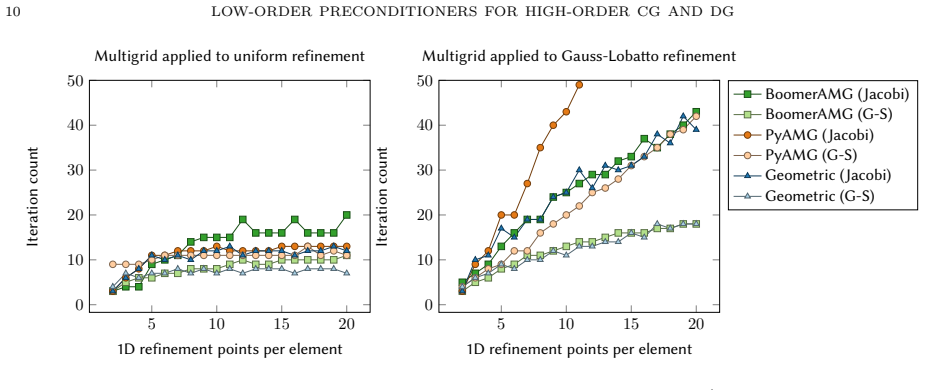
- [Section 4.1; Table 3] The numerical evidence offered in support of (17) is supportive but not conclusive. In the vertex-patch tests on the 32×32 mesh, the CG iteration count increases from 26 at p=2 to 38 at p=20, a growth of about 46%. Moreover, at p=2 the iteration count grows steadily under h-refinement (4, 10, 14, 20, 26 for nx=2 through 32). The paper characterizes these trends as pre-asymptotic, but the data are also consistent with slow, unbounded growth of the condition number. If the author intends the headline claims to be unconditional, then a proof of (17) or at least a much more extensive empirical study (larger p, direct condition-number estimates, and a study of the dependence on aspect ratio) is needed. Otherwise, the wording should state explicitly that the observed robustness is an empirical finding rather than a proven uniform bound.
minor comments (4)
- [Abstract and Section 5] The abstract and conclusions state that the preconditioner is 'robust in h and p' and 'robust in the penalty parameter' without qualification. These statements should be aligned with the conditional nature of Theorem 1 and Corollaries 1-2, for example by adding a clause such as 'assuming the local solvers are uniform preconditioners, which is verified numerically.'
- [Table 3 and Section 4.1] In the vertex-patch column of Table 3, the p=2 row shows a monotonic increase in iteration counts with h-refinement (4, 10, 14, 20, 26 for nx=2 to 32). Even if this is a pre-asymptotic effect, the author should comment on whether the growth persists at larger nx and how it interacts with the claimed h-robustness of the parallel version.
- [Lemma 2 and Remark 2] The symbol h is used both for the coarse-mesh spacing (in Lemma 2 and the product-rule bound) and for the refined-mesh element size (in Remark 2). A brief sentence distinguishing these two uses, e.g., h for the coarse mesh and ~h/p for the refined mesh, would improve readability.
- [Proof of Lemma 2] The step in which Ih is said to be bounded on Q2([0,1]^d) in the H^1_i seminorms is stated as 'it is clear'; a short justification with the explicit constant c_I (for instance by a direct calculation on the reference cube) would make the proof more self-contained.
Circularity Check
No significant circularity: the p-robustness claim is a conditional theorem resting on an explicitly stated uniformity assumption for local solvers, with independent FEM-SEM equivalence and Schwarz theory carrying the argument.
full rationale
The paper's central claims are derived rather than assumed. Theorem 1 explicitly assumes that each local solver R_j is a uniform preconditioner (Eq. 17) and then proves the Schwarz decomposition bounds; Corollary 1 combines that conditional result with the external FEM-SEM spectral equivalence result (Proposition 2). The uniformity of the local ILU-smoothed multigrid solver is not proven in the paper, but it is also not a fitted parameter or a disguised restatement of the global conclusion. It is an explicit hypothesis whose numerical verification is reported in Section 4. If that hypothesis fails for some p or aspect ratio, Corollary 1 would be false for the implemented solver, but that is a correctness risk, not circularity. The DG extension is imported from an independent external result (Theorem 2, citing Antonietti et al.), and the BR2 norm-equivalence proof is self-contained using trace inequalities. Self-citations to the author's earlier tensor-product preconditioners appear only as background and are not load-bearing. No equation is defined in terms of its own output, and no fitted constant is relabeled as a prediction. Therefore the circularity score is 0.
Assumptions & free parameters
assumptions (6)
- standard math FEM-SEM spectral equivalence (Propositions 1-2): high-order and low-order Gauss-Lobatto refined stiffness matrices are spectrally equivalent with constants independent of h and p.
- standard math Bramble-Xu bounds for L2 projection onto coarse space V0 (Eq. 22): |u0|_H1 ≲ |uh|_H1 and ||uh-u0||_L2 ≲ h |uh|_H1.
- standard math Trace and inverse trace inequalities for DG spaces, Lemma 4 from [17] (Eqs 32-33).
- ad hoc to paper Uniformity of local approximate solvers R_j, Eq (17): constants C0, C1 independent of h and p satisfy C0 a(u_j,u_j) <= a(R_j A_j u_j, u_j) <= C1 a(u_j,u_j).
- domain assumption Uniform coarse solver R0 for coarse space V0, assumed via BoomerAMG.
- domain assumption Affine coarse mesh for FEM-SEM equivalence in Section 3.1; curved elements are tested but not analyzed.
Cite this review
Pith. "Pith review of Efficient low-order refined preconditioners for high-order matrix-free continuous and discontinuous Galerkin methods." pith.science (2026). https://pith.science/paper/77CBG24Z
@misc{pith2026190807071,
  author       = {Pith},
  title        = {Pith review of: Efficient low-order refined preconditioners for high-order matrix-free continuous and discontinuous Galerkin methods},
  year         = {2026},
  howpublished = {\url{https://pith.science/paper/77CBG24Z}},
  note         = {Machine review of arXiv:1908.07071}
}
abstract
In this paper, we design preconditioners for the matrix-free solution of high-order continuous and discontinuous Galerkin discretizations of elliptic problems based on FEM-SEM equivalence and additive Schwarz methods. The high-order operators are applied without forming the system matrix, making use of sum factorization for efficient evaluation. The system is preconditioned using a spectrally equivalent low-order ($p=1$) finite element operator discretization on a refined mesh. The low-order refined mesh is anisotropic and not shape regular in the polynomial degree of the high-order operator, requiring specialized solvers to treat the anisotropy. We make use of an element-structured, geometric multigrid V-cycle with ordered ILU(0) smoothing. The preconditioner is parallelized through an overlapping additive Schwarz method that is robust in $h$ and $p$. The method is extended to interior penalty and BR2 discontinuous Galerkin discretizations, for which it is also robust in the size of the penalty parameter. Numerical results are presented on a variety of examples, verifying the uniformity of the preconditioner.
Figures
Figures from the paper (6 more)


Reference graph
Works this paper leans on
- [1]
-
[2]
P. R. Amestoy, T. A. Davis, and I. S. Duff , An approximate minimum degree ordering algorithm, SIAM Journal on Matrix Analysis and Applications, 17 (1996), pp. 886–905, https://doi.org/10. 1137/s0895479894278952, https://doi.org/10.1137%2Fs0895479894278952
work page 1996
-
[3]
R. Anderson, A. Barker, J. Bramwell, J.-S. Camier, J. Cerveny, V. Dobrev, Y. Du- douit, A. Fisher, T. Kolev, W. Pazner, M. Stowell, V. Tomov, J. Dahm, D. Medina, and S. Zampini , MFEM: a modular finite element library . 2019
work page 2019
-
[4]
P. F. Antonietti and P. Houston , A class of domain decomposition preconditioners for hp-discontinuous Galerkin finite element methods , Journal of Scientific Computing, 46 (2010), pp. 124–149, https://doi.org/10.1007/s10915-010-9390-1 , https://doi.org/10.1007% 2Fs10915-010-9390-1
-
[5]
P. F. Antonietti, M. Sarti, and M. Verani , Multigrid algorithms for hp-discontinuous Galerkin discretizations of elliptic problems, SIAM Journal on Numerical Analysis, 53 (2015), pp. 598–618,https: //doi.org/10.1137/130947015, https://doi.org/10.1137%2F130947015
-
[6]
P. F. Antonietti, M. Sarti, M. Verani, and L. T. Zikatanov , A uniform additive Schwarz preconditioner for high-order discontinuous Galerkin approximations of elliptic problems, Journal of Sci- entific Computing, 70 (2016), pp. 608–630, https://doi.org/10.1007/s10915-016-0259-9 , https: //doi.org/10.1007%2Fs10915-016-0259-9
-
[7]
D. N. Arnold , An interior penalty finite element method with discontinuous elements , SIAM Journal on Numerical Analysis, 19 (1982), pp. 742–760, https://doi.org/10.1137/0719052, https://doi. org/10.1137%2F0719052
doi:10.1137/0719052 1982
-
[8]
D. N. Arnold, F. Brezzi, B. Cockburn, and L. D. Marini , Unified analysis of discontinuous Galerkin methods for elliptic problems , SIAM Journal on Numerical Analysis, 39 (2002), pp. 1749–1779, https://doi.org/10.1137/s0036142901384162, https://doi.org/10.1137%2Fs0036142901384162
Show all 64 references
-
[9]
T. M. Austin, M. Brezina, B. Jamroz, C. Jhurani, T. A. Manteuffel, and J. Ruge , Semi- automatic sparse preconditioners for high-order finite element methods on non-uniform meshes , Journal of Computational Physics, 231 (2012), pp. 4694–4708, https://doi.org/10.1016/j.jcp.2012....
2012 doi
-
[10]
Bassi, S
F. Bassi, S. Rebay, M. Savini, G. Mariotti, and S. Pedinotti , A high-order accurate discontin- uous finite element method for inviscid and viscous turbomachinery flow , in Proceedings of the Second European Conference on Turbomachinery Fluid Dynamics and Thermodynamics, R. Decu...
1997
-
[11]
P. D. Bello-Maldonado and P. F. Fischer , Scalable low-order finite element preconditioners for high-order spectral element poisson solvers , SIAM Journal on Scientific Computing, 41 (2019), pp. S2– S18, https://doi.org/10.1137/18m1194997, https://doi.org/10.1137%2F18m1194997
2019 doi
-
[12]
J. H. Bramble and J. Xu , Some estimates for a weighted L2 projection, Mathematics of Com- putation, 56 (1991), pp. 463–463, https://doi.org/10.1090/s0025-5718-1991-1066830-3 , https: //doi.org/10.1090%2Fs0025-5718-1991-1066830-3
1991 doi
-
[13]
Brezzi, G
F. Brezzi, G. Manzini, D. Marini, P. Pietra, and A. Russo , Discontinuous Galerkin approxima- tions for elliptic problems , Numerical Methods for Partial Differential Equations, 16 (2000), pp. 365– 378, https://doi.org/10.1002/1098-2426(200007)16:4<365::aid-num2>3.0.co;2-y , ht...
2000 doi
-
[14]
K. Brix, C. Canuto, and W. Dahmen , Nested dyadic grids associated with Legendre-Gauss- Lobatto grids , Numerische Mathematik, 131 (2014), pp. 205–239, https://doi.org/10.1007/ s00211-014-0691-4 , https://doi.org/10.1007%2Fs00211-014-0691-4
2014
-
[15]
Brown , Efficient nonlinear solvers for nodal high-order finite elements in 3D , Journal of Sci- entific Computing, 45 (2010), pp
J. Brown , Efficient nonlinear solvers for nodal high-order finite elements in 3D , Journal of Sci- entific Computing, 45 (2010), pp. 48–63, https://doi.org/10.1007/s10915-010-9396-8 , https: //doi.org/10.1007%2Fs10915-010-9396-8
2010 doi
-
[16]
Brown, A
J. Brown, A. Abdelfata, J.-S. Camier, V. Dobrev, J. Dongarra, P. Fischer, A. Fisher, Y. Dudouit, A. Haidar, K. Kamran, T. Kalev, M. Min, T. Ratnayaka, M. Shephard, 24 LOW-ORDER PRECONDITIONERS FOR HIGH-ORDER CG AND DG C. Smith, S. Tomov, V. Tomov, and T. W arburton , CEED ECP ...
2018 doi
-
[17]
Burman and A
E. Burman and A. Ern , Continuous interior penalty hp-finite element methods for advection and advection-diffusion equations, Mathematics of Computation, 76 (2007), pp. 1119–1141, https://doi. org/10.1090/s0025-5718-07-01951-5 , https://doi.org/10.1090%2Fs0025-5718-07-01951-5
2007 doi
-
[18]
Canuto , Stabilization of spectral methods by finite element bubble functions , Computer Meth- ods in Applied Mechanics and Engineering, 116 (1994), pp
C. Canuto , Stabilization of spectral methods by finite element bubble functions , Computer Meth- ods in Applied Mechanics and Engineering, 116 (1994), pp. 13–26, https://doi.org/10.1016/ s0045-7825(94)80004-9, https://doi.org/10.1016%2Fs0045-7825%2894%2980004-9
1994
-
[19]
Canuto, P
C. Canuto, P. Gervasio, and A. Quarteroni , Finite-element preconditioning of G-NI spectral methods, SIAM Journal on Scientific Computing, 31 (2010), pp. 4422–4451, https://doi.org/10. 1137/090746367, https://doi.org/10.1137%2F090746367
2010
-
[20]
Canuto, M
C. Canuto, M. Y. Hussaini, A. Quarteroni, and T. A. Zang , Spectral methods, Springer Berlin Heidelberg, 2006, https://doi.org/10.1007/978-3-540-30726-6 , https://doi.org/10. 1007%2F978-3-540-30726-6
2006 doi
-
[21]
Canuto and A
C. Canuto and A. Quarteroni , Approximation results for orthogonal polynomials in Sobolev spaces, Mathematics of Computation, 38 (1982), pp. 67–67
1982
-
[22]
Canuto and A
C. Canuto and A. Quarteroni , Preconditioned minimal residual methods for Chebyshev spectral calculations, Journal of Computational Physics, 60 (1985), pp. 315–337, https://doi.org/10.1016/ 0021-9991(85)90010-5, https://doi.org/10.1016%2F0021-9991%2885%2990010-5
1985
-
[23]
Canuto, A
C. Canuto, A. Quarteroni, M. Y. Hussaini, and T. A. Zang , Spectral methods, Springer Berlin Heidelberg, 2007, https://doi.org/10.1007/978-3-540-30728-0 , https://doi.org/10. 1007%2F978-3-540-30728-0
2007 doi
-
[24]
Chalmers and T
N. Chalmers and T. W arburton, Low-order preconditioning of high-order triangular finite elements, SIAM Journal on Scientific Computing, 40 (2018), pp. A4040–A4059, https://doi.org/10.1137/ 17m1149444, https://doi.org/10.1137%2F17m1149444
2018
-
[25]
Cuthill and J
E. Cuthill and J. McKee , Reducing the bandwidth of sparse symmetric matrices , in Proceedings of the 1969 24th national conference, ACM Press, 1969, https://doi.org/10.1145/800195.805928, https://doi.org/10.1145%2F800195.805928
1969
-
[26]
E. F. D’Azevedo, P. A. Forsyth, and W.-P. Tang , Ordering methods for preconditioned conju- gate gradient methods applied to unstructured grid problems, SIAM Journal on Matrix Analysis and Ap- plications, 13 (1992), pp. 944–961, https://doi.org/10.1137/0613057, https://doi.org...
1992 doi
-
[27]
E. F. D’Azevedo, P. A. Forsyth, and W.-P. Tang , Towards a cost-effective ILU preconditioner with high level fill , BIT, 32 (1992), pp. 442–463, https://doi.org/10.1007/bf02074880, https:// doi.org/10.1007%2Fbf02074880
1992 doi
-
[28]
M. O. Deville and E. H. Mund , Finite-element preconditioning for pseudospectral solutions of elliptic problems, SIAM Journal on Scientific and Statistical Computing, 11 (1990), pp. 311–342, https: //doi.org/10.1137/0911019, https://doi.org/10.1137%2F0911019
1990 doi
-
[29]
Dryja and O
M. Dryja and O. B. Widlund , Some domain decomposition algorithms for elliptic problems , in Iterative Methods for Large Linear Systems, Elsevier, 1990, pp. 273–291, https://doi.org/10.1016/ b978-0-12-407475-0.50022-x , https://doi.org/10.1016%2Fb978-0-12-407475-0.50022-x
1990
-
[30]
R. D. F algout and U. M. Yang , hypre: a library of high performance preconditioners , in Lecture Notes in Computer Science, Springer Berlin Heidelberg, 2002, pp. 632–641,https://doi.org/10.1007/ 3-540-47789-6_66 , https://doi.org/10.1007%2F3-540-47789-6_66
2002
-
[31]
K. J. Fidkowski, T. A. Oliver, J. Lu, and D. L. Darmofal , p-multigrid solution of high- order discontinuous Galerkin discretizations of the compressible Navier-Stokes equations , Journal of Computational Physics, 207 (2005), pp. 92–113, https://doi.org/10.1016/j.jcp.2005.01.0...
2005 doi
-
[32]
P. F. Fischer , An overlapping Schwarz method for spectral element solution of the incompressible Navier-Stokes equations , Journal of Computational Physics, 133 (1997), pp. 84–101, https://doi. org/10.1006/jcph.1997.5651, https://doi.org/10.1006%2Fjcph.1997.5651
1997
-
[33]
P. F. Fischer and J. W. Lottes , Hybrid Schwarz-multigrid methods for the spectral element method: Extensions to Navier-Stokes , in Domain Decomposition Methods in Science and Engineering, Springer, LOW-ORDER PRECONDITIONERS FOR HIGH-ORDER CG AND DG 25 2005, pp. 35–49, https:/...
2005 doi
-
[34]
Fortunato, C
D. Fortunato, C. H. Rycroft, and R. Saye , Efficient operator-coarsening multigrid schemes for local discontinuous Galerkin methods , SIAM Journal on Scientific Computing, 41 (2019), pp. A3913– A3937, https://doi.org/10.1137/18m1206357, https://doi.org/10.1137%2F18m1206357
2019 doi
-
[35]
Hackbusch, Multi-grid methods and applications, Springer Berlin Heidelberg, 1985, https://doi
W. Hackbusch, Multi-grid methods and applications, Springer Berlin Heidelberg, 1985, https://doi. org/10.1007/978-3-662-02427-0 , https://doi.org/10.1007%2F978-3-662-02427-0
1985 doi
-
[36]
Hassan, E
O. Hassan, E. Probert, K. Morgan, and J. Peraire , Line relaxation methods for the solution of 2D and 3D compressible flows , in 11th Computational Fluid Dynamics Conference, American Institute of Aeronautics and Astronautics, July 1993, https://doi.org/10.2514/6.1993-3366, htt...
1993 doi
-
[37]
Heinrichs , Line relaxation for spectral multigrid methods , Journal of Computational Physics, 77 (1988), pp
W. Heinrichs , Line relaxation for spectral multigrid methods , Journal of Computational Physics, 77 (1988), pp. 166–182, https://doi.org/10.1016/0021-9991(88)90161-1, https://doi.org/10. 1016%2F0021-9991%2888%2990161-1
1988 doi
-
[38]
Helenbrook, D
B. Helenbrook, D. Mavriplis, and H. Atkins , Analysis of “p”-multigrid for continuous and discon- tinuous finite element discretizations , in 16th AIAA Computational Fluid Dynamics Conference, Amer- ican Institute of Aeronautics and Astronautics, June 2003, https://doi.org/10.2...
2003 doi
-
[39]
B. T. Helenbrook and H. L. Atkins , Application of p-multigrid to discontinuous Galerkin formu- lations of the Poisson equation , AIAA Journal, 44 (2006), pp. 566–575, https://doi.org/10.2514/1. 15497, https://doi.org/10.2514%2F1.15497
2006 doi
-
[40]
V. E. Henson and U. M. Yang , BoomerAMG: a parallel algebraic multigrid solver and preconditioner, Applied Numerical Mathematics, 41 (2002), pp. 155–177, https://doi.org/10.1016/s0168-9274(01) 00115-5, https://doi.org/10.1016%2Fs0168-9274%2801%2900115-5
2002 doi
-
[41]
Klckner, T
A. Klckner, T. W arburton, J. Bridge, and J. Hesthaven, Nodal discontinuous Galerkin methods on graphics processors, Journal of Computational Physics, 228 (2009), pp. 7863–7882, https://doi. org/10.1016/j.jcp.2009.06.041, https://doi.org/10.1016%2Fj.jcp.2009.06.041
2009 doi
-
[42]
Kronbichler and K
M. Kronbichler and K. Ljungkvist , Multigrid for matrix-free high-order finite element com- putations on graphics processors , ACM Transactions on Parallel Computing, 6 (2019), pp. 1–32, https://doi.org/10.1145/3322813, https://doi.org/10.1145%2F3322813
2019 doi
-
[43]
P. L. Lions , On the Schwarz alternating method. I. , in Domain Decomposition Methods for Partial Differential Equations, R. Glowinski, G. Golub, G. Meurant, and J. P´ eriaux, eds., SIAM, 1988
1988
-
[44]
J. W. Lottes and P. F. Fischer , Hybrid multigrid/Schwarz algorithms for the spectral ele- ment method , Journal of Scientific Computing, 24 (2005), pp. 45–78, https://doi.org/10.1007/ s10915-004-4787-3 , https://doi.org/10.1007%2Fs10915-004-4787-3
2005
-
[45]
D. J. Mavriplis , Multigrid strategies for viscous flow solvers on anisotropic unstructured meshes , Journal of Computational Physics, 145 (1998), pp. 141–165
1998
-
[46]
Melenk, K
J. Melenk, K. Gerdes, and C. Schwab , Fully discretehp-finite elements: fast quadrature, Computer Methods in Applied Mechanics and Engineering, 190 (2001), pp. 4339–4364, https://doi.org/10. 1016/s0045-7825(00)00322-4, https://doi.org/10.1016%2Fs0045-7825%2800%2900322-4
2001
-
[47]
M ¨uthing, M
S. M ¨uthing, M. Piatkowski, and P. Bastian , High-performance implementation of matrix-free high-order discontinuous Galerkin methods , 2017, https://arxiv.org/abs/arXiv:1711.10885
2017 arXiv
-
[48]
L. N. Olson and J. B. Schroder , Smoothed aggregation multigrid solvers for high-order discontinuous Galerkin methods for elliptic problems , Journal of Computational Physics, 230 (2011), pp. 6959–6976, https://doi.org/10.1016/j.jcp.2011.05.009, https://doi.org/10.1016%2Fj.jcp...
2011 doi
-
[49]
L. N. Olson and J. B. Schroder , PyAMG: Algebraic multigrid solvers in Python v4.0 , 2018, https: //github.com/pyamg/pyamg. Release 4.0
2018
-
[50]
S. A. Orszag , Spectral methods for problems in complex geometries , Journal of Computational Physics, 37 (1980), pp. 70–92, https://doi.org/10.1016/0021-9991(80)90005-4, https://doi. org/10.1016%2F0021-9991%2880%2990005-4
1980 doi
-
[51]
L. F. Pavarino, Additive Schwarz methods for the p-version finite element method , Numerische Math- ematik, 66 (1993), pp. 493–515, https://doi.org/10.1007/bf01385709, https://doi.org/10.1007% 2Fbf01385709
1993 doi
-
[52]
Pazner and P.-O
W. Pazner and P.-O. Persson , Approximate tensor-product preconditioners for very high order discontinuous Galerkin methods , Journal of Computational Physics, 354 (2018), pp. 344–369, https: 26 LOW-ORDER PRECONDITIONERS FOR HIGH-ORDER CG AND DG //doi.org/10.1016/j.jcp.2017.10...
2018 doi
-
[53]
Pazner and P.-O
W. Pazner and P.-O. Persson , Interior penalty tensor-product preconditioners for high-order discontinuous Galerkin discretizations , in 2018 AIAA Aerospace Sciences Meeting, American Insti- tute of Aeronautics and Astronautics, Jan. 2018, https://doi.org/10.2514/6.2018-1093, ...
2018 doi
-
[54]
Persson and J
P.-O. Persson and J. Peraire , Newton-GMRES preconditioning for discontinuous Galerkin dis- cretizations of the Navier-Stokes equations, SIAM Journal on Scientific Computing, 30 (2008), pp. 2709– 2733, https://doi.org/10.1137/070692108, https://doi.org/10.1137%2F070692108
2008 doi
-
[55]
J. W. Ruge and K. St ¨uben, Algebraic multigrid, in Multigrid methods, S. F. McCormick, ed., Society for Industrial and Applied Mathematics, Jan. 1987, ch. 4, pp. 73–130, https://doi.org/10.1137/1. 9781611971057.ch4, https://doi.org/10.1137%2F1.9781611971057.ch4
1987 doi
-
[56]
Shahbazi , An explicit expression for the penalty parameter of the interior penalty method , Journal of Computational Physics, 205 (2005), pp
K. Shahbazi , An explicit expression for the penalty parameter of the interior penalty method , Journal of Computational Physics, 205 (2005), pp. 401–407, https://doi.org/10.1016/j.jcp.2004.11.017, https://doi.org/10.1016%2Fj.jcp.2004.11.017
2005 doi
-
[57]
J. Shen, F. W ang, and J. Xu , A finite element multigrid preconditioner for Chebyshev-collocation methods, Applied Numerical Mathematics, 33 (2000), pp. 471–477, https://doi.org/10.1016/ s0168-9274(99)00114-2, https://doi.org/10.1016%2Fs0168-9274%2899%2900114-2
2000
-
[58]
Slotnick, A
J. Slotnick, A. Khodadoust, J. Alonso, D. L. Darmofal, W. Gropp, E. Lurie, and D. J. Mavriplis, CFD vision 2030 study: a path to revolutionary computational aerosciences , Tech. Report NASA-CR-2014-218178, NASA Langley, 2014
2014
-
[59]
Toselli and O
A. Toselli and O. B. Widlund , Domain decomposition methods — algorithms and theory , Springer Berlin Heidelberg, 2005, https://doi.org/10.1007/b137868, https://doi.org/10.1007% 2Fb137868
2005 doi
-
[60]
Vermeire, F
B. Vermeire, F. Witherden, and P. Vincent , On the utility of GPU accelerated high-order methods for unsteady flow simulations: a comparison with industry-standard tools , Journal of Computational Physics, 334 (2017), pp. 497–521,https://doi.org/10.1016/j.jcp.2016.12.049, https...
2017 doi
-
[61]
W ang, K
Z. W ang, K. Fidkowski, R. Abgrall, F. Bassi, D. Caraeni, A. Cary, H. Deconinck, R. Hartmann, K. Hillewaert, H. Huynh, N. Kroll, G. May, P.-O. Persson, B. van Leer, and M. Visbal , High-order CFD methods: current status and perspective , International Jour- nal for Numerical M...
2013 doi
-
[62]
Wesseling , Introduction to multigrid methods , Tech
P. Wesseling , Introduction to multigrid methods , Tech. Report NASA-CR-195045, Institute for Ap- plied Mathematics and Computer Science, NASA, 1995
1995
-
[63]
Xu , Iterative methods by space decomposition and subspace correction , SIAM Review, 34 (1992), pp
J. Xu , Iterative methods by space decomposition and subspace correction , SIAM Review, 34 (1992), pp. 581–613, https://doi.org/10.1137/1034116, https://doi.org/10.1137%2F1034116
1992 doi
-
[64]
Xu and L
J. Xu and L. Zikatanov , The method of alternating projections and the method of subspace corrections in Hilbert space, Journal of the American Mathematical Society, 15 (2002), pp. 573–598
2002
Reviewed August 14, 2026 · model on record in the stance chip above.
Discussion (0). Continue with ORCID to comment.