REVIEW 2 major objections 3 minor 36 references
Explosion in the quasi-Gaussian HJM model
T0 review · 2 major / 3 minor · reviewed 2026-08-14 · deepseek-v4-flash
Pith's one-line read The quasi-Gaussian HJM short rate explodes in finite time with positive probability for CEV exponents in $(1/2,1]$, and almost surely for large initial rates.
desk verdict Worth a serious referee, but Theorem 1 has a missing hitting-Γ argument that must be repaired. read the letter →
The pith
A machine-rendered reading of the paper's core claim, the machinery that carries it, and where it could break.
The reading
What carries the argument
The argument is carried by a Lyapunov function $V(r,y)=C_1-\frac{C_2}{(1+y)^{\delta_1}}-\frac{C_3}{(1+r)^{\delta_2}}$ with $(1+\delta_1)(1+\delta_2)=2\gamma$, together with a comparison theorem that reduces the time-dependent forward-curve model to a time-homogeneous system when $\lambda'(t)+\beta\lambda(t)\ge\beta\lambda(0)$. Applying the infinitesimal generator of the diffusion to $V$ and invoking the Lyapunov-function explosion criterion of [12] turns the explosion problem into two algebraic inequalities in $\beta,\sigma,\gamma$, giving the explicit conditions (i) and (ii). A second auxiliary function $V_0=e^{-r}+e^{-y}$ is used to verify the hitting-time condition needed for almost-sure explosion.
What would settle it
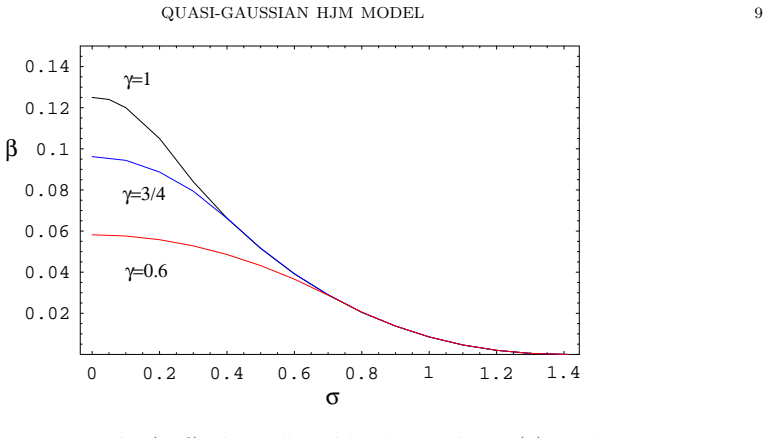
Simulate the time-homogeneous SDE (20)-(21) with parameters satisfying condition (i) or (ii), for example $\gamma=1$, $\beta=0.05$, $\sigma=0.2$, $r_0=0.1$, over a long horizon and estimate the probability of explosion from a large ensemble; the proof guarantees this probability is positive, so a carefully controlled run finding no explosion at all would contradict the claim. To test the comparison step directly, simulate the time-inhomogeneous model (8)-(9) with a forward curve that violates $\lambda'(t)+\beta\lambda(t)\ge\beta\lambda(0)$ and check whether explosions persist.
Extended reading notes
Core claim
The central discovery is that explosion is a genuine property of the quasi-Gaussian HJM model with a CEV-type volatility, not an artefact of a small-noise approximation. For the time-homogeneous model with constant initial forward rate $r_0$, Theorem 1 shows that the two-dimensional diffusion $(r_t,y_t)$ with $\varepsilon$-CEV volatility explodes with positive probability for $\gamma\in(1/2,1]$ provided that either $\sup_{R\ge\varepsilon}F(R;\beta,\sigma)>0$ or $\sup_{R\ge\varepsilon}\bigl(G(R)-(2\beta+\tfrac12\sigma^2\delta_2(\delta_2+1))\bigr)\ge0$, where $F$ and $G$ are explicit functions of the model parameters and $\delta_1,\delta_2>0$ satisfy $(1+\delta_1)(1+\delta_2)=2\gamma$. Under the extra assumptions $\beta>0$ and a large enough initial short rate satisfying inequality (40), Theorem 2 upgrades this to almost-sure explosion. The log-normal case $\gamma=1$ is included, and the authors note that this matches explosions observed numerically and previously derived in a deterministic small-noise limit.
Load-bearing premise
The most fragile load-bearing premise is the comparison step near equation (19): the explosion proved for the time-homogeneous auxiliary model is transferred to the original time-inhomogeneous model only when the forward curve satisfies $\lambda'(t)+\beta\lambda(t)\ge\beta\lambda(0)$, an inequality that can fail for a declining forward curve.
Editorial extensions
If this is right
- Zero-coupon bonds with maturity beyond the explosion time have price zero with positive probability, because $P(T,T+\delta)$ contains the factor $\exp(-G(T,T+\delta)x_T-\tfrac12 G(T,T+\delta)^2y_T)$ and $x_T,y_T$ explode.
- Eurodollar futures prices, which involve $\mathbb{E}^Q[P^{-1}(T,T+\delta)]$, become infinite for sufficiently large $T$ when the Theorem 1 conditions hold, and LIBOR-linked caps, swaptions and CMS products inherit the singularity.
- Explosion is confined to $\gamma\in(1/2,1]$; for $0<\gamma\le1/2$ the coefficients satisfy a linear-growth condition and the solution is non-explosive and square-integrable.
- With mean reversion $\beta>0$ and a sufficiently high initial short rate satisfying inequality (40), explosion occurs almost surely rather than merely with positive probability.
- Capping the short-rate volatility at a finite level restores sub-linear growth and eliminates explosion, a practical remedy for pricing applications.
Reading between the lines
- The two conditions in Theorem 1 are sufficient, not necessary; the true explosion region in the $(\beta,\sigma,\gamma)$ parameter space is likely larger, so explosions may also occur for parameter sets outside the proved region.
- The comparison assumption $\lambda'(t)+\beta\lambda(t)\ge\beta\lambda(0)$ means the proved explosion applies most directly to flat or rising forward curves; for downward-sloping yield curves the mechanism could be delayed or suppressed, and this is testable by simulation.
- The same Lyapunov ansatz may extend to multi-factor quasi-Gaussian models, where no necessary-and-sufficient explosion criterion is known, potentially yielding explicit sufficient conditions for explosion in higher-dimensional term-structure models.
- The almost-sure explosion in Theorem 2 requires a large initial short rate; for small initial rates only positive-probability explosion is guaranteed, so low-rate calibrations may remain on the non-explosive side in practice.
Signed reviews
Editorial analysis
A structured set of objections, weighed in public.
Referee Report
Summary. The paper analyzes the ε-CEV modified one-factor quasi-Gaussian HJM short-rate model (8)-(9). Its main results are for the time-homogeneous case λ(t)=λ0: Theorem 1 proves non-explosion for γ∈(0,1/2] and, for γ∈(1/2,1], finite-time explosion with positive probability under either of the parameter conditions (i) sup_R F(R;β,σ)>0 or (ii) sup_R (G(R)-(2β+1/2σ^2δ2(δ2+1)))≥0. Theorem 2 upgrades this to almost-sure explosion when β>0 and r0 satisfies (40). The proof uses a Lyapunov function V(r,y)=C1-C2/(1+y)^{δ1}-C3/(1+r)^{δ2} together with the Chow-Khasminskii explosion criteria. The paper closes with implications for zero-coupon bond prices and Eurodollar futures and a small numerical illustration.
Significance. The result, if fully established, is a useful rigorous addition to the interest-rate modeling literature: it identifies a wide and practically relevant parameter region in which the quasi-Gaussian HJM model with CEV-type volatility has explosive short-rate paths, and it quantifies the consequences for derivatives pricing. The construction of the Lyapunov function is explicit and the parameter conditions are checkable; the numerical section illustrates that the proved region is not vacuous. The main obstruction is that the proof of Theorem 1 as written does not connect the initial condition (r0,0) to the set Γ where the Khasminskii criterion applies, and the comparison reduction at Eq. (19) is asserted without proof. Both are localizable and appear repairable, so the manuscript merits a major revision rather than rejection.
major comments (2)
- [§3, proof of Theorem 1(b)] The proof verifies hypotheses (A.1)-(A.3) of Proposition 1 and then concludes P(τ<∞)>0. Proposition 1, as quoted in the paper, gives this conclusion only when the process starts at a point of Γ=[2R,∞)×[2R,∞). The initial condition of Theorem 1 is (r0,0); this point never lies in Γ because y0=0, and for the parameter values used in Figure 1 (r0=0.1, R=1/δ2=1) it lies in D. The paper gives no argument that the diffusion reaches Γ with positive probability from (r0,0). The inequality LV≥CV is only used on D^c and says nothing about the crossing from D to Γ. Please add a reachability lemma, for example via the support theorem and an explicit control path from (r0,0) to Γ, or restrict the theorem to initial conditions in Γ.
- [§3, Eq. (19)] The reduction from the time-inhomogeneous system (8)-(9) to the time-homogeneous system (20)-(21) is asserted in one sentence with a reference to Yamada [36], but no comparison proof is given. For the statement to hold one needs both λ'(t)+βλ(t)≥βλ(0) and the monotone dependence of y on r, and this should be shown explicitly. Since a declining forward curve can violate (19), the paper should either prove the comparison or clearly state that the rigorous explosion results are confined to λ(t)≡r0 and that Theorem 1 does not cover general forward curves.
minor comments (3)
- [Appendix, Eq. (58)] The definition of x should be x = r^{δ2+1}/y, not x = r^{δ1+1}/y. With the printed definition the two terms in (57) do not collapse to a single function of x; with the corrected exponent the derivation is valid.
- [Appendix, Eq. (69)] For the record, Eq. (69) is consistent with Eq. (68): substituting a and b from (71) into (68) reproduces (69) exactly; the apparent discrepancy in the ordering of the terms inside the minimum is only a notational matter.
- [§3.1, Eq. (38)] The small-δ2 expansion of G(R0(δ2)) appears to have a sign error: from G(δ)=δ^{1+δ}(1+δ)^{-(1+δ)} one obtains G(δ)=δ+δ^2(logδ-1)+O(δ^3(logδ)^2), not δ2+δ2^2(logδ2+1). The leading-order conclusion σ_max=√2 is unaffected.
Circularity Check
No material circularity: the central explosion theorem rests on an independent Lyapunov-function proof; the only self-citation is motivational/illustrative and is not load-bearing.
full rationale
The main derivation chain, Theorems 1 and 2, is self-contained apart from the use of external explosion criteria. The paper explicitly constructs a Lyapunov function (47), verifies the conditions (A.1)-(A.3) of Proposition 1 in the proof of Theorem 1, and reduces the parameter conditions (i) and (ii) to the algebraic inequalities (89) and (90) obtained from Lemma 2. No parameter is fitted to explosion data, and no 'prediction' is obtained by renaming a fitted input. The comparison step around Eq. (19) is asserted via an external comparison theorem of Yamada [36], and the main theorems in fact assume the time-homogeneous case λ(t) ≡ r0, so this comparison is not the load-bearing step. The only self-citation [30] appears in the introduction as motivation and in the numerical example as the small-noise explosion time and critical value β_C; it is not used to prove Theorem 1(b) or Theorem 2. Thus there is no circular reduction by construction. The score of 2 reflects the presence of a minor self-citation that is not load-bearing; it does not indicate circularity in the central proof. A possible proof gap concerning the application of Proposition 1 to initial data outside Γ is a correctness issue, not a circularity issue, and does not raise this score.
Assumptions & free parameters
free parameters (4)
- C2, C3 =
not fixed numerically; existence only
- δ1, δ2 =
any positive pair satisfying (1+δ1)(1+δ2)=2γ
- R =
any R≥ε in the sup in (24)/(25)
- ε =
small positive cutoff
assumptions (6)
- standard math The comparison theorem of Yamada [36] applies to the SDEs (8)-(9) and (20)-(21) under the drift ordering condition (19).
- standard math Theorem 1 and Theorem 2 of Chow-Khasminskii [12] provide sufficient conditions for explosion with positive probability and almost surely.
- domain assumption The one-factor quasi-Gaussian HJM model admits the two-state Markov representation (3) under the separable volatility form (2).
- domain assumption The forward curve satisfies λ'(t)+βλ(t) ≥ βλ(0) (Eq. 19).
- ad hoc to paper The ε-CEV modification (7) leaves the large-r behavior unchanged and keeps the origin unattainable.
- domain assumption The origin (0,0) is unattainable and the boundary ∂D is regular.
Cite this review
Pith. "Pith review of Explosion in the quasi-Gaussian HJM model." pith.science (2026). https://pith.science/paper/TT2HS46G
@misc{pith2026190807102,
  author       = {Pith},
  title        = {Pith review of: Explosion in the quasi-Gaussian HJM model},
  year         = {2026},
  howpublished = {\url{https://pith.science/paper/TT2HS46G}},
  note         = {Machine review of arXiv:1908.07102}
}
read the original abstract
We study the explosion of the solutions of the SDE in the quasi-Gaussian HJM model with a CEV-type volatility. The quasi-Gaussian HJM models are a popular approach for modeling the dynamics of the yield curve. This is due to their low dimensional Markovian representation which simplifies their numerical implementation and simulation. We show rigorously that the short rate in these models explodes in finite time with positive probability, under certain assumptions for the model parameters, and that the explosion occurs in finite time with probability one under some stronger assumptions. We discuss the implications of these results for the pricing of the zero coupon bonds and Eurodollar futures under this model.
Figures


Reference graph
Works this paper leans on
-
[36]
Yamada, T. (1973) On a comparison theorem for solutions of stochastic differential equations and its applications. J. Math. Kyoto Univ. 13 497-512. E-mail address: dpirjol@gmail.com E-mail address: ling@cims.nyu.edu
work page 1973
-
[1]
Andersen, L. and J. Andreasen. (2000). Volatility skews and extensions of the LIBOR market model. Applied Mathematical Finance 7(1), 1-32
work page 2000
-
[2]
Andersen, L. and V. Piterbarg. (2007). Moment explosions in stochastic volatility models. Finance and Stochas- tics. 11, 29-50
work page 2007
-
[3]
Andersen, L. and V. Piterbarg. (2010). Interest Rate Modeling. Atlantic Press, London
work page 2010
-
[4]
Andreasen, J. (2010). Markovian term structure models, in Encyclopedia of Quantitative Finance , Ed. R. Cont, Wiley, New York
work page 2010
-
[5]
(1993) Generalized Vasicek models of the term structure, Applied Stochastic Models and Data Analysis
Babbs, S. (1993) Generalized Vasicek models of the term structure, Applied Stochastic Models and Data Analysis. 1, 49-62
work page 1993
-
[6]
Cakici, N. and J. Zhu. (2001) Pricing Eurodollar futures options with the Heath-Jarrow-Morton model. Journal of Futures Markets. 21, 655-680
work page 2001
-
[7]
Cao, L. and P. Henry-Labordere. (2016) Interest rate models enhanced with local volatility. SSRN id=2793125
work page 2016
Show all 36 references
-
[8]
(1992) Markov representation of the Heath-Jarrow-Morton model
Cheyette, O. (1992) Markov representation of the Heath-Jarrow-Morton model. Working paper, Barra
1992
-
[9]
(2012) Explicit volatility specification for the linear Cheyette model
Chibane, M. (2012) Explicit volatility specification for the linear Cheyette model. Working paper, Shinsei Bank Ltd
2012
-
[10]
Chibane, M. and D. Law. (2013) A quadratic volatility Cheyette model. Risk, 60-63 (July)
2013
-
[11]
Chien, H. H. (2001) On the complexity of the Ritchken Sankarasubramanian interest rate model. Ph.D. Thesis, National Taiwan University
2001
-
[12]
Khasminskii
Chow, P.-L., and R. Khasminskii. (2014) Almost sure explosion of solutions to stochastic differential equations. Stoch. Processes and their Applications 124, 639-645
2014
-
[13]
(1996) Notes on option pricing I: Constant elasticity of diffusion
Cox, J. (1996) Notes on option pricing I: Constant elasticity of diffusion. J. Portfolio Management 124, 639-645
1996
-
[14]
(1952) The parabolic differential equations and the associated groups of transformations
Feller, W. (1952) The parabolic differential equations and the associated groups of transformations. Annals of Mathematics 55, 468-519
1952
-
[15]
Jablecki and D
Gatarek, D., J. Jablecki and D. Qu. (2016) Non-parametric local volatility formula for interest rate swaptions. Risk, 1-5 (February)
2016
-
[16]
Jarrow and A
Heath, D., R. Jarrow and A. Morton. (1992) Bond pricing and the term structure of interest rates: A new methodology for contingent claim valuation. Econometrica 60, 77-105
1992
-
[17]
(1993) Problems in certain two-factor term structure models
Hogan, M. (1993) Problems in certain two-factor term structure models. Ann. Appl. Prob. 3(2), 576-581
1993
-
[18]
Hogan, M. and K. Weintraub. (1998). The lognormal interest rate model and Eurodollar futures. Citibank Working Paper. QUASI-GAUSSIAN HJM MODEL 21
1998
-
[19]
Hoorens, B. (2011). On the Cheyette short rate model with stochastic volatility, MSc Thesis, Delft University of Technology
2011
-
[20]
Hunt, P. J. and J. E. Kennedy. (2004) Financial Derivatives in Theory and Practice . Wiley Series in Probability and Statistics, Chichester
2004
-
[21]
(1991) Bond and option evaluation in the Gaussian interest rate model
Jamshidian, F. (1991) Bond and option evaluation in the Gaussian interest rate model. Research in Finance 8, 131-170
1991
-
[22]
Karatzas, I. and S. Shreve. (1991) Brownian Motion and Stochastic Calculus . Graduate Texts in Mathematics, Volume 113, Springer Science & Business Media, Second Edition, New York
1991
-
[23]
Karatzas, I. and J. Ruf. (2016) Distribution of the time to explosion for one-dimensional diffusions. Prob. Theory and Related Fields. 164, 1027-1069
2016
-
[24]
(2012) Stochastic Stability of Differential Equations
Khasminskii, R. (2012) Stochastic Stability of Differential Equations . Springer, New York
2012
-
[25]
(1969) Stochastic Integrals
McKean, H.P.Jr. (1969) Stochastic Integrals. Academic Press, New York
1969
-
[26]
Morton, A. J. (1989) Arbitrage and martingales. Doctoral dissertation, Cornell University
1989
-
[27]
Acar and M
Natcheva-Acar, K., S.K. Acar and M. Krekel (2015). Modeling credit spreads with the Cheyette model and its applications to credit default swaptions. Journal of Credit Risk 5, 47-71
2015
-
[28]
Pinsky, R. G. (2008) Positive Harmonic Functions and Diffusion. Cambridge Studies in Advanced Mathematics v. 45, Cambridge University Press, Cambridge
2008
-
[29]
(2014) Hogan-Weintraub singularity and explosive behaviour in the Black-Derman-Toy model
Pirjol, D. (2014) Hogan-Weintraub singularity and explosive behaviour in the Black-Derman-Toy model. Quan- titative Finance 15, 1243-1257
2014
-
[30]
Pirjol, D. and L. Zhu. (2017) Small-noise limit of the quasi-Gaussian lognormal HJM model. Operations Research Letters. 45, 6-11
2017
-
[31]
Ritchken, P. and L. Sankarasubramanian. (1995) Volatility structures of forward rates and the dynamics of the term structure. Math. Finance 5, 55-72
1995
-
[32]
Sandmann, K. and D. Sondermann. (1997) A note on the stability of lognormal interest rate models and the pricing of Eurodollar futures. Math. Finance 7(2), 119-125
1997
-
[33]
Stroock, D. W. and S. R. S. Varadhan. (1979) Multidimensional Diffusion Processes. Grundlehren der mathema- tischen Wissenschaften, Volume 233. Springer-Verlag, Berlin
1979
-
[34]
(2007) Some results on strong solutions of SDEs with applications to interest rate models
Wissel, J. (2007) Some results on strong solutions of SDEs with applications to interest rate models. Stochastic Processes and their Applications 117, 720-741
2007
-
[35]
Xing, J., and Y. Li. (2016) Nonlinear Lyapunov criteria for stochastic explosive solutions, Stat. Prob. Lett. 109 63-67
2016
Reviewed August 14, 2026 · model on record in the stance chip above.
Discussion (0). Continue with ORCID to comment.