REVIEW 3 major objections 4 minor 20 references
On the 486-vertex distance-regular graphs of Koolen--Riebeek and Soicher
T0 review · 3 major / 4 minor · reviewed 2026-08-14 · deepseek-v4-flash
Pith's one-line read This paper shows that three distance-regular graphs on 486 vertices — the Koolen–Riebeek graph, the second Soicher graph, and the incidence graph of a symmetric transversal design from $\mathrm{AG}(5,3)$ — are all preserved by the same…
desk verdict A genuinely new unification of three 486-vertex distance-regular graphs under one rank-9 group action, with the Soicher-graph identification leaning on an unpublished uniqueness theorem and the computational checks not shipped. read the letter →
The pith
A machine-rendered reading of the paper's core claim, the machinery that carries it, and where it could break.
The reading
What carries the argument
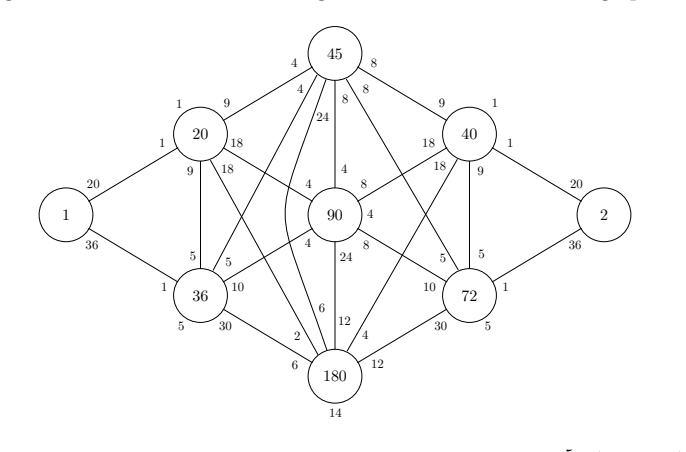
The load-bearing object is the rank-9 action of $H \cong 3^5:(2\times M_{10})$ on 486 points, whose nine suborbits have lengths $1,2,20,36,40,45,72,90,180$; the edge sets of the three graphs are unions of the corresponding orbitals. The explanation is carried by the ternary Golay code $G \subset \mathbb{F}_3^{11}$: the 243 cosets of $G$ form one part of each bipartition, and the 81 ten-dimensional subspaces containing $G$ but not $G+e_0$ form the other. Weight-distribution calculations split those 81 subspaces into 45 Type I and 36 Type II spaces, and the differing incidence rules on the same set of 486 vertices reproduce the intersection arrays $\{45,44,36,5;1,9,40,45\}$, $\{56,45,16,1;1,8,45,56\}$, and $\{81,80,54,1;1,27,80,81\}$.
What would settle it
Build the rank-9 orbital graph from the appendix generators and compare it directly, via an explicit isomorphism or non-isomorphism computation, with a graph constructed from the original 1993 Suzuki-group construction; if they are non-isomorphic, the claimed identification collapses. Equally decisive would be finding two non-isomorphic distance-regular graphs with intersection array $\{56,45,16,1;1,8,45,56\}$, which would disprove the uniqueness statement on which the identification rests.
Extended reading notes
Core claim
On the paper's own terms, the central discovery is that each of the imprimitive distance-regular graphs $\Delta$, $\Upsilon$ and $\Sigma$ is preserved by the same rank-9 action of $H \cong 3^5:(2\times M_{10})$ on 486 points, with suborbits of lengths $1,2,20,36,40,45,72,90,180$. Starting from the ternary Golay code $G$ in $\mathbb{F}_3^{11}$, the 243 cosets of $G$ and the 81 ten-dimensional subspaces containing $G$ but not $G+e_0$ form the vertices; the 45 Type I subspaces give the Koolen–Riebeek graph $\Delta$ as an incidence graph, the 36 Type II subspaces together with the 20 weight-one cosets $\pm e_i$ give the Soicher graph $\Upsilon$, and the full collection of 81 subspaces gives the AG(5,3) incidence graph $\Sigma$. The identification is confirmed by checking weight distributions, setwise stabilizers, and the resulting intersection arrays.
Load-bearing premise
The load-bearing assumption is that the graph obtained from the rank-9 action with intersection array $\{56,45,16,1;1,8,45,56\}$ really is the second Soicher graph; the paper relies on a uniqueness theorem cited only to an unpublished corrections file, so if that uniqueness theorem fails, the constructed graph might be a different distance-regular graph with the same parameters.
Editorial extensions
If this is right
- The same subgroup $3^5:(2\times M_{10})$ acts as automorphisms of all three graphs, so any property of the vertex set invariant under that subgroup is simultaneously a property of all three graphs.
- The Soicher graph $\Upsilon$ is realized explicitly from the ternary Golay code: put the 20 weight-one cosets and the 36 Type II subspaces adjacent to the zero coset, then translate by the group action.
- The Koolen–Riebeek graph $\Delta$ is the incidence graph of the cosets against the 45 Type I subspaces, giving a direct code-theoretic construction distinct from the original 45-coclique description.
- The induced subgraph of $\Upsilon$ on the 243 cosets is the distance-transitive graph with intersection array $\{20,18,4,1;1,2,18,20\}$, previously known as the coset graph of the shortened ternary Golay code; the observation that it embeds as an induced subgraph of $\Upsilon$ is new.
Reading between the lines
- Inference: the three graphs are three edge-rules on one 486-point geometry, so other unions of the nine orbitals could be tested for distance-regularity or association-scheme structure, potentially yielding further graphs with the same automorphism group.
- Inference: the 45/36 split of the ten-dimensional subspaces is detected purely by weight distribution; if an analogous split exists for other perfect codes, similar coincidences might occur for other rank-k actions.
- Inference: because $\Upsilon$ contains the shortened-Golay coset graph as an induced subgraph, one could ask whether $\Upsilon$ is a covering or blow-up of that 243-vertex graph with the Type II flats attached, connecting the construction to existing covering theory.
- Inference: a direct computer isomorphism test against the original 1993 construction would settle the identification of the orbital graph with $\Upsilon$ without relying on the unpublished uniqueness result.
Signed reviews
Editorial analysis
A structured set of objections, weighed in public.
Referee Report
Summary. The paper studies three known distance-regular graphs on 486 vertices: the Koolen--Riebeek graph Δ, the second Soicher graph Υ, and the incidence graph Σ of a symmetric transversal design from AG(5,3). The authors show that all three graphs can be obtained as unions of orbitals in the same rank-9 action of the group H = 3^5:(2×M10), and they explain the connection using the ternary Golay code. Explicit permutation generators for H are given in the appendix, and orbit diagrams and distance distribution diagrams are provided. The identification of the orbital graph with the Soicher graph Υ, however, is made only by matching the intersection array and invoking an unpublished uniqueness theorem of Brouwer.
Significance. If the constructions are correct, the paper provides a new unified perspective on three known distance-regular graphs, together with a coding-theoretic explanation and a new induced subgraph observation (the coset graph of the shortened ternary Golay code appears inside Υ). The explicit generators and orbit diagrams are valuable computational data. The main weakness is that the central identification with Υ depends entirely on an unpublished uniqueness result, and several key computational verifications are not reproducible from the manuscript. These issues are fixable and do not invalidate the overall approach, but they must be addressed before the main claim can be considered established.
major comments (3)
- [Section 3 (table and following paragraph)] The orbital graph (*) with intersection array {56,45,16,1;1,8,45,56} is identified with the Soicher graph Υ solely by stating that Υ is the unique distance-regular graph with this array, citing the unpublished corrections file [7]. The theorem is neither stated nor proved, and no direct isomorphism check with Soicher's original construction is provided. Since the abstract and all later references to Υ inherit this step, this is a load-bearing point. Please add a precise statement of the uniqueness theorem with a citable source, or supply a computational isomorphism certificate (including code) between the orbital graph and the graph constructed by Soicher in [18].
- [Section 4 (weight distributions and isomorphisms)] Several computational claims are asserted without reproducible support: the Magma weight-distribution classification of the 81 subspaces into Type I and Type II, the Magma computation of setwise stabilizers, the GAP verification that the Type I incidence graph is the Koolen--Riebeek graph Δ, and the GAP check that the orbital graph is isomorphic to Σ. These are not merely implementation details; they are part of the proof of the paper's central claim. Please provide the GAP and Magma scripts (or detailed pseudocode) together with the resulting output, for example as ancillary files or an appendix.
- [Section 4 (paragraph on the valency-56 graph)] The sentence "But this is precisely the construction of the Soicher graph Υ given above" is not justified explicitly. The graph (*) from Section 3 is obtained as an EdgeOrbitsGraph orbital union, but the reader is not told which orbitals are used. Please state which suborbits of the rank-9 action form the edge set of (*) (presumably those of lengths 20 and 36) and show that the graph defined by making G adjacent to the 36 Type II subspaces and the 20 weight-1 cosets is exactly the union of those orbitals. This will make the construction in Section 4 match the orbital graph (*) in a verifiable way.
minor comments (4)
- [Section 3 (table)] The graph listed as "K3162" is not standard notation. If it denotes the complete multipartite graph with 162 parts of size 3, please use a standard notation such as $K_{3[162]}$ and verify that the intersection array {483,2;1,483} corresponds to that graph.
- [Section 1 (introduction)] There is a typo: "Two important class" should read "Two important classes".
- [References ([7])] Reference [7] is an online corrections file with no version date or access date. Please provide a full citation, including the URL, a version identifier, and the date the file was accessed, so that readers can locate the exact statement of the uniqueness theorem.
- [Section 4 (weight distributions)] The weight distributions are given in a compact notation that is ambiguous in the extracted text (e.g., "01 110 270 ..."). Consider presenting them as explicit weight enumerators (polynomials or tables), which would make the two classes easier to check.
Circularity Check
No circularity: the constructions and identifications rest on independent computational verification and external uniqueness results, not on fitted inputs or self-citation.
full rationale
The paper's derivation is self-contained and non-circular. It begins with an explicit rank-9 permutation action of H = 3^5:(2×M10), computes the resulting distance-regular orbital graphs and their intersection arrays, and only then matches these to the known Koolen–Riebeek graph, the Soicher graph, and the AG(5,3) incidence graph. The identification of the orbital graph (*) with the Soicher graph uses the intersection array {56,45,16,1;1,8,45,56} and invokes Brouwer's uniqueness theorem from reference [7]. That uniqueness theorem is an external mathematical result, not an assumption of the paper's conclusion, and it is not authored by the present authors, so the self-citation pattern does not apply. The graph Σ is independently constructed from the 4-flats of AG(5,3) and verified isomorphic in GRAPE; Δ is likewise obtained from a specific orbital and its automorphism group is checked computationally. No parameter is fitted to any target graph, no target graph is used as an input in the construction, and no claimed prediction reduces by construction to its own input. The only self-reference is the authors' online catalogue [2], which is contextual and not load-bearing. Any concern that the uniqueness proof in [7] is unpublished is a correctness or provenance risk about external support, not circularity. Accordingly, the paper merits a circularity score of 0.
Assumptions & free parameters
assumptions (5)
- standard math The ternary Golay code G is the unique perfect 6-dimensional code in F3^11 with minimum distance 5.
- domain assumption W=V/G is isomorphic to AG(5,3), and 4-flats of AG(W) correspond to 10-dimensional subspaces of V containing G but not G+e0.
- domain assumption The second Soicher graph Υ is the unique distance-regular graph with intersection array {56,45,16,1;1,8,45,56}.
- standard math The automorphism group of the Berlekamp-van Lint-Seidel graph Γ is 3^5:(2×M11) of rank 3, and H=3^5:(2×M10) appears as its index-11 maximal subgroup.
- domain assumption The computational results from GAP and Magma reported in Sections 3 and 4 are correct.
Cite this review
Pith. "Pith review of On the 486-vertex distance-regular graphs of Koolen--Riebeek and Soicher." pith.science (2026). https://pith.science/paper/XJTFSVYS
@misc{pith2026190807104,
  author       = {Pith},
  title        = {Pith review of: On the 486-vertex distance-regular graphs of Koolen--Riebeek and Soicher},
  year         = {2026},
  howpublished = {\url{https://pith.science/paper/XJTFSVYS}},
  note         = {Machine review of arXiv:1908.07104}
}
abstract
This paper considers three imprimitive distance-regular graphs with 486 vertices and diameter 4: the Koolen--Riebeek graph (which is bipartite), the Soicher graph (which is antipodal), and the incidence graph of a symmetric transversal design obtained from the affine geometry $\mathrm{AG}(5,3)$ (which is both). It is shown that each of these is preserved by the same rank-9 action of the group $3^5:(2\times M_{10})$, and the connection is explained using the ternary Golay code.
Figures


Figures from the paper (1 more)

Reference graph
Works this paper leans on
-
[7]
A. E. Brouwer, A. M. Cohen and A. Neumaier, Corrections and additions to the book ‘Distance-Regular Graphs’, available from https://homepages.cwi.nl/~aeb/math/ bcn/. 10
-
[18]
L. H. Soicher, Three new distance-regular graphs, European J. Combin. 14 (1993), 501–505
work page 1993
-
[1]
R. F. Bailey, On the metric dimension of incidence graphs, Discrete Math. 341 (2018), 1613–1619
work page 2018
-
[2]
R. F. Bailey, F. L. Bosquet, C. M. Bowers, A. D. M. Jackson and C. H. Weir, https: //www.distanceregular.org, 2017–present
work page 2017
-
[3]
E. R. Berlekamp, J. H. van Lint and J. J. Seidel, A strongly regular graph derived from the perfect ternary Golay code, in A Survey of Combinatorial Theory (Proc. Internat. Sympos., Colorado State Univ., Fort Collins, Colo., 1971) , pp. 25–30. North-Holland, Amsterdam, 1973
work page 1971
-
[4]
T. Beth, D. Jungnickel and H. Lenz, Design Theory (second edition), Volume I, Cam- bridge University Press, Cambridge, 1999
work page 1999
- [5]
-
[6]
A. E. Brouwer, A. M. Cohen and A. Neumaier, Distance-Regular Graphs, Springer- Verlag, Berlin, 1989
work page 1989
Show all 20 references
-
[8]
A. E. Brouwer and W. H. Haemers, Structure and uniqueness of the (81 , 20, 1, 6) strongly regular graph, Discrete Math. 106/107 (1992), 77–82
1992
-
[9]
A. E. Brouwer, J. H. Koolen and R. J. Riebeek, A new distance-regular graph associated to the Mathieu group M10, J. Algebraic Combin. 8 (1998), 153–156
1998
-
[10]
A. E. Brouwer and J. H. van Lint, Strongly regular graphs and partial geometries, in Enumeration and Design (Waterloo, Ont., 1982) , eds. D. M. Jackson and S. A. Van- stone, pp. 85–122. Academic Press, Toronto, 1984
1982
-
[11]
E. R. van Dam, J. H. Koolen and H. Tanaka, Distance-regular graphs, Electronic J. Combin. (2016), Dynamic Survey #DS22
2016
-
[12]
The GAP Group, GAP – Groups, Algorithms, and Programming, Version 4.10.2 (2019); https://www.gap-system.org
2019
-
[13]
A. A. Ivanov, R. A. Liebler, T. Penttila and C. E. Praeger, Antipodal distance- transitive covers of complete bipartite graphs, European J. Combin. 18 (1997), 11–33
1997
-
[14]
Jungnickel, The number of designs with classical parameters grows exponentially, Geom
D. Jungnickel, The number of designs with classical parameters grows exponentially, Geom. Dedicata 16 (1984), 167–178
1984
-
[15]
F. J. MacWilliams and N. J. A. Sloane, The Theory of Error-Correcting Codes , North Holland, Amsterdam, 1977
1977
-
[16]
V. C. Mavron and V. D. Tonchev, On symmetric nets and generalized Hadamard matrices from affine designs, J. Geom. 67 (2000), 180–187
2000
-
[17]
C. E. Praeger and L. H. Soicher, Low rank representations and graphs for sporadic groups, Australian Mathematical Society Lecture Series 8, Cambridge University Press, Cambridge, 1997
1997
-
[19]
L. H. Soicher, DESIGN: The Design Package for GAP, Version 1.7 (2019); https://gap-packages.github.io/design
2019
-
[20]
L. H. Soicher, GRAPE: GRaph Algorithms using PErmutation groups, Version 4.8.2 (2019); https://gap-packages.github.io/grape. 11
2019
Reviewed August 14, 2026 · model on record in the stance chip above.
Discussion (0). Continue with ORCID to comment.