REVIEW 1 major objections 6 minor 11 references
Computer Bounds for Kronheimer-Mrowka Foam Evaluation
T0 review · 1 major / 6 minor · reviewed 2026-08-14 · deepseek-v4-flash
Pith's one-line read A computer program proves that the combinatorial foam invariant equals the Tait coloring count on two fullerene webs, and constrains the dodecahedral web to 58 or 60.
desk verdict The first exact computations for nonreducible webs are real, but the missing code means the central theorem is only as good as an uncheckable table. read the letter →
The pith
A machine-rendered reading of the paper's core claim, the machinery that carries it, and where it could break.
The reading
What carries the argument
The load-bearing object is the closed-foam evaluation formula implemented by the program. For a closed foam $F$, the formula expresses a symmetric polynomial $\langle F\rangle=\sum_{c\in\mathrm{adm}(F)}P(F,c)/Q(F,c)$ over the field of two elements, summing over admissible colorings of the foam's facets, and $J^\flat(F)$ is this polynomial evaluated at $E_1=E_2=E_3=0$. The program enumerates facets and admissible colorings, generates a finite set of half-foams with top boundary $K$, forms the matrix of pairings $(F_i,F_j)_\varphi$ in the polynomial ring $\mathbb{F}[E]$, and performs a Smith normal form decomposition over that ring. The rank of the pairing matrix on a finite subspace is a lower bound for $\dim J^\flat(K)$, while the theorem that $\langle K\rangle_\varphi$ is a free module of rank $\mathrm{Tait}(K)$ supplies the matching upper bound; when the two bounds coincide, all intermediate inequalities collapse to equalities.
What would settle it
Recompute the ranks in Tables 2 and 3 with an independent implementation of the closed-foam evaluation formula; any difference would invalidate Theorem 4.2, and for $W_1$ a single new half-foam that raises the lower bound above 58 would refute the suggested value.
Extended reading notes
Core claim
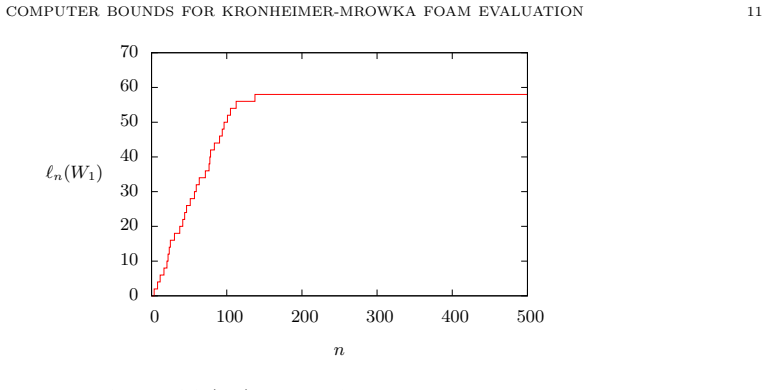
On the paper's own terms, the discovery is a pair of computations. Theorem 4.2 states that for the webs $W_2$ and $W_3$ shown in Figure 6, $\dim J^\flat(K)=\operatorname{rank}\langle K\rangle_\varphi=\mathrm{Tait}(K)$ and $\operatorname{qdim} J^\flat(K)=\operatorname{qrank}\langle K\rangle_\varphi=\ell_q(K)$, so both the dimension and the graded dimension collapse to the Tait data. For the dodecahedral web $W_1$, the program yields $\dim J^\flat(W_1)\in\{58,60\}$; the lower bound 58 is reached after 156 half-foams and remains 58 through 6,727 of the 11,160 half-foams generated, which the paper takes as strong evidence that $\dim J^\flat(W_1)=58$. Since $\mathrm{Tait}(W_1)=60$, this would make $W_1$ the first nonreducible web for which the equality question is answered negatively.
Load-bearing premise
The exact statements for $W_2$ and $W_3$ assume that the paper's computer program correctly implements the closed-foam evaluation formula and the matrix computations; the suggested value for $W_1$ additionally assumes that the saturation of the lower bound at 58 over thousands of half-foams is a reliable sign of the true dimension.
Editorial extensions
If this is right
- For $W_2$ and $W_3$, equality between $\dim J^\flat(K)$ and $\mathrm{Tait}(K)$ is now established for nonreducible webs, the first such examples, and the graded version is established as well through $\ell_q(K)$.
- For $W_1$, the dimension is proven to be either 58 or 60, leaving a single binary choice; the saturation data favor 58.
- If $\dim J^\flat(W_1)=58$, the open question asking whether $\dim J^\flat(K)=\mathrm{Tait}(K)$ for every web would have a negative answer, ruling out the specific strategy of identifying $J^\flat$ with the gauge-theoretic functor.
- For the other tested fullerene webs $W_4$ through $W_7$, the method gives nontrivial lower bounds strictly below the Tait counts, so their true dimensions are constrained to short intervals, such as 178, 179, or 180 for $W_4$.
- The inequalities $\dim J^\flat(K)\le\mathrm{Tait}(K)\le\dim J^\sharp(K)$ are tight for $W_2$ and $W_3$, so the whole chain collapses to a single number for those webs.
Reading between the lines
- The exactness of the results for $W_2$ and $W_3$ could be made independently checkable by releasing the program's source code and a transcript of the Smith normal form computations; as presented, the tables are the only evidence, and a single bug in facet enumeration or arithmetic could change a rank.
- The saturation at 58 for $W_1$ is a heuristic, not a proof; a finite certificate for $\dim J^\flat(W_1)=58$ would require either a spanning set of half-foams for the whole space or a proof that the pairing matrix rank cannot increase past 58, for example from a degree bound on generators.
- The dodecahedral web is a pivot between two conjectures: the symmetry of $\operatorname{qrank}\langle K\rangle_\varphi$ under $q\mapsto q^{-1}$ would force $\dim J^\flat(W_1)=60$, so the suggested 58 would refute that symmetry as well as the equality question.
- The same computational pipeline could probe other small fullerenes; for each new web the ratio $\ell(K)/\mathrm{Tait}(K)$ gives a cheap indicator of where the equality question might fail first.
Signed reviews
Editorial analysis
A structured set of objections, weighed in public.
Referee Report
Summary. The paper describes a Mathematica program that computes lower bounds on the dimension and quantum dimension of the Kronheimer-Mrowka combinatorial foam-evaluation functor J^flat for planar webs, using Khovanov-Robert's closed-foam evaluation formula on finite sets of half-foams. These lower bounds are sandwiched between the known upper bounds (dim J^flat(K) <= Tait(K) and qdim J^flat(K) <= qrank<K>_phi) to obtain exact values for two fullerene webs W2 and W3 (Theorem 4.2). For the dodecahedral web W1 the computation gives a lower bound of 58 while Tait(W1)=60, and the paper suggests, without claiming a proof, that dim J^flat(W1)=58. The paper also develops structural results (Corollary 3.1, Theorems 4.1 and 4.3) that make the computational results rigorous conditional on the correctness of the program's output.
Significance. If the computations are correct, the paper achieves the first nonreducible webs for which dim J^flat equals the Tait number, and the first computation of qdim J^flat equal to qrank of the phi-module for such webs. The dodecahedral web W1 becomes a concrete candidate for a negative answer to Khovanov-Robert's Question 2.1. The mathematical framework is clean and parameter-free, and the paper is explicit in distinguishing proved theorems from the heuristic suggestion for W1. The main weakness is that the central numerical claims rest on an unversioned external program that the reader cannot inspect or verify from the manuscript.
major comments (1)
- [Section 3.2, Remark 3.6, Tables 2-3] The exact entries in Tables 2 and 3, on which Theorem 4.2 and the W1 discussion rest, are outputs of a Mathematica program that is not included in the submission; reference [3] is a bare URL with no version, checksum, or file name. The manuscript describes the algorithm at a high level but provides no test cases, no output files, and no certificates for the Smith normal form computations in Eqs. (23)-(32). Because a bug in facet enumeration, coloring enumeration, closed-foam evaluation, or the Smith normal form computation would invalidate Theorem 4.2, the central claim is not independently checkable as submitted. I request that the complete program be made available in a versioned form as supplementary material, and that the authors provide verifiable certificates for the table values (for example, the matrices S, B, T for the Smith decompositions, or an independent verification script).
minor comments (6)
- [Section 4, proof of Theorem 4.2] The inference from ell(K)=Tait(K) to equality of the three quantum dimensions in Eq. (33) is valid but requires the observation that ell_q(1)=ell(K)=Tait(K)=qrank<K>_phi(1); since the inequalities in Eq. (33) are coefficientwise, this forces ell_q = qdim J^flat(K) = qrank<K>_phi. Please add a sentence spelling out this argument.
- [Introduction, page 1] The sentence 'dim J^flat(W1) must be either 58 and 60' should read 'either 58 or 60'.
- [Section 3.1] The statement 'For the empty web K = emptyset we take S(K) = emptyset' is ambiguous: if S(emptyset) is the empty set, the recursive construction for reducible webs cannot produce any half-foams. Please clarify whether S(emptyset) is intended to be the singleton set containing the empty half-foam, and make the convention explicit.
- [Reference [3]] The reference to the computer program should be a complete citation with a specific file or URL, an access date, and a version or checksum, rather than a bare homepage URL.
- [Table 2] The columns N_ell, N_e, and N are defined in the text but not in the caption; please include their definitions in the caption so that the table is self-contained.
- [Remark 4.2] In the sentence 'if use only IH cobordisms' the word 'we' is missing; please fix this typographical error.
Circularity Check
No significant circularity: the derivation is a computation of finite-rank lower bounds feeding into external inequalities by Khovanov–Robert, not a repackaging of the conclusion.
full rationale
The paper's central results, Theorem 1.1 and Theorem 4.2, are derived by computing lower bounds ell(K) and ell_q(K) from finite sets of half-foams and comparing them with the independently stated Tait numbers and the Khovanov–Robert rank bound. Corollary 3.1 supplies dim J^flat(K) <= Tait(K), Theorem 4.1 supplies ell_q(K) <= qdim J^flat(K), and Theorem 3.1 supplies rank< K >_phi = Tait(K). For W2 and W3 the table shows ell(K) = Tait(K), so the inequalities collapse to equalities. No parameter is fitted to the target dimension, and no conclusion is assumed in the computation: the bilinear-form ranks are computed directly from Khovanov and Robert's closed foam evaluation formula, which is an external proved result (arXiv:1808.09662), not a result of this paper. The lower bounds are genuine lower bounds by the linear-algebra argument of Remark 2.4, and the saturation value ell(K) is reported as a lower bound, not as an input. The only caveats are empirical and reproducibility-related rather than circular: the Mathematica program is referenced via the author's website [3] without a version or hash, so Tables 2 and 3 cannot be independently checked from the arXiv record, and the 'suggestion' that dim J^flat(W1) = 58 is an extrapolation from saturation after 6,727 of 11,160 half-foams. Neither of these involves defining a quantity in terms of the target result, fitting a parameter to a prediction, or importing a load-bearing conclusion from the author's own prior unverified work. The cited Kronheimer–Mrowka and Khovanov–Robert results are external mathematical theorems whose assumptions do not include the paper's computed values. Therefore the derivation chain is self-contained conditional on the correctness of the external evaluation formula and the computation, which is a correctness/reproducibility risk, not circularity.
Assumptions & free parameters
assumptions (5)
- domain assumption Khovanov and Robert's formula gives a well-defined closed foam evaluation J^b(F) and the associated functor J^b, with rank<K>_phi = Tait(K) for every web K.
- standard math The universal construction turns the closed foam evaluation into a TQFT-style functor with nondegenerate bilinear form on J^b(K).
- standard math F[E] is a PID, so submodules of a free module are free and Smith normal form applies to matrices over F[E].
- domain assumption The reduction algorithm for reducible webs yields bases of half-foams whose images span J^b(K') in the reducible case.
- domain assumption The listed Tait numbers and fullerene enumeration data for W1 through W7 are correct.
Cite this review
Pith. "Pith review of Computer Bounds for Kronheimer-Mrowka Foam Evaluation." pith.science (2026). https://pith.science/paper/62GOM4DC
@misc{pith2026190807133,
  author       = {Pith},
  title        = {Pith review of: Computer Bounds for Kronheimer-Mrowka Foam Evaluation},
  year         = {2026},
  howpublished = {\url{https://pith.science/paper/62GOM4DC}},
  note         = {Machine review of arXiv:1908.07133}
}
abstract
Kronheimer and Mrowka recently suggested a possible approach towards a new proof of the four color theorem that does not rely on computer calculations. Their approach is based on a functor $J^\sharp$, which they define using gauge theory, from the category of webs and foams to the category of vector spaces over the field of two elements. They also consider a possible combinatorial replacement $J^\flat$ for $J^\sharp$. Of particular interest is the relationship between the dimension of $J^\flat(K)$ for a web $K$ and the number of Tait colorings $\mathrm{Tait}(K)$ of $K$; these two numbers are known to be identical for a special class of "reducible" webs, but whether this is the case for nonreducible webs is not known. We describe a computer program that strongly constrains the possibilities for the dimension and graded dimension of $J^\flat(K)$ for a given web $K$, in some cases determining these quantities uniquely. We present results for a number of nonreducible example webs. For the dodecahedral web $W_1$ the number of Tait colorings is $\mathrm{Tait}(W_1) = 60$, but our results suggest that $\dim J^\flat(W_1) = 58$.
Figures

Figures from the paper (4 more)


Reference graph
Works this paper leans on
-
[3]
A. D. Boozer, Computer program for finding lower bounds on J ♭(K), http://www.math.ucla.edu/~davidboozer. COMPUTER BOUNDS FOR KRONHEIMER-MROWKA FOAM EV ALUATION 15
-
[1]
K. Appel and W. Haken, Every planar map is four colorable , volume 98 of Contemporary Mathematics. American Mathe- matical Society, Providence, RI, 1989
work page 1989
-
[2]
C. Blanchet, N. Habegger, G. Masbaum, and P. Vogel, Topological quantum field theories derived from the Kauffman bracket, Topology, 34(1995) 883–927
work page 1995
-
[4]
G. Brinkmann and W. M. Dress, A Constructive Enumeration of Fullerenes , J. Algorithms, 23(1997) 245–358
work page 1997
-
[5]
G. Gonthier, Formal Proof–The Four-Color Theorem, Notices of the American Mathematical Society, 55(2008) 1382–139
work page 2008
-
[6]
M. Khovanov and L.-H. Robert, Foam evaluation and Kronheimer–Mrowka theories , preprint, arXiv:1808.09662
-
[7]
P. B. Kronheimer and T. S. Mrowka, Tait colorings, and an instanton homology for webs and foams , preprint, arXiv:1508.07205
-
[8]
P. B. Kronheimer and T. S. Mrowka, Exact triangles for SO(3) instanton homology of webs , preprint, arXiv:1508.07207
Show all 11 references
-
[9]
P. B. Kronheimer and T. S. Mrowka, A deformation of instanton homology for webs , preprint, arXiv:1710.05002
-
[10]
Robert and E
L.-H. Robert and E. Wagner, A closed formula for the evaluation of sln-foams, preprint, arXiv:1702.04140
-
[11]
Robertson, D
N. Robertson, D. Sanders, P. Seymour, and R. Thomas, The Four-Colour Theorem, J. Combin. Theory Ser. B, 70(1997) 2–44
1997
Reviewed August 14, 2026 · model on record in the stance chip above.
Discussion (0). Continue with ORCID to comment.