REVIEW 3 major objections 6 minor 53 references
DeepSketchHair: Deep Sketch-based 3D Hair Modeling
T0 review · 3 major / 6 minor · reviewed 2026-08-14 · deepseek-v4-flash
Pith's one-line read Three networks turn 2D hair sketches into editable 3D hairstyles
desk verdict First deep-learning sketch-to-3D-hair pipeline, coherent and worth refereeing, but the evaluation leans on machine-traced training sketches and no released code, so the headline claim of matching arbitrary sketches is not fully nailed. read the letter →
The pith
A machine-rendered reading of the paper's core claim, the machinery that carries it, and where it could break.
The reading
What carries the argument
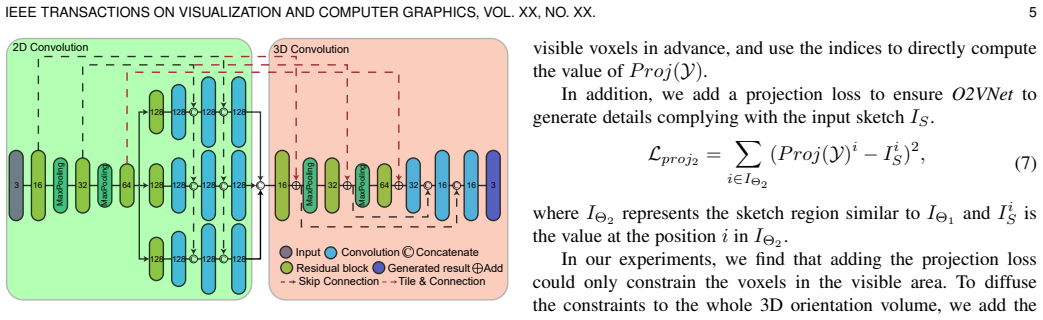
The load-bearing object is the dense 2D orientation field, an intermediate map that gives every pixel in the hair region a direction vector for the strand passing through it. This representation bridges the gap between sparse, ambiguous sketch strokes and the full 3D volume, so the network never has to jump directly from a few strokes to 3D structure. The rest of the machinery consists of the three conditional GANs built on WGAN-GP, together with projection, Laplacian, and preservation losses that keep the synthesized 3D orientation field consistent with the input view and with previously generated hair during multi-view editing.
What would settle it
Collect freehand sketches from users who are told to draw freely, with gaps, overlapping strokes, and inconsistent directions, then feed those sketches into the trained pipeline and compare the grown strands against the users' intended hairstyles; high orientation error or consistent user rejection would refute the generalization claim. A cheaper check is to compare S2ONet's orientation output on real user sketches against the orientation map obtained by tracing that same output and re-inputting it.
Extended reading notes
Core claim
The central claim is that sparse, ambiguous 2D sketches can be mapped to dense strand-level 3D hair models through a learned pipeline of three generative adversarial networks. S2ONet fills the sketch and mask into a dense 2D orientation field, where every pixel stores the direction of the visible hair strand passing through it. O2VNet lifts that 2D orientation field, aided by the bust depth map, into a 128x128x96 3D orientation field from which strands are grown. V2VNet updates the 3D orientation field when the user draws additional sketches in new views, while preserving the parts of the volume not touched by the new input. The networks are trained on 653 strand-level hairstyles, using projection and Laplacian losses to tie the generated volume to the input view and to spread local constraints throughout the volume.
Load-bearing premise
The networks are trained only on synthetic sketches traced from the very orientation maps they must predict, so the claim that real freehand sketches produce desired hairstyles rests on the assumption that casual user drawings closely resemble those clean, perfectly consistent traces.
Editorial extensions
If this is right
- A single hair contour plus a handful of direction strokes can produce a complete strand-level 3D hairstyle, cutting modeling time to minutes for novice users.
- The same pipeline can ingest portrait images or cartoon references by automatically extracting masks and orientation maps, and then lets users refine the result by sketching in other views.
- Using an intermediate dense 2D orientation field avoids the ambiguity of direct sketch-to-3D learning and preserves local detail from the input view.
- Multi-view editing with V2VNet changes only the relevant region while keeping the rest of the hairstyle intact, enabling iterative refinement of a 3D hair model.
- The approach is bounded by voxel resolution and training data, so fine details such as Afro textures and unseen shapes like polystrip styles are not faithfully reproduced.
Reading between the lines
- Going beyond the paper: if the synthetic-to-real gap is closed by augmenting training with real traced sketches, the same two-stage design could apply to other strand-like structures such as fur, grass, or braided patterns.
- Going beyond the paper: the sketch-to-dense-2D-field-to-3D-volume architecture suggests that for any sparse and ambiguous input, predicting an intermediate dense field aligned with the output view may be more effective than direct regression to the 3D target.
- Going beyond the paper: the V2VNet strategy of preserving invisible voxels while updating visible ones could be reused for other local 3D editing tasks, where a targeted change should not disturb the rest of a pre-existing model.
- Going beyond the paper: a direct measurement of how far real freehand sketches are from the clean traced training distribution, followed by stroke-aware data augmentation, would be a testable next step toward robust generalization.
Signed reviews
Editorial analysis
A structured set of objections, weighed in public.
Referee Report
Summary. The paper presents DeepSketchHair, an interactive system that converts 2D hair sketches (a contour plus a few direction strokes) into strand-level 3D hair models. The pipeline comprises three GAN-based networks: S2ONet maps the input sketch and mask to a dense 2D orientation field; O2VNet maps this field together with a bust depth map to a 3D volumetric orientation field; and V2VNet updates the volume from additional sketches drawn in rotated views. The networks are trained on synthetic data generated from 653 3D hair models, and the paper includes a qualitative gallery, a five-user pilot study, comparisons with prior image-based and sketch-based hair modeling methods, and ablations of the main components. The central claim is that the system generates 3D hair models that match the input sketch both globally and locally, and that it is the first deep-learning technique for sketch-based strand-level hair modeling.
Significance. If the central claim is accepted, this would be a useful contribution as the first deep-learning pipeline for sketch-based strand-level hair modeling and interactive multi-view editing. The architecture choices are clearly described and mostly well motivated, particularly the intermediate dense 2D orientation field, the projection and Laplacian losses for O2VNet, and the dedicated V2VNet for multi-view updates. The qualitative results and comparisons are visually compelling, and the S2ONet ablation is directionally consistent with the method's design. However, the paper currently rests on an untested synthetic-to-real sketch transfer assumption and on an evaluation that is too anecdotal and underpowered to fully support the claim of matching arbitrary freehand sketches. The absence of released code or data also limits independent verification, though that alone is not a reason to reject.
major comments (3)
- [§4.3, 2D Sketch Map generation] The tracing procedure as written is internally inconsistent. The text states that a neighbor is marked as a candidate when the dot product between p and pn is below the threshold ϱ = 0.5, and then "we choose the most matching pixel among the candidate pixels as the next iterative pixel by finding the minimum dot product." If taken literally, this follows the least-aligned neighbor rather than the most aligned one; it is presumably meant to be "above" and "maximum." Since the synthetic sketch maps are the only training inputs for S2ONet and the paper's generalization claim depends on their resemblance to real freehand strokes, this ambiguity should be corrected and the resulting maps verified. If the literal reading is intended, the maps are not clean orientation-consistent traces, and the connection between training and test inputs becomes even weaker.
- [§7.1, Pilot Study] The pilot study does not provide quantitative evidence that DeepSketchHair matches real freehand sketches. It uses five novice users, reports only timing and anecdotal "positive feedback," and contains no objective measure of whether the generated hair matches user intent (for example, agreement between the S2ONet-predicted orientation and the user's intended direction, task completion rate, or a comparison against a baseline). Because S2ONet is trained exclusively on machine-traced sketch maps generated from ground-truth orientation fields (§4.3), the system's central claim of handling casual user sketches rests on an unmeasured distribution-transfer assumption. The authors should add a real-sketch evaluation, ideally with multiple users and objective error metrics, before the main claim can be accepted.
- [§7.2 and §7.3, Quantitative comparisons and ablations] The quantitative evidence is too thin to support the comparative and ablative claims. Table 3 reports MSE values without error bars, test-set sizes, or statistical significance tests; Fig. 15 reports MSE numbers for O2VNet variants without any details on the test sample or variance; and §7.2 compares against prior work mostly qualitatively. Since the paper's conclusion emphasizes "outstanding performance," at least the main ablation claims need standard deviations, number of test examples, and a clear statement of how the test set is split from the 653-model dataset.
minor comments (6)
- [§4.1, Eq. (1)] The sets m and n used for content and style layers in Eq. (1) are not defined before the equation; the sentence describing m={0,2} and n={0,1,2,3,4} should be moved before Eq. (1) or integrated into its explanation.
- [§4.1, Network architecture] The phrase "we enclasp them into a 2D tensor" is unusual wording; consider replacing it with "concatenate" or "combine."
- [§5.3, Hair Synthesis] The sentence "our hair strands are more continuous and venerable in noise regions" appears to be a typo; likely "robust to noise" or "more stable in noise regions" was intended.
- [§4.2, Network Architecture] The sentence "We share the same discriminator architecture with zhang and zheng [9]" should capitalize the author names as "Zhang and Zheng."
- [§4.1 and §4.2, Notation] The ground-truth 2D orientation is denoted ~Λ in Eqs. (2) and (3), but the text surrounding Eq. (1) sometimes uses Λ for the target; please define both symbols explicitly and use them consistently.
- [Table 1] A short caption or a note explaining the meaning of the "views" and "strokes" columns would help readers interpret the interaction statistics.
Circularity Check
No significant circularity: the system is a supervised three-network pipeline with independent ground-truth supervision; synthetic sketch generation is a standard sparse-to-dense training construction, not a circular reduction.
full rationale
DeepSketchHair is an empirical machine-learning system rather than a formal derivation, and its claimed results are evaluated against external benchmarks and ground-truth 3D hair models. Each network is trained with supervised losses: S2ONet regresses a dense 2D orientation field from sparse sketch and mask inputs and is directly compared to the ground-truth dense orientation map (Eq. 2 with per-pixel loss at l=0); O2VNet regresses a 3D orientation volume against the ground-truth volume with content, style, projection, and Laplacian losses (Eqs. 3, 6-10); V2VNet updates a rotated volume under additional sketch constraints with the same supervised losses plus an orientation-preserving term (Eqs. 11-12). The training sketch maps are produced by tracing the ground-truth dense orientation map (Sec. 4.3), which is a sparse-to-dense data-generation strategy: the sparse strokes are a subset of the dense field, so the network is asked to infer more information than the input contains. That is a domain-shift/generalization limitation, not circularity, because the dense output is not defined to be the input. Self-citations such as Hair-GAN [9] and example-based synthesis [50] appear as architectural inspiration, data-preprocessing tools, or quantitative baselines; the central claim does not reduce to any of these citations. The pilot study is anecdotal, and the Sec. 4.3 tracing description appears internally inconsistent (choosing the minimum dot-product after thresholding below 0.5), but both are correctness/robustness concerns outside the circularity taxonomy. No fitted parameter is renamed as a prediction, and no derivation is equivalent to its input by construction.
Assumptions & free parameters
free parameters (7)
- content loss weight alpha (S2ONet) =
0.01
- style loss weight beta (S2ONet) =
5
- gradient penalty weight lambda =
10
- O2VNet loss weights iota, kappa, gamma, delta, epsilon =
0.01, 5, 0.1, 0.5, 2e-5
- V2VNet original-field loss weight zeta =
0.1
- sketch tracing dot-product threshold rho =
0.5
- hair growing direction threshold theta =
150 degrees
assumptions (5)
- domain assumption The synthetic sketch traces generated from ground-truth orientation fields are representative of real user sketches.
- domain assumption A dense 2D orientation field is sufficient as an intermediate representation to bridge sparse sketches and 3D orientation volumes.
- domain assumption The 3D orientation field plus the bust depth map contains enough information to reconstruct strand-level hair.
- domain assumption The 653-model dataset covers the hairstyle space users will request.
- domain assumption WGAN-GP training with the stated loss weights converges to a useful solution.
Cite this review
Pith. "Pith review of DeepSketchHair: Deep Sketch-based 3D Hair Modeling." pith.science (2026). https://pith.science/paper/UV6MC5F5
@misc{pith2026190807198,
  author       = {Pith},
  title        = {Pith review of: DeepSketchHair: Deep Sketch-based 3D Hair Modeling},
  year         = {2026},
  howpublished = {\url{https://pith.science/paper/UV6MC5F5}},
  note         = {Machine review of arXiv:1908.07198}
}
read the original abstract
We present sketchhair, a deep learning based tool for interactive modeling of 3D hair from 2D sketches. Given a 3D bust model as reference, our sketching system takes as input a user-drawn sketch (consisting of hair contour and a few strokes indicating the hair growing direction within a hair region), and automatically generates a 3D hair model, which matches the input sketch both globally and locally. The key enablers of our system are two carefully designed neural networks, namely, S2ONet, which converts an input sketch to a dense 2D hair orientation field; and O2VNet, which maps the 2D orientation field to a 3D vector field. Our system also supports hair editing with additional sketches in new views. This is enabled by another deep neural network, V2VNet, which updates the 3D vector field with respect to the new sketches. All the three networks are trained with synthetic data generated from a 3D hairstyle database. We demonstrate the effectiveness and expressiveness of our tool using a variety of hairstyles and also compare our method with prior art.
Figures


Figures from the paper (13 more)


Reference graph
Works this paper leans on
-
[1]
A data-driven approach to four-view image-based hair modeling,
M. Zhang, M. Chai, H. Wu, H. Yang, and K. Zhou, “A data-driven approach to four-view image-based hair modeling,” ACM Trans. Graph., vol. 36, no. 4, pp. 156:1–156:11, 2017
work page 2017
-
[2]
Avatar digitization from a single image for real- time rendering,
L. Hu, S. Saito, L. Wei, K. Nagano, J. Seo, J. Fursund, I. Sadeghi, C. Sun, Y .-C. Chen, and H. Li, “Avatar digitization from a single image for real- time rendering,” ACM Trans. Graph., vol. 36, no. 6, pp. 195:1–195:14, 2017
work page 2017
-
[3]
Single-view hair modeling for portrait manipulation,
M. Chai, L. Wang, Y . Weng, Y . Yu, B. Guo, and K. Zhou, “Single-view hair modeling for portrait manipulation,” ACM Trans. Graph. , vol. 31, no. 4, pp. 116:1–116:8, 2012
work page 2012
-
[4]
Dynamic hair manipulation in images and videos,
M. Chai, L. Wang, Y . Weng, X. Jin, and K. Zhou, “Dynamic hair manipulation in images and videos,” ACM Trans. Graph., vol. 32, no. 4, pp. 75:1–75:8, 2013
work page 2013
-
[5]
Single-view hair modeling using a hairstyle database,
L. Hu, C. Ma, L. Luo, and H. Li, “Single-view hair modeling using a hairstyle database,” ACM Trans. Graph., vol. 34, no. 4, pp. 125:1–125:9, 2015
work page 2015
-
[6]
Modeling hair from an rgb-d camera,
M. Zhang, P. Wu, H. Wu, Y . Weng, Y . Zheng, and K. Zhou, “Modeling hair from an rgb-d camera,” ACM Trans. Graph. , vol. 37, no. 6, pp. 205:1–205:10, 2018
work page 2018
-
[7]
Hairnet: Single-view hair reconstruction using convolutional neural networks,
Y . Zhou, L. Hu, J. Xing, W. Chen, H.-W. Kung, X. Tong, and H. Li, “Hairnet: Single-view hair reconstruction using convolutional neural networks,” in Proceedings of the European Conference on Computer Vision (ECCV), 2018, pp. 235–251
work page 2018
-
[8]
3d hair synthesis using volumetric variational autoencoders,
S. Saito, L. Hu, C. Ma, H. Ibayashi, L. Luo, and H. Li, “3d hair synthesis using volumetric variational autoencoders,” ACM Trans. Graph., vol. 37, no. 6, pp. 208:1–208:12, 2018
work page 2018
Show all 53 references
-
[9]
Hair-gan: Recovering 3d hair structure from a single image using generative adversarial networks,
M. Zhang and Y . Zheng, “Hair-gan: Recovering 3d hair structure from a single image using generative adversarial networks,” Visual Informatics 2019, vol. 3, no. 2, p. to appear, 2019
2019
-
[10]
A trigonal prism-based method for hair image generation,
Y . Watanabe and Y . Suenaga, “A trigonal prism-based method for hair image generation,” IEEE Computer Graphics and applications , vol. 12, no. 1, pp. 47–53, 1992
1992
-
[11]
Interactive multiresolution hair modeling and editing,
T.-Y . Kim and U. Neumann, “Interactive multiresolution hair modeling and editing,” ACM Trans. Graph., vol. 21, no. 3, pp. 620–629, 2002
2002
-
[12]
A statistical wisp model and pseudophysical approaches for interactive hairstyle generation,
B. Choe and H.-S. Ko, “A statistical wisp model and pseudophysical approaches for interactive hairstyle generation,” IEEE Transactions on Visualization and Computer Graphics, vol. 11, no. 2, pp. 160–170, 2005
2005
-
[13]
Sketchy hairstyles,
X. Mao, S. Isobe, K.-i. Anjyo, and A. Imamiya, “Sketchy hairstyles,” in International 2005 Computer Graphics, 2005, pp. 142–147
2005
-
[14]
A sketching interface for modeling and editing hairstyles,
S. Malik, “A sketching interface for modeling and editing hairstyles,” in SBM, 2005, pp. 185–194
2005
-
[15]
Realistic hair from a sketch,
J. Wither, F. Bertails, and M.-P. Cani, “Realistic hair from a sketch,” in IEEE International Conference on Shape Modeling and Applications 2007 (SMI’07), 2007, pp. 33–42
2007
-
[16]
Modeling realistic virtual hairstyles,
Y . Yu, “Modeling realistic virtual hairstyles,” in Proceedings Ninth Pacific Conference on Computer Graphics and Applications. Pacific Graphics 2001, 2001, pp. 295–304
2001
-
[17]
Sketching hairstyles,
H. Fu, Y . Wei, C.-L. Tai, and L. Quan, “Sketching hairstyles,” in Pro- ceedings of the 4th Eurographics workshop on Sketch-based interfaces and modeling, 2007, pp. 31–36
2007
-
[18]
Generative adversarial nets,
I. Goodfellow, J. Pouget-Abadie, M. Mirza, B. Xu, D. Warde-Farley, S. Ozair, A. Courville, and Y . Bengio, “Generative adversarial nets,” in Advances in neural information processing systems , 2014, pp. 2672– 2680
2014
-
[19]
A survey on hair modeling: Styling, simulation, and rendering,
K. Ward, F. Bertails, T.-Y . Kim, S. R. Marschner, M.-P. Cani, and M. C. Lin, “A survey on hair modeling: Styling, simulation, and rendering,” IEEE transactions on visualization and computer graphics, vol. 13, no. 2, pp. 213–234, 2007
2007
-
[20]
A survey of image-based techniques for hair model- ing,
Y . Bao and Y . Qi, “A survey of image-based techniques for hair model- ing,” IEEE Access, vol. 6, pp. 18 670–18 684, 2018
2018
-
[21]
A system of 3d hair style synthesis based on the wisp model,
L.-H. Chen, S. Saeyor, H. Dohi, and M. Ishizuka, “A system of 3d hair style synthesis based on the wisp model,” The Visual Computer, vol. 15, no. 4, pp. 159–170, 1999
1999
-
[22]
The cluster hair model,
X. D. Yang, Z. Xu, J. Yang, and T. Wang, “The cluster hair model,” Graphical Models, vol. 62, no. 2, pp. 85–103, 2000
2000
-
[23]
V-hairstudio: an interactive tool for hair design,
Z. Xu and X. D. Yang, “V-hairstudio: an interactive tool for hair design,” IEEE Computer Graphics and Applications , vol. 21, no. 3, pp. 36–43, 2001
2001
-
[24]
Generation of 3d hair model from 2d image using image processing,
K. W. Ming, T. Hiroki, and N. Masayuki, “Generation of 3d hair model from 2d image using image processing,” inApplications of Digital Image Processing XIX, vol. 2847, 1996, pp. 303–312. IEEE TRANSACTIONS ON VISUALIZATION AND COMPUTER GRAPHICS, VOL. XX, NO. XX. 13
1996
-
[25]
Capture of hair geometry from multiple images,
S. Paris, H. M. Brice ˜no, and F. X. Sillion, “Capture of hair geometry from multiple images,” ACM Trans. Graph., vol. 23, no. 3, pp. 712–719, 2004
2004
-
[26]
Modeling hair from multiple views,
Y . Wei, E. Ofek, L. Quan, and H.-Y . Shum, “Modeling hair from multiple views,” ACM Trans. Graph., vol. 24, no. 3, pp. 816–820, 2005
2005
-
[27]
High- quality hair modeling from a single portrait photo,
M. Chai, L. Luo, K. Sunkavalli, N. Carr, S. Hadap, and K. Zhou, “High- quality hair modeling from a single portrait photo,” ACM Trans. Graph., vol. 34, no. 6, pp. 204:1–204:10, 2015
2015
-
[28]
Autohair: Fully automatic hair modeling from a single image,
M. Chai, T. Shao, H. Wu, Y . Weng, and K. Zhou, “Autohair: Fully automatic hair modeling from a single image,” ACM Trans. Graph. , vol. 35, no. 4, pp. 116:1–116:12, 2016
2016
-
[29]
Auto-encoding variational bayes,
P. K. Diederik, M. Welling et al., “Auto-encoding variational bayes,” in Proceedings of the International Conference on Learning Representa- tions (ICLR), 2014
2014
-
[30]
Robust flow- guided neural prediction for sketch-based freeform surface modeling,
C. Li, H. Pan, Y . Liu, X. Tong, A. Sheffer, and W. Wang, “Robust flow- guided neural prediction for sketch-based freeform surface modeling,” ACM Trans. Graph., vol. 37, no. 6, pp. 238:1–238:12, 2018
2018
-
[31]
Teddy: a sketching interface for 3d freeform design,
T. Igarashi, T. Igarashi, S. Matsuoka, and H. Tanaka, “Teddy: a sketching interface for 3d freeform design,” in Proceedings of the 26th Annual Conference on Computer Graphics and Interactive Techniques , 1999, pp. 409–416
1999
-
[32]
Plushie: An interactive design system for plush toys,
Y . Mori and T. Igarashi, “Plushie: An interactive design system for plush toys,” ACM Trans. Graph., vol. 26, no. 3, 2007
2007
-
[33]
Fibermesh: Designing freeform surfaces with 3d curves,
A. Nealen, T. Igarashi, O. Sorkine, and M. Alexa, “Fibermesh: Designing freeform surfaces with 3d curves,” ACM Trans. Graph., vol. 26, no. 3, 2007
2007
-
[34]
3-sweep: Extracting editable objects from a single photo,
T. Chen, Z. Zhu, A. Shamir, S.-M. Hu, and D. Cohen-Or, “3-sweep: Extracting editable objects from a single photo,” ACM Trans. Graph. , vol. 32, no. 6, pp. 195:1–195:10, 2013
2013
-
[35]
Geose- mantic snapping for sketch-based modeling,
A. Shtof, A. Agathos, Y . Gingold, A. Shamir, and D. Cohen-Or, “Geose- mantic snapping for sketch-based modeling,” in Computer graphics forum, vol. 32, no. 2pt2, 2013, pp. 245–253
2013
-
[36]
Shape synthesis from sketches via procedural models and convolutional networks,
H. Huang, E. Kalogerakis, E. Yumer, and R. Mech, “Shape synthesis from sketches via procedural models and convolutional networks,” IEEE transactions on visualization and computer graphics , vol. 23, no. 8, pp. 2003–2013, 2016
2003
-
[37]
3d sketching using multi-view deep volumetric prediction,
J. Delanoy, M. Aubry, P. Isola, A. A. Efros, and A. Bousseau, “3d sketching using multi-view deep volumetric prediction,” Proc. ACM Comput. Graph. Interact. Tech., vol. 1, no. 1, pp. 21:1–21:22, 2018
2018
-
[38]
3d shape reconstruction from sketches via multi-view convolutional networks,
Z. Lun, M. Gadelha, E. Kalogerakis, S. Maji, and R. Wang, “3d shape reconstruction from sketches via multi-view convolutional networks,” in 2017 International Conference on 3D Vision (3DV), 2017
2017
-
[39]
Interactive sketch-based normal map generation with deep neural networks,
W. Su, D. Du, X. Yang, S. Zhou, and H. Fu, “Interactive sketch-based normal map generation with deep neural networks,” Proc. ACM Comput. Graph. Interact. Tech., vol. 1, no. 1, pp. 22:1–22:17, 2018
2018
-
[40]
Deepsketch2face: A deep learning based sketching system for 3d face and caricature modeling,
X. Han, C. Gao, and Y . Yu, “Deepsketch2face: A deep learning based sketching system for 3d face and caricature modeling,” ACM Trans. Graph., vol. 36, no. 4, pp. 126:1–126:12, 2017
2017
-
[41]
Image-to-image translation with conditional adversarial networks,
P. Isola, J.-Y . Zhu, T. Zhou, and A. A. Efros, “Image-to-image translation with conditional adversarial networks,” CVPR, 2017
2017
-
[42]
Improved training of wasserstein gans,
I. Gulrajani, F. Ahmed, M. Arjovsky, V . Dumoulin, and A. C. Courville, “Improved training of wasserstein gans,” inAdvances in Neural Informa- tion Processing Systems, 2017, pp. 5767–5777
2017
-
[43]
Scribbler: Controlling deep image synthesis with sketch and color,
P. Sangkloy, J. Lu, C. Fang, F. Yu, and J. Hays, “Scribbler: Controlling deep image synthesis with sketch and color,” in Proceedings of the IEEE Conference on Computer Vision and Pattern Recognition , 2017, pp. 5400–5409
2017
-
[44]
Two-stage sketch colorization,
L. Zhang, C. Li, T.-T. Wong, Y . Ji, and C. Liu, “Two-stage sketch colorization,” ACM Trans. Graph. , vol. 37, no. 6, pp. 261:1–261:14, 2018
2018
-
[45]
Image style transfer using convolutional neural networks,
L. A. Gatys, A. S. Ecker, and M. Bethge, “Image style transfer using convolutional neural networks,” in Proceedings of the IEEE Conference on Computer Vision and Pattern Recognition, 2016, pp. 2414–2423
2016
-
[46]
Learning a probabilistic latent space of object shapes via 3d generative-adversarial modeling,
J. Wu, C. Zhang, T. Xue, W. T. Freeman, and J. B. Tenenbaum, “Learning a probabilistic latent space of object shapes via 3d generative-adversarial modeling,” inAdvances in Neural Information Processing Systems, 2016, pp. 82–90
2016
-
[47]
U-net: Convolutional networks for biomedical image segmentation,
O. Ronneberger, P. Fischer, and T. Brox, “U-net: Convolutional networks for biomedical image segmentation,” in International Conference on Medical image computing and computer-assisted intervention, 2015, pp. 234–241
2015
-
[48]
Multi-view supervision for single-view reconstruction via differentiable ray consistency,
S. Tulsiani, T. Zhou, A. A. Efros, and J. Malik, “Multi-view supervision for single-view reconstruction via differentiable ray consistency,” CoRR, vol. abs/1704.06254, 2017
2017 arXiv
-
[49]
Photographic image synthesis with cascaded refinement networks,
Q. Chen and V . Koltun, “Photographic image synthesis with cascaded refinement networks,” in Proceedings of the IEEE International Confer- ence on Computer Vision, 2017, pp. 1511–1520
2017
-
[50]
Example-based hair geometry synthesis,
L. Wang, Y . Yu, K. Zhou, and B. Guo, “Example-based hair geometry synthesis,” ACM Trans. Graph., vol. 28, no. 3, pp. 56:1–56:9, 2009
2009
-
[51]
V2v-posenet: V oxel-to-voxel prediction network for accurate 3d hand and human pose estimation from a single depth map,
G. Moon, J. Yong Chang, and K. Mu Lee, “V2v-posenet: V oxel-to-voxel prediction network for accurate 3d hand and human pose estimation from a single depth map,” inProceedings of the IEEE Conference on Computer Vision and Pattern Recognition, 2018, pp. 5079–5088
2018
-
[52]
Displaced dynamic expression regression for real-time facial tracking and animation,
C. Cao, Q. Hou, and K. Zhou, “Displaced dynamic expression regression for real-time facial tracking and animation,”ACM Trans. Graph., vol. 33, no. 4, pp. 43:1–43:10, 2014
2014
-
[53]
Laplacian surface editing,
O. Sorkine, D. Cohen-Or, Y . Lipman, M. Alexa, C. R ¨ossl, and H.-P. Seidel, “Laplacian surface editing,” in Proceedings of the 2004 Euro- graphics/ACM SIGGRAPH Symposium on Geometry Processing , ser. SGP ’04, 2004, pp. 175–184. Y uefan Shen is a Ph.D. candidate at the State K...
2004
Reviewed August 14, 2026 · model on record in the stance chip above.
Discussion (0). Continue with ORCID to comment.