REVIEW 3 major objections 4 minor 47 references
Diagnosing Cosmic Ray Modified Shocks with H {\alpha} Polarimetry
T0 review · 3 major / 4 minor · reviewed 2026-08-14 · deepseek-v4-flash
Pith's one-line read Edge-on H-alpha polarimetry of supernova remnant shocks can reveal whether a cosmic-ray precursor has decelerated the upstream plasma, because the polarization direction flips by 90 degrees when it has.
desk verdict A genuinely new diagnostic proposal with a physically plausible polarization flip; the main caveat is the assumed cold, single-velocity decelerated proton population, which the paper does not stress-test. read the letter →
The pith
A machine-rendered reading of the paper's core claim, the machinery that carries it, and where it could break.
The reading
What carries the argument
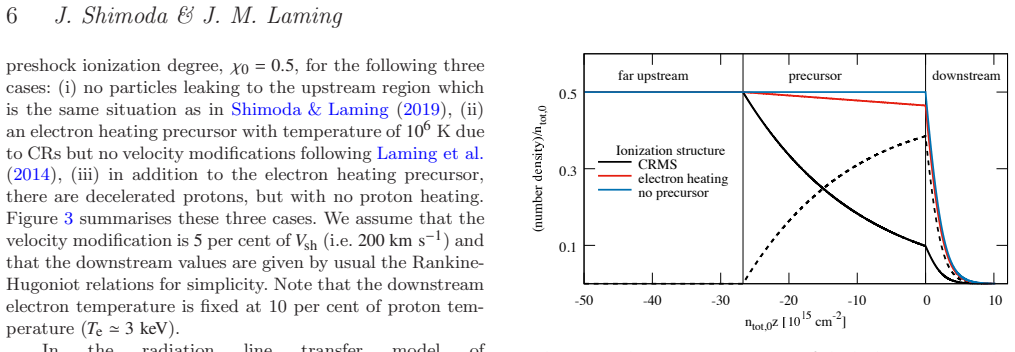
The load-bearing mechanism is the Ly$\beta$-to-H$\alpha$ conversion under resonant scattering: a hydrogen atom absorbs a Ly$\beta$ photon, is excited to the $3p$ state, and decays to $2s$, emitting H$\alpha$ whose linear polarization is fixed by angular-momentum conservation and by the scattering phase matrices for the $3p_{1/2}$ (unpolarized channel) and $3p_{3/2}$ (polarizing channel) sublevels. The sign of the Stokes $Q$ parameter is set by the angular anisotropy of the incident Ly$\beta$ radiation field after attenuation, $\exp(-\tau_\nu/|\mu|)$. In an unmodified shock the Ly$\beta$ beam from downstream is elongated along the shock normal, giving polarization parallel to the shock surface. In a modified shock, charge-exchange reactions with protons decelerated to $0.95V_{\rm sh}$ create a second hydrogen population whose Doppler-shifted Ly$\beta$ absorption preferentially removes photons travelling at $\mu \approx 0$, reversing the anisotropy and flipping the polarization to the shock-velocity direction. The full calculation combines this scattering with a collisional-radiative model of hydrogen level populations, ionization balance, and emissivities.
What would settle it
Take spatially resolved H$\alpha$ polarimetry across the limb of a supernova remnant shock with $V_{\rm sh} \simeq 4000\ {\rm km\,s^{-1}}$ and preshock density below about $30\ {\rm cm^{-3}}$, choosing a remnant with independent gamma-ray evidence for efficient cosmic-ray acceleration. The model predicts that if the shock is modified, the upstream polarization will sit along the shock velocity with a degree near five per cent and will rotate by $90^\circ$ relative to an unmodified shock; an observation that keeps the polarization parallel to the shock surface across the entire precursor, at a sensitivity below one per cent, would falsify the diagnostic.
Extended reading notes
Core claim
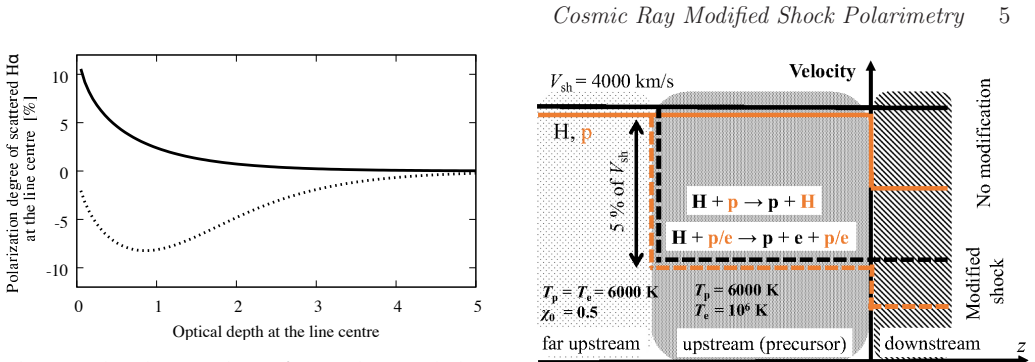
The central claim is that the polarization angle of upstream H$\alpha$ acts as a sign of cosmic-ray-modified shock. In the upstream region of a fast shock, H$\alpha$ is dominated by the Ly$\beta$-to-H$\alpha$ conversion: hydrogen atoms absorb Ly$\beta$ photons radiated by the downstream gas and re-emit H$\alpha$, and because this is a scattering process the H$\alpha$ is linearly polarized with a degree set by the anisotropy of the incident Ly$\beta$ beam. In an unmodified shock the beam is elongated along the shock normal, producing polarization parallel to the shock surface; in a modified shock, charge exchange with protons decelerated to $0.95V_{\rm sh}$ creates a second hydrogen population whose Doppler-shifted absorption removes the Ly$\beta$ photons travelling at small angles to the shock surface, reversing the anisotropy and producing polarization along the shock velocity. The paper computes the effect with a hydrogen level-population and radiative-transfer model, obtaining degrees of about two per cent for the unmodified shock, about one per cent for an electron-heating precursor with no deceleration, and about five per cent for the modified shock. It also shows that the upstream H$\alpha$ surface brightness is comparable to the downstream value, making the polarized precursor emission detectable in principle.
Load-bearing premise
The diagnostic assumes that the cosmic-ray precursor decelerates the upstream protons by five per cent of the shock speed without heating them, so that every velocity distribution stays a shifted Maxwellian; if proton heating broadens the decelerated distribution, the direction-dependent Ly$\beta$ absorption asymmetry that produces the polarization flip could be smeared out and the signal lost.
Editorial extensions
If this is right
- An edge-on observation of an SNR limb can separate a cosmic-ray-modified shock from an unmodified one by the position angle of the H$\alpha$ polarization alone, even when the precursor itself is spatially unresolved.
- The predicted few-per-cent polarization is observationally accessible; polarized H$\alpha$ at $2.0 \pm 0.4$ per cent has already been detected toward SN 1006.
- Because the H$\beta$/H$\alpha$ ratio barely changes with the velocity modification, polarimetry supplies information that the Balmer decrement cannot.
- The condition that the precursor length exceed the charge-exchange length translates to a lower bound on the cosmic-ray diffusion coefficient, about $10^{25}\ {\rm cm^2\,s^{-1}}$, and to a lower bound near $33$ TeV on the energy of the cosmic rays driving the modification in a Bohm-like field.
- The upstream H$\alpha$ surface brightness is comparable to the downstream brightness, so the polarized precursor emission should be detectable rather than lost against the shock itself.
Reading between the lines
- A testable extension would be to map the polarization position angle as a function of distance from the shock front; the spatial profile of the expected angle flip would trace the deceleration profile of the precursor and, with a model, the cosmic-ray pressure gradient.
- The same Ly$\beta$-scattering mechanism should imprint a weaker polarization signal on H$\beta$ through Ly$\gamma$ conversion, so a combined H$\alpha$/H$\beta$ polarimetric measurement could separate resonant-scattering polarization from collisional-excitation emission.
- Because the polarization flip relies on the decelerated protons retaining a narrow velocity distribution, kinetic or hybrid simulations that include neutral coupling could test whether precursor turbulence or proton heating washes out the signal.
- Combining upstream H$\alpha$ polarimetry with downstream H$\alpha$ polarimetry, which is sensitive to the acceleration efficiency, could in principle measure both the cosmic-ray pressure and the injection efficiency in the same shock.
Signed reviews
Editorial analysis
A structured set of objections, weighed in public.
Referee Report
Summary. This paper proposes a new observational diagnostic for cosmic-ray-modified shocks: linear polarimetry of upstream Hα produced by the Lyβ-to-Hα conversion. The authors set up a plane-parallel slab model of an SNR shock, use a published radiative-transfer and atomic-population model, and consider three upstream states: no precursor, an electron-heating precursor without velocity modification, and a precursor in which protons are decelerated by 5% of the shock velocity without being heated. They compute the hydrogen ionization structure, Hα emissivity, and Stokes Q/I as functions of upstream position for Vsh = 4000 km s−1, T0 = 6000 K, and preshock ionization degree 0.5. Their main finding is that the polarization direction flips between the unmodified case (polarization parallel to the shock surface at large Lyβ optical depth) and the modified case (polarization perpendicular to the shock surface), with a few-percent degree, and that a velocity modification of 200 km s−1 is sufficient to produce the flip. They also show that the upstream Hα surface brightness is comparable to the downstream value and that the Hβ/Hα ratio is insensitive to the velocity modification. The paper concludes that Hα polarimetry can be a unique diagnostic of the CR back-reaction in SNR shocks.
Significance. If the predicted sign flip is robust, this is a genuinely new, falsifiable probe of CR precursor physics; it goes beyond SED fitting and connects a direct observable to the bulk deceleration of the upstream plasma. The model is a forward calculation with no fitted data, it builds on published atomic data and prior models, and it makes concrete predictions for the sign, degree, and spatial profile of the polarization, as well as for the Hβ/Hα ratio. The connection to the existing polarized Hα detection in SN 1006 (Sparks et al. 2015) gives the proposal some observational plausibility. The main weakness is that the central prediction has not yet been shown to survive plausible variations in precursor thermodynamics, so the significance of the diagnostic is currently conditional.
major comments (3)
- [Section 3 (case iii), before Fig. 4; Eqs. (32)-(34)] The sign flip is produced by the assumption that the decelerated protons remain a cold, shifted Maxwellian with no heating, so that the 200 km s−1 shift places the charge-exchanged atoms outside the line core for μ≃±1 while they still absorb at μ≃0. If precursor proton heating broadens the decelerated distribution to a thermal width comparable to 200 km s−1, or if the deceleration occurs gradually so that charge-exchanged atoms are born over a continuum of bulk velocities, this direction-dependent absorption asymmetry is reduced and the predicted polarization flip can be washed out. The paper states the no-heating assumption but does not justify it or test its sensitivity; this is load-bearing for the abstract's central claim.
- [Abstract and Fig. 6] The statement that the unmodified shock has polarization parallel to the shock surface is not true at all positions in the model. In case (i), the polarization is positive, i.e. perpendicular to the shock surface, close to the shock front and becomes negative only at Lyβ optical depth of order unity. Since a real edge-on observation will integrate the Stokes parameters over a spatial resolution element along the shock-normal coordinate, the sign comparison in the abstract may not correspond to the quantity that is actually measured. The paper should specify the spatial region it refers to and give the polarization predicted for an observationally motivated integration.
- [Section 3, parameter set] The quantitative claims of a few-percent polarization and sensitivity to a 5% velocity modification are computed for a single parameter point: Vsh=4000 km s−1, T0=6000 K, χ0=0.5, and ΔVsh=200 km s−1. The charge-exchange rate, Lyβ optical depth, and the precursor length scale all depend strongly on these parameters, so without a parameter scan it is unclear whether the sign flip and the few-percent degree are generic features or specific to this one case.
minor comments (4)
- [Section 4] In the discussion of the Hα FWHM, '30-50 km−1' should read '30-50 km s−1'.
- [Section 2, footnote 2] The estimate that multiply scattered Lyβ has negligible polarization is based on a dust-scattering calculation; a short estimate for resonantly trapped Lyβ in hydrogen would be more directly relevant, since the polarization budget of the trapped radiation is one of the stated simplifications.
- [Eq. (35)] The numerical factor in the diffusion-coefficient lower bound is stated without derivation; showing the prefactor explicitly would help readers reproduce the constraint on the CR diffusion coefficient.
- [Figs. 6-8] The vertical axis labels in Figures 6-8 would be clearer if the units (percent for polarization, specific units for surface brightness) appeared directly in the axis labels rather than only in the caption.
Circularity Check
No significant circularity: the polarization flip is a forward-model prediction from an assumed velocity modification, with no fitted parameters or definitional circularity.
full rationale
The paper computes Hα polarization from Lyβ scattering using a radiative transfer model previously published by the same authors (Shimoda & Laming 2019), but that model uses independent atomic physics inputs (oscillator strengths from Wiese & Fuhr 2009, charge-exchange rates from Janev et al. 1993/2003) and is not parameterized to reproduce the target polarization. The velocity modification (5% of Vsh, i.e. 200 km/s) is an explicit assumed input, not a fitted output; the polarization direction and degree are derived quantities computed from the assumed velocity structure and atomic processes. The central claim—that polarization direction flips between unmodified and modified shocks—is a forward-model output with no free parameters tuned to any observed polarization. The paper does not fit any parameter to the polarization data it predicts, nor does it define any quantity in terms of the target result. The self-citation to Shimoda & Laming (2019) is standard prior-model use and does not reduce to the paper's own conclusion; the cited model is independently constructed and the current calculation extends it with new precursor ionization equations. No circular step can be exhibited.
Assumptions & free parameters
free parameters (8)
- Shock velocity Vsh =
4000 km/s
- Far upstream temperature T0 =
6000 K
- Preshock ionization degree chi0 =
0.5
- Electron heating precursor temperature =
1e6 K
- Velocity modification DeltaVsh =
200 km/s (5 percent of Vsh)
- Downstream electron temperature fraction =
10 percent of proton temperature, Te about 3 keV
- Precursor front location zpre =
zpre = 3 (np/ntot,0) Vsh/CCX
- Frequency integration window =
Doppler velocity -25 to 25 km/s
assumptions (7)
- standard math Rayleigh scattering phase matrices for 3p1/2 and 3p3/2 transitions describe Ly-beta to H-alpha conversion via conservation of angular momentum.
- ad hoc to paper Incident Ly-beta is completely unpolarized, and any polarization built up during Ly-beta trapping is negligible.
- domain assumption All particle velocity distributions are shifted Maxwellians in the shock rest frame.
- domain assumption Charge-exchange cross-sections and ionization rates from Janev et al. are accurate at the relevant velocities.
- domain assumption H-alpha emission is optically thin for the adopted upstream density, so H-alpha scattering does not alter the polarization.
- domain assumption Bremsstrahlung, SNR ejecta emission, and external radiation sources are negligible.
- domain assumption The shock is plane-parallel, axially symmetric, and observed exactly edge-on.
Cite this review
Pith. "Pith review of Diagnosing Cosmic Ray Modified Shocks with H {\alpha} Polarimetry." pith.science (2026). https://pith.science/paper/W4JBVDBN
@misc{pith2026190807216,
  author       = {Pith},
  title        = {Pith review of: Diagnosing Cosmic Ray Modified Shocks with H \alpha Polarimetry},
  year         = {2026},
  howpublished = {\url{https://pith.science/paper/W4JBVDBN}},
  note         = {Machine review of arXiv:1908.07216}
}
abstract
A novel diagnostic of cosmic-ray modified shocks by polarimetry of H $\alpha$ emissions is suggested. In a cosmic-ray modified shock, the pressure of cosmic rays is sufficiently high compared to the upstream ram pressure to force the background plasma to decelerate (measured in the shock rest frame). Simultaneously, a fraction of the hydrogen atoms co-existing in the upstream plasma collide with the decelerated protons and undergo charge-exchange reactions. As a result, hydrogen atoms with the same bulk velocity of the decelerated protons are generated. We show that when the shock is observed from edge-on, the H $\alpha$ radiated by these upstream hydrogen atoms is linearly polarized with a sizable degree of a few per cent as a result of resonant scattering of Ly $\beta$. The polarization direction depends strongly on the velocity modification; the direction is parallel to the shock surface for the case of no modification, while the direction is parallel to the shock velocity for the case of a modified shock.
Figures

Figures from the paper (3 more)


Reference graph
Works this paper leans on
-
[1]
write newline
" write newline "" before.all 'output.state := FUNCTION fin.entry write newline FUNCTION new.block output.state before.all = 'skip after.block 'output.state := if FUNCTION new.sentence output.state after.block = 'skip output.state before.all = 'skip after.sentence 'output.state := if if FUNCTION not #0 #1 if FUNCTION and 'skip pop #0 if FUNCTION or pop #1...
-
[2]
Archambault S., et al., 2017, @doi [ ] 10.3847/1538-4357/836/1/23 , https://ui.adsabs.harvard.edu/abs/2017ApJ...836...23A 836, 23
-
[3]
Beck R., 2001, , http://adsabs.harvard.edu/abs/2001SSRv...99..243B 99, 243
work page 2001
-
[4]
Bell A. R., 1978, @doi [ ] 10.1093/mnras/182.2.147 , http://adsabs.harvard.edu/abs/1978MNRAS.182..147B 182, 147
-
[5]
Bell A. R., 2004, @doi [ ] 10.1111/j.1365-2966.2004.08097.x , http://ads.nao.ac.jp/abs/2004MNRAS.353..550B 353, 550
arXiv 2004
-
[6]
Berezhko E. G., Ellison D. C., 1999, @doi [ ] 10.1086/307993 , http://adsabs.harvard.edu/abs/1999ApJ...526..385B 526, 385
doi:10.1086/307993 1999
-
[7]
Blandford R., Eichler D., 1987, @doi [ ] 10.1016/0370-1573(87)90134-7 , https://ui.adsabs.harvard.edu/abs/1987PhR...154....1B 154, 1
-
[8]
Blandford R. D., Ostriker J. P., 1978, @doi [ ] 10.1086/182658 , http://adsabs.harvard.edu/abs/1978ApJ...221L..29B 221, L29
doi:10.1086/182658 1978
Show all 47 references
-
[9]
Blasi P., Morlino G., Bandiera R., Amato E., Caprioli D., 2012, @doi [ ] 10.1088/0004-637X/755/2/121 , http://adsabs.harvard.edu/abs/2012ApJ...755..121B 755, 121
2012 doi
-
[10]
Chandrasekhar S., 1960, Radiative transfer
1960
-
[11]
A., Kirshner R
Chevalier R. A., Kirshner R. P., Raymond J. C., 1980, @doi [ ] 10.1086/157623 , http://adsabs.harvard.edu/abs/1980ApJ...235..186C 235, 186
1980 doi
-
[12]
O., Falle S
Drury L. O., Falle S. A. E. G., 1986, @doi [ ] 10.1093/mnras/223.2.353 , http://ads.nao.ac.jp/abs/1986MNRAS.223..353D 223, 353
1986 doi
-
[13]
O., Voelk J
Drury L. O., Voelk J. H., 1981, @doi [ ] 10.1086/159159 , https://ui.adsabs.harvard.edu/abs/1981ApJ...248..344D 248, 344
1981 doi
-
[14]
R., Wright G
Graham J. R., Wright G. S., Hester J. J., Longmore A. J., 1991a, @doi [ ] 10.1086/115676 , https://ui.adsabs.harvard.edu/abs/1991AJ....101..175G 101, 175
-
[15]
R., Wright G
Graham J. R., Wright G. S., Geballe T. R., 1991b, @doi [ ] 10.1086/186014 , https://ui.adsabs.harvard.edu/abs/1991ApJ...372L..21G/abstract 372, L21
-
[16]
R., 1947, @doi [ ] 10.1086/144976 , https://ui.adsabs.harvard.edu/abs/1947ApJ...106..457H 106, 457
Hamilton D. R., 1947, @doi [ ] 10.1086/144976 , https://ui.adsabs.harvard.edu/abs/1947ApJ...106..457H 106, 457
1947 doi
-
[17]
P., McCully C., Pandya V., Eriksen K., 2018, @doi [ ] 10.3847/1538-4357/aac94b , http://adsabs.harvard.edu/abs/2018ApJ...862..148H 862, 148
Hovey L., Hughes J. P., McCully C., Pandya V., Eriksen K., 2018, @doi [ ] 10.3847/1538-4357/aac94b , http://adsabs.harvard.edu/abs/2018ApJ...862..148H 862, 148
2018 doi
-
[18]
Inoue T., 2019, @doi [ ] 10.3847/1538-4357/aafb70 , https://ui.adsabs.harvard.edu/abs/2019ApJ...872...46I 872, 46
2019 doi
-
[19]
Inoue T., Yamazaki R., Inutsuka S.-i., Fukui Y., 2012, @doi [ ] 10.1088/0004-637X/744/1/71 , http://adsabs.harvard.edu/abs/2012ApJ...744...71I 744, 71
2012 doi
-
[20]
K., Smith J
Janev R. K., Smith J. J., 1993, Cross Sections for Collision Processes of Hydrogen Atoms with Electrons, Protons and Multiply Charged Ions
1993
-
[21]
K., Reiter D., Samm U., 2003, C ollision processes in low-temperature hydrogen plasmas
Janev R. K., Reiter D., Samm U., 2003, C ollision processes in low-temperature hydrogen plasmas. Berichte des Forschungszentrums J^^c3^^bclich Vol. 4105, Forschungszentrum, Zentralbibliothek, J^^c3^^bclich, http://juser.fz-juelich.de/record/38224
2003
-
[22]
Katsuda S., et al., 2016, @doi [ ] 10.3847/2041-8205/819/2/L32 , https://ui.adsabs.harvard.edu/abs/2016ApJ...819L..32K 819, L32
2016 doi
-
[23]
Kne z evi \'c S., et al., 2017, @doi [ ] 10.3847/1538-4357/aa8323 , https://ui.adsabs.harvard.edu/abs/2017ApJ...846..167K 846, 167
2017 doi
-
[24]
O., Cesarsky C
Lagage P. O., Cesarsky C. J., 1983a, , https://ui.adsabs.harvard.edu/abs/1983A&A...118..223L 118, 223
-
[25]
O., Cesarsky C
Lagage P. O., Cesarsky C. J., 1983b, , https://ui.adsabs.harvard.edu/abs/1983A&A...125..249L 125, 249
-
[26]
M., 1990, @doi [ ] 10.1086/169257 , https://ui.adsabs.harvard.edu/abs/1990ApJ...362..219L 362, 219
Laming J. M., 1990, @doi [ ] 10.1086/169257 , https://ui.adsabs.harvard.edu/abs/1990ApJ...362..219L 362, 219
1990 doi
-
[27]
M., 2015, @doi [ ] 10.1088/0004-637X/805/2/102 , https://ui.adsabs.harvard.edu/abs/2015ApJ...805..102L/abstract 805, 102
Laming J. M., 2015, @doi [ ] 10.1088/0004-637X/805/2/102 , https://ui.adsabs.harvard.edu/abs/2015ApJ...805..102L/abstract 805, 102
2015 doi
-
[28]
M., Hwang U., Ghavamian P., Rakowski C., 2014, @doi [ ] 10.1088/0004-637X/790/1/11 , https://ui.adsabs.harvard.edu/abs/2014ApJ...790...11L 790, 11
Laming J. M., Hwang U., Ghavamian P., Rakowski C., 2014, @doi [ ] 10.1088/0004-637X/790/1/11 , https://ui.adsabs.harvard.edu/abs/2014ApJ...790...11L 790, 11
2014 doi
-
[29]
Lee J.-J., Koo B.-C., Raymond J., Ghavamian P., Pyo T.-S., Tajitsu A., Hayashi M., 2007, @doi [ ] 10.1086/517520 , https://ui.adsabs.harvard.edu/abs/2007ApJ...659L.133L 659, L133
2007 doi
-
[30]
A., Raymond J
Medina A. A., Raymond J. C., Edgar R. J., Caldwell N., Fesen R. A., Milisavljevic D., 2014, @doi [ ] 10.1088/0004-637X/791/1/30 , https://ui.adsabs.harvard.edu/abs/2014ApJ...791...30M 791, 30
2014 doi
-
[31]
Morlino G., Bandiera R., Blasi P., Amato E., 2012, @doi [ ] 10.1088/0004-637X/760/2/137 , http://adsabs.harvard.edu/abs/2012ApJ...760..137M 760, 137
2012 doi
-
[32]
Morlino G., Blasi P., Bandiera R., Amato E., Caprioli D., 2013, @doi [ ] 10.1088/0004-637X/768/2/148 , http://adsabs.harvard.edu/abs/2013ApJ...768..148M 768, 148
2013 doi
-
[33]
C., 1978, @doi [ ] 10.1086/156500 , http://adsabs.harvard.edu/abs/1978ApJ...225..380M 225, 380
Myers P. C., 1978, @doi [ ] 10.1086/156500 , http://adsabs.harvard.edu/abs/1978ApJ...225..380M 225, 380
1978 doi
-
[34]
Ohira Y., 2012, @doi [ ] 10.1088/0004-637X/758/2/97 , http://adsabs.harvard.edu/abs/2012ApJ...758...97O 758, 97
2012 doi
-
[35]
Ohira Y., 2016, @doi [ ] 10.3847/0004-637X/817/2/137 , http://adsabs.harvard.edu/abs/2016ApJ...817..137O 817, 137
2016 doi
-
[36]
Ohira Y., Takahara F., 2010, @doi [ ] 10.1088/2041-8205/721/1/L43 , https://ui.adsabs.harvard.edu/abs/2010ApJ...721L..43O 721, L43
2010 doi
-
[37]
C., 1991, @doi [ ] 10.1086/132881 , http://adsabs.harvard.edu/abs/1991PASP..103..781R 103, 781
Raymond J. C., 1991, @doi [ ] 10.1086/132881 , http://adsabs.harvard.edu/abs/1991PASP..103..781R 103, 781
1991 doi
-
[38]
N., 2009, @doi [ ] 10.1111/j.1745-3933.2008.00591.x , https://ui.adsabs.harvard.edu/abs/2009MNRAS.393L..26R 393, L26
Roy N., Bharadwaj S., Dutta P., Chengalur J. N., 2009, @doi [ ] 10.1111/j.1745-3933.2008.00591.x , https://ui.adsabs.harvard.edu/abs/2009MNRAS.393L..26R 393, L26
2009
-
[39]
M., 2019, @doi [ ] 10.1093/mnras/stz758 , https://ui.adsabs.harvard.edu/abs/2019MNRAS.485.5453S 485, 5453
Shimoda J., Laming J. M., 2019, @doi [ ] 10.1093/mnras/stz758 , https://ui.adsabs.harvard.edu/abs/2019MNRAS.485.5453S 485, 5453
2019 doi
-
[40]
M., Katsuda S., 2018a, @doi [ ] 10.1093/mnras/stx2339 , https://ui.adsabs.harvard.edu/abs/2018MNRAS.473.1394S 473, 1394
Shimoda J., Ohira Y., Yamazaki R., Laming J. M., Katsuda S., 2018a, @doi [ ] 10.1093/mnras/stx2339 , https://ui.adsabs.harvard.edu/abs/2018MNRAS.473.1394S 473, 1394
-
[41]
Shimoda J., Akahori T., Lazarian A., Inoue T., Fujita Y., 2018b, @doi [ ] 10.1093/mnras/sty2034 , https://ui.adsabs.harvard.edu/abs/2018MNRAS.480.2200S 480, 2200
-
[42]
C., Raymond J
Smith R. C., Raymond J. C., Laming J. M., 1994, @doi [ ] 10.1086/173558 , http://adsabs.harvard.edu/abs/1994ApJ...420..286S 420, 286
1994 doi
-
[43]
C., 2003, @doi [ ] 10.1051/0004-6361:20030839 , http://adsabs.harvard.edu/abs/2003A
Sollerman J., Ghavamian P., Lundqvist P., Smith R. C., 2003, @doi [ ] 10.1051/0004-6361:20030839 , http://adsabs.harvard.edu/abs/2003A
2003 doi
-
[44]
B., Pringle J
Sparks W. B., Pringle J. E., Carswell R. F., Long K. S., Cracraft M., 2015, @doi [ ] 10.1088/2041-8205/815/1/L9 , https://ui.adsabs.harvard.edu/abs/2015ApJ...815L...9S 815, L9
2015 doi
-
[45]
M., Heng K., 2012, @doi [ ] 10.1111/j.1365-2966.2012.20787.x , http://adsabs.harvard.edu/abs/2012MNRAS.422.2357T 422, 2357
Tseliakhovich D., Hirata C. M., Heng K., 2012, @doi [ ] 10.1111/j.1365-2966.2012.20787.x , http://adsabs.harvard.edu/abs/2012MNRAS.422.2357T 422, 2357
2012
-
[46]
L., Fuhr J
Wiese W. L., Fuhr J. R., 2009, @doi [Journal of Physical and Chemical Reference Data] 10.1063/1.3254213 , https://ui.adsabs.harvard.edu/abs/2009JPCRD..38.1129W 38, 1129
2009 doi
-
[47]
W., Girart J
Yang H., Li Z.-Y., Looney L. W., Girart J. M., Stephens I. W., 2017, @doi [ ] 10.1093/mnras/stx1951 , https://ui.adsabs.harvard.edu/abs/2017MNRAS.472..373Y 472, 373
2017 doi
Reviewed August 14, 2026 · model on record in the stance chip above.
Discussion (0). Continue with ORCID to comment.