REVIEW 4 major objections 5 minor 68 references
From One Pattern into Another: Analysis of Turing Patterns in Heterogeneous Domains via WKBJ
T0 review · 4 major / 5 minor · reviewed 2026-08-14 · deepseek-v4-flash
Pith's one-line read A slowly varying heterogeneous background makes Turing instabilities local: patterns grow exactly where the classical conditions hold pointwise, in a nested hierarchy of mode supports.
desk verdict A genuinely useful derivation of local Turing conditions for heterogeneous domains, with an acknowledged but unresolved turning-point phase problem that a referee should push on. read the letter →
The pith
A machine-rendered reading of the paper's core claim, the machinery that carries it, and where it could break.
The reading
What carries the argument
The workhorse is the WKBJ ansatz $w=e^{\lambda t}e^{i\phi(x)/\varepsilon}p(x)$, with $\phi'$ determined by the eigenvalues $\mu^\pm_\lambda(x)$ of $B_\lambda(x)=D^{-1}(J(x)-\lambda I)$. Expanding in powers of $\varepsilon$ and applying a Fredholm solvability condition gives the amplitude prefactor $Q_0(x)\propto[\mu^\pm_\lambda]^{-1/4}\exp(-\int s_*^T p_*'/s_*^T p_*\,dx)$. The zeros of $[\mathrm{tr}(B_\lambda)]^2-4\det(B_\lambda)$ are the turning points: there the two eigenvalues coalesce, the left and right eigenvectors become orthogonal, and $Q_0$ develops a $|x-x_*|^{-1/4}$ singularity. Imposing effective Dirichlet conditions at these points selects sine modes and yields the quantization condition $\int_a^b\sqrt{\mu^\pm_\lambda(x)}\,dx=n^\pm\pi\varepsilon$, which determines the discrete growth rates and their nested supports.
What would settle it
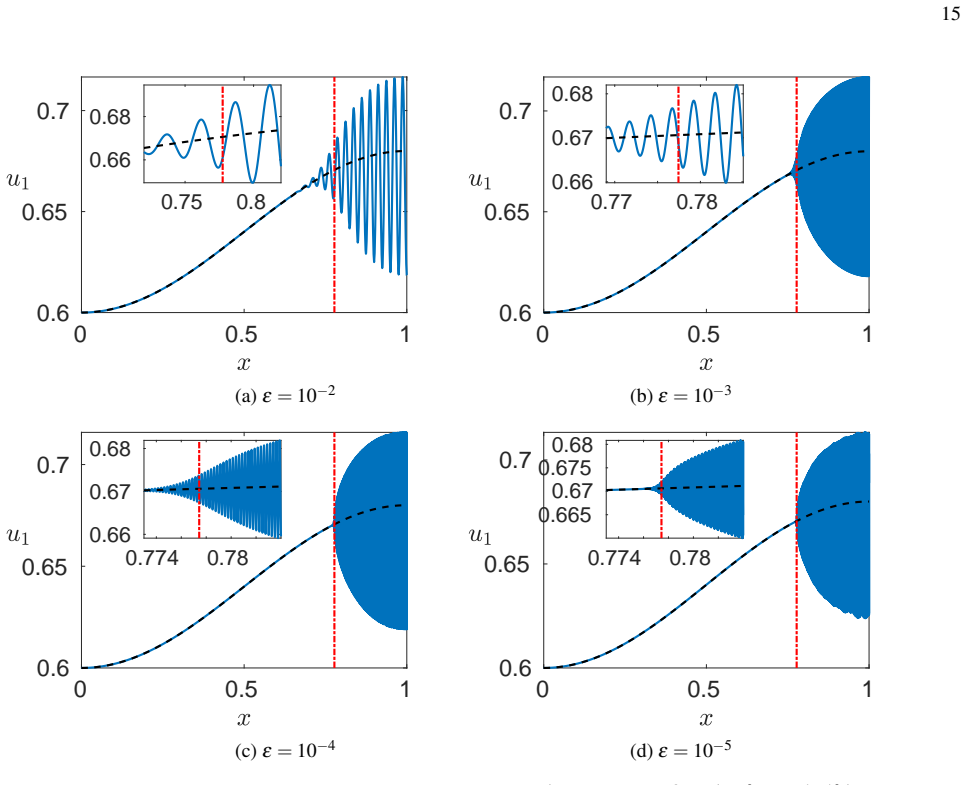
Compute the full numerical spectrum of the linearized operator (3) for the Schnakenberg example the paper uses ($\alpha=1$, $d=1/40$, $\beta(x)=3/5+(1-\cos\pi x)/25$) at a small value such as $\varepsilon=10^{-3}$, and compare the eigenvalues and supports with the WKBJ predictions from (27); if the predicted localized modes are absent, or do not tend to zero at the singular point $x_*\approx0.7774$, then Criterion 2 is not a correct asymptotic description.
Extended reading notes
Core claim
The central claim is that the classical Turing conditions can be applied pointwise in a heterogeneous medium. For a two-component reaction-diffusion system $\partial_t u = \varepsilon^2 D u_{xx} + F(u,x)$ with a slowly varying steady state $u_*(x)$ that is stable in the absence of diffusion ($\mathrm{tr}(J)<0$ and $\det(J)>0$ everywhere), the paper's Criterion 2 states that if $\mathrm{tr}(D^{-1}J(x))>0$ and $[\mathrm{tr}(D^{-1}J(x))]^2-4\det(D^{-1}J(x))>0$ for all $x$ in the largest such region $T_0$, then for sufficiently small $\varepsilon$ the steady state is unstable to a non-homogeneous perturbation that grows exponentially on the interior of $T_0$. The unstable modes are constructed by WKBJ theory: they are localized to nested regions $T_\lambda\subseteq T_0$, with support strictly shrinking as the growth rate $\lambda$ increases, and they vanish at the singular points that bound $T_\lambda$. This is what gives the paper its title: one pattern destabilizes into another, with the new pattern confined to the region where the local conditions hold.
Load-bearing premise
The argument assumes the unresolved inner region at each singular point can be replaced by an effective zero boundary condition, so that the piecewise WKBJ solutions are genuine asymptotic eigenfunctions; the paper does not construct that inner solution.
Editorial extensions
If this is right
- Slowly varying spatial heterogeneity does not destroy Turing's mechanism; it localizes it, so the patterning region is predicted in advance as the set $T_0$ where the local conditions hold.
- There is no single dispersion relation or global wavenumber for the heterogeneous problem: each unstable mode has a distinct support, so heuristics based on the fastest-growing Fourier mode need to be replaced by local information.
- The monotonicity $T_{\lambda_2}\subseteq T_{\lambda_1}$ for $\lambda_1<\lambda_2$ means the pattern's spatial extent is encoded in the growth-rate spectrum: slow modes paint wide regions, fast modes sit inside them.
- For fixed small $\varepsilon$, only finitely many discrete growth rates are allowed, selected by the phase integral $\int_a^b\sqrt{\mu^\pm_\lambda}\,dx=n^\pm\pi\varepsilon$, so the theory gives explicit countable mode predictions.
- Sequential or hierarchical patterning—an established pattern serving as the heterogeneous background for the next—can be modelled as an instability of a heterogeneous steady state rather than as a fresh symmetry breaking from homogeneity.
Reading between the lines
- A genuine solution of the unsolved boundary-layer problem at the singular points would replace the effective Dirichlet condition by a connection formula; until then, the scaling $\varepsilon^{8/9}$ for the inner layer gives a concrete numerical target.
- If the envelope of a developed pattern tracks the locally fastest-growing mode, then a single converged simulation (or experiment) could be used to read off the spatial variation of growth rates, although the paper only conjectures this envelope relation.
- The same WKBJ reduction should carry to higher-dimensional slowly varying domains, where the predicted patterning regions would follow level sets of the local dispersion relation; the authors state this as an anticipation rather than a derived result.
- The paper explicitly excludes rapidly varying heterogeneity; mapping the failure threshold as heterogeneity's length scale approaches the diffusion length would connect this smooth-heterogeneity theory to step-function treatments in the literature.
Signed reviews
Editorial analysis
A structured set of objections, weighed in public.
Referee Report
Summary. The manuscript derives generalizations of the classical Turing instability conditions to two-component reaction-diffusion systems with smoothly varying spatial heterogeneity, using a WKBJ expansion in the small parameter ε. The authors define 'permissible' growth rates through the reality and non-negativity of the local eigenvalues of D^{-1}(J−λI), prove monotonicity of the unstable support Tλ in λ, and construct piecewise WKBJ modes localized on intervals whose endpoints are simple zeros of the discriminant. They state local Turing conditions (Criterion 2) and a discrete mode-selection condition (Criterion 3). For the Schnakenberg model with spatially varying kinetics, they compare the predicted supports with direct numerical simulations for ε down to 10^{-5}, and they construct the predicted discrete modes and their supports. The paper is clearly written, and the logical structure from local eigenvalue conditions to instability criteria is mostly self-contained and presented as a series of explicit propositions.
Significance. If the derivation were complete, the paper would make a genuinely useful contribution to the pattern-formation literature. It provides a principled justification of the widely used heuristic of local Turing conditions, and it identifies a structurally new feature: unstable modes with different growth rates are localized in different, nested spatial regions. Proposition 8, the monotonicity of Tλ in λ, is a clean and testable prediction, and the numerical experiments in Section IV are careful and support the predicted support and localization of patterns as ε is decreased. The instability conditions are consequences of the WKBJ formalism and stability assumptions rather than fitted parameters, and the comparison with numerics is quantitative for the support. The main weakness is the treatment of the singular points where the discriminant vanishes, which is acknowledged by the authors but is load-bearing for the claimed mode construction.
major comments (4)
- [Section III.B and SI S2; Eqs. (23b)-(23c) and (27)] The 'effective Dirichlet' condition at a singular point x* is imposed rather than derived. At a simple zero of [tr(Bλ)]²−4det(Bλ), the two WKBJ eigenvalues collide and x* is a turning point for the coupled system (8), not a hard wall. The inner layer identified in SI S2 has width ε^{8/9}, and no matching of the outer WKBJ solution to a solution of the inner problem is supplied. For scalar WKBJ turning points, the connection formula generically adds a phase (π/4 in the standard Airy case) to the oscillatory argument; the sine forms in (23b)-(23c), which have phase zero at x*, therefore constitute an unproved choice of connection. Consequently, the quantization condition (27) and the discrete modes plotted in Figures 5-6 are not established as asymptotic eigenvalues or eigenfunctions of the linearized operator (3). Because Criterion 3 and, through it, Criterion 2 rely on the existence and form of these modes, this gap is load-bearing for the central claim. A constant phase correction might preserve the existence of some mode for sufficiently small ε, but it would change the mode numbers, supports, and growth rates at finite ε, so the manuscript's proof as written depends on the uncorrected condition.
- [Discussion, final paragraph; SI S2] The authors state that fully resolving the boundary-layer structure across the singularities is beyond the present scope and then assert that their results 'will remain valid even with such refinements.' The second assertion is not supported by the analysis. A connection phase changes the oscillatory factor over O(1) spatial intervals, so it is not an exponentially small correction; it affects which linear combination of WKBJ exponentials satisfies the boundary conditions and hence the predicted eigenfunctions. The paper should either supply the missing connection/matching analysis or explicitly present the modes as formal approximations whose leading-order support is numerically verified, with the phase and quantization statements marked as conjectural rather than derived.
- [Section III, paragraph after Eq. (27); Criterion 2] The reduction of Criterion 3 to Criterion 2 is only sketched. The text says that relaxing the single-interval restriction and taking 'a suitable choice of arbitrarily small ε' yields Criterion 2, but no proof is given that for every sufficiently small ε there exists a permissible pair (λ, n±) satisfying (27) with Tλ approximating T0. Since Criterion 2 is stated as the main heterogeneous instability condition, a precise statement with explicit quantifiers, and a proof (or a precise asymptotic bound) are needed. The current wording leaves the meaning of 'for sufficiently small ε' ambiguous, and the claim that the perturbation grows for all x in the interior of T0 should be justified uniformly as ε→0.
- [Section IV.B, Figures 5-6] Figures 5-6 are constructed directly from the WKBJ formulas (23b) and (27), so they do not provide an independent check of the mode-selection condition. The full simulations in Figures 2-4 confirm the spatial support and localization of the patterned state, but they do not resolve individual eigenvalues or eigenfunctions of the linearized operator. To support the discrete mode predictions, the authors should compare the WKBJ modes with numerically computed eigenfunctions of the discretized linearized problem (3) at the same parameter values; this would also help identify whether the phase correction discussed above is numerically significant.
minor comments (5)
- [Abstract and Section II] The sentence 'conditions for instability which are local versions of the classical Turing conditions We find that the structure...' is missing punctuation between 'conditions' and 'We'.
- [Section III, near Eq. (8)] The expansion for p(x) reads p(x) = p0 + εp1 + ε²p1 + ...; the coefficient of ε² should presumably be p2, not p1.
- [Section III.B] The sentence 'we have to determine what happens to the WKBJ solution on approaching the point where sT_* p_* ≠ 0 and beyond' should refer to points where sT_* p_* = 0, not ≠ 0, based on the surrounding discussion.
- [Criterion 3 proof] The proof references 'Proposition 9', but Proposition 9 is stated in the Supplementary Information, not in the main text; the cross-reference should be made explicit so the main text is self-contained.
- [Data availability statement] The data availability statement contains the placeholder URL 'http://dx.doi.org/xx.xxxx/xxxxxxxxxxxxxxxxxx'; this should be replaced with a working link or removed before publication.
Circularity Check
No significant circularity: the WKBJ derivation is self-contained and numerically checked; the singular-point matching gap is an unproved asymptotic assumption, not a circular reduction.
full rationale
The paper's derivation chain is self-contained. The WKBJ ansatz in Section III produces leading-order modes (11) from Eq. (8) via a standard solvability condition, and the definition of a 'permissible' pair (Definition 1) imposes only that the mode-selection integral (16) be real and nonzero. Propositions 2-7 then derive the pointwise inequalities tr(B_lambda) > 0 and [tr(B_lambda)]^2 - 4det(B_lambda) > 0 as an if-and-only-if consequence of permissibility, not as an input assumption. Criterion 3 and Proposition 8 construct the modes and the monotonicity of their supports from these inequalities, and Criterion 2 is explicitly an amalgamation of Criterion 3 across possible lambda values. The self-citations (refs. 32, 36, 49, 50) are used only for motivation or context and are not load-bearing in the derivation. The Schnakenberg example is an independent numerical check: the predicted support T0 and the mode structures in Figs. 5-6 are computed from the asymptotic formulas, not fitted to the simulations. The paper's own caveat that 'fully resolving the boundary-layer structure across these singularities is beyond our present scope' identifies an unproved asymptotic-matching step, namely the effective Dirichlet condition at singular points where the discriminant vanishes; however, this is a rigor gap rather than a circular reduction because the WKBJ modes are not defined in terms of the instability conclusions, and no fitted parameter is renamed as a prediction. Therefore no circularity is present.
Assumptions & free parameters
assumptions (5)
- standard math Formal WKBJ expansion and Fredholm solvability condition yield asymptotic solutions to the linearized system.
- domain assumption The diffusion is weak (0 < epsilon << 1) and the heterogeneous base state varies on O(1) spatial scales, so diffusion is a singular perturbation.
- domain assumption The discriminant [tr(Blambda)]^2 - 4det(Blambda) has only simple zeros and at most two zeros in [0,1].
- ad hoc to paper Outer WKBJ solutions can be extended through singular points by imposing effective Dirichlet conditions, based on a Q0 ~ |X|^{-1/4} scaling, without resolving the interior boundary layer.
- domain assumption The steady state u*(x) has O(1) derivatives and satisfies zero-flux boundary conditions, excluding boundary layers at domain edges.
Cite this review
Pith. "Pith review of From One Pattern into Another: Analysis of Turing Patterns in Heterogeneous Domains via WKBJ." pith.science (2026). https://pith.science/paper/OUE4BAZV
@misc{pith2026190807219,
  author       = {Pith},
  title        = {Pith review of: From One Pattern into Another: Analysis of Turing Patterns in Heterogeneous Domains via WKBJ},
  year         = {2026},
  howpublished = {\url{https://pith.science/paper/OUE4BAZV}},
  note         = {Machine review of arXiv:1908.07219}
}
read the original abstract
Pattern formation from homogeneity is well-studied, but less is known concerning symmetry-breaking instabilities in heterogeneous media. It is nontrivial to separate observed spatial patterning due to inherent spatial heterogeneity from emergent patterning due to nonlinear instability. We employ WKBJ asymptotics to investigate Turing instabilities for a spatially heterogeneous reaction-diffusion system, and derive conditions for instability which are local versions of the classical Turing conditions We find that the structure of unstable modes differs substantially from the typical trigonometric functions seen in the spatially homogeneous setting. Modes of different growth rates are localized to different spatial regions. This localization helps explain common amplitude modulations observed in simulations of Turing systems in heterogeneous settings. We numerically demonstrate this theory, giving an illustrative example of the emergent instabilities and the striking complexity arising from spatially heterogeneous reaction-diffusion systems. Our results give insight both into systems driven by exogenous heterogeneity, as well as successive pattern forming processes, noting that most scenarios in biology do not involve symmetry breaking from homogeneity, but instead consist of sequential evolutions of heterogeneous states. The instability mechanism reported here precisely captures such evolution, and extends Turing's original thesis to a far wider and more realistic class of systems.
Figures


Figures from the paper (3 more)


Reference graph
Works this paper leans on
-
[1]
A. M. Turing, Philosophical Transactions of the Royal Society of London. Series B, Biological Sciences 237, 37 (1952)
1952
-
[2]
P. De Kepper, V . Castets, E. Dulos, and J. Boissonade, Physica D: Nonlinear Phenomena49, 161 (1991)
work page 1991
-
[3]
M. C. Cross and P. C. Hohenberg, Reviews of modern physics 65, 851 (1993)
1993
-
[4]
Kondo and T
S. Kondo and T. Miura, science 329, 1616 (2010)
2010
-
[5]
J. D. Murray, Mathematical biology, interdisciplinary applied mathematics (Springer, New York, 2004)
work page 2004
-
[6]
J. B. A. Green and J. Sharpe, Development 142, 1203 (2015)
work page 2015
-
[7]
Woolley, Visions of mathematics, chapter 48: Mighty morphogenesis (2014)
T. Woolley, Visions of mathematics, chapter 48: Mighty morphogenesis (2014)
work page 2014
-
[8]
Wolpert, in Current topics in developmental biology (Elsevier, 2016), vol
L. Wolpert, in Current topics in developmental biology (Elsevier, 2016), vol. 117, pp. 597–608
work page 2016
Show all 68 references
-
[9]
D. M. Holloway, Ph.D. thesis, University of British Columbia (1995)
1995
-
[10]
Warmflash, B
A. Warmflash, B. Sorre, F. Etoc, E. D. Siggia, and A. H. Brivanlou, Nature methods 11, 847 (2014)
2014
-
[11]
E. L. Weber, T. E. Woolley, C.-Y . Yeh, K.-L. Ou, P. K. Maini, and C.-M. Chuong, Experimental Dermatology28, 355 (2019)
2019
-
[12]
Meinhardt, Developmental biology 96, 375 (1983)
H. Meinhardt, Developmental biology 96, 375 (1983)
1983
-
[13]
K. D. Irvine and C. Rauskolb, Annual review of cell and developmental biology 17, 189 (2001)
2001
-
[14]
Sheth, L
R. Sheth, L. Marcon, M. F. Bastida, M. Junco, L. Quintana, R. Dahn, M. Kmita, J. Sharpe, and M. A. Ros, Science 338, 1476 (2012)
2012
-
[15]
S. T. A. Pickett and M. L. Cadenasso, Science 269, 331 (1995)
1995
-
[16]
Clobert, J.-F
J. Clobert, J.-F. Le Galliard, J. Cote, S. Meylan, and M. Massot, Ecology letters 12, 197 (2009)
2009
-
[17]
C. A. Cobbold, F. Lutscher, and J. A. Sherratt, Ecological complexity 24, 69 (2015)
2015
-
[18]
Bassett, A
A. Bassett, A. L. Krause, and R. A. Van Gorder, Ecological Modelling 354, 115 (2017)
2017
-
[19]
Kurowski, A
L. Kurowski, A. L. Krause, H. Mizuguchi, P. Grindrod, and R. A. Van Gorder, Bulletin of mathematical biology 79, 2302 (2017)
2017
-
[20]
E. J. Crampin, W. W. Hackborn, and P. K. Maini, Bulletin of mathematical biology 64, 747 (2002)
2002
-
[21]
A. L. Krause, M. A. Ellis, and R. A. Van Gorder, Bulletin of mathematical biology 81, 759 (2019)
2019
-
[22]
G.-Q. Sun, M. Jusup, Z. Jin, Y . Wang, and Z. Wang, Physics of life reviews19, 43 (2016)
2016
-
[23]
Belmonte-Beitia, T
J. Belmonte-Beitia, T. E. Woolley, J. G. Scott, P. K. Maini, and E. A. Gaffney, Journal of theoretical biology334, 1 (2013)
2013
-
[24]
V . F. Bre˜na Medina, D. Avitabile, A. R. Champneys, and M. J. Ward, SIAM Journal on Applied Mathematics75, 1090 (2015)
2015
-
[25]
Avitabile, V
D. Avitabile, V . F. Bre˜na Medina, and M. J. Ward, SIAM Journal on Applied Mathematics 78, 291 (2018)
2018
-
[26]
D. L. Benson, J. A. Sherratt, and P. K. Maini, Bulletin of mathematical biology 55, 365 (1993). 19
1993
-
[27]
K. Page, P. K. Maini, and N. A. M. Monk, Physica D: Nonlinear Phenomena 181, 80 (2003)
2003
-
[28]
K. M. Page, P. K. Maini, and N. A. M. Monk, Physica D: Nonlinear Phenomena 202, 95 (2005)
2005
-
[29]
Iron and M
D. Iron and M. J. Ward, Mathematics and computers in simulation 55, 419 (2001)
2001
-
[30]
M. J. Ward, D. McInerney, P. Houston, D. Gavaghan, and P. Maini, SIAM Journal on Applied Mathematics62, 1297 (2002)
2002
-
[31]
J. Wei, M. Winter, and W. Yang, Calculus of Variations and Partial Differential Equations56, 142 (2017)
2017
-
[32]
A. L. Krause, V . Klika, T. E. Woolley, and E. A. Gaffney, Physical Review E97, 052206 (2018)
2018
-
[33]
Kolokolnikov and J
T. Kolokolnikov and J. Wei, SIAM Review 60, 626 (2018)
2018
-
[34]
J. F. G. Auchmuty and G. Nicolis, Bulletin of Mathematical Biology 37, 323 (1975)
1975
-
[35]
Doelman, P
A. Doelman, P. van Heijster, and J. Shen, Philosophical Transactions of the Royal Society A: Mathematical, Physical and Engineering Sciences 376, 20170183 (2018)
2018
- [36]
-
[37]
Lengyel and I
I. Lengyel and I. R. Epstein, Science 251, 650 (1991)
1991
-
[38]
I. R. Epstein and K. Showalter, The Journal of Physical Chemistry 100, 13132 (1996)
1996
-
[39]
R ¨udiger, D
S. R ¨udiger, D. G. M´ıguez, A. P. Munuzuri, F. Sagu´es, and J. Casademunt, Physical review letters 90, 128301 (2003)
2003
-
[40]
D. G. M ´ıguez, V . P´erez-Villar, and A. P. Mu˜nuzuri, Physical Review E 71, 066217 (2005)
2005
-
[41]
R ¨udiger, E
S. R ¨udiger, E. M. Nicola, J. Casademunt, and L. Kramer, Physics Reports 447, 73 (2007)
2007
-
[42]
L. Yang, M. Dolnik, A. M. Zhabotinsky, and I. R. Epstein, Physical review letters 88, 208303 (2002)
2002
-
[43]
Peter, M
R. Peter, M. Hilt, F. Ziebert, J. Bammert, C. Erlenk ¨amper, N. Lorscheid, C. Weitenberg, A. Winter, M. Hammele, and W. Zimmermann, Physical Review E 71, 046212 (2005)
2005
-
[44]
L. Haim, A. Hagberg, and E. Meron, Chaos: An Interdisciplinary Journal of Nonlinear Science 25, 064307 (2015)
2015
-
[45]
Dewel and P
G. Dewel and P. Borckmans, Physics Letters A 138, 189 (1989)
1989
-
[46]
Kuske and W
R. Kuske and W. Eckhaus, SIAM Journal on Applied Mathematics 57, 112 (1997)
1997
-
[47]
Otsuji, S
M. Otsuji, S. Ishihara, C. Co, K. Kaibuchi, A. Mochizuki, and S. Kuroda, PLoS computational biology 3, e108 (2007)
2007
-
[48]
Mendez, S
V . Mendez, S. Fedotov, and W. Horsthemke, Reaction-transport systems: mesoscopic foundations, fronts, and spatial instabilities (Springer Science & Business Media, 2010)
2010
-
[49]
Klika, M
V . Klika, M. Koz´ak, and E. A. Gaffney, SIAM Journal on Applied Mathematics 78, 2298 (2018)
2018
-
[50]
Klika, Chaos: An Interdisciplinary Journal of Nonlinear Science 27, 073120 (2017)
V . Klika, Chaos: An Interdisciplinary Journal of Nonlinear Science 27, 073120 (2017)
2017
-
[51]
P. K. Maini, T. E. Woolley, R. E. Baker, E. A. Gaffney, and S. S. Lee, Interface focus2, 487 (2012)
2012
-
[52]
T. E. Woolley, R. E. Baker, and P. K. Maini, inThe Incomputable (Springer, 2017), pp. 219–235
2017
-
[53]
H. I. Dwyer and A. Zettl, Electronic Journal of Differential Equations (EJDE)[electronic only] 1995 (1995)
1995
-
[54]
M. M. Malamud, in Sturm-Liouville Theory (Springer, 2005), pp. 237–270
2005
-
[55]
Bremmer, Communications on pure and applied mathematics 4, 105 (1951)
H. Bremmer, Communications on pure and applied mathematics 4, 105 (1951)
1951
-
[56]
Alder and H
K. Alder and H. K. A. Pauli, Nuclear Physics A 128, 193 (1969)
1969
-
[57]
D. J. Griffiths and D. F. Schroeter, Introduction to quantum mechanics (Cambridge University Press, 2018)
2018
-
[58]
C. M. Bender and S. A. Orszag, Advanced mathematical methods for scientists and engineers I: Asymptotic methods and perturbation theory (Springer Science & Business Media, 2013)
2013
-
[59]
C. N. Tennyson, H. J. Klamut, and R. G. Worton, Nature genetics 9, 184 (1995)
1995
-
[60]
Singh and R
J. Singh and R. A. Padgett, Nature structural & molecular biology 16, 1128 (2009)
2009
-
[61]
Sekine, T
R. Sekine, T. Shibata, and M. Ebisuya, Nature Communications 9 (2018)
2018
-
[62]
J. D. Crawford, Reviews of Modern Physics 63, 991 (1991)
1991
-
[63]
D. J. Wollkind, V . S. Manoranjan, and L. Zhang, Siam Review36, 176 (1994)
1994
-
[64]
L. E. Stephenson and D. J. Wollkind, Journal of Mathematical Biology 33, 771 (1995)
1995
-
[65]
Chen and J
Y . Chen and J. Buceta, PLOS ONE14, e0220994 (2019)
2019
-
[66]
We can only see a short distance ahead, but we can see plenty there that needs to be done
contained a spatial heterogeneity representing a precursor pattern from a previous pattern forming event. Such a situation could be directly captured by considering distinct reaction-diffusion processes occurring at different time points in development, 18 or on different temp...
-
[67]
Gierer and H
A. Gierer and H. Meinhardt, Kybernetik 12, 30 (1972)
1972
-
[68]
From One Pattern into Another: Analysis of Turing Patterns in Heterogeneous Domains via WKBJ
A. M. Turing, Mind 59, 433 (1950). 20 Supplementary Information for the Journal of the Royal Society Interface article “From One Pattern into Another: Analysis of Turing Patterns in Heterogeneous Domains via WKBJ” by A. L. Krause, V . Klika, T. E. Woolley, and E. A. Gaffney S1...
1950
Reviewed August 14, 2026 · model on record in the stance chip above.
Discussion (0). Continue with ORCID to comment.