REVIEW 3 major objections 3 minor 45 references
Beyond mean-field corrections to the quasiparticle spectrum of superfluid Fermi gases
T0 review · 3 major / 3 minor · reviewed 2026-08-14 · deepseek-v4-flash
Pith's one-line read Low-energy quasiparticles in superfluid Fermi gases decay by emitting one collective boson, except near the dispersion minimum.
desk verdict First analytic treatment of quasiparticle damping by collective mode emission across the BCS-BEC crossover, but the unitarity-level numbers lack an error estimate. read the letter →
The pith
A machine-rendered reading of the paper's core claim, the machinery that carries it, and where it could break.
The reading
What carries the argument
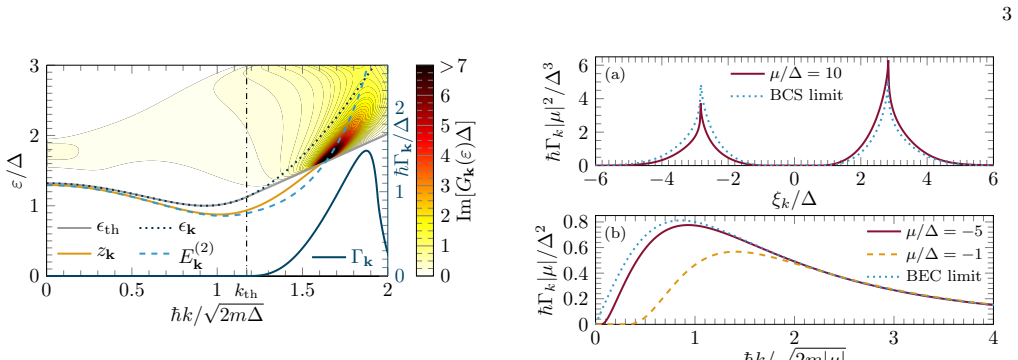
The central object is the effective Hamiltonian of Eq. (1): BCS fermionic quasiparticles of energy $\epsilon_k = \sqrt{\xi_k^2 + \Delta^2}$ coupled to collective Anderson-Bogoliubov bosons of energy $\hbar\omega_q$ through the three-body amplitude $A_{k,q}$ of Eq. (3). The load-bearing calculation is the one-boson-exchange self-energy of Eq. (4), whose imaginary part (Eq. 6) gives the damping rate once the resonance condition $\epsilon_k = \epsilon_{k-q} + \hbar\omega_q$ is satisfied. The threshold condition $|\partial\epsilon_k/\partial k| < \hbar c$ is what keeps the quasiparticles undamped near the minimum; in the BCS and BEC limits the sums are recast in universal variables that make the damping and shift analytic.
What would settle it
Measure the quasiparticle spectral function by momentum-resolved rf spectroscopy: the paper predicts a strictly sharp (zero-width) peak at the dispersion minimum and damping turning on only when the group velocity exceeds the sound speed; a finite width at or below that threshold, or damping onset at a different wavevector, would falsify the central claim.
Extended reading notes
Core claim
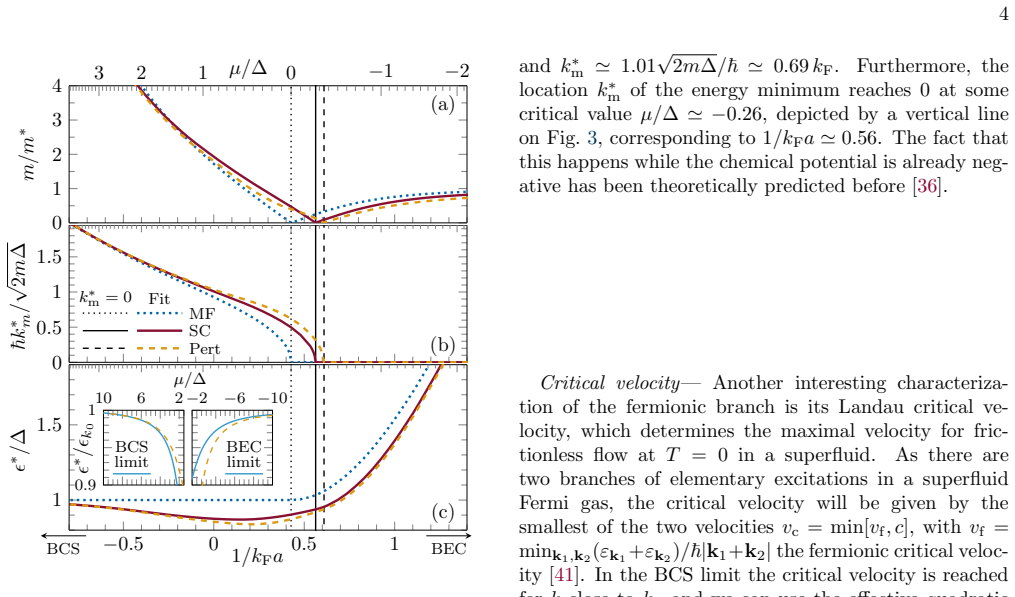
The central claim is that the quasiparticle spectrum of a superfluid Fermi gas, beyond the BCS mean-field result, is governed by the coupling of fermionic quasiparticles to the Anderson-Bogoliubov collective mode. The paper shows that the quasiparticle pole remains real below the threshold $\epsilon_{\rm th} = \min_q[\epsilon_{k-q} + \hbar\omega_q]$, which happens exactly where $|\partial \epsilon_k/\partial k| < \hbar c$; once the group velocity exceeds the sound velocity, the pole enters the emission continuum and the damping rate $\Gamma_k$ (Eq. 6) becomes nonzero. In the BCS and BEC limits the damping vanishes as $\Delta^2/\mu^2$ and $\mu^2/\Delta^2$, respectively, and closed-form expressions are obtained. At unitarity the corrected gap is $\epsilon^* \simeq 0.88\Delta \simeq 0.41 \epsilon_F$, close to the measured value $0.44\epsilon_F$, and the minimum sits at $k^*_m \simeq 0.69 k_F$.
Load-bearing premise
The whole calculation leans on truncating the quasiparticle's interactions to the emission or absorption of exactly one collective boson, while neglecting all other processes and far-off-shell contributions; if those neglected processes matter at the energies considered, the predicted lifetimes and shifts would be incomplete.
Editorial extensions
If this is right
- The undamped region around the branch minimum means the fermionic quasiparticle is a well-defined excitation there, so rf spectra should show a sharp peak whose position gives the dressed gap.
- In the BCS limit the fermionic Landau critical velocity is reduced by the factor $1 - 0.5(\Delta/\mu)^2$ relative to the mean-field result.
- In the BEC limit the damping rate has a $1/k^3$ tail and the threshold wavenumber vanishes as $\Delta/(4|\mu|)$.
- The location of the branch minimum moves to $k=0$ at $\mu/\Delta \simeq -0.26$ ($1/k_F a \simeq 0.56$), while the chemical potential is already negative.
- The smallness of the difference between perturbative and self-consistent results indicates that higher-order multi-boson processes give even smaller corrections to the spectrum.
Reading between the lines
- A natural extension of the paper would be to use the same dressed dispersion to compute transport coefficients such as the shear viscosity or sound attenuation in the crossover, where the finite quasiparticle lifetime would enter directly.
- Because the paper's threshold criterion $|\partial\epsilon_k/\partial k| = \hbar c$ is general, applying the same one-boson-emission picture to roton-like dispersions in dipolar Bose gases or superfluid helium would give a testable prediction for where damping sets in there.
- If the neglected branch-cut and four-fermion processes were included, one would expect additional damping only for quasiparticle energies above $3\Delta$; a numerical check of this bound would show whether the pronounced damping peak seen around $3\Delta$ is physical or an artifact of the truncation.
- The unitarity prediction $\epsilon^* \simeq 0.41\epsilon_F$ can be compared directly with existing gap measurements; reanalyzing those data with the effective-mass correction may reveal whether the remaining discrepancy is due to temperature or to higher-order processes.
Signed reviews
Editorial analysis
A structured set of objections, weighed in public.
Referee Report
Summary. The paper studies the fermionic quasiparticle branch in superfluid Fermi gases across the BCS-BEC crossover, focusing on the correction to the quasiparticle energy due to coupling to the Anderson-Bogoliubov collective mode. Starting from an effective Hamiltonian (Eq. 1) with a single-boson coupling, the authors compute the second-order self-energy (Eqs. 4-6) and show that close to the dispersion minimum the quasiparticle remains undamped because boson emission is kinematically forbidden. They then compute the perturbative and self-consistent quasiparticle energy near the minimum in the BCS and BEC limits and at unitarity, extracting the renormalized gap, effective mass, position of the minimum, and the Landau critical velocity. The paper also re-derives the quasiparticle Green's function from the microscopic self-energy of Eq. (11), showing that the pole-only approximation used throughout corresponds to dropping gapped branch-cut contributions and certain off-shell terms. The central quantitative results include an energy gap at unitarity ε* ≈ 0.88Δ ≈ 0.41ε_F, an effective mass ratio m/m* with nontrivial crossover dependence, and a critical velocity that is lowered by an amount of order (Δ/μ)^2 in the BCS limit.
Significance. If the calculation is taken at face value, this is a useful contribution: it provides an analytical treatment of the damping and energy shift of fermionic quasiparticles caused by coupling to the collective phonon-like mode, with explicit limiting behaviors in the BCS and BEC regimes and a self-consistent analysis that shows the quasiparticles remain well defined near the minimum. The paper is transparent about its approximations, explicitly noting the omission of branch cuts, multi-boson processes, and four-fermion processes, and it identifies the 3Δ threshold beyond which such processes become resonant. The comparison with the measured quasiparticle gap is encouraging. However, the quantitative claims at unitarity, where the expansion parameter is not small, remain uncontrolled, and the paper does not provide a bound on the size of the omitted virtual cut contributions.
major comments (3)
- [Energy corrections and Eq. (11)] The reduction of the microscopic self-energy (11) to the pole-only form (4) drops the two gapped branch cuts of the inverse pair propagator M^{-1}. These cuts are gapped but not zero, and their virtual contribution to Re Σ at z ≈ ε_k shifts the quasiparticle energy even when no real decay is kinematically allowed. At unitarity, where Δ/μ is O(1), there is no small parameter controlling this omission, as footnote [39] concedes. Consequently, the reported values of ε*, m/m*, and v_f do not come with an error estimate. I request a quantitative assessment: for instance, evaluating the branch-cut contribution to Eq. (11) at selected momenta near k_0 in the unitary case, or identifying an explicit small parameter that suppresses the cut integrals relative to the pole contribution.
- [Quasiparticle Green's function, Eqs. (14)-(16)] The derivation leading to Eq. (4) drops the B-dependent terms and the terms corresponding to γ†γ†b† in Eq. (14), with the justification that these are far off-shell and should be omitted consistently with the branch-cut reduction. However, the off-diagonal entries of Eq. (14) contain products A B that are of the same formal order in the quasiparticle-boson coupling as the diagonal terms retained after Eq. (16); setting B = 0 is an additional truncation that is not obviously of the same size as the branch-cut omission. The paper should quantify the magnitude of the B terms, at least in the BCS and BEC limits where A and B can be evaluated analytically, to show that they are negligible compared with the retained diagonal self-energy.
- [Fig. 3 and conclusion] The agreement of ε* ≈ 0.41ε_F with the experimental gap 0.44ε_F is encouraging, but it does not test the pole-only truncation: both the mean-field gap and the correction are computed within the same BCS-RPA/GPF scheme, and omitted virtual processes could change both the gap and the interpretation. The conclusion should state explicitly that the quoted values are derived within an approximation whose systematic error has not yet been estimated, rather than implying that the experimental agreement validates the truncation.
minor comments (3)
- [Fig. 3] The top axis uses μ/Δ and the bottom axis uses 1/k_F a, which are not independent; it would help to state the relation between them used for the mapping (e.g., from the GPF equation of state of Ref. [24]).
- [Eq. (8) and surrounding text] The phrase 'the quasiparticle lifetime thus diverges like μ^2/Δ^2' is ambiguous: the damping rate vanishes, so the lifetime diverges; please rephrase for clarity.
- [Bibliography] Ref. [37] is an erratum to Ref. [30]; please cite the original Phys. Rev. Lett. 119, 260402 (2017) article as well, so that the reader can locate the relevant result without relying on the erratum notice.
Circularity Check
No significant circularity: the quasiparticle corrections are computed from a published input Hamiltonian by a parameter-free perturbative self-energy; self-citations are present but not load-bearing.
full rationale
The derivation chain is: (i) adopt the effective quasiparticle-boson Hamiltonian of Eq. (1) with coupling amplitude A_{k,q} from Ref. [31]; (ii) compute the one-loop self-energy of Eqs. (5)-(6); (iii) solve for the real poles and extract the gap, effective mass, and Landau critical velocity. No parameter in any predicted quantity is fitted to that predicted quantity: the quadratic fit of Eq. (9) is a read-out of the already computed branch, and the comparison with the experimental gap Δ = 0.44ε_F from Ref. [21] is an external benchmark. The reduction of the microscopic self-energy Eq. (11) to the quasiparticle Green's function Eq. (4) is an explicit approximation, not a circular identification: the paper drops gapped branch cuts and B-dependent far-off-shell terms, and the text flags these omissions ('we omit highly off-resonant processes'; footnote [39] states 'there is no small parameter' at strong coupling). These are correctness risks concerning neglected contributions, not circularity. Self-citations appear in the input Hamiltonian (Ref. [31]) and in the BCS-limit dispersion (Ref. [40]), but the central new content—the self-energy, the pole analysis, and the crossover dependence of the damping and energy shift—is computed in the present paper and is compared with independent formalisms (Refs. [34,36]) and experiment. The only mild concern is that the bosonic bath and the fermionic quasiparticles are both defined within the same BCS/RPA framework, so the calculation inherits that framework's assumptions; this is a physical modeling limitation rather than a derivation that reduces by construction to its own inputs.
Assumptions & free parameters
assumptions (4)
- domain assumption The effective quasiparticle Hamiltonian (Eq. 1) with the coupling amplitude A_{k,q} (Eq. 3) describes the low-energy physics.
- domain assumption The collective mode spectrum omega_q is given by det M(omega,q)=0 within RPA/GPF (Eq. 2).
- domain assumption Far-off-shell branch cuts and higher-order processes (e.g., 1-to-3 fermions, multi-boson) can be neglected in the low-energy regime.
- domain assumption Perturbation theory in the coupling A is valid even though no small parameter is guaranteed in strong coupling.
Cite this review
Pith. "Pith review of Beyond mean-field corrections to the quasiparticle spectrum of superfluid Fermi gases." pith.science (2026). https://pith.science/paper/M7HABB7R
@misc{pith2026190807310,
  author       = {Pith},
  title        = {Pith review of: Beyond mean-field corrections to the quasiparticle spectrum of superfluid Fermi gases},
  year         = {2026},
  howpublished = {\url{https://pith.science/paper/M7HABB7R}},
  note         = {Machine review of arXiv:1908.07310}
}
read the original abstract
We investigate the fermionic quasiparticle branch of superfluid Fermi gases in the BCS-BEC crossover and calculate the quasiparticle lifetime and energy shift due to its coupling with the collective mode. The only close-to-resonance process that low-energy quasiparticles can undergo at zero temperature is the emission of a bosonic excitation from the phononic branch. Close to the minimum of the branch we find that the quasiparticles remain undamped, allowing us to compute corrections to experimentally relevant quantities such as the energy gap, location of the minimum, effective mass, and Landau critical velocity.
Figures
Reference graph
Works this paper leans on
-
[39]
Processus d’interaction entre photons et atomes,
C. Cohen-Tannoudji, J. Dupont-Roc, and G. Grynberg, “Processus d’interaction entre photons et atomes,” (In- terEditions et ´Editions du CNRS, Paris, 1988) Chap. III. ´Etude non perturbative des amplitudes de transition
work page 1988
-
[1]
Philippe Nozi` eres,Theory of interacting Fermi systems (W.A. Benjamin, New York, 1964)
work page 1964
-
[2]
The- ory of Superconductivity,
J. Bardeen, L. N. Cooper, and J. R. Schrieffer, “The- ory of Superconductivity,” Phys. Rev. 108, 1175–1204 (1957)
work page 1957
-
[3]
Random-Phase Approximation in the Theory of Superconductivity,
P.W. Anderson, “Random-Phase Approximation in the Theory of Superconductivity,” Phys. Rev. 112, 1900– 1916 (1958)
work page 1958
-
[4]
Collec- tive mode of homogeneous superfluid Fermi gases in the BEC-BCS crossover,
R. Combescot, M. Yu. Kagan, and S. Stringari, “Collec- tive mode of homogeneous superfluid Fermi gases in the BEC-BCS crossover,” Phys. Rev. A 74, 042717 (2006)
work page 2006
- [5]
-
[6]
Effec- tive interactions in a quantum Bose-Bose mixture,
O. I. Utesov, M. I. Baglay, and S. V. Andreev, “Effec- tive interactions in a quantum Bose-Bose mixture,” Phys. Rev. A 97, 053617 (2018)
work page 2018
-
[7]
Ground-state properties of interacting Bose polarons,
Senne Van Loon, Wim Casteels, and Jacques Tempere, “Ground-state properties of interacting Bose polarons,” Phys. Rev. A 98, 063631 (2018)
work page 2018
Show all 45 references
-
[8]
Observation of a roton collective mode in a two-dimensional Fermi liquid,
Henri Godfrin, Matthias Meschke, Hans-Jochen Lauter, Ahmad Sultan, Helga M. B¨ ohm, Eckhard Krotscheck, and Martin Panholzer, “Observation of a roton collective mode in a two-dimensional Fermi liquid,” Nature 483, 576 EP – (2012)
2012
-
[9]
Quasiparticle and phonon lifetimes in superconductors,
S. B. Kaplan, C. C. Chi, D. N. Langenberg, J. J. Chang, S. Jafarey, and D. J. Scalapino, “Quasiparticle and phonon lifetimes in superconductors,” Phys. Rev. B 14, 4854–4873 (1976)
1976
-
[10]
Roton-Phonon Interactions in Superfluid 4He,
B. F˚ ak, T. Keller, M. E. Zhitomirsky, and A. L. Cherny- shev, “Roton-Phonon Interactions in Superfluid 4He,” Phys. Rev. Lett. 109, 155305 (2012)
2012
-
[11]
Observation of roton mode pop- ulation in a dipolar quantum gas,
L. Chomaz, R. M. W. van Bijnen, D. Petter, G. Faraoni, S. Baier, J. H. Becher, M. J. Mark, F. W¨ achtler, L. San- 6 tos, and F. Ferlaino, “Observation of roton mode pop- ulation in a dipolar quantum gas,” Nature Physics 14, 442–446 (2018)
2018
-
[12]
Many-body physics with ultracold gases,
Immanuel Bloch, Jean Dalibard, and Wilhelm Zwerger, “Many-body physics with ultracold gases,” Rev. Mod. Phys. 80, 885–964 (2008)
2008
-
[13]
836 (Springer Science & Business Media, 2011)
Wilhelm Zwerger, The BCS-BEC crossover and the uni- tary Fermi gas , Vol. 836 (Springer Science & Business Media, 2011)
2011
-
[14]
Emergence of a molecular Bose-Einstein condensate from a Fermi gas,
Markus Greiner, Cindy A. Regal, and Deborah S. Jin, “Emergence of a molecular Bose-Einstein condensate from a Fermi gas,” Nature 426, 537–540 (2003)
2003
-
[15]
Measurement of Sound Velocity in a Fermi Gas near a Feshbach Resonance,
J. Joseph, B. Clancy, L. Luo, J. Kinast, A. Turlapov, and J. E. Thomas, “Measurement of Sound Velocity in a Fermi Gas near a Feshbach Resonance,” Phys. Rev. Lett. 98, 170401 (2007)
2007
-
[16]
Making, probing and understanding ultracold Fermi gases,
Wolfgang Ketterle and Martin W Zwierlein, “Making, probing and understanding ultracold Fermi gases,” in Proceedings of the International School of Physics Enrico Fermi, Course CLXIV , edited by M Inguscio, W Ket- terle, and C Salomon (IOS Press, Amsterdam, 2008)
2008
-
[17]
Second sound and the superfluid fraction in a Fermi gas with resonant interactions,
Leonid A. Sidorenkov, Meng Khoon Tey, Rudolf Grimm, Yan-Hua Hou, Lev Pitaevskii, and Sandro Stringari, “Second sound and the superfluid fraction in a Fermi gas with resonant interactions,” Nature 498, 78–81 (2013)
2013
-
[18]
Gold- stone mode and pair-breaking excitations in atomic Fermi superfluids,
Sascha Hoinka, Paul Dyke, Marcus G. Lingham, Jami J. Kinnunen, Georg M. Bruun, and Chris J. Vale, “Gold- stone mode and pair-breaking excitations in atomic Fermi superfluids,” Nature Physics 13, 943–946 (2017)
2017
-
[19]
and momentum-resolved rf-spectroscopy [20], in par- ticular of the quasiparticle gap [21], are in fact already available. Moreover, using Feshbach resonances to tune the interaction strength [22], experiments can study this effect in the whole range between a weakly-interacting...
1908 arXiv
-
[20]
Radio-frequency spec- troscopy of ultracold fermions,
S. Gupta, Z. Hadzibabic, M. W. Zwierlein, C. A. Stan, K. Dieckmann, C. H. Schunck, E. G. M. van Kempen, B. J. Verhaar, and W. Ketterle, “Radio-frequency spec- troscopy of ultracold fermions,” Science 300, 1723–1726 (2003)
2003
-
[21]
Using pho- toemission spectroscopy to probe a strongly interacting Fermi gas,
J. T. Stewart, J. P. Gaebler, and D. S. Jin, “Using pho- toemission spectroscopy to probe a strongly interacting Fermi gas,” Nature 454, 744 (2008)
2008
-
[22]
Determination of the superfluid gap in atomic Fermi gases by quasiparticle spectroscopy,
Andr´ e Schirotzek, Yong-il Shin, Christian H Schunck, and Wolfgang Ketterle, “Determination of the superfluid gap in atomic Fermi gases by quasiparticle spectroscopy,” Physical Review Letters 101, 140403 (2008)
2008
-
[23]
Crossover from a Molecular Bose-Einstein Condensate to a Degen- erate Fermi Gas,
M. Bartenstein, A. Altmeyer, S. Riedl, S. Jochim, C. Chin, J. Hecker Denschlag, and R. Grimm, “Crossover from a Molecular Bose-Einstein Condensate to a Degen- erate Fermi Gas,” Phys. Rev. Lett. 92, 120401 (2004)
2004
-
[24]
Equation of state of a superfluid Fermi gas in the BCS-BEC crossover,
H. Hu, X.-J. Liu, and P. D. Drummond, “Equation of state of a superfluid Fermi gas in the BCS-BEC crossover,” EPL 74, 574 (2006)
2006
-
[25]
Quantum fluctuations in the superfluid state of the BCS-BEC crossover,
Roberto B. Diener, Rajdeep Sensarma, and Mohit Ran- deria, “Quantum fluctuations in the superfluid state of the BCS-BEC crossover,” Phys. Rev. A 77, 023626 (2008)
2008
-
[26]
Equation of State of a Fermi Gas in the BEC-BCS Crossover: A Quantum Monte Carlo Study,
G. E. Astrakharchik, J. Boronat, J. Casulleras, and S. Giorgini, “Equation of State of a Fermi Gas in the BEC-BCS Crossover: A Quantum Monte Carlo Study,” Phys. Rev. Lett. 93, 200404 (2004)
2004
-
[27]
Contribu- tion to the theory of superfluidity in an imperfect Fermi gas,
L.P. Gor’kov and T.K. Melik-Barkhudarov, “Contribu- tion to the theory of superfluidity in an imperfect Fermi gas,” Sov. Phys. JETP 13, 1018 (1958 [ZhETF, 40, 1452])
1958
-
[28]
BCS-BEC crossover at finite temperature in the broken-symmetry phase,
P Pieri, L Pisani, and G Calvanese Strinati, “BCS-BEC crossover at finite temperature in the broken-symmetry phase,” Physical Review B 70, 094508 (2004)
2004
-
[29]
Gap equa- tion with pairing correlations beyond the mean-field ap- proximation and its equivalence to a Hugenholtz-Pines condition for fermion pairs,
L Pisani, P Pieri, and G Calvanese Strinati, “Gap equa- tion with pairing correlations beyond the mean-field ap- proximation and its equivalence to a Hugenholtz-Pines condition for fermion pairs,” Physical Review B 98, 104507 (2018)
2018
-
[30]
Gidrodinamieskoe dejstvie i Boze-spektr sverhtekuih Fermi-sistem,
Vladimir Andreevich Andrianov and Viktor Nikolae- vich Popov, “Gidrodinamieskoe dejstvie i Boze-spektr sverhtekuih Fermi-sistem,” Teoreticheskaya i Matem- aticheskaya Fizika 28, 341–352 (1976), [English transla- tion: Theoretical and Mathematical Physics, 1976, 28:3, 829837]
1976
-
[31]
Three- Phonon and Four-Phonon Interaction Processes in a Pair-Condensed Fermi Gas,
H. Kurkjian, Y. Castin, and A. Sinatra, “Three- Phonon and Four-Phonon Interaction Processes in a Pair-Condensed Fermi Gas,” Annalen der Physik 529, 1600352 (2017)
2017
-
[32]
Absorption and emission of a collective excitation by a fermionic quasiparticle in a Fermi superfluid,
Hadrien Kurkjian and Jacques Tempere, “Absorption and emission of a collective excitation by a fermionic quasiparticle in a Fermi superfluid,” New Journal of Physics 19, 113045 (2017)
2017
-
[33]
Pair-Breaking Collective Branch in BCS Superconduc- tors and Superfluid Fermi Gases,
H. Kurkjian, S. N. Klimin, J. Tempere, and Y. Castin, “Pair-Breaking Collective Branch in BCS Superconduc- tors and Superfluid Fermi Gases,” Phys. Rev. Lett. 122, 093403 (2019)
2019
-
[34]
Phononic collective excitations in superfluid Fermi gases at nonzero temperatures,
S. N. Klimin, J. Tempere, and H. Kurkjian, “Phononic collective excitations in superfluid Fermi gases at nonzero temperatures,” Phys. Rev. A 100, 063634 (2019)
2019
-
[35]
Crossover from BCS superconductivity to Bose-Einstein condensation: A self-consistent theory,
R. Haussmann, “Crossover from BCS superconductivity to Bose-Einstein condensation: A self-consistent theory,” Zeitschrift f¨ ur Physik B Condensed Matter91, 291–308 (1993)
1993
-
[36]
Ab- sence of Fermionic Quasiparticles in the Superfluid State of the Attractive Fermi Gas,
Nils Lerch, Lorenz Bartosch, and Peter Kopietz, “Ab- sence of Fermionic Quasiparticles in the Superfluid State of the Attractive Fermi Gas,” Phys. Rev. Lett. 100, 050403 (2008)
2008
-
[37]
Spectral functions and rf response of ultracold fermionic atoms,
Rudolf Haussmann, Matthias Punk, and Wilhelm Zw- erger, “Spectral functions and rf response of ultracold fermionic atoms,” Physical Review A 80, 063612 (2009)
2009
-
[38]
Erratum: Landau Phonon-Roton Theory Revisited for Superfluid 4He and Fermi Gases [Phys. Rev. Lett. 119, 260402 (2017)],
Yvan Castin, Alice Sinatra, and Hadrien Kurkjian, “Erratum: Landau Phonon-Roton Theory Revisited for Superfluid 4He and Fermi Gases [Phys. Rev. Lett. 119, 260402 (2017)],” Phys. Rev. Lett. 123, 239904 (2019)
2017
-
[40]
However, the correction to the eigenenergy never exceeds 15%, see e.g
At strong-coupling there is no small parameter guaran- teeing the smallness of the coupling amplitude. However, the correction to the eigenenergy never exceeds 15%, see e.g. Fig 3(c), and the self-consistent result remains close to the perturbative one. This suggests that high...
-
[41]
Concav- ity of the collective excitation branch of a Fermi gas in the BEC-BCS crossover,
H Kurkjian, Yvan Castin, and A Sinatra, “Concav- ity of the collective excitation branch of a Fermi gas in the BEC-BCS crossover,” Physical Review A 93, 013623 (2016)
2016
-
[42]
La vitesse critique de Landau d’une partic- ule dans un superfluide de fermions,
Yvan Castin, Igor Ferrier-Barbut, and Christophe Sa- lomon, “La vitesse critique de Landau d’une partic- ule dans un superfluide de fermions,” Comptes Rendus Physique 16, 241–253 (2015)
2015
-
[43]
Fermi gas throughout the BCS-BEC crossover: Comparative study oft-matrix approaches with various degrees of self- consistency,
M. Pini, P. Pieri, and G. Calvanese Strinati, “Fermi gas throughout the BCS-BEC crossover: Comparative study oft-matrix approaches with various degrees of self- consistency,” Phys. Rev. B 99, 094502 (2019). 7
2019
-
[44]
Pairing with polarization effects in low-density neutron matter,
H.-J. Schulze, A. Polls, and A. Ramos, “Pairing with polarization effects in low-density neutron matter,” Phys. Rev. C 63, 044310 (2001)
2001
-
[45]
Screening effects in superfluid nuclear and neutron matter within brueckner theory,
L. G. Cao, U. Lombardo, and P. Schuck, “Screening effects in superfluid nuclear and neutron matter within brueckner theory,” Phys. Rev. C 74, 064301 (2006)
2006
Reviewed August 14, 2026 · model on record in the stance chip above.
Discussion (0). Continue with ORCID to comment.