REVIEW 3 major objections 6 minor 14 references
Bondi accretion in the finite luminous region of elliptical galaxies
T0 review · 3 major / 6 minor · reviewed 2026-08-14 · deepseek-v4-flash
Pith's one-line read Galaxy gravity boosts Bondi accretion rate
desk verdict A sound, modest extension of Bondi accretion to finite radii and Hernquist galaxy radiation; the algebra holds, but the saddle claim and radiation-force assumptions need sharper treatment. read the letter →
The pith
A machine-rendered reading of the paper's core claim, the machinery that carries it, and where it could break.
The reading
What carries the argument
The machinery is the finite-radius Bernoulli integral in dimensionless form. The paper writes the steady spherical flow equations in units where $r = R r_e$, $v = V c_{sf}$, $c_s = C_s c_{sf}$, and $\rho = Z \rho_f$, with $r_e = GM/c_{sf}^2$; mass conservation becomes $R^2 V Z = \lambda$, where $\lambda = \dot M / (4\pi G^2 M^2 \rho_f/c_{sf}^3)$ is the dimensionless accretion rate. The Bernoulli equation separates into $f(u)$, unchanged from Bondi, and $g(R)$, which encodes all finite-boundary and galactic terms; the maximum of $g(R)$, at the critical radius where the Mach number is one, determines $\lambda_c$. For the Hernquist galaxy the function is $g(R) = R^{4(\gamma-1)/(\gamma+1)}[(1-l)/R + m_g(1-l_g)/(R+R_g) - (1-l)/R_f - m_g(1-l_g)/(R_f+R_g) + V_f^2/2 + 1/(\gamma-1)]$; its derivative gives the critical radius $R_c$ and its value at $R_c$ gives $\lambda_c$ (Eqs. 18 and 32). The paper also checks the topology of the transonic solutions and finds saddle-type critical points.
What would settle it
Re-solve the sonic-point condition retaining the boundary kinetic term $V_f^2/2$ in the Bernoulli integral for a grid of $R_f$ and $m_g/R_g$ values; if the resulting $\lambda_c$ differs from the values produced by Eq. (32) by more than the paper's quoted few-percent accuracy for $R_f \gtrsim 2$, or if $\lambda_c$ fails to approach $0.625$ ($\gamma=1.4$) and $0.367$ ($\gamma=1.6$) as $R_f$ reaches about $10^3$, the central finite-radius claim is falsified.
Extended reading notes
Core claim
On its own terms, the paper claims that Bondi's steady spherical accretion solution is robust to replacing the boundary at infinity with a finite radius $r_f$, provided $r_f$ is large enough. The Bernoulli integral retained at the finite boundary shows that the boundary kinetic term $V_f^2/2$ is negligible for $R_f = r_f/(GM/c_{sf}^2) \gtrsim 2$, so the approximate critical accretion parameter $\lambda_{c0}$ and the exact $\lambda_{c1}$ agree to within a few percent. At large $R_f$, $\lambda_c$ asymptotes to the classical Bondi constants $0.625$ ($\gamma=1.4$) and $0.367$ ($\gamma=1.6$). In the Hernquist galaxy case, the galaxy's potential adds a term $m_g/(R+R_g)$ to the Bernoulli function, and optically thin Thomson-scattered radiation from the central source and the stellar population adds repulsive terms $(1-l)/R$ and $m_g(1-l_g)/(R+R_g)$; maximizing the resulting function $g(R)$ (Eq. 32) gives a critical radius and a critical $\lambda_c$ that increase with the galaxy's linear density $m_g/R_g$ and decrease with both luminosity parameters, with a saddle-type transonic solution at the critical point.
Load-bearing premise
The load-bearing premise is that every gas parcel is optically thin with opacity set only by Thomson scattering and that both the central black-hole luminosity and the galaxy luminosity are constant with radius, so the radiation force acts as pure inverse-square repulsion; if absorption, multiple scattering, or radiation-driven outflows become significant, the derived dependence of $\lambda_c$ on $m_g/R_g$, $l$, and $l_g$ no longer follows.
Editorial extensions
If this is right
- For observed elliptical galaxies, Bondi estimates of black hole accretion rates made from gas density and temperature at a finite radius remain reliable whenever that radius is more than about $10^2$-$10^3 GM_{\mathrm{BH}}/c_{sf}^2$; closer in, boundary corrections should be applied.
- In a Hernquist host, a denser, more compact stellar distribution (larger $m_g/R_g$) raises the maximum possible accretion rate, so galaxy mass profiles push the inferred rate above the classical Bondi value.
- Radiative feedback suppresses accretion: higher Eddington-scaled central luminosity $l$ and galactic luminosity $l_g$ both decrease $\lambda_c$, with the central luminosity having the stronger effect.
- The critical point is always a saddle, so the analytic maximum-accretion solution is the physically selected transonic solution and can serve as the reference state for time-dependent or multi-dimensional work.
Reading between the lines
- The near-linear dependence of $\lambda_c$ on $m_g/R_g$ hints at a ready correction factor of the form $1 + \alpha\, m_g/R_g$ for Bondi-based black hole accretion estimates in ellipticals, with $\alpha$ set by $\gamma$, $l$, and $l_g$; fitting that factor to observed galaxies would be a direct test of the model.
- Because the radiation terms appear as $(1-l)$ and $m_g(1-l_g)$ multiplying the two gravitational terms, the same equations imply an Eddington-scaled threshold near $l=1$ or $l_g=1$ at which the effective gravity reverses and outflow rather than accretion should set in, a regime the paper does not explore.
- The optically thin, Thomson-only treatment is best suited to hot, diffuse coronal gas; at smaller radii where absorption and line driving matter, the derived scalings would need to be replaced, so for bright systems the present $\lambda_c$ likely acts as an upper bound rather than a full prediction.
Signed reviews
Editorial analysis
A structured set of objections, weighed in public.
Referee Report
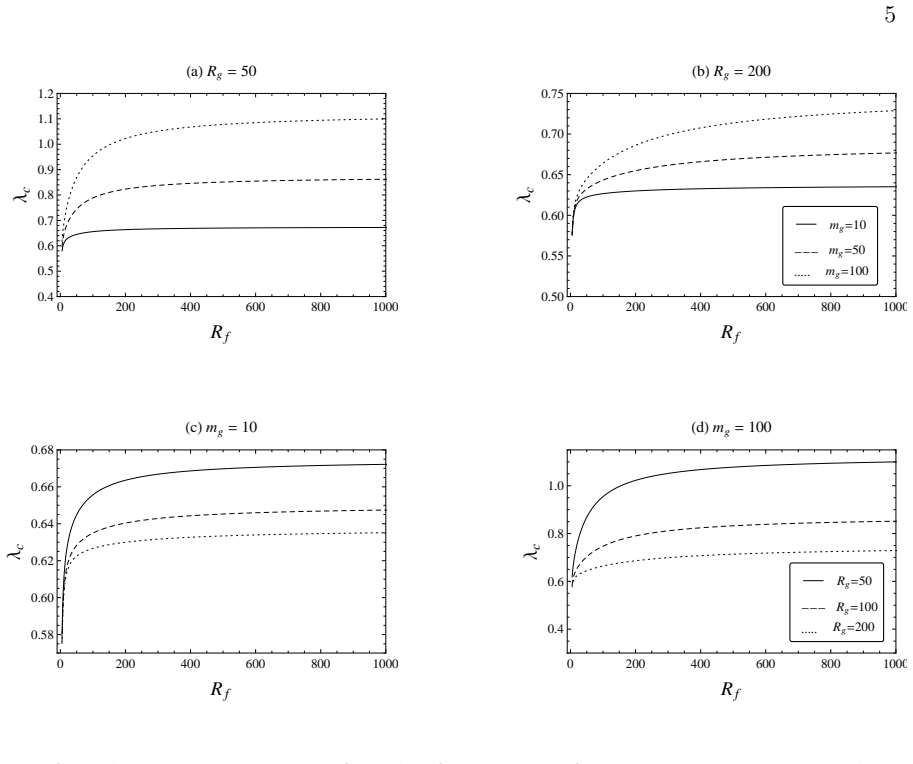
Summary. The paper revisits steady, spherically symmetric polytropic Bondi accretion with boundary conditions imposed at a finite outer radius r_f rather than at infinity. It derives the modified Bernoulli equation and the critical accretion parameter λ_c in dimensionless form (Eqs 12-19), showing numerically that λ_c approaches the classical Bondi value when r_f is 2-3 orders of magnitude larger than GM/c_sf^2 and that the kinetic energy at r_f is negligible for r_f > about 2 GM/c_sf^2. It then specializes to a Hernquist galaxy, adding the galactic gravitational potential and, in the optically thin Thomson-scattering approximation, the radiation force of the central source and the galaxy (Eqs 20-32). Parameter scans indicate that λ_c increases roughly linearly with the dimensionless galaxy linear density m_g/R_g and decreases with both Eddington-scaled luminosities l and l_g (Figs 3-6). The final section argues from Mach-number plots that the transonic critical point is a saddle.
Significance. If the central claims hold, the paper provides a simple, self-contained extension of Bondi's formula to finite, luminous galactic environments. The dimensionless formulation is clean, the algebra is internally consistent, and the recovery of the classical Bondi limit for large r_f is a reassuring external benchmark. The paper contains no fitted parameters and the parameter scans cover the relevant regime, so the qualitative scaling of λ_c with m_g/R_g, l, and l_g is useful for interpreting X-ray observations of elliptical galaxies. However, the dependence on l and l_g is only as robust as the inverse-square Thomson radiation force assumed in Eq. (29), and the paper's quantitative statements would benefit from a local stability analysis and numerical error estimates.
major comments (3)
- [§2, equation after Eq. (19), Fig. 1] The 'exact' solution λ_c1 is not actually defined. The displayed algebraic equation involves two unknowns, λ_c1 and R, and is only the sonic-point condition u=1; it is not accompanied by the critical-point condition dg/dR=0 that would determine R_c. Please state the complete system, for example R_c from dg/dR=0 with A = -1/R_f + λ_c1^2/(2 R_f^4), together with λ_c1^{2a} = g(R_c,λ_c1)/f(1), and describe the numerical solution method. Without this, the comparison in Fig. 1 that is used to justify neglecting V_f^2/2 is not reproducible.
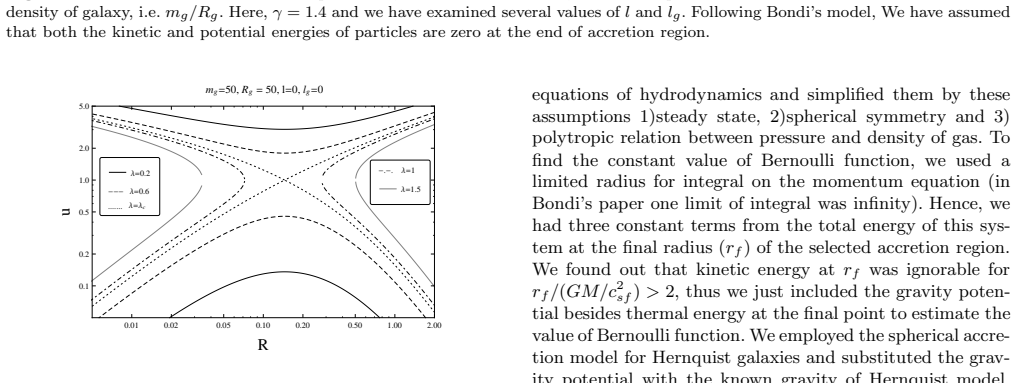
- [§5, Eq. (33), Figs 7-8] The conclusion that the transonic critical point is of saddle type is not established by the plotted Mach-number curves. Saddle, node, and center are distinguished by the eigenvalues of the linearized autonomous system at the critical point, or equivalently by the signs of the two slopes of the integral curves in the (R,u) plane. The observation that 'the slope of u's curve completely changes and becomes positive at R=R_c' is not a local stability analysis. Please either add the eigenvalue calculation or soften the claim to 'consistent with a saddle'.
- [§4, Eq. (29), Fig. 6, §6] The central claim that λ_c decreases monotonically with l and l_g is derived solely from the optically thin Thomson radiation force, where the luminosity enters through exact inverse-square terms and factorizes into (1-l) and (1-l_g). The manuscript lists absorption as future work in §6, but the abstract and summary present the dependence without this caveat. In a real galactic nucleus, dust absorption, line driving, or multiple scattering would modify both the magnitude and the radial dependence of f_rad, so the factorization in Eq. (32) and the linear trends in Fig. 6 are not guaranteed. Please state the optically thin, Thomson-dominated regime as a scope condition in the abstract and conclusion, and if possible give a rough column-density or dust-to-gas criterion for where the approximation breaks down.
minor comments (6)
- [Abstract] The abstract contains the typo 'kinitic' for 'kinetic', and the text has several other typographical errors ('accrection', 'centeral') that should be corrected.
- [Figure 2] The caption and text say Figure 2 shows R_c, but the rendered ordinate label appears to be λ_c; please verify that every panel in Figs 2 and 3 is labeled with the quantity actually plotted.
- [Eq. (25)] The symbol L is used both for the central source luminosity and for the total galaxy luminosity in the same expression; please use distinct notation, for example L_BH and L_gal.
- [§5] The statement that 'there are two solutions for u per each λ < λ_c' is imprecise, because for a fixed radius there may be zero, one, or two solutions depending on R; please rephrase as a statement about the topology of the solution curves.
- [Figs 1-6] The paper does not report numerical convergence or error bars for the parameter scans; please state the root-finding tolerance, grid resolution, or other numerical accuracy used to generate the figures.
- [Eqs. (15) and (17)] The critical-radius formulas are valid only for γ < 5/3; the paper treats γ = 1.4 and 1.6, but this domain of validity should be stated explicitly.
Circularity Check
No significant circularity: the paper derives λ_c from algebraic critical-point equations with all galaxy and luminosity parameters scanned as inputs, and the Bondi limit is a genuine consistency check.
full rationale
The derivation chain is self-contained. Starting from the steady, spherically symmetric polytropic Bondi problem, the paper integrates the momentum equation between a finite outer radius r_f and r, yielding the Bernoulli-type equation (5) and its dimensionless form (7). The critical accretion parameter λ_c is then obtained from the algebraic condition that f(u) and g(R) are simultaneously extremal, as stated in Eqs. (13)-(18). No parameter is fitted to reproduce the central claim. The galaxy mass ratio m_g=M_g/M_BH, scale-length ratio R_g=r_g/r_e, Eddington-scaled luminosities l and l_g, and outer radius R_f are all scanned inputs whose values are chosen by the authors, not inferred from the output. The result that λ_c approaches the classical Bondi value for large R_f is a limiting consistency check of the same equations: when r_f→∞ and the galaxy terms are absent, the function g(R) reduces to Bondi's, so the asymptotic values λ_c ≈ 0.625 for γ=1.4 and 0.367 for γ=1.6 are consequences of that limit, not an independently fitted endpoint. The radiation-force model of Eq. (29), f_rad = G M_BH [l/r^2 + (M_g/M_BH) l_g/(r+r_g)^2], is an explicit physical assumption (optically thin, Thomson scattering, constant luminosity) that determines the parameterization of l and l_g; it affects the astrophysical applicability of the result under absorption or multiple scattering, but it is not a circular step because the dependence of λ_c on l and l_g is derived from that assumed force law, not defined in terms of the conclusion. There is also no load-bearing self-citation: the cited galaxy-potential and radiation-density results (Hernquist 1990; Dehnen 1993; Tremaine et al. 1994) are external, and the paper does not invoke a uniqueness theorem or prior work by its own authors to force its choice of equations. Overall, the central derivations are independent of their conclusions, so the circularity score is 0.
Assumptions & free parameters
free parameters (6)
- γ (polytropic index) =
1.4 and 1.6 used in plots
- m_g = M_g/M_BH
- R_g = r_g/r_e
- l = L/L_Edd
- l_g = L_gal/L_Edd,g
- R_f = r_f/r_e
assumptions (5)
- domain assumption Steady state, spherical symmetry, and a polytropic equation of state p = K ρ^γ for the accreting gas.
- domain assumption The gas is optically thin and opacity is dominated by Thomson electron scattering.
- domain assumption The galaxy follows the Hernquist (1990) density and luminosity profile.
- domain assumption The central source luminosity L is constant with radius (Cassinelli & Castor 1973).
- domain assumption Gas self-gravity is neglected.
Cite this review
Pith. "Pith review of Bondi accretion in the finite luminous region of elliptical galaxies." pith.science (2026). https://pith.science/paper/D5A2S5JN
@misc{pith2026190807356,
  author       = {Pith},
  title        = {Pith review of: Bondi accretion in the finite luminous region of elliptical galaxies},
  year         = {2026},
  howpublished = {\url{https://pith.science/paper/D5A2S5JN}},
  note         = {Machine review of arXiv:1908.07356}
}
abstract
The classical Bondi model is adopted to study accretion onto the finite luminous region around the central massive black hole (MBH) in an elliptical galaxy. Unlike Bondi (1952), we define the boundary conditions at a certain finite radius ($r_f$) instead of at the infinity and examine the variation of solutions for a simple case. In the following, we consider the special case of an MBH at the center of a Hernquist galaxy and involve the gravity and luminosity of its own galaxy. Our results in the first part show that kinetic energy at the final radius is ignorable even for not so far away from the center. Moreover, the mass accretion rate will be approximately equal to its Bondi value if the final radius ($r_f$) becomes about 2-3 orders of magnitude larger than semi-Bondi radius, i.e. $GM/c_{sf}^2$ (where $M$ and $c_{sf}$ are the mass of the central object and the sound speed at $r_f$). In the second part, adding the two extra forces of gravity and radiation in the momentum equation let us know that the maximum possible of accretion rate increases with a greater characteristic linear density of galaxy and lower radiation. e.g.:
Figures

Figures from the paper (5 more)



Reference graph
Works this paper leans on
- [1]
- [2]
-
[3]
2012, MNRAS, 424, 728
Barai, P., Proga, D., & Nagamine, K. 2012, MNRAS, 424, 728
2012
-
[4]
Beckmann, R. S., Slyz, A., Devriendt, J. 2018, MNRAS 478, 995 Begelman M. C., 1978, MNRAS, 184, 53 Begelman M. C., 1979, MNRAS, 187, 237 Bondi H., 1952, MNRAS, 112, 195 Ciotti L., & Pellegrini S. 2017, ApJ, 848, 29 Ciotti L. & Pellegrini S., 2018, ApJ, 868, 91 Dehnen W., 1993, MNRAS, 265, 250 Edgar R., 2004, New Astronomy Reviews, 48, 843 Fukue J., 2001, ...
work page 2018
- [5]
-
[6]
Hernquist, L., 1990, ApJ, 356, 359 Kato S., Fukue J., Mineshige S., 2008, Black-Hole Accre- tion Disks Towards a New Paradigm. Kyoto Univ. Press, Kyoto Korol V., Ciotti L., & Pellegrini S. 2016, MNRAS, 460, 1188 Kaaz N., Antoni A., Ramirez-Ruiz E., 2019, ApJ, 876, 142
work page 1990
-
[7]
Loewenstein, M., Mushotzky, R. F., Angelini, L., Arnaud, K. A., Quataert, Eliot 2001, ApJ, 555, 21 Maraschi L., Reina C., & Treves A., 1974, A& A, 35, 389 Mathews W. G., & Guo F., 2012, ApJ, 754, 154
work page 2001
-
[8]
R., Rohanizadegan, M., Nulsen, P
McNamara, B. R., Rohanizadegan, M., Nulsen, P. E. J. 2011, ApJ, 727, 39
work page 2011
Show all 14 references
-
[9]
H., & Bogdanovi , T
Park, K.-H., Wise, J. H., & Bogdanovi , T. 2017, ApJ, 847, 70 c© 2019 RAS, MNRAS 000, 1– ?? 10 M. Samadi; S. Zanganeh; S. Abbassi
2017
-
[10]
2005, ApJ, 624, 155
Pellegrini, S. 2005, ApJ, 624, 155
2005
-
[11]
2010, ApJ, 717, 640 Ramirez-Velasquez J
Pellegrini, S. 2010, ApJ, 717, 640 Ramirez-Velasquez J. M., Sigalotti L., Gabbasov R., Cruz F., Klapp J., Contreras E., 2019, arXiv:1902.00360 Ruffert M.; Melia F., 1994, A& A, 228L, L29
2010 arXiv
-
[12]
R., Fabian, A
Russell, H. R., Fabian, A. C., McNamara, B., Broderick, A. E., 2015, MNRAS, 451, 588
2015
-
[13]
2007, MNRAS, 380, 877 Tremaine S., Richstone D
Sijacki, D., Springel, V., Di Matteo, T., & Hernquist, L. 2007, MNRAS, 380, 877 Tremaine S., Richstone D. O., Byun Y.-I., Dressler A., Faber S. M., Grillmair C., Kormendy J., Lauer T. R., 1994, AJ, 107, 634
2007
-
[14]
V., Yukita, M., Million, E
Wong, Ka-Wah, Irwin, J.A., Shcherbakov, R. V., Yukita, M., Million, E. T., Bregman, J. N. 2014, ApJ, 780, 9 Yalinewich A., Sari R., Generozov A., Stone N. C.; Metzger B. D., 2018, MNRAS, 479, 4778 c© 2019 RAS, MNRAS 000, 1– ??
2014
Reviewed August 14, 2026 · model on record in the stance chip above.
Discussion (0). Continue with ORCID to comment.