REVIEW 3 major objections 4 minor 19 references
Invariant hypersurfaces with linear prescribed mean curvature
T0 review · 3 major / 4 minor · reviewed 2026-08-14 · deepseek-v4-flash
Pith's one-line read All rotational Hλ-hypersurfaces in Euclidean space are classified by one parameter, λ.
desk verdict Useful classification paper with a real but localized bug in the explicit formulas; the rotational part is worth refereeing. read the letter →
The pith
A machine-rendered reading of the paper's core claim, the machinery that carries it, and where it could break.
The reading
What carries the argument
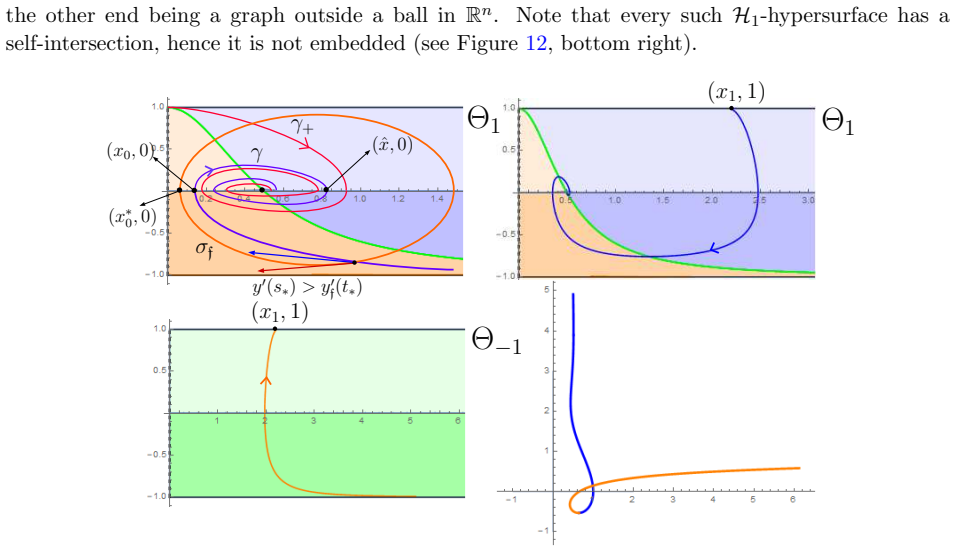
The central mechanism is the phase plane $\Theta_\varepsilon=(0,\infty)\times(-1,1)$ for the autonomous system $x'=y$, $y'=(n-1)(1-y^2)/x-n\varepsilon(y+\lambda)\sqrt{1-y^2}$, where $\varepsilon=\pm 1$ records whether the profile's height is increasing or decreasing. An orbit $\gamma(s)=(x(s),y(s))$ determines the profile curve $\alpha(s)=(x(s),z(s))$ of a rotational $H_\lambda$-hypersurface by integration; the unique equilibrium $e_0=((n-1)/(\lambda n),0)$ corresponds to the flat cylinder $C((n-1)/(\lambda n))$, and the curve $\Gamma_\varepsilon$ where $y'=0$ splits the plane into monotonicity regions. Lemma 3.2 gives the unique orbits ending at the boundary points $(0,\pm 1)$, which represent profiles meeting the axis orthogonally, while Proposition 4.2 uses Lemma 4.1 (no closed $H_\lambda$-hypersurfaces) to rule out the two axis-meeting orbits gluing into a sphere. The same ODE setup, integrated explicitly for the base curve of a cylindrical example, yields Theorem 2.1's parametrizations.
What would settle it
The decisive check is numerical: for $n=3$ and $\lambda=2$, integrate system (3.3) from the two boundary conditions $(0,1)$ and $(0,-1)$ and compare the $x$-coordinates where each orbit first crosses the axis $y=0$; if they coincide, the two profiles glue into a closed rotational $H_\lambda$-hypersurface, which Lemma 4.1 forbids. Any explicit closed $H_\lambda$-hypersurface in $\mathbb{R}^4$ would falsify the central classification.
Extended reading notes
Core claim
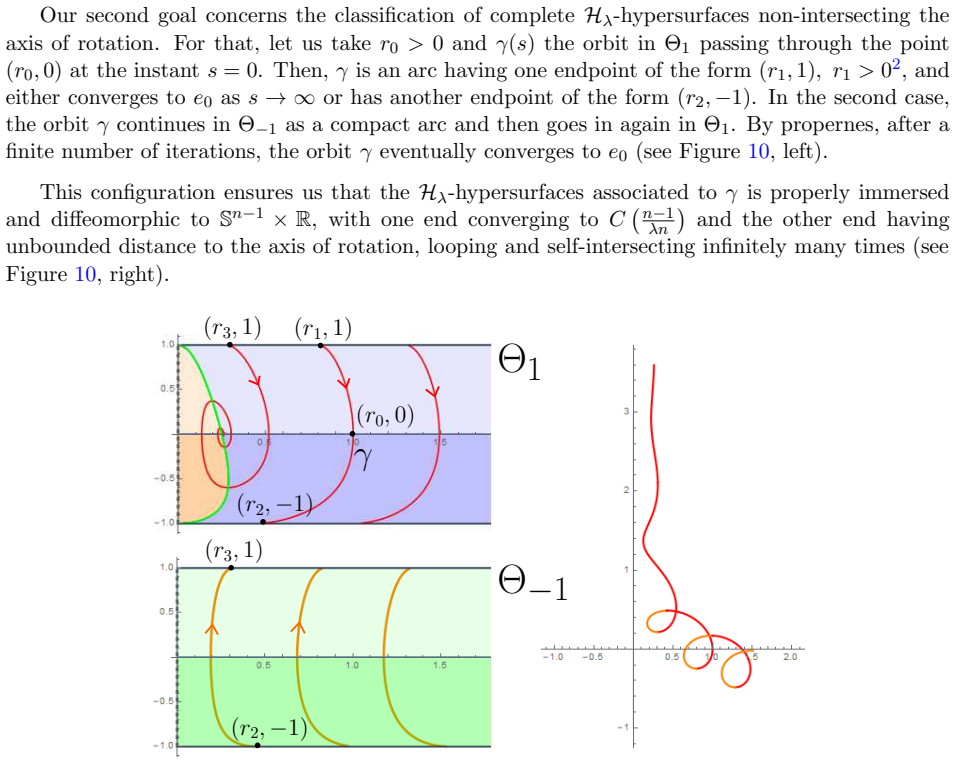
The paper's central discovery is that, in $\mathbb{R}^{n+1}$, an immersed oriented hypersurface whose mean curvature satisfies $H_\Sigma(p)=\langle\eta_p,v\rangle+\lambda$ can be fully described from the single number $\lambda$ once rotational symmetry is imposed. There are two geometric classes: profiles that meet the rotation axis orthogonally and profiles that do not. The axis-intersecting surface with upwards orientation is properly embedded, simply connected, and converges to the flat constant-mean-curvature cylinder $C((n-1)/(\lambda n))$ of radius $(n-1)/(\lambda n)$, intersecting it infinitely often when $\lambda>\sqrt{n-1}/2$, finitely often when $\lambda=\sqrt{n-1}/2$, and not at all when $\lambda<\sqrt{n-1}/2$. The downwards-oriented axis-intersecting surface is a horizontal hyperplane when $\lambda=1$, a strictly convex entire graph when $\lambda<1$, and a properly immersed surface with infinitely many self-intersections and unbounded distance to the axis when $\lambda>1$. Every non-axis-intersecting rotational example is properly immersed and diffeomorphic to $S^{n-1}\times\mathbb{R}$, with one end asymptotic to the same cylinder and the other end either self-intersecting at infinity ($\lambda>1$) or a graph outside a compact set ($\lambda\le 1$). The paper also classifies complete constant-curvature $H_\lambda$-hypersurfaces, which must be flat and cylindrical, by explicit parametrizations of their base curves.
Load-bearing premise
The classification depends on Lemma 4.1, which says no closed $H_\lambda$-hypersurface exists in any dimension; the paper gives the proof only for $n=2$ and asserts that it extends easily to higher dimensions, so a closed example for $n\ge3$ would collapse the uniqueness part of the classification.
Editorial extensions
If this is right
- In every dimension $n\ge2$, the rotational $H_\lambda$ landscape is a one-parameter family: the value of $\lambda$ alone decides whether an end is a properly embedded graph, a spiraling approach to a cylinder, or an unbounded self-intersecting immersion.
- The axis-nonintersecting examples force the topology $S^{n-1}\times\mathbb{R}$ onto every complete rotational $H_\lambda$-hypersurface that avoids the axis.
- Because $H_\lambda$-hypersurfaces are exactly the constant-weighted-mean-curvature surfaces for the density $e^{\langle x,v\rangle}$, the classified examples are explicit critical points of the weighted area-minus-volume functional.
- For $\lambda<1$, the downwards-oriented axis-intersecting surface is a strictly convex entire graph, so the classification yields entire graphical solutions of the prescribed-mean-curvature equation.
- For $\lambda=1$, the only downwards-oriented axis-intersecting rotational example is a horizontal hyperplane, isolating that parameter value as a rigidity point.
Reading between the lines
- The proof of uniqueness in Theorem 4.3 leans on Lemma 4.1, whose higher-dimensional case is only asserted; if a closed $H_\lambda$-hypersurface existed for $n\ge3$, the two axis-meeting orbits could glue into a sphere and the classification would need revision. This is an inference about the proof's reliance, not a claim made in the paper.
- The same end dichotomy—one end asymptotic to the cylinder, the other end a graph or an unbounded self-intersecting end—may be a property of the equation rather than of rotational symmetry, so non-rotational complete $H_\lambda$-hypersurfaces are worth testing for the same behavior.
- The explicit cylindrical parametrizations could seed numerical searches for periodic orbits of the rotational system in higher dimensions; a closed solution would appear as a periodic orbit gluing across the boundary, which Lemma 4.1 says cannot exist.
- For $\lambda=1$, the horizontal hyperplane solution invites a Bernstein-type question: whether every complete embedded $H_1$-hypersurface that is a graph over a horizontal hyperplane must itself be a hyperplane.
Signed reviews
Editorial analysis
A structured set of objections, weighed in public.
Referee Report
Summary. The paper studies oriented hypersurfaces Σ^n in R^{n+1} whose mean curvature satisfies H_Σ(p)=⟨η_p,v⟩+λ, the class of H_λ-hypersurfaces, and connects them to weighted mean curvature, the volume-preserving mean curvature flow, and translating solitons. Section 2 treats complete flat (cylindrical) H_λ-hypersurfaces and claims an explicit classification of their base curves by solving system (2.2). Section 3 sets up the phase-plane analysis for rotational H_λ-hypersurfaces, following [BGM2], and Section 4 gives the main classification: Theorem 4.3 for rotational hypersurfaces intersecting the rotation axis and Theorem 4.4 for those not intersecting it. The claimed classification is that Σ_+ is always properly embedded, simply connected, and asymptotic to the cylinder C((n−1)/(λn)), while Σ_− is a horizontal hyperplane for λ=1, an entire strictly convex graph for λ<1, and a properly immersed surface with infinitely many self-intersections for λ>1; every non-axis-intersecting example is properly immersed, diffeomorphic to S^{n−1}×R, with one end asymptotic to the cylinder and the other end either self-intersecting at infinity or a graph outside a compact set.
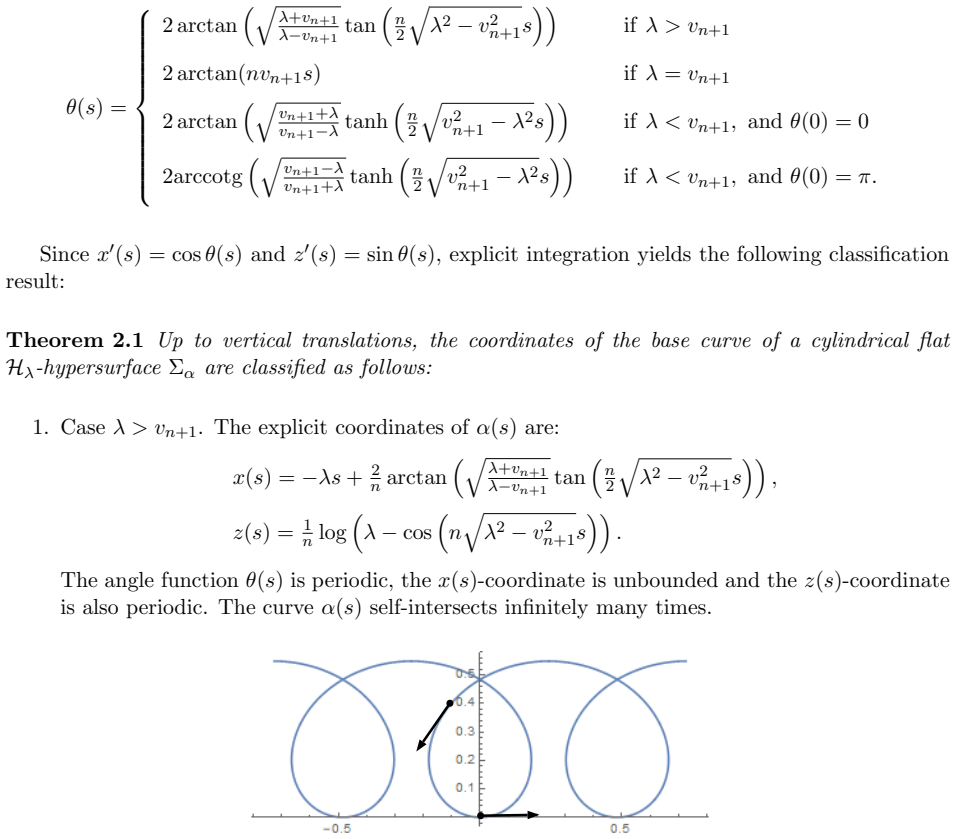
Significance. If the results are correct, the rotational classification is a substantial contribution: it extends López's n=2 classification to all dimensions, uses a coherent phase-plane framework, and gives falsifiable geometric conclusions about embeddedness, self-intersections, and asymptotics. The paper also correctly identifies the relation between H_λ-hypersurfaces, weighted mean curvature, and the geometric flow (1.4). The overall architecture of Section 4 is coherent, and the rotational classification does not appear to depend on the explicit formulas of Theorem 2.1. However, Theorem 2.1, which is one of the two advertised main results, is false as stated for general v_{n+1}: the printed parametrizations do not solve system (2.2) unless normalization conditions that are not made are imposed. The paper therefore cannot be accepted in its current form, but the defects are localized and fixable.
major comments (3)
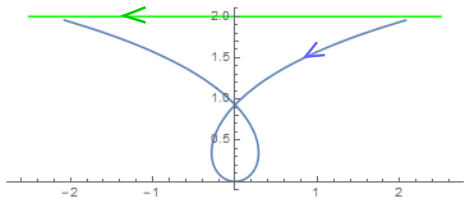
- [Section 2, Theorem 2.1, cases λ>v_{n+1} and λ=v_{n+1}] The printed explicit coordinates do not satisfy system (2.2) for general v_{n+1}. In the case λ>v_{n+1}, differentiating the displayed x(s) gives x'(0)=v_{n+1}, whereas (2.2) together with θ(0)=0 forces x'(0)=cos 0=1. The correct integration is x(s)=(θ(s)/n−λs)/v_{n+1}; for the λ=v_{n+1} case the factor n/2 in front of arctan(ns) should be 2/(n v_{n+1}) with argument n v_{n+1}s, and the z(s) formula likewise carries a missing factor 1/v_{n+1}. These are not cosmetic issues: Theorem 2.1 is the paper's advertised classification of cylindrical flat H_λ-hypersurfaces, and as printed it is false for v_{n+1}≠1 (and, in the λ=v case, even for v_{n+1}=1 unless n=2).
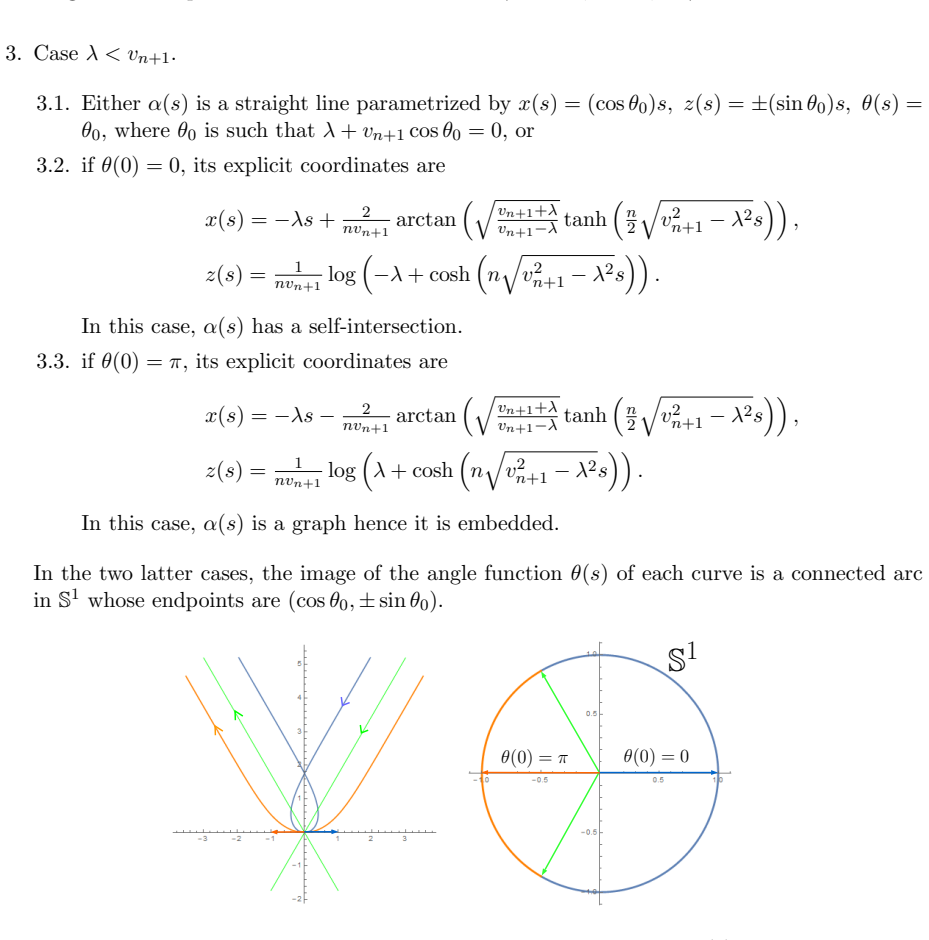
- [Section 2, Theorem 2.1, case λ<v_{n+1}, θ(0)=π] The displayed x(s) in this case also fails the initial condition: direct differentiation gives x'(0)=−λ−(v_{n+1}+λ)/v_{n+1}, which is not the required cos π=−1. The root inside the arctan should be √((v_{n+1}−λ)/(v_{n+1}+λ)), matching the θ(s)=2 arccot(...) formula displayed before the theorem, not the reciprocal √((v_{n+1}+λ)/(v_{n+1}−λ)) that is printed. Thus this case of Theorem 2.1 is incorrect as stated.
- [Lemma 4.1 and Proposition 4.2(3)] Lemma 4.1 asserts that no closed H_λ-hypersurface exists in any dimension, but the text only cites the n=2 proof in [Lop] and says the proof 'can be easily extended'. This lemma is load-bearing: Proposition 4.2(3) rules out the configuration x_+=x_− by gluing γ_+ and γ_− into a closed rotational sphere and invoking Lemma 4.1. The authors should supply the n-dimensional proof in the paper or give a reference that covers all dimensions. A short proof is available: from the first variation formula and the divergence theorem one gets ∫_Σ H_Σ⟨η,v⟩=0 and ∫_Σ⟨η,v⟩=0; since H_Σ=⟨η,v⟩+λ, this yields ∫_Σ⟨η,v⟩^2=0, so v is tangent to Σ, and the complete lines p+tv would then lie in the compact hypersurface, a contradiction.
minor comments (4)
- [Section 4, page 13, paragraph before Figure 8] The text says 'Σ_+ is a strictly convex graph that converges to C(n−1/n)'; in the λ>1 subsection this should be C((n−1)/(λn)), and the notation C(r) should be defined at its first use.
- [Throughout Section 4] The expressions 'λ>√n−1/2' and 'λ<√n−1/2' should be typeset as λ>√((n−1)/2) and λ<√((n−1)/2), since the current notation is ambiguous.
- [Section 2, displayed θ-formulas] The word 'arccotg' should be 'arccot' or 'arccotangent' for consistency with the other formulas.
- [Abstract and introduction] The abstract says the paper obtains 'explicit parametrizations of constant curvature hypersurfaces'; the body treats flat cylindrical H_λ-hypersurfaces. The wording should be aligned to avoid suggesting a classification of all constant-mean-curvature hypersurfaces.
Circularity Check
No circularity: the rotational and cylindrical classifications are derived from the ODE and prior independent results; noted gaps are missing proofs/formula defects, not self-reference.
full rationale
The claimed classification is not circular. Hλ-hypersurfaces are defined by equation (1.2), and the cylindrical and rotational reductions are obtained by substituting the geometric ansatz into the standard mean-curvature formula: equations (2.2) and (3.1)-(3.3) are derived from the geometry, not assumed. The subsequent classifications are phase-plane consequences: the equilibrium and eigenvalues are computed from the linearization (4.1), the monotonicity regions come from the nullcline Γε in (3.4), and the orbit-endpoint assertions rest on Lemma 3.2, a general existence/uniqueness result taken from [BGM2] and ultimately supported by the Dirichlet problem in [Mar], rather than on the Hλ classification being proved. Lemma 4.1 cites an external n=2 theorem [Lop] and states that the proof extends; while the n>2 argument is not written out, and Theorem 2.1 contains an apparent normalization defect in the printed formulas, these are correctness and completeness concerns, not cases where a conclusion is manufactured from its own input. No fitted parameter is relabeled as a prediction, and no defined quantity collapses into the target result.
Assumptions & free parameters
assumptions (6)
- standard math Complete hypersurfaces of constant curvature in R^{n+1} are flat, hence cylindrical over a plane curve (Liebmann, Hilbert, Hartman-Nirenberg).
- domain assumption For a rotational Hλ-hypersurface, the density vector v must be parallel to the rotation axis ([Lop, Proposition 4.3]).
- domain assumption Existence and uniqueness of phase-plane orbits with endpoints (0, ±1) on the boundary (Lemma 3.2, from [BGM2, Corollary 2.4] and [Mar, Corollary 1]).
- domain assumption There are no closed Hλ-hypersurfaces (Lemma 4.1); for n = 2 this is [Lop], and for n > 2 the paper asserts the proof extends without giving it.
- standard math Standard stable-manifold and linearization theory for planar autonomous systems.
- standard math Mean curvature comparison principle for graphs.
Cite this review
Pith. "Pith review of Invariant hypersurfaces with linear prescribed mean curvature." pith.science (2026). https://pith.science/paper/HXGWGEUO
@misc{pith2026190807378,
  author       = {Pith},
  title        = {Pith review of: Invariant hypersurfaces with linear prescribed mean curvature},
  year         = {2026},
  howpublished = {\url{https://pith.science/paper/HXGWGEUO}},
  note         = {Machine review of arXiv:1908.07378}
}
abstract
Our aim is to study invariant hypersurfaces immersed in the Euclidean space $\mathbb{R}^{n+1}$, whose mean curvature is given as a linear function in the unit sphere $\mathbb{S}^n$ depending on its Gauss map. These hypersurfaces are closely related with the theory of manifolds with density, since their weighted mean curvature in the sense of Gromov is constant. In this paper we obtain explicit parametrizations of constant curvature hypersurfaces, and also give a classification of rotationally invariant hypersurfaces.
Figures
Figures from the paper (11 more)





Reference graph
Works this paper leans on
-
[1]
Alexandrov, Uniqueness theorems for surfaces in the large, I, Vestnik Leningrad Univ
A.D. Alexandrov, Uniqueness theorems for surfaces in the large, I, Vestnik Leningrad Univ. 11 (1956), 5--17. (English translation: Amer. Math. Soc. Transl. 21 (1962), 341--354)
work page 1956
- [2]
-
[3]
Bueno, The Björling problem for prescribed mean curvature surfaces in 3 , Ann
A. Bueno, The Björling problem for prescribed mean curvature surfaces in 3 , Ann. Glob. Ann. Geom. 56 2019, 87--96
work page 2019
-
[4]
Bueno, Half-space theorems for properly immersed surfaces in 3 with prescribed mean curvature, Ann
A. Bueno, Half-space theorems for properly immersed surfaces in 3 with prescribed mean curvature, Ann. Mat. Pur. Appl. DOI: 10.1007/s10231-019-00886-1
-
[5]
The global geometry of surfaces with prescribed mean curvature in $\mathbb{R}^3$
A. Bueno, J.A. Gálvez, P. Mira, The global geometry of surfaces with prescribed mean curvature in ^3 , preprint. arxiv:1802.08146
-
[6]
Rotational hypersurfaces of prescribed mean curvature
A. Bueno, J.A. Gálvez, P. Mira, Rotational hypersurfaces of prescribed mean curvature, preprint. arxiv:1902.09405
work page Pith review arXiv 1902
-
[7]
E.B. Christoffel, Über die Bestimmung der Gestalt einer krummen Oberfläche durch lokale Messungen auf derselben. J. Reine Angew. Math. 64 (1865), 193--209
-
[8]
J. Clutterbuck, O. Schnurer, F. Schulze, Stability of translating solutions to mean curvature flow, Calc. Var. Partial Diff. Equations 29 (2007), no. 3, 281--293
work page 2007
Show all 19 references
-
[9]
Gromov, Isoperimetry of waists and concentration of maps, Geom
M. Gromov, Isoperimetry of waists and concentration of maps, Geom. Funct. Anal. 13 (2003), 178--215
2003
-
[10]
B. Guan, P. Guan, Convex hypersurfaces of prescribed curvatures, Ann. Math. 156 (2002), 655--673
2002
-
[11]
Huisken, The volume preserving mean curvature flow, J
G. Huisken, The volume preserving mean curvature flow, J. Reine Angew. Math. 382 (1987), 35--48
1987
-
[12]
Huisken, C
G. Huisken, C. Sinestrari, Convexity estimates for mean curvature flow and singularities of mean convex surfaces, Acta Math. , 183 (1993), no. 1, 45--70
1993
-
[13]
Ilmanen, Elliptic regularization and partial regularity for motion by mean curvature, Mem
T. Ilmanen, Elliptic regularization and partial regularity for motion by mean curvature, Mem. Amer. Math. Soc. 108 (1994)
1994
-
[14]
López, Invariant surfaces in Euclidean space with a log-linear density, Adv
R. López, Invariant surfaces in Euclidean space with a log-linear density, Adv. Math. 339 (2018), 285--309
2018
-
[15]
Marquardt, Remark on the anisotropic prescribed mean curvature equation on arbitrary domains, Math
T. Marquardt, Remark on the anisotropic prescribed mean curvature equation on arbitrary domains, Math. Z. 264 (2010), 507--511
2010
-
[16]
Martín, A
F. Martín, A. Savas-Halilaj, K. Smoczyk, On the topology of translating solitons of the mean curvature flow, Calc. Var. Partial Diff. Equations 54 (2015), no. 3, 2853-2882
2015
-
[17]
Minkowski, Volumen und Oberfläche, Math
H. Minkowski, Volumen und Oberfläche, Math. Ann. 57 (1903), 447--495
1903
-
[18]
Pogorelov, Extension of a general uniqueness theorem of A.D
A.V. Pogorelov, Extension of a general uniqueness theorem of A.D. Aleksandrov to the case of nonanalytic surfaces (in Russian), Doklady Akad. Nauk SSSR 62 (1948), 297--299
1948
-
[19]
Spruck, L
J. Spruck, L. Xiao, Complete translating solitons to the mean curvature flow in ^3 with nonnegative mean curvature, Amer. J. Math. (2017), 1--23, arXiv:1703.01003
2017 arXiv
Reviewed August 14, 2026 · model on record in the stance chip above.
Discussion (0). Continue with ORCID to comment.