REVIEW 3 major objections 5 minor 1 cited by
Quasi-two-dimensional Fermi surfaces and unitary spin-triplet pairing in the heavy fermion superconductor UTe$_2$
T0 review · 3 major / 5 minor · reviewed 2026-08-14 · deepseek-v4-flash
Pith's one-line read UTe2's superconducting order parameter is a unitary spin-triplet state in the strong spin-orbit coupling limit, with point nodes on one of its two quasi-two-dimensional Fermi surface cylinders, excluding the previously proposed…
desk verdict A sharp group-theory argument for unitary strong-SOC triplet pairing in UTe2, built on a calculated Fermi surface that still needs dHvA confirmation; deserves refereeing. read the letter →
The pith
A machine-rendered reading of the paper's core claim, the machinery that carries it, and where it could break.
The reading
What carries the argument
The load-bearing mechanism is the Fermi surface topology obtained from DFT+U (U = 7 eV) and corroborated by DFT+DMFT: two quasi-two-dimensional cylinders, one electron-like and one hole-like, weakly dispersive along kz and nested along kx. The argument then runs through the irreducible representations of the point group D2h for odd-parity pairing. In the weak spin-orbit coupling limit every representation gives line nodes on such cylinders; in the strong spin-orbit coupling limit only B2u and B3u give point nodes, and because D2h is one-dimensional, every strong-SOC representation is unitary. This representation count is what converts the Fermi surface shape into a pairing-symmetry conclusion.
What would settle it
A de Haas-van Alphen measurement that resolves the Fermi surface and finds a third cylinder or significant kz dispersion, or a thermal-transport measurement that resolves line nodes rather than point nodes, would falsify the central claim.
Extended reading notes
Core claim
On its own terms, the paper's central discovery is that the Fermi surface of UTe2 is quasi-two-dimensional and consists of two separate cylinders, an electron cylinder and a heavier hole cylinder, which are nested along the kx-direction in a way reminiscent of UGe2. Given that topology, the paper proves by group theory that all weak spin-orbit coupling odd-parity representations yield line nodes, whereas the strong spin-orbit coupling representations B2u and B3u yield point nodes on one of the cylinders. The paper therefore concludes that the observed point nodes in thermal conductivity, together with the quasi-two-dimensional Fermi surface, demand a unitary spin-triplet state of either B2u or B3u symmetry, with the nodes likely on the heavier hole cylinder along kx. It also concludes that the previously proposed non-unitary weak spin-orbit coupling d-vector (1,i,0) is excluded, since it would produce a half-gapped state with line nodes that is inconsistent with the measurements.
Load-bearing premise
The central claim rests on the assumption that the real Fermi surface of UTe2 really is the two quasi-two-dimensional cylinders the calculation finds, and that the superconducting pairs are governed by strong spin-orbit coupling; if either is false, the point-node classification no longer follows.
Editorial extensions
If this is right
- UTe2's zero-field superconducting state preserves time-reversal symmetry, so a non-unitary, half-gapped interpretation of the data is ruled out.
- The gap has point nodes along the kx direction, most likely on the heavier hole Fermi surface, which is consistent with the observed a-axis anisotropy in thermal conductivity.
- The Fermi surface nesting along kx, analogous to UGe2, supports magnetic-fluctuation-mediated spin-triplet pairing as the likely pairing mechanism.
- The quasi-two-dimensional Fermi surfaces predict a characteristic de Haas-van Alphen signal: oscillation frequencies that rise monotonically and diverge as the field rotates away from the c-axis.
- The frustrated two-leg ladder magnetism provides a natural route to the absence of long-range order and the observed magnetic anisotropy.
Reading between the lines
- If the unitary B3u state is confirmed, the field-reentrant superconducting phases of UTe2 would have to arise from a field-induced change of the Fermi surface or of the pairing channel rather than from the zero-field state breaking time-reversal symmetry.
- A measurement that locates which cylinder carries the nodes, for instance by field-angle-resolved thermal conductivity or quasiparticle interference, would single out B2u (electron cylinder) from B3u (hole cylinder).
- The strong-SOC unitary scenario implies that the odd-parity pairing is not equal-spin pairing, so future Knight-shift or spin-polarization measurements should find no spontaneous internal field in the superconducting state; this is a cleaner test than the node geometry itself.
Signed reviews
Editorial analysis
A structured set of objections, weighed in public.
Referee Report
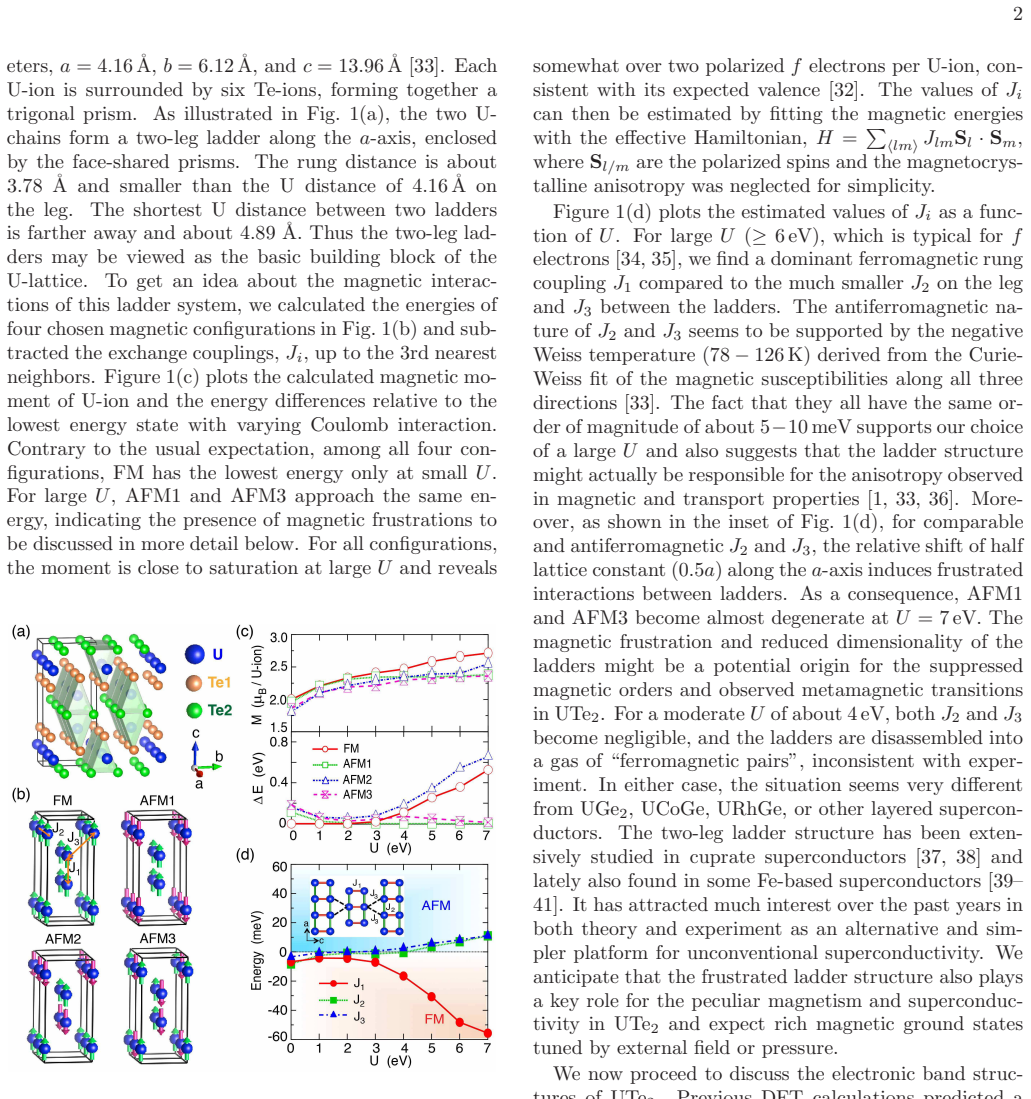
Summary. This paper reports DFT+U and DFT+DMFT calculations of the newly discovered heavy fermion superconductor UTe2, finding that strong electronic correlations close a semiconducting gap and yield a metallic state with two quasi-two-dimensional Fermi surface cylinders, one electron-like and one heavier hole-like. The authors perform a group-theory classification of odd-parity pairing states for the D2h point group, arguing that weak-SOC states produce line nodes on a quasi-2D Fermi surface, inconsistent with the experimentally suggested point nodes, whereas strong-SOC B2u and B3u states can have point nodes. They conclude that the calculated Fermi surfaces demand a unitary spin-triplet strong-SOC state, presumably B3u with point nodes on the heavier hole sheet along the kx-direction, in agreement with thermal conductivity data. The paper also discusses magnetic frustration arising from a two-leg ladder structure and provides predicted de Haas-van Alphen frequencies as a falsifiable test.
Significance. If the central claim holds, the paper would establish that the superconducting order parameter of UTe2 is a unitary spin-triplet state in the strong-spin-orbit-coupling limit, preserving time-reversal symmetry, and would explain the observed point-node thermal conductivity. The paper is timely and significant: it provides a concrete, falsifiable prediction (the dHvA frequencies of the two quasi-2D cylinders) and a rigorous group-theory classification that is internally sound given the calculated Fermi surface. The exclusion of weak-SOC non-unitary states from line nodes is robust for any quasi-2D Fermi surface. However, the entire nodal classification is conditional on the DFT+U Fermi surface at U=7 eV, which has not been measured, so the central claim is a model-consistency argument rather than an empirical determination.
major comments (3)
- [Fig. 4(a) and the paragraph after Table I] The central conclusion that the Fermi surfaces 'demand' a B2u or B3u state rests entirely on the DFT+U (U=7 eV) Fermi surface topology. Since U=0 gives a semiconducting gap and the paper does not show how the Fermi surface evolves with U, the robustness of the two quasi-2D cylinders is not established. Please provide a U-dependence scan (for example U=6 and 8 eV) of the Fermi surface and of the nodal projections in Table I, or explicitly state that the pairing classification is conditional on this calculated Fermi surface and must be verified by dHvA experiments.
- [Table I, B2u and B3u rows] The point-node classification in Table I is a projection onto the calculated Fermi surfaces: for B3u the d-vector vanishes on the kx-axis (ky=kz=0), and for B2u it vanishes on the ky-axis (kx=kz=0). Point nodes therefore occur only if a Fermi-surface sheet intersects the corresponding axis. The paper assigns the B3u nodes to the heavier hole sheet 'presumably', but it does not show explicitly which calculated sheets intersect which axis, nor how sensitive this intersection pattern is to the Fermi-surface cross-section. If the actual Fermi surface differs, the point nodes could move to the other sheet, disappear, or become line nodes, which would weaken both the exclusion of the weak-SOC state and the claimed agreement with thermal conductivity. Please show the intersections explicitly and quantify the sensitivity.
- [Concluding paragraph] The statement that the previously proposed non-unitary pairing is 'excluded' overstates the logical status of the argument. The exclusion of weak-SOC states is valid only under the assumption that the Fermi surface is quasi-two-dimensional, and the further selection of B2u or B3u over the fully gapped Au and B1u states relies on the experimental evidence for point nodes. If the real Fermi surface lacks the assumed axial intersections, the compatibility argument fails. The manuscript should present the conclusion as a conditional consistency argument tied to the calculated Fermi surface, which is itself a prediction to be tested.
minor comments (5)
- [Table I] There is a typo in the table header: 'basis fucntion' should read 'basis function'.
- [Fig. 4(d) caption] The caption says 'point nodes for B2u and B3u representations on the calculated electron and hole Fermi surfaces, respectively', but the text says the point nodes are 'presumably on the heavier hole Fermi surface (the B3u representation)'. Please clarify which sheet hosts the nodes of each representation, and whether the assignment is determined by the computed Fermi-surface geometry or by the thermal-conductivity comparison.
- [Magnetic exchange couplings, Fig. 1(d)] The exchange couplings Ji are fitted with a Heisenberg model that neglects magnetocrystalline anisotropy; the statement that the ladder structure is responsible for the observed magnetic and transport anisotropy is therefore not directly supported and should be phrased more cautiously.
- [DMFT methods] The manuscript states the DMFT parameters (U=8 eV, J=0.6 eV) but does not specify the impurity solver details, the number of Matsubara frequencies, or the analytic continuation procedure beyond 'continuous-time quantum Monte Carlo'. Please add these computational details for reproducibility.
- [Abstract and title] There is a typographical artifact 'spin-tr iplet' in the title and abstract; please correct it to 'spin-triplet'.
Circularity Check
No significant circularity: the pairing-state classification follows from standard group theory applied to an independently calculated Fermi surface, and the thermal-conductivity comparison is model selection, not a fitted input.
full rationale
The derivation chain is self-contained and non-circular. The Fermi surface is obtained from first-principles DFT+U and DMFT calculations with a Hubbard U chosen from the standard range for uranium f-electron systems and cross-checked against the measured Weiss temperature; it is not adjusted to reproduce the superconducting gap structure. The nodal classification in Table I is a standard D2h group-theory enumeration of odd-parity pairing states, with the nodal properties obtained by projecting the basis functions onto the calculated Fermi surfaces. No parameter is fitted to the thermal-conductivity data: the experimental point-node/axis anisotropy is used only to select between the allowed B2u and B3u candidates, which is legitimate model selection rather than a circular prediction. The exclusion of the weak-SOC non-unitary state follows from its predicted line nodes versus the experimentally implied point nodes, an independent logical constraint. The only self-citation (Ref. 21) is a general remark that Fermi-surface topology is important for pairing and is not load-bearing. The central claim is conditional on the calculated quasi-2D Fermi surface, and the paper explicitly proposes future dHvA measurements as a test; this makes the claim empirically fragile if the calculated Fermi surface is wrong, but fragility is not circularity. No step in the paper reduces by construction to its own input or renames a fitted quantity as a prediction.
Assumptions & free parameters
free parameters (4)
- Hubbard U (DFT+U) =
7 eV
- Hubbard U (DMFT) =
8 eV
- Hund's coupling J (DMFT) =
0.6 eV
- Exchange couplings J1, J2, J3 =
J1 dominant FM, J2/J3 about 5-10 meV AFM at large U
assumptions (4)
- domain assumption Strong spin-orbit-coupling limit for the pairing classification.
- domain assumption The superconducting order parameter belongs to a single irreducible representation of D2h.
- domain assumption The Heisenberg exchange model with couplings up to 3rd nearest neighbors (J1, J2, J3) captures the magnetic interactions, with magnetocrystalline anisotropy neglected.
- standard math Nominal double counting in DFT+DMFT.
Cite this review
Pith. "Pith review of Quasi-two-dimensional Fermi surfaces and unitary spin-triplet pairing in the heavy fermion superconductor UTe$_2$." pith.science (2026). https://pith.science/paper/KHJKBGEG
@misc{pith2026190807396,
  author       = {Pith},
  title        = {Pith review of: Quasi-two-dimensional Fermi surfaces and unitary spin-triplet pairing in the heavy fermion superconductor UTe$_2$},
  year         = {2026},
  howpublished = {\url{https://pith.science/paper/KHJKBGEG}},
  note         = {Machine review of arXiv:1908.07396}
}
abstract
We report first-principles and strongly-correlated calculations of the newly-discovered heavy fermion superconductor UTe$_2$. Our analyses reveal three key aspects of its magnetic, electronic, and superconducting properties, that include: (1) a two-leg ladder-type structure with strong magnetic frustrations, which might explain the absence of long-range orders and the observed magnetic and transport anisotropy; (2) quasi-two-dimensional Fermi surfaces composed of two separate electron and hole cylinders with similar nesting properties as in UGe$_2$, which may potentially promote magnetic fluctuations and help to enhance the spin-triplet pairing; (3) a unitary spin-triplet pairing state of strong spin-orbit coupling at zero field, with point nodes presumably on the heavier hole Fermi surface along the $k_x$-direction, in contrast to the previous belief of non-unitary pairing. Our proposed scenario is in excellent agreement with latest thermal conductivity measurement and provides a basis for understanding the peculiar magnetic and superconducting properties of UTe$_2$.
Figures


Forward citations
Cited by 1 Pith paper
-
Insulator-metal transition and topological superconductivity in UTe2 from a first-principles calculation
The authors show that a GGA+U calculation with U above 1 eV turns insulating DFT UTe2 metallic, and the resulting Fermi surfaces imply time-reversal-invariant topological superconductivity with Majorana surface states...
Reference graph
Works this paper leans on
-
[1]
S. Ran, C. Eckberg, Q. Ding, Y. Furukawa, T. Metz, S. R. Saha, I. Liu, M. Zic, H. Kim, J. Paglione, and N. P. Butch, Science 365, 684 (2019)
work page 2019
-
[2]
D. Aoki, A. Nakamura, F. Honda, D. Li, Y. Homma, Y. Shimizu, Y. J. Sato, G. Knebel, J. Brison, A. Pourret, D. Braithwaite, G. Lapertot, Q. Niu, M. Vali˘ ska, H. Harima, and J. Flouquet, J. Phys. Soc. Jpn. 88, 043702 (2019)
work page 2019
- [3]
-
[4]
I. Sheikin, A. Huxley, D. Braithwaite, J. P. Brison, S. Watanabe, K. Miyake, and J. Flouquet, Phys. Rev. B 64 220503(R) (2001)
work page 2001
-
[5]
D. Aoki, T. D. Matsuda, V. Taufour, E. Hassinger, G. Knebel, and J. Flouquet, J. Phys. Soc. Jpn. 78, 113709 (2009)
work page 2009
- [6]
-
[7]
D. Aoki, K. Ishida, and J. Flouquet, J. Phys. Soc. Jpn. 88, 022001 (2019)
2019
-
[8]
S. S. Saxena, P. Agarwal, K. Ahilan, F. M. Grosche, R. K. W. Haselwimmer, M. J. Steiner, E. Pugh, I. R. Walker, S. R. Julian, P. Monthoux, G. G. Lonzarich, A. Huxley, I. Sheikin, D. Braithwaite, and J. Flouquet, Nature 406, 587 (2000)
work page 2000
Show all 54 references
-
[9]
D. Aoki, A. Huxley, E. Ressouche, D. Braithwaite, J. Flouquet, J. Brison, E. Lhotel, and C. Paulsen, Nature 413, 613 (2001)
2001
-
[10]
N. T. Huy, A. Gasparini, D. E. de Nijs, Y. Huang, J. C. P. Klaasse, T. Gortenmulder, A. de Visser, A. Hamann, T. G¨ orlach, and H. v. L¨ ohneysen, Phys. Rev. Lett. 99, 067006 (2007)
2007
-
[11]
T. Metz, S. Bae, S. Ran, I. Liu, Y. S. Eo, W. T. Fuhrman, D. F. Agterberg, S. Anlage, N. P. Butch, and J. Paglione, arXiv:1908.01069 (2019)
2019 arXiv
-
[12]
Knafo, M
W. Knafo, M. Vali˘ ska, D. Braithwaite, G. Lapertot, G. Knebel, A. Pourret, J. Brison, J. Flouquet, and D. Aoki, J. Phys. Soc. Jpn. 88, 063705 (2019)
2019
-
[13]
Miyake, Y
A. Miyake, Y. Shimizu, Y. J. Sato, D. Li, A. Nakamura, Y. Homma, F. Honda, J. Flouquet, M. Tokunaga, and D. Aoki, J. Phys. Soc. Jpn. 88, 063706 (2019)
2019
-
[14]
Knebel, W
G. Knebel, W. Knafo, A. Pourret, Q. Niu, M. Vali˘ ska, D. Braithwaite, G. Lapertot, M. Nardone, A. Zitouni, S. Mishra, I. Sheikin, G. Seyfarth, J. Brison, D. Aoki, and J. Flouquet, J. Phys. Soc. Jpn. 88, 063707 (2019)
2019
-
[15]
S. Ran, I. Liu, Y. S. Eo, D. J. Campbell, P. Neves, W. T. Fuhrman, S. R. Saha, C. Eckberg, H. Kim, J. Paglione, D. Graf, J. Singleton, and N. P. Butch, arXiv:1905.04343 (2019)
2019 arXiv
-
[16]
Q. Niu, G. Knebel, D. Braithwaite, D. Aoki, G. Lapertot, G. Seyfarth, J-P. Brison, J. Flouquet, and A. Pourret, arXiv:1907.11118 (2019)
2019 arXiv
-
[17]
Imagjo, Y
S. Imagjo, Y. Kohama, A. Miyake, C. Dong, M. Toku- naga, J. Flouquet, K. Kindo, and D. Aoki, J. Phys. Soc. Jpn. 88, 083705 (2019)
2019
-
[18]
Kozii, J
V. Kozii, J. W. F. Venderbos, and L. Fu, Sci. Adv. 2, e1601835 (2016)
2016
-
[19]
J. D. Sau and S. Tewari, Phys. Rev. B 86, 104509 (2012)
2012
-
[20]
Bastien, A
G. Bastien, A. Gourgout, D. Aoki, A. Pourret, I. Sheikin , G. Seyfarth, J. Flouquet, and G. Knebel, Phys. Rev. Lett. 117, 206401 (2016)
2016
-
[21]
Y. Li, M. Liu, Z. Fu, X. Chen, F. Yang, and Y.-F. Yang, Phys. Rev. Lett. 120, 217001 (2018)
2018
-
[22]
Blaha, K
P. Blaha, K. Schwarz, G. Madsen, D. Kvasnicka, and J. Luitz, WIEN2K, An Augmented Plane Wave+Local Or- bitals Program for Calculating Crystal Properties (Karl- heinz Schwarz, Techn. Universit¨ at Wien, Austria, 2014)
2014
-
[23]
J. P. Perdew, K. Burke, and M. Ernzerhof, Phys. Rev. Lett. 77, 3865 (1996)
1996
-
[24]
Kotliar, S
G. Kotliar, S. Y. Savrasov, K. Haule, V. S. Oudovenko, O. Parcollet, and C. A. Marianetti, Rev. Mod. Phys. 78, 6 865 (2006)
2006
-
[25]
Georges, G
A. Georges, G. Kotliar, W. Krauth, and M. J. Rozenberg, Rev. Mod. Phys. 68, 13 (1996)
1996
-
[26]
Haule, C
K. Haule, C. Yee, and K. Kim, Phys. Rev. B 81, 195107 (2010)
2010
-
[27]
K. Held, O. K. Andersen, M. Feldbacher, A. Yamasaki, and Y.-F. Yang, J. Phys.: Condens. Matter 20, 064202 (2008)
2008
-
[28]
A. J. K. Haneveld and F. Jellinek, J. Less-Common Met- als 21, 45 (1970)
1970
-
[29]
G. V. Ellert, A. A. Eliseev, and V. K. Slovyanskich, Zh. nerong. Khim. 16, 1451 (1971)
1971
-
[30]
St¨ owe, J
K. St¨ owe, J. Solid State Chem. 127, 202 (1996)
1996
-
[31]
A. J. K. Haneveld and F. Jellinek, J. Less-Common Met- als 18, 123 (1969)
1969
-
[32]
St¨ owe, J
K. St¨ owe, J. Alloys Compd. 246, 111 (1997)
1997
-
[33]
Ikeda, H
S. Ikeda, H. Sakai, D. Aoki, Y. Homma, E. Yamamoto, A. Nakamura, Y. Shiokawa, Y. Haga, and Y. Onuki, J. Phys. Soc. Jpn. 75, 116 (2006)
2006
-
[34]
J. H. Shim, K. Haule, and G. Kotliar, Europhys. Lett. 85, 17007 (2009)
2009
-
[35]
Q. Yin, A. Kutepov, K. Haule, and G. Kotliar, Phys. Rev. B 84, 195111 (2011)
2011
-
[36]
Tokunaga, H
Y. Tokunaga, H. Sakai, S. Kambe, T. Hattori, N. Higa, G. Nakamine, S. Kitagawa, K. Ishida, A. Nakamura, Y. Shimizu, Y. Homma, D. Li, F. Honda, and D. Aoki, J. Phys. Soc. Jpn. 88, 073701 (2019)
2019
-
[37]
Dagotto, Rev
E. Dagotto, Rev. Mod. Phys. 66, 763 (1994)
1994
-
[38]
Dagotto, Rep
E. Dagotto, Rep. Prog. Phys. 62, 1525 (1999)
1999
-
[39]
Takahashi, A
H. Takahashi, A. Sugimoto, Y. Nambu, T. Yamauchi, Y. Hirata, T. Kawakami, M. Avdeev, K. Matsubayashi, F. Du, C. Kawashima, H. Soeda, S. Nakano, Y. Uwatoko, Y. Ueda, T. J. Sato, and K. Ohgushi, Nat. Mater. 14, 1008 (2015)
2015
-
[40]
Zhang, L
Y. Zhang, L. Lin, J. Zhang, E. Dagotto, and S. Dong, Phys. Rev. B 95, 115154 (2017)
2017
-
[41]
S. Chi, Y. Uwatoko, H. Cao, Y. Hirata, K. Hashizume, T. Aoyama, and K. Ohgushi, Phys. Rev. Lett. 117, 047003 (2016)
2016
-
[42]
S. V. Halilov and E. T. Kulatov, J. Phys.: Condens. Mat- ter 3, 6363 (1991)
1991
-
[43]
Werner, A
P. Werner, A. Comanac, L. de’ Medici, M. Troyer, and A. J. Millis, Phys. Rev. Lett. 97, 076405 (2006)
2006
-
[44]
Haule, Phys
K. Haule, Phys. Rev. B 75, 155113 (2007)
2007
-
[45]
J. H. Shim, K. Haule, and G. Kotliar, Science 318, 1615 (2007)
2007
-
[46]
Shlyk and R
L. Shlyk and R. Troc, Physica B 262, 90 (1999)
1999
-
[47]
Yang and D
Y.-F. Yang and D. Pines, Phys. Rev. Lett. 100, 096404 (2008)
2008
-
[48]
S. V. Dordevic, D. N. Basov, N. R. Dilley, E. D. Bauer, and M. B. Maple, Phys. Rev. Lett. 86, 684 (2001)
2001
-
[49]
R. Y. Chen and N. L. Wang, Rep. Prog. Phys. 79, 064502 (2016)
2016
-
[50]
P. M. C. Rourke and S. R. Julian, Comput. Phys. Com- mun. 183, 324 (2012)
2012
-
[51]
A. B. Shick and W. E. Pickett, Phys. Rev. Lett. 86, 300 (2001)
2001
-
[52]
Watanabe and K
S. Watanabe and K. Miyake, J. Phys. Soc. Jpn. 71, 2489 (2002)
2002
-
[53]
J. Kang, R. M. Fernandes, E. Abrahams, and P. W¨ olfle, Phys. Rev. B 98, 214515 (2018)
2018
-
[54]
Yip and A
S. Yip and A. Garg, Phys. Rev. B 48, 3304 (1993)
1993
Reviewed August 14, 2026 · model on record in the stance chip above.
Discussion (0). Continue with ORCID to comment.