REVIEW 1 major objections 3 minor 17 references
About the cyclically reduced product of words
T0 review · 1 major / 3 minor · reviewed 2026-08-14 · deepseek-v4-flash
Pith's one-line read The cyclically reduced product $u*v$ is always a cyclic permutation of $v*u$, and for reduced words the cancellations behind both products match up to cyclic permutation.
desk verdict A genuinely systematic treatment of the cyclically reduced product, with one localized but real overclaim in Theorem 4.1(iv) that needs a small fix before publication. read the letter →
The pith
A machine-rendered reading of the paper's core claim, the machinery that carries it, and where it could break.
The reading
What carries the argument
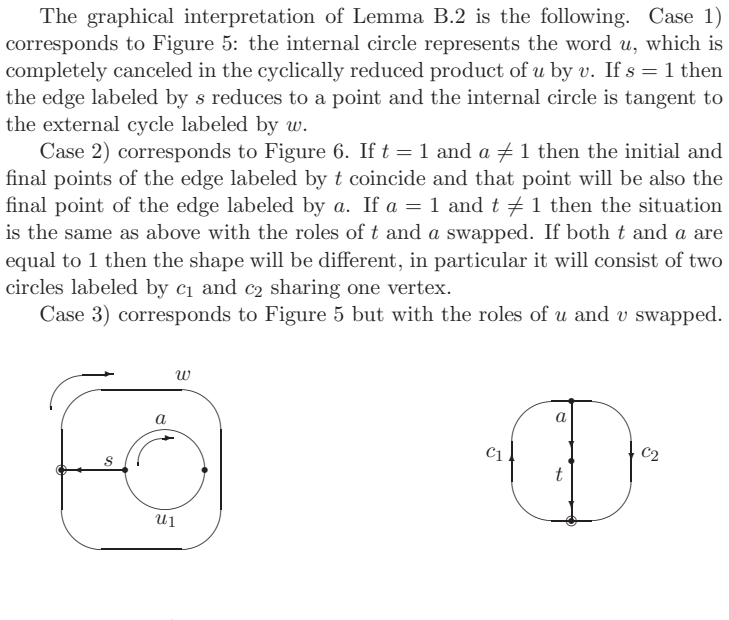
The load-bearing structure is the three-case factorization of reduced word pairs given in Lemma B.2. Starting from the reduced product $\rho(uv)=u_1v_1$ and its cyclic-reduction decomposition $u_1v_1=t(u*v)t^{-1}$, the prefix position of $u_1$ inside $t(u*v)t^{-1}$ yields exactly three shapes: $u_1$ is a prefix of $t$; $u_1$ is a prefix of $t(u*v)$ but not of $t$; or $u_1$ lies beyond $t(u*v)$. These translate into explicit factorizations $u=u_1a$, $v=a^{-1}s(u*v)s^{-1}u_1^{-1}$ (case 1), $u=tc_1a$, $v=a^{-1}c_2t^{-1}$ (case 2), or the case-1 shape with $u$ and $v$ interchanged (case 3). Lemma B.1 supplies the periodic-conjugacy fact $\rho(bwb^{-1})=b_1w_2w_1b_1^{-1}$ that lets the proof track cancellations, and Appendix A's formalism of exchanges and (semi-)Peiffer deletions supplies the collapse certificate: the element of the monoid $H$ associated with the rotation identity is moved through the states $\eta_k$ and reduced to $1$ in $2n+3$ operations. The number $n$ is the power of $u*v$ occurring in the factorization of the conjugating word $b$.
What would settle it
Enumerate all pairs of reduced words over a two-letter alphabet up to length 10, compute $u*v$ and $v*u$, and compare: any pair for which $u*v$ is not a cyclic permutation of $v*u$, or whose canceled-letter sequences are not cyclically identical, would refute Theorem 4.1.
Extended reading notes
Core claim
The paper's core claim is Theorem 4.1. It asserts that for any words $u$ and $v$ with $u*v \neq 1$, $u*v$ is a cyclic permutation of $v*u$, even though the operation $*$ is not commutative. When $u$ and $v$ are reduced, the theorem adds that the canceled letters obtained while reducing $uv$ to $u*v$ coincide, up to cyclic permutation, with those obtained while reducing $vu$ to $v*u$. The identity among relations that follows from the rotation is shown to be a cyclically-reduced analogue of the free-group fact that $u \cdot v$ is a conjugate of $v \cdot u$, and it semi-Peiffer collapses to $1$ in $2n+3$ steps: $n$ exchanges of type B-1, $n$ of type B-3, one exchange of type A-2, one semi-Peiffer deletion and one Peiffer deletion. A corollary is that if $u$ and $v$ are relators of a presentation, the van Kampen diagrams for $u*v$ and $v*u$ are homeomorphic, with boundary cycles that are cyclic permutations of one another.
Load-bearing premise
The entire proof rests on Lemma B.2's claim that every pair of reduced words $u,v$ with $u \neq v^{-1}$ falls into one of exactly three factorization shapes; if a fourth shape ever occurred, the cancellation analysis and the collapse sequence would not cover it.
Editorial extensions
If this is right
- For any word $w$, the cyclically reduced form of any cyclic permutation of $w$ is a cyclic permutation of $\hat{\rho}(w)$ (Corollary 4.3).
- For any words $t$ and $w$, $\hat{\rho}(twt^{-1})$ is a cyclic permutation of $\hat{\rho}(w)$, with equality whenever $\rho(t)\rho(w)\rho(t)^{-1}$ is reduced; this gives one half of the conjugacy criterion for free groups (Corollary 4.4).
- If $u$ and $v$ are relators of a group presentation, the van Kampen diagrams associated with $u*v$ and $v*u$ are homeomorphic, with boundary cycles that are cyclic permutations of one another (Remark 4.2).
- For any nonempty reduced words $u$ and $w$ there exist infinitely many pairs of cyclically reduced words $v,v'$ with $v$ a cyclic permutation of $v'$ and $u*v = v'*u = \hat{\rho}(w)$; uniqueness fails but a weak Latin-square statement holds (Corollary B.6).
- The rotation identity between $u*v$ and $v*u$ semi-Peiffer collapses to $1$ by an explicit sequence of $2n+3$ operations, so the algebraic relation behind the rotation is as trivial as the free-group conjugacy identity.
Reading between the lines
- Passing to the quotient of cyclically reduced words by cyclic permutation would make $*$ genuinely commutative; this 'cyclic word' algebra may be a more convenient setting for search algorithms built on the Andrews–Curtis equivalence.
- The length of the collapse sequence is governed by the exponent $n$ in Lemma B.1; tracking how $n$ grows with word length could convert Theorem 4.1 into an explicit algorithm for transforming $u*v$ into $v*u$ in a presentation, and that algorithmic bound is not worked out in the paper.
- The statement that cancellation footprints coincide up to cyclic permutation suggests a topological lifting: pictures or van Kampen diagrams for the two products should differ only by moving the basepoint, which could interact with crossed-module or identity-amoeba invariants beyond the paper's scope.
- An exhaustive small-alphabet check of Theorem 4.1 is a natural, cheap test: because the statement is uniform in word length, a counterexample, should one exist, would show up at modest length.
Signed reviews
Editorial analysis
A structured set of objections, weighed in public.
Referee Report
Summary. The paper develops basic algebraic properties of the cyclically reduced product * on cyclically reduced words. After setting up terminology for words, reduced forms, cyclic permutations, and reversions, it proves that the set of cyclically reduced words with * has a unique identity and unique inverses, that * is neither associative nor commutative, and that a weak form of the Latin-square property holds. The central result, Theorem 4.1, asserts that u*v is always a cyclic permutation of v*u, that for reduced u and v the portions canceled in the two products agree up to cyclic permutation, and that the associated identity among relations collapses by an explicit 2n+3-step sequence of exchanges and deletions. The technical core is a three-case factorization lemma, Lemma B.2, proved in Appendix B, with an identities-among-relations formalism developed in Appendix A.
Significance. If the central theorem stands, the paper fills a genuine gap in the literature: the cyclically reduced product, previously used in work of Rourke and Ivanov, is shown to have a 'twisted commutativity' with an explicit algebraic footprint. The paper is self-contained and carefully structured: the key classification Lemma B.2 is proved rather than imported, and the proof of the main theorem is an explicit case analysis. The semi-Peiffer collapse in Theorem 4.1(iv) is a substantive and checkable statement. However, one claim in the main theorem overstates what Lemma A.10 proves; this is a local but genuine error that must be corrected.
major comments (1)
- [Theorem 4.1(iv), Lemma A.10] The statement of Theorem 4.1(iv) claims that the final operation in the collapse is 'a Peiffer deletion between the third and fourth terms'. Lemma A.10, which is the cited justification, proves only two semi-Peiffer deletions; a Peiffer deletion additionally requires equality of the two conjugating words, and that equality is not guaranteed. Concrete check: take X={x,y}, u=y^{-1}x^{-1}, v=x^2y. Then u*v=x, and in Case 1 of the proof u1=y^{-1}x^{-1}, a=1, s=x, w1=x, w2=b1=1, n=1, q=y. Running the prescribed B-1, B-3, A-2 sequence on the element h leaves a terminal third/fourth pair whose relators are u and u^{-1} and whose conjugating words are y^{-1}x^{-1} and xy. These two words are not equal, so the deletion is semi-Peiffer but not Peiffer. The semi-Peiffer collapse and the rest of the theorem are not affected; the fix is to replace 'Peiffer' by 'semi-Peiffer' in part (iv).
minor comments (3)
- [Lemma A.10] The repeated phrase 'which is easy to verify' for the algebraic identities in items (I)-(IV) should be replaced by explicit computations or at least by displayed derivations; the distinction between semi-Peiffer and Peiffer deletions in the proof depends on exactly these identities.
- [Abstract and Introduction] The notation for the set of cyclically reduced words is inconsistent: the abstract uses \hat{\mathcal F}(X) while the body uses \hat F(X). Please unify the notation.
- [Throughout] The text contains many typographical and OCR-style artifacts (for example '/squaresmallsolid' and broken spacing). These should be cleaned before publication.
Circularity Check
No circular derivation: Theorem 4.1 is proved from in-paper Lemma B.2 and Lemma A.10; the Peiffer-deletion overclaim is a correctness gap, not circularity.
full rationale
The paper's central chain is self-contained: Lemma B.2 is proved in Appendix B by a prefix trichotomy on the factorization u1v1 = t(u*v)t^{-1}, and Lemma A.10 is proved by an explicit sequence of exchanges and deletions. Theorem 4.1 is derived from these two in-paper lemmas and does not invoke the result it generalizes. The only self-citations ([15] for the style of Lemma B.2's proof, and [16]/[17] for twisted associativity and generalized Latin-square statements) are not load-bearing: the proof of Lemma B.2 appears in full in the paper, and [16]/[17] are not used to prove Theorem 4.1. There is a structural inconsistency: Appendix B claims to depend only on Sections 1 and 2, yet Corollary B.6 invokes Corollary 4.4; this is not circular because Corollary B.6 is never used to prove Theorem 4.1. There is also a correctness gap, not a circularity: Theorem 4.1(iv) states the final deletion is a Peiffer deletion, but Lemma A.10 only establishes two semi-Peiffer deletions; the proof says 'iv) then follows from Lemma A.10', and the explicit pair u=y^{-1}x^{-1}, v=x^2y shows the last pair's conjugating words are unequal, so the deletion is only semi-Peiffer. Parts i)-iii) and the semi-Peiffer collapse are unaffected. No equation is constructed from its own conclusion, no fitted quantity is later called a prediction, and no load-bearing result is imported solely from the author's earlier work.
Assumptions & free parameters
assumptions (4)
- standard math Unique reduced form: the reduced form ρ(w) of a word is independent of the order of cancellations (Remark 1.10).
- standard math Levi's Lemma on common prefix/suffix decompositions of equal concatenations (Remark 1.3).
- standard math Existence and uniqueness of cyclically reduced form: every word w factors as ρ(w)=t c t^{-1} with c cyclically reduced (Remark 2.4).
- standard math Standard theory of identities among relations, including Peiffer and semi-Peiffer moves (Brown-Huebschmann [2], Appendix A).
Cite this review
Pith. "Pith review of About the cyclically reduced product of words." pith.science (2026). https://pith.science/paper/2RUQKEWI
@misc{pith2026190807435,
  author       = {Pith},
  title        = {Pith review of: About the cyclically reduced product of words},
  year         = {2026},
  howpublished = {\url{https://pith.science/paper/2RUQKEWI}},
  note         = {Machine review of arXiv:1908.07435}
}
abstract
The cyclically reduced product of two words is the cyclically reduced form of the concatenation of the two words. While the reduced form of such a concatenation (which is the product of the free group) verifies many basic properties like for example associativity, the same is not true for the cyclically reduced product which has been very little studied in the literature. Recently Sergei Ivanov has proved that the Andrews-Curtis conjecture (stated in 1965 and still not solved) is equivalent to a formulation where the reduced product is replaced by the cyclically reduced product (and the conjugations replaced by cyclic permutations). In this paper we study properties of the cyclically reduced product $*$ and of the set of cyclically reduced words $\hat{\mathcal{F}(X)}$ equipped with $*$. In particular we find that even if $*$ is not commutative nor verifies the Latin square property, weaker versions of these properties hold true. We also show that $\hat{\mathcal{F}(X)}$ equipped with $*$ and with cyclic permutations enjoys similar properties as the free group equipped with the reduced product and conjugations.
Figures

Figures from the paper (1 more)
Reference graph
Works this paper leans on
-
[16]
C. Vaccaro, Twisted associativity of the cyclically reduced product of words, part 1 , arXiv:1909.04863, https://arxiv.org/abs/1909.04863
arXiv 1909
-
[17]
Twisted associativity of the cyclically reduced product of words, part 2
C. Vaccaro, Twisted associativity of the cyclically reduced product of words, part 2 , arXiv:1910.09300, https://arxiv.org/abs/1910.09300. Address: Dr. Carmelo Vaccaro Department of Computer Science and Engineering University of Kurdistan-Hewlˆ er 30 Meter Avenue, Erbil, Kurdistan Region, Iraq e-mail: carmelovaccaro@yahoo.it 37
work page Pith review arXiv 1910
-
[1]
R. S. Bowman and S. B. McCaul, Fast searching for Andrews–Curtis trivializations, Experiment. Math., 15(2006), 193–198
work page 2006
-
[2]
R. Brown and J. Huebschmann, Identities among relations , in: Low Dimentional Topology, London Math. Soc. Lect. Notes, 48: 153-202. Cambridge Univ. Press, 1982
work page 1982
-
[3]
C. Choffrut and J. Karhum¨ aki, Combinatorics of words , in: G. Rozen- berg and A. Salomaa (eds), Handbook of Formal Languages , Springer, 1997
work page 1997
-
[4]
Hazewinkel (ed.), Encyclopedia of Mathematics , Springer Science/ Kluwer, 2001
M. Hazewinkel (ed.), Encyclopedia of Mathematics , Springer Science/ Kluwer, 2001
work page 2001
-
[5]
S. V. Ivanov, On Rourke’s extension of group presentations and a cyclic version of the Andrews–Curtis conjecture , Proc. Amer. Math. Soc. 134(2006), 1561—1567
work page 2006
-
[6]
S. V. Ivanov, On conjectures of Andrews and Curtis , Proc. Amer. Math. Soc. 146(2018), 2283—2298
work page 2018
Show all 17 references
-
[7]
C. R. Jordan, D. A. Jordan, Groups, Newnes, 2004
2004
-
[8]
Karhum¨ aki,Combinatorics of words , available online at the author’s webpage
J. Karhum¨ aki,Combinatorics of words , available online at the author’s webpage
-
[9]
R. C. Lyndon, P. E. Schupp, Combinatorial Group Theory , Springer, 1977. 36
1977
-
[10]
Magnus, A
W. Magnus, A. Karrass, D. Solitar, Combinatorial Group Theory, Cam- bridge University Press, 2003
2003
-
[11]
Panteleev, A
D. Panteleev, A. Ushakov, Conjugacy search problem and the Andrews- Curtis conjecture, Groups, Complexity, Cryptology 11(2019), 43—60
2019
-
[12]
Rourke, Presentations and the trivial group , in Topology of low- dimensional manifolds, Lecture Notes in Math., vol
C.P. Rourke, Presentations and the trivial group , in Topology of low- dimensional manifolds, Lecture Notes in Math., vol. 722, Sp ringer- Verlag, 1979, pp. 134–143
1979
-
[13]
Scarabotti, On the presentations of the trivial group , J
F. Scarabotti, On the presentations of the trivial group , J. Group The- ory 2(1999), 319–327
1999
-
[14]
Short, Diagrams and Groups, in The Geometry of the Word Problem for Finitely Generated Groups, Birkh¨ auser, 2007
H. Short, Diagrams and Groups, in The Geometry of the Word Problem for Finitely Generated Groups, Birkh¨ auser, 2007
2007
-
[15]
Vaccaro, Algorithmic and geometric methods for characterizing all the relators of a group presentation , Ph.D
C. Vaccaro, Algorithmic and geometric methods for characterizing all the relators of a group presentation , Ph.D. Thesis, University of Palermo, 2009
2009
Reviewed August 14, 2026 · model on record in the stance chip above.
Discussion (0). Continue with ORCID to comment.