REVIEW 3 major objections 5 minor 39 references
Screening the Coulomb interaction and thermalization of Anderson insulators
T0 review · 3 major / 5 minor · reviewed 2026-08-14 · deepseek-v4-flash
Pith's one-line read A nearby gold plane that weakens the long-range Coulomb interaction in an Anderson-insulating indium-oxide film makes the memory-dip shallower but leaves the film's thousand-second relaxation time essentially unchanged, so slow…
desk verdict Clever screening method and solid memory-dip data, but the key claim about relaxation times rests on one unreplicated pair and should be read as a hypothesis, not a resolution. read the letter →
The pith
A machine-rendered reading of the paper's core claim, the machinery that carries it, and where it could break.
The reading
What carries the argument
The central object is the screened-reference pair: two simultaneously deposited amorphous indium-oxide films, one with a 200 Å gold plane separated by a 7–11 nm SiO₂ spacer. The gold plane's image charges screen the long-range Coulomb interaction, while the pair isolates the interaction's effect from other sample properties. The other machinery is the gate protocol—jumping the gate voltage and fitting the late-time conductance relaxation to exp(−t/τ)—which yields the thermalization time, together with the disorder parameter k_F l used to place each sample relative to the metal-insulator transition.
What would settle it
Measure relaxation times on a series of screened indium-oxide films with spacer thickness varied from about 5 nm to 30 nm while holding k_F l fixed; the paper's claim predicts τ does not change systematically with spacer thickness, whereas any Coulomb-gap-controlled relaxation would predict τ increasing as the screening plane is moved away.
Extended reading notes
Core claim
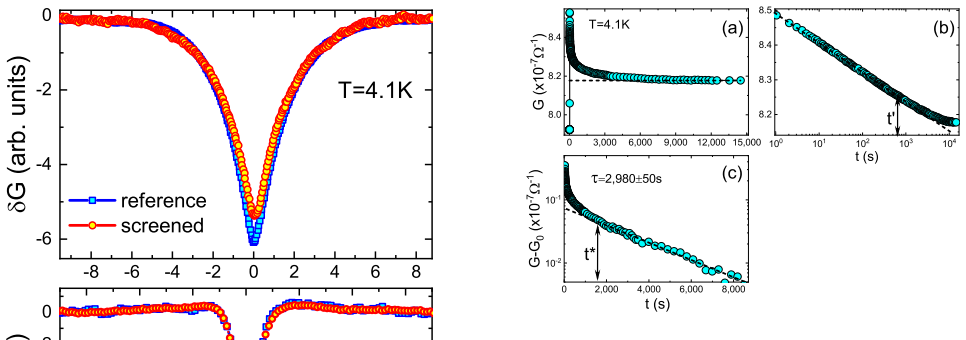
On the paper's own terms, the discovery is that the long-range Coulomb interaction can be switched off experimentally—by a nearby metallic plane that introduces image charges and cuts the interaction range to roughly 8 nm—and the glassy dynamics of the Anderson insulator does not care. Six screened-reference pairs of amorphous In_xO films were compared: the screened film's memory-dip is consistently shallower by 12–23%, the expected signature of a modified Coulomb gap, so the screening plane is doing its job. But the exponential relaxation time τ measured by the gate protocol is the same in screened and reference films, meaning thousands-of-seconds relaxation persists without the long-range part of the interaction. Combined with the observation that τ decreases linearly with k_F l and vanishes at the metal-insulator transition, the paper concludes that quenched disorder, not the long-range Coulomb interaction, controls slow thermalization, and that a finite density of states at the chemical potential is compatible with these long times.
Load-bearing premise
The screened and reference films are identical in disorder and differ only by the image charges induced by the nearby gold layer; if depositing the gold layer changes the film's disorder, the comparison between the pair cannot isolate the Coulomb interaction.
Editorial extensions
If this is right
- Theory of electron-glass relaxation can drop the long-range Coulomb tail and still account for thousand-second relaxation times, because the experiments show a finite density of states at the Fermi level suffices.
- The memory-dip magnitude and the relaxation time are decoupled: screening changes the dip but not τ, so measurements of one cannot be used to infer the other.
- The vanishing of τ as k_F l approaches the critical value 0.31 supports treating the slow dynamics as an electronic, Anderson-localization-driven effect rather than a structural-defect effect.
- The gate protocol is a valid substitute for thermal quench in measuring τ, provided the sample is equilibrated longer than τ; this makes repeated, history-controlled dynamics measurements practical.
Reading between the lines
- A testable extension is to vary only the spacer thickness d on otherwise matched samples: the paper's claim predicts τ independent of d, while Coulomb-gap-controlled relaxation would predict τ growing with d.
- The result suggests that other glassy electronic systems, such as doped semiconductors or phase-change materials, should also be re-examined with a screening plane to separate interaction from disorder contributions to memory effects.
- Because both disorder and interaction grow with carrier concentration in these films, the observed N-dependence of τ may be mostly a disorder effect (higher N requires stronger disorder for localization); an experiment that tunes N by gate doping at fixed quench disorder could settle this.
Signed reviews
Editorial analysis
A structured set of objections, weighed in public.
Referee Report
Summary. The paper reports experiments on amorphous indium-oxide Anderson insulators configured with a nearby gold screening plane, intended to shorten the spatial range of the Coulomb interaction. It makes three main claims: (i) the memory dip, a conductance feature associated with the Coulomb gap, is reduced by 12–23% in screened samples, consistent with the theoretical estimate of Hadley et al.; (ii) the long-time exponential relaxation time tau, extracted from a gate-protocol, is essentially the same for a screened sample and a reference sample, so relaxation over thousands of seconds does not require the long-range Coulomb interaction or a true gap in the density of states; and (iii) tau decreases with the disorder parameter k_F*l and tends to zero near the metal-insulator transition, supporting disorder as the dominant control parameter for the slow thermalization dynamics.
Significance. If the central null result is correct, it would be a useful constraint on theories of electron glasses and on the role of long-range interactions in slow thermalization of Anderson insulators. The experimental methodology is well conceived: the screening-plane geometry is a direct way to modify the interaction range, the gate-protocol is validated against thermal quench cooling, and the memory-dip reduction is shown for six sample pairs. The paper also gives explicit credit to prior theoretical work and to the author's earlier structural studies that support the interpretation of the disorder dependence. However, the central claim about dynamics rests on a single un-replicated pair comparison, and the paper itself acknowledges the difficulty of ensuring that screened and reference films differ only by image charges. Because tau is exponentially sensitive to disorder, this missing control is load-bearing rather than cosmetic.
major comments (3)
- [Dynamics of screened-reference samples, Fig. 9] The statement that 'limiting the range of the Coulomb interaction to approximately 8 nm does not have a significant effect on the system relaxation-time' is not established by the data as presented. The comparison is a single pair labeled the 'best-matched' screened-reference pair, with no error bars, no repeated measurements, and no statistical test. Given the exponential sensitivity of tau to disorder shown in Fig. 10, and the factor-of-two difference in low-temperature sheet resistance between the screened (R_sq=3.1 MOhm) and reference (R_sq=6.3 MOhm) samples in Fig. 5, an accidental disorder difference could mask a real effect of screening on tau. The paper's own caveat in 'Modifying the memory-dip by a screening-plane' acknowledges that depositing the gold layer can change disorder and that a few percent difference in room-temperature resistance can become orders of magnitude at helium temperatures; this caveat directly applies to the dynamics comparison. I ask the authors to provide multiple screened-reference pairs, quantitative uncertainty estimates, or a systematic variation of spacer thickness to rule out this alternative.
- [Modifying the memory-dip by a screening-plane] The quantitative evidence that the screening layer is actually limiting the Coulomb interaction is weakened by the absence of a systematic dependence on spacer thickness d. The paper reports that in the six pairs, 'it was not possible to see a systematic dependence on the spacer d' and attributes this to thickness fluctuations of roughly ±8%. This means the claimed 12–23% reduction in memory-dip magnitude, and the inferred d*N^(1/3) values of 2.8 to 1.6, are only a consistency check with the theory of Hadley et al., not a controlled test. Because the gold deposition itself could alter disorder (annealing, strain), the possibility remains that part of the observed memory-dip reduction is not due to image-charge screening. A series with intentionally varied d, or a demonstration that the MD reduction is independent of R_sq across a broader set of samples, would make the central screening claim load-bearing.
- [Disorder vs. Interaction, Fig. 10 and proposed scaling] The proposed scaling relation tau = tau(N) * [k_F*l - (k_F*l)_C] is introduced as 'seeming to suggest' but is not fitted or tested; tau(N) is not determined and the scatter in Fig. 10 is not quantified. Since the paper argues that disorder dominates over interaction, this relation is part of the evidence for that conclusion. I ask for either a quantitative fit to the data, a collapse test for the two carrier densities, or an explicit statement that the relation is only a qualitative guide. This is not a fatal issue, but it needs to be addressed if the 'dominant role of disorder' claim is to be supported by the data set.
minor comments (5)
- [Title] The title contains a formatting artifact: 'An derson insulators' should be 'Anderson insulators'.
- [Thermalization dynamics] In the paragraph introducing the gate-protocol, 'An effective and way to take the system far from equilibrium' appears to be missing a noun; it should probably read 'An effective way...'.
- [Fig. 5] The paper calls this pair 'best-matched' in terms of room-temperature resistance, but the low-temperature sheet resistances differ by a factor of two. Please state explicitly what matching criterion was used and what tolerance was accepted.
- [General notation] The abbreviation 'MD' is used repeatedly after the phrase 'memory-dip' but is never explicitly defined; please define it at first use.
- [Unnumbered equation] The scaling relation for tau should specify units, the range of validity, and the uncertainty in the critical value (k_F*l)_C; the latter is quoted elsewhere as 0.31±0.03 but is not carried through to the scaling plot.
Circularity Check
No circularity: the central null result is a direct screened-vs-reference experimental comparison, not derived from a fitted model or a self-referential uniqueness claim.
full rationale
The paper's central claim is an experimental null result: the exponential relaxation time measured in a screened sample is essentially the same as in a reference sample, and therefore the long-range Coulomb interaction plays no significant role in the slow thermalization dynamics. This is supported directly by the data in Fig. 9, where tau is obtained by fitting the measured relaxation to exp(-t/tau) and then comparing the two samples. No equation in the paper defines the predicted tau in terms of the screening geometry or in terms of a fitted parameter in a way that would force the result; tau is an independently measured quantity. The effectiveness of the screening plane is checked through the memory-dip reduction (12-23%) and compared with the theoretical estimate of Hadley et al. [18], but this comparison is a consistency check and does not feed the relaxation-time conclusion. The premise that the memory-dip shape is disorder-independent is stated with reference to prior work [7], but the present paper also demonstrates this directly in Fig. 2 by showing that two reference samples with very different sheet resistances have the same memory-dip shape up to a multiplicative constant. Similarly, the disorder sensitivity of the dynamics is not imported solely from [17]; the paper measures tau as a function of kF l in Fig. 10 and shows the dependence directly. The paper explicitly acknowledges the main experimental limitation: depositing the gold screening layer may alter the disorder of the screened sample, and the dynamics comparison relies on a single best-matched pair (Fig. 9). That is a legitimate robustness concern affecting the strength of the null claim, but it is not a circularity. No derivation step reduces to its own input, and no load-bearing uniqueness theorem or ansatz is smuggled in via self-citation. The paper is self-contained with respect to its principal experimental comparison, so the appropriate circularity score is 0.
Assumptions & free parameters
free parameters (2)
- tau(N) prefactor in proposed scaling =
not determined
- Stretched-exponential parameters A, tau', beta =
A=3.3e-8 Ohm^-1, tau'=185 s, beta=0.33
assumptions (5)
- domain assumption The metallic screening plane weakens the long-range Coulomb interaction via image charges; the resulting reduction in the memory-dip can be mapped to d N^{1/3} using the theory of Hadley et al. [18].
- domain assumption The shape of the memory-dip is independent of disorder, sweep rate, and time since cooldown, depending only on carrier concentration.
- domain assumption The gate-protocol reproduces the same relaxation state as a thermal quench, so the exponential relaxation time tau is the thermalization time.
- domain assumption kFl = (3pi^2)^{2/3} hbar sigma_RT e^{-2} N^{-1/3} is an appropriate measure of quenched disorder in these films.
- domain assumption The slow relaxation is electronic in origin and not due to structural defects; annealing changes only the material density, not the amorphous structure or composition.
Cite this review
Pith. "Pith review of Screening the Coulomb interaction and thermalization of Anderson insulators." pith.science (2026). https://pith.science/paper/SNVXUBYO
@misc{pith2026190807443,
  author       = {Pith},
  title        = {Pith review of: Screening the Coulomb interaction and thermalization of Anderson insulators},
  year         = {2026},
  howpublished = {\url{https://pith.science/paper/SNVXUBYO}},
  note         = {Machine review of arXiv:1908.07443}
}
read the original abstract
Long range interactions are relevant for a wide range of phenomena in physics where they often present a challenge to theory. In condensed matter, the interplay of Coulomb interaction and disorder remains largely an unsolved problem. In two dimensional films the long-range part of the Coulomb interaction may be screened by a nearby metallic overlay. This technique is employed in this work to present experimental evidence for its effectiveness in limiting the spatial range of the Coulomb interaction. We use this approach to study the effects of the long-range Coulomb interaction on the out-of-equilibrium dynamics of electron-glasses using amorphous indium-oxide films. The results demonstrate that electronic relaxation times, extending over thousands of seconds, do not hinge on the long-range Coulomb interaction nor on the presence of a real gap in the density of states. Rather, they emphasize the dominant role played by disorder in controlling the slow thermalization processes of Anderson insulators taken far from equilibrium.
Figures


Figures from the paper (6 more)



Reference graph
Works this paper leans on
-
[1]
P. W. Anderson, Phys. Rev. 109, 1492 (1958)
1958
- [2]
-
[3]
I. V. Gornyi, A. D. Mirlin, and D. G. Polyakov, Phys. Rev. Lett. 95, 206603 (2005)
2005
-
[4]
D. M. Basko, I. L. Aleiner, and B. L. Altshuler, Ann. Phys. (N.Y.) 321, 1126 (2006)
work page 2006
-
[5]
V. Oganesyan and D. A. Huse, Phys. Rev. B 75, 155111 (2007); Rahul Nandkishore and David A. Huse, Annu. Rev. Condens. Matter Phys., 6, 15 (2015)
work page 2007
-
[6]
M. Ben-Chorin, D. Kowal and Z. Ovadyahu, Phys. Rev. B 44, 3420 (1991); M. Ben Chorin, Z. Ovadyahu and M. Pollak, Phys. Rev. B48, 15025 (1993)
work page 1991
- [7]
-
[8]
J. H. Davies, P. A. Lee, and T. M. Rice, Phys. Rev. Lett, 49, 758 (1982); M. Gr¨ unewald, B. Pohlman, L. Schweitzer, and D. W¨ urtz, J. Phys. C, 15, L1153 (1982); J. H. Davies, P. A. Lee, and T. M. Rice, Phys. Rev. B 29, 4260 (1984); C. C. Yu, Phys. Rev. Lett., 82, 4074 (1999)
work page 1982
Show all 39 references
-
[9]
M¨ uller and L
M. M¨ uller and L. B. Ioffe, Phys. Rev. Lett. 93, 256403 (2004)
2004
-
[10]
Vikas Malik and Deepak Kumar, Phys. Rev. B 69, 153103 (2004)
2004
-
[11]
Grempel, Europhys
R. Grempel, Europhys. Lett., 66, 854 (2004); A. B. Kolton, D. R. Grempel, and D. Dominguez, Phys. Rev. B 71, 024206 (2005)
2004
-
[12]
Eran Lebanon, and Markus M¨ uller, Phys. Rev. B 72, 174202 (2005); M. M¨ uller and E. Lebanon, J. Phys. IV France, 131, 167 (2005)
2005
-
[13]
Ariel Amir, Yuval Oreg, and Yoseph Imry, Phys. Rev. B 77, 165207 (2008); Ariel Amir, Yuval Oreg, and Yoseph Imry, Annu. Rev. Condens. Matter Phys. 2, 235 (2011)
2008
-
[14]
Meroz, Y
Y. Meroz, Y. Oreg and Y. Imry, EPL, 105, 37010 (2014)
2014
-
[15]
Pollak, M
M. Pollak, M. Ortu˜ no and A. Frydman, ” The Electron Glass”, Cambridge University Press, England (2013)
2013
-
[16]
Pollak, Discuss
M. Pollak, Discuss. Faraday Soc. 50, 13 (1970); A. L. Efros and B. I. Shklovskii, J. Phys. C: Solid State Phys., 8, L49 (1975)
1970
-
[17]
Ovadyahu, Phys
Z. Ovadyahu, Phys. Rev. B. 95, 134203 (2017)
2017
-
[18]
Hadley, M
B. Hadley, M. Green, M. Pollak, R. Chicon, and M. Ortu˜ no, J.l of Non-Crys. Solids 97&98, 233 (1987)
1987
-
[19]
Ovadyahu, Phys
Z. Ovadyahu, Phys. Rev. B 95, 214207 (2017)
2017
-
[20]
Imry and Z
Y. Imry and Z. Ovadyahu, Phys. Rev. Lett.. 49, 841 (1982)
1982
-
[21]
B. L. Altshuler, A. G. Aronov, and A. Yu. Zyuzin, Sov. Phys. JETP 59, 415 (1984); Zh. Eksp. Teor. Fiz. 86, 709 (1984)
1984
-
[22]
A. I. Larkin and D. E. Khmel’nitskii, Sov. Phys. JETP 56, 647 (1982); Zh. Eksp. Teor. Fiz. 83, 1140 (1982)
1982
-
[23]
Frydman and Z
A. Frydman and Z. Ovadyahu, Phys. Rev. B 55, 9047 (1997)
1997
-
[24]
Ovadyahu, and M
Z. Ovadyahu, and M. Pollak, Phys. Rev. B 68, 184204 (2003)
2003
-
[25]
Ovadyahu, Phys
Z. Ovadyahu, Phys. Rev. B 97, 214201 (2018)
2018
-
[26]
Shahar and Z
D. Shahar and Z. Ovadyahu, Phys. Rev. B 46, 10917 (1992)
1992
-
[27]
Givan and Z
U. Givan and Z. Ovadyahu, Phys. Rev. B 86, 165101 (2012)
2012
-
[28]
B. R. Bulka, B. Kramer, and A. MacKinnon, Z. Phys. B - Condensed Matter 60, 13 (1985)
1985
-
[29]
Bulka, M
B. Bulka, M. Schreiber, and B. Kramer, Z. Phys. B - Condensed Matter 66, 21 (1987)
1987
-
[30]
Ovadyahu, Phys
Z. Ovadyahu, Phys. Rev. Lett., 115, 046601 (2015); Z. Ovadyahu, Phys. Rev. B 97, 054202 (2018)
2015
-
[31]
Mih` aly and L
G. Mih` aly and L. Mih` aly, Phys. Rev. Lett., 52, 149 8 (1984)
1984
-
[32]
V. K. Thorsmølle, and N.P. Armitage, Phys. Rev. Lett. 105, 086601 (2010)
2010
-
[33]
For example, the data for the intermediate range of 15s ≤ t≤ 5x10³s in Fig.7c may be fit- ted with the three parameters A=3.3x10 -8Ω -1, τ ′=185s, and β=0.33
This part of the relaxation may be fitted to a stretched- exponential function, ∆G(t)=A ·exp[-(t/τ ′)β ] by adjust- ing the parameters τ ′and β. For example, the data for the intermediate range of 15s ≤ t≤ 5x10³s in Fig.7c may be fit- ted with the three parameters A=3.3x10 -8Ω -...
-
[34]
Pollak and M
M. Pollak and M. Ortu˜ no, Sol. Energy Mater., 8, 81 (1982); M. Pollak, Phil. Mag. B 50, 265 (1984)
1982
-
[35]
T. G. Castner, N. K. Lee, G. S. Cieloszyk, and G. L. Salinger, Phys. Rev. Lett. 34, 1627 (1975); David Stroud and David J. Bergman, Phys. Rev. B 25, 2061(R) (1982); H. S. Choi, J. S. Ahn, J. H. Jung, T. W. Noh, and D. H. Kim, Phys. Rev. B 54, 4621 (1996)
1975
-
[36]
S. D. Baranovskii, B. I. Shklovskii, A. L. Efros, Sov. Ph ys. JETP 51, 199 (1980); A. M¨ obius, M. Richter, and B. Drittler, Phys. Rev. B 45, 11568 (1992); A. L. Efros, B. Skinner, and B. I. Shklovskii, Phys. Rev. B 84, 064204 (2011)
1980
-
[37]
P. W. Anderson, Phys. Rev. Lett. 18, 1049 (1967); A. J. Leggett et al., Rev. Mod. Phys. 59, 1 (1987); Z. Ovadyahu, Phys. Rev. Lett., 99, 226603 (2007)
1967
-
[38]
Vedika Khemani, Rahul Nandkishore, and S. L. Sondhi, Nature Physics, 11, 560 (2015)
2015
-
[39]
D. L. Deng, J. H. Pixley, X Li, S. D. Sarma, Phys. Rev. B. 92, 220201(R) (2015). 9
2015
Reviewed August 14, 2026 · model on record in the stance chip above.
Discussion (0). Continue with ORCID to comment.